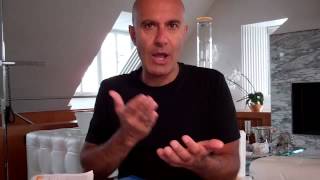
Informal on-tour talk by Robin Sharma presenting six concise productivity tactics. He frames the need for focus amid modern distraction and recommends (1) "walk with the giants" (learn from top performers), (2) "play out on the wire" (take risks and stretch comfort zones), (3) build genius-level habits (routine, exercise twice daily), (4) set five small daily goals, (5) spend time alone to think and recharge, and (6) read a book a week. Short anecdotes (hotel room, bush plane, Singita game reserve) and neurobiology references illustrate and motivate each tactic.
Chapters
Hi, it's Robin Sharma. Well, you know, I want to keep.
It raw and real as I always want to do.
I'm inviting you here into my hotel room. I'm on a tour. I'm going to be going next to Botswana, then South Africa and then into Mauritius. And I really wanted to share some of my ideas on productivity. We're all trying to be more productive. In this age of dramatic distraction, there's never been so much, much noise. And for the elite performer, someone who wants to make their life significant, someone who wants to get value from their days, someone who wants to stay focused on what's truly most important versus getting caught up in all the complexity. Getting world class in terms of productivity is key.
And I want to take you through.
Five ideas that I know can be game changers if you execute flawlessly on them. And the first is really walk with the giants. So what you want to do is ask yourself, who are the people whose lives I want to be living? Who are the most productive people I know? Who are the most talented people I know? Who are the most gifted people I know? And find a way, even if it's just through their books or through their blogs or through their video podcasts, spend time with those people. Because the fact of the matter is, you will become a lot like the five people you spend most of your time with. Their belief system, their ways of being, are particularly contagious, and you want to find those people and rub shoulders with those people on a consistent basis. Number two, to be more productive, more focused, to get more done. You want to play out on the wire? Here's what I mean. As human beings, we are literally hardwired to stay clinging to our patterns. So many thousands of years ago, what kept us alive was we would stay within our safe harbor of the known. We would stay within the same group of people. We would behave in the same ways. And that consistency allowed us to survive in a world of tremendous uncertainty. But what it's done is literally, biologically and neurologically. It's hardwired us to avoid taking risks, to avoid stretching, to stay within a comfort zone. And it no longer serves us in the world we're in. As a matter of fact, the clearest route to obsolescence is to do the things you did yesterday. So the second idea, to be more productive, play out on the wire. It comes from Papa Wallenda, the great high wire walker. And what he said was, life is lived on the wire. The rest is just waiting. And my challenge to you, to become more productive, to get your spark back so you get more done, so you have more energy is to start to put yourself out there, start to get more rejected. Take your goals and amp them up 10 times what they were yesterday. Do the things that frighten you. Get brilliant at being uncomfortable. Literally institutionalize risk into your life. So you do the things that you would never have thought you did. And here's the thing, the more little risks you, you take every day, the more you grow in your power. Because everything that you fear, everything that you are currently resisting right now, you've literally given your power to, you're given your confidence to so to get more energy so you're more productive. Start doing the things that you've been resisting. Start taking some risks consciously. Number three, build genius level habits. So over the past few months I've been reading about the habits of Stephen King, you know, John Irving, some of the most creative productive people in the world. And if you study the Picasso's and the Mozarts and the Beethovens and the Stephen King's, here's what you realize. They're not more talented than you. How do they get so much done? Well, we know it, we don't practice it. They have built great habits. Stephen King says, you know, I get up in the morning and I sit at my desk and I write. Whether I feel like doing it or if I feel like I don't like doing it, I sit there and I do the work. And the key is building great habits. So literally say, you know, every day I'm going to start writing at 7 o' clock whether I feel like it or not. Every day I'm going to go to the gym for a swim at 12:30 whether I feel like it or not.
Literally.
Let's go to the neurobiology. You start to hardwire those habits into your brain. And if you look at the most productive people, it's not like they're more have more willpower than you do. It's not like they're more gifted than you do. They figure out two or three disciplines, you know, a certain time of working, a certain time for recovery, a certain time to work out. You know, related to that exercise is one of the most valuable peak performance productivity tools in the world. Do two workouts a day, one for 20 minutes in the morning and maybe one at 5 o' clock to jump start your evening. Okay. Fourth productivity habit. Set five little goals every single day.
Well, just as I was telling you about the five little goal concept on the previous tour, stop my videocam, pass out. So here I am back. I'm now in South Africa. I met a game reserve, a game lodge on the Singita game reserve. And this morning was incredible. Right behind me, I saw a number of the big five. And it's really interesting because these five little goals came from an earlier idea about the big five, the five most important things in your life that you're actually building your life around. And this morning I actually saw some of the big five right behind me. Anyway, I'll get right back to it. So the idea, this fourth idea is every morning what you do is you set five little goals. And the power of little goals is sometimes when goals are big, we don't even attack the goals. But by setting these incremental five little goals every day at the end of 30 days, that's 150 little goals. At the end of 12 months from this moment we're sharing together, it's almost 2,000 little goals. This cannot help but be your best 12 months yet if you achieve these five little goals every single day over the course of 12 months. And in many ways, it's not, not only that you've achieved, after 12 months from this moment, nearly 2,000 acts of excellence or acts of progress or acts of meaningful goals, it's who you've become in terms of your confidence, your creativity, your energy that's really very powerful. Two final ideas in this video, spend time alone. It's incredibly important to get away from this noise in this world of so much complexity and think. Think about how you can be more productive. Think about the best uses of your time. As I actually flew here from Botswana to this game reserve, I had a chance in the cockpit to fly the plane a little bit. We were in a small bush plane and I had a chance to fly the plane. And you've heard this before, but it was a powerful metaphor, which is a lot of the time. I mean, I was getting pushed off course, and then I'd come back on course. And most of the flight, when I was flying the plane, I was getting pushed off course and getting back on course. And that's what happens in our days, in our weeks, our months and our life. We're constantly being pulled off course by Facebook notifications, mobiles, ringing, emails, meetings, interruptions. I mean, that is one of the greatest things we're at war at right now, the war against distraction. And most of us are suffering from partial attention deficit disorder. And you really need to pull yourself away from the noise on a daily basis and think, maybe it's writing in a journal, maybe it's by going for a walk in the woods. Maybe it's by meditating, but thinking about the best uses of your time, reconnecting with your values, refocusing so you come back even stronger. And by the way, time alone also recharges your focus. I mean focus is like it's a commodity and it gets depleted and you must refill your focus every day to be more productive. Final idea A book a week simple idea. It'll kick start your engine. It'll keep you focused and inspired. It'll help you get your best work done. I hope these six ideas Again forgive me for the battery going out on the video cam but this is raw and real. So from here at the Sangeeta Game Reserve in South Africa, I hope these six ideas on productivity have been helpful.
Of service to you.
As always, look in your inbox. Over the next few days I'll be sending you some more great ideas that I know will be game changers in terms of productivity. All the very best. Talk to you soon.