The 9 Strange Rules of ULTRA-Successful Entrepreneurs - Part 2 | Robin Sharma
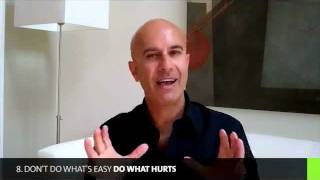
Robin Sharma covers rules 4 through 9 for ultra-successful entrepreneurs. Profits matter more than revenue. Do the hardest task first. Act like a world-class organization before you become one. Accept being disliked as proof you're disrupting things. Choose discipline over easy choices. Get 1% better every day instead of chasing shortcuts.
Chapters
Strange rule of ultra successful remarkable entrepreneurs number four. They understand that sales are insanity. Profits are reality. Sales are insanity. Profits are reality. Now what does that mean? Well, you know, I go to cocktail party sometimes when I'm speaking at a conference and I meet a lot of the entrepreneurs, I work with a lot of entrepreneurs. A lot of my time is spent in know in that market. And at these cocktail parties you hear these entrepreneurs talking about the sales of their business. Oh, my business Last year did 15 million. Oh, my business last year did 25 million. Oh, my business last Year did 3 million. Oh, my business last, year did $100 million. It's just cocktail language and I think in many ways it's a battle of the egos. Here's what remarkable entrepreneurs have discovered. It's a brain tattoo. They say sales are insanity, profits are reality. Here's what I mean. It's not how much your business makes, you know, top line sales, it's how much your business.
Makes at the end of the day after costs. In other words, what really matters is profits. I was reading about a company the other day, they did over $100 million and their profits were below $2 million. Their profits were below $2 million. Why? Because they focus on top line revenue and sales versus the actual profits. I don't know if I'm expressing this point clearly. I hope I am because it's fundamentally important. Don't worry about the people who are saying we're making 5 million or 7 million or 20 million or 50 million or 100 million. A lot of those companies are actually not making profits. Focus a lot more not only on the top line sales. Of course you want to grow that. But what really is important are the profits at the end of the day after your costs, what is the profit? That's the reality. Strange rule of remarkable entrepreneurs number five. It's a great one to help you get through these turbulent times. In terms of productivity, this is more of a productivity idea of those 1% remarkable entrepreneurs. See, here's what ordinary entrepreneurs do you they say, I'll wait until I have the energy to tackle that difficult project which will grow our profits. Here's what remarkable entrepreneurs do. They say, I'm not going to wait for the energy to do the work. They say I'll do the work to get the energy. It's a strange rule. It's counterintuitive. Very few people get this. When I don't have energy, I look at my to do list and I ask myself what's most difficult on that to do? List. And first thing in the morning, when I'm most resisting it, I do that thing. I do the difficult thing first.
Stunningly, it gives me energy to do other things. So that strange rule is a very powerful one. Don't wait until your energy to do the work. Do the work, do your TO dos. When you don't feel like doing your to dos, it will reply you with energy. If you do this every day, here's what happens. It's the upward cycle of more and more energy. You have more and more energy. You take on more and more projects. You develop more and more leaders versus just employees so that you have a band of superstars who populate your company. You actually start developing more relationships with your customers. You actually start having more energy to exercise. You have more energy to learn. You have more energy to go to conferences. You have more energy to spend time with your family. You have more energy to involve yourself in volunteer work. You have more energy to enjoy life. Because what's the point of building a great business if you're not having fun? This point number five is a very important one. Okay, point number six. Picasso didn't wait until he was Picasso to behave like Picasso. So strange rule number six is this one. And I learned it from IBM. One of our clients, one of the founders of IBM, was asked what was one of the great secrets of building IBM. And he said, well, we had a vision of IBM being a hundred million dollar company when we were just a startup. But here's the question that we asked ourselves every single day. What do we need to do tomorrow to behave like a hundred million dollar company even when we're a startup? Picasso didn't wait until the world revered him to behave and perform and to deliver the masterpieces that he did until the world caught up with the genius as a remarkable entrepreneur. Don't wait until the world sees you as world class for you to perform like world class. That's what most ordinary entrepreneurs do. They say, you know what? I will work like Steve Jobs, I will work like Tony Hsieh, I will work like.
Sergey Brin and Larry Page. I will think like fred Smith of FedEx When I get to world class. But right now, I'm busy being busy. The strange rule, the sixth strange rule of remarkable ultra successful entrepreneurs is when they're in their garages or when they're so far from their vision, they are still.
Sweating the details, they are still going the extra mile, they are still evangelizing their message, they are still wowing customers, they are still amazing with their team. So don't wait until you're world class, until you think, perform and behave at world class. Do it now to get the results of world class. Strange rule number seven, ultra successful entrepreneurs, that 1% on the bell curve, they like to be unliked. Now I got this from a biography I was reading on Jay Z. Jay Z had a great line, you've probably heard it before. He said, I'm not a businessman, I'm a businessman. And I thought that's a great insight. Anyway, so I'm reading this biography on Jay Z and one of the things that I read that really sent a shiver up my spine was this. He said, you know, I knew that I was starting to become a world class brand and become an icon. And I challenge you become an icon. He said, I knew I was starting to become an icon in my industry when people started to dislike me. And I thought that was incredible insight. Because what I've realized in my work with remarkable entrepreneurs, billionaires, super entrepreneurs, for the past 15 years as their private advisor is they have developed such a tough skin to the point where they understand that being unliked, being criticized, maybe even being hated by your competitors shows you that you're doing genius level work. I mean, the very nature of being a disruptor, the very nature of doing Apple level products, the very nature of being the absolute best in the world at what you do in your industry means you're going to disrupt the status quo. You're going to be a visionary, you're going to be playing at a level that your competitors are scared of playing at. Here's what your competitors do. They'll try to bring you down. Here's what the marketplace does, they'll try to bring you down. Here's what the consumer sometimes might do. They'll say, that's crazy. I've never seen a product like that. I've never seen a company that's good. And so what I'm suggesting to you is ultra successful entrepreneurs understand that you can know you're doing great work when people start to criticize you. And that's why they like to be unlinked. Okay, the two final strange rules of ultra successful entrepreneurs. Then I'll wrap up point number eight or rule number eight. Ultra successful entrepreneurs don't do what's easy, they do what hurts. I think of I was watching this documentary on Muhammad Ali. It was something like Fighting Ali. It was great documentary and the documentarians invited a lot of the people who fought against Ali. And here's one of the lines that I got from the movie that I thought was really exceptional. Muhammad Ali said in all of those workouts, all of those 5am running sessions, all of those training, preparation, practice sessions, not once did I enjoy them. I didn't like them. But he said I liked the idea of being a world champion. I think this is a great idea for us to remember as entrepreneurs. Let's learn from ultra successful entrepreneurs. The 1 percenters, the remarkable entrepreneurs. They don't do what's easy, they do what hurts. One of my friends, Nito Combain has the line and it speaks to this point. He said the price of discipline is always less than the pain of regret. Ultra successful entrepreneurs do what hurts. In other words, when everyone else is focusing on the cash grab, they focusing focus on delivering 10x value. When everyone else is being busy, being busy, suffering from death by meeting remarkable entrepreneurs are developing their team, they're building leaders, they're building a zappos like culture. They do what hurts rather than what's easy. As I was finishing up the eighth strange rule of ultra successful entrepreneurs, my battery gave out so I had to go get it charged. Part of the realities of recording video in the world that we live in. But I'm back with the ninth strange rule of ultra successful entrepreneurs. And that final rule is this. They love going slow versus going too fast. And what does that mean? It means that it's counterintuitive. It's a strange rule. What do most entrepreneurs, what do ordinary entrepreneurs do? They're looking for doing something revolutionary that will accelerate their profits, that will take their business to where they want to get it to, that will take their brand to a place called world class. What ultra successful entrepreneurs do, that's counterintuitive. They understand that it's all about slow and steady wins the race. Remember the tortoise and the hare? We learned it when we were kids. The hare was fast, the tortoise was slow and steady and ultimately won the race. What I'm suggesting to you is the best businesses, the best entrepreneurs, the truly remarkable 1 percenters understand that it's about the daily micro wins. 1% every single day over time leads to stunning improvements in the quality of your business, the quality of your customer service, the quality of your innovation, the quality of your life. 1% every single day leads to small daily improvements that over time lead to stunning results. That is one of the secrets to organizational change and to personal change. Don't worry about the big win. Don't worry about the revolutionary change, the little iterations, the little acts of optimization, the little tweaks and improvements each and every day eventually amount to a tsunami of success for you as a remarkable entrepreneur and within your business. Hope you've enjoyed this video. Hope you've enjoyed the strange rules I challenge you and encourage you in the middle of all this economic messiness. Focus on these nine rules. I know they're going to help you with your team. I know they're going to help you build a remarkable world class business and ultimately help you build a better life and a career that helps you change the world. Thank you.
More from Clegg

The #1 Skill Gen Z Needs | Simon Sinek + Esther Perel | A Bit of Optimism Podcast







AI Won't Tell You the Full Truth | Arthur Brooks + Simon Sinek | A Bit of Optimism Podcast



How To Make the Best Decision | Arthur Brooks and Simon Sinek | A Bit of Optimism