The Alternate Orbit of History's Heroes | Mastery Session
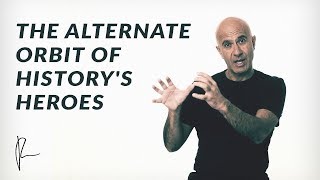
Robin Sharma's "The Alternate Orbit of History's Heroes" is a spoken mastery session arguing that history's great figures operate in a different "orbit" than most people: they cultivate deep interior maturity, prioritize helpfulness and a monomaniacal mission over accumulation, practice minimalism and fierce focus, persist long-term, and develop moral authority often via suffering or voluntary discomfort. The talk illustrates each pillar with examples (Nelson Mandela, Mother Teresa, Mahatma Gandhi, Martin Luther King Jr., Bernini/Taj Mahal) and ends with practical prompts (teach/share the episode, event links).
Questions this video answers
Less than 10 possessions (examples given: a spinning wheel, eyeglasses, a watch).
"The Alternate Orbit of History's Heroes" — a Robin Sharma mastery session (YouTube video).
July 26, 2018 (as shown in the original metadata).
Chapters
Hi, it's Robin Sharma, author of the Leader who Had no Title, founder of the Titan Academy, and welcome to this mastery session. This mastery session is called the Alternate Orbit of History's Heroes. I'm going to repeat that again. The Alternate Orbit of History's Heroes. One of my fascinations has been studying the lives of great women and great men. Nelson Mandela is the Mother Teresas, the Elon Musk's and the Steve Jobs's, the Mother, the Rosa Parkes and the Madame Curies, the Joan of Arcs and the William Shakespeare's. I just, I really have a deep appetite to understand what makes genius genius. And when I look at the great women and men of the world who really elevated humanity and our civilization, someone like a Rosa Parks, someone like, as I mentioned, a Mother Teresa, someone like a Mahatma Gandhi, what I've realized is these individuals are playing in an other or alternate orbit. So the vast majority of people, what they do is they are pursuing things. They derive their power by what they have in the world. They measure success by more money and a larger house and a faster car and more social status. But if you look at the so called great ones, the history makers who have shaped humanity, they really are in an alternate universe or another orbit. They're really not fueled by the things that most people are chasing. So what I wanted to do in this episode for you, because I know you were on the rise not only to be more productive and not only to be more successful, but to have a greater influence and service to the world. I wanted to deconstruct what the great heroes of humanity have done to create their alternate orbit so. So you can get the same results if that speaks to you. So the first part of the deconstruction is this. When I look at a Nelson Mandela, for example, what I've realized is through their interior work, you know, my four interior empires, mindset, Heart Set, Health Set and Soul Set. And so through his interior work to build his internal character, Nelson Mandela got to a level of maturity that most people just don't get to. Why? Because most people are so outer focused and building exterior lives and it's not so hip and cool and stylish anymore to build vast and undefeatable interior lives. But he did. And maybe it was a lot of his time through the suffering of 27 years of incarceration, maybe it was the 18 years that he spent in isolation on Robben Island. The point really is through his personal excavation, through his reflection, through his prayer, through his contemplation for so many Years, he built a vast interior reservoir of strength and creativity and true versus fake power that created an inner life of incredible maturity. And so the first point really is do whatever it takes to build a life of such maturity where it's not about your ego, but it's about lifting the world.
And that's incredibly powerful because if you base your power on things, should you lose those things, you lose your power. You're in a really vulnerable place. But if you derive your power and your self worth and your sense of self from who you are, your moral authority, your sense of creativity, your.
Ability to love yourself, your knowledge of the fullness of the gifts that you were born into, if that's where your identity comes from, then your world could fall apart and you still stay strong. So first point, work on your maturity level so you get to a place where it's not about me, it's about we work on your maturity so you're not deriving your strength in the world from external things, but you're getting it from your internal character or your internal life. Okay? Secondly, if you look at Nelson Mandela, Mother Teresa, Mahatma Gandhi, Martin Luther King Jr. Yonas, Salk, these people all had another thing in common. And this is the second piece of the deconstruction of the alternate orbit of history's heroes. And the second point is really this. They were less about accumulation and more about helpfulness. I'm going to repeat that again so you can calibrate it or dial into it. They were less about accumulation and they were more about helpfulness. You see.
Society right now is defining success by how much you have. But Mahatma Gandhi died with less than 10 possessions. I mean, he had a spinning wheel, he had his eyeglasses. I believe he had a watch and a few other things.
Mother Teresa, I was actually in her mission in Kolkata in India, and I went into her bedroom and all she had was a very spartan bed and a desk. And if you look at the Martin Luther King Jr. These people all lived very spartan lives and very sparse lives. Why? Because they really didn't care about accumulating things. They were on a monomaniacal mission to free the population that they were serving. So point number two really is it's not about accumulating things. If you really want to be a hero of history, it's about finding some kind of fiery cause that fuels your passion and that brings on your talent for the benefit of helping as many people as possible. And in my work, I call that a cause. In my work, I call that a monomaniacal. Mission. And, you know, you don't have to be a Nelson Mandela or a Mother Teresa to live like this. You can be a schoolteacher who says, you know what, here's the higher mission I want to dedicate the rest of my career to. And it's educating young people to believe in themselves and to capitalize on their skills so they do great things in their lives and they're of benefit to the world. You could be a baker and understand that you know what your cause could be. Every single person who comes in this bakery, I will leave them better than I found them. Because every day is an opportunity to lift another human being and to radiate optimism and to model possibility. You could be a taxi driver, you could be a firefighter. I don't know what you do. But the difference between a victim and a leader is a victim sees a job as a job and a leader sees a job as a cause. And that really is a game changing insight. If you say, you know what, I might not be leading millions, but I am leading a team at the office, or I am leading my family, or I'm not leading anyone, but I'm a human being and I have the capacity to walk out into the world, world. And in a world where a lot of people are closed and a lot of people are negative and a lot of people have walls, you can stand for possibility and you can stand for high energy and you can stand for hope and you can stand for love. And that's a really profound responsibility and opportunity you have on your shoulders today. Third part of the deconstruction is all of the heroes of histories were minimalists versus complexitarians. I just made a word up and you can make up your own words, but most people, and I say that with a smile on my face, but I love making up words. And minimalism is so valuable in terms of an approach to life. I've been teaching this for decades. Minimalism is not only a design vibe. If you go to the Tate Modern in London, one of my favorite art galleries, if you go to some of the art galleries in New York City, if you go to, you know, some design spaces in Zurich comes to mind. There's an area where they have a lot of new design spaces, where, you know, a lot of the high tech companies are and a lot of the creative companies are, and they're very minimalist. So most people, when they think of minimalism, it's, it's, it's like an interior designer will set up a minimalist space. There might Be concrete floor, floors, not a lot of messes, not a lot on the walls, lots of light, lots of glass. Minimalism. So for years and years I've been encouraging my high level clients. And you probably know I work with a lot of the Fortune 500, I coach billionaires, I've worked with elite performers in industry for going into my third decade. And I'm simply saying one of the things I've helped them understand is minimalism is not just a design vibe. Minimalism is a way to set up your entire life. You see, because here's one of the secrets of world class do few things strikingly well. Most people right now are suffering, and I use the word suffering on purpose. They are suffering from massive levels of complexity. Whether it's on the social media, whether it's diversion through their devices or they have so many friends and they have so many books to read and they have so many social engagements and they haven't stepped back from the complexity of their lives to say, why am I doing all this? They just think it's normal. And actually some of them have numbed themselves and it's so part of their normal lives, they really don't know they're doing it. And what I'm encouraging you to do is remember that history's heroes were not complexitarians. They were minimalists. They had a few possessions, they had a few friends, they didn't have five homes, they didn't have seven cars, they didn't have 40,000, you know, followers. You know, in terms of like the social media, these people kept it staggeringly simple. And I think that's really, really important because if you keep, if you simplify versus go complex, what happens is you can then take your energy and your focus and your personal resources and focus them on the few things that will be most important. And that's what the great ones do. They marshal and harness their resources, their mental focus, their physical energy, their personal willpower, their individual gifts, their time. I call those the five assets of performance. And they focus them on just a few things. And if you, I want you to think about it in your life. If you stripped away all the noise, you focused on the signal, you stripped away all the complexity, you got monomaniacally concentrated on just a few things, of course you'd be brilliant at those few things. Final two ideas in this deconstruction of the alternate orbit of history's heroes.
Fourth point, persistency versus the short game. We do live in a world where everything just happens so fast that if we have a project or a cause or a mission, if it doesn't happen instantly, or if it doesn't manifest or materialize the way we want it within a month or within a quarter, even within a year, we give up. And we then start chasing the next shiny toy of opportunity. So I was in Piazza Navona in Rome a few weeks ago, working on a new book. And I love Piazza Navona because it's one of the most beautiful squares on the planet. And when I'm in my creative cycle, I go there just to refuel. And if you walk into Piazza Navona, what you're going to see is, I think it's called the fourth Rivers sculpture by Bernini. And the point I'm trying to make to you is as I looked at this masterpiece of a sculpture, what I realized is the true masters are not all about impatience. They're not all about the short game. They understand that world class is a process, and that genius could take decades. And what makes rare air output is the ability to stick with a singular vision of your masterpiece, whatever that is. A great company, a great family, a gorgeous life, a new book, a film, I don't know.
But mastery comes through deep focus, patience, and persistency. And when I looked at Bernini's sculpture, you could see the level of deep detail, you know, and so few people have it. It really is a gargantuan competitive advantage. A gc, what I teach in my work as a gca, a gargantuan competitive advantage. Because most people don't have patience anymore. Most people.
Do not have the grit and the resolve to stay with a sculpture that's a metaphor for you, their sculpture for maybe a year on just a little piece, and maybe the next piece of your sculpture, another year or two years. You know, it took.
22 years to build the Taj Mahal, but it became one of the seven wonders of the World. That's a metaphor for you that I really want you to think about. And then the final part of the deconstruction of history's heroes would be this. The great heroes understood that moral authority is necessary to elevate humanity. I'll repeat that again so you can lock and load on that insight. Moral authority is necessary to be of service or an instrument for humanity. So suffering gets a bad rap. In our world today, in society, we all want it quick. But if you look at, again, a Nelson Mandela, Mother Teresa, Amatma Gandhi, a Rosa Parks, a Martin Luther King Jr.
A Marcus Aurelius, you look at the great states people, the great women who led nations, the great men who led movements. I've been studying samurai lately. You know, I've been studying a lot of the great warriors. I've been reading a lot about Alexander the Great. And you could say, well, Robin, in the comments section or whatever, you could say, robin, some of these people were bloody. Some of these warriors, and I hear you, my larger point is simply this. If you look at the great warriors or the great empire builders or the great heroes of humanity, they all had one thing in common. Many of them developed invincible moral authority to live by their deepest vision, values and virtues through the hard winters of deep suffering. A gca, a gargantuan competitive advantage in a world where everyone, everyone wants it easy. They want a warm house. They want a car with heated seats if you live in a cold place. We want great food. We want a life of ease. We want all our devices around us. We want. Want easy friends who don't make us maybe, who don't stretch us if we even read. We want easy books. I guess what I'm suggesting to you is voluntary discomfort will build you and strengthen you. And the great heroes of history often didn't do it voluntarily. They suffered. They suffered in a prison cell. They suffered for the benefit of their movement. They suffered long treks through mountains with not a lot of food when they're on a military campaign. They suffered the humiliation of being attacked by their critics. And so, in this age of ease, we are becoming weak as leaders, weak as humans, weak as possibilitarians. And I'm just saying to you, sure have your nice things. We all want a nice life, myself included. And yet make sure you don't fall into the chasm or.
The trap of living a life that is so easy that you don't develop those muscles of strength, fiery resolve and moral authority. So that has been my discourse, my teaching, my offering with great humility and great love and a deconstruction of a lot of the great heroes of humanity that we look up to. And my point that I want to end with is lead where you're planted. You know, you could say, well, those people are so lofty and they're so much ahead of me, and they're cut from a different cloth. And that's just not true. Remember the journey? I think it was Lao Tzu who said, the journey of a thousand miles begins with that single step. Small daily improvements, when done consistently over time, will lead you to absolutely stunning results. So start today. I hope I've been of service to you and here's what I want you to do over the next 24 hours. I want you to teach what I've shared with you or share this episode with three friends. And what I've learned is teacher learns the most. When you you teach something to someone else or even if you share it, you're going to elevate not only your three friends, but you're going to elevate yourself as you start the conversation about what I shared in this episode for you. Secondly, a lot of people say, Robin, we want to learn more about your live events. I'd love to have you at one of them if that feels right to you. And if you're interested Personal Mastery Academy, just go over to personalmasteryacademy.com My first flagship event, 4 Days, the Titan Summit. One of the highest level business building and elite performance events anywhere in the world. Again, the Titan Summit and just go to thetitansummit.com and you can get all the information. And finally, I want to thank you so much for all your support and I want to wish you all green lights. Thanks so much. Hi, this is Robin Sharma. I hope you received great value from this master set. If you'd like to receive potent training videos, blog posts, learning tools and information on my two live events, Personal Mastery Academy and my flagship four day experience, the Titan Summit, go ahead and visit robinsharmer.com.
More from Clegg

The #1 Skill Gen Z Needs | Simon Sinek + Esther Perel | A Bit of Optimism Podcast







AI Won't Tell You the Full Truth | Arthur Brooks + Simon Sinek | A Bit of Optimism Podcast



How To Make the Best Decision | Arthur Brooks and Simon Sinek | A Bit of Optimism