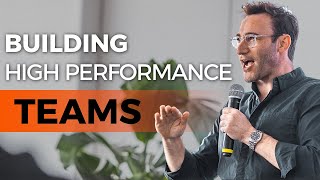
Simon Sinek contrasts two failure modes in leadership: over-emphasis on performance produces ‘mercenary’ cultures, while over-emphasis on harmony yields no accountability. He argues for bringing empathy to work as a way to build a foundation of trust so people are supported when they struggle — which both improves wellbeing and, counterintuitively, boosts performance. He gives a concrete manager–report example (asking “Are you okay? I’m worried about you.”) and notes that women often resonate more readily with these ideas. He links empathy and trust to high-performing teams characterized by deep trust, love, and camaraderie.
Chapters
You go too far in the direction of performance, performance, performance. You build an organization filled with mercenaries that will stab each other in the back to hit numbers and hit personal rewards if you slide them too far the other direction. You know, you have a hippie commune where everybody loves each other but no work gets done and there's no accountability. And, and this is the hard part about leadership, which is it's, it's, it's, it's like marriage, it's like friendship, it's like children, which is you'll never be on the path. You're constantly blocking and tackling and trying to make it work. But what makes it work over the course of time is that strong foundation of trust that when you screw up or get it wrong or you're grumpy or you're tired that people are patient with you. And it's just viewing people as human beings and bringing empathy to work. Now usually when I talk about these themes, you know, people find them uncomfortable. Now I know this is women in leadership that we're talking to and I will say that women understand my work better than men. You know, I talk about this stuff and women tend to go, yeah, and men tend to say, do you have any case studies? You know, and so when I talk about bringing empathy to work, there's nothing, there's nothing mushy or weak about this. I'll give you a simple example. Here's a fairly normal scenario. You know, a manager walks into one of their reports office and says, hey, I've noticed your numbers are down for the third quarter in a row. We've had this conversation before. If you don't pick up your numbers in the fourth quarter, I don't know what's going to happen. Right? That's a fairly common scenario. Here's that same scenario with empathy injected. Hey, I noticed your numbers are down for the third quarter in a row. We've had this conversation before. Are you okay? I'm worried about you. What's going on? That's empathy injected into leadership, where you actually concerned about the person rather than missing the number. And what you'll find is people will open up, ask for help, tell you what the challenges are. Maybe they have structures, struggles at home. Maybe they've been put in a position where they don't actually have the training to do the job. There's a wealth of things that we can support and help. And by the way, when we do that, not only does it build trust, but it actually helps the performance because we can help. We know what the what the root of the, what the problem is. And so we need more of that at work in order to produce high performing teams. You know, when I talk about high performing teams and I looked at some of the most, the highest performing teams, you know, in the world, what you'll find is deep, deep, deep levels of trust, love and camaraderie.