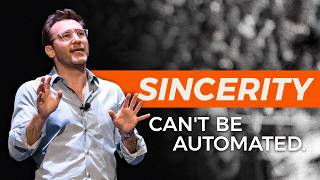
In this talk, Simon Sinek argues that while artificial intelligence can generate perfectly crafted words—apologies, press releases, even entire books—it cannot replace the personal struggle, sincerity, and learning process that make someone a better leader, partner, or employee. He begins by describing how early career training teaches technical skills, but once promoted to a leadership role, people receive no formal instruction on how to manage others. The choice to become a leader therefore requires a conscious decision to learn difficult, interpersonal skills such as listening and authentic communication. Sinek illustrates this with a scenario where someone uses ChatGPT to draft an apology to a partner; the AI‑generated words may be polite, but they lack genuine sincerity, leading to further conflict. He emphasizes that authentic, heart‑driven communication—formed through personal effort, reflection, and advice from trusted humans—builds trust and love. Sinek warns that modern culture’s obsession with metrics and perfect outcomes overlooks the value of the messy, iterative process that cultivates character. He acknowledges that AI can be a useful resource, but insists that true growth comes from struggling with ideas, organizing thoughts, and understanding why we choose certain words. The core message is a call to leaders and individuals to prioritize learning the underlying skills of empathy, authenticity, and purposeful communication rather than relying on AI to supply the finished product.
Chapters
When you were junior in your career, somebody taught you how to do your job. You either went to school for it, if you're an accountant or something like that, or the company gave you lots of training. Why did they give you that training? Because they want you to be good at your job. That's why they gave you the training. They're not idiots. They don't expect you to know how to do it if they didn't show you how to do it. But they'll eventually promote you and they give you no training. You get promoted to a position where you're now responsible for people who do the job you used to do. but nobody teaches that. And so the choice to become a leader means I will choose to learn this new skill that's difficult, right? When you enter a relationship, you have to make choices to learn how to listen. You have to make, you have to do that. And so the AI conversation is, well, what kind of person do you want to be? What kind of leader do you want to be? What kind of partner do you want to be? What choice are you going to make? And I'll give you an example. Let's say you have a fight with someone. I don't care if it's at work or at home, right? You have a fight with your girlfriend, right? And you feel bad and you want to put it right. And so you go to ChatGPT and you say, here's what happened. I want to take responsibility. What should I say to repair this relationship? Have you read my phone? And Careful. And ChatGPT gives you a perfect answer. And you don't memorize it, but you got it. You got the gist, right? And you go to your partner and say, and you give what ChatGPT told you to say. And she goes, thank you. That is, thank you so much. Yes. Yes. Did you get that from ChatGPT? And if you say yes, You're back to being in a fight again. Yeah. Because you weren't sincere. You weren't sincere. That doesn't mean we can't use ChatGPT, right? If you have a fight with somebody at work or you have a fight with your partner, you should get advice. You should get advice from your friends. If you have a therapist or a coach, you should get advice from them. And you take all the advice from people and you form a strategy and you go to your partner and you fumble and bumble and say, I want to put this right. And you and it comes from the heart. And it's that that makes somebody fall in love with you or trust you. It's that you actually mean it. It's the sincerity. It's not that you got the words right. It's that it came from you, from the heart, not from the head. Right? And we're in a society right now that is so obsessed with the net result, the end result. Like, "I wanna write the perfect apology. I wanna write the perfect press release. I wanna write the perfect blog post." We're all wearing metrics devices and we're all so obsessed with the metric and the end result that we've forgotten the value of the process. We've forgotten the value of the heart. It's not just the head. Right? So for example, could AI write my next book? 100% it could. There's enough out there that it could take source material from. I could tell it all my thinking and it'll bang out a book. I have no doubt. Right? I've tried it with articles. Scary good and getting better. But here's something I know. Here's something I know for a fact. I am smarter. I am a better problem solver. I am much better at pattern recognition. I'm better at understanding the logic of an argument because— not because books exist with my ideas in them. It's because I wrote them. It's because I struggled to organize the thoughts. It's because I had sleepless nights trying to solve problems. I was having brainstorming sessions with a million people to help me. I had to ask for help. It was that I wrote it. The struggle of the process is what made me better. And that's why I'm talking about the example with the partner, which is it's the process. It's the struggle of the process that makes you better. A better partner, a better boss, a better employee, that you're choosing to be a better version of yourself. Now, AI can absolutely live alongside. It can be one of the resources you call upon. But I would like to learn the skill, and I would like others to learn the skill too. I don't want them to just say the perfect thing. I want them to know why they're choosing those words.