The One with Brené Brown | A Bit of Optimism with Simon Sinek: Episode 27
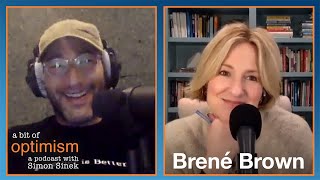
A recorded conversation between Simon Sinek and Brené Brown exploring how the pandemic and recent political events reveal a leadership vacuum in the United States, tracing cultural shifts since the fall of the Berlin Wall toward more short-term, finite thinking. They contrast ‘power over’ versus ‘power with’, argue that honesty and vulnerability (even when fallible) are central to trustworthy leadership, and debate how storytelling, cognitive tools, and neurobiology shape people’s ability to imagine and sustain positive collective action. The discussion also notes that negative emotions are more salient biologically, making positive vision harder to communicate and sustain without concrete tools and ongoing honesty.
Chapters
Over the years, people who like my work bring up Brene Brown's name more than anyone else. And Brene told me that the people who like her work bring up my name more than anyone else. It turns out that we may be two sides of the same coin, that our work together is something bigger than by itself. So what a treat for me to sit down and talk to Bernay. And what might surprise people is we actually don't agree on everything. In fact, we even disagree on my own work.
But one thing is true. We respect each other and we learn from each other. This is a bit of optimism.
First and foremost. How are you?
We're good. Texas in general is really still suffering deaths and just hard stuff.
I mean, it's insane to me, the pandemic, Texas, you know, one of the whole things that this thing's revealed to me is just, especially in the United States, we think we're, like, so far ahead and we got everything sorted out. Like, this whole thing is so Faustian to me. Like, we made a deal to be rich and we're crap now.
It is a complete Faustian bargain. I mean, there's a couple of bad things. First of all, I don't understand why 500,000 people dead. We are the center of oil and gas business in the United States, and we've got people dead from a snow and ice storm and just the failures in leadership. But no one remembers that when it's time to vote, we have a leadership.
Vacuum in the United States. I mean, we have a leadership vacuum in the world, but it's really significant in the United States. It's not a recent thing. This is a slow boiling frog. And you can trace it very easily back to the fall of the Berlin Wall, where we had this existential threat outside of our own borders. It was a philosophical and ideological contest. And it doesn't matter what somebody's politics are. You can go back and listen to JFK or Ronald Reagan's inaugural address. They both talked about peace on Earth, world peace as driving ambitions. To say those words right now, world peace, it actually sounds cheesy.
Oh, yeah.
And this idea of, like, big purpose and idealism to drive decisions was a real thing and made easier by the fact that there was this existential threat, this contest. And when the Soviet Union ran out of money to play in the game, we falsely believed we had won. Because you don't win in an infinite game. The player just dropped out. It's like Circuit City went bankrupt. Best Buy didn't win anything. And then you start to see the fact that we no longer have great purpose, we no longer have an external existential threat. What starts to happen is we become more and more finite, more and more short term focus, more and more insular. And the great philosophical contests are no longer external, they become internal. So we no longer perceive external threats as existential, we now perceive each other as existential threats. We have opposing political parties that, that are just different philosophies of how to advance what was laid down for us in the Declaration of Independence. That's all it is. Like, we think we should go this way. Well, we think we should go this way. That's what political parties are. But now we actually accuse each other of being anti American, unpatriotic traitors and view each other as the threat to America.
What I know.
I was listening to. Jon Meacham has a podcast series about great speeches given over time. And I was listening to Kennedy during Bay of Pigs, Martin Luther King, Churchill during the Blitzkrieg. And there's a couple things that struck me. One, the big audacious goal that's slightly out of reach, you know, the just cause, as you would say, and the honesty and no bullshit way they talk. I mean, let me tell you, I was listening to this series of speeches during the Bay of Pigs where Kennedy was on, like, well, it seems dire and we're not sure what we're going to do, but it does seem really dangerous. I'll get back with y' all tomorrow after we do some more thinking. Our Churchill saying, we cannot concede your sons, your brothers, your fathers will die, but we cannot give up. Can you imagine that kind of candid response from a politician today? The game is so finite, it actually starts two years after they're elected because they have to start campaigning again.
Yeah, I don't think people realize how powerful being honest really is. It's the whole debate about taking pilots out of a cockpit. Can you imagine getting on a plane with no pilots where just computers control the aircraft? And the strong argument could be made that the computers are way more reliable.
Yeah, less fallible.
Less fallible than pilots. But we would rather have a human being in charge knowing that they make mistakes because most airplane crashers are pilot error. And it's the same here. I don't think politicians and leaders recognize that simply being honest, even if I'm going to make a mistake, is actually way more confident building than pretending you've got everything under control.
When do you think that shifted?
Well, like I said, I think it's been a steady drumbeat since the fall of the Berlin Wall. And you can see it, it's got nothing to do with the political parties. You know, Bush 41 and then Clinton. And you start to see, especially in the Clinton years, we did a lot of dismantling of regulation that made us way more finite minded. And by the time you get to the Trump administration, Trump is not a cause, he's a symptom for sure. And he's the most exaggerated finite player because that's the path we've been on.
It's really interesting. A couple of thoughts. One, when Trump was elected, I was writing the forward for a book and they said, can you write about your thoughts? And I said, you know, I think this is white male power over, making the last stand. I think it could have been Trump or anyone else. I think this is someone with a very specific point of view about power being finite and using power over, not power with power to. And power is infinitely shared. And this is going to be a last stand and it's probably going to get violent and crazy. And I think that happened. I think that this idea of power over versus power within two really coincides with what you're talking about around the fall of the Berlin Wall.
I'm very uncomfortable and I've thought about this a lot over the years and it really bugs me. I'm very uncomfortable with the fact that you have to have a. Not that like it's wonderful and beautiful and ideological to know what we stand for. But I recognize that that's ethereal, right? Vision is an ethereal thing inherently. It's intangible. Whereas when there is an existential threat or something, or someone who stands for something different or opposed to what you stand for, it's tangible and easier to see. And the challenge I have is do you have to have a. Not that like, you know, we can all agree in. Not that like we don't want to be the Soviet Union. Do you have to have, and I even don't like the term an enemy to be clear on what you stand for. And I uncomfortably keep coming to the answer yes.
Well, I'll tell you how this relates very much to my research. When I asked people about love, they told me about heartbreak. When I asked them about trust, they told me about betrayal. When I asked them about connection, they told me about disconnection. So part of the problem is that we lack actually the language and vocabulary to talk about what is. People have a really hard time defining love, but they can tell you with excruciating detail about heartbreak. And if you look into the literature in psychology and social science, across the board, you'll see that we have 100x the research on negative emotion than we do on positive emotion. So I think it's the inability to articulate in a meaningful, galvanizing, keyword being galvanizing way what is possible.
What is it about positive emotion that feels intangible, where negative emotion feels very real?
Well, I think it goes down to neurobiology, I think it goes down to our wiring that we are wired for survival above all else. There's not even a close second in terms of what the brain is wired to do. And so the brain's interest in positive affect is not as great as the brain's acute feelers out for negative affect. Everything from fear and physical threat to emotional threat, to stress, overwhelm, anxiety, despair, anguish. It's how we're wired.
This explains a lot, but it's also a little bit depressing because if it's a biological thing, that means positive is always intangible and hard to grasp, and negative is always tangible and easy to grasp. Does that mean you have to have evil to know what good feels like?
No. No. I mean, I'm hardwired. Most of us are that if someone says something really shitty to me or not one of my children, I'm hardwired to punch them in the face. But I don't do that. And so I think we can address the hard wiring with mindfulness and critical thinking. But I will tell you, positive emotion requires more complex thinking. It requires reality checking some of the emotional feelings that we're having. I can scare you into joining me. I have to engage with you cognitively in a thinking way to inspire you to join me.
I don't know. I agree that it requires more thought for the affirmative, but I mean, let's look at your career and my career, right? The things that we have come up with, we're not the first people to come up with, for sure. People have been talking about purpose for thousands of years. You and I learned how to communicate the things we believe in the positive by telling good stories. Storytelling. And storytelling makes those intangible things feel tangible. And people join the story. And we don't have to be rational or convince someone to join. We can inspire someone to join because we can paint a picture of a future that is so clear to them in their own imaginations that they're inspired to say, I'd like to be a part of that, please.
I disagree.
Go on.
Go on. I wish I could see his face right now.
Oh, I love this.
Yeah, no, I disagree.
I love this. Go on.
What I would say is.
I mean, I disagree and agree. I do think there's a fundamental difference in the way I think about it.
Because rational thought doesn't inspire. No, facts don't inspire.
No, but I'll tell you what does is conceptually complex ideas made accessible with language that people didn't have access to before they heard you talk.
You mean a story?
No, no, I mean sometimes a story. I do think in three acts you can inspire someone. And whether that three act story is a Pixar movie, or that three act story is a 20 minute TED Talk, or that three act story is A Five Minute Story, you can inspire someone with a story. I don't think you can engage people in meaningful change without giving them some tools and skill building, which requires new cognitive ways of thinking about things. I don't think that all cognition is rational dry thought. I mean, I think storytelling is a cognitive craft that has emotional valence. Like I'm thinking about going in and doing some work with Pixar when they got stuck on a film and it's like ballet. The more effortless it looks, the more really deep, analytical cognitive work goes into it with storytelling. Like, I'm a good storyteller because I understand the craft of story, but who gives a shit if I'm not saying something that's important?
So I don't think we disagree.
I don't think we do either.
I think this is actually not one or it's one end. Right?
Yes, I agree.
And I think that the story invites because we started this talking about what does it take somebody to join and then the question is, what does it take for them to stay and do hard work? You know, it's like everybody joins the gym with the vision in January and then is done by March when they realize this is hard work. And they see gym memberships go up 12% every year, every January. So I think the story does the invitation and then we want to see that there's goods. Otherwise it's just marketing. We want to see that there's honesty and we want to see that the leader believes in this. It's not just their get rich quick scheme. And I think time, you know, it's kind of like relationships, I guess. When we go on a first date, everything's amazing because we're fitting someone into the vision we have with a partner we want and they check all the boxes and then all of the things that are wrong start to show up and they're like, all right, I still like them. But then the beauty and the love comes later when we realize all the vulnerability and the hard work.
I think that's true.
I don't think it's either or. I think it's both. But you still need the vision and the story for the invitation to go on the second date, the third date, the fourth date. You don't start with hard work. You don't start on date one. Like, let me tell you all my baggage. You'll never get a second date, even though I really want to know your baggage. And it's actually going to make me fall in love with you. Just not yet.
I'm thinking. I'm really thinking. This is my thinking face, so. Yeah, but stories are not neutral. Stories can be fashioned into weaponry really easily.
Sure.
I'm trying to think about.
So hold on, hold on. I have to. So does this mean we can't be vulnerable on date one?
No. I disagree.
More from Clegg

The #1 Skill Gen Z Needs | Simon Sinek + Esther Perel | A Bit of Optimism Podcast







AI Won't Tell You the Full Truth | Arthur Brooks + Simon Sinek | A Bit of Optimism Podcast



How To Make the Best Decision | Arthur Brooks and Simon Sinek | A Bit of Optimism