The Power of Giving Away Power: A LIVE Conversation with Matthew Barzun
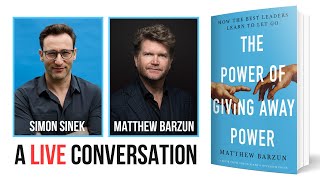
Live conversation (Simon Sinek hosting Matthew Barzun) promoting Barzun’s book The Power of Giving Away Power. Primary theme is the "constellation mindset": view each person as a star that stands out and connects into a larger constellation, contrasted with pyramid/top-down and mirrored bottom-up hierarchies. Key claims: power multiplies when shared (power as something you make, not a zero-sum resource); practical starter practice—bring three expectations to meetings (expect to need others, expect to be needed, expect to be changed); recommend shifting negotiation language from "win-win" to "what will we make together." The session includes examples, audience Q&A on delegation, servant leadership, generational strengths, and the book-writing process; intermittent technical interruptions occur.
Chapters
Hello, everyone. Thanks for joining. We're on Facebook, YouTube and LinkedIn. So wherever you are in the virtual world, welcome. This is actually really, really exciting for me because we're launching a new book called the Power of Giving Away Power by Matthew Barzin on Optimism Press. So I'll tell you the history of Optimism Press. It's a nice story. I kept meeting these wonderful people and saying, you should write a book. And I would introduce them to my publisher and all the books that I recommended to them, like people really liked and were getting good value of them. I would go to conferences and I'd hear people quoting them, and I called the publisher, I called Penguin and said, why don't we just do this together? Let's start our own imprint, which basically means our own little publishing company, and let's just publish our own books. And that's what we did. So we started our own little publishing company called Optimism Press, where I get to find amazing people who I believe their ideas are big ideas who are having profound impact and can have profound impact in the world. And if you follow our work, I'm sure you're a part of the movement, you know, the vision. The vision is to create a world in which the vast majority of people wake up every single morning inspired, feel safe wherever they are, and end the day fulfilled by the work that they do. And Matthew Barzin's book, the Power of Giving Away Power, I believe, is one of those pieces of the jigsaw puzzle that we need to build that world. So I thought, what fun to invite Matthew to talk about it. I met Matthew a bunch of years ago in London when he was still the US Ambassador to Great Britain. And he invited me. I hadn't met him before, and he invited me to come speak to the embassy and some students. And we got along is basically what happened. And I loved his thinking. And every time he would start talking, I would take notes. And I found him incredibly wonderful and down to earth. And quite frankly, we became friends. And he's now back in the United States, living in Louisville, Kentucky. And we thought, we need to write down some of those ideas more formally because they're so good. Hence the power of giving away power. So without further ado, I'm going to bring Matthew on. If you have any questions, please drop them in the chat and we will answer all of your questions. Matthew Barzin.
Hello, Simon. Hello, everyone.
Well, I am blushing for your kind words. I am. It's just great to be here with you and all of my fellow fans of Simon Sinek. And fellow beneficiaries of your why, my friend, that is why I am sitting here in Louisville, Kentucky, live streaming with this great group.
Congratulations. You are now a published author.
Yeah, how about that?
How does that feel?
Oh, well, I learned from someone named Simon Sinek that the feeling of nervousness and the feeling of excitement are actually physically or physiologically. I think you said the same feeling. It's just how we choose to interpret that. So I. I am excited and nervous.
So as I was saying before, you're one of those rare people that you're humble, you're down to earth, and almost every time you would start talking, you would start philosophizing. I found myself frantically looking for a pen and paper to start taking notes on the things you said. And so what a personal thrill it is for me that I get to take some of that big thinking that you have about how to reorganize the world and more importantly, how to reorganize our businesses and organizations.
To be a more equitable world in the world that you imagine. It's wonderful. So thank you, thank you. Thank you for letting me bring your ideas to life and to the world. Without any further ado, I would love to jump into the questions, if I may. I have a bunch here that people pre submitted and we'll take some live ones as they show up as well. So, Matthew, here's one from Dana B. What does that say?
Did I. Did I lose sound? Matthew's writing, writing notes to me.
Did we lose Matthew?
Where it looks like we're having connection issues. So in the meantime, I can tell you a little bit about the power of giving away power. So I'll share one of the principles that's in the book that I absolutely love while we figure out the tech issue.
He's back.
But I'm back. Can you hear me?
We can hear you perfectly. I was about to start explaining your thinking. Okay, good. Let's jump right in. Okay, Dana B. Wants to know what exactly is the constellation mindset and how does it apply to companies?
Well, the constellation mindset is a way of seeing, thinking, feeling, and behaving.
About how you see yourself and the people around you. And to cut right to it, it's about seeing yourself as a star and more importantly, seeing everyone around you as a star. And then the game becomes, well, how do we make connections between us to build something more useful, more powerful than any of us could alone? And we'll get into this later, but that's in contrast.
Sorry to interrupt, but I want to give A little context for where the constellation mindset came from. And so I know you have this rant that I absolutely love. We talk about the pyramid and how we organize top down and how we've responded to that. Can you start there? Because I think it'll contextualize what the constellation is.
That's a good point. So before we get into constellation mindset, we should talk about its alternative, which as Simon said, I think too often is kind of our default setting. Here's what I mean. We all got the memo that top down leadership doesn't work, right? So what we end up doing is we like, I know we think we do the opposite. Let's be bottom up, right? And that does feel better for like a second. But think about it. The bottom up mentality forces us into one of two modes. Either you're thinking of other people as beneath you, or you think of yourself as beneath someone else. This is just the exact same pyramid shape in reverse order. It's hierarchy by another name. So we cannot, we do not escape this pyramid mindset when we turn to bottom up. We need to do something different. Now, the alternative, once you do escape, you realize that, then you escape that and you're like, well, okay, well, maybe I'm just sort of on my own. The world is just, I'm a one of a million stars in the night sky. And I guess that's the way it is. And I'm giving up all order, all stability, all purpose. No, this consolation mindset lets you find a way where you can stand out as a star and yet fit into something bigger, namely a constellation.
One of the things that I love about this idea of a constellation mindset, regardless of where we are in the hierarchy, and there's still hierarchy, is to look out at the people we work with, our team, and you see everybody as a star, as you just said. And what I love about that from a mindset perspective is it forces someone whether, whether you're seeing somebody who's, who's higher in the hierarchy or lower in the hierarchy. It forces you to try and see their talents. Because that's that when you talk about the constellation mindset, it's the requirement to look for someone's talent so you can see that they are a star. It's not this philosophical idea, everyone's a star, Kumbaya, let's all hold hands and sit around a campfire.
It's the requirement that you look for someone's talents and understand how they fit in to this constellation and make a bright point, which I Absolutely love.
And found myself doing since you taught me about it.
Cool.
Ralph W. Asks, how do I apply the constellation mindset if I'm a low level employee? Do I have to convince my higher ups to adapt to this mindset?
You do not have to condense your quote. I have to put them in air quotes. Higher ups because I really. Once you get this consolation mindset in, you reject all forms of the pyramid. So, so yes, I know what you mean, Ralph. No, you can begin this. We all can begin this like right away at our next meeting.
And.
Expectations into that meeting one. And Simon was just making this.
This is.
I think I might have lost you.
Yeah, you're cutting in a. I'm going.
To pretend like I'm still on. Anyway.
Matthew's Wi Fi sucks. That is the hierarchy attempting to shut him down. That's what that is. That is top down leadership in action.
So I'll do what I can based on what I know of Matthew's work.
We have a good question from Kelly.
Go ahead, Kelly. Go ahead, Kelly.
Kelly says she sees a lot of correlation between the pyramid mindset and a fixed mindset from the infinite game.
Yeah.
And the constellation mindset and an infinite mindset.
Yeah.
Are they the same or are there differences?
So Kelly said that she sees a lot of comparisons between the fixed mindset of a pyramid and the finite mindset that I write about and the infinite game and a constellation mindset. Are they the same thing? They're not the same thing, but they are absolutely related. Matthew, I'm just answering your question about the correlation between the pyramid and the infinite game.
I like it when you explain it better.
We took a question from the audience.
I'm so sorry.
The show must go on. The show must go on.
There are similar, but they're not the same. Matthew and I clearly love each other's works because we see how our works relate to each other. Absolutely. To have an infinite mindset helps you see the constellation because you understand that this is infinite, that, that the stars are ever expanding, they're ever changing. You can see new patterns and new constellations all the time. And whereas the, the, the. When you have a finite mindset, you view your organization as fixed and you view people in fixed roles and, and, and, and fixed responsibilities even.
And so yes, I think having an infinite mindset absolutely helps you embrace a constellation mindset. And the more you embrace a constellation mindset, the easier it becomes to operate with an infinite mindset. They are not the same, but they are definitely correlated. Would you agree, Matthew? I Know you agree.
I totally agree. And I think I left Ralph W. Stranded. Is that true?
Did I cut out Ralph W. Asked, how do I apply the constellation mindset if I'm a lower level employee? Do I have to convince my higher ups to adopt this mindset?
You do not have to wait. You can begin at your next meeting if you bring in three expectations into that meeting. Expectation number one, expect to need others. Right? Expect to need the other stars. Number two, expect to be needed. Right? You were the only one who can bring your truth to that meeting. And if you don't bring yourself, you know, death, denying a unique thing that only you can contribute. And those are really important. But the most important one is number three, expect to be changed. And what I mean by that is if you have made this meeting one in which this group has made something together, made a constellation, as I like to put it, you cannot help but be a different person at the end of that meeting than you were in the beginning. And everyone will be like that. Because when you make something together, you're part of it. It's part of you. But you're not diminished. You're still your own self. You're just a little richer for it. And you bring that into the next meeting and so on. And I. If you do that, that is such a powerful and unusual way of conducting ourselves that that news will start to spread. You'll want to do it again. The people in that meeting with you will want to do it again. And it can start to spread out.
What you're proposing sounds, it's definitely simple, but I think it's actually more difficult than it sounds because what you're asking people to do is show up to every meeting with an open mind and humility.
I am valued.
And I value others. And to your third point that I can be changed, which is I'm no longer seeing my point of view as right versus wrong, but rather simply as a point of view as a point of light. And the constellation may change, the pattern may change, I may change my mind. But that, that is. Was there a point? Is there something that happened in your career or was it an evolution? Was it an event that helped you learn to approach a meeting with that level of humility that I walk into a meeting accepting that I can be changed and I may be changed.
I can't point to one particular meeting, but the pattern that I saw repeating over and over again was a bunch of smart people I liked just trying to win arguments all the time, and it was kind of exhausting. And I'd watch it. And then I remember in Simon, you and I joked about this. It's like, hey, try this. Everyone at your next meeting, quick show of hands. How many people here like to lose an argument? No one ever raises their hand.
Okay, well, the show must go on.
So Matthew talked about this when I did the podcast with him that nobody ever goes into a meeting, nobody ever says, I want to lose an argument. You know, he said, quick show of hands. Who wants to lose an argument? Nobody ever wants to. Nobody ever wants to lose. And this is the problem, which is we're all showing up to win. And when you're talking about different colors in an argument, there's no such thing as winning. Hopefully when he comes back, he'll tell us the rest of that story. Graham, do we have another question that I can field? While Matthew unfortunately gets all stressed out back home about his broken wi Fi? Even though we're having fun.
Yeah, we do. SADAF S asks, what's the best way to align personality types with leadership skills?
SADAF asks, what's the best way to align personality types with leadership skills? That's a great question. I think much is too much is made of personality types and some being better organized for leadership versus another. The reality is we all have strengths and weaknesses. And this is why I think that teamwork is actually the big thing. It actually goes to Matthew's point, quite frankly, which is to come into a meeting knowing that others are valuable and I am valued, and that's the most important. That's the most important thing. And so I think when you learn those. Those strengths and weaknesses, it helps you understand the kind of teammate you can be and what you can bring to a team. And it's great to learn what other strengths, if you do strengths, finders or one of the other.
You know, enneagram, whatever, whatever your thing is, it's fun to know how the others show up on the team as well. So I think it's very important to learn those things. Whatever your preference is, whatever format you like to use, it's very important to understand the others, and you want to make sure that you have different strengths on the team. I've seen this happen where you know that we put all one kind of personality type on a team, and the reality is different tasks require different things. Now as it relates to leadership, again, it's understanding your personality type and how to leverage all of that stuff to help others. But the principles of leadership are unchanged regardless of your personality type. They remain completely separated. There's Someone at my front door. It's probably FedEx. Okay. It's just one of those days. Matthew, you were telling the story of nobody wants to. When you say a show, quick show of hands, who wants to lose an argument?
Yeah. And no one raises their hand. Right. And so why do we trick ourselves or tell ourselves or train the next generation to think that we're in the argument winning business? It's just not. I mean, there's a time and place for that. I get that. But like most of what we're doing in meetings is trying to make stuff together and not trying to win. So I guess that I watched a series of that and it just seems like it just became exhausting, everyone pretending that they had the right answer and trying to win. There must be some alternative. So I was on the search to find an alternative.
This is something that I think you and I have coming at the same coin from two sides, where you talk about the fact that we've perhaps done ourselves a disservice by teaching each other, teaching ourselves that the goal is to win an argument because nobody wants to lose one.
And I talk about it in terms of over indexing, in rugged individualism. It's me. And I have to be the strongest, I have to be the smartest, I have to hit all my numbers, otherwise I am not going to get promoted. And I think one of the things you and I are both advocating for is actually teamwork is actually way better to advance anything, whether it's thinking, ideas, production, process, progress, all of these things are just better when we work together. And.
The idea of trying to win as an individual all the time actually does damage to the organization. And trying to win as a company all the time does damage to economies and whatnot.
Exactly. And that's why win win, although it's so tempting and we say that win win is a losing formula, go unpack that for me because I know and it sounds right again for like a little bit, but just once you invoke winning, you get losing for free. It just comes along. It's a package deal.
And you framed it as a finite game the minute you've done that.
Interesting. What language do I use when I'm about to go into a negotiation other than win win, or is that finite and that's allowed?
Yeah, well, once you've sort of accepted it as a capital and negotiation.
That is sort of a finite game. But if you just say, hey, what are we going to be making together? We might be making decisions. It's not always a physical product. But like we are going to make this. And you think about it.
You know, Covid recovered all this public policy stuff, climate change that people are wrestling with. Damn it.
This is a really significant point, which is the idea of when you sit down a negotiation table and you, even if you're a well intended negotiator, you say, let's get to a win win. We're still thinking about ourselves. I'm on one side of the win equation and the other party's on the other side of the win equation. And what I really, really like is that you say, what are we going to make together? So it's not about my win and your win, which are two separate, you know, self licking ice creams.
But rather what are we going to make together, which I, which I really, that's such a wonderful way to start, to start a negotiation. What are we going to make together? And then you start to realize that the points that I'm arguing will hurt that process.
I really love that.
We got a great question in the chat from Teresa who asks, how do you feel servant leadership differs to giving away power?
Theresa asks, what's the difference between servant leadership and giving away power?
Oh, okay. Before my Internet kicks out again.
You have seven seconds.
Go.
Yeah, exactly. So sorry guys, we just said, when.
You were off, we said this is proof that the hierarchy is trying to shut you down. Oh, it's the paradigm.
Very good, very good.
Okay. So.
I think at its core.
Servant leadership, lots to love about that term and about the people who feel attracted to that term. I'm one of them. I just think that it ends up, I think, making us think that this is a selfless act, this is selflessness. And there's this wonderful woman who taught me a story I'm going to pass on very quickly, named Lynn Twist. She's an amazing woman. She's helping save the rainforest. She takes a four day trek through the Amazon to the headwaters of the headwaters of the Amazon, meets with the tribal chief. She thinks her organization can help. She makes her pitch about that help. And the tribal leader through a translator says, I think I understand, thank you. If you're here to help, please leave. And you know, like any of us, she would just like totally defeat it. Like, I blew it. And then he continues. But if you're here to, if you're here because you think your liberation is inexorably tied up with our liberation, sit, stay, let's work through this together. And that difference between helping and mutual getting free together, mutual liberation, whatever word sometimes that turns people off. But being free together is the challenge, is the work. And often selflessness is greeted with, if you're here to help, please leave. So that's the distinction I would make is.
So here's. So I'm gonna. I want to. Is there a. Unpack this with me. This is the thought that went through my mind. Is there a hubris to the concept of servant leadership?
Yes. And I say this as a progressive, you know, Democrat. My politics are pretty well known. But. But it's that awful tone that. That people can take, and I've unfortunately taken it in my life, which is sort of has that implied, like, you're welcome, which is just so. It's just so off putting.
Yeah.
Like, and it's.
You know, allow me to help you.
It's kind of that.
Right. There's a lot of condescension in it. There's a lot of pyramid stuff. There's a lot of, like, I'll help those at the bottom.
Like, that's so good. It goes back to the point you made some moments ago, which I think is such a great way to enter a meeting is, you know, what can we make together? You know, you know, which is not servant leadership. It needs an. We need an. I guess it's constellation leadership. It needs a new word. Because to your point, servant leadership is still inexorably linked, inexorably tied up with. With the pyramid.
I think so.
Love that.
How's your Internet? Shall I do another question?
I mean, let's just.
We're holding together, right?
Flip the coin, roll the dice. I love it.
All right, let's keep going. Ahmad K. Asks, what do you think is the biggest thing standing in the way of companies and countries success today? Go small. Ahmad, nice little question for you there.
The pyramid, Ahmad. The pyramid. And not some hierarchy out there. It is inside each and every one of us. I told this story to Simon on his awesome podcast, but if you ask 10 people what is the opposite of winning to get them warmed up, they all say in unison, losing. And then you say, okay, now the more interesting question, what's the opposite of winning and losing? 9 out of 10 of us say not playing, sitting it out. 1 in 10 of us says, playing or being, learning, laughing, all these other things that we do and enjoy in life that aren't strictly winning and losing. That pyramid within us. This is the world of up, down, in, out, ranking, rating, sorting, sifting that world. That is the biggest impediment for countries, companies, and each of us personally, which.
I Think ties perfectly to what you said some moments ago about being willing to be changed. Because when you first told me that story, I remember thinking how depressing that only 1 out of 10 people say playing versus not playing. When asked the opposite of winning and losing, they say playing. I thought that was depressing. And then you corrected me. You said, no, no, no. As soon as one person says playing, everybody else goes, oh, yeah. And then you convert the other nine people. And so the idea of being willing to showing up, even if you have a point of view about something is fine. But willing to show up and say, I can be changed, I think is required in that. In that. And we lost Matthew again. Okay, I'm going to answer this one from my perspective because it's the question, and he's not here. Why do you think so many leaders struggle with delegating or giving away power?
Matthew, we're going to take turns answering this question. Why do you think so many leaders struggle with delegating or giving away power? I think there's a couple things. One is fear, especially when you're.
If you're at a senior position, you used to be at a middle and lower position. That's how we. That's how you make your way up the pyramid. Right? And so we're all used to being doers and we get good at something, which is what gets us promoted, and then we get promoted to oversee the people who do the job we used to do. And that's an entirely different skill set. And so it's very, very difficult to let go of something and allow somebody to try something, fail, not do it as well as us, especially when we are better at doing their job, because that's what got us promoted. And so part of it is education. We don't teach people the skill of leadership so that when they achieve a position of leadership, when they're offered a position of leadership, they actually are more equipped to let go because they understand that's not my job anymore. And if there's an infinite mindset to say, by letting go, I might see the numbers go down because this person isn't as good as me. But by allowing them to learn and learn and learn, the numbers will come back up. And more importantly now we have two people who are really good at this, and when we do that, we're going to give it to somebody else who doesn't know how to do it. And then you have three people who know how to do it. And that way, if one person's out sick or leaves for a Better job opportunity. You're not stuck because you took the small dips to prevent a big dip. So I think fear is one of them, is one of the reasons we struggle to delegate. I guess. The other one is it just feels good to be in charge. So ego. And the other one is education. We don't teach people how to let go. We don't teach people how to lead. Matthew, you want to take a stab at it? Why? What is the question?
No, I got it.
Okay.
I mean, I think I agree with everything you said. And just to add to it, I think it is a perspective and that when you say delegating, there's often in the mind of a leader this idea of sharing power. Like, who could be against that? And yet the leaders and I talk about some of these in the book, these amazing leaders, most of whom we've never heard, heard of, they saw something the rest of us missed, which is power obviously shouldn't be lorded over. Other people are hoarded to yourself and all that. But they went farther. Like, power shouldn't even be shared in the sense of divvying up, because they saw power not as something that's like a scarce resource that you mine. They saw power as something you make. Like we talked about earlier, once you see power as something you make and you only can make with other people, then it's a different way of framing, like, hey, you've got X amount of power. Why don't you share it with your team? And fundamentally that's like, invokes a lot of loss. And like, oh, I guess I'm going to have less. And when you were saying in, your answer was so great. It's like, and then two and then three, so it can multiply. And multiplication and division in this context are very different.
I think this is worth underscoring because I think this is so good. And I know we called your book the Power of Giving Away Power, but it's partially done for. We want a good title. That's. That's intriguing, but in some way, shape or form, it plays on old, on old misunderstandings and misperceptions of power. When you think of power as an infinite resource, which I think is so fascinating. When you say giving away power, I'm actually not giving away anything. I'm not taking my power and giving my power to you. And now I have less power. I'm simply, I retain all of my power and I'm giving you some as well.
It's lifting people off and it's sort of like you Give it. And then you just get it back. And then you give it again and you get it back, and it just multiplies and grows. But. But it is misunderstood. It's so funny. My whole career up till now, I have studiously avoided ever using the word power in diplomacy, business, politics. And now I use it twice in a short title.
Twice in one title. Yeah.
Yeah.
But I think that's what you're doing. I think you're challenging the definitions of power, which is what I love. Which is what I love about your work.
Yan. S. Or it could be Janice, depending on where they're from. I don't know.
What's the relationship between. What's that? Why don't we go with Yanish, then there's. Okay, they're Scandinavian.
Jan, what's the relationship between the infinite mindset and the constellation mindset? I took a crack at that when you logged off. But I want you. I want to hear your point of view.
Actually, I don't want to hear your point of view, so never mind.
You back.
Matthew, do I have you?
Oh.
So close.
So close.
This next question says for Matthew. Sorry, Tony. What else do we have?
Go and hear from Shane.
Go ahead, Shane. Yes.
Shane says, how do you try and convince older generations that their strengths are still strengths in a changing culture moving forward?
Ooh.
Oh, you. Oh. I want you to tackle this one, Matthew. I'm gonna. How do you convince. I struggle with that word, but we'll get to that in a moment. How do you convince an older generation that their strengths are still strength, even in a changing cultural world?
Oh, I want to see what you say to that one, Simon. I. You know, I got. I lost the connection when we got that great question about personality types, which I loved your answer and didn't have anything to add to that I was thinking about. Here's a visual aid while I last. If you go make an org chart, you go make an org chart. Literally. I think in Microsoft PowerPoint, which is what I use, Office, it says org chart hierarchy is the default. Right. It's a bunch of boxes that make it super easy. I. Of course, I'm allergic to pyramids, so I don't make org charts that way. And so I've been making my own org charts in PowerPoint for a long time. And if you've done it, you make little circles, and then you put those things called connectors. And there's a point you were making about personality types. When you put up. When you put a connector, which is like a line in Microsoft but it's a line that like tries to find a shape. When you get it near the shape, the shape lights up and it has like six connection points that you could possibly attach that line to.
Yeah.
And I think about that in the context of personality types, I think that in the context of this last question, around the strengths they have, like connect to their strength. Just find it, it's there. If you look at them as a 360 degree thing, don't force it in this side.
Find the thing and then let it connect to a different star that way to get sort of abstract once again.
You know, I think part of being a star in the constellation is not only seeing yourself as a star, because we're all pretty good at that, but it's seeing other people as a star as well. And I think it goes back to your point of humility before, which is it's the humility of an older generation to say that young generations do bring something to the table that I may not know, but. And, and it's also for younger generations to say older generations have something that I don't have. And to connect the generational points of view is more powerful than. I'm right and you're wrong.
Well, that's right. We talked about this when you came to the embassy many moons ago in London, that our governments, and this is not unique to governments, we tend to put on these blinders and we really love people sort of age 30 to 60. We don't pay attention to them before. We sort of tune them out after 65. And they're some of the most interesting people I've ever met are the older generation and the younger ones. And so widening the aperture, factoring them in. And the other thing I think that gets in the way is this platitude that we say, which is what unites us is greater than what divides us. And I know what people mean, I've said that. But this constellation mindset is like, no, no, no. Lots of energy and potential energy lives in difference as long as we constructively engage the difference and make something with that difference. So we should be seeking out difference from the older generation, from the younger generation, and making meaning out of it.
It really is this magical connection between naivete and wisdom.
And I think, do explain.
I think arguably the people who we listen to, and we're all guilty of it, which is that 30 to 60. Right. Have neither naivete or wisdom because they've lost their naivety and they're not yet old enough or experienced enough to be wise. Because they're still in the game. But when they leave the game and they can look back, it's like I love the movie the Fog of War, which is this extended interview with Robert McNamara. And what's amazing is people have visceral hatred for Robert McNamara for all the right reasons, given he's the architect of the Vietnam War. But when you listen to this old wise man who now is no longer in the game, be able to look back and criticize himself and his actions and have perspective that he didn't have when he was in the game, it's very hard to hate him and realize what he brings to the table is wisdom.
Somebody who's under 30 has unbelievable naivete. They believe they can change the world. I'm going to start a business and it's going to change business. And you think about all of the companies that actually did change the world. The apples, the Microsoft, they were all started by 20 somethings, if not younger. Facebook was started by a college student. Right. And it's like because they're so naive to believe that they can, that it sets them up for that opportunity and they're not encumbered by the old ways of doing things. So I think to bring unconstrained thinking with the perspective of wisdom and to your point, broad blinders, because I think what happens between 30 and 60 is the blinders go in. I think before 30 and above 60 the blinders actually open up again for different reasons. And I think that's a really interesting point of view.
Well, I do too. And back to Fog of War. I think it's Errol Morris, who the amazing documentary filmmaker. We talk a lot about language. I'm obsessed with it because words make worlds and all that. I do believe that. I know you do too. It's like the body language that we use. And I don't know the details, but it's worth everyone googling how he makes his films. He has this technique where the person, Robert McNamara, he's I think looking at the filmmaker, not looking at a blank camera, looking at a blank screen. You have to do it all the time in your work. Simon is a weird thing. Just like in zoom. Looking at a picture of yourself all day long is weird and it does weird things to you. So makes you keep exactly he, he. Errol Maher has did something very clever with the body language of film to bring that out of, to sort of educe from Robert McNamara. This, this wisdom that if you feel backed in a corner you'll fold your arms and give the Same answer you've given for 30 years. Not interested.
And even now, talking to you like I'm trying to look at you, which unfortunately, because the placement of the camera makes me look like I'm looking down. And if I'm going to look camera to make eye contact with an audience, I'm not looking at you. And it feels weird. And so I'm constantly jostling between the two because I'm trying to have a conversation with you, but recognizing that there's an audience. So I hear what you're saying, and that's even more extreme, which is the ability to form human connection. Right. That's what Errol Morris does. For those who haven't seen Fog of War, it did win an Oscar. Not that that's a reason to see it, but it is absolutely brilliant. I think his best work, if you ask me. Errol morris, not Robert McNamara.
Although arguably Robert McNamara is best.
Moving right along.
Yeah, let's move on. Okay. Jada H.
Oh, this is a good one for you, Matthew. I love this because you've just. You've just got done writing your book. What is the hardest part of distilling all of your experiences and ideas into one book?
Brutal.
So hard. Really hard. You should find a Simon Sinek in your life because, boy, do they make it worth the work. And to give you that early encouragement, so you use the word Jada. Distillation, which I'm dialing in semi successfully from Kentucky. We love to make whiskey. And there are three steps to make whiskey, and the first one's fermentation. The second one's distillation, and the third one, trivia question. You normally use aging, but it's maturation. Okay? So distillation is really important, but step number one is fermentation. You bubble up all these ideas, and if you have a loving.
Critical friend. Good sense of that word. I like the word critical. Like critics count. They do. They're wonderful. Loving critics are hugely important. Simon, read my first offering, which was three times as long, and you were just wonderfully accepting of it. You're like, I'm glad you did this, but I'm not interested in that book. But there are ideas in it. If you could distill those down and weave them together in a different way, not chronologically, I'd be interested. And so it took a long, long time. It was really hard, and it did feel like distillation. But fermentation bubbling up comes first, I think.
Oh, I love this. I love the analogy of whiskey, where the first, the fermentation the bubbling up. And that's exactly what you do to write a book. I mean, the process that I use, that I think you adopted, it's not for everyone, but it's. The process I use is I buy blank index cards, no lines, and I just. There they are. And I just have. I just. I just. I allow the fermenting. I just. Any idea that comes to mind that I think is related, even. Even if it's by a loose thread, I write it down. And it doesn't have to be in full sentences. It's just to remind me so that I know what it is. And I walk around with my stack of index cards, and every time I have an idea or a story that might work, I put it down. It's a fermenting. And then the distillation is I take this stack of cards and I start organizing them and seeing if I can tell a story and what belongs, what doesn't belong. And then the maturation is the ability to tell the story over and over and over again until it makes sense. Look at that. Who knew that whiskey was actually.
A means to writing a book?
This one is from Tony B. And it says, for Matthew, what is your why? And how does the constellation mindset fit in?
No.
So good. Just as I said, for Matthew, he's gone. We'll get him back. We'll answer this one question, and then we'll spare everybody the torture and we'll call it a day. Okay, Matthew. The last question was actually for Matthew, so I couldn't answer. Tony B. Asks, what is your why? And how does the constellation mindset fit into that?
Okay, I'm debuting my why here, which seems appropriate with this wonderful group of fellow Simon Sinek fans. Well, the image, you know, Simon loves have an image, so I brought them here. The image is a big boat and a little boat, which, when I got to do my why with Simon, which was really cool, and you can hear that story on his podcast with me, so I won't repeat it here before the Internet clips out, but mine is to encourage people to see how they can stand out and fit in at the same time so that we can build more, bigger, better things together.
Beautiful.
And how does that fit into the constellation mindset?
Well, it is. So standing out and fitting in is what you are in a constellation. And I'll close for those of you who are American, and I think it's much bigger than America. I think the best idea of America is summed up in our Latin phrase, e pluribus unum from many one. We talked about the pyramid. You could think of that as from many bricks, one pyramid, which would be incredibly depressing. You either fit in or you're left out. But that is not what the founders did. Eupluribus unum is right underneath the constellation on our national motto, which is right above the eagle's head. I'm not having a. I'm spatially challenged here. There you go. It's that thing above the eagle's head. E Pluribus unum is written under the constellation from many stars. One constellation stand out as a star fit into a larger constellation. That I think is what I want to devote my life to trying to do.
I love that. Matthew Barzin, thank you for taking the time. Thanks for enduring Wi Fi challenges. Thank you everybody else for doing the same.
Thank you. Thank you.
If you're interested in more of Matthew's work, which I highly, highly, highly, highly recommend, he's been highly influential in my growth. Check out his new book, the Power of Giving Away Power, sold in fine bookstores anywhere and some not so fine.
Ones, if I might be honest.
You can visit the link in the description or the link we're dropping in the chat to learn more about Matthew and his work. You can also check out the episode that he and I recorded together in A Bit of Optimism, where we have a lovely conversation about cell phones and all kinds of cool things that are influenced by constellation thinking. Matthew Barzin, always a joy. Always a joy. Thank you so much for taking the time.
Thank you, Simon. Thank you. And thank you everyone for putting up with my sketchy connection. Really, really grateful.
Bye, everyone. See you soon.
More from Clegg

The #1 Skill Gen Z Needs | Simon Sinek + Esther Perel | A Bit of Optimism Podcast







AI Won't Tell You the Full Truth | Arthur Brooks + Simon Sinek | A Bit of Optimism Podcast



How To Make the Best Decision | Arthur Brooks and Simon Sinek | A Bit of Optimism