The Real Goal of Storytelling (Hint: It’s Not Being Right) | A Bit of Optimism Podcast
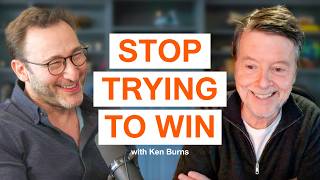
In this episode of the A Bit of Optimism podcast, host Simon Sinek interviews documentary filmmaker and historian Ken Burns. The conversation weaves together Burns’s philosophy of documentary making, his approach to historical complexity, and broader reflections on how stories shape understanding. Burns argues that filmmaking is an act of subtraction—distilling hundreds of hours of footage into a concise narrative—while preserving the “intervals between the notes” that convey mystery and depth. He stresses that objectivity is a myth; every documentary carries degrees of subjectivity, and the goal is to start with a blank slate and let the story reveal itself, offering multiple perspectives that challenge binary thinking. The dialogue explores specific historical subjects— the American Revolution, the Vietnam War, World Wars, and figures like Lincoln—illustrating how nuanced storytelling can expose contradictions and moral ambiguities. Sinek introduces James Carse’s concept of finite versus infinite games, applying it to war, politics, and business, and both guests discuss how a finite mindset (seeking winners and losers) leads to conflict, whereas an infinite mindset (sustaining the game) fosters empathy and innovation. They also examine American identity, the myth of exceptionalism, and cultural traits such as optimism, improvisation, and the tension between simplicity and complexity. Throughout, Burns shares anecdotes from his decades‑long career, his editing process, and his love for literature (e.g., One Hundred Years of Solitude). The episode concludes with mutual appreciation for the conversation and an invitation to continue exploring how stories can shift perspectives and foster a more compassionate world.
Chapters
It is okay to try and simplify the world so that we can understand it and feel like we matter in it. And we have to accept that there is complexity that sometimes we understand and sometimes we don't. Those things have to live together.
You know, we make films and they're not additive. You don't build a film, you subtract a film. We have 500 hours of footage and we get down to 12. And it's, it's to do what you're talking about, to kind of simplify in a way. But we also want to leave open This is the mystery of life that we have been handed. It's not the note, it's the intervals between the notes that make music, and it's the cut between the shots that make film.
It's complicated. These are the words that hang on the wall of Ken Burns's editing room. These are the words that also capture how he understands history. It's complicated. There are few people whose work has actually shaped how we understand things. And Ken Burns is definitely one of those people. Whether it's our understanding of the Vietnam War, the origins of baseball, or even the building of the Brooklyn Bridge, Ken always tries to build his documentaries to tell the story from other angles, multiple perspectives, including ones we've never heard before, all of which challenge our understanding of what may have actually happened. His newest documentary, a 6-part PBS series, explores the American Revolution in a way that reveals so much more depth and complexity than most of us are even aware of. To sit down with him was insane. He is so smart, and his ability to recall entire lines, paragraphs from his own work and the work of others—
Fellow citizens, we cannot escape history. The fiery trial through which we pass will light us down in honor or dishonor to the latest generation.
I mean, it was crazy. I just sat back and at times felt a little stupid, but my God, he's fascinating. So get comfy, because this is a detailed love letter to storytelling, and an invitation to consider what history can teach us about who we are, and who we're still becoming. This is A Bit of Optimism. Your work feels more important to me now than ever. Because I think television is a large part of where we get our opinions, not just our information but our opinions. We already know that people don't know what to trust or who to trust, and even documentaries are biased. And your work seems to stand out from those where you are willing to, I think, start with what you believe is a blank slate in your head and say, let's see where the story goes. How did you get to that? Because you, you're a documentarian, you can't help but have an opinion. How do you make sure that you stay even when you're telling a story?
That's a really wonderful, um, question, Simon. I remember the first day of film class in college at Hampshire College, a brand new experimental school in its second year when I arrived in September of '71. The first day was a just this question about objectivity and subjectivity. There's nothing objective, no matter what a documentary may claim. Even those proponents of cinema vérité aren't. They're pointing their camera in one direction, not looking in the other. So what you have are degrees of subjectivity. And I think that that's where we've tried to be free, as you said, a blank slate when we begin. We're not trying to impose our own beliefs on the material, nor are we buying into any particular set of historiographies. That is to say, the way in which you engage the past. Maybe it's Marxist, maybe it's Freudian, maybe it's semiotics, deconstruction, queer studies, Afrocentrism. I mean, there's lots of fashions of historiography. You know, I resort to a baseball metaphor, calling balls and strikes. We have in our main editing room a neon sign that says in lowercase cursive, "It's complicated." And it works on many levels. One is, you know, if you've got a scene and it's working, and no filmmaker wants to touch a good scene, right? It's working, leave that alone. But if you find new contradictory information that would destabilize this perfectly working scene, you're making it perhaps less perfect, less better, and we're always willing to do that. So that's the first line of it, but a lot of it gets to the larger questions. Is that, you know, we live in a media culture, in a computer culture, in which everything is a 1 or a 0, or a good or a bad, a yes or a no. And there are no binaries, actually, in life. We know this from our friendships. We know it if we look in the mirror. So there's complicated things. So the tendency to say, in the case of the American Revolution, something I've been thinking about for the last 10 years and worked on a film about, you know, you can throw George Washington out because he was an owner of slaves. As the writer Rick Atkinson says, you can't square that circle morally. In lots of ways, it's indefensible. And yet we don't have a country without him. Babe Ruth, if I go back to baseball, strikes out many, many more times than he gets a hit or a home run. But all in our highlight reel, superficial world, that's all we show is Babe Ruth hitting a home run. He also comes up only once every 9 times at bat. So it means that we're also obligated not just to focus on all of the things, his strikeouts, his game-ending double plays, as well as his walk-off homers, you have to look at the other people. And that's what we've tried to do in that. And so if you go in without an axe to grind, and I don't have one, you're telling a story. The novelist Richard Powers says the best arguments in the world, and that's all we do, and that's all your question is implying, the best arguments in the world won't change anybody's point of view. The only thing that can do it is a good story, which means you're not force-feeding what that change is. You're just offering them the range of complexity that allows them to sit in that contradiction, to sit to sit in what Wynton Marsalis said in our jazz thing, sometimes a thing and the opposite of a thing are true at the same time. And we can hold that with the people we love. We have to hold it with ourselves, otherwise we go crazy. And so we've tried to extend that to the work. And so what happens is that amongst a sea of stuff, we come out having spent 10 years trying to get it right, staying up at night over, you know, everything is footnoted and it says, I'll make this up, 16 dead, 16 battleships, 16 months. And there are 2 scholars that have said this, and then all of a sudden we've locked the thing, the narrator's gone home, it's it. And then we learn that a 3rd scholar believes that it may not be true. Right. So we go scanning all of the stuff that's been read and we find a perhaps 6 episodes ahead, take the perhaps, copy it, and move it back and say perhaps 16 months. Yeah, yeah, yes. And then we sleep better at night. Now Even if we had left it alone, even that scholar would never have given us a hard time. Yeah. But if you do that a million times, and literally a million times, and every film project, particularly the series, are more than that.
Yeah.
A million problems that you have to sort of overcome and adjudicate and worry about. Then you have something which can generally speak to everybody without feeling like it's pablum, without being some sort of amorphous thing that doesn't really do things. This is a very dynamic, in the case of American Revolution, film with new information that sort of shatters the myth of a bloodless gallant story of just guys in Philadelphia thinking great thoughts. Those great thoughts are not diminished, but we've got a much more complicated dynamic.
People who set out to make a documentary, when I talk to them, at some point they will say, I felt the story needed to be told.
Right.
And usually there's some sense of, and this is where the bias comes in, or not, I guess, but there's some sense of injustice or there's something just wildly interesting and uncovered, but there's always this story needs to be told. And very curious for you, how do you come to this story needs to be told?
Well, let's take the this out. I'd be more comfortable. I mean, it is for me truly a this. Story needs to be told. I remember looking at a map of the Yadrang Valley, which is in the Central Highlands, a map we'd made showing American and NVA, North Vietnamese forces, and Viet Cong forces. And I suddenly went, wow, this could be the British moving west on Long Island towards Brooklyn. And I went, we're doing the American Revolution. So that story needed to be told, but I didn't know how much it needed to be told. So stories need to be told, Simon. If you just think about Shakespeare alone, all of the major characters are deeply flawed. And some of them are more flawed than they are good. But Keats wrote a letter about him saying that Shakespeare had negative capability, this ability to hold in tension people's strengths and weaknesses and not decide. The moralist in us wants to decide. But if you don't, then you've got a much more interesting plot and you can follow Iago, you can follow Henry V, you can follow Macbeth, you can follow Hamlet, you can follow Shylock. These are not just primary but secondary and tertiary characters. For example, Shylock is essentially a negative force in The Merchant of Venice, but he has one of the greatest speeches of all times. Am I not human? Have I not organs, senses, affections, dimensions, passions fed by the same food, subject to the same diseases? If you tickle us, do we not laugh? If you poison us, do we not die? You've got this plea for the understanding of his humanity. And that's one of the great contributions, one of the great moments, the Rialto scene in The Merchant of Venice, to me, for all its tropes and incipient antisemitism, It's Shylock who shines. Yeah.
Was there a time that we were ever not binary? We know that we're super binary now. You said right and wrong, good or bad, I'm right, you're wrong. Is it worse now or are we romanticizing the past?
We're always romanticizing the past and we're always Chicken Littles making our present so bad, so, so bad. I think the first communication between people, it was a lie. This binary thing doesn't exist. It's what we superimpose on it and what we say. And that's why stories become the incredible, um, powerful way in which we— again, Wynton Marsalis— keep the wolf from the door, I think, is our own mortality. Nobody's getting out of this alive.
But why do we make things binary? I mean, like, I don't know if you ever were a Game of Thrones fan.
You know, I, I don't think that every show women have to show their breasts.
There's a Saturday Night Live parody that the creative director was a 15-year-old boy.
Well, that I find hilarious and wonderful. Yeah.
So that explains everything, right?
It does. But it's everything. It's Sopranos. I mean, I like The Sopranos better than Game of Thrones.
Putting that aside, notwithstanding, the thing that was both infuriating and wonderful about Game of Thrones was the good guys, quote unquote, The characters we like, the ones who stood for truth and honor and all of that stuff, did horrible things.
Yeah.
And the bad guys who were evil and all of this stuff had virtue.
It's called a good story.
Human beings and human relationships, you said it right at the beginning, it's complicated, it's messy. Do we default to binary because we're not that smart? We want things to be simple. We want explanation.
Well, I think it's funny because we accept that complexity in almost every aspect of our life, including on our cable TV choices. Choices. I shouldn't have said that. It really ages me. In our streaming choices. But in our politics, we want everything to be binary for simplicity. Yeah. You know, I've been making films about the US for 50 years, but I've also been making films about us. That is to say, the lowercase two-letter plural pronoun, all of the intimacy of us and we and our and all of the majesty, complexity, contradiction, and even controversy of the US. And the only thing I've learned, 50 years, is that there's only us. There's no them. It is in the interests of authoritarians, if you're speaking politically, or in the interests of news media who just want the simplest way to conflict, which is of course the driver of good stories, to just make it a binary thing.
It's actually a great segue, which is you studied America from every angle. You went deep into the Vietnam War. What are the mistakes we keep making? Why are we not studying our history? Because it seems that we keep making the same mistake. Are there the big three that we keep making?
Yeah, well, I don't know if there's a big three, but I like to quote Ecclesiastes, which is, as you know, the Old Testament, which is filled of, you know, lots of wisdom in addition to some pretty old-fashioned kind of eye for eye, tooth for tooth, which has gotten us into trouble. There's one of your three, you know. But it says, what has been will be again, what has been done will be done again. There's nothing new under the sun, which means that human nature doesn't change, and it doesn't. You can go back into the revolution and be stunned at the way— I mean, Mark Twain riffed on this. He didn't know it was Ecclesiastic, but he said history doesn't repeat itself, but it rhymes. If he did say that, and I think he did, and I did a film on Twain, we just couldn't find two sources that agreed. He didn't write it down, he just said it and it was recorded by a reporter. No event has ever happened twice, but human behavior never changes. And that human behavior superimposes itself. All the venality and virtue, all the generosity and greed, all the selfishness and self-sacrifice, all of those pairs that you can create, human beings do. And not just one person to the next, but within somebody. Right? Yeah. I mean, so it's Whitman-esque. Do I contradict myself? I contradict myself. So there's that going on. So human beings are always doing that. And there is also this huge thing that we understand on a human basic level. Like if you go to the ball and 99 people tell you that your gown, Simon, looks beautiful, and one person tells you that it doesn't. That's all you remember. That's all you remember. And so we are prisoners of the opinions of others. And when this gets to a state level, then you're looking weak if you don't do this, or you're looking this if you don't do that. The biggest war in history is World War II, and we're pretty clear about it in lots of ways. And it— there's, there's kind of— it's, it's easy. It's not a good war. There's no such thing as a good war, but it is, as we called in our film on World War II called Just the War, the first episode is called Unnecessary. So I think you can make arguments, as we didn't say that, the people commenting in our film made that thing, but World War I is completely avoidable. And it's the most important war in world history. Second World War is the biggest, but the most important, like it's why we're having trouble from the Stans back to Israel, the Mediterranean. Right? It's all coming out of what World War I—
World War II came out of World War I.
And World War II, though bigger, came out of World War I. And so there's, you know, if you can go back to that, and then you can just see on display, you know, the assassination of the Archduke Ferdinand in Sarajevo sets in motion these dominoes. Sometimes you say this is unavoidable. And you can see if, you know, you take over Ethiopia, and then you take over this, and then you invade the Sudetenland and then Austria, and then you invade Poland, and you've got people who have a pact with Poland, you've started a war. And then the Japanese attacked Pearl Harbor, and then Hitler did the greatest favor ever done for the United States, which is he declared war on the United States so that Franklin Roosevelt could not only declare war on Japan but declare war on Germany as well a few days later, because that's where he knew the real problem was. So you've got just people doing these things all the time through history. And it's always, it makes mistakes.
I've had these conversations with folks in the military, in the intelligence community, in an evening after dinner with a whiskey kind of thing, you know, how—
Me too.
And I don't know if you know James Karsas' work of the infinite game, Finite and Infinite Games.
No, but I'm sure I will get to it because one of our projects, you know, we've got Stalinistic 10-year plans. He actually worked in 5-year plans, but one of them is a history of the CIA.
So Jim Carse, uh, was a theologian and philosopher in the mid-1980s. Well, this idea came from the mid-1980s. He died during COVID And he defined these two types of games, finite games and infinite games. A finite game is defined as known players, fixed rules, and agreed-upon objectives. Football, baseball, even conventional warfare. If you have a winner, necessarily there has to be a loser or losers, and there's always a beginning, middle, and end. And then you have infinite games. Infinite games are defined as known and unknown players, which means you don't necessarily know who all the players are and new players can join at any time. The rules are changeable, which means every player can play however they want. And the objective is to perpetuate the game, to stay in the game as long as possible. Right. And I was so struck by Karsa's work because we are players in infinite games every day of our lives. Nobody wins. Nobody's gonna win global politics. It doesn't exist.
Right.
Nobody wins health, nobody wins career, nobody wins business. There's no winner in business. You know, when Circuit City went bankrupt, Best Buy didn't win anything. But when we listen to the language of CEOs, of politicians, they talk about being number one, being the best, or beating their competition based on what agreed-upon metrics, objectives, and timeframes.
So maybe you've now added number two, right, of these truths that is parsing between these the toggling between these absurdities.
And when we look at Vietnam, and these are the conversations we would have, which is, which is a finite war exists when you have a declared end state upon when it's reached, the war concludes. When we eject Iraq from Kuwait, the war will end.
Right.
Right. And it did. No moving goalposts.
Right.
And Vietnam, when you play with a finite mindset, when the other player's playing— you've seen Fog of War.
Yes.
When McNamara sits down with his counterpart from the Vietnam War and he said, what was the number? How many were you willing to lose before you would surrender? And his North Vietnamese counterpart looks at him and goes, what are you talking about?
What are you talking about? So let me add a little, because I spent many years, 10 and a half years on Vietnam. Let me tell you just a few little benchmarks. Yeah. One, in January of '45, OSS parachute into northern Vietnam and save the life of an insurgent leader, hoping that he'll fight a rearguard action against the Japanese. His name is Ho Chi Minh, who's had some disease, which they were able to treat and help him. That September 2nd, that day is really important in world history because the Japanese were surrendering unconditionally. You're finite. On the USS Missouri in Tokyo Harbor, he declared Vietnamese independence in Ba Dinh Square to tens of thousands, if not hundreds of thousands of people. Standing next to him are OSS officers who are a month later told to get the hell out of there because he's a commie, he's a bad guy, we don't want to be a part of them. Then, you know, the French later on come to us and threaten us. De Gaulle says he'd be forced to go into the Soviet orbit if we don't help him with his bill. So by the time of Dien Bien Phu, their devastating loss, the Americans are basically bankrolling 80% of the French military budget. Still can't stop the Vietnamese and General Giap from triumphing. So then there's the Geneva Accords that are agreed upon in which they divide the country into half and the Catholics, they want to go south and revolutionaries and other people want to go north. And then in 2 years there'll be an election. So in '56, there should be— like, everyone knew that Ho Chi Minh would be elected. The Communists, the Soviets, and the Chinese were very suspicious of him. They saw him more as a nationalist than a, than a Communist. He would have been elected overwhelmingly, maybe not huge, uh, majorities in the South, but certainly in the North. And instead, we went with Ngo Dinh Diem, a corrupt politician in South Vietnam. And then the die was cast. So that all that sort of stuff and that a metrics guy, McNamara, coming from Ford thinks you can figure everything out with some figure and doesn't understand the passions of love of country, of freedom. I mean, when Ho Chi Minh declared independence with those OSS guys, guess who he's quoting? Thomas Jefferson. That all men are created equal, that they're endowed by their creator with certain unalienable rights He's using our catechism. We're the first original anti-colonial movement, right? He's not the last. He's not the second, you know, but it's an important moment that the most significant revolution, ours, engendered all these other things first in Europe and then Latin and South America and then in Asia and Africa. And it's all the same idea, this genie let out of the bag where this British complaints between Englishmen suddenly get broken out into natural laws. And even though it's not about freeing enslaved people or extending votes to women, that's going to happen. Because once you've said, we hold these truths to be self-evident, that all men are created equal, slavery's done, women have suffrage. It's just going to be an impossible long time for the very reason that human beings, as we've cited, have these kind of unexplainable behaviors.
This to me is the most insidious of the repeating behaviors that we don't learn. Where you cannot fight finite versus infinite. The player who plays to win versus the player who's playing to survive— the player who's playing to win will always find themselves in quagmire.
Yeah, this is the British, right? I mean, this is the British.
They're playing—
he's the head of an insurgency. Yeah, he doesn't have to win. He makes terrible battlefield mistakes at Long Island and at Brandywine, protecting his left and then his right flank, but then he gets away and they suddenly realize I don't have to win. Thomas Paine said, we conquer by the drawn game, meaning you are screwed, Britain, because you have to win and we don't have to win. And this is a war of attrition. And by the time you get in a powerful ally that's gonna spend the equivalent of $30 billion to help you, the French, and by that time, the Spanish come in and the Dutch come in and they're challenging the British property, and not just the 13 colonies, they have 13 much richer, more important colonies to them based on slave labor in the Caribbean that the French and the Spanish are challenging that. And Gibraltar, and, and then in the subcontinent, and then what's now the Philippines. So it's a global war that is over the prize of North America, but also the fight between empires in which somebody has to win.
This is passion versus metrics, right?
Yeah.
It's the banker who, who, who tells the CEO what to do versus the startup who's driven by idealism and passion.
And I'm gonna— I don't care that I'm in my garage.
I don't care that I'm in my garage, and I will overcome all odds because I have to.
I'm in New Hampshire because I was told not to go there, but I need to go someplace where I could live for nothing 47 years ago. And then when the first film was nominated for an Academy Award, people said, oh, you'll go back to New York, you'll go to LA. And I said, no, I'm staying here, which is that— that decision, that second one, is the most important kind of professional decision I've made.
And Jopp, you know this better than I do, but I read Jopp's little treatise the people's war. And he understood he couldn't beat America militarily. He couldn't beat America financially, but he could beat them socially.
Right. So the other, the question should have been not from McNamara to his counterpart, but from his counterpart to McNamara. Like, what was your number? Yeah.
What was your number?
They had a number. And we finally figured out what it was. You know, Nixon and Kissinger tie themselves into knots. Yeah. You know, if they'd accepted the peace terms that were available in January of '69 when they came into office, they would have been, you know, better than the terms they accepted before, and there'd be 25,000 more Americans alive and hundreds of thousands, if not more than a million, Vietnamese and Laotians and Cambodians still alive. And if we'd gone with Ho Chi Minh and said, let them have their election, we believe in free elections, and done that, there'd be 6 or 7 million people still alive or their descendants still alive. But we didn't. We went to a place, we had some numbers that, that we needed. And finally Nixon and Kissinger say, okay, well, we can just pretend this. They reach out to the South Vietnamese government to bypass the talks, right, that are making progress, thinking that that will keep Humphrey from overtaking him. Humphrey was 20 points down, and then he loses by 0.7 percentage points. If the election had happened a week later, Humphrey would have won in '68. Instead, they had this idea of the decent interval. We've got Kissinger on tape saying, "Mr. President," this is just paraphrasing, "Mr. President, the South Vietnamese are weak and corrupt and they're going to fall." He goes, "Oh yeah, they've been sucking at the teat too long," our president says. Then he goes, "But if we give them enough material, enough money, they will be able to hold out. When they do collapse, which they will collapse, no one will remember and no one will blame us." Tell that to the mother of the 25,000 Americans who were killed during that indecent interval.
It's, like I said, it's the reason I'm enamored by Karsa's work, because I see it everywhere. I see it in business all the time, where you have an infinite game where people are playing with finite mindsets. Invariably, when that happens, trust is destroyed, cooperation is destroyed, and innovation is destroyed. Question for you. Like, why not British history? Why not the Plantagenets? Why not the Tudors?
Oh, because I'm so parochial. I mean, I'm Guam, I'm Samoa, I'm an American possession. It's my country. I'm interested in how it works. And every film— I mean, I've made the same film over and over again. Every single one is the same film. It's just asking this question, who are we? And you never answer that question, you just deepen it. I think with each successive project, you get, you know, a little bit more. Not to say that the early stuff isn't good. That first film, Brooklyn Bridge, was— I thought, still, I can, I can look at it. And what's so great is that it's just practice. You know what I mean? It's like, when the film is done, it's yours. But up until that time, we're just— it's the process of doing it. And now I'm into other— I'm working on a history of Reconstruction called Emancipation to Exodus. I'm doing something on LBJ and the Great Society, his domestic thing, as opposed to his, his foreign policy failures. I mean, he went to McNamara and Rusk and Bundy and Ball and said, "I need you more than he needed you," meaning, "I'm not an internationalist. I just want to be the second coming of FDR. Just please go take care of this." Now, he's responsible. He's the guy who waited until his landslide victory against Goldwater to put boots on the ground in March of '65. He went into it. He's culpable. And we only spent one sentence in 18 hours and 10 episodes talking about his domestic agenda. But the din of the war began to affect the effectiveness of his domestic program. So we just want to go back and sort of understand his complicated and tragic existence.
So from the Brooklyn Bridge to the Vietnam War to baseball to the revolution, you know, and everything in between and after. And I appreciate that you can't quote unquote answer the question, But who are we? Who is America relative to the world? Who is America relative to us? What does it mean to be an American based on what you've learned?
I can't answer that. I can give you little feelings and parts of feelings. It's ephemeral. Lincoln gives a wonderful speech, what we'd now call the State of the Union speech, but it's in December of '62. Things have been going bad, but we did have the stalemate at Antietam, the bloodiest day in American history. He's able to give the Emancipation Proclamation. And he's, he's like, he's going both directions. So this is who we are. And because he's the greatest poet president and who gets us in a way, in a timeless way, I can quote this. He says, first, fellow citizens, we cannot escape history. The fiery trial through which we pass will light us down in honor or dishonor to the latest generation. Okay, so We're prisoners of this history. We've got to be mindful of what it is. And we say we're against slavery and what— we got to act it and enact it. Then a few sentences later, he says, the dogmas of the quiet past are inadequate to the stormy present. As our case is new, we must think anew. We must act anew. We must disenthrall ourselves, and then we can save our country. The end of this thing is that he calls us the last best hope of earth. All three of those I agree with. And look at his second inauguration just before he's murdered. There is a part in the penultimate moment in which he is Old Testament fear. I mean, he has got a lightning bolt and he said, okay, you want to continue this thing and that every drop of blood drawn by the lash, meaning slavery, will be met by one drawn by the sword. We'll do this for as long as you motherfucker fuckers want to do this, right? He knows the war is going to end very shortly, but he is— it has got unbelievable fury. And then he pivots next sentence, practically. He goes, with malice towards none, with charity. I mean, goes completely New Testament.
Yeah.
And it's all about forgiveness and embracing and taking care of the widow and the orphan and, you know, those who have borne the bat. I mean, it is Amazing. And that is us. And that's as close as I can get for you.
I'm gonna push you because what makes us not French? What makes us not English? What makes us not Italian?
Geography?
No, no, there's something to be an American.
Yeah. I mean, we invented this thing. I think the revolution is the most significant event in world history since the birth of Christ. I'm happy to have conversations not debates, but conversations about somebody else's favorite. And so that makes us the inventors of putting into practice Enlightenment thinking that had come out of the Renaissance, that borrowed from antiquity, ideas about virtue. Pursuit of happiness is not acquisition of things in a marketplace of objects, but lifelong learning in a marketplace of ideas. It's about increasing your virtue because you've now had bestowed on you —this thing that had never happened. Everybody was a subject under authoritarian rule. Now you were a citizen. What were you going to do? And everybody in the Founders were freaked out about it. You know, John Adams says, "There's so much ambition and avarice, so much lust for profit. Is there virtue enough to maintain a republic?" The key word in the phrase that I quoted was not from Adams, but from the Declaration, is "pursuit." We're a nation in the process of becoming. 11 years later in Philadelphia, in the same place, they say, "A more perfect union." There is a kind of striving. There is a kind of improvisational genius. Interesting that I said improvisational because at the opening of my baseball series, the scholar and writer Gerald Early said, "When they study our American civilization 2,000 years from now," and think about how long that is because go back 2,000 years and look at civilization. He said, "When they study the American civilization 2,000 years from now, we'll be known for only 3 things." three things: the Constitution, baseball, and jazz music. And at the heart of these, the, you know, the Constitution is still the shortest constitution on Earth, four pieces of parchment amended, that's able to adjudicate for the most part the most complicated problems, uh, from the, uh, of the American story. And then baseball's got infinite chess-like combinations. And of course, at the heart of the art form that we've given to the world is this idea that you don't play the notes on the page, but Listen to what someone else plays and then you interpret this and do something which everyone else can only dream of, which is create art on the spot.
I think we're moving down the field here a little bit. One of my favorite things about America is we celebrate our quote-unquote independence on July 4th, 1776, which of course is nonsense. That's just simply the date we signed the Declaration of Independence. Yeah. And the war didn't end and we weren't recognized as an independent nation until the Treaty of Paris, right?
And we won the Battle of Yorktown on October 17th, 1781, but the British didn't disoccupy New York City until November 25th, 1783. That's 2 years and a month plus later.
So a full 7 years after the Declaration, do we actually have it? And then what is it?
1789 is, uh, is the beginning of the United States government, the Constitution, and the, and the first president. Constitution is the summer of '87, and then George Washington assumes office in 1789.
Okay, so we have a constitution in 1787 and president in 1789. I love how we celebrate our independence in 1776, but this to me captures one of the essential qualities of America, which is we don't celebrate the day we had it, we celebrate the day we would like to have it.
We decided we wanted it. Yeah, no, it's, it's fantastic. It's fantastic.
It's the naive optimism and the— I think these are— but these are very interesting, the naive optimism and the quality of improvisation to your point, which I'd never thought about before, are very American qualities. And if you go to like Europe, for example, it's much more structured. It's much more, you know, you go to parts of Asia, it's much more do as you're told, follow the rules, paint inside the lines.
It's just important not to paint this with broad strokes because you can go to the front lines in Ukraine right now and I will show you people who are as dedicated and as open and improvising and ideas as, as, as the Americans were at Brandywine or Valley Forge.
But of course, and I can find strict elements in the United States that seem to defy this because we do know that New York and Los Angeles belong in America. The cultures there don't belong in France. We do know there is something called American and it is hard to define, but because we can recognize it, it— we should be able to put some things. And in general, Of course, we can find examples of all these things everywhere.
Well, I have 265 hours of films, which I can, you know, you know, if you want to extrapolate from those 265 hours what it is historically, they're mostly all histories. I think you could do that. I'm less in for the distinction because does that not play into the binary? We're Americans and we're better in this way.
I didn't say it was better. I didn't say it was better. And I think the important thing is it's like people, right? Which is the character of a nation is like the character of a person. You are who you are.
So how do you square that, these particular cultural, linguistic, religious, geographic differences and the accumulation of them over time with the fact of Ecclesiastes, which says there's nothing new under the sun? That I can point out behaviors of French noblemen, uh, and Russian peasants and Americans that is exactly the same manifest— that human beings—
but there is a difference between the behaviors of a, of a, of a person or a small group and the culture of a nation. Like the culture of a, uh, like you, you choose to live in New Hampshire because there's a culture there that you like, you feel like you belong, You feel seen, you feel heard. It's not necessarily political. There's a thing in the air that you are drawn to. And we know that there's an American-ness because people immigrate here because I'm kind of the black sheep of where I grew up. I'm the improviser, I'm the idealist, I'm the crazy optimist. I don't feel like I belong here. You know where I'm going to go? I'm going to go to America. So we know that there's—
When you're tired, you're poor, you're huddled masses, the teeming refuse of your shores, right? I mean, so we're basically, our thing is we'll take anybody who is there and some people are lazy and some people are fruitful and some people have bad luck and some people have good luck and some people have both. I'm just pushing back a little bit only because characterizations breed, like if we're exceptional, and I told you already, I believe the last best hope of earth, right? That was part of that same address of Lincoln in December of '62, not delivered by him, it was delivered in writing to Congress. I believe that. But the trap of exceptionalism, the trap of distinction is a huge one. And almost all of our flaws come from that because that's a finite thing in your infinite world, right? I mean, that is where we have gotten into trouble and where we have committed horrible sins thinking that we are a priori right.
I think the nuance here is, is not the exceptionalism part, which is we can be different, and it goes right back to the beginning of this conversation, which is empathy, which is I can be me and I can recognize the qualities that I have And I can recognize the qualities you have, or sometimes I understand you and sometimes I don't. And the, the, the rub, the empathy part is, and I don't think I'm better than you. I just think I'm different. And so I want to know what makes America different, not what makes America better.
Yeah, it's, it, there, there are a lot of them are accidental stuff. A lot of them are some of the ideas that you've promoted. I, I think at our best, we often believe that everybody's equal. And there's no communication except among equals. If I somehow feel I'm better than you or you feel you're better than me or worse that, and still you feel you're lesser than me and I feel that I'm lesser than you and some sort of obsequious kind of kowtowing has to take place, nothing happens. So the communication happens in that free exchange. But, you know, you, I think that's human behavior. Yeah, it's not just purely American, but like, why, why—
and I appreciate that back then they were English— but why, why is it these colonists, why was it that our Founding Fathers— what was about the conditions and the, and the men at the time that allowed for these people to write that document and pursue that revolution, which you say is, is you know, the most important thing since the birth of Jesus. Why did that group of people not rise up, you know, from York against the king in—
Well, they have, not necessarily in York, but certainly in Ireland and Scotland, and it was brutally repressed. But what was it about these people in these times in this place? So it's complicated, Simon. And what happens is that they have enjoyed about 150 years of what somebody in Britain called salutary neglect. They're the least taxed people on earth. They're incredibly literate. They're very healthy. They now own land, and they pay about 1 shilling a year in taxes to local legislators. And the British win, with our help, what we call the French and Indian War, but the rest of the world sees as a global war called the Seven Years' War. But the British is— are depleted. They can no longer defend us. And what Americans want to do more than anything else is go over and take Indian land in the Ohio Valley. Valley, like a normal guy whose family has worked in Wales or Scotland or Ireland or England, dependent land for 1,000 years, never owned something, now wants something. And the Brits say, we can't protect you, you can't cross over the Appalachians. So they're going, wait a second, you promised. And then they're big land speculators like, uh, George Washington and Benjamin Franklin who've decided that they own, because they've surveyed it, 25,000 acres in the Ohio Valley, which then they want to resell at a huge profit George Washington may at this time be the richest man in the country. So they're pissed off at the British. And then the British say, well, if we're protecting them and we can't afford to protect them, we need to tax them. And they go, no, that's taxation without representation. So you have all of these arguments that are just the arguments that people do everywhere against imposed stuff. And then all of a sudden, as I suggested before, this clash between Englishmen breaks out into an argument about natural rights. Why? Because we're in the Enlightenment and we are using the big argument. So you have people who enslave people saying that what Britain is doing to us is like slavery, right? And it's not like slavery at all. But they're using that as an argument. And so what you have is an increasing rhetoric that the more tyrannical they accuse the government of George III, the more tyrannical they act, the more radical they accuse us of being, the more radical we act. And then we happen. And then after Lexington and Concord, which is April of '75, it isn't for 15 months before anybody gets up the courage to say, well, maybe we should be independent, right? We've already had the Battle of Bunker Hill. The British have 40% casualties. It's a Pyrrhic victory for them. They take the hill, but they're still boxed in by the Americans. And they won't have 40% casualties till 1916, the first day of the Somme, right? I mean, it's that bad, that bloody. but it still takes us another year to say, and actually we want to be independent. So why? An Englishman comes in and writes this thing called Common Sense that comes out in January of '76. At that time, you know, they want the king to come to their aid, and he goes, it's the king who's the problem. So the answer is so complicated, and people are loyalists here, and you may be a loyalist starting off, but when the occupying army rapes your daughter or steals your crops, suddenly you're a patriot and you're a patriot until they suddenly take away your farm or they, they've won this battle and now you're not so sure and your chance of winning at Lexington and Concord is zero and, and you're going to keep going. What's amazing and gets to the heart of your question is that there are lots of people who are animated by this new idea. Yeah. For the first time, Jefferson writes a few phrases after pursuit of happiness, All experience has shown that mankind are more disposed to suffer while evils are sufferable. It just means that people are put up with the autocrats' boot on their back, right? Yeah. On their neck. And that we're creating a new thing called citizens. And that's going to require more energy. It's going to require more virtue. It's going to require more civic engagement than has ever taken place before. And we don't know that human beings can do that. But a few people hold to that and they come to that a lot out of anger. Even Adams says It's unbelievable how much anger, as well as cause, fuels these sorts of things.
Your passion is contagious.
What I'm saying is it's complicated. And there's no— you can't bottle that thing and go, this is American, and not— I can't go into the lab and go, oh, I see a little bit of French here, and I see a little bit of German as well. And there's a lot of Native American. And by the way, There's lots of enslaved people in this story too, who get nothing out of this, but they're part, you know what I mean? That when you do a lab analysis, you, you, the purity test is, is, uh, falls apart.
From somebody who's made a career of trying to simplify the world, I so appreciate your, uh, adherence to the complexity of it. Yeah. And I don't, and I don't disagree about the complexity. I know you don't. What I so love about your point of view, your perspective, your work is that they are, they are snippets of time. They're merely arbitrary captures of a moment, maybe because something big happened, you know, but there's a lot that came before and there's a lot that will come after. And sure, you can tell the story of Vietnam. Sure, you can just tell the story of the revolution. Sure, you can tell the story of any of the stories you tell, and you, you would be making films forever to explain all the little pieces and things and, you know, nuances and things that seem inconsequential become huge, and huge things that become inconsequential, and all these little ripples that make something happen in this way on this day. And by the way, that thing will then have ripples beyond it. Exactly. I think there's a duality here that's really important. Which is, I don't know anybody on the planet that has your recall, your ability to keep in your head the organization, the dates, the people, you know, and your ability to comprehend the complexity and the complicatedness of it all in a moment. And so I think the reason to try to simplify, and I'm the first to admit in my own work, that I simplify for understanding, fully acknowledging that I'm leaving things out that makes it technically wrong. Like, I know that the chemicals in the body, dopamine and endorphins, you know, serotonin, oxytocin, they don't release neatly like I write about them. It's messy and complicated, but to understand it, I need to simplify it just so you'll understand it. And, and I think there's this duality that has to exist. Where I do crave simplicity. I want to know why the sun comes up in the morning and why it goes down at the end of the day. I need, I need an explanation because otherwise I will either feel lost or stupid or dumb.
But you know that at dawn or sunset, a switch doesn't flip and it goes from darkness to light or light to darkness. There's this, this gradual thing that takes place which we call dawn and dusk that has the ability to overpower or short circuit the tendency to go flick, light is gone, right? Flick, light came on again.
Where I'm trying to get to, which is, and if I make any conclusion about the world we live in today, and I do not want to go down that rabbit hole as to how we got here, but the duality matters. It is okay to try and simplify the world so that we can understand it and feel like we matter in it. And We have to accept that whatever simplicity that we latch onto, that there is complexity that sometimes we understand and sometimes we don't, that those things have to live together. And you have to be cognizant of both, that I am simplifying the complexity, but I appreciate that there is complexity.
Well, you know, we make films and they're not additive. You don't build a film, you subtract a film. We have 500 hours of footage and material and we get down to 12. And it's to do what you're talking about, to kind of simplify in a way. But we also want to leave open, particularly in the ability of long form. We always say we want the whole to be greater than the sum of the parts. And yet, we never ask what's that difference, right? If you build a bridge or a house, 1 and 1 has to equal 2. But if you're creating art, if you're pursuing ideas, the power of ideas, You want 1 and 1 to equal 3, and you don't necessarily— and in faith as well, that's in art, that's part of it. And you don't necessarily know or have even the apparatus to be able to even possibly begin to describe, which is why I dodged your what makes the American different, that difference between the sum of the parts, which is just addition, duality, adding up, and the whole. And you have to just— this is the mystery of life that we have been handed.
I think what I'm concluding, and I'm sort of realizing this in the moment as I'm talking to you, I'm sort of learning as I'm talking to you, which is to understand the duality of subtraction to get to the ability to tell the story, but to recognize that the 500 hours became 7, you know, just to know that, that is where empathy exists. That's right. That's the space. Which is, I can say—
It's not the note. It's the intervals between the notes that make music.
Exactly.
And it's the cut between the shots that make film.
It's all of these things. And so like, what I mean by that is I can work with someone and I'd be like, ugh, they're lazy. I've now simplified the world around me to make it easy for me to understand and easy to understand their behavior. Or they're an asshole, you know? But if I simply understand the complexity and say, well, I don't know what they're going through, or maybe they had a bad night's sleep, or maybe they've put they're in a job that they don't understand, or nobody's given them any training, or they have a bad leader. All of a sudden, the appreciation for complexity, even if I'm simplifying the world, helps me have empathy.
That's correct. That's correct. Simplification is an understandable way. When somebody says, "How was your day, dear?" You don't say, "I backed slowly down the driveway, avoiding the garbage can at the curb." You just don't do that. You edit human experience. Unless, of course, you get T-boned at that moment, and that's exactly the way you do it. But what happens is we edit it, but we go way too far in the editing it where we get so reductionist that we get to a place where we think it's black and white and nothing is black and white.
That is a perfect place to end. I have a couple of questions here that I'm supposed to ask you. By the way, I could talk to you forever, maybe 500 hours. I agree. We'll do this again. You're too fun. It is.
All of this is fun.
What's your favorite book and why?
Wow. I like— In a novel, it's a sort of toss-up. Well, I'll just say I like 100 Years of Solitude by Gabriel García Márquez, which is often called magical realism because in the midst of what is a then and then and then, stuff happens that just don't happen on Earth, like a maid ascends to heaven as she's hanging up the laundry. You know, there's just that stuff. I remember weeping at the end of that book and slowing down my reading when I was 100 pages Beautiful.
And just because I can't help myself, when you do a subject, when you go down, when you decide to go down a rabbit hole, I mean, you can spend a decade of your life. Yeah. On a thing. Yeah.
Well, I'm, I, you know, in that 10 years that I made The American Revolution, 10 and a half, I made, I released a film a year, sometimes 2 films a year. So I've got other different groups that are working and I can move when I can give some stuff and then I can come back. And then at the last year, it's pretty intensely that thing. So there's, you know, you would, you're helped by doing other things because it's like, you know, rubbing your tummy and patting your head. You can learn something about separating and you come back to the revolution, the next cut, and you go, you're free and liberated from all of the stuff.
Do you, when you choose a subject, do you sort of like take a deep breath and go, here we go? Or, or are you like, no, this is worth spending the next decade of my life studying?
Oh, both. Both. You go, yikes. You bite it. You know, there's a thing on my office door that says, from Tyrone Guthrie, who had a theater in Minneapolis, the Globe Theater. But he said, we are looking for ideas large enough to be afraid of again. It's not a very well-written sentence, but I like that idea of biting off more than you can chew and learning how to chew it. And at the same time, you go into it. People say, you must, 10 years, you must get so bored. You go, no, I actually enjoy the promotion only because it's this airlock that mitigates the grief of letting it go. Because the second this thing is out, it's yours. It's not mine. And people say, what did you intend here? I said, whatever you felt, right? So there is this thing of letting it go. And so the evangelical, I call it the evangelical part of it, of going out and proselytizing about the American Revolution or Muhammad Ali or Jackie Robinson or this Central Park Five or the Civil War is the way in which you mitigate the grief of having to let it go. I want to keep talking. It's so unfair.
This is the exact same thing as to why I think corporations aren't innovative. You know, small companies are innovative. Big companies buy innovative small companies. And it's not size or scale that makes you lose innovation. I mean, you have all the money, you have all the people, you have all the market conditions. Why aren't you innovative? And I think it's this point, which is small companies, their ambitions or their vision is larger than the resources they have available to achieve it. That's right. Whereas large companies, they moderate the vision to be very achievable, to make sure they can afford it. And I think what keeps you interested for 10 years, or in the case of a company, forever—
Is that we're operating on the same seat-of-the-pants thing up here as we did when I first met you. Exactly.
And when we, and we as a nation say, "All men are created equal," which is clearly an ideal we will never get to, but it is, we should die trying. And that's kind of the point. And the ambition is so much bigger than our ability and our resources. That's the reason to keep at it.
And everything imposes itself in front of that because you want to make it certain. And so that's the authoritarian's imprint. Let's just make it certain. Let's just— we're happy to have the—
That's the finite player's Achilles heel.
Yes. Yeah. Certainty. And there's nothing certain. The opposite of faith is not doubt. Doubt is central to faith. The opposite of faith is certainty. Amen.
Ken Burns, you are wonderful. This has been great, Simon.
I've really enjoyed talking with you. You're the best.
I hope to meet you in person one day soon.
Look forward to it.
If you're ever on the West Coast, please let me know. Thank you so, so much.
This was a thrill. Great. Thank you.
A Bit of Optimism is a production of The Optimism Company. Lovingly produced by our team, Lindsay Garbineas, Phoebe Bradford, and Devin Johnson. Subscribe wherever you enjoy listening to podcasts, and if you want even more cool stuff, visit simonsinek.com. Thanks for listening. Take care of yourself. Take care of each other.
More from Clegg

The #1 Skill Gen Z Needs | Simon Sinek + Esther Perel | A Bit of Optimism Podcast







AI Won't Tell You the Full Truth | Arthur Brooks + Simon Sinek | A Bit of Optimism Podcast



How To Make the Best Decision | Arthur Brooks and Simon Sinek | A Bit of Optimism