Together is Better | Book Club with Simon
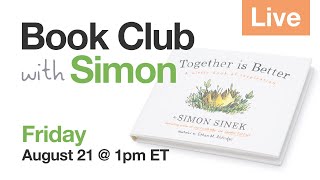
Simon Sinek discusses his illustrated book Together Is Better, which started as a collection of his tweets and features scented pages, handwritten sections, and art by Ethan Aldridge. He explains the book's design choices and answers questions about leadership, finding your why, and how teams use it in practice.
Chapters
Okay, here we go. Hello, everyone, and welcome back to book club. You know, this one is a spontaneous one. I think this might be our 12th book club, something like that. 12th or 13th book club. We were supposed to be done two weeks ago, but I was enjoying myself too much, and so we decided to throw this one in spontaneously because it's fun. We're back on LinkedIn, Facebook, YouTube and Twitter. Welcome, everyone from around the world who's here today. Let's do Dakota. Potato, Peel and pie. Literary society. You guys, I think you've been here a dozen times. Hello. From New Zealand. From Prague. That's where my family's from. Seneca is a Czech name. Newfoundland. Newfie's in the house. Alberta. Scottsdale, Arizona. Malaysia. How are you? Socal, Always good to see you. Swindon, nice to see you again. Romania, this is insane. How many people are here. This is wonderful. I just love how global we are. Hello. Iceland. I love Iceland. I saw. What do you call it, Northern lights. I saw the aurora borealis when I was there. It was magical, magical, magical. Toronto and Italy. Where in Italy? I love Italy. Okay, let's talk about. Together's better. I'll tell you the history of where this book came from.
As always, I'm going to tell you a little bit about the book and we'll take some live questions and we have some questions that you sent into book club. So thanks very much for those. Okay, so this book wasn't supposed to be. I was sitting in my publisher's office and I was just. We were just. Our meeting was done and we were just, you know, kicking it, and they were talking about Twitter. Two of the people at the publishing company were talking about Twitter. And they looked down at me and they said, you have a Twitter account, right? And I went, yep. They said, do you use it? I'm like, I don't use it like everybody else. I said, I just post quotes. I just post little thoughts that I have, but that's all I do. And he looked down at me and he said, well, how many followers do you have? And I don't remember what the number was, but it was a. It was a couple hundred thousand. And he said, really? I said, yeah. He's like, I didn't know that. That. That you had that. I'm like, well, you know, I like sharing. And so I said, why don't we do something with all the quotes? People seem to like them. I'd like to make a quote book. He said, fine. And that's literally how this came to be. So my Contract actually said untitled tweet book. Nobody knew it was going to be, including me. I just said, I have an idea. It was going to be untitled tweet book. And then the craziness began. I decided I want it to be illustrated. So we found a wonderful illustrator, Ethan Aldridge, who's fantastic, and I wanted it to. I was inspired by children's books. I didn't want to just do a plain, you know, quote book. I thought that was boring. So I went to. I literally went to the bookshop and was looking at children's books, and there was a little book called. There was a book called.
What was it called? It's called how to have an Idea or something. It was this magical little children's book about an egg that represents an idea. I just loved it. And that became the inspiration for this book because I wanted to be modeled after a children's book, even though technically for adults, I wanted it to be long. So this. These are my bookmarks. This. Pieces of tissue, these. This is a standard size small book. But I wanted to go this way, which they told me I can't do. I said, yes, come on, we can do it. So we got. So the first. The first struggle we had to have was making the book go sideways. And everybody thought I was crazy at the company. My publisher believed in me, but everybody thought I'd gone on my rocker. And we're calling him and saying, why are you publishing this? This book? It's a freaking children's book for adults that's not going to sell. And then I said I wanted it scented. I was at a. An event, and I was sitting next to this, these two women, dawn and Samantha Goldworm from a company called 1229. And I asked them what they did, and they. They designed scents for brands like they sent, you know, Mercedes or something, launches a new car, and at the show that has a special scent, things like that. And. And I said, well, have you ever sent it a book? They said, I don't think it's ever been done. I'm like, can it be done? They said, yeah, there's new technology. We could do that. I said, well, I'd like to send a book. So I went back to the publisher and said, and I'm getting a custom design sent from this amazing company on the smell of Optimism, and we should put it in the book. Well, that was also another struggle. Anyway, eventually the book got made, and here it is, and there's a few wonderful little things that you'll notice about it. All of Those handwritten pages. I wanted the book to be human. It's got all of these sensory things. It's got color, it's got visual, it's got smell, it's got a song at the end. We made the COVID a little softer. I purposely never brought it out in digital because I want it to only exist in reality. Because it was the most human thing I could do in a book. It has all these wonderful things. All the handwritten pages that you see, the little chapter sections. That's actually my handwriting. I sat there and wrote every single one of those pages. They just. They just printed them. So that's actually my handwriting. The song at the Back by Alo Black. I asked Alo if he would write in his handwriting the lyrics. So you'll see all of the lyrics are handwritten. That's actually Alo's handwriting. So all of it was. Was described. Designed to be organic and human and just a lot of fun. And of course, the best part, I dedicated it to my sister. As you see, it says, for Sarah, I'll follow you anywhere. And I didn't want her to know. And because we work together, she sees all of the things that are happening. So we had to make special. You know, we in. In the publishing industry, they come out with something called galleys, which is a soft cover, pre published edition, basically, so we can all see what it looks like, we send it to press, things like that. We had to make all of the galleys, all of the PDFs, everything. We had to make it without the dedication page because I didn't want Sarah to see it. So we had this whole conspiracy that she could never see it until the book came out. And then when the book came out, we surprised her and showed it to her. And I should introduce you to Sarah. Sarah, come over here and say hello. This is Sarah. This is my sister Sarah, who. We work together. We're like best friends. The book is dedicated to her. And I would follow her anywhere. I'd follow you anywhere.
You make me cry. I know I'll go back to my.
Okay, let's talk about Together is better, shall we? By the way, this is my favorite picture in the whole thing. That kind of represents these three kids sitting, getting ready to go on their adventure.
Staring at the wall. I think is a. Is a. Is a feeling we've all had before. Like, should I, shouldn't I. Do I do this? Do I not do this? Don't. Do I take the plunge? Do I go on the journey? Do I do the difficult thing? Do I leave the certainty of the known, even if it's uncomfortable, to go on the uncertain adventure? And I think the quote perfectly captures a vision, is like a dream. It will disappear unless we do something with it. Do something big or do something small. But stop wondering and go on an adventure. I love everything about that. The original illustration is actually hanging in my. Hanging in my office from what I. I mean, I haven't been to my office in six months, but it's there. Okay. I could tell you a couple more stories if you like, but why don't we do some.
Questions? I'll tell you one more thing. So how did I come up with the story? The story is actually cut and dry based on Joseph Campbell. If you know your Joseph Campbell. Hero's Journey. It's Star Wars. It's.
Lord of the Rings. It's. It's. You know, this hero's journey is hero's arc, where we have our heroes who go on this journey. And first they meet someone, a mage or something who sends them on their journey. That's. That's the. The woman at the beginning. And then they face all these trials and tribulations, and then they're. They don't like each other. And then they come together, forced to come together, and they discover something wonderful. And the temptation is to stay there, but then they have to bring it back. Because the ultimate of the. The ultimate trial of the hero is not to just discover the thing of magic, but to come and share it with other people. And these wonderful kids go on this journey for a better playground. They find the better playground. It's a magical place. It's Utopia. And they make the very difficult decision to leave Utopia to go back to their old playground. But what they do is they bring that vision to life for the people that they left. And that is really the journey that I hope that we're all on that. That we're all looking to find some magic in our lives and share it with others. This is definitely the journey that I've been on. When I discovered my why, it created a passion in me like no other. And I thought, I have to share this. It's not good enough for us to find passion in our own jobs. It is right for us to find ways to share that passion with other people so they can feel it too. There we go. Okay, should we do some questions.
Also? By the way, I love this picture because that, to me, represents what leadership really is. Leadership is not getting the crown. Leadership is not getting the power. Leadership is the ability to get it and give it away. And that's what. What this kid does. He's given the crown, but then he immediately passes it off to someone else who he trusts and loves. I actually took that picture and put it on stationary.
Okay, let's do some questions, why don't we?
And if I think of any more stories, I'll tell you them. But I do really love this little book. It turned out to be such a surprise. And by the way, like I said, my publisher gave me top cover because his CEO called him up and said, what are you doing? They thought it was a big waste of money. They thought it was just some vanity project that Simon was doing, and it caused a lot of stink in the company. And here's the funny thing. The book actually debuted on the New York Times bestseller list. Nobody expected. Nobody was even checking. I called the publisher and said, somebody emailed me. You're not going to believe this. No one was looking. So it turned out that I'm not the only person who likes magical little, sweet little books. Okay, Janet Packer from Yorkshire, England. How are you? Is it the person or the vision that people follow? And why? What a good question. So visions tend to be ethereal. They exist in our imaginations. And as human beings, we do a lot better with tangibility, right? It's why we tend to lean towards finite instead of infinite. It's why we like metrics, because they're easy to measure. And so what ends up happening is.
The person, the visionary, if you want to call it the person, becomes the tangible representation of the vision. So we say we follow the person, but in reality, what we're doing is following the ideals that they espouse. So whether it's a. Whether it's business or whether it's politics or whether it's social change, we say, I follow Martin Luther King. But what we're actually saying is, I follow the vision that he represents. So the person becomes the personification, the representation, the tangible manifestation. I can't think of any more tion words of the vision. And so we follow the person, but in reality, we're following what they espouse. We follow what they stand for.
Because that's the ideal, because we're only following the person. If there's an absence of vision and we follow a big personality, like that happens, too. Sometimes we can mistake the two.
Sometimes people tell us what we want to hear. And sometimes there's big personalities and we can follow the person. But when they die, usually their vision dies, too. The true test is when that person moves on, that their vision lives on beyond them, and their vision becomes our own. It becomes a lot more tangible. Okay, Pete Brambaugh from Olathe, Kansas. Is it Olath or Olathe? I'll go with Olaf. I want to use this little book to motivate my council members and mobilize them around a shared purpose, activating a mostly dormant alumni association of 27,000 individuals. My question is, what is the best way to use the book to accomplish this high purpose? So again, we put this book out there, like I do with all my work. I'll tell you another funny little story.
I attended this luncheon once. It was a couple years ago, and I went by myself and sort of, in typical Simon weird, introvert way, I sort of, like, kept to myself and, like, just walked around by myself. And I was getting lunch from the buffet, and I happened to be standing next to somebody, and we started talking and really enjoying our conversation. Turns out it was director Baz Luhrmann. Totally cool. Didn't recognize him. He introduced himself and.
He told me how he thinks about his work. He says his work is like a child. He says when he's producing something, when he's working on a project, he gives it his all. He wants to raise this child. He wants this project to be the best thing it can possibly be. And then when it's done, he puts it out into the world, and it goes off and lives a life of its own. And he goes on to the next project, and he says people will come up to him on the street and say, oh, my God, I love Moulin Rouge. And he always replies, oh, how is he? I haven't seen him in ages. Say hi. For me, it's kind of that, like, it's out there and does its own thing. I have the same belief about my work, you know, And I love that. I love that he said that. So I put their teams with their companies. I found that companies and teams read it together. And so one of the ways you can do it. There's a few ways that I've heard that other people are doing it. One is they gift it to everybody. So it's sort of a little more on the DL, where they gift it to everybody and. And somebody says, this is great. We should use this. So it becomes their idea. Another way I've heard it done is.
Bringing it to a meeting.
And bringing out one of the quotes and saying, I think this inspires us. Like, why haven't we done this? This is very inspiring. Can we talk about what our Opportunities are. So I would say whatever works for you is the best. Maybe even just share it with a couple of people. Share your copy with a couple of people and say, what do you think of us using this to inspire some change in the next meeting?
But it has been used for sure, as I've heard. So definitely holding something up as a prop and having it come from the book is more organic than it coming from you. People for some reason are more comfortable something coming from an outside source.
Good. Okay. Sarah, Nicole, the Raft girls from Swindon. Good to see you again.
We are stuck by how the. How infinite the message is. So we wondered if you had read Finite and Infinite Games by James Carrs when you wrote together is better. Looking forward to Leaders eat last book club.
Okay, so I noticed that as well. I actually made reference in the back in this book. I realized to Finite and Infinite. I noticed a friend of mine, Brian Collins, gave me Dr. Carson's book Years ago. And so I was already a lover of his work and a devotee to Finite and Infinite, even though I had no idea what to do with it. And it wasn't until years later that I realized an opportunity to build on Dr. Carson's work and offer something actionable that we could use to change our mindset for the game we're in, to really use his work as a foundation. I honestly don't remember the exact year that I was given the book, but I think it's safe to say that. That I had read the book because I'm using the language so exactly how Kars meant it. So, yes, I do believe I had read Finite and Infinite Games before I wrote this book. Any live questions from Amy Davies? Hello, Amy Davies.
In regards to the publisher saying no to doing the book with people telling you, no, this is crazy. This can't be done. How do you overcome that and continue to. To believe in yourself and your vision to make it become a reality?
So my actual publisher, the guy who actually decides to give me a contract and publish me.
You know, I had two books out already. I had start with why out and I had Leaders eat last out. And nobody expected either of those books to do well. And they both did well. And so I think he was a little more like willing to take a bet on me, which he did. And he and I were and continue to be a great partnership. He's still. He's still my publisher and we're dear friends now. We've known each other for 12 or 13 years now. Ooh, everything's moving around. Look at that, wait, I can't do it. There, there's the crown, there's the, there's the book club, it's. There we go. Anyway, I think, you know, I was. This, I think goes to the point of good, good trust and good leadership, which is I was actually shielded from a lot of the pressure, all of the. When his CEO called him and said, you're crazy, why are you doing this? Don't do this. I actually was unaware that that was happening until later. He took a lot of the heat for me. So I think that's a sign of good leadership, which is he protected me and let me go make my book. He believed that I was onto something and I kept showing him progress. Like, here's the story that I came up with and here are the characters that we've come up with and here are the illustrations and here are the things that we're planning on doing. And he could see it coming to life, though he had no imagination for what it could be. At the beginning, I had a kernel of an idea of what it could be. As he saw it coming to life, he got more confident. But he trusted me and I trusted him. The only fights we had were, you know, the scented book, like change the pricing structure. Those, those were difficult conversations because they wanted to make it temporary and a promotion and, but, and so what I saw, you have to play your politics. And so I never, I never heavy handed, I never sort of demanded and said this has to happen. And I never lost my temper or anything like that. But I would make allowances, I'd say, well, okay, listen, I know that the scented page ads cost to the production, so why don't we make it in the first edition and if it sells well, then we'll keep it and if it doesn't sell well, are you guys okay making it promotional for the launch? And all the sales team would say yes, yes, because they're okay with the lower sales numbers at the beginning. And turns out it sold well. So we kept it in. So I had to believe in my own product as well because if it didn't sell well, we would have had to reduce the cost. So it was, it was a, it was a, it was a, it was a journey.
It was life. Life imitating art, as Oscar Wilde said. He actually, he said, I find more often that life imitates art more than art imitates life. I think he said, okay, let's do another question.
Victoria, just this comment. I wrote my name on the back and passed it to the person who was Taking over my position, I encouraged them to sign and continue to pass this book around when they were ready to show.
Oh, my God, I love that. Did you hear that? What was her name?
Victoria Alcuquer.
Victoria Alkaker says that she, when she was done with her job, she signed the book, gave it to the person who replaced her, and they've continued to sign the book and pass it on to the. To each person.
Who'S taken that job, which I absolutely love. And this book was about giving. It was very important to me that this book would be given as a gift. I didn't want to. I was more interested, believe it or not, for people to buy this book for someone else than to buy this book for themselves. Which is why the very first page we put to and from, by the way, that is my handwriting. We put to and from. The book is designed to be a gift. So I absolutely love that it was passed down and gifted down, and it continues to be signed. I adore that. Oh, great idea. Chrissy Seaman. Seaman Saeman. What steps can I take to help find my vision? The concept sounds great, but feels confusing and hard to attain. Can you please expand on this? Absolutely. So let's talk about two different things. Let's talk about vision and let's talk about why. So I talk about vision and just cause as synonymous terms. So I think we put too much pressure on ourselves that you have to have a vision. Come up with your vision. Especially. Especially young people today, because everybody's comparing themselves to Steve Jobs. You know, not everybody's a visionary leader. Like, not everybody's Steve Jobs or Richard Branson or Martin Luther King, like Sarah Blakely. You know, not everybody's visionary. It's a very small percentage of the population that we would call visionary. They live in their imaginations. We don't have to come up with a vision, but we do have to find a vision. So if there is a vision that you've heard from someone else that you believe in, that inspires you, that gives you goosebumps, that it says, that's. That's what I've been trying to say. They put into words the way I feel, then take that vision and make it your own. So you can take somebody else's vision and make it your own. It's like the previous question, you know, do we follow the person? Do we follow the vision? You may find the person, but it's really the vision that you believe in. And so you can choose to follow the person, or you can just say that vision is now Mine. And that is perfectly good and useful.
You know, I talk about the vision that we all share. Anyone who's here, probably we all share the same vision, which is we all believe in building a world in which the vast majority of people wake up every single morning inspired, feel safe wherever they are, and end the day fulfilled by the work that we do. That is the vision that we all subscribe to, which is why we keep coming to these book clubs and enjoying each other's companies. We're all on the same path now. Take that vision, make it your own. If that's something, write it down, claim it. That's. That's the only way this thing's going to come to life, is of all of us are working in our own way to bring that vision to life. Because certainly none of us can do it alone. It's going to take all of us.
Now, that's vision. A why is different. A why comes from your past. It is who you are. It is the foundation of what inspires you. It's your spark, if you want to call it that. It's the thing that gets you out of bed in the morning. And it's very often the foundation of a vision. What one comes the past. It is objective. A vision is about the future. It is subjective. There are many ways to find your why. I wrote a book called find you'd why. The reason I wrote that book is because for eight years people complained that they read start with why and I never told you how to find it in the book and they complained. So we wrote find your way eight years later.
Also.
On our website, start with what is our website called? Simonsenic.com, we have a start with why class of which we reserve for people.
Who are going through hard times right now. We've allowed for it to be for free for some people, which is very important. And so you can go there and there's a whole class that only takes two hours to find your why, which is a really, really wonderful class. And I can tell you a fun way to do it really quickly. It's called the friends test. Find a friend you love who loves you back. The kind of friend you could call at 3 o' clock in the morning and they'll take the call. Or you could call them at 3 o' clock and they could call you and you take the call. Don't do this with family. Don't do this with spouse. Don't do this with a boyfriend or girlfriend. Those, those relationships are too close. Do with a friend you Love. And ask them this question, why are we friends? And they're going to look at you like you're crazy because you're asking them to put into words something that exists in the part of the brain that controls feelings and behavior, but not language. And then you. You say, come on. And you use the word what. What specifically is about me that I know you'd be there for me no matter what. And they're going to struggle and they're going to start describing you. I don't know. You're trustworthy and smart and funny. And you have to play devil's advocate. Yes, that's the definition of a friend. What specifically is it about me? That I know you'd be there for me no matter what. And they're going to go through a few rounds of trying to describe you. You're going to continue to play devil's advocate. You're going to drive them crazy, and eventually they'll give up and they'll start describing themselves. I don't know. My friends told me when I did this, I don't even have to talk to you, Simon. I can just sit in a room with you, and I feel inspired. And I got goosebumps. In fact, I'm getting them right now. So the point is, they will say something, that you will have an emotional response. Either goosebumps or you're well up. And what they're doing is they're articulating the value you have in their lives. In other words, that's your why. It's the value you have in their lives. It's who you are. And you can do this with multiple friends, and they'll give you very, very similar, if not the exact same answer. It's kind of spooky because the thing you give to the world is the thing they value. So that's a way to find your why. Anything over there. Otherwise, Gary avails Gary of ales. How are you?
Page 45.
I'm drinking a smoothie filled with all kinds of nonsense in it. Whatever I could find that wasn't run out. Okay, Gary's asking me a very, very specific question. Page 45. I'm going there. Yes. Page 45. The quote. The quote is, here's the picture.
If the challenge we face doesn't scare us, then it's probably not that important. Yes, Gary.
So why do you say this? And why is fear so important versus other primary emotions?
So he. He says, why do I say this? And why is fear so important versus other primary emotions? I don't think it's necessarily about fear. But I think something that scares us means that it's big, that it's worth it, that it intimidates us. I think we can have multiple feelings at the same time. We can be inspired, excited, and afraid at the same time. We can be scared by what we have to do. So when you, when you, when you imagine doing something different, it could be something. And by the way, a lot of the things are in our own mind to, to one person. Quitting your job because you're dissatisfied is an easy decision for some. It's a very, very difficult decision. It's. It's not a right or, it's not a right or wrong. So to say, am I going to do this? I really want to do this. I really want, like, jumping off the high dive. Like, I really want to do this. I really want to do this. But my goodness, it's so high up. But I really want to do this. And I believe that I can do this. And I know it'll be an amazing experience. And I know I should do this. And this is going to be fun, but this is. I'm looking down and it's really high up. Okay, here we go. And there's a leap of faith.
And I think scary challenges. If a challenge doesn't scare us, you know.
Then, then I, you know, you think about making incremental change in our lives or in the lives of others. You know, I think if it's difficult and if it scares us a little bit, it means it's probably worthwhile. It's probably something important, something small and minuscule, though important, though good, will it produce profound change in our or someone else's lives or the lives of the world we live in? So I'm all, and maybe this is my own personal bias, but I like a difficult problem and I like looking going, how are we going to do this? Difficult things mean that you have to rely on other people. Easy things you can often do by yourself. And I think doing something that requires help is going to be a good, is a good problem to solve. It means other people want to solve it with you. Let's move on.
There's a question here about, from Shadi. What is the meaning of the photo on the book? The image on the COVID Shadi?
Yeah. Hi, Shadi. What is the image on the book? The crown. So the crown sitting in the grass. The crown is the metaphor we use for leadership, and it's available to anyone.
I can't get it. It's the way this program works. I Don't even have a point there. It is. We just, because at the end I talked about how the, the, the bully, the boss, you know, takes off his crown and gives it to, to Charlie, we called him. And then Charlie immediately takes it and passes it on and this crown becomes the symbol of, of, of, of, of power that we give away. And so I think we were all just struck by this metaphor that we, we decided to, to, to put it on the ground and says it belongs to no one and it's available to anyone and be the leader you wish you had. Anyone can, can, can hold the power and share it. So I think it was just, it was that metaphor that it's available. It doesn't belong to anyone. It never does.
Nice question Laura Clark asked. I'm struggling. She says how do you know as a leader when performance issues in your team are due to your leadership or maybe they just don't have the capability to deliver in the role you ask. Thanks.
For your always insightful words.
This is one of the hard things about leadership. You know, is it us or is somebody actually struggling? So if, if more than one person is struggling, we, you know, there might be process issues, it might be us. I think feedback is important. There has to be two way feedback. So, and also being willing to accept. I think, I think it's how you show up as the leader as well that will reveal these things. You know, if we show up saying you've got to get your performance back up, what's the problem? I think we, then the pressure we're exerting may actually exacerbate a problem. But to give someone help and coaching and say how are you doing? You know, keep me posted, I'm here to help. And at some point it becomes very obvious that for example, you put someone in a job to be an accountant and they're no good at math and you know, you give them enough Runway, you give them enough time and coaching to see if they can learn the skill or if, if they have the skill and, and in time it starts to be. Become readily available that, that they're struggling. And the most important thing is, is if they're in a job that they can't do, not only will they're per, not only is their performance down which, which is which, which is a struggle for, for the company.
But they're unhappy because nobody wants to do a job they can't do and nobody wants to do a job they're struggling to do. In other words, there's, and so to sit down and have honest conversations like, are you okay? And what we'll tend to find in these people is their stress is much higher than other people on the team. You know, we all have periods of high stress, but what you'll see is continued high stress. And so that may be showing up in other ways, too. So they may be short tempered, they may be punchy, they may be. They. They may be, you know, just a little difficult to work with for more than one person. And so probably a good sign that there's high stress. Probably a good sign that they're struggling. Probably a good sign. Good time for a difficult conversation. But, yeah, time reveals it. I think one of the things you have to do is offer a little bit of patience. I know in this marketplace, it's a lot harder. Sometimes we just don't have the Runway, but if you can.
That'S what we want to do. It is a difficult. It is a difficult thing. But I love that you're asking the question. I really love that. Here's one from Portugal from Nuno Felguiras. My Portuguese is not good.
Hello, Nuno, what do you prefer, social distance or physical distance? I think physical distancing is the thing we're supposed to be doing. I would like us to be socially close. I never want people to be socially distant. We want to be socially close and physically, physically apart during these strange times.
Okay. What else? Don't think if I can tell you any more stories. Oh, thank you.
I love this.
One on one. One on one coaching.
One on one coaching from one. I get it. I get it. One on one coaching. I get it. Very good.
How about a T shirt with a quote from the page with the kids looking at the big wall?
Okay, so one from one on one coaching. Why not a T shirt with the quote from the kids looking over the big wall? Funny you should ask. I've been wanting to do a T shirt inspired by this book for a while, and I'll be totally honest, I don't know what to do. So we've decided, should we. We've thought about, should we just do a quote and nothing else? Should we do one of the pictures? Should we do the kids. Should we do the, you know, the kid handing the crown away? Just. Just an image. Should we do one of the images on the back and the quote on the front? Which quote should we do? So if you have any ideas or suggestions. Should we do a quote on the T shirt? Should we put an image on the T shirt? Should we put a quote and if so, which quote? Do you like tell us in the comments or if you have suggestions for the kind of T shirt we could make, please email book clubimon sinek.com Send us your, send us your suggestions and we'll take a look. We'll crowdsource it. We'll take a look at what your suggestions are, which are your favorite quotes, which are your favorite images and we'll make the T shirt. So I definitely want to make one. Just been struggling what to make, you know, do I put the wall with kids looking at it kind of a weird T shirt? I don't know. Let me know what you like and we'll make the T shirt. Thank you one I really appreciate that.
Brandy Anger from Wisconsin I have an idea to ask my entire team to read together is better and refer back to it as we all look for motivation to return to the office as opposed to continuing to work remotely. True. I miss my team. Together is definitely better. Any other advice for me on this front? I think what you just said is the best thing you can do.
I think to call your team and when you have the next time you have your next team zoom call, tell them I think be open about it, say I miss us, I miss the team. I miss saying hi in the hall, I miss getting lunch. I miss the chitter, the chit chat we have as we walk into the meeting and the chit chat we have as we walk out of the meeting. Because at the end of the day, it's not the meetings that we build trust. It's not the zoom calls we build trust. It's what happens in between the meetings. It's all those little human interactions, all those little details that we've been deprived of for too long now. And I think you should tell them, I think you should tell them, you say and tell them you're trying to think of things to remind us that together is better. And, and you can have, you can maybe even every, every huddle you have. If you do a weekly huddle, maybe read one of the chapters, you know, one of the little sections and share the quotes and then for your huddle exercise, go around and ask people how it makes them feel or what you know, which is their favorite thought. But, but I think it is a, a great thing to do to simply tell your team how much you miss them and how much you love them and try and think of the details, the actual things you miss, the innocuous things that nobody thinks are important. Like I miss it when, you know, Sarah would walk into my office every morning and bring me a cup of coffee and then walk out. Like, the little things that we're missing out on, try and be specific and create imagery that they can remember, too.
What else we got?
Getting a few questions on where is your inspiration for writing for the quotes?
Like, where do I get more? Where do I get the quotes from?
Inspiration for quotes. And even when do you write them down and how do you remember them?
So the questions were, where do the quotes come from? How do I remember them? Where do I write them down? So, funny story, that's kind of how I started using Twitter. So when Twitter was an early thing, I signed up for it like everybody else, to see what all the hubbub was about. And then, if you remember the early days of Twitter, people were just posting about what they were doing, like, I'm eating strawberry ice cream. And I tried that for, like, three minutes and thought it was so stupid. And so I stopped using it. And so I had, like, no tweets. And I would think of these things in. In conversation, I would say something to someone, and I was like, ooh, that's interesting. And I'd write it down, and I had all these, like, torn off pieces of paper and napkins and sugar packets that were literally. I'd keep in a binder clip all these ridiculous pieces of paper, like, the little bits of inspiration that I was having and the quotes that I'd be writing down, and I had this horrible fear that I was going to lose them all. And so I'm like, hey, I have this Twitter account. I'm just going to keep them there. So every time I had a crazy little thought or a little quote or something, I would say in a conversation that I'd be like, ooh, I got to write that down. I would turn on my Twitter and just put the quote there, and it became just a filing cabinet just for me. It wasn't intended to have followers. I literally was using Twitter as a filing cabinet. And I never interacted with anybody on Twitter. I just kept using it as a filing cabinet. And people kept following me to read these little quotes, which I thought was fantastic. So it was so fun for me is there was just a repository, and it became something that other people were enjoying, too, and more important, sharing them with other people. So that became my primary place to store my quotes. But they very often happened in the middle of conversations. You know, somebody is, you know, giving somebody advice on starting a business, and I would say something like, look, it doesn't matter when you start. It doesn't matter where you start. All that matters is that you start. And I'd be like, ooh, I should write that one down. I'll use that piece of advice again one day.
And that's all it was. I think I'm not unique in this respect. I think lots of us say things that we find interesting in our own conversations with people, especially when we're in a giving mode. Giving advice, sharing, trying to inspire, leading. I think we often say things and the trick is to capture them really quickly, because as quickly as we have those thoughts and ideas, we lose them. I actually carry a notebook now. If I have ideas more than a quote, I carry a little notebook in my back pocket. Well, I used to when I had a back pocket. Now I just wear sweatpants.
But I write them down. You got to write them down somewhere. Phone, notebook, Twitter, whatever. Write them down, because you will lose them, and you never know when they'll come in handy.
Tina Liliadal from Houston, Texas. When we find a vision of the world that we want to build and perhaps our contribution to the playground, the organization starts small. How do we build to do more? For example, if I am a consumer of a product and I want to volunteer or work for the company or who makes the product, how do I show I have more to contribute to the cause than just buying their products and giving great reviews?
Well, there's multiple ways to do that. You have to. You asked a specific. You gave a specific example. So that's. Use that example. Any company worth its salt that has a good vision wants other people to share in that vision.
So Airbnb, for example, is about connection and inclusion. And so you don't have to work for Airbnb to practice inclusion. You can be a host. And you can also not be a host. You can just practice togetherness, connection, and inclusion.
Southwest Airlines is about, you know, fairness and freedom. And if you've ever flown Southwest Airlines, which I know you have because you're in Houston.
As you know, when you board a Southwest Airlines flight, it kind of different from every other airline. Like, there's other airlines that are very, very good, that I enjoy flying. And when you stand in line, you kind of just stand in line and wait to board the plane. And that's kind of all you do. Southwest, everybody talks to each other. Have you ever noticed that? Have you ever noticed that in the Southwest line, you just talk to the people in line with you and everybody's really friendly.
In other words, go ahead and live the Southwest values, because all of these organizations with the Vision. Want the vision to spread? People ask me often, how can I help? And my answer is always the same. Please practice the things I talk about. Please be the leader you wish you had. Because I imagine this world inspired, safe and fulfilled. Other people share that vision. None of us can do it alone. It's going to take all of us working all over the place to do it. So if, if the, if the company offers counsel, advice on, on what to do, follow it. And if you can discern the vision, believe in it and try and bring it to life in other, other places. Here's one from, from Malaysia, from Lei Pang Fung. I've been curious about this ever since purchasing the book. How and why did you choose this smell to represent the optimism scent? Great question. So the, the, the nose, that's the official name. The nose of 1229 is a woman named Dawn Goldworm. She's apparently well known as a nose in the nose industry.
In the scent industry. And she comes from, you know, designing a lot of perfumes before she started her own company. And.
When we, when we got together, she has a process and she took me through it. She took me through this process where she asked me a ton of questions about my personality, about my vision, about what I want to do. And then she went away. And she's synesthetic, so she can see colors and like she smells things in color. It's kind of amazing. Like, she'll smell something and say, oh, that's like a greenish y blue, you know.
But she went away and she designed the scent based on the answers I gave her in this process that she took me through. And she brought me back three options and she said, what do you think of these? And I smelled all three. And the one that I fell in love with was the one she predicted I would fall in love when we got together. She has a process and she took me through it. She took me through this process with was this one. And ostensibly it's the smell of optimism, but it's really the smell of my personality. So if I ask her what's it made of? She'll say high notes with some low notes. She'll say because she knows that I'm bright, but there's a little bit of edge underneath. And so she tried to capture some of those, those, those oaky notes in there as well, those woody notes. And so I, I, I remember when the, when it first came out.
A friend of mine, a few friends of mine, said, simon, we love the scent. And I told this to Dawn, I'm like Dawn. My friends love the scent. And dawn smile and says, of course they love the scent. Scent. They love you because the scent is a representation of you. I thought that was so fun. But we've heard some really funny stories that have come out of this. There was one story we heard.
As a guy we work with who he would get nervous before he went into big meetings and he would actually smell the scent to bring up his spirits before he had a big presentation to give. And we heard about this and we called the manufacturer who makes the pages and we said, can we just buy some pages from you? And we got a stack of pages with no book and we sent them to him and said, here, for your next set of meetings. And we sent him a whole stack of smelly pages. But it really does. Smell is very, very powerful. Smell, more than any of our other senses, is most closely related to memory. It's, you know, when we smell things, it takes us back more than photographs, more than things we hear. It's very closely related to memory. And so I've loved hearing how people have used the scent even outside the book. And we used to have a candle. I think we don't have any more left. I think we're sold out. We made a bunch of candles of this scent. There was the smell of optimism candle because I thought it would be fun to do that because I wanted to burn it in my house. And I think we just sold that recently and I don't think we're going to make any more.
We'll do a couple more questions. One, one more question. Here is Joanna, who's the mum, and Emma, who's her eight year old, gansel from the Mummy Daughter Book Club in the uk. I knew it was the UK because I could see how you spelled mummy.
So from Emma, from the eight year old, she asked, how can you make and keep friendships during the pandemic when you can't really meet anyone? It is much harder, Emma, as, as much as you're learning to maintain friendships during the pandemic, we're at a distance. And it's the same for the adults, which is it's harder for us to maintain and build trust at our companies.
When we're at a distance. It takes more work and so ask mom if you can have permission to just have Zoom calls or FaceTime calls with your friends.
And try and do that. Try and talk to people and ask them how they're doing. The most important thing is to check in with your friends, say, how are you? You know, find out say, hey, it's been hard. Are you okay? What are you doing to help pass the time? Like show an interest in how your friends are doing as opposed to just reporting on what you've seen or what you've done. But it takes more work and phone calls are great too. You don't always have to see them. So sometimes talking to people and giving them your full attention. So when you're talking to them, you're only talking to them, you're only with them, you're not doing something else on the side also that can help. But checking in with people and asking them how they're doing and how they're feeling and listening, it's a great time to learn to listen. And you are definitely old enough to learn to do that. Wonderful skill. So thank you, Emma. I love that question.
Mom is on here and just says, thank you, Simon. She's over the moon.
Oh, great. Well, you're welcome, Joanna. Nice to meet you, Emma. And hopefully one day we'll meet in person too. And so I'll just finish up the question here, which comes from Joanna. How can I teach a young child some basic leadership skills for surviving education and their first job? How can I help them to grow an infinite mindset? So when I was researching Leaders Eat Last, I was reading about parenting and sort of the impact parents have on their children. And you know, it makes you wonder like where, how do kids become the kids they are, you know, where do they get their values, you know, and things like that. And it turns out it's not all from the parents. You know, kids are very much influenced by their teachers, their friends, you know, you know, the people they meet, extended family. And that's why you can have two kids from the same parents, you know, completely different in so many respects.
Because kids, kids come together in all different ways. However, what I learned from the research is that there are two things that every single child learns from their parents. And this is universal around the world, cross cultural. Every single child learns how to treat themselves and how to treat others. That comes from the parents. And so I think if you want to grow an infinite mindset, I think practicing giving, practicing charity.
Learning that sharing is a good thing and sometimes a difficult thing for a kid to learn.
And the hard skill of listening and the way we're going to teach listening is we're going to practice listening. And so when Emma's having a bad day, just, you know, are you a good listener? Are you good at saying tell me more? There's a great book, it's on my desk somewhere. Oh, it's holding the computer up so I can't show you. I've talked about it before. I'll just hold up and I'll hear it. I'm going to drop down a little bit. Okay. How to talk to kids so kids will listen and listen so kids will talk. It is a parenting book, but it's a phenomenal book for any adult to learn how to. I recommend it to in companies. And so, Joanna, this kind of. This book, how to talk to Kids so kids will Listen. Listen so kids will talk.
Will help you perfect your listening skills. And then as you do them, Emma will learn them too. Okay. And I think that's where we're going to end. Thank you so much, everyone for joining.
Apparently, lots and lots and lots of T shirt ideas coming in. Thank you, thank you, thank you. We're going to go through them all. Keep the T shirt ideas coming in. Book clubimoncinek.com and we'll go through them all and we'll let you know what T shirt we come up with. We'll announce it on social media. I love this idea of crowdsourcing this. Also, just a reminder, I think it's still live. Otherwise I'm going to speak out of turn and we'll cause a little panic. But I think we still have a discount code for book club if you want to go and take any of our classes. We did this just for book club. Get 20% off for any of our classes. Book club rules. One word. Book club rules. Book club rules. If you want that, that's just for us. And this is officially the last book club, assuming I don't do another one. Thank you everyone for coming. It is the highlight of my week. I love doing it. I look forward to it. Thank you for all the questions. I love that you came from all over the world to join and we'll see you real soon. Take care of yourselves. Take care of each other. See you soon, everyone.
More from Clegg

The #1 Skill Gen Z Needs | Simon Sinek + Esther Perel | A Bit of Optimism Podcast







AI Won't Tell You the Full Truth | Arthur Brooks + Simon Sinek | A Bit of Optimism Podcast



How To Make the Best Decision | Arthur Brooks and Simon Sinek | A Bit of Optimism