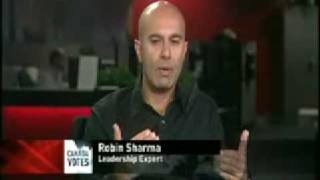
TV interview transcript of leadership expert Robin Sharma discussing what makes a great leader. Sharma emphasizes authenticity, self-leadership, courage, innovation, and excellence; he argues leadership can be trained and outlines a leadership acronym “IMAGE.” The format is an interviewer-host dialogue focused on political leaders and debate performance.
Questions this video answers
I: Innovation and Imagination; M: Merchant of wow (excellence); A: Authenticity; G: Guts (courage); E: Ethics and Excellence.
He was a litigation lawyer.
Chapters
Well, in these TV debates, we know Canadian voters will focus on what the leaders are saying. They'll also look at how they're saying it. Leadership ability or their perception of it is, of course, a key requirement for the country's top job. In the run up to the debates, we've been examining what it takes to be a leader. And today we're talking to someone considered a leader of leaders. Robin Sharma has been named one of the top 10 leadership gurus in the world. He's counseled rock stars and royalty, and he joins us now. So you've actually helped many different individual, whether they're movers and shakers, titans of the corporate world, or just people who want to change their lives. What essentially makes a leader?
Well, as we were talking before we went on air, in many ways it is that feeling test in the sense that we know a leader when we feel it. I mean, some leaders are very charismatic and some leaders are very quiet and humble. There's been studies in the business world that have said the best leaders are actually leaders who are quite humble. They're very low key, they would prefer to give the credit to their team. And yet when it comes to the growth of their organization, organization, they have a fierce kind of passion to win. So leaders come in all forms. But I think in many ways, what makes a great leader, I'd say authenticity in this day and age.
So in politics, you often hear the term royal jelly, that there are people who have what it takes and people who don't. Are leaders born or bred?
I think leadership can be trained. I have a very simple philosophy on leadership. It's lead without title. But I think in many ways we don't know how to lead. When we go through school, we have courses on geography and math. No one tells us the elements of leadership. And I think the best political leaders are people who understand what makes a leader. And in many ways it is authenticity. In many ways it's courage. Because leadership is not a popularity contest. In some ways, it's about doing what's right rather than what's easy. I think leadership is also about innovation and dreaming and the things that we think are soft but are so essential to building a great country.
You know, when you talk about all of that, if you're going to be a leader and take charge and make change, you have to take charge of your own life. Like, I guess leadership to aspire to be a leader, it comes from within. I gather when you often make your presentations, you say, hey, I am. Case in point, you changed your Life to help people change their lives. Tell me a bit about your personal journey.
Well, I used to be a litigation lawyer. I did it for many of the wrong reasons. You know, all too often we follow the crowd rather than showing leadership. And leadership in so many ways is about detecting your own values and living life on your own terms. And long story short, Nancy, I was unhappy. I pulled back from the noise of our noisy world. I spent about a year and a half in a lot of contemplation while I was still working as a lawyer, reading a lot of books, interviewing elders. And I made some profound changes in my life, which led me down a different path. And I think your point, though, is very important. And it's a value we've lost in this world, which is we think in many ways leadership is what we do on the outside. That's actually a function of who we are on the inside. So great leadership begins with self leadership. Knowing your values, knowing yourself, and being true to yourself when you're out there in the world.
Okay, let's go back to the political arena, particularly as people are focused on the debates tonight and tomorrow we'll get the leaders, at least their Personas, showcased on television. What do the Personas or style of leadership actually tell us about who they really are, which you say is important here?
I think, you know, it's that old cliched line, which is you can preach a better sermon by who you are than what you say. So I think in so many ways, what we say is a reflection of our values. And Warren Buffett said it very well. He said, there can never be a better you than you. And I think what we're going to get from the debates, when we really look at them is we're going to get a sense of who's really aligned with their values, who is walking their talk, who's authentic. And that's a very powerful message to send to people.
So, in other words, when the leaders, particularly when there is this potential for spontaneous combustion in a debate, the camera doesn't lie, that they will reveal themselves, that that opportunity for spontaneity leads to candor, and we might actually see whether they mean what they say and say what they mean.
Absolutely. And candor is so very important. It's again, another line which is, say what you mean and then mean what you say. Jack Welch, you know, one of the greatest CEOs in business, he said controversial, too. Very controversial. Because he does tell it like it is as well. I saw him recently in New York, and he tells it like it is. But that's very refreshing in this day and age. And I think that's what we need of leaders. People are going to say, here's my vision. They're going to share their vision to a scared organization and they're going to say, here's my vision. Here's why you should buy into it. Here's what the mountaintop looks like. Here's why you should follow me.
And yet there are huge risks, as we know in politics in telling it like it is, because every. Every announcement, every pronouncement is focus group or, you know, polled. So you know that you're not going to be able to please everybody all of the time. So for Canada's next prime minister, you say authenticity is really important. What else are the important traits?
I have a cheesy little acronym, okay? It's image.
Okay.
And I don't think leadership is about image, but the acronym is image. I stands for innovation and imagination. We need more dreamers in this world. We need more people that are going to say, you know what? Here's what the big vision is and here's why you should follow me. M. Merchant of wow. We need excellence. You know, we need to raise our standards in every possible way and get to the greatness of our country, as idealistic as that sounds. A. Authenticity. We spoke about that. Transparency, being yourself. It's not a popularity contest. G. Guts. So being courageous, making the tough calls, being tough when you need to be. And then E is really about ethics and excellence. And again, excellence is so very important because we live in a world, especially in business, where a lot of companies play it mediocrity. Because excellence is scary. Excellent means you do have to step out of the tribe. You have to be a little different and have high standards.
Wow, that's inspiring. Robin, great to talk to you. Thanks for sharing your observations.