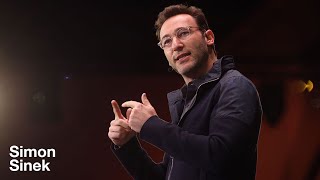
Excerpt from Simon Sinek's talk discussing the distinction between vision (a long-term, idealized future) and short-term goals; the difficulty and discipline required for true leadership (building trust, caring for employees) versus easier short-term management tactics; how rivalry and arbitrary metrics can produce short-term wins but weaken companies; and the intense pressure public company executives face from Wall Street and analysts, which often discourages long-term, courageous decisions and adoption of an 'infinite mindset.'
You know, having a just cause and working every day to advance an idealized state of the future that for all practical purposes you'll never reach. You know, this is what vision is. This is why we call it vision. Because you can imagine it in your mind's eye. You know, increasing top line revenues by X billion billions of dollars by the end of 2025 is not a vision, it's just a goal.
But to advance vision, it, it takes real discipline. It's much easier to just set short term goals and align our incentive structures to just work on the short term. It's easier and I get my bonus quicker. Building trusting teams, that's the hard work of leadership. It's so much easier to just hire and fire people and who cares? You throw nuts, spaghetti against the wall, eventually it sticks. But to actually spend the hard work of doing good leadership and worrying about people as human beings and how do they feel and are they okay and do we have a productive work environment? Like, that's hard work and it requires constant attention. Management is just easier.
Worthy. Rivalry. Competition is exciting and fun and we can set these arbitrary goals and these arbitrary metrics and we beat them because look at our market share. Even though we're losing money hand over fist.
It makes people feel good and the thrill of the competition. But ultimately it forces us to make decisions that weaken the company over time.
Existential flex is a really stressful experience to lay upon a company again. We've already invested so many man hours and so much money. Why do we want to walk away from that investment? Because it's the wrong investment, that's why. Well intentioned and you got it wrong. It happens sometimes. Cut your losses and change directions. It's really hard to do, especially when you're accountable to outside forces that don't want to see you do that. They want to hit the short term numbers. So yeah, it requires tremendous courage to, to do all these things. I understand that the pressures on us, including the incentive structures and the outside pressures on most executives, is extreme and overwhelming. We hear it all the time, especially in the public markets. Every public company executive knows that Wall street and the analyst community is a big joke. They all know that regularly massive pressure is put upon them to make decisions that they know are bad for the company or to avoid making decisions that they know are good for the company. And they all shrug their shoulders and say, what am I supposed to do? This is why it takes courage. There's safety in numbers. So yeah, I cannot even imagine the overwhelming pressures, especially that a public company CEO must face on a daily basis. It takes tremendous, tremendous courage to do the right thing and change to an infinite mindset. And it's ultimately good for the people, good for the customer, good for the shareholder, and good for the longevity of the company, too.