Your Unhappy Brain Needs Some Assistance with happiness expert Mo Gawdat | A Bit of Optimism Podcast
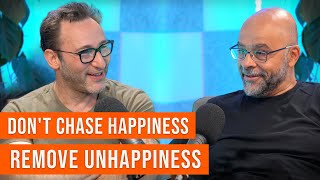
Mo Gawdat lost his son Ali and built a happiness philosophy around a simple equation: happiness equals perception minus expectations. He argues happiness is your brain's default setting, buried under stress, and shares practices like weekly Saturday reflection to uncover it.
Chapters
Can you share some of the things that you've learned about this happiness practice?
If you understand that your default setting is happy, then there is nothing you need to bring from outside you to find happiness. You need to remove shit to be happy. And that negation strategy is quite an interesting one.
So that's good. This is so actionable. I love this. Which is it's the reverse of what most people do, which is they make a list of the things that they think will bring them happiness. But what you do, this remove the un, is you make the list of the things that are causing you stress and you go about removing them.
You remove the uneasiness.
It's a removal process, not an add.
And there is a reason for it.
So good. Being happy is a choice, but that doesn't mean it's an easy choice. Mo Gaudat had to face that choice under the most excruciating of circumstances. After the tragic death of his 21 year old son, Ali, Mo was forced to contemplate how being happy could even be a possibility. After a meteoric and lucrative career as chief business officer at Google X, he had all the money and all the power, but he was miserable. It sounds strange to say, but it took the death of his son to teach him how to find happiness. Now a best selling author, Mo has dedicated his work to figuring out where true happiness comes from. And it starts with a powerful truth. Happiness isn't something we find, it's something we practice. By choosing joy even when life hurts, this is a bit of optimism.
This episode is brought to you by True Classic. I wear their T shirts and have long before they became a sponsor. And it's really cool to see how their company is growing. You are living proof at an extreme level that human beings can hold two opposite feelings at the same time.
Oh, wow. Are we starting that deep? Yes, sir. That's actually.
Yeah. I shouldn't start that deep, should I?
I went straight in.
We don't have to start there. We can.
No, no, we start anywhere.
But I was thinking when I was learning about you, you know. Yeah. We could talk about tech and how you all this. But. But at the end of the day, one of the. I learned this during lockdown.
Yeah.
Because. Because my business was thrown into chaos.
I know.
And secretly I was loving it because I like chaos. Because there's creativity in chaos. And I was having fun and I had tremendous guilt that I was having fun. And I didn't tell anybody. I was having fun because I was also mourning the insanity and the loss and death and fear. And I struggled with those opposing feelings. Guilt for having fun and yet having real sadness. And I learned during lockdown during COVID era, I learned that human beings can hold to sometimes opposing feelings at the same time.
It's the design of the universe, my friend. It is the uncertainty principle at its best. I think the idea of paradoxical existence is. Is probably one of the least.
Celebrated forms of intelligence, which I tend to believe is a bit more associated with the feminine. You know, those who associate with the feminine will be a little more comfortable with looking at you in the eyes and say, I love you, but I fucking hate you at the same time. You know that feeling?
And I've heard that said to me.
And it's actually, it holds true. Yeah. And, and, you know, and it goes de. Into, you know, situations where people would want to believe that one side is right and the other is wrong when everyone is wrong, or that one side is wrong and the other is right when everyone's right. And, and, you know, and it is quite a. It's quite a frowned upon, let's say, a view in the business world, because you need certainty and data to be able to make a decision and back it up and say, I made it because of this.
Yeah.
But it is important because life is not that straightforward.
At the risk of going too deep too soon.
No, go for it.
Let's back up a second because you and I know what we're talking about, but people on the other end may not know what we're talking about. How you at an extreme level, hold two feelings simultaneously.
Unbelievable loss and unbelievable discovery.
Yeah.
Is that fair to put it that way?
It, it would be at the time. It would be quite challenging to call it a loss now, honestly.
Yeah.
So Ali Habibi. I have Ali and Aya, my son and my daughter.
Yeah.
And Ali, was that one of those people that, you know, sort of overwhelmingly make you love them like it is, you know, those people. It's like you're trying to find something that sort of like breaks it a little bit. But he had, you know, when he was in his. In his early teens, Ali. Most of his photographs with his friends, he would be standing in the middle and like six girls from this side and two boys and five girls on the other side holding him, you know, like literally reaching out. He had this incredible, incredible presence to him. And then he leaves and, you know, he leaves our world because of.
A medical malpractice, basically. Simplest, simplest. And, and, and, and, and, and the shock because he, he was Studying in Northeastern in Boston at the time. And he had, you know, he had the band and they were touring the US in summer. And then he texts in May and says, hey guys, I feel obligated. I, I'm verbatim, yeah, to come and see you before the tour.
And so we say of course Habibi will book his tickets. And my daughter was studying in Canada, was coming as well. I took a couple of weeks off as if almost I knew, I don't know. And then he gets an appendix inflammation, the simplest surgery ever. And the surgeon does five mistakes in a row, every one of them fixable, every one of them avoidable to start.
And he fixes three of them wrong.
And so it's malpractice on top of malpractice.
Yeah, I'd, I mean it took me quite a bit of time not to rage.
Because also rage wouldn't have brought Ali back if you think about it. But anyway, four hours later, Ali is no longer with us. And you and I know that, you know, if you sort of are, are paid your whole life to fix problems and so you have that mentality that everything's fixable if you put enough bandwidth to it. Not death. No. And, and suddenly you're faced for the very first time with something that really stops you in your tracks. And.
And my, my daughter and Ali were, Aya and Ali were very close.
And so what's the age difference?
One and a half? One, one and a bit, yeah. One and four months or something like that. And Ali was quite a. Honestly, he was the masculine figure in her life. I was running around like a typical businessman closing billion dollar deals and you know, celebrating my ego and, and, and he, he would call her every single day, literally Boston and Montreal. Not very far. Yeah. And he would go visit her every. Like really he was the father figure if you want.
Yeah.
Two weeks before he dies, he, he, he tells her that he had a dream.
That he was everywhere and part of everyone.
Which.
Which if you understand spirituality, of course I understand that now, but you know, if you understand, if you have a spiritual inclination, being outside space time in your non physical form lends you the ability to be everywhere and part of everyone.
But that's not how I understood it then. I was then chief business officer of Google X. I had previously been the vice president of emerging markets at Google for seven years. So I had basically opened most of Google's businesses worldwide and, and so I knew how to make something everywhere and part of everyone, if you want.
And so the message in my Mind and my heart really was blurred. I heard her say, everywhere and part of everyone. And I thought of it as a target. And so I basically. Seriously. And it's so weird because all I could hear myself saying is, of course, habibi considered done, if that's your wish.
It's a business plan.
It's a business plan.
Yeah.
And my devious plan, interestingly, I mean, if you know this story before I was the typical success, success story, I was filthy rich by age 29. And I had this very unusual math.
Skill. And I was a software developer. And like Malcolm Gladwell would say the, you know, and outliers. Right place at the right time. So my, My peak was when the Internet started. I coded at the time, 1996, a bit of a. Of a crawler, like the Google crawlers afterwards, where I would go across the Internet, find news about stocks, and I would wake up every morning at 6am with buy and sell recommendations and print money on demand. It was really, really successful. And I don't know if I call that success now, but let's call it rich.
Yeah. Yeah.
And. And so the more you succeed and realize that this is not what you want, the more depressed you become. And so I was clinically depressed. Everything I had, a beautiful wife, two wonderful kids, you know, massive home, the garden and swimming pool and, you know, cars and everything you want. And of course, when you're depressed, you try and you're rich, you pour money on the problem, but, you know, money doesn't solve the problem. So you become more desperate if you want. It's like, this is not solvable. And at the time, who helped me? Ali and I. So Ali was this wise little Zen monk. Yeah, it was really, really unbelievable. You would talk to him since maybe age 6 or 7, and he would literally sit there silently looking at you, very curious, and then asks you a couple of questions, almost like, you know, to entertain you. It's like, yeah, you know, I'm interested, I'm interested. And then eventually says something like, well, you could have asked me. Right. And then he would repeat what I said, blending a bit of heart in it. Which I'm. I'm the. I'm the algorithm guy.
Yeah.
And. And says it in eight words. And I go like, holy damn. Like, this is it. Okay. And so through my depression, if you want, I learned quite a bit with Ali. And so when he died, my way of meeting the target, if you want, was I'm gonna take what we discussed and put it in a book. And if I can get to 10 million people. And then 72 years later, through six degrees of separation, my calculation would be that tiny bit of his essence would be everywhere and part of everyone, weird as it sounds.
And so, so 17 days after he dies, I'm sitting down to write about happiness.
And.
Do you, do you weep while.
You'Re writing about happiness?
I weep almost once a week now, but then I think I stopped once a week.
It is, it's not. I, you know, I think people can recognize from the bald head and the voice and the beard that I'm a manly man. But, you know, I have to say.
Emotions have been.
We didn't give them time in this very fast paced modern world.
I have so many questions. There's so much.
Here's the struggle.
With your message, if I can put it that way, which is.
We know these tropes. Money can't buy happiness. We know it. We know the number of wealthy people who come in and say, but you have to understand, it didn't make me happy. We know the importance of feelings, even when we try and resist them. A lot of these things are known.
And yet with all that knowledge, people still perceive that money will buy them happiness and they still pursue riches versus fulfillment or joy. That we still think we can rationalize our way through relationships or explain our way through relationships or business plan our way through our emotions. Right?
Yes.
And, you know.
And I guess the question I'm getting at is, you know, how much are you and I preaching to the converted? How much are people listening to this? And it's only the ones who've made the conversion, made the discovery, or are predisposed to it. I mean, you talked about these. You said, you said right at the beginning, you know, women are better at nuance. Women are better at holding paradox and two feelings simultaneously. It's more quote, unquote, traditionally masculine to want exactness and clarity in black and white. Separation, Separation.
Do we find ourselves preaching to the converted? How do we find language that somebody who knows all of the.
Tropes says.
Okay, you've made me curious at least.
Well, I think the challenge is it's a lot more nuanced than the Semper slogans. Nothing you and I can explain, or anyone for that matter, is. It can be summed in one sentence. 1 sentences are made for Instagram. Right? You know, while, while money most of the time doesn't buy you happiness, poverty buys you unhappiness. And, you know, the research will tell you that if you're, if you're unable to make Ends meet, basically. If your income is less than the average income of the place you live in, then it's hard to find happiness.
Can I question that? I know.
Does poverty buy unhappiness? Is that true or is it that we know that up until a certain income that when you gain money it actually does buy happiness?
Correct. Right.
It's not the opposite. It's not that poverty makes.
I was going to come to that.
Poverty doesn't necessarily make you unhappy because.
Some of the poorest.
Right.
People in the world are the happiest. You know, travel to South Africa. Sorry. To. To Africa or to South America.
Yeah.
And man, it's like if we're fed today, we're going to dance and love.
Our heads and their, their lives are difficult. We have to confuse. We cannot confuse struggle and happiness.
But you see, then you. Once again, is our life easy?
Our lives are easy.
Easy on some fronts, but the mental.
We don't worry about food.
Yeah, exactly.
The most part.
Yeah. But, but then what, what do we do? We create, you know, mental tigers in our heads and we run them over and over until they, they make us miserable. Right. We, we, we read too much news. We worry about the stock market. We do. You know, I'm not. What I'm trying to say is there is so many levels of. There is no answer that says money does not buy you happiness, buys your happiness. The, the answer is very straightforward. What is enough?
Yeah.
Okay. And you know, I am today.
And it's really. This is where people struggle.
I'm only giggling because literally last night I was having this conversation with a friend where the richer somebody is, the more they're concerned about their taxes.
Correct.
Right. So like the richest people I know will live in places they don't want to live. And when you ask them why do you live there? They say taxes. I've never heard of anyone going bankrupt paying taxes. Right.
Yeah.
You have to make money to pay taxes. And it's the ungodly rich where if you took away, by the way, and it's only on income, it's not on assets. Right. So they only pay it once when they get that windfall and that's it, you know. But I just find that funny because you hyper optimize.
Right. And interestingly, of course, I mean, again, for everyone listening, paying taxes is a problem of privilege. So let's, let's not, not compare that to people who are hungry or in a war zone or whatever. Right? But, but, but, but the reality is that for everyone, their problems are as Far stretching as they barely can handle. So I'll. I'll give you my own example.
Yeah. Yeah.
Because of my Eastern upbringing and my traditional spirituality, if you want, and because of a very weird thing that I did in early in my life around what I call the mathematics of the divine, I tend to strongly believe that this is not the end of life. Right. That we live here. That, you know, death is the, Is the opposite of birth. It's not the opposite of life. Right. Right or wrong.
Oh, let's say that again. That's quite profound. Death is the opposite of birth. It is not the opposite of life.
If life was a video game, you come to this level of the game through a portal called birth, and you leave this level of the game through a portal called death.
Right?
And the game continues way long before and long after. Right, right. And, and, and, you know, I, we can get into the mathematics of that if you want, but irrelevant. For me, that means that the loss of Ali is a tiny bit more tolerable than someone else who doesn't have that belief. Right. And so accordingly, when, when I look at my.
You know, my, my, my tendency to find certainty, I have absolutely zero certainty that I'll finish this interview, but I have a hundred percent certainty that sooner or later I'll be where he is. Right. And, and if that is my mindset, then my, my, my, the, the, the weight of the problem is slightly different for me. And, and it's quite interesting. Ali habibi, he had the tattoo on his back, but he never showed me. Interesting. He had it when he was 16 and he went back to his mom and said, you know, I'm so upset that I used Papa's money to, to buy, to. To get it, but, you know, when I get to pay him back, I'll show it to him. Right?
When it's his.
Yeah. So, I mean, like, why are you so nice, you little. Anyway, anyway, so he, he, he sits up on, on the operating table before he walks in, before they push him in, and it shows and it says, the gravity of the battle means nothing to those at peace. Right? And it's the very last message.
How old was he?
He was 21 and a half when he left.
I mean, 21 and a half to have. And he put that when he. On his body when he was 16.
When he was 16. It's almost as if he was plotting a very complex plan to make us love him. And then, you know, literally, the gravity.
Of the battle means nothing to those who have peace.
At peace. Yeah.
And it is quite, you know, quite the message you need when he leaves four hours later. But it's also almost as if we settled all our debt to each other.
Now, that concept of those at peace is very different between you and I and everyone. I, I am probably 10% of how rich I used to be, okay? But I'm filthy rich compared to my current needs, which is quite interesting because there were times where I had so much money and I, you know, had to, to, to, to pour it into my depression, okay. Or pour it into places that I was told I need to pour it into and spend days of my week worrying about those places. Right. When in reality I need. This is, I think now, $14 or something. I have maybe 14 of those a year. Do the math, right? And, and, and, you know, I still earn shitloads of money that I, you know, I'm not bragging or anything that I don't spend on myself, okay? Spend on so many other people that need it way more than me. And it's an interesting way to find happiness.
Did you do that before? Did that come after?
I did that quite a bit of my life, but I became quite extreme to the point that, you know, business people like you would think of me as completely mad.
You. First of all, my first mistake is thinking that I'm a business person.
Good.
Your second mistake, thinking that I would think that was mad.
Yeah.
I think, I think part of the joy of making money is to give it away, is to share it. Is to give it away. And it's really funny, you know, I.
I, I, and, and to give it away not for tax purposes.
And not to give it away for tax purposes. Right? Yeah, the, the, it's a very funny thing. Goes back to masculine, feminine.
It's un.
I meet men who have some sort of exit or liquidity event or whatever. The stock price goes up and they find themselves extremely wealthy and they leave their job. And you ask them, what do you do now? And invariably they say, I'm an investor.
I'm an investor.
So you made shit tons of money, and your goal now is to make more money.
Right?
And I meet women who have some sort of liquidity event, and you ask them, what do you do? And they say, I'm a philanthropist. Now, the philanthropists are, of course, investing, and the investors are, of course, doing philanthropy. But what's so interesting is where they put the priority. That one puts the priority on the giving and the other one puts the priority on the, on the taking, on the. And I find that fascinating. And, and then I talk to very. I had this conversation with somebody who was, who's, who's got more money than any one person needs in multi lifetime. And I was talking to him about philanthropy and he almost got angry at some of my questions. He says, you don't understand how difficult it is to give money away. And I'm thinking, I don't know, I.
Could do some damage.
And I give money away the way I give to.
Somebody on the street. I put a, a few dollars in the cup and I walk on with my day. I don't worry, is he going to waste it? Is it going to go to the things that I want it to go to? You take a risk and sometimes it'll go well and sometimes it won't, but that's it, it's gone.
It's a portfolio approach.
It's a portfolio approach, whereas.
I think it's less than a portfolio approach, it's a trust approach. Whereas this guy, I was talking to him and he was saying, well, you know, you can't just give money. You have to put boundaries and you have to, how do I know they're going to not going to waste it? And he's treating it like an investment of some sorts, which is he wants to pour over the management of the company and make sure that they're not destroying his investment. And my attitude is if there's a dance company I want to give to, I give them a bunch of money with no restrictions. I don't think they're going to like run off to Rio and that's it, they're gone. Where the hell are they? They closed the dance company and they're living in Fiji.
Right.
I'm fairly confident that if I'm giving to them, they're going to want to make art. And if I'm going to give to a, you know, a researcher, they're going to want to find a cure. And I don't need to put restrictions. And I find again, the ultra wealthy put all these guardrails and they want reports back. And look, some of it's going to go badly and some of it's going to be mismanaged. 100% true. But on balance, if you're giving to good people who are trying to do good things, they'll do good with the money you give them, or at least they'll try really, really hard to do that.
Money is just a symbol. It is what it represents to you. Right? And so you'll find that someone who comes from poverty, for example, if he's you know, $100 million worth. Those hundred million dollars to him represent a risk. Right. And I know many people who are like that. Right. If you come from poverty, there is no way you can stop and tell yourself, am I now safe?
Yeah.
Okay. If you come from, you know, a teenage years where you were the slightly chubby, maybe, you know, bullied a little bit child, then money to you is in your face. Right. Okay. If you're the one that, you know, struggled to, because you were the geek and you know, the bad boys were getting the girls and, you know, you're, you're now a, a founder of a tech startup, money to you represents more girls. Right, right, right. And the whole idea is that for most people, as I said, we struggle to find the, to define the context.
Yeah.
And specifically when, when the seasons change.
Yeah.
Right. So. So, you know, when, when you're running and your method of acquiring money is being very precise about every calculation and every cent, you know, you may become a multi zillionaire and still go to the supermarket and go like, oh, they're ripping me off on 2 cents. I'm gonna walk to the next one. Right. While some others would simply say, well, you know what, 2 cents is not a big deal for me. But also, by the way, next time I'll go to the next one. Yeah, right. And while others will simply say, hey, you know what? I don't care. I'm so rich and famous now, I don't care about the, the 2 cents. And is each of those approaches can be judged by us because we're not them. But the trick is to ask yourself, where am I? Where am I in terms of why do I do what I want to do? And I think I learned this in my mba. I had a professor of operations management who worked at Chrysler in the 70s.
Back in the day.
Yeah. And he basically was, you know, talking about operations and when the Japanese entered the American market and how, you know, they started to optimize everything, like, you know, instead of the. This nut and bolt having four turns to be locked, let's make it three turns. And, you know, now we've shaved off a quarter of a second and. Right. And then he basically would, would go like. But then the Japanese replaced the board with a clip. And so it doesn't even take a fraction of a second. Okay. And he started to talk about why were we doing the things that we were doing. Okay. And I think that applies to life in such a massive way. Each and every one of us, if we really Sit down. And I do that on Saturdays to observe the seasons of your life, that you're not that teenager that was bullied anymore, or that you're not that young businessman that was trying to prove, as you quickly acquiring and learning the three letter acronyms in the company when you walked in to try and appear, that you know more than you don't, more than you actually do. And I think that the. The trick is you fail. You fail to observe that something has changed.
This is good. You're talking about going to the cause rather than the symptom.
Right? I mean, that's 100%.
That's what this is. I mean, I mean, you might know this story. Again, it goes back to the sort of the. When the Japanese started sort of overtaking the American market and the Toyota Way. And of course, just as a quick aside, the Americans completely misunderstood the Toyota Way. First of all, we called it lean. No, no, it's not about efficiency. It's about improvement. Those are not the same things. The Toyota Way is about constant improvement.
Was always constant improvement.
And we made it about efficiency. And that's why lean doesn't really work in America, because we don't really get it. We think it's a calculation, and it's about process as your point. It's about root. And there's this. One of the stories that I love is some American car executives went and toured a Japanese car factory, and, you know, cars are basically made the same way. And at the end.
The Americans were confused because on the American assembly line, there's a guy at the very end with a little rubber mallet who just makes sure the doors.
Yeah, this guy is not at the end.
Right?
Yeah.
And there's no mallet guy. And the Americans say, where's the guy with the mallet? And the Japanese are like, what do you mean, the guy with the mallet? Like, well, how do you make sure the doors fit? And the Japanese say, we designed them to fit. If they didn't fit, it's not the problem for the end, it's the problem for the beginning, 100%. And that's exactly what you're talking about, which is when we are struggling with something, we so often treat the symptoms, which is why we throw money at things or why we become hedonists or whatever. The thing is, right.
We treat the superficial. And yet, and I love this, I want to learn more about the Saturday practice you have where you sit. It sounds like you sit and go to the beginning and say, what's the root cause of this let me deal with that. And maybe that root cause is me, you know, which is I was, whatever it is, the chubby kid who was bullied in school. I have to deal with my issues.
Yeah, it's me, 100%.
So what is your Saturday practice?
Saturday really matters, believe it or not. So most Saturdays, my alarm clock is set to 2pm doesn't matter when I wake up. But I am in reflection mode until 2:00pm, right. And. And I reflect on a lot of things, like simple exercise.
Are you alone?
Yeah. 100.
So you're. You're a little bit walled off until 2 o'.
Clock. Yeah. So I'm completely alone. No interaction to interaction with timepieces. So I don't know what time it is. No interaction with the Internet, no interaction with news. You know, I'm not checking my WhatsApp. I'm completely with my little remarkable or paper and pen and, you know, and basically thinking, okay. And there are lots of things that I do repetitively. Yeah, okay. For example, I do a stress, you know, stock taking. Basically I write down everything that stressed me the week before and I basically scratch out the shit that I don't want to scratch to stress me the next week. For example, you know, this annoying friend that's constantly negative will probably receive a text saying, hey, can we make our interactions a little more positive or maybe make them less.
So you're going through the things that are causing you stress and you address them.
Address them one by one. Right. And again, you know, we, we think that life should be stressful, especially busy ones, because, you know, it's a trophy and, you know, and unstressable. My.
Well, how else. If we don't suffer stress, how else will we become obsessed with our. Our whoops and our longevity practice?
Exactly.
Exactly. Exactly.
And then we measure everything. Right. You know, you have a. I, I used to have all of those measurement devices. Right. I see you still have. No, I don't even.
No, no. It hasn't been charged for two years.
Is that true?
It was given to me as a gift and it's more sentimental than anything else. But the.
You see, that's that one.
My ring. Yeah, I know. I wear it. And the people from Aura, it's embarrassing, you know, they reached out and said, oh, we see Simon wears an OURA ring. And we were like, don't, no, don't. Because I can't help exact.
How do I speak about dead.
I don't even know where the charger.
Is, I think so I know the guys from whoop very well.
Yeah.
And I think there is a use to it.
You know, in terms of learning things about yourself that you may not be.
They're fun for a week, but I think they're really fun in the first week and.
Or. Or as long as they're needed.
Or as long as they're needed. But then they become a bit special.
You need to notice the context change. It's like, you know, I used to use something called my fitness pad, obsessively measuring every calorie that I eat. Right. After a while, you sort of know that this is a bit too much. This is a bit too little, you know, and after a while, you know, you're much younger than I am, but after a while, you go like. And that little belly, it's cute. I'm happy with this. Right. And, you know, and honestly. And you see, once again, when I was in my teens, twenties, I was obsessed with my shape and my. Right. When I was in my 20s, I started to be more obsessed with the health of my brain and how much I read every day. Right. And then when I'm in my 50s, I'm really obsessed about. I'm actually undergoing a season change as we speak. Right. So, you know, we said Saturday practice stress is part of it, but also that reflection of, what do I want? What do I want? Is so interesting.
It goes back to the question I was asking before. Why does it take loss? Why does it take tragedy? Why does it take sadness? Why does it take age for us to come to these conclusions? Why can't people in their 20s and 30s live the life Ali did? Yeah, that's the irony of this.
Oh, my God.
This magical little child. He did. What did he have.
His whole life. It sounds like his whole short life.
His whole life.
He lived the life that you have learned to live in your 50s. That took tragedy to get you here. Today's episode is brought to you by True Classic. And this ad that you're about to hear isn't really like a normal ad. I sat down with Ryan, their CEO, and we had a conversation about his journey, about the lessons he's learned, so that we could use some of those clips to share with you. We call it an ad with authenticity.
We have five core pillars as a company. Going fast is literally number one. So when people come aboard, they already know the deal. It is every single day. We're moving and shaking on a million things, juggling a ton of plates. But you know what I've learned what really works for us in terms of people Is that entrepreneurial DNA when they come in and they start making moves? Because it's really. It's what they know best, right? When you're an entrepreneur, you just get in, you start problem solving, start figuring it out. Those are the people that thrive in our environment. The ones that don't work out come from the legacy apparel brands. When they come in and they're just like, this is chaos, guys. I can't thrive in this. And then other people come in and they don't want anything else but the chaos. They just love it because every day is kind of new.
So you're capturing my favorite thing about the entrepreneurial journey, which is what most people don't realize is that being a small business owner and being an entrepreneur are not the same thing. You know, being a small business owner means you just own a small business. Being an entrepreneur means you're a problem solver. And there are entrepreneurs and corporations, right? It's a mindset rather than an ownership, you know, and what people forget is that if you're a creative person, creativity is finding order in chaos.
Tragedy is an interesting one. You have to, you know, you have to make an.
Or. Pain.
Pain.
I call it a nudge.
Nudge?
Yeah. A nudge is, you know, when you. When you. You're half American, half British. So, you know, both, right? In. In, you know, in. In America, if. If a road is a little sloping upwards, right? And you're walking that road, that basically is what needs. What America is so celebratory of grit, right? You need to try harder, okay? You come into the UK and it's all roundabout.
And the idea is you get into a roundabout, and sometimes you get in and you want to go out on the third exit, but life closes that exit, right? And so you keep turning in the roundabout, insisting to hit the third exit, but life is telling you, hey, you know, the force is open. Can you try that? And you keep saying, no, I'm going to, you know, go around and around and around until the third one is open for me. Because you're so stubbornly.
Preoccupied by your current season, right? Life is telling you, change of season, new exit, new life, new exploration, new experiences, right? And it's so interesting that when we continue to resist, life goes like fourth. Do you want to go from the fourth? Like, fourth? And you don't. So it nudges the hell out of you. It gives you. It literally shoulders you out through a loss, through pain, through depression, through burnout, through. Right.
I love all of this. And you're talking about serendipity. You're talking about open mindedness. You're talking about what happens when the plan doesn't go according to plan, which is, by the way, always. You know, what's the joke? You know, if you want to make God laugh, tell him your plans. Yeah, exactly. You know what? I'm with you. But I'll go back to the original question, which is, why does it take loss, heartache, pain, hurt, age, time to learn these lessons? And we know that that's not empirical because.
We know that Ali didn't have any of those things to come to his magical disposition. What was it about this teenager who had such clarity of life and a calmness that was so attractive to people. It made him so loved and lovable. What is it? Why does it take. You see what I'm trying to get to, which is, how can young people learn the lessons?
Look, there's a good. You wrote a book about happiness. Because I have to believe in some part of you. You said, I don't want other people to go through what I've gone through to learn the lessons I've learned. So I'm going to write them down so you can learn the lessons without.
But the question I get most, believe it or not, is why is your mission 1 billion happy, not 7 billion happy or 8 billion happy? Interesting question, right? Honestly. Because when you really think about it, and simply because I find that happiness is a choice. Okay. You know, I can tell you what.
You can lead the horse to water. Yeah, you can lead the horse to water. But they're gonna have to choose it. And it's foolhardy to say everybody, and.
It'S so arrogant to believe that everyone would make that choice. I mean, when I go and speak in France or in Poland.
Yeah.
I kid you not. The first question I get at the end of the session is, well, we, we, we get, we get the, the, the logic is, is works, you know, but why, why happiness? And I'm like, seriously, Seriously, People go like, happiness is a sign of weakness. We're supposed to be here, you know, fighting it out, okay? And I, you know, I, it's.
But you don't question that. You don't argue with them. It's their choice. If you, if they shrug your shoulders.
And say they can't make the choice.
Live your life.
Yeah, I, you know, I simply.
You're not there to convince anybody.
Exactly. I simply say, well, if, you know, I'm. I'm here to teach the technique. If you so choose. Right. But that also applies to management and leadership.
Yeah.
Okay. It also applies to war and peace. Unfortunately, there are. There is, you know, for some of us, there is one, an arrogance that what you know, is true, and two, a refusal.
To see the world from any other perspective. Okay. And three, interestingly, the drive to live based on that lack of awareness. Okay. I don't remember, who was it, Jack Welch or someone that used to say, you know, you hire people for three things, their passion and their energy and their.
Intentions or something like that. If the third is wrong, the first two will kill you. Right. You know, basically. Basically, if people have the intention to walk into a company, and I hired people like that in my life before, where their only objective is I'm going to play politics and backstab everyone and go up the ladder. Right. And they're with energy and passion, and they are very intelligent and energetic and passionate and so on. They'll use their intelligence and their passion and, you know, not benefit anyone at all. Okay. And I think what we humans do in life is we do that to ourselves. We. We are told at a point in time that a lot of money in a Ferrari is something that you need to have. Yeah. Right. And. And some of us, you know, get to question that, like Ali. Okay. Who's very reflective and, you know, who would look at things and go, like, I. I really don't want a Ferrari. And I actually, you know, when Ali graduated, I was a freaking spoiled rich brat.
Yeah.
And I love that boy. So I said, habibi, do you want the car to go to university? And, you know, I have many. Pick anyone you want or why don't I buy you a Porsche 911?
Yeah.
Right. And I, you know, I. I don't regret saying that now because I. I matured. Right. But I love him and I have the money, so why not?
Yeah.
And he would go like, papa. But how would my friends feel about that?
Yeah.
But I. I'm, you know, it's not something I'm passionate about.
Yeah.
But it's not something that represents me. Maybe if you're so generous, maybe I can take one of the four by four so I can put the band gear in it. Right. And it is quite interesting that he had the awareness of who he is, okay. And he had the willingness, when I insisted many times for him to drive my fancy cars, okay. To.
Take his friends along. And then his friends would go like, oh, my God. And he goes like, I just didn't feel any difference. Right. He had the willingness to sit with himself and say this is not what I want from life. And the season I'm going through now, after 58 years of success, takes you quite a bit of courage to say, yeah, I effed up a few things and there are a few things I've never experienced and there are a few things I'd love to enjoy and there are a few things that I need to learn. Right. And unless you sit down and find that you're going to be the same until you're gone.
There's a guest I had on the podcast named Angela Trimbur. We haven't aired her episode yet, but one of the things she talks about is absolutely amazing. She had breast cancer and it was treated and everybody who had breast cancer, the other women who had it who came to her and said, it comes back in two years. And so she suddenly had this horrible fear that it's going to come back in two years. And she talks about it as this kind of magical gift because when you're told you've got three months to live, you go, bucket list. You empty the bank account, you travel the world, you go full bucket list. Right. If you're told you have five years to live, 10 years to live, you're like, eh, eh, I'll put it off. I got time.
Let's see.
Yeah, you know, we'll see. But two years was sort of this magical period because it was not enough that she could be complacent, but it was enough that there was some urgency. But not bucket list urgency. The responsible urgency.
Yeah.
And she, she, she just had this assumption that it's going to come back and she's going to die in two years. And she started making choices. The way that she started living her life is, I've only got two years to live. Do I want to do this or that? And it gave her a confidence and a direction in life. It never came back. But she continues to live her life with this idea that two years. And I thought that was such an amazing number, you know, because people like, live your life like it's your last day. No, don't do that, don't do that.
I call that compartment too. Live it like it's your last day and, and live it like you have 10 years to go. It's interesting. Last year was a very challenging year for me. January, I lost my sister and then my sister in law, but she really is my sister. I met her for the first time when I was a young teen and she really, truly was a sister to me. Then she had a heart attack next to My brother's bed, who was suffering with cancer. Two months later, he was cured from cancer, but still left. Left our world. He had an unexpected ulcer. And then two months later, I lost my mom.
Which, you know, you sort of, you sort of think that you've now, you know, become strong enough after losing Ali. And then life goes like, no, hold on. I can, I'll prove you. I can show you. I can show you variety, right? And so I'm sitting with my. One of my friends, Alexandra, and Alexandra is Serbian, so she's very direct. Yeah, okay. Wonderful young lady who is so honest, so kind. You know, we love each other for, you know, 13 years, friends and so on. And so I'm sitting there with my philosophical face on, saying, you see how vulnerable life is? And she goes like, you're going to be fine. You're not going to die. And I'm like, what? And she goes like, you're doing good in the world. The world benefits from you. You're probably going to live a little longer. Like, Alex, you don't know that. And as I'm trying to explain if you know or you don't, with my philosophical face, she says, but I can guarantee you, you have a few, you know, you have very few good years in you. I was like, what? And she said, you know those road trips that you always talk to me about? Well, I can tell you, you have seven to nine years where you can take a long one in whichever car you want. And if you want to take it in a sports car, probably three years. So chop, chop. Very, very eye opening, I'll tell you that. I mean, truth is.
I lived so many lives. I mean, it's just scary when you really think about it. But, you know, I'm Egyptian, born and raised in Egypt, public school, public university in Egypt. You know, I shouldn't have become the chief business officer of Google X. If you take any mathematical probabilities, it's close to impossible.
And yet I lived and I lived a rich life and I lived for a simple life. And I've, you know, I've lived months of my year, years of my life, where at the end of the month, you know, we could barely make ends meet. And, you know, it's. It is, I lived.
And somehow in all of those lives, if you remember, the only thing that you. We started the conversation with was when life was interestingly engaging. I don't want to call it challenging. It's interestingly engaging where you sit down and you go, like, how can I make this go the Furthest for me and those that I love. Okay. And, and I think the challenge is with experience over the years, fewer and fewer and fewer and fewer things stress you. Fewer and fewer and fewer things challenge you. Okay.
You know, because you've been familiar if you've learned it.
Right?
Yeah. Like, oh, this again. I know this one.
I have seen this one. You know, this one is different, but it's the same fabric. At least I know how to manage my emotions about it and so on and so forth. Yeah.
And the trick is when it doesn't become challenges in challenging, you start to get into those mind generated.
You know, depression causing. Yes, right.
It's not chemical. It's sort of self imposed.
It's, it's, it's, it's incessant mind racing.
Yeah, yeah, yeah.
And your incessant thoughts start to take you into.
You know, all those sorts of scenarios that actually have no bound anymore because they're not even bound by the physical rules anymore. Right.
Yeah.
And it's, and that, that of, of experience is what I call a problem of privilege. Right. And, and when you have problems of privilege, that actually is the sign that tells you, hold on, you know, life is actually really good.
Yeah.
I am really blessed. What do I want with my life? What do I want the next five years to look like? Do I want to do more of the same? Get more of the same green back that I don't even know, it's just sitting in the bank somewhere that I will never spend just to tell my friends that I. Another deal. Okay. Do I want to give it away to people and see the joy? I mean, just for everyone listening to us, your coffee can feed the family in Africa. Right. I'm not talking about the very famous and rich who spend, you know, a few hundred thousand on their vacation. Right. That few hundred thousand can save a village in Africa. And yes, I know. Actually one of the things I've started to see recently, you know, I know that it's actually very difficult for us to imagine that those in Africa are humans too, or those in the Middle east are humans too. Or those in Russia, Ukraine are humans, humans too. Right. And because we are so used to our own life, getting into our cars in the morning and just going through what we believe is life. Okay. And one of the things I've started to see that is really thrilling. My heart is finally the Middle east is starting to show beautiful dances and music instead of angry. Save us. Okay. So in the, you know, I don't know if you've seen in the last few days, the Lebanese posts are all about the, the rockets flying overhead while they're dancing in parties and laughing and, you know, saying life is, is amazing. Right. They've been bombed themselves a few days back and they're like, yeah, you know, some of us have lost, some of us are not, and we will live. Right? And I think that idea of, can we look at each other and say.
Honestly, another Ferrari is not going to be a big deal?
But we're still circling the wagons here, which is that they have been bummed and they have had to face their own mortality for them to say, but let us, let us dance. And so again, I'm going back and maybe the answer is no, right? Maybe the answer is you can learn some from reading a book, you can learn some from listening to a podcast. Maybe a friend will say something to you that will give you a new perspective. That'll. But, but maybe you have to be punched in the face.
All I can guarantee you is if you don't, if you don't wait until you're punched in the face and you change.
Yeah.
You may not be punched.
You may not be punched. So it's like insurance.
Yeah. So I remember that I wanted to write Soul for Happy, my first book. I wanted to Write it in 2011. Okay.
Yeah.
But I was chief business Officer of Google.
Too busy.
Yeah. And, you know, I sit down and I start writing on a flight and then I go, I land on the other side and I have all of those deals and all of those clients and all of those meetings and. All right. And I delay it and delay it and delay it. And life keeps saying, write it, it's a good book. Write it, it's a good book. Write it, it's a good book. Until I, you know, I don't. I'm circling the roundabout so it goes like, okay, you know what? Ali's leaving.
You know, now write the book.
Now. Now write the freaking book. Yeah, right.
What else do you need?
Yeah. And, and, and you know, I know for a fact in my heart that maybe if I had written it, he wouldn't have had to leave. Okay?
Because you wouldn't have had to learn.
The lesson because you wouldn't have. And, and, and that's very arrogant, by the way, because it's his life, not mine. But I can, I can tell you that again, it's quite complicated. I've. I've had a very in enlightening experience. When I was 26, I had the near death experience. Right. Went all the way through that same exact description that I've never read before, but went all the way through the tunnel, if you light. Okay. Found myself in that peace and tranquility and truly, and you know, as, as, as the, the, the kind souls as they describe in near death experiences were walking in my direction. I was like, yeah, right. They brought me back and I was really angry with the doctor. Like, I was really angry. Like, why this is so lovely over there. Right. And you know, it seems to me in my unproven philosophy from that experience that we sort of always, all of us get asked if it's time to.
Leave, but you didn't learn your lesson.
Something about me changed, but I didn't learn my lesson. Right.
Can you share some of the things that you've learned about this happiness practice that people can implement?
Look, happiness to me, I like the.
I mean, I think. Look, you, you said it. Which is, happiness is a choice. So number one is you have to choose to. That you want to be happy. Right.
So happiness is a choice. And happiness is your default setting is the most important to assumptions, if you wanna look at them that way. So, so understand this. Every child is born happy. Right? So your, your, your default operating system is happy. Of course, you know, some children may be exposed to violence when they're in the womb. Sure, sure. So, so but if, if you're.
All things being equal.
Oh, yeah, exactly. If you're just coming out of the box, you know, unboxing a child, the child's default setting is happy. Right, Right. It cries when it has a reason to cry.
Right.
Okay. Feed it and it will go back to happy. You know, playing with their toes, looking at the ceiling. And that's it. Right. You were that child too. And then, and then as you went on through life, do you remember Super Tramp?
Of course.
Oh, yeah.
Oh, I know.
Super Tramp.
Yeah.
So, so Breakfast in America is one of the great old times.
100%. 100%. And Roger Hutchinson is an amazing artist. So. So they had had the Logical song. Remember? The logical. Yeah. I was young, it seemed that life was so.
When I was young, it seemed like life was so.
There you go. Yeah. And, and, and so basically when in my, in the depths of my depression years, I'm sitting in a cafe in Seattle, I remember vividly I was working at Microsoft at the time. And, and you know, must have been on a Walkman or like a Disc man or something. And I'm listening and then this song comes along and comes on and, and it says, when I was Young, it seemed that life was so wonderful. All the birds were thinking so happily, you know. And then they sent me a way to teach me how to be sensible, logical, responsible, practical, cynical, critical, and so on. Right. And, and that's the story of your life, right? The basically life as a child. When you don't overthink things, you're happy. Yeah. Okay. And then you start to become cynical and critical and you sort of learn to succeed in life. And we humans are very capable. You tell me the target is to succeed, then go like, yep, absolutely. And most of us remember that, that you probably into your 20s, you were not that upset with anything. This generation is because of the amount of, of of negativity we pour on them. So, so if you understand that your default setting is happy, then there is nothing you need to bring from outside you to find happiness. You need to remove shit to be happy. Okay. And, and, and that negation strategy is quite an interesting one.
So that's good.
Yeah. So I'm, I, I'm sitting there.
I, you know, I basically take the rest of the day off and I start to look back at the things that, you know, what I, I'm like, yeah, when I was young, it seemed that life was so wonderful. So, so I keep going back. When I was 18, I was happy. When I was 16, I was happy. When I Was 4, I was happy. When I WAS 2, I was happy. Right. There were things that upset that happiness. But I went back.
But this goes back to. I love this. Right. And this is so actionable. I love this. Which is. It's the reverse of, of what most people do, which is they make a list of the things that they think will bring them happiness.
But what you do this, remove the.
Is you make the list of the things that are causing you stress and you go about removing them.
You remove that.
It's a removal process, not an admin.
And there is a reason for that, so.
Good.
There is a reason for that. Okay. Nothing ever from outside you. This is, you know, rule number two or assumption number two. Nothing from outside you will bring you happiness. Why? Because nothing has an inherent value of happiness within it.
Right.
Right. Take anything in life, you know, rain. Okay. Rain cannot make you happy or unhappy.
Right.
Right. If it's your ex girlfriend's wedding, it makes you happy.
There's no, there's no such thing as bad weather. Just inappropriate clothing.
Yeah. No inappropriate intention desires. Right. So if, you know, if you, if you want a classic car, I love to restore classics and I lose money on them. All the time. You know, if you want the classic car to make money on it, you're going to be unhappy all the time. If you want a classic car because you love the art of restoring it, you'll be happy, right? If you, if you, if you want a classic car because you want to drive all the time without breaking, you'll be unhappy, Right? And everything else. If you want rain, rain makes you happy.
Yeah.
If you don't want rain, rain makes you unhappy. So mathematically that means the equation is not one parameter. It's not what life gives you. Yeah. Okay. It's what life gives you in comparison to what you want life to give you. And so I wrote that in Solve for happy. Very clear, straightforward. I said, your happiness is equal to or greater than the difference between the events of your life and your expectations of how life should.
Say that again slowly.
Your happiness is equal to or greater than the difference between the events of your life.
Yeah.
Or, or more accurately, your perception of the events of your life.
Yeah.
And your hopes and desires and wishes of how life should be.
Ah, so good, right?
Now take that and apply it to every moment in your life. You felt unhappy.
Yeah.
Okay. It wasn't because life was wrong. It was because life was not what you wanted to be. You know what that is? That's a six year old behavior. Okay? Like, mommy, I want ice cream, right? It's not the right time for ice cream. Mommy doesn't have the time. Or you didn't have lunch yet or whatever, right? But you want ice cream. And for some reason, when you cried enough as a child, when you, when you were miserable enough as a child, ice cream showed up. Or mommy tapped you on the back and said, come on, baby. Right? And we continue to do this somehow expecting that life when we are upset is going to go like, yeah, okay, fine, here's your ice cream right? Now here's the trick. Life doesn't give a shit about you, okay? Life simply is there to say, look, there will be a multiple, you know, a series of events. Some of them are easy, some of them are tough. Some of them are enjoyable. Some of them you learn from, okay? And it's your choice how to react to every one of them. It's your, it's your choice to, to choose your perception of the event. And it's your choice to set your expectations realistically. So you get stuck in traffic, you can choose a perception that says, I hate this. This is annoying. This is wasting two of my precious moments, okay? I will be late to my Event everything is. Is, you know, is. Is miserable. Or you can say, oh, my God, I'm in a car. Oh, my God, I'm in a city. Oh, my God, there are no bombs on top of me. Oh, my God, I'm not starving to death. Oh, my God, I'm. You know, I am.
This is the worst thing that's happening to me. Life is good.
100%, right? 100%. If this is the worst that's happening to me, okay, you know, it's.
It's a nice little. It's a. It's a hack. Because I know that when things go wrong for me, like somebody. I'm in a restaurant, they bring me the wrong meal. I mean, you know, whatever. It is. Stupid shit, right? But I know, like, you know, and because we're all assholes to some degree, you know, the blood starts to boil over. Stupid stuff. And I say out loud to the person who's very often apologetic or something, don't worry. I'm so sorry. I'm so sorry. And I always say, if this is the worst thing that happens to me all week, I'm way ahead of the game. Your hotel room's not ready. I mean, who gives a shit, right? The stuff that drives us nuts, saying it out loud to someone, it's not really for them, it's for you. If this is the worst thing that happens to me all week, I'm ahead of the game, you know? And immediately. Immediately you realize.
And by the way. And by the way.
It'S very actionable. Meaning, you know, if you hear your brain saying, this is shit.
Yeah.
Okay, ask your. This is, by the way, your brain's tendency. Because your brain is a survival machine. We use it to invent iPhones. Right. But. But it is first and foremost a survival machine. It wants to know what's wrong with life so that it can work on it. Right? Because what's wrong is what makes you unsafe. Right? So when your brain tells you, as per its nature, you know this. You know, the traffic is shit, okay? Ask it and say what's good about the traffic? Right? What is good about this? And it will comply. First it will say, yeah, and London taxis are annoying. Now, I asked you what is good about this?
Yeah.
Okay. And if you insist. So my. My practices, I used to.
I can listen to Supertramp.
Exactly. A lot of. A lot of. Or I can sing it in my head. My practice used to be, you know, for every negative thing that my brain gives me. Yeah, okay. It is obliged to give me a good one.
So you play the game. It's like, okay, 100. It's a zero sum. If you're giving me negative, I want positive play.
100 now. But then I realized that my brain is quite a coward, right? So I started to for every negative thing that it gives me, asking for nine.
Nine, good.
Yeah. Because that's the nature of life, by the way. If you take the mathematics of life. Yeah. Right. Now, here's the trick. Life doesn't give a shit about you, okay? Life simply is there to say, look, there will be a multiple, you know, a series of events. Some of them are easy, some of them are tough. Some of them are enjoyable. Some of them you learn from. Okay?
More from Clegg

The #1 Skill Gen Z Needs | Simon Sinek + Esther Perel | A Bit of Optimism Podcast







AI Won't Tell You the Full Truth | Arthur Brooks + Simon Sinek | A Bit of Optimism Podcast



How To Make the Best Decision | Arthur Brooks and Simon Sinek | A Bit of Optimism