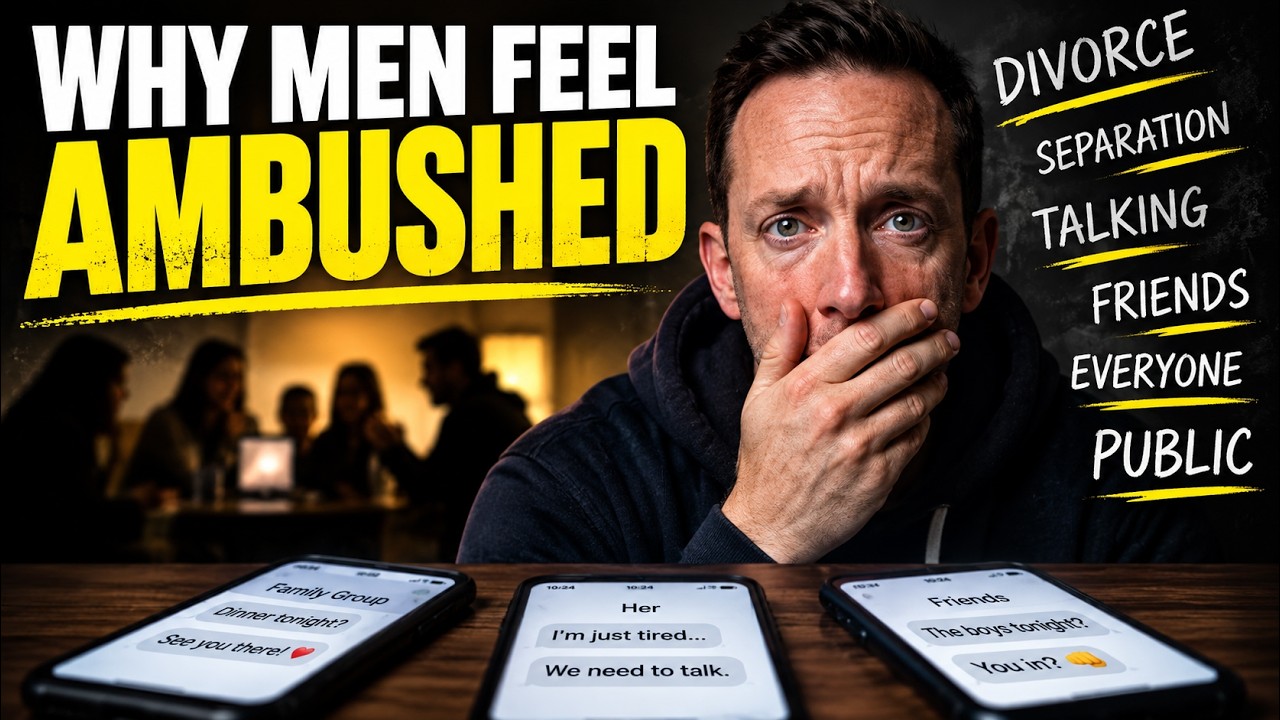
Why GOOD HUSBANDS Still Get Left

In this monologue, Cody Butler answers a client’s question about why every effort to save a failing marriage seems to make things worse. He argues that most men misidentify the core problem: they treat the relationship as a set of mechanical tasks to fix, while the wife’s primary need is relief from overwhelming emotional pressure and nervous‑system overload. By applying more task‑based solutions or emotional pressure (e.g., pleading, guilt‑tripping, or trying to prove love through effort), men unintentionally reinforce the very condition the wife is trying to escape, accelerating the divorce trajectory. Butler reframes the marriage as a feedback mirror of the man’s internal state, asserting that the husband’s emotional stability, self‑worth, and “emotional sovereignty” must be cultivated first. When a man becomes internally grounded, he can provide genuine emotional safety, reduce pressure, respect the wife’s autonomy, and create an environment where the wife can choose to stay rather than flee. He outlines the psychological dynamics (emotional blindness, fear of loss, identity entanglement), the need to shift from “fix‑it” to “safety‑provide” mode, and offers practical next steps: develop emotional regulation, detach identity from marital outcomes, and seek coaching (Cody AI, masterclass). The talk concludes with a call to action for viewers to engage with further resources.
Chapters
Hey, Cody Butler here, and I want to answer a question today that I've been emailed in by a client, and that question is, all I want to do is save my marriage and my family, but everything I do seems to make the situation worse. How do I make it better? So this is, this is a common problem, right? The harder you try, the worse the situation seems to get. So the reason this happens is there's some fundamental psychological understanding that needs to take place here to where we can actually start to understand what's going on and how to turn it around. So that's exactly what we're going to cover in this video. This situation applies to men in late-stage marriage crisis divorce situations where the wife wants out or she's asked for a divorce, she's very unhappy and is getting ready to leave the marriage, and the man is really desperately trying to save his marriage, save his family, and stop the collapse really of everything he loves. So what's going on is every attempt to turn this situation around, it seems to backfire, it seems to increase the distance, not decrease it. And it seems to increase the emotional exhaustion that the wife, but both of you really are experiencing. And obviously when this happens, the situation begins to feel confusing and it begins to feel hopeless. And it's also very counterintuitive because the things that actually change and save a marriage in a late-stage marriage divorce situation, very counterintuitive, very backwards to what you think they would be. So The core problem here with the intuition is that the man doesn't understand what the real problem actually is. He's trying very hard and making a lot of effort to solve the wrong problem. Of course, if you solve the wrong problem, you're not going to get the outcome that you're looking for. So he's trying to solve a problem that doesn't actually exist while simultaneously agitating and exacerbating, stimulating the real problem, actually making it worse. So The the actual causation of this, why this is happening, is because there's a level of emotion, emotional blindness to what she's actually trying to escape from. What she's trying to get away from or what she's trying to achieve with divorce or separation is not what you think it is. So let's get into what it actually is. So the problem that most men think is causing the problem is structural issues, mechanical issues. Checklist failures, household logistics problems, etc., etc., and it results in a, if I fix enough things, she'll stay. It's kind of like, tell me what you need to fix, tell me what you need to do, give me the checklist, write down what I need, and I'll fix it, or in other words, the structural mechanical issues. But the belief driving this is that relationship repair is task-based. And of course, as men, that makes a lot of sense to us, right? We're logically based, we're outcome-oriented, and if something needs fixing, just tell us what needs fixing and we'll fix it. But that belief is not true in the marriage because you're dealing with a woman who is not task-based. To her, the relationship is emotionally, emotionally based, not task-based. And if we approach it from a task-based, checklist, mechanical position, we're going to get everything wrong, and as a result, we're going to end up in the situation where just everything starts to get worse. So the real problem that's going on within the marriage, or the problem at least that she's facing, that she's trying to escape from, is that she's now experiencing overwhelming emotional pressure, overwhelming emotional exhaustion, a lack of emotional safety, nervous system overload. And she is not primarily seeking structural fixes. She doesn't want you to fix the fence. She doesn't want you to take the trash out. She doesn't want you to do a date night. She's actually looking and seeking emotional relief. So divorce situations and separation situations, when the woman finally says that she wants out of the marriage, it's because she's actually seeking relief from the emotional overload, the emotional overwhelm. And the only way now that she believes that she can actually get that relief is by leaving the relationship, by stepping outside of the marriage in the form of separation space or divorce. So when you understand that, now you know that she's leaving the marriage to get a sense of relief, not to have specific checklist problems solved. Now we can actually start to resolve the problem. Now what happens often is the reason everything you do, try to do, makes the situation worse is because Everything that you're doing is increasing the emotional overwhelm, the nervous system overload, and the exhaustion and pressure. When you're constantly coming to her now saying, "Tell me what you want. I'll do it. I'll do this." Blah blah blah blah blah. I'm willing to do all of these things at this point when she's decided to leave. This is actually just applying emotional pressure to her. If she's decided she's going to leave, seeing you break down, seeing you upset, seeing you Go into depression, etc., or any, anything like that, she's— this is going to increase the overload. This is going to increase the pressure that she's experiencing. It's going to want her to move further and further away. So basically what is happening is, in its most simple form, is she needs emotional relief that she cannot get within the marriage. So she's— she, she moves to divorce or separation to get that relief. Then you take that same pressure and you apply it outside of the marriage on on top of, uh, to her as well. Now, now she's got a double problem because now she can't get the relief outside of the marriage either, and this ultimately is going to move to even result in even more distance, more separation, because if she can't get the relief in the marriage and she can't get the relief while being somewhat friendly or, you know, communicable outside of the marriage, now she's going to go to complete and total communication cutoff, which is where a lot of people find themselves, and this is why. So you have to understand that the problem that she's looking to solve is she Emotional relief. So the big misunderstanding is that he approaches what's going on, her emotional collapse here, with mechanical problem solving. She doesn't need problems solved, she needs pressure removed. So basically what's going on here is the man is focusing on tasks, logistics, proving that he loves her through effort, proving, you know, Tell me what to do and I'll do it, blah blah blah. Or even worse, applying pressure for her to stay, such as this is going to damage the children. This you know basically applying applying more pressure, thinking that that pressure is going to get her to change her mind and stay when actually that pressure is the very thing that she's looking to escape from. All you're doing in that situation is actually making the situation worse. So when I work with men, the first step that we go through, the first stage of saving your marriage, of turning it around. Is you've got to stop making the situation worse. If a train's going in the wrong direction at great speed, the best thing you can do is you've got to stop that train before you can turn it around. So what happens is instead of stopping, just slowing the situation down, you actually speed things up by adding more and more pressure. So what the man is missing is the emotional experience entirely. He's not understanding where she's coming from emotionally, and actually what she's actually leaving from. So a great question to ask yourself Is, what is my wife trying to escape right now? What does she need to get away from that, that so badly that she feels like she needs to leave this marriage? That, that really, when we can uncover that, that's where the healing and the restoration starts to take place in working on that. So why does this make the situation worse when you do the things that you think are actually going to help them, help the marriage? Why does it make it worse? Well, it's because it reinforces The exact things that she's looking to escape from. She's looking to get away from emotional pressure, from suffocation, from exhaustion. And when, when she leaves, when she separates from the marriage, and, and for example, if you break down, you become emotionally unstable, she now feels responsible. It's a mistake that men make quite often is, is they feel that she's just cold or doesn't care about you, or she's just stopped caring. This is not necessarily the case. There comes a point when somebody just becomes so exhausted, they have to start to look after themselves. They have to, they have to prioritize their own survival, and this is often when the woman actually makes the decision to leave the marriage or to ask for divorce, is she's reached a point where she can take no more emotional pressure. She's at a complete overload, and she's doing this now out of the necessity for self-preservation. So when you do these things, when you apply these pressures, suffocations, etc., all you're doing is communicating to her that you still do not understand the real root cause. You don't understand the problem at hand. Which is she's exhausted, she feels immense pressure and suffocation, and she's looking for some relief. So ultimately, she just experiences more of the thing that she's actually trying to escape from. And fundamentally, that is— this is the answer to the question, right? Why is everything— why does everything I do seem to make the situation worse? This is the answer. So the critical principle here is that You cannot solve a problem that you don't understand. You have to understand fully what the problem is, and you also have to understand that her problem is emotional. It's not structural or mechanical, so emotional problems cannot be solved mechanically, and as men, we really love to do that, right? We really love to put on our Mr. Fix-It hat and fix the problem or become the mechanic within the relationship, When actually she doesn't need a mechanic, she needs emotional support. Or instead of a mechanic, she needs an emotional counselor, metaphorically speaking, right? So the harder you push structurally, the more emotionally unseen she feels. The more, the more you try to fix the problem, the more she actually feels like you don't understand the problem and that there's going to be no relief or no solution within the marriage. So The marriage here, again, this is a problem that we need to understand. The marriage is not something that's separate from you. It's not separate from you, the man. It is, and it is not something that's happening to you. You're not, you're not experiencing the marriage, or what's going on in the marriage is not happening to you. You are— the marriage is reflecting you. So if you're unstable, the marriage is reflecting that back to you. It's not the instability within the marriage that's causing you to be unstable. It's the instability within you. That is being reflected into the marriage that's causing the instability. So often the marriage is reflecting a lack of emotional regulation or stability, a lack of real masculine leadership, a lack of self-worth within the individual, nervous system stability— instability within the man, emotional maturity within the man. All of these things are issues that the man typically is experiencing. And The marriage is simply reflecting that back. When the man shows up in the marriage in a way that's unstable or exhibits a lack of emotional regulation, or you show up with a lack of self-worth and you're taking some— you're trying to get your sense of self-worth from the marriage, you end up in a situation where you require the marriage to give something to you, which is a fundamental misunderstanding of what the marriage is. The marriage is a place You go to give, not a place you go to take stuff from. And when you show up emotionally regulated with a strong, authentic sense of true masculine leadership, with strong self-esteem, self-worth, etc., then you pump that into the marriage, and that lowers her pressure levels, that lowers her overwhelm, that lowers the level of crisis that she's looking to move away from. And that is when she starts to come back. When the pressure level dips and starts to normalize within the marriage, that's when, that's when she starts to look at the marriage as something that she can operate within and stay within. And that only happens when this happens within the man. Or in other words, if you fix the man, you fix the marriage. If you stabilize the man, you stabilize the marriage. An unstable marriage is a reflection of an unstable man. It is the man's job fundamentally to pump stability into the marriage, not the woman's job to pump stability into the man to stabilize you. So what actually begins to change this situation? The question was, everything I do makes the situation worse. So the presupposition in that is you want to make the situation better, right? So you have to start seeing the marriage not as criticism or failure or something that needs to be fixed, fixed, but as a feedback device, as something to reflect back to you what needs to change within your— within yourself. It— when you start to see the marriage as an invitation for self-regulation and self-control, and you start to see this as an opportunity for the man to stabilize himself first, and you start to work on that, you fix the man, you fix the marriage, you stabilize the man, you stabilize the marriage. Look, an apple tree is only ever going to produce apples. An orange tree is only ever going to produce oranges. An apple tree is never going to produce oranges, and if the marriage is unstable at this point, it's because you have— you are an unstable tree, relatively speaking, right? And I know some people are going to comment now, well, why is it always the man's responsibility? Well, I don't know the answer to that question. I just know that it is. I'm not here to fight Reality, and I'm not here to argue. If you don't believe that it is the man's responsibility to stabilize the relationship and pump that stability in, power to you. Not here to fight with you on that. But I can tell you, after many decades of doing this, this is what fixes marriages. This is what saves marriages. So the goal here, what changes the situation or saves your marriage, is the man establishing emotional sovereignty within himself. And what does that mean? It means that he takes— he gives— he gives stability to the marriage. He doesn't take— he doesn't become stable when the marriage is stable. He's internally grounded. He's emotionally regulated. He's not a monkey with a machine gun that is easily triggered, that every time something happens that he doesn't like, he pumps instability and pressure into the marriage. But ultimately, the key here is The goal for every man I work with is to arrive at a place of emotional sovereignty. What does that mean? Well, it's separating your identity, self-worth, and competency from marriage outcomes, her emotions, and her decisions. The problem that arises here quite often is that when she decides to leave the marriage, it challenges your identity, your self-worth, and your competency. Her decisions determine whether you're stable or not. Her emotions— if she's having a good day, you're having a good day. If she's having a bad day, and she's challenging who you are, then this challenges your self-worth, and a man who's emotionally sovereign finds his identity, self-worth, and competency from within himself, and he doesn't need the marriage, or me, or her, or anybody else to find that sense of self-worth, etc., and confidence, and I've got several videos on this channel on that topic about, about Why the marriage is so painful, the collapse of the marriage is so painful, and it's because you're losing more than your wife. You're losing more than the marriage. You're losing a sense of identity, self-worth, etc., etc. I highly suggest checking some of those out. So stability, emotional sovereignty means that your stability originates internally first, or in other words, I show up today completely stable, completely regulated. And even though my wife, who is it? She's she's a woman. She's inherently unstable. She's emotional. This is what she's going to do. It's her nature to pump instability into the relationship and and to be emotional. Women are emotional. We're logical. We can overcome emotions with logic. This is our role to do that. Is to operate out of a place of emotional sovereignty and internal authority. To where it doesn't matter how she shows up today. If she shows up and says that the marriage is on, you're having a good day and you're stable. If she shows up and said the marriage is off and she wants a divorce today, then you— this, this crushes you and completely destabilizes and just throws a ton of instability into the marriage. The emotionally sovereign man, it doesn't— he's not dependent on how she shows up or what happens on any given day. So To arrive at this place of emotional sovereignty is you have to stop seeing the marriage as a place to get validation for your sense of self-worth, confidence. It's not a place that you derive your identity from. It's not a place that you derive your emotional regulation and stability or your sense of self-worth. All of these things— validation, identity, your emotional regulation, and self-worth, confidence— these are things that you derive internally, and you pump that into the marriage. It's not something that you get from the marriage. So the key fundamental shift here is that if you want this to turn around, you have to start seeing the marriage as a place that you go to give stability, a place that you go to give safety. So again, look at these. I mean, I know that the, the, the, the— there's a community of men here are going to just push back on this and go, so why is it my job? Why is it my job? Well, It's your—is it your job as a husband and a father to provide safety for your family, or is it your children's job or your wife's job? Is it your job to provide financial stability? Is it your job to provide that sense of leadership and groundedness and and emotional regulation? It absolutely is. And if you disagree with that, that's fine. But then this this is not a place for you, and I'm certainly not somebody for you to be listening to. But if you believe that. It is your role as the man to provide the stability, the safety, the groundedness, and the leadership. This is how you do it. This is a place for you to learn how to do it. So why do most men not do this? Well, it's fear-driven, right? Why are they— why, why do men not do— why do they not— when we understand that what she needs is pressure release, pressure relief, why do they not do it? Well, it's fear-driven because most men in a divorce scenario, late-stage marriage crisis scenario, carry the fear that if I give her the emotional freedom that she needs for the pressure to be reduced enough to come back, she'll just leave. If I, if I back off, if I give her some, some space, if I give her the things that she needs, then she will choose to leave the marriage. If I don't fight for this marriage, she's going to leave. If I don't show her how much I care, she's going to leave. So what the actual fear is, is the fear of her finding her sovereignty, the fear of her finding Her autonomy, the fear of her finding her own independent choice, her own independent choice, and the subconscious belief that's driving all of this is if she, if I, if she has fully has a choice, if I give her the full autonomy and sovereignty, then, and I give her that choice, then she won't choose me. She will choose leaving over choosing me. But the truth of the matter is. This is not about choosing you. This is your ego. This is, this is, this is the part of you that needs to let go. This is not about her choosing you or validating you. This is about her requiring and needing an environment out of necessity that reduces the cognitive overload and pressure that she's experiencing. And when you give her autonomy, independent choice, and sovereignty, and you give her that freedom, to exist in that environment, it creates an environment that creates space for her to move back into, and she will choose that over the alternative. Her leaving is the worst-case scenario. It's the worst-case scenario for her. She does not— I can almost assure you, in virtually every situation, leaving is far worse than staying in many, many ways. She's aware of all the damage that this is going to do and the problems that it's going to cause her. Yet she's choosing it anyway. Why? Because it's not a choice, it's a self— it's a self-preservation situation at this point. Give her a different choice. Right now she feels like the only choice she has is to leave the marriage to get what she needs, and that's it. Give her the choice of getting what she needs inside of the marriage and see what happens. So this fear of— if, if, if this fear and subconscious belief that if she has the choice to choose, she won't choose you, What it actually results in is an attempt to control, contain, emotionally manage, reduce her autonomy subconsciously to make her dependent upon you because there's this belief as men that if she becomes dependent, then she won't leave. But again, all this does— now we understand what the true problem is— all it does is create suffocation, pressure, and emotional imprisonment, which are the very things that she's looking to escape from. Anyway, so here's the crux of the matter, right? Why does everything I do make the situation worse? Because ironically, everything that you do to, to make this situation better, it actually accelerates the very outcome that you fear the most. This is why. So the deeper truth here is that a healthy marriage that you're going to be happy in and she's going to be happy in and has longevity and survivability It requires two emotionally sovereign people. You don't want to be controlled any at all, and you're not going to tolerate that. She's the same. It requires two people being in a marriage because they choose to be in a marriage because it's in it's in everybody's best interest. It's in her best interest to be in the marriage, and it's also in your interest for her to be in the marriage and vice versa. So ironically, here's the truth that you have to embrace. That really truly is the problem here. Her emotional sovereignty is not a threat to you. It's not a threat to the marriage. But while you subconsciously still believe that her sovereignty is a threat, you're going to cause problems and you're going to accelerate the demise of this relationship. So her emotional sovereignty is actually an asset to the marriage. It's actually a sign of her emotional health and a sign of an emotionally healthy marriage. And it is also necessary for genuine connection. Now, you people say— I see it all the time— just let her go. If you love her, set her free. And it's like, well, setting her free is not giving up on the marriage and granting her wish to let her go. Setting her free is giving her the emotional sovereignty that you would— that you demand for yourself as well, and understanding that that sovereignty is an asset Not a threat to you or the marriage. So what actually improves the dynamic of the marriage here? Well, it's your emotional regulation. So I understand that if your wife has asked for a divorce or you're in a marriage threat scenario, it's very destabilizing, and I have every sympathy for that. I understand the difficulty of you saying, well, Cody, how am I supposed to regulate and be emotionally stable? I'm losing everything. I understand that, but you also have to understand that if you want to fix this marriage, you have to reduce the pressure that she's experiencing, and to do that, you are going to have to emotionally regulate yourself. You are going to have to create a sense of emotional safety for her within the marriage. She needs to feel emotionally safe within the marriage instead of needing to leave the marriage to feel emotionally safe, and that requires you developing a respect for her autonomy, even though that feels like a threat to you right now. Even though that feels dangerous, and it feels like if I do this, that is the end for sure. If I give her the freedom to choose, she's not going to choose me. You need to find a sense of internal groundedness, or i.e., develop that sense of emotional sovereignty. And if you want help doing this, check out a link in the description. If you want your your own personal, if you want your own situation spoken into and your situation. Looked at. Check out Cody, Coach Cody AI. There's a link in the description. Check it out and, and it will talk to your very— your situation so you don't have to deal with the generalities like this. But part of what needs to happen here is that you need to develop a stability under uncertainty, which— this is where we find out who you really are. This is the real measure of the man. It's easy for a man to be emotionally stable, grounded, have a sense of confidence and self-worth when the ground that he's standing on is safe and the future is certain. It's when you're unstable, when the ground becomes unstable and the future becomes fragile, this is where we learn if you have stability or not. So what needs to happen is you need to develop the ability to have that stability under uncertainty to where you're not pumping that instability and fear into the marriage, which she's trying to get away from, as I said, 100%. times now. And the way you do this is you have to detach your identity from the outcome of the marriage, or again, develop that sense of internal authority and emotional sovereignty. So let's just be very clear about some stuff. This does not mean just throwing your hands in the air, giving up. Does not mean emotional passivity, going, I, I'm just going to let her do whatever. Doesn't mean tolerating abuse, and it does not mean you abandoning the marriage. None of these things are required. But what it does mean is you have to develop an understanding for what the real problem is. As I've said, you cannot fix— most men are trying really hard to fix the wrong problem. You're working on the wrong area, and you, you have to understand fully what the problems are before you can fix them. Most of you watching this can fix the problems. You do have the ability and the skill to do it. What— where you're really lacking is in the diagnosis. The diagnostics of those problems. And that is where I can really help you out, is in diagnosing what the real problems are and where to focus on. So you need to focus on regulating yourself first. You need to become stable under pressure, stable in the face of uncertainty. You need to start to reduce and remove the emotional pressure that she's experiencing within the marriage, start to respect her autonomy, and create an environment of emotional safety. Whether the marriage is going to be saved or not, ultimately is most likely going to come down to this. I don't know if you can save your marriage. I don't know what you've done. I don't know what happened. You may have done some really, really silly stuff for all I know. Not every marriage is savable, but every marriage that is savable comes down to this: can you create emotional safety, and how long is it going to take? If you can, and you can do it in a reasonable amount of time, then the chances of the marriage being saved become exponentially higher. So Better results come from asking better questions. So let's get some core internal shifts here and ask some better questions. So right now you're asking the question basically, how do I force this marriage to survive? Or what do I need to do to change the outcome of this marriage which is heading for divorce right now? That's not a great question. That's not going to get you the result that you're looking for. The better question to ask, man, is how do I become emotionally stable and emotionally sovereign regardless of the outcome Or how do I act emotionally? Stay— how do I, how do I act in a way that is most productive to save this marriage and detach from the day-to-day events of this marriage? Because on a day-to-day basis, this is going to be very challenging for you. She's going to challenge you. Trust me on that. You will go— if you do not find a way to detach from the day-to-day outcome, because we got to develop a longer, longer time frame here and You have to, you have to look at the situation from— this is about the war, not the daily battles. You may lose daily battles. She may be absolutely adamant on given days that this marriage is going to end, but you have to be stronger than her. You have to be stronger than that. You have to be stronger than her emotion. If you are not stronger than her emotion, her emotion will win. But if you are stronger and you're able to stand strong in the face of that opposition, if you're able to stand strong And remain emotionally stable and sovereign, even when your marriage— you've been told your marriage is over, even when you're being told lots of things you don't want to hear, and you can adopt the philosophy that I'm going to win the war even though I may lose individual battles on a daily basis, then the chances of you saving this marriage become exponentially higher. So let's look at some key takeaways here. Most men unintentionally reinforce her decision for divorce Uh, by solving the wrong problems. You're trying to fix the wrong things, and, and as the whole premise of this video is, it's making the situation worse. The second core takeaway is the marriage is reflecting the emotional condition of the man. The man is not reflecting the emotional condition of the marriage. Your marriage can get better because you can get better. Your marriage can stabilize because you can stabilize. Your marriage can improve because you can improve. And it's the only reason it can improve. Emotional safety for your wife and reducing pressure is more important. It matters more than the mechanical and structural fixes that you're looking at right now. And the stability required for you to do this is— it's developed internally. You need to provide relief, not pressure, That's what changes the divorce dynamic. Most men inadvertently apply pressure to their wife, which is the very thing she's looking to escape from, instead of giving relief. Relief, not pressure. That's the dynamic that produces change. And the stronger the internal sovereignty of the man, the healthier the relationship environment becomes, and the more likely reconciliation takes place. A man who is internally sovereign, emotionally sovereign, is a very strong man that is going to be very attractive to a woman. A man who is not internally sovereign, and the degree to which he is not internally sovereign and emotionally sovereign, that man is needy, controlling, demanding, emotionally unstable, all of these things, all of the things that a woman is not attracted to at all. So most men will accidentally Worsen the situation through pressure and emotional dependency, as I've just said, and the emotional sovereignty changes that entire dynamic. So if you want to go more into the specifics of that, check out Cody AI, link in the description. That's going to speak into your specific situation. I've also got a free masterclass called You Can Win Her Back, where I go into what the more specifics exactly of how to stop reinforcing this exhaustion, how to become more emotionally grounded, of what actually works to turn the situation around in late-stage marriage. So hopefully you like this. Give me a thumbs up, like, leave me a comment, let me know what you thought about this, subscribe, and I'll see you in the next video. Oh yeah, make sure you watch this video as well. You're going to like this one.
More from Cody

I’ve Coached 1000's of Men in Marriage Crisis, This Is The Mistake They All Make





His Wife Says She Feels Unsafe. Then We Find Out Why? — Live Coaching With Cody Butler