The Dark Side of Deep Breathing: How This Common Technique Intensifies Your Public Speaking Phobia!
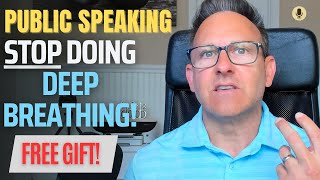
Robert Summa argues deep breathing before public speaking can backfire for people with phobia. When you're already in fight-or-flight mode, adding oxygen intensifies anxiety instead of calming it. He suggests rebreathing CO2 through a paper bag to trigger your parasympathetic nervous system instead.
Chapters
Hey, friends, welcome back to public Speaking cure, the only channel dedicated to helping you get over your fears and phobia. Public speaking. And today I'm really excited because we're going to talk about something that's out there. Biggest myth out there that I just can't stand whenever I hear it, and that is deep breathing exercises to help calm down your system before we get up on stage or we have to present right. It's the wrong thing to do. And today I'm going to prove why all the myths out there about deep breathing are incorrect when it comes to public speaking.
So today we're going to cover one of my favorite topics, and it's the deep breathing myth. And if you've heard me a thousand times say I can't stand when I hear public speaking coaches or presentation seminars going over deep, deep breathing to calm ourselves down before we're about to get up in public speak because this is actually the wrong thing to do. And I'm going to prove it to you today in this episode. So stay tuned. But before we dive into the deep breathing myths, there is a link below. So I'm going to give you a gift. And my gift is a diagnostic quiz. And when you take this diagnostic quiz in the link below, you're going to find out, do you actually have a phobia of public speaking? Because if you have a phobia of public speaking, then speaking coaches and seminars are not the way to go. You need to work with somebody like myself, a speaking phobia expert, or you can work with a psychologist, but they take a little bit longer. So let's get back into the deep breathing mix. We're going to geek out a little bit and learn the science behind it, because we have to learn the science behind it before we can really understand why it doesn't work in the first place. So we're going to jump into a PowerPoint right now where I'm going to go over a little bit about the sympathetic and the parasympathetic responses of our nervous system and the fight or flight response and how it all correlates into why the deep breathing myth just doesn't work. It is 100% incorrect. And not only incorrect, it makes your phobia worse. So we're going to geek out a little bit and we're going to go over the sympathetic and the parasympathetic nervous systems, right? There are two automatic nervous systems in the human body, and one is the sympathetic nervous system, which is a heightened alert or maybe anxiety or when we're doing exercises. And the other is the parasympathetic nervous system. And if you want to remember an easy way to remember it, just think about when you're coming off a high of anxiety or excitement. You have to parachute down. So you can call that the parasympathetic nervous system, which is the calming effect, right? So we know about the fight or flight freeze response, but these systems also keep us calm, and that is the parasympathetic nervous system. So it's the opposite of the sympathetic fight or flight response.
Really quickly. Again, the sympathetic nervous system is when we feel unsafe or threatened. The sympathetic nervous system response is automatically activated when we feel a sense of danger or threat. So the sympathetic triggers the fight or flight or freeze response and is there to keep us safe from a physical danger or threat. Now, the parasympathetic again coming down is our nervous system. This one is how we calm ourselves down or stay calm. So the parasympathetic is the calming nervous system.
So basically, if you look at the parasympathetic on the left hand side, that is, you know, a calming. It's some people call it the parasympathetic nervous system of rest and digest. And the sympathetic, of course, is basically when we're in an anxious state. So when we're in an anxious state, when we look at sympathetic, we get the dilated pupils, our saliva stops while we get dry mouth on stage, our heartbeat starts rapidly beating, we get the hyperventilation. All these go into fight or flight. But on the other side, the parasympathetic, well, that slows down the heartbeat, right? It opens up our breathing again and it triggers all your immune systems and digestion systems to reactivate. But in the sympathetic, our digestion stops, our immune system stops because it's putting all that energy into being able to fight off a bear or outrun a tiger, or if there's a fire in your house, you have to escape. It puts all that energy into being able to escape a real physical danger or threatening.
A healthy nervous system operates in the calm state most of the time. And if you look at the graph right here, you basically see when you're waking up in the, in the morning and then.
You know, resting throughout the day, we're always going through this normal curve, right? We're always going through arousal. If you laugh over exercising, it goes into a little bit of upper state, but always comes back down. And we want to stay in these normal lines. When we go above the sympathetic, basically, we're activating the fight or flight response. And then of course, when we're going below parasympathetic, that might be more of like a state of depression or really being tired.
So when we encounter emotional stressors like public speaking, we get embarrassed, right? And that keeps us stuck in the sympathetic state longer than the typical short burst to outrun a bear or outrun a dog or be able to get out of a dangerous situation, right? Are usually short bursts. But when we're stuck in it, like for public speaking, well, it creates a whole anxiety level and can go, even go into panic attack. And that's why public speaking is one of the biggest anxieties, because we get stuck. Once you're stuck up there, it's hard to escape and come back down into the parasympathetic state.
So if we take a look at public speaking phobia, people with general anxiety and panic disorder, we spend more time in elevated states, right? But when we have the fear of public speaking, look what happens. That traumatic event is getting up on stage or getting ready to go up on stage or presenting, right? It puts us up into that upper end of the sympathetic state. And then we get stuck on. And now we're hitting that fight or flight response. And when we hit the fight or flight response, remember all those things that shut down, you know, in the things that stimulate, so it shuts down our saliva, so we get dry mouth, right? We start to sweat and our heartbeat goes up and we get the quivering voice and shaky hands because we have all that adrenaline rush and cortisol and oxygen in our bodies to be able to fight off the bear or outrun the tiger or be able to escape from a fire, any kind of real physical danger or threat. But public speaking is not a physical danger or threat. It's a phobia. And a phobia is an irrational fear of something, right? And since we have an irrational fear, it's triggering the amygdala, the fight or flight response, as if we are in that. That state. So it's a false alarm. But look what happens. We get stuck on. And now we're on stage and we get the heart beating and we're sweating, and then it shuts down. Our thinking brain, our thinking brain basically shuts down. That's where we get brain freeze and we forget what we want to say. We start stumbling on our words and everything we practice goes out the window because basically our brain is shutting down because the fight or flight response is taking over. Now, if you look at the lower levels and we're not going to dive too deep into it. But people with depression disorder, they typically spend more time at the bottom end. So people with depression are way down there. And people with general anxiety are at the top of the state of the sympathetic. But panic from public speaking obviously shoots us way up there into panic mode. And that's what we need to stay out of.
And of course, this takes us to the crux of what I can't stand is the deep breathing exercise myth. And if you follow me on YouTube or blogs or my LinkedIn or any other videos or my website, you undoubtedly heard me say a thousand times that all coaches and seminars make your phobia 9 to 35 times worse. That's right. These coaches in seminars make your phobia 9 to 35 times worse than you already were. And there's two reasons deep breathing exercises and the other one we're not going to get into. I'm going to make another video is practice makes perfect. Keep getting up to mic and it makes you better a better speaker. Well, those are both incorrect. But today we're just going over deep breathing exercises, and we're going to go now into why it is wrong, why it's the biggest myth, and why it actually makes you worse.
So the thought of deep breathing, it sounds logical, right? Because we went over the parasympathetic response and sympathetic. So we know the sympathetic is excited and the parasympathetic is bringing us down. So the logic sounds right. If we do these deep breathing exercises, it slows down the heart rate, right? It sounds smart, it sounds logical, but it's actually the wrong thing to do. Why? Because when we're in a sympathetic state, we're already automatically sending more oxygen into our muscles to be able to outrun the tiger or be able to fight off the bear or outrun a fire or anything that's a physical danger threat. So we have all this adrenaline, cortisol and a lot of oxygen going through our system to be able to get into that short burst of fighting off that bear. So if we start implementing deep breathing exercises, you're bringing in more oxygen into an already overly oxygenated state, Right? So if we're already overly oxygenated because we're in that fight flight response response and we start doing deep breathing, well, guess what? It just triggers us even to a higher state of anxiety. And now we're really going to trigger the fight or flight response even harder, sending us into a higher anxiety state. Now when we get on stage, we got the tunnel vision. We're really hyperventilating because we just spiked our anxiety that much higher and we thought we were going to be calming ourselves down, but it's the opposite. It actually makes us more excited and more anxious and, and that's why this myth is totally debunked. If you study any psychologist, they will tell you that if you do deep breathing when you're already in a fight or flight mode, it is going to trigger to be even higher. So does it work? It only works when we're already in a calm state. Deep breathing exercise is part of meditation, but you're already in a very meditative state when we're doing these deep breathing exercises or we're not over oxygenated. Sympathetic response. We're already in a low parasympathetic state when we do deep breathing exercises to bring us even lower into that real low calming place. Right? The real low parasympathetic. So while deep breathing exercises sounds logical, it's only logical when you're already calm. But when you're excited, it's the wrong thing to do. It will make it worse. So we need to stop doing these exercises.
So again, why do they prescribe this? They don't know any better. These people are not phobia experts. They don't know about the fight or flight parts of the brain. These people are not experts in how the brain functions. These men and women are all public speakers. They don't have a phobia public speaking. That's why they are public speakers. Right? So they're already in a parasympathetic state when they get on stage. They're not excited. They may have some normal nerves, but they're not way up in that sympathetic, you know, high response when they get up on stage, they're in the normal response. So deep breathing for them brings them down because they're not up here already in sending it up into a higher state. So they don't know any better. They don't have a phobia. And since they're operating in a normal, healthy parasympathetic state, deep breathing might actually help them be mentally calmer. But for those of us with the phobia, it's a 100 trigger. And that's why it is not the right thing to do when we have the fears of phobia of public speaking.
As a matter of fact, this is kind of funny, but if you ever watch those cartoons when you're a kid and when somebody's really nervous, like Bugs Bunny's really nervous or Flintstones really nervous, they breathe into a paper bag to calm themselves down. Well, believe it or not, it's actually true. We need more carbon dioxide, not oxygen. Even furthering more than myth, right? So we need more carbon dioxide to bring us down to that parasympathetic state. So, again, watch those cartoons. When you see people breathe into a paper bag, while it's funny, it's actually the truth. They're all rebreathing CO2, which triggers the parasympathetic nervous system. So it's funny because unfortunately, we can't walk around with paper bags at work when we're getting on stage, but it's actually the right thing to do. So, again, deep breathing the wrong thing to do. Carbon dioxide is what we really need, but unfortunately, we can't walk around breathing into paper bags before we're getting on stage and presenting. But I just wanted to add that in that this is even more proof that oxygen is not the way to go. Deep breathing myth just debunked.
So, in closing, as a recap, we know that public speaking is not a physical danger threat, right? And we have to be prepared for this. Anxiety and emotional triggers to prevent a total prefrontal cortex hijack from the amygdala. And what is that? That's basically when the fight or flight response goes off, it shuts off our normal thinking brain, which is why we get on stage. We forget what we want to say. Everything we practice kind of goes out the window. We forget things that we want to talk about, and we lose our words and we lose our place. It's because our thinking brain is shutting down because the fight, flight, and freeze response is taking over. So by understanding more about what's going on, we can kind of slow down by understanding what's happening and living in the moment. If we live in the moment and take a step back and say, okay, I know what's going on in my body, and I know why. This will help us learn how to turn off the fight or flight response and keep us out of that really heightened sympathetic state. So, again, knowing that public speaking is not a physical danger or threat, right? All this time has just been an illusion. It's a perfect illusion. And that's what basically a phobia is. A phobia is an irrational fear of something. So we know public speaking is not a physical danger threat, but because it's an irrational fear, it's triggering us to go into that fight, flight, or freeze response. So we have to become aware of our triggers, and we have to learn to notice our body signs, and we have to notice when we're flooding and what is flooding? Flooding is when we're getting that oh moment and we're starting to get the hyperventilation, the heart starting to beat. If we can really live in the moment of that flooding and say to ourselves, wait, this is a false alarm. Public speaking is not a physical danger threat. I know I'm not in harm's way. I know I'm not having a heart attack because my heart's beating. And I know this is not a dangerous situation. If we can actually live in the moment, then we can actually start to reverse the fight or flight response from going off when we are public speaking. So we need to pause, we need to pause the amygdala and I'm going to go over that in more videos to come on how we actually do that. But it's just understanding that we can actually stop the amygdala from going off. We can actually talk to it. We can actually learn to change our relationship with the amygdala which is in charge of the fight or flight response. So if we commit to accept and return to the issue from a commerce perspective, what would you tell yourself from the outside looking in when you're about to public speak? Right. What would you tell yourself? Just think about that. What would you tell yourself looking in on yourself right before you going on the public speak? You can tell yourself, hey, I'm not in a threatened situation. My heart's beating, but I'm not having a heart attack. You know, I'm breathing heavy, but I'm not outrunning a bear. This is a emotional stress. That's a false alarm because I have a phobia public speaking, which is not a real physical danger or threat. So I hope this video really helped you understand why deep breathing is the wrong thing to do, why it's the opposite of what we should be doing. And even though we can't be breathing in paper bags, well, it is actually the way to get over and bring us down to a parasympathetic state. So really the crux is just don't do deep breathing exercises before you get up. We know it's going to trigger it. So just remain calm and understand that you're not in a, in a real dangerous situation. Do not do deep breathing exercises because it's going to bring us into a higher oxygenated state. And by not doing that and doing the opposite and just sitting calmly and just living in a moment, we can actually stop the amygdala from going off. I hope you found this video really helpful. So again, there is a link below where you're going to find a diagnostic quiz to find out do you have a phobia public speaking. And if you do, you're going to go to another video that gives you your own diagnosis, a personal diagnosis, and then a 50 minute free workshop, which goes into a lot more deeper diving into how to actually get over the phobia of public speaking. Thank you.
More from Robert


MUST WATCH! Fear of Public Speaking Explained 🎤 | Grab Your FREE Mini-Course Today! | Link Below!
What is the FEAR of Public Speaking (Glossophobia) | And Can We REALLY Overcome It?
Why You REALLY have a FEAR of PUBLIC SPEAKING | The ANXIOUS Brain (Part 2) | Glossophobia
Overcome Your FEAR of Public Speaking for CONFIDENCE, SUCCESS, WEALTH & RELATIONSHIPS | Glossophobia