Why You REALLY have a FEAR of PUBLIC SPEAKING | The ANXIOUS Brain (Part 2) | Glossophobia
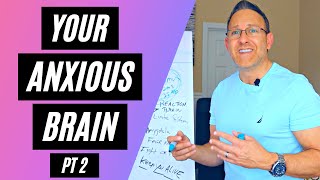
Robert Summa explains why public speaking triggers fear: your amygdala reacts in 75 milliseconds, faster than your rational brain can catch it. The thalamus, at 50 ms, can be trained to intercept that fear signal. Fifty hours of practice rewires your brain to shrink the amygdala's grip.
Chapters
Hey, guys. Welcome back to Public Speaking Cure, the only channel on YouTube that is dedicated to helping you get over your fears and phobia of public speaking forever. So today we're going to go over the Anxious Brain part two. But before we dive into another whiteboard session, if you haven't seen part one of the Anxious brain, I highly suggest you see it and then come back so that you get the most value from this video. So to watch Anxious Brain part one, there's a link below another again, watch that video first, then come back and watch part two.
Don't forget to hit the subscribe button because we're pushing out content every single week to help you get over your fears and phobias of public speaking. Also down below, there's a link to a free PDF self assessment test, where you're going to find out where do.
You fall on the scale when it.
Comes to your fears and phobia?
Are you medium or are you up.
To severe and even panic attack? And when you click on that PDF, you're also going to get 20% off my upcoming master course, which is due for release Labor Day weekend. So I hope you enjoy part two of the Anxious Brain.
Welcome to Thalamus.
Okay, so we're going to go into.
Another white four session and. And we're going to go over the thalamus, right? And the thalamus ends up. It's going to be our hero and it's going to be the conqueror and crusher of our inter phantoms of fear, of public speaking. Okay, so let's jump in, and then after we do the whiteboard session, we'll come back and do another recap.
Okay. Welcome back to the Whiteboard session. So what have we learned so far? We learned so far that the amygdala is the powerful part of the brain. The prefrontal cortex is the logical, smart.
Part of the brain.
And the amygdala is much stronger, much stronger than the logical prefrontal cortex. So we also know that the amygdala is basically the reaction brain, right? It's reaction and it has a bias on fear response, which triggers the fight or flight response. And that's there to keep you alive or to keep you safe at any moment of the day. As a matter of fact, the amygdala is always on. It's always just going, right. It's always running subconsciously. And every moment of every day, no matter what you're doing, everything, all your senses are running through the amygdala. So all your sight, sight, hearing, Taste everything, thinking all your things run through the amygdala, okay? And it's always looking out to keep you safe, right? Is this a moment I should be afraid of? Is that a moment I should be afraid of? Right? So it's always been in the background, right? Running to keep you safe. And it has its own knowledge system, has, like, its own database, right?
So it stores things.
So something that it didn't like is stored in there.
So that's how it also triggers.
So if you recall, I spoke about when we were children, we were in school, how we got ridiculed. You know, so we got ridiculed or teased or we were embarrassed in school.
While we're growing up.
That's a learned environmental negative bias learned through prefrontal cortex. And so your amygdala has picked up that I don't like being teased. I don't like being ridiculed. I don't like being bullied. I don't like being laughed at. So it stored it as a negative bias, right? So that's why we have the fear of public speaking.
It's an environmental, learned behavior through your prefrontal cortex, right? When you got laughed at to say, oh, I didn't like that at all. So as we grow up, it stays in the amygdala. The amygdala doesn't have a sense of time. It has no language. All it knows is keeping you safe. Right?
So not only is it powerful, but.
It'S also extremely fast.
Just how fast is it? Well, the computing time of the amygdala is 75 milliseconds. Just to give you an idea of what 75 milliseconds is, just blink your eye for a second.
Okay.
Blink your eye.
Okay.
Four times faster than that. And that is really actually great of the brain to have that quickness. Compute. I will give you, like, an example. You're walking in your backyard, right? And out of the corner of your eye, there's a garden hose. But you react, you jump back. You're like, oh, oh, my God. I thought that was a snake, right? So that's your amygdala, right?
At the corner of your eye, senses.
Something coiled up, and you jumped, and it jumped and made you jump to.
Protect you from what could be a snake.
Now it was just a garden hose, right? And you're like, but that's what the amygdala does. And that's kind of what it does when your boss walks in and says, hey, I like your.
Your.
Your PowerPoint presentation. You're going to present tomorrow in front of a thousand people. And you've got that oh moment, right? The oh moment. So let's move to the prefrontal cortex. Now, the prefrontal cortex now is the only weaker, but it's much slower. The computing time of the prefrontal cortex is 350 milliseconds. That's five times slower than the amygdala. But that is designed to.
To keep you safe.
Let's just pretend for a second that you didn't have an amygdala on that day. You're walking through the grass, right? No amygdala, just a prefrontal cortex. And out of the corner of your eye, you saw that snake. And by the time you said yourself, oh, what is that thing? It's already bitten you, right? The snake has already bitten you. And if it's a poison snake, you're dead. So the mind is remarkable in how it's designed to keep you safe. So, as you recall, before, we have to rewire the brain to not fear public speaking as a oh moment, right, it's not a coiled snake. It's not going to bite you. It's just a hose. It's really just a hose, right? So how do we do that? If the prefrontal cortex is weaker and so much slower, and the amygdala is always on, right? And it's fast and it's powerful, how.
Are we going to reverse the public.
The fear of public speaking of fear. And that, my friends, is where the thalamus comes in. So welcome the thalamus. Now, the thalamus has connections to the prefrontal cortex and the amygdala. And guess what? All sensories go through the thalamus, and believe it or not, they hit the thalamus first before the amygdala. And on top of that, guess what again? The thalamus has a 50 millisecond computing time that's 35% faster than the amygdala. And that, my friends, that is our window of opportunity to overcome our fears and phobia public speaking. You see, when I said we're going to be doing exercises, we are not going to be doing exercises directly to the amygdala. We're going to be doing exercises using your prefrontal cortex, the logical part of brain, to train the thalamus, right? Now, the thalamus, all the senses, except for smell, all senses except for smell, also run through the thalamus and they hit it first. So the thalamus, actually, because it's 35% faster can actually tell the amygdala if something should be feared or not. So the amygdala has all the stored fear. But what we're going to do is we're going to do exercises to the thalamus. We're going to train the thalamus, and we're going to do physiological exercises, which is like the beating of the heart and the sweating in psychological, which is the anxious, noisy brain. We're going to do exercises, like I told you before about that Navy seal, where basically the thalamus is going to be the catcher, right? He's going to be the net before it hits the amygdala. And when we teach the thalamus that public speaking is nothing to be feared, it's. It's just a garden hose, it's not a snake, then basically the thalamus is going to say, hey, hey, amygdala, guess what? We don't have anything to worry. So next time, after doing these exercises, right, and you do exercises, exercises, exercises, and you become like that Navy seal, what happens is your boss is going to walk into the office and say, hey, you're doing a presentation tomorrow, and your thalamus is going to catch it, tell the amygdala, it's okay, we got this. And you're going to say, okay, boss, no problem. And I know that's really hard to believe from where you're standing right now, but it's totally true. This is where we actually crush our fears and phobia of public speaking. So your boss will walk in, say, we're going to do a presentation. You're going to be okay, boss. No problem. And you might have a little bit of excitement, but it's fun excitement. It's not bad excitement. It's not panic. It's not fear. It's like, yes. Okay, so I hope you enjoyed this, and we're going to go back in and recap what we just learned.
Okay? So I hope you enjoyed that whiteboard session on the thalamus. So let's recap what we learned. The thalamus is 35% faster than the amygdala at 50 milliseconds to compute. Where the amygdala is 75 milliseconds to compute. Okay, so 35% faster than the amygdala. And guess what? It's our thalamus that first receives all the input sensories before it even gets to the amygdala. Right? Everything except for the sense of smell. So everything except for the sense of smell actually runs through the thalamus first before reaching the amygdala. And in fact, it is the thalamus who assesses for the very first, tiniest detection of a threat.
And that is really, really, really good news for us. That is our window of opportunity. So think about it. If the thalamus is 35% faster, right, than the amygdala, that's where we're going to have our opportunity to start rewiring our brain. You see, the thalamus is implicated in the intention in learning, and it learns in schemes of narratives that we develop throughout the years of our lives, throughout the entire course of our lives. So the thalamus actually learns. So the amygdala is powerful, kind of dumb. Thalamus is a little bit faster, but smart. Okay, so I hope you're getting excited about this thalamus. So now we know we can use the intelligence of the prefrontal cortex to train the thalamus to learn itself, actually train the thalamus. So we're not going to actually train the amygdala. We're going to train the thalamus to learn to no longer fear certain detections that once were perceived as threats, such as anxious thoughts and body sensations that accompany public speaking. So retraining the word, the real technical word for it is called neuroplasticity. Right? Neuroplasticity is retraining the brain, and it is the only driver to overcome our primal triggers of fear through exercises and repetition. If you remember back in the whiteboard session, the first one, we were talking about doing these exercises, right? And repetition and creating a Navy SEAL.
Public speaker out of you.
Right? So that is how we are going to create the Navy seal, through neural plasticity, which is the retraining in the. In the creating new neuron pathways to the thalamus to no longer fear public speaking. So as we start doing these exercises, we're going to see remarkable differences within just days. I know that I did for my fears of phobia, I started seeing immediate, immediate transitions and transformations in my brain. But here's the thing. It takes about 50 hours to really create the hardened neuroplasticity to take a stronghold. Okay, so that's the sweet spot, about 50 hours of exercises. Now, do you need to do 50 hours of exercises? Personally, I know that I saw remarkable differences within four to five weeks, and I was doing exercises for about two to three weeks of that time. So everybody is different. But when it comes to research and Ivy League schools and documentation, they do have that 50 hours is that sweet spot for neuroplasticity to take a stronghold. So I would go back to saying, we're actually coping, right? Remember I said we're coping and then we eventually cure. I would say that that 50 hour is the marker we actually cure. But as you'll see, the coping strategies are enough for many people to get over their fears and phobia of public speaking. So these exercises are going to form the new connections and strengthen those connections to the thalamus. And we can also. This is really interesting. Science shows we can also literally shrink the amygdala and turn off triggers. So as you look at this picture, you see all those red dots and you see the black ones. The black ones are returning off the fears and phobias, right? Where we're actually teaching the thalamus to no longer fear things that we did in the past, right? So the thalamus is faster than the amygdala. So the thalamus can actually catch. Right. The incoming fear of what we thought was the incoming fear, a false alarm, which is the fear and phobia of public speaking, right? And say, hold on, amygdala, this is not something to be afraid of. So the thalamus is actually going to stop the amygdala from reacting. And when you stop the amygdala from reacting, it starts turning off the triggers, right? Because you're actually teaching the amygdala to not fear certain things, right? So it's still going to jump from the garden hose. But when your boss walks into your office and says you're doing a presentation, you're just going to sit there and be like, okay, sounds good. I know it sounds crazy right now to hear that, but it's really true. And it works for me because I do practice presentations all the time now. I love getting up and presenting, Right. Do I get nervous? Yeah, but it's the fun nerves. It's the excitement nerves. It's not the fear and phobia nerves. And the panic attack and the sweating and the beating of the heart, right? Maybe a little bit of beating the heart from excitement. Right? But that's exciting. Beatment and not fear. So what happens is, as we start turning off those triggers, an incredible thing happens. The amygdala begins to shrink in size. And this is really great to know because what happens is when you have fears of phobias, it causes an overreaction of the amygdala. The amygdala is really sensitive to sensories, right? But as the thalamus starts training the amygdala to no longer fear certain things, it actually begins to relax a little bit and shrink down, for lack of better terminology. So this is really excellent news for.
Us to learn because now we're going.
To understand that going forward, as we start crushing phobias, the amygdala is going to be less reactive to things again. We can actually use the prefrontal cortex to teach the faster thalamus that the physiological symptoms, which are the body sensations and the psychological symptoms, which is that anxious, noisy brain that's associated with public speaking, that these are no longer those oh moments. Right. And therefore not trigger the fight or flight responses.
More from Robert





The Dark Side of Deep Breathing: How This Common Technique Intensifies Your Public Speaking Phobia!



MUST WATCH! Fear of Public Speaking Explained 🎤 | Grab Your FREE Mini-Course Today! | Link Below!

What is the FEAR of Public Speaking (Glossophobia) | And Can We REALLY Overcome It?

Overcome Your FEAR of Public Speaking for CONFIDENCE, SUCCESS, WEALTH & RELATIONSHIPS | Glossophobia