Why You REALLY have a FEAR of PUBLIC SPEAKING | The ANXIOUS Brain (Part 1) | Glossophobia

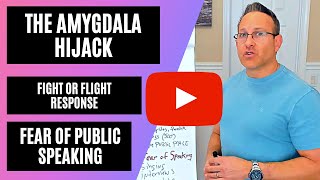
YouTube video by Robert Summa explaining the brain-based causes of fear of public speaking (glossophobia) and offering exercises to 'cure' it. The presenter contrasts the logical prefrontal cortex with the older limbic system/amygdala, describes negative-bias learning from childhood and social situations, and previews physiological and psychological home exercises (military/Navy SEAL analogy) to rewire responses and build coping strategies.
Chapters
Hey, guys, welcome back to Public Speaking Cure, the one and only channel on YouTube that is dedicated to helping you get over your fears and phobias of public speaking. So what causes the fears and phobia in your brain? What is the cause of it? Well, today we're going to deep dive into the brain. We're going to geek out a little bit and learn a little bit about the brain and why we actually have these fears and phobias. And then, aha. How do we undo it? Right? How do we undo those fears and phobia? So we're gonna dive right in. But before we do, I just want to remind you to click the subscribe button. We'll be releasing new content every Sunday or Monday. And also really important here down below, there will be a link to a PDF and it's a self assessment test on public speaking. Where do you fall on the category that scale from no nerves to moderate nerves to severe and even panic attack. In addition, when you click that PDF and you and you download that PDF, you're going to get a 20% discount off my upcoming master course on how to conquer your fear of public speaking forever in just four weeks, which is going to be released around Labor Day. So I can't wait for that to be released. I'm working on it right now. And if you have any questions or anything that you want to learn, put it in the comment sections below because I'm building it out right now. I'm about halfway through and I think it's going to be really a great learning experience for everybody out there. So I hope you enjoy this video on the anxious brain.
So why is it that when you go to these seminars that cost thousands of dollars, or maybe your corporation pays thousands of dollars for these experts, gurus or coaches to come in for a day or two, why isn't they never actually help you get over your fear? It's always in the brochure, get over your fear and then learn how to present better. Right? But they always spend like four, five minutes on getting over fear and they give you these anecdotal breathing techniques that just don't work. It actually makes your fear worse. So the reason why these experts, these seminars, these coaches, the reason why they help can't help you get over your actual fear of public speaking is because they don't understand how the brain works, right? They don't have expertise. They didn't go to school to learn the brain and the psychological parts of the brain and how it works and how phobias and Fear actually are created in the brain, and that's what we're here to do. We're here to crush it. Because speaking in public, whether it's presenting, giving a toast or whatever you're going to be doing, however you present, right? Get up on the stage, sing anything, right? Stage fright. 76 to 85% of the people in the world have the fear of public speaking. And of that huge number, over half have a moderate to severe fear or phobia of public speaking. And that is what we're here to talk about today. And I'm going to teach you a little bit about the brain, or a lot of it. We're going to kind of geek out a little bit here so you can really get an understanding on why we had the fearophobia. Because until you learn the reason why, we can't attack it and actually cure, and I say cure, your fear of public speaking. And that's what my channel is all about doing, is actually getting you to that podium without that fear, right? So that you can present, so that you can speak karaoke, give a toast, whatever it is you want to do, basically you want to be able to rid yourself of that fear and be cured forever, ever, for rest of your life. Never had that fear again. So we're going to talk a little bit about the brain, but what we really want to focus on three pieces, okay? And the three pieces are the prefrontal cortex, the limbic system. And in part of that limbic system is called the amygdala, right? Amygdala. Amygdala is how you pronounce this word right here. And even I have a hard time pronouncing sometimes. So the prefrontal cortex, that is the intelligent part of the brain, the logical brain, okay?
And that is basically very large in humans and primates. And the humans are even bigger than primates. But the primates are pretty smart. They're pretty intelligent. But humans, we can build houses, we can build fire, we watch tv, we can. You know, we're just very logical beings on this earth, right? And that's because we have a very large logical brain.
All animals have the limbic system, right? So all of us, whether you are a bird or a bug or a fox or a human, we have the limbic system, right? And the limbic system is the older part of the brain. And it's basic. It has many functions keeping you alive. And there's parts of it that actually, you know, the blood pressure and your blood temperature and stuff like that. But we're going to go over the part that really goes over the fear response and that is in the amygdala. The amygdala are two almond shaped pieces right here. And basically, very powerful part of your brain, the limbic system is really powerful. The prefrontal cortex is smart, but weak, Very weak. Okay. However, it is this piece, the weak part that we need to train to become stronger than the limbic system. Because the limbic system in the amygdala primary. The primary goal is to keep you alive. So it really has a bias on fear because basically it's an immediate response and that keeps you alive. You know, we go back all to the days of, you know, the dinosaurs and, you know, being in a forest. Just like any other animal out there, it lives in fear. Think about a deer every single day, or a mouse or a squirrel. All it does is live, eat in fear. Getting eaten, right? So this is a really strong part of the brain to keep you alive. So the negative bias is probably nine to 30 times higher than a reward. So let me give you an example of that. You have your yearly review with your boss and he's like, Bob, you know, you're really good at these five things. You're analytical, you're smart, you present well, whatever, right? But then he goes to one piece because you really need to deal with people better. People have a negative response to you. You can be really negative towards people. You can be kind of mean sometime. You really need to focus on that, on that piece. If I were to ask you two years from now, what did your boss tell you? Say two years ago, what are you going to say? He told me I'm mean to people because it has a negative bias. This limbic system is all about the negative bias. Like I said, nine to 30 times stronger than all the rewards. You're not going to remember all the great things he said about you. You might remember one. He's like, oh, he says I'm analytical, which is good. But I think he did. But you're really going to remember the bad parts and there's a reason for that. Again, keeping you alive. It's important for your survival. Touch a hot stove. Ow. Never do that again. Touch a fire. Ow. Never do that again.
So.
Basically what happens is you have a lot of centuries going through the prefrontal cortex and this is the logical part. So what happens is through the logical part, we can also learn fear. Maybe in school we were teased and I always kind of, I kind of think that a lot of, of our fear of Public speaking goes back to being younger, right? And it's a learned environmental. So maybe you're in a spelling bee and you lined up in the spelling bee and if you don't spell it right, you have to sit down, right? That's a negative, a negative bias force, right? Nobody likes that. If you, if you didn't win that spelling bee, you lost that spelling bee in your mind, right? You really lost it. Or maybe your teacher called out on you and you weren't paying attention and everybody laughs at you. Or maybe she asked you to spell a word, you didn't know how to spell it. Or maybe she asked you or he asked you a math question, you didn't do your homework, so you didn't know, you didn't study. And all the kids laugh at you. So you have this built in fear through the logical system that basically teaches your limbic system to be afraid of public speaking.
So here's where we need to go.
Fear of public speaking. So the prefrontal cortex has learned, oh, your boss walks into your office, says, bob, I saw that deck that you, that you sent an email so great that you know, in a couple of days we're going to be doing a department in presentation and I want you to present in front of the entire department of 100 people, or maybe it's the entire company, right? And your, your brain goes, oh, why does it go oh? Because it goes all the way back to the limbic system, which has that fear bias. So its primary goal is fear response, which creates panic and alarm. And remember, the amygdala is there to keep you alive. Think about when you're walking through a forest, okay, back in the day, or even today, you're in the forest by yourself and you're walking around a corner of a path and you hear crinkling of a leaf. That crinkling of a leaf can be either a, a squirrel or it could be a bobcat or a bear. So you go on heightened alert. And when you go on that heightened alert, what does it do? Closes off the prefrontal cortex, right? Your logical part, because you are going now into fight or flight response because you don't know what's around that corner. It could be a bear, it could be a bobcat, could be a squirrel. But your brain is like better safe than sorry. So it goes into immediate alarm, right? Anxiety, you know, you have to, you freeze up, you're ready, go around the corner, you're getting ready. Or you might even stop and say, back off that path. Like I heard Something I'm not going over that way. So what we need to do is figure out is the, uh, oh, a real threat when it comes to public speaking, or is it a false perception? Because just think about it presenting, you're not going to die. Your heart might beat, you're not having a heart attack, you're not going to faint. Nobody's going to come up and, you know, kill you. Nobody's going to eat you. So basically, we need to get over the false perception of public speaking as something that is an oh moment leading to fear.
So what we need to do is rewire the brain how you think, using the prefrontal cortex. Now, as I said before, the prefrontal cortex is logical but really weak when it comes to limbic system. If there's ever a battle between limbic system and the prefrontal cortex, that limbic system is going to beat it every single time. Unless we rewire the limbic system to not see things as a threat. So we can't change the symptoms, right? The heart beating, your anxious thoughts, the noise in your brain. We can't change your symptoms. But what we can change is your relationship to those symptoms, right? So your boss walks in and said you're doing a presentation. You can either go, this is dangerous alarm, a panic attack or anxiety attack. And you want to avoid. You're like, no, no, no, no, not me. I'm not getting in front of 100 people. Or you can say, wait, this is a mental game. It's not really dangerous, right? It's not serious.
So what we are going to do.
Is we are going to through both physiological and psychological. Physiological, mean body, the pitter patter of your heart or the sweat. And psychological, the mind, that noise is. We are going to do some exercises, and these exercises you can perform out of the comfort of your home. Everything I'm going to give you, you can do at home. You don't have to practice in front of people. You know, that's what they always tell coaches. Practice makes perfect. You know, no, you have to get to the mic first. So I'm going to do this through exercises. So I wrote the word military here. And the reason why I did this is to remind myself to give you an analogy, right? So think about Navy seals.
These people walk into.
They get flown into a country, they parachute down, they go into a building to save somebody, three of them, maybe five of them, and they're walking to a building where There could be 50 people, right? Talk about a situation that is a threat, but they're cool, right? They're cool because they have practiced over and over again these scenarios. They go into those homes where the. They have those things that pop up, right? And it's friend or foe. And you have to make a decision really quick through your prefrontal cortex. They're strengthening that prefrontal cortex, right? To react to the situation that's going there. These Navy SEALs can walk to an actual dangerous situation, but they've taught themselves through so much exercise to change the relationship, right? And that's what we're going to do. We're going to create a Navy seal. You're going to be a Navy SEAL of public speaking, Right? You getting excited? I hope you are. I love geeking out. I hope you do too. So.
Here'S what I'm going to create for you. I'm going to give you two models, and we're going to work on both, right? To get over your fear. So this is the Lazarus and Folkman model right here. And basically, this is just an outline of how things work in your brain. You know, cause panic or no anxiety. And this is what we're gonna walk, work on. So you have the input. This input is your boss walking into your office saying, you're presenting tomorrow in front of a thousand people, okay? Because you did such a great job. I'm so proud of you. And you have to first appraisal. Is this a threat right now, where you're standing today? Hell yeah, it's a threat, right? Because your prefrontal cortex has taught your limbic system to not like public speaking. Because when you were a kid, you got ridiculed, right? We all did. That's the problem. All kids got ridiculed. And it's a learned negative bias. So right now you're like, yeah, this is a threat. Do I have the coping strategies?
No, I don't have any coping strategies. I don't know what to do. Anxiety, panic, alarm, right? So we need to get from this place to no anxiety. And there's two ways of doing it. And through these exercises, what's going to happen is the input is. Okay, first appraisal. This is a threat. When your boss walks in and says you're speaking in front of a thousand people, okay? Is this a threat? Okay? The event or situation, you're going to say yourself, false alarm. You know, this could be a false. This could be a false alarm, right? Even though your noises, your head still going to be noisy because we're going to change the relationship of that noise. Or you might get the pitter patter, like, oh my God, what am I going to do? Right. But you're going to change your relationship with those things. So is this a threat? No. In the beginning, while we're doing these exercises, it's going to be like, well, maybe, but after some exercises you're going to be like, the second appraisal is, but do I have the sufficient coping strategies? And you're going to say, actually, Bob Summa taught me some coping strategies. Yeah, I do have coping strategies. No anxiety, no panic, zero. Right. And eventually, through these exercises, and some are going to be more psychological than physiological, we have to go over the, the pitter patter of your heart, the sweating, the trembling when somebody tells you something and that noise in your head. We're going to attack both. And once we attack both, you're going to become like that Navy Seal because we're going to do these exercises out of the safety of your home. You're going to do it by yourself. You don't need other people. And through these exercises, eventually, you know, this is, you're right here, you're a military, right? You're a military. You're training, you're training and training. So you know, you have coping strategies. But we're going to create a Navy SEAL out of you. We are going to cure your fear of public speaking so that you never have anxiety or panic attack for the rest of your life when it comes to public speaking. So I hope this made a lot of sense. So again, we're going to repeat this recap. We are going to do exercises to change your relationship. We're going to empower you with these coping strategies and then we're actually going to remove the entire perception of, of a threat and forever so that you don't have anxiety. Next time your boss walks in and says you're going in front of people, you're gonna be like, yes, okay. You'll be really pumped up.
More from Robert


The Dark Side of Deep Breathing: How This Common Technique Intensifies Your Public Speaking Phobia!


MUST WATCH! Fear of Public Speaking Explained 🎤 | Grab Your FREE Mini-Course Today! | Link Below!

What is the FEAR of Public Speaking (Glossophobia) | And Can We REALLY Overcome It?

Why You REALLY have a FEAR of PUBLIC SPEAKING | The ANXIOUS Brain (Part 2) | Glossophobia