Paolo Lombardi & Adam Berk | How To Nail Your Startup Engagement Program 14 March, 2023
Webinar (14 Mar 2023) by Paolo Lombardi and Adam Berk about designing corporate "startup programs" (accelerators, incubators, challenges, corporate venture funds, hackathons, venture client models, etc.). Core thesis: there is no single best model — success depends on alignment among (1) the corporation’s strategic objectives and governance, (2) the program features (funding, education, admission, duration, location, mentorship) and target startup segment, and (3) the maturity and motives of the reachable startup ecosystem. Key practical points: break programs into recruitment → activation → follow-on stages and design the follow-on (integration/scaling) before running programs; validate features with small tests (lean approach); adapt common features (e.g., demo day) to solve integration problems (invite core business to selection/pitching). Draws on research of ~450–500 programs and includes examples (Startup Chile, Microsoft ecosystem programs, World Food Program accelerators). Audience Q&A covers recruiting scientists, keeping alumni engaged, avoiding the ‘pilot trap’, and installing a ‘gearbox’ to align startups with corporate performance/portfolio/process/product management systems for scaling.
Questions this video answers
They surveyed more than 450 programs, nearly 500 in total.
A free half-hour online session with one of the presenters if you photograph your canvas and send it to them by the end of that day.
"Startup Program Design" — reported as 105 stars on Amazon (as stated in the webinar).
Chapters
We're going to discuss startup engagement programs here. We use startup programs as a short version of that. What we mean by that is every organization has the problem of ambidexterity, I.e. the ability to deliver on the core business and core activities, even if you're a government. And the ability to self innovate the organization. And this can be done by the book in three different ways. One is you build, so you use your internal R and D or everything like scum quarks. It can be completely inside, a bit outside. You can buy, so you can grow inorganically and buy innovation through acquisition. And that's at the right end of the spectrum. The M and A that you see on the right side of the slide or.
Paul, we don't see the slides yet.
Oh, you don't see the slides.
Yeah.
Thank you, Frank. There we are.
There we are.
Okay.
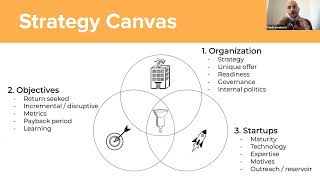
Right. And so build by your partner. That's the title of the slide. I was at Parner, so Parner is not just a hybrid, it's different. It's a way to tap into things and innovation that has not been thought for you and obviously needs some adaptation to be to enter your organization and innovate your organization. So that that complicates the things with respect to other patterns. It's called every. Every of these patterns. Everyone has got its peculiarities, pros and cons. It's not that one is better than the other. We're not gonna say that partnering is better than building or buying. It just depends on your strategy and how you mix these ele. Today what we are really going to focus on is partnering with startups. So how your organization to solve ambidexterity can engage with external startups to innovate. And just a terminology point here, what are startup programs? Well, they are everything that encompasses incubators, accelerators, challenges, corporate venture funds, akathons, collaboration platforms, venture clients. And there are many more names out there, everyone with a different nuance. But in general, we use the term startup program. To encompass all of these. And they are programs that are made to engage with the external startup ecosystem and the startup community around your organization to get to a partnership between your organization and a startup of some kind. And if you think about it, they're very different. Right. So accelerators, corporate venture funds, akitons are very different, but they all have common traits that we call features. One example is they all have a very defined duration, beginning and an end. Most of them have two, if not all three of these stages. A recruitment stage where startups get identified from the external community and brought into the program with an admission process. And then there's an activation stage where you do something with the startups and you can ask them to pilot a project with you or other things. And then there's a follow on stage after a graduation. There is another funnel there. And the follow on can include other activities. For example, integration of the pilot in your organization. And another, another example of, sorry, the partnership can be, actually can happen at different stages. In the last example I gave, so the integration after the pilot, that, that is the longest arrow that you see there. So actually the real partnership happens in the follow on, but it's activated in the activation stage. There are other examples like Akatos where you only engage startups for like two or three days, or challenges where you engage them for three months. And there the partnership happens during the activation stage and rarely it could happen also in the, in the recruitment stage. And then there are various features here as well that are in common. Funding, for example, is usually involved in all of these programs. It can happen at the beginning of the activation stage, like in accelerators. It can happen at the end as a prize, like in hackathons or challenges, or it can be distributed throughout the activation stage, like in incubators. Take another example of education and mentorship that usually happens during the activation stage. Think of accelerators or actons. But more and more there are programs like Zync in the UK that is targeting researchers, or Oasis 500 in Jordan that operates in an ecosystem that needs some education, that put education and mentorship already in the recruitment stage and that can also be in the follow on stage, like for example, alumni activities or mentorship for alumni. So the point here is that there are features that allow to create a design space around softer programs that can be flexible enough to address different needs and different goals, depending on what you want specifically to achieve. And other features beyond those I mentioned before, funding and education are the location and how you do the admission process, the graduation process, whether you give office space or access to labs or manufacturing or anything like this. Now a question we got asked really often during our research was holy grail is the program that is better than others all the time. So one learning that we got is that no, it doesn't seem there's any holy grail in startup programs. The answer is always, it depends. When you ask what's the best model for me? Well, it depends. It depends on your organization, on your objectives, on the status of the startup ecosystem that you can reach out to and the Beauty is that these kind of products that can be designed, you don't need to go buy the book if you don't, if you think that doesn't work for you, you have these, this design space available that has become clearer and clearer to the point that people have already designed and changed the models a lot. And we believe this is going to continue to the point that every organization being so different in strategy, in internal governance and organizational issues itself, and also its stage of maturity to working with startups, it will have a different way of instantiating these programs. But the only grail, another learning we have is that the holy grail is actually like in everything is in alignment, inconsistency. So if you create a program where everything is consistent, that's the secret, that's what works. And one thought about it, if you create an offering with the features that you see on the left, that will attract like any other product, a very specific kind of segment within the startup ecosystem, it could attract idea team stages, whereas you need a late stage startups or vice versa. And you will then create a partnership, whoever comes in the program. The point is, or you'll be able to. The point is, does that partnership achieve the objectives that you had for startups, for the startup partnership? The idea behind this is that obviously you want to start planning like every product or every initiative from the objectives that you have and backwards to what kind of startups can help you achieve those objectives and then backwards to what kind of features you're going to put in the program to attract and those startups and make them work well with you. And this brings us to our strategy canvas. While we were researching Adam May remember we've had I think like 4, 5, 6, 7 different attempts of creating canvases. But at the end we really understood that there are three things that many organizations didn't nail. That is the overlap, finding the sweet spot of this Venn diagram, the intersection of the organization itself, its strategy, its unique offer to startups, its readiness level to working with startups. Maybe you want to start from an easier program before you and test the water with that before you commit to bigger programs. The governance within the company, internal politics is, you know, is marketing on board, is R and D on board and so on the objectives. So depending on the objective, whether you want to integrate external innovation or you want to find diversification opportunities, or you want to enter different markets, these are very different objectives that can be targeted with different structures and different startups. And the metrics that go with them obviously change as well. And the payback period, if you want results in one, in one year, that's going to be different than 10 years required by corporate venture capital. The learning you want to get because sometimes, as I said, you may want to prepare your organization for a more advanced program to come later on. And third point is the startup ecosystem. So the maturity level there, the technology, the expertise that can bring and the motives. Now if you can combine this, if you can understand the context so these three, three big circles, then you can design a program. But starting with a program doesn't always work if it doesn't match the context. And let me give you an example which I'd like to develop with Frank because he's an exper of growing organizations. So there are different goals and different types of programs and some of them have nailed it. There are programs that align with startups by having a common goal, that is the growth of the startup itself. And the corporate venture capital sometimes does, it sometimes doesn't. One case where at least in their claims and would they communicate it's been done. It's intel capital where the strategy was or has been recently to invest in startups that can grow. And by growing they affect positively Intel's core business. That doesn't mean they need to be integrated. It could be actually startups that promote a standard that intel is interested in or they stimulate demand for intel products and that doesn't require any integration. So the growth of the startup is going to affect the growth of intel without any integration. So this is kind of a sweet spot of corporate venture capital that works very well by keeping alignment in the long term with the startup on the same goal. Now that's also a third learning I'm going to give you. That is a lot of the programs we have surveyed and we looked at more than 450 programs, almost 500 to write this book. It is that a lot of them plan very well, the recruitment and the activation stage, but not so well, the follow on stage. That is actually where most corporations tend to fail. And so once you close a partnership, then what happens? How do you integrate that technology? How do you grow the startup? How do you support it to grow more? How do you develop an ecosystem based on your platform if that's the goal and so on. Our take is that in design it's really important to start from this stage and then maybe have walk backward. I think I've spoken enough. And this is the last slide. These are our two contact emails. You can reach us there. And Adam really likes this. So he asked Me to put. If you like this presentation and you want to know more, we're gonna give you half an hour online session with one of us for free if you take a photo of your canvas and send it to us by the end of today. Right, and that's our website. I think I'm finished.
Super, thanks a lot, Paolo. Could we go back from screen sharing now? There we are. Friendly people there. Adam, anything to add?
Yes, I have a new gimmick other than the canvas. I wasn't going to pander for reviews but I think we need some 4 star honest reviews to give us some street credit. So I think like you said, I could do that. Like you said, you know, all good things happen in debate, you know, so you know, you can't please everyone. So yes, that was my other gimmick. But let's. Gimmick's over, let's get back to the book.
Okay, so Andrea asked. Andrea, would you mind coming on mic and ask your question directly in the chat?
Yeah, sure, Frank.
Yeah.
So when you presented the funnel it was interesting to see of course the different phases of engaging with startups. So I was wondering if you have any tips on the most effective way of engaging with them on one side during the recruitment phase and on the other side how to keep in touch and keep them engaged during the follow up stage. So we have tried different things such as LinkedIn groups, email one to one. Then we were wondering whether there is any golden rule there.
So I'll be bold and I hate to, you know, have in mind the world. The world did not need another canvas, you know, but we really pushed. We were inspired by the Japanese ikigai. If anyone's seen that, you know the reason for living, do you mind sharing quickly your organization, who you are, the job to be done. So I'm also, we're both also big fans of jobs to be done. So that was sort of circle two and then the type of startups, I think it's really important we're seeing all different types of specialization right now because you know, our definition of startups was just external but you could have students, you can have two folks in the garage, you have scientists, you have social impact, entrepreneur, you know, there it could be, it's so wide ranging and that's why Paul and I finally, we got really passionate about well it depends. But we don't feel like that's a cop out answer because as long as there's balance, we do feel like we're at least, you know, drawing a line that there is an answer. It's not always, it depends but it doesn't. But there's the balance. So if you don't mind and I'll try not to take too much time, quick organization, job to be done. It's not always, you know, chasing unicorns. Sometimes you know, there's, there's acquiring new technology, equity environment, culture, job creation and then who do you think you're, you're.
Yeah, absolutely. So quickly me and Jessica here on the call as well. We come from the University of Zurich BioMed Entrepreneurship Team. Job to be done is basically to provide coaching and training to aspiring life science entrepreneurs that would like to bring their innovations from the lab to the market. So by the training we hope that we help them avoid common mistakes, get access to key learnings from experienced entrepreneurs. So on the recruitment phase they are very much scientists thinking about the business. But on the follow on phase some of these are, you know, start to be established startups that already have some investment from VC and so on.
So I think the short answer is go ahead Paola.
Well, I think no, I'll let you speak Adam, but I have direct experience of this actually. So here the question with scientists is that they don't have role models. Some of them think the reason why they became scientists was not to start a company, otherwise they would be entrepreneurs since day one. Right. So you want to create role models for them in the communication first of all before even going out and start a call for interests by, by showing scientists that actually have a big impact on the world thanks to technology transfer and the fact that they sacrifice their academic career and academic dream to have social impact or economic impact through this startup activity. So that's a first piece of advice. You have to create a relationship that starts very early on, on before the call and the other for the follow on. It is dislike everyone else there you probably want to, so you just, you probably want just stay in touch because you, if you are university, I suppose you don't take equity so that that's not a way to, to link yourself to them. But so keeping in touch means tap on your alumni network so heaven speak to the other scientists, have them come in and select people to enter your system, your program and try to create mentor opportunities for them as mentors or to meet again the mentors of your program later on and that is going to open the way for you to actually get updates because that's not a problem. I guess you have that you don't know your impact three years after because startups stop answering your emails. So but if you create these occasions and you create a relationship that, that is what I, I see it may work.
Do we have time for one more question? I think there's a very interesting one from Mass. Did I get this right? You want to come on on mic?
Yeah.
Hope you can hear me.
Yes.
So yeah, so I, I was just hanging on to your. And thank you for the, for the presentation. So so obviously I was listening to.
The.
Element on the, the follow on activities like so I guess we can all create interventions and I think we pretty much have figured out how to scout and source and maybe do matchmaking and design pilots and execute pilots. But I think we are sort of in that process. We are somehow accumulating, let's call it organizational debt in a way that someone needs to pay off. And it's not the innovating team that are going to pay that off, it's in the organization. So we're dealing with this constant flow of, of change where traditional change management is just not going to cut it. So I was just looking for some pointers or maybe expertise or hubs or some people in the world who are. Are passionate about this question and maybe have some advice.
Two minutes please. Paolo and Adam. Is there a short answer?
Paolo? Well, short answer is that you have a few passionate people here in this room beyond Adam and myself, Frank. Absolutely. But in the. The other. So the, the point is that one of our interviewees has said internal innovation teams should walk more the corridors of the corporation rather than the startup ecosystem. The corridors in the startup ecosystem. Meaning that what you said is totally right. You fall into risk to fall into the pilot trap where you actually do a lot of pilots and then nothing happens because the organization is not ready. There are programs we mentioned venture client that, that is going to be covered in another talk later in this conference. Yes, but other programs also, Frank, what you do that actually tackles specifically the preparation of the organization before you even start looking for startups. Right. So and that's a learning we got for innovation sourcing or solution sourcing. That's what you need to do before even starting. You need to make sure that at least the business, the problem owner is there and active and has budget to commit to a follow on to the pilot and has the structure, maybe engineering is on board or to actually, to actually go on. But I'll let Adam talk now and I'm sure. Well there's something just, just a second.
Adam. Double checking. Max, we do have time until 45 past the hour, right? Yeah. So because in my meeting, invited only said going to 30 minutes past the hour, so. Okay, that's fine, Adam, back to you. So that.
All right. I like how you strategically went. When you thought we were short on time, you went to Palo. I think that was a smart move on your part. But now, so I won't suck up too much time, I heard two questions there. I heard a cultural question, and then I heard a more tactical question of integration. I think there's a quote in the book, we have more pilots than Delta or a European airline of your choice. I think what's beautiful about this and what Paolo was alluding to, if you think about an actual sort of feature change, demo day is this placeholder. It's sort of this common theme. But when people started to realize that there was this integration problem that you needed to sort of preload the business units, demo day switched from a demo day to sort of a matchmaking between the core, you know, the not made here syndrome is addressed head on by either putting the core businesses on the selection committee or having a demo day where they're pitching. They're making that relationship early. So I think it was one of these if then statements where, where you have the placeholder of a demo day. But the adaptation came when demo day was switched to meeting the core business to literally solve the not made here syndrome. So there's little feature adaptations like that that if you know exactly what you're trying to solve for, the feature changes become obvious, like that one.
And there are also programs where the demo day or the matchmaking actually happens at the beginning of the program, at the very beginning. And they are usually programs that collect more than one company from kind of the same sectors so that you also have your competitors at the table. So if you're really interested, you're going to push to get a relationship with the startup. But it seems it really works much better than the classic demo day of accelerators at the end. Doing it at the beginning sets the stage very well.
Would you want me to chip in with one of the comments that I have, Paulo? Okay, so I'm coming from, as I said, from the question, how can corporates build new businesses? And this deals with corporate startups, meaning from some entrepreneurship programs, some corporate mavericks that burn for the idea, but also applies to greenfield startups from the outside side that the company takes in and scales it to leverage, to multiply the size of its investment, and obviously to also the technologies that these bring. So what the 20 companies and two business schools that co created the lean Scale up has found as best practice is to say there needs to be a dedicated phase between, let's say honeymoon, right? The POCs, the getting to know each other, do the market testing, that kind of phase and the actual making it big stage, scaling up many, as it is called by many companies. And in this phase you basically need to install a gearbox between the, between the corporate startup or the external startup and align it. You've got two value creation systems on the one roof, right? The day to day business and the new stuff, right? Coming from the inside or coming from the outside. And if you dive deeper then what, what's going on in this phase we see three streams, Adam. It's, it's, it's the organizational debt, right? And, and other debts that are still open. Are we really scalable when it comes to go to market or the technology, etc. That kind of stuff, right? That needs to be taken care of in the subsequent scaling up phase number two, and that's the decisive point is you align and it turns out that the trick is to get that external startup or the internal startup into these systems that trig the organizational behavior of the core of the day to day business. Turns out mass that they are so called PM systems, right? A lot of systems that have a P and an M. Performance management, portfolio management, process management, product management, etc. And you need to weave in the new stuff into this target system so that you get the corporate support. Anything to add from you, Paulo?
Yeah, no, that's absolutely perfect. I understand everything you said. So that's kind of basically what we mean by planning the follow on stage to the program before you, even as part of the program planning. I mean that's part of the program design. One of the common mistakes is, as Maz, you said, it seems like the innovation team doesn't take responsibility of that because it should be the company. There's that division there that is not as black and white. In fact it shouldn't be black and white. It should be that the innovation team that is part of the company helps create that follow on stage as part of program planning before starting. So that gearbox that Frank was mentioning should come even before you start the first call for startups if you want. Obviously it's not always possible. Maybe you want to pilot one part of the program before the other one is started because otherwise you, you would wait for three years before you know, you get the budget approval, etc. Etc. So there are tactics that go through that learning so you can create a program that as an Objective as learning. And that's actually communicated to the executive leadership. So we are doing a pilot program where we're going to test our recruitment and activation stage. But there won't be any integration here because we didn't get the approval from engineering to commit resources yet. But you get the ball rolling in the meantime. So there are tactics you can apply there, but you definitely want to get to the point where you plan that follow on stage before you run the real program.
Any more questions from the audience? I do have one. Paolo and Adam, I mean you researched some 500 programs. I think that was the figure that you mentioned. Which one impressed you most? We understood the message. There's no one size fits at all, no best program, quote unquote. But which impressed you most and why?
Oh, this is a tough one.
That's why.
I mean.
I think I would be unjust to do name good name dropping here, but.
I have, I have a couple. I'll, I'll take that. This is no disrespect to anyone. I'm not naming. But yeah, I mean Startup Chile was, you know, I'll go a little. Startup Chile was, I think what influenced some of tech peaks. So they reinvented a model and I think they've also evolved from the job to be done from, you know, techstars obviously created, you know, we've been following them a lot recently. TechStart stands out and created with, along with Y Combinator created this sort of shell of this model. But I think Startup Chili stands out because they sort of of started the ball rolling in this adaptation in terms of like they're going to use the, the framework of an accelerator but for a different purpose instead of just to find unicorns or to make money for job creation. And they, so they use the same formula for a different purpose. And I think even internally they, Paolo, we remember they went from job creation to this. What was their second thesis?
It was economical growth of Chile. Part was cultural and the second part was job creation, actually.
So my answer for now, Startup Chile, I think, you know, sort of set, set the standard. Then obviously there were some, some Microsoft programs that also. The job, the job, the job to be done was different. It was not necessarily roi, but I think with their ecosystem and sort of giving, you know, the, they were explicit about what the role was not to create unicorns or to create roi, but to create a healthy ecosystem on Microsoft platforms. And so that was consistent and aligned and balanced. And then of course I would have to mention the World Food Program. They started with with one accelerator and, and now I think they're up to 30 programs and they're doing good work for the world. So that's what I call the chapter six, like an impact. An impact related program. I have to mention some of those as well. I feel bad if I left it left anyone out.
Paola, which ones impressed you most?
Yeah, I think I, I can only reinforce what Adam said. Programs that are very well aligned and consistent are very impressive because there's a lot of design that went there. There'. I won't say the name, but it's in the book where they, they planned to create an ecosystem around their technology platform. And the way they did it, they, they actually created briefs from, they took briefs from internal units that wanted an addition to the technology platform. At the beginning they really had to push for obtaining that those briefs because people. So startups will never, will never bring anything. But then the way they, thanks to those briefs, they identified the startups, they created success cases that were pushing the use of the platform to the point that year two or three, they started having too many contacts from internal units and too many briefs. So they couldn't run as many call for startups for all the internal units. Units that were actually seeing success in other stories and wanted to replicate that for the units. So when you get that alignment of features, then that's when it works. And when people say we tried corporate accelerator and it didn't work for us. Well, did you ask yourself why didn't work for us? Did you copy paste another program without adapting it? That usually is one of the reasons why, why it didn't work and because you didn't make sure that the features were aligned with your context.
Okay, I've got one more question from my side Paolo, please, a short one and then another one from Brett in the chat. How do we know when the features that you want to design into that startup program, the funding, the education, the mentorship, the follower are actually aligned? Is that just a mental exercise that you look at it or do you have litmus tests and where you can EAS judge? Guys, this is not fully aligned.
Yeah, that's a great question. Obviously it can come from a few things. So you actually look at models and people who already tried some features of that model if would work there or not your own experience and then test it. So exactly what you would do with another product. So. And both Adam and I come from the lean validation and lean startup movement. So what do you probably want to do if you're, if you're Big and uncertainty whether those features are aligned or consistent. You want to invest less to a smaller program. Test only one part, for example, the recruitment by doing a challenge before you do an accelerator or doing an accelerator before you commit to a corporate venture fund and so on so that you understand with the lower investment whether there's consistency. I'll close those. You said to be brief.
Okay, so coming to Brett's question, what are the ramifications of why Combinator's pullback from late stage startup investing to focus on its core accelerator program?
This is today's news, basically.
So, okay, yeah.
So why Combinator? Because, I mean the claim is that it's not related to Silicon Valley bank crash, but Y Combinator announced today, yesterday or Friday that they would reduce their investments to only from late stage to early stage. Now it's debated why they actually did it and the ramifications. I think Y Combinator has always been started as a very early stage investor. So I don't expect a big negative impact on, on the startup ecosystem by actually ycre focusing on their main core business. So I'll, I'll give it to Adam.
For Adam, short one, we have one minute left.
I'll, I'll double back and answer the, the, I think Paolo nailed it with the features and validation and testing. And then when we first started writing the book, I, I was mindful not to just force the lean startup product management, but it's just like any other product. And so if you have a marketing hypothesis about how to attract startups, test that. If you have the demo day adaptation and you think you're trying to test and you have a hypothesis, test that. And if you do that independently, yes, you can use the framework, but it's your job to start making the balance is up to you and test those things things independently and, and I think you'll succeed.
Okay, so thank you very much Paolo and Adam for being with us with the audience. Startup program design is the name of the book. It's 105 stars at Amazon. And Max, you already pasted the link to the next session in the chat window. So I hope you get a lot of value out of the session and looking forward to see you shortly then. All the best. Famous last words. Paolo to Ender.
Well, thank you very much, Frank. Thank you innovators for having us here.
Okay, see you soon. Goodbye.
More from Adam


Brad Feld from Techstars answers the inevitable "funding" question from the audience.

Preview! Talking Startup Program Design w Bernhard from the World Food Programme Innovation Accel