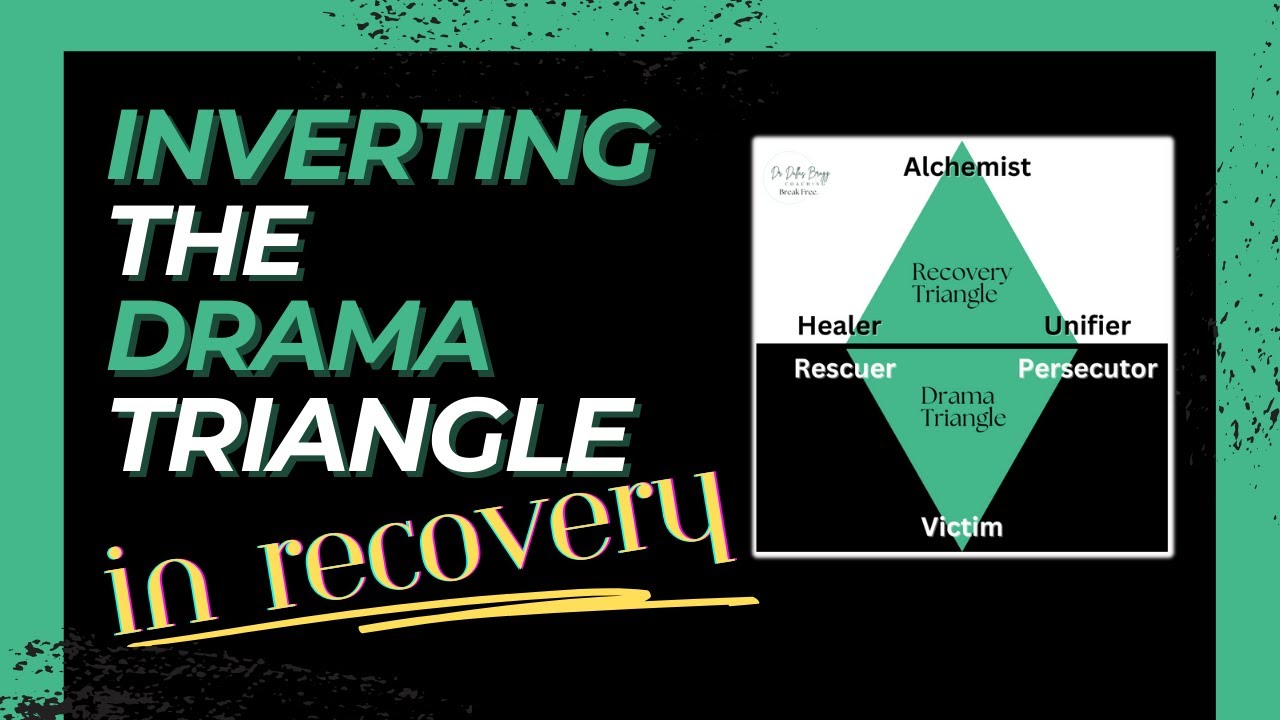
In this instructional video, sobriety coach Dr. Dallas Bragg shares his personal journey through the "incubation" stage of addiction, describing how he juggled numerous social roles—father, husband, leader, salesman, etc.—and ultimately adopted a martyr‑savior identity to gain self‑worth. He introduces Stephen Karpman's Drama Triangle (Victim, Rescuer, Persecutor) as a framework that maps onto addictive behavior, explaining each role and how it manifests in recovery communities. Bragg then presents his own "Recovery Triangle," an inverted version of the Drama Triangle, consisting of the Alchemist, Healer, and Unifier. He outlines the light and shadow aspects of each role, ties the model to the universal law of polarity, and offers concrete steps: self‑reflection, journaling, and an action plan to shift from a drama role to its healthier counterpart. Throughout, he references Gabor Maté on trauma response, provides a link to a deeper article, and invites viewers to contact him for free coaching, subscribe, and engage with the concept. The video’s purpose is to give addicts a blueprint for evolving their relational patterns toward empowerment and wholeness.
Chapters
Hey, Dr. Dallas Bragg here, sobriety coach. Today we're taking a look at the roles we play in active addiction, or when you're in what I call the incubation stage, which is pre-addiction, when you can retroactively look back and see, oh, that's why I became an addict, and how to transform these roles into their healthy counterparts and to supplement your recovery journey. You are not going to want to miss this one. Now, I can remember many nights pulling into the driveway after a long day of work. This was when I was closeted, married, with 2 kids. I remember I sang pretty heavily most nights, which indicated that I was feeling pretty shell-shocked by all the roles that I had to play that day. I had to be the crafty salesman. I had to be the influential leader, the responsible citizen, the supportive coworker, the obedient subordinate, the charismatic networker. That's all in one day, changing hats. All day is exhausting. Each of these roles requires its own set of unique perspectives, right? Responses and approaches. It can be easy to lose yourself, your sense of self, in all of these roles. Or, as it was with my case, the multiple roles allowed me to drown out my sense of self. It's because I believed that true self was going to be rejected, that it was abnormal. So back to my story. You know, car lights driving into the driveway would always prompt what I would see— 2 little silhouettes running through the house. And that was my kids. They were coming to meet me at the door. Daddy, daddy, daddy. Now it was time for me to take on new roles. The playful daddy. The academic scholar. I was always working on school. The attentive husband, the attentive husband, the handyman, the gardener, the shrewd financial manager. You know, at some point I would finally collapse into bed. So, you know, all this, these roles, this prior list that I'm talking about, they were really sub-roles. My main arc, my main character, Was playing the martyr. The story that I had in my head, it placed me as the sacrificial lamb to keep everything else alive around me, like a plate spinner. And I thought of myself as a hero because I placed my needs last. But the truth was that I made myself indispensable so I could feel a shred of self-worth. Didn't have it inside, so I had to get it somewhere. If we aren't claiming our inherent worthiness, what we're born with already, we're going to look elsewhere to fill that gap. You know, my story is a prime example of how addiction does not discriminate, because from the affluent to the homeless— I'm not saying that they both have the same trials and tribulations, but they do share common ground. Because externally, I was an all-American dad, right? I was a successful leader climbing the ladder. But internally, my emotions were bubbling up and they were churning like a volcano, like volcano lava. But fortunately, there's a— there's an academic term to describe my behavior, my martyr-like behavior at that time. And so if we look at Stephen Karpman's drama triangle, I'll bring it up here. He coined the various roles of dysfunctional social interactions. Karpman's work didn't focus on addiction per se, but it is relevant to the roles we accept as addicts. So take a look here. You see there's the victim, rescuer, and persecutor. We'll talk a little more about what those mean in just a minute and how they apply to you as an addict. The rescuer in this example is a better— rather than the martyr— is a more accurate reflection, really. A better reflection of the role that I was accepted, that I took on as my narrative. Rescuers jump in to save others or the situation, right? Whether it be work, at home, wherever it is. The rescuer strives to be an indispensable solution to all problems, Everywhere. But because becoming all things to all people helps to deflect their own trauma and their own work and their own healing. And of course, we also feed off of validation. The season of my life was— it was, like I said, the incubator for an active addiction. It was working. It was heating up. It was in there, right? But so before helping someone solve their problems, Go within to discern your true motivation. Because do you ask yourself, do I desire to serve this person, or do I need to feel worthy? Am I fulfilling my own insecurities? I see this type of enabling behavior a lot with sponsors in the recovery community. So the victim. The victim perceives the world as out to get them, right? They'll always find blame for their current life condition. There's a complete lack of accountability. So as addicts, it can be really easy to assign blame to parents or adverse life conditions in the early part of your life. It's tricky for me because as I help clients peel back the layers of their own addiction. Together, we're pinpointing circumstances that created the conditions for their addictive behavior. For more on this, you can see my video, When the Why Matters. This is an act of self-awareness, right? But it's, it's not blame self-awareness. So as Dr. Gabor Maté says, and I quote him a lot, it isn't what happened to us, it's how we reacted to it, right? So what happened in the past informs self-awareness in the present. So we're going to embrace empathy for our parents or anyone else who harmed us. Any other condition from our early life. We're going to develop empathy for that. We're going— we are connected. Because we're all connected and we're all traumatized and we're all unified in this journey back to wholeness. So we give people a break. The persecutor is like an overly critical parent, right? Or an auditor. So they, they are the first to point out the flaws in others or their situations. They act as self-appointed auditors in others' recovery journeys. And like an auditor, they assume self-appointed immunity to any mistakes. They're never to blame because they're doing the auditing, right? This role can be seen among a lot of veteran sobriety people in recovery. The persecutor's restrictive and punitive approach, it really creates an unsafe environment for newly sober folks. I hear a lot, this is how I did it and what the Big Book says. So it's the only right way. So I have created the Recovery Triangle. It's inverting the Drama Triangle to help you elevate and supplement your recovery journey. So for your consideration, I've created an inverse of the traditional Drama Triangle. Here it is. If you identify with one or more of the Drama Triangle roles, This is going to give you a blueprint for evolution. As with anything else, every role has a light and shadow aspect. So I presented them here. I presented the light aspects of the shadow drama triangle. So you see we have Alchemist, Unifier, and Healer. So for example, if you're playing the Victim role in the drama triangle, Do not— don't reject that part of you. Don't dismiss it as part of yourself. Embrace it. Embrace that it served you for a season and then transmute that into its higher version, which would be the Alchemist. So I created this model by incorporating the universal law of polarity. And the law of polarity states that everything is on a spectrum of opposites. For instance, hot and cold exist on opposite poles of the same element. which is temperature. Hot contains some cold in it and vice versa. So components of both sides are essential. There's parts of each in each element, right? In each component. So let's take a look at the inverted recovery triangle roles. So let's look at the Alchemist first. The Alchemist observes injustice of trauma because a lot of trauma is injustice. It observes maladaptive tendencies that you've created along the way, but it does not identify with them. The narrative of victimization is going to shift into a narrative of empowerment. The alchemist transforms the dull ore, like if you can think of like iron ore, of what happened to them into golden opportunities. So you use the pain of what happened to you to fuel your drive. The healer, the healer seeks to give back through service to others. The motivation is to facilitate individual empowerment. So the narrative of the savior complex shifts into servanthood. So the healer equips others through their own experience. And they really delight in the advancement of other people. Okay, so the Unifier upholds the oneness of all creation. They're going to advance the notion that there is no right or wrong, only learning. The narrative of persecution shifts into interdependence. So all hierarchy is going to be dissolved. The Unifier understands that everyone is a reflection of So which role on this Recovery Triangle would be ideal for you to embody? Read the description of that role or listen to the description of that role. You can also read it online. I'll put this— I'll put the link here to my article about it. Begin journaling around how you currently align, where you're off base with the role you want to be, and devise an action plan To make subtle changes right now to get yourself to that role. If you'd like some assistance with this, feel free to email me. My contact information will be all in the description of this video. You know, I spent many years priding myself in fixing other people's messes, and I always thought, how could helping other people feel better ever be a negative trait? But it was. It felt good to me at the time, but so it is with shadows. Right? The unconscious rejection wound that I had was a shadow I didn't know I had. It pushed me to plunge myself into the needs of others so I could ignore my own needs. I was carrying some deep pain and I sought out external validation. So I was addicted to fixing other people. Using the Recovery Triangle, I can now embody the inverse role. Which is healer. This is what motivated me to launch my sobriety coaching business in the first place. I help others feel empowered to heal and show up as their best selves. If you'd like to sign up for a free coaching session with me, please contact me here. All my descriptions, all my contact information will be in the show notes. I don't know, it's not show notes. All the information will be in the Uh, description of the video. If you like this, if you are still watching and listening, please subscribe to my channel. I would love to hear from you. If you can comment, give me your thoughts. What would you change about the Recovery Triangle? What would you add? What would you subtract? Is it a good concept? Does it make sense? Give it to me straight. Um, subscribe, sign up for notifications, and then if you can, follow me on all my social medias as well. I think you'll get— I post different information on different modalities depending on what they allow me to do in the algorithm. So anyway, have a great day and I hope this helps.