From $0 to $20k/mo in 3 Months inside Client Ascension (How Alex Scaled his B2B Accounting Company)
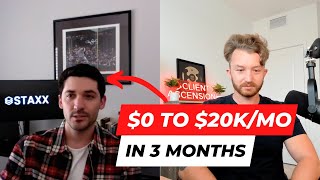
Alex Tenorio scaled his fractional CFO service, Stacks, from zero to $20k/month in three months using Client Ascension. He relied on consistent daily outreach (50-100 contacts via cold email and Twitter), built repeatable systems, and tapped the community for help with offer design and hiring to push past the $20-30k ceiling.
Chapters
Yo, what's up, everybody? I got Alex Tenorio here. He's. He's a member inside Client Ascension. What's up, brother? Thanks for coming on.
Yeah, thanks for having me, man. Good to be here.
Could you share what you joined Client Ascension at, what revenue level and what you're at now and how long it took you?
So I actually started at zero. I really needed some help building and crafting, like a whole new offer for what I do. I'm a CPA and I do fractional CFO services for agencies, E Comm owners. And yeah, started at zero. Daniel, you helped me a lot just crafting the offer and actually changing it and that kind of really helped springboard the whole start of all this. Sweet.
So where are you at now? What's your revenue?
Revenue right now? Doing about 20k a month, hopefully by the end of this month. It's like middle of May. My goal is to get to 30. Got about two to three deals that could get me there. So it's been, it's been a bit of a whirlwind. It's been really cool. But yeah, 0 to 20k right now and trying to get to at least 50, hopefully by the end of the year.
Yeah, we were just talking about this before we started the recording, but like you were essentially saying the things that you did two, three months ago are starting to take fruition now. And I think that's a super important thing for a lot of people. They don't, they don't understand that where if you were running some kind of like E Comm business or whatever, and you're selling like $20, $30 products, a lot of your results or your sales will come almost instantaneously upon you executing some marketing action. But this is a little different because you're selling like a high ticket service to sophisticated business owners. Right. And they have sales cycles and you have to execute outbound campaigns, obviously, like you're, you're doing cold email. So like kind of from your anecdotal experience, what's that, what's that been like? And does that like, how do you not get discouraged when you see like, oh, you're doing something for the first like month or two months, and in hindsight, it doesn't sound like a long time, but when you are existing every single day of 60 days of nothing, see, it's a little different.
Yeah, 100%. So one of the things like I picked up from one of the calls that I was on with you was you mentioned a latency effect, which was those messages that you're pushing out those initial campaigns, there's going to be a point in time where that the effect of like the long tail effect of those campaigns might not actually really start hitting. Especially once you start the consistency of outbound, it could be two to three months to where the, that daily effort is going to start bearing some fruit. So for me at least when I started pushing out actually it was cold email, but also automated Twitter dms. Just getting in touch and building those campaigns and just doing the little things and making sure that at a minimum daily I'm reaching out to 50 to 100 different business owners, that those things have to be consistent. And that two months in, that's when I really started to see those responses and clients actually start to close. Like I just had a client, I followed up three to four weeks after we initially talked and it's now been two months and they just closed and they're actually one of my biggest clients now. So I think like, especially when you're getting started, like it's hard, you have to put in the effort. There's, when you're getting things started, there's a lot of front loaded activity. It's similar to like dropshipping if you have. That's where I got my start. Like I had a high ticket store. I quit my job as a cpa. I was working in LA for this big accounting firm. I quit everything to start Ecom and you know, a lot of that work building up the store, doing all the little pieces of code to put in apps, things like that, like that's all front loaded. You have to do that in the front to start eventually experiencing the results from it. So like that latency effect, you just got to push through it, man. If that's a skill and that's an expertise that you have and you want to present an offer to the market, you either want it or you kind of don't. Like you got to put in the effort and be willing to kind of, you know, bear all the weather and all the storms that are going to happen with just seeing no results. Like that's just going to be part of the process. And I think if you come into the process knowing that you'll be much better suited to take advantage of that three, four months down the road.
Yeah, and it's, it's, it's like an iterative process with many components in it too. So like for instance, people watching this, like we do a lot of cold email and then we, we help people make video sales letters and put Video sales letters on their page and then collect social proof and how to do that, like what to say and how to construct the offer and how to, and how to run a sales process. And it's like, all right, so a lot of your leads are coming from cold email and then you get responses to the cold emails and then people don't respond to it and then like how do you follow back up to re engage them? And then they're on a call. It's not just about what you say in a call, it's like the follow up after the call. Because there's some extraneous circumstance that well, I gotta talk to business partners. There's a bunch of shit that happens like all of the time. And yeah, what would you say? Like what's been the most useful for you in client ascension?
Having any bit of expertise, like any layer of the process, whether it's sales, hiring, offer structure, copywriting systems, operations. Like there's a million questions that are going to run through your head when you're starting and you're launching a new offer. Having a dedicated person that's literally there to do nothing other than help you find solutions for that, that those people have experience, like every aspect of the business there's an expert in client ascension that has, you know, experience in that particular area. So being able to like go to them and explain your process and have dedicated time each week to each person, you know, that pays dividends. Because if you're just starting an offer, you're doing a million things and you're wearing all the hats, I mean me in particular, like there's just, there's a lot of things going on in the day to day. My team now is about seven people. So whether that's VAs that I have or I just brought on somebody to help with some marketing and some inbox management, you know, that takes time to cultivate and like train them and then also manage all the other aspects. So definitely like having just one big source of truth and a bible of other people that are familiar with the things that you're going through really helps. And it just shortcuts, it really just acts as a big shortcut to get from point A to point B. Yeah.
I feel like it's, it's. People get success in direct proportion to the time horizons with which they operate. So it's like, it's very interesting to see where you could take something like, oh, some like SMMA dude or something. I'm gonna start a marketing agency. And they think it's like oh, I'm gonna send eight cold emails and then I'm gonna sign a $8,000 per month client and they're, and they're just automatically gonna get the best results ever. And it's like, it's, it's funny because like, like you've seen this now where it's like, no, it's like you're gonna operate a super long sales process with, which means like if you have some form of logistical load inside your business, or if you're paying people to execute some marketing or lead generation campaign, you have to float like the capital it takes that you have to pay them to execute it. And then it's like, it's literally just a continuous series of investing capital to acquire labor or software or tools of any form. And like understanding that you need to play long term games and every single person who plays long term games eventually wins. That's pretty much how it works 100%.
I mean, you touched on this actually, I think yesterday when we were in your weekly call and you were talking about economies of scale and there's the preconceived notion that if I have to invest $2,000 into something, then my margin goes down by $2,000. But if you're thinking of that, that's the short term perspective. If you're looking at the long term perspective, you're a human that only has 24 hours in a day. That $2,000 that you would otherwise be managing the inputs for. If you use that $2,000 to hire somebody to do a specific function at scale you were mentioning, your margin is only going to go down so much when you first invest that 2000. Yes, your margin will get hit, but over time you have to be able to scale things and look at the long term and go, okay, I can see and forecast this out and go, the force multiplier of that $2,000 is going to pay dividends and allow me to free up time to shorten the time taken to get more clients or to hire more people, or to streamline my operation so that I can continue scaling. And I think a lot of people think that it's too quick actions or I can invest my time into one thing for two weeks and just get results now. But oftentimes I see it a lot of times where people start hitting success quickly and then they realize, oh shit, there's actually a lot I have to do on the fulfillment side to make this happen. And I think like, especially if you're thinking about your reputation, like you want to be able to fulfill those clients and provide quality results and just be an all around good person and not end up with empty promises. So like, at scale, being able to do those things and thinking of things that are long term, like, it's, it's so much more to think about than just wanting quick success within a month.
You know, this has always been super interesting to me. I'll hear some people say it's like that, like, oh yeah bro, I'm gonna scale this up. And when they say scale, they're like thinking like 20k a month and it's like, oh no, no, no, no. So it's, that's, that's not scale, my friend.
I was just seeing the tweet. Like people think high ticket clients are 3 to 5k per month.
And what else is, what else is very interesting is that people think that there's, there's this kind of misconception that oh, I'll go send some emails and then I'll get, I'll get like a bunch of clients and then I'll just have this income level and it's like, oh no, no, no, you don't understand. You, you create a system by which you will execute cold emails and then one, it's never going to turn off. You're never turning it off ever. Then, okay, now you have a, you, you are acquiring clients. And it's not just as easy as oh, I just do the client work. It's going to be a lot of work and you need to systematize that and create functions and processes behind the actual execution of that. And when people, people don't really, it starts to happen around like 20 to 30k where it's like, dude, there's no way you're getting past that by yourself. There's, there's, there. It's actually, it's so impossible to do that when you're managing a lot of people. You just can't, you just, you can't do it. So what happens a lot is like the people who get the best success in client, essentially it's like they kind of come in where it's like they're not saying like, oh, I'm gonna send some emails to get some clients and like that's it. It's like, no, no, no, you're gonna set up a system of cold email and you're gonna be sending cold emails, right? And then it's okay, now I'm gonna build a process around, process and system around fulfilling for the clients to where it's, it's almost like you're building the business to sell, I guess you say, like, kind of in a way, but it's like, it's just building systems and processes around it and people just, like, people don't, they don't recognize that. Or it's like, no, no, you need. People got to understand, like, you're building like a straight line. Like, it's just the same thing every time in the entirety of the business.
Yeah, you're building an asset. And I also think, like, people starting, I mean, myself included, you get, you know, there's a bit of shiny object syndrome. You see all the people on Twitter flashing these numbers. You see, you know, maybe even interviews, like we're having, right? But like, there's a point where there's a reason why you're doing this. You're not doing this to completely end up spending your entire day working on this. You have to start thinking about the asset that you're building to where you're building a brand. If you want to remove yourself from the business, yes, the founder of that company, that service, that offer has to be involved. But at the same time, if you truly want to start removing yourself, you've got to be able to, you know, think of these chess moves and be, be able to create a brand that people can gravitate towards versus always gravitating towards you as the owner and build systems in place because things will break. Like, that's the point you want to, you want things to break because at that point you realize it's unsustainable if you have influx of leads that you just cannot handle. That's a point that typically, you know, okay, I gotta start hiring someone to make, manage this. There's just going to be points that you, you can't sustain it. And that's good. You know, you want those, those types of problems, but at the end of the day, like, you're building an asset. It's like, does Jeff Bezos do customer service for Amazon? No. But the dude makes billions of dollars and he's got people that are smarter than him in their own, like, zones of genius to handle those things. And I think being able to think of that and leveraging the experience of a community that has gone through all those steps and knows what to do and helps you get from like 20 to 50k in six months versus 18 months, like, that's, that's what you should be thinking of in terms of, like, results. If you're trying to get from point A to point B. Leveraging people to have the experience and the connections as well in the community as a sounding board and as a coach to be able to get you there without wasting 12 months of your time. You know, I mean, this by far shortcutted my ability to put all these pieces together. I just wouldn't have been able to do it otherwise. I mean, maybe I could, but it would have taken a lot longer, that's for sure. Sweet. Sweet.
Glad to see you got some results in here, brother. Before we end this, you got anything else you want to share? I'm going to put the links to all your stuff in the description, too.
Yeah, I mean, Stacks is my company, so I. I essentially help agencies, e comm owners, streamline, automate their financial processes, especially a lot of us that are in the community. I mean, I can't tell you how many times I've seen agency owners working off of, like, one little Google spreadsheet, or not knowing, like, what cash they have, what are their profit levels, you know, what are their costs for fulfillment per client. That's what I specialize in. I put a. I put out a ton of resources on my Twitter. And yeah, I just want to say, like, client session has been incredibly helpful for me. It's been awesome getting to hang out with you. I know. We were just in Tampa, like, what, two weeks ago? Oh, yeah, yeah. Great group of dudes in here. And I appreciate you having me on there.
Got you, brother. Appreciate it.










