How Stephen Got to $25k/mo With his Video Marketing Agency in 4 Months inside Client Ascension
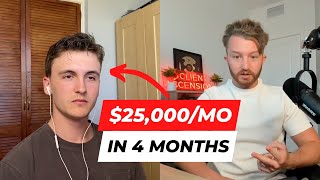
Stephen grew his video marketing agency to $25k/month in four months using cold email and Twitter outreach. He scaled from inconsistent leads to 12-20 calls a week by following scripts from peers and building case studies. The core move: consistent volume in outreach, not clever tactics.
Questions this video answers
December (joined Client Ascension back in December).
$25,000 ("last month I hit 25k").
About 32 calls in one week ("I think it was like 32 calls actually in one week was my highest").
Consistently between 12 and 20 calls per week ("consistently, I'm getting anywhere between 12 and 20 on a weekly basis").
Approximately 80% cold email, 20% from Twitter ("I'd say like 80% cold email and the rest from Twitter").
Chapters
Stephen, what's up, brother? Thank you for coming on, my friend. And could you share with everyone because you've been a Client Ascension for about four months now. Could you share with everyone what did you join Client Ascension at? And then where are you now in terms of revenue level?
For sure. So when I joined in Client Ascension back in December, the last two months I've done nothing. As in literally zero. And then last month I hit 25k.
Nice. So you, you were doing like sporadic deals every here and there though, right. Whereas, like in your video editing, so they would just like kind of come and go and whatnot. But now it's actual like a system behind it, 100%.
I think the biggest issue for me was the lack of consistency. It was exactly as you said, very sporadic. I was, I was relying on, you know, just, just luck, as it were. In terms of Legion, I couldn't really consistently book meetings and therefore, obviously I couldn't consistently close deals. So I was hopping on maybe one or two, maybe three calls a week. And when you're going down that path, you're so desperate to close, you end up just not being good at sales. And it's just like a domino effect. And yeah, for that reason, everything was very sporadic. And I think, yeah, the biggest change and the biggest effect that I had on my business joining was, was the consistency and just completely nailing that Legion. So then when you're booking in 15, 20 calls a week, it's. It's a completely different picture when it comes to sales and just makes your life a lot easier.
Yeah, I feel like there, because there's a lot of people who, who would be in your position before where they're selling something. It's, it's super sporadic. There's, there's no degree of predictability in it. Like, they don't know how many callers are good. They don't, they don't know how many deals they're going to sign. And therefore they never get into the point where like, oh, let me go hire this person to help me do this, because they just don't know if their business is gonna die in the next month or two or something like that. So if you, if you had to like, give a single piece of advice to the version of you that existed four months ago, what would you say to them? Where it's like, if you had to distill basically everything that, like, that you've employed thus far in the last four months, like, what would, what would kind of be like a couple sentences or, or Any piece of advice that you'd give to that version of yourself?
For sure, yeah, it's. It's a great question, but I think the main thing comes down to consistency and volume. I had, like, a bad tendency to, to try different outreach, whether it's called email or Twitter DMs or LinkedIn, and just give up on it quickly if it wasn't working. And I think the consistency paired with the volume in terms of, like, the sheer scale of emails at the end, paired those together. And that's obviously when, when you start.
To see the results, was it like, what was what stopped you from being consistent with it? Was it like you didn't know what it should look like? Because, I mean, it's like someone can spin up a cold email campaign or cold DMs or something like that, and obviously, the longer you. You do something, you need to build up momentum. And I feel like, was that kind of what stopped you is you didn't know, like, what success looked like, and then, like, once you were able to see kind of like behind the scenes of what other people's stuff looks like, is that what enabled you to be more consistent or was it something else?
Yeah, no, that, that is definitely, you know, like 100% the situation I was in. Because I think when, when you're in somewhere like client ascension and you're getting advice from people that have been there, seen it and done it and got the results, so when they're telling you what scripts to include in your cold email and it's not working for the first week, you think, well, you know, I can just give this more time because I know it's going to at some point. And I think obviously that's the biggest, biggest change. And obviously when you're sort of going alone and you're just sort of testing things that you're coming up with, if it doesn't work for the first week, you're just going to assume that's essentially because you don't know what you're doing. But obviously, as I said, like, when you're in client ascension and you've got people writing scripts for you, whether it's email or LinkedIn or Twitter DMS, as I mentioned, you just, you have that ability to be more consistent with it because you can just like, trust the process because it's tried, it's tested and it's proven to work.
And you've, like, you, you've sent a bunch of messages in the WINS channel. There's one week where you booked 30 calls, right?
Yeah, yeah, yeah, that was. That was a crazy week. I think. I think 30. I think it was like 32 calls actually in one week was my highest. But, yeah, that was like a. That was a high week. But I think still consistently, I'm getting anywhere between 12 and 20 on a weekly basis. Consistently, yeah.
Was that. Was that all from cold email right there, like other data sources or.
I'd say. I'd say like 80% cold email and the rest from Twitter.
Yeah, yeah. Nice. Did Christian help you write those scripts?
Yeah, yeah. So Christian's been a fantastic help. I mean, obviously he wrote the scripts for me at the beginning when I first joined, which really set, like, the foundation for what else I was going to include. But as you know, like, I've been doing a lot of other more targeted campaigns in my niche, and every time, you know, I've got to spin a new campaign up, Christian's been able to helped me write those scripts for those as well. And they're just printing meetings.
You ended up getting some really good list from. I think it was Mickey, right?
Yeah, yeah. So obviously we're in the similar niche, and it was actually because he was going to an event in my niche, and it just gave me the idea that I could reach out to everyone that went to that event and come up, like a super personalized campaign around that, which worked really, really well. I'm still using that, obviously, for different events, and it's working too.
Yeah. Dude, just when you. When you. When you start doing some relevant type stuff like that, like, based off some kind of. Not. It doesn't have to be some. I'll use the word event. Doesn't have to be an actual physical event, but like, something occurred and you can mention it in a cold email. It's like, hilarious how well that works as opposed to just like a standard. Oh, personalize the first line.
Yeah, yeah. I mean, I remember back before I even joined Client Ascension, one thing that you always said is, like, when you're doing stuff on your own and you try, like, different new things, you can always just tell when you try something and it's just gonna, like, rip. And I think this was definitely that moment for me. You know, like, I just came up with this idea and it was just so good. You could just tell it was just gonna carry on, carry on. And obviously, as I said, because of, like, the nature of what it is, there are events in my niche and like a bi weekly monthly basis, so I can just keep re. Spinning up for the same thing, and it works Just as well.
It's so funny. What is? If you. Because. Because it wasn't too long ago that you were essentially just a glorified freelancer. What would. In terms of, like, fulfillment and operations, how. How different does it look now compared to what it was before? Like, do you have. Do you have people on your team? Like, how does that structure work?
Yeah, exactly. And I think. I think structure is like the keyword because I think before there was none. I was very much ad hoc in the fulfillment, you know, when I was. I think at the end of the day, I was putting so much effort and time. Mental, sort of mental effort into signing the clients that when I signed them, I just wanted to sign the next. And then like, the fulfillment wasn't the priority when I think that changed, obviously, when I joined, I built like the actual back end of the business. I learned how to. To deliver to these clients and actually, you know, come away with case studies, which I have done since. I think that's been a massive drive to a lot of success as well, because I've been fortunate to get some really, really good case studies. I think it was yourself mentioned that the importance of doing so. Those case studies have gone to directly impact the, like, future deals that I've signed from those. Because people have seen those case studies.
Dude, it's. It's so crazy. I say this to so many people. I'm like, dude, there's essentially two halves to your business where it's like, one is pre social proof and one is after social proof. And it's just like. And now you see what I mean, that you have case studies and just like, yes, I work with these people. These people, these people. This is what I've done. It's so much easier in terms of two things. Like, one, getting people on the phone in the first place and two, actually converting them. It's just like. Like, obviously if they see, like people just follow the herd. So social proof, it just makes it easier. So did you see that yourself? Like, right when you started getting case studies and social proof, it just started working astronomically better?
Yeah.
Yeah.
Literally it was like black and white, you know, because I think a lot of the. Even if it wasn't the actual tangible case studies that I've got, you know, the clients that I've worked with in my space are very big names that everyone else in the space would recognize. So to simply say, you know, like, we've worked with so and so and so and so we can do the same for you, has worked so well. Even if I don't necessarily need to mention the results we've got, just the sheer fact that we've worked with them, you know, it just creates that, like, feeling for them that they will understand why these companies are working with us. Yeah.
So that, that's what's funny about it is it doesn't even have to be like, because you, you have something that you could morph it into like a tangible, hey, I'm going to do this and like get you this result. But even because you have a kind of like a form of a product service where you're giving somebody like tangible deliverables, like it's like it's assets, it's video assets. And just showing that I've worked with all of these other people has equivalent of enough force as opposed to, hey, I worked with all these people and they got like X specific result. If you were like an advertising agency or something like that. It's just the concept of showing like, yes, people do in fact use me and I'm not an Internet scammer.
Yeah, yeah. I mean, exactly. I almost think it's just as like, as important and effective as having the tangible results. Because although you can say the results, you can't always necessarily prove it. Whereas for me, I can say, we worked with this company and my prospect goes on like this company's Twitter patient. They actually see the video we created for them, you know, like, they can see it right there. So, like, I think personally that's just as effective when it comes to social proof. And yes, it's worked really well.
Dude, I'm sure you've heard me say this before, but it's like if, if something isn't simple, it won't work. And I'm just like thinking of the. I was thinking about it earlier today. It was kind of just like a graph where the X axis is how much social proof you have and the Y axis is how easy it is to get your next client. And it's just like a direct straight line where the more evidence and social proof you have, just the easier it is to get more and more and more. And then you just, it just goes through this compounding thing. And that's a, that's like precisely what you have now. And it's funny because, I mean, I could sit here a week, or you could sit here and be like, well, how do I get to, how do I get to 100k a month? And it's, it's directionally like largely the same exact thing you're doing right now it's just like amping those up a little bit or making it slightly more efficient. It's. It's hilarious to me that people will run their businesses for so long and it doesn't even like, conceptualize to them in their mind to like, go gather social proof when it's like that's like 80% of the equation of what actually grows a company.
Yeah, yeah, I think as well, like, I know you always mentioned about how most people think, you know, if you've got six case studies on your website, the seventh word matter. But, like, it really does. And I think for me, when it came to writing my copy, you know, I was saying we've worked with X company and then I tested it by putting more and more and more companies, and the more companies I included, you know, the better response I was getting. So it's literally like, is there's such like a positive correlation between the amount of companies you mentioned that you've worked with to the amount of, like, replies you get. Which is, which is crazy because, you know, at first you think you don't want to. If you write an email, you don't want to say, we've worked with like, enlist seven companies or whatever, but it works a lot better than just listing that one or two. Yeah. So, yeah, it really is like that simple.
So funny. All right, brother. If you had, if you, if you had one piece of advice for somebody who was maybe stuck in your situation before, like late, late last year to try to get them to in a position you are now, what would you tell them?
I'd say focus on inputs consistently, because I think that's what I did. And even when, you know, you're going through days and you're getting no email responses back or anything like that, you've just got to keep sticking to it, you know, show up and do the same thing every day. That compound effect really does come into play.
Dope, dude. I appreciate you very much. I'm going to put all of your links in the description. If any of you guys want to connect with Stephen or buy some videos from him, he's got you. Sure appreciate it, bro.










