How to price your services for maximum profit (Marketing Agencies & B2B Companies)
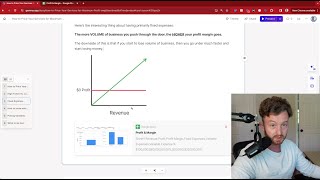
Daniel Fazio shows marketing agencies how to find the price that maximizes profit, not just margin. A spreadsheet example proves that lower prices often beat higher ones in fixed-cost businesses because volume matters more. Aim for a 20-30% close rate on calls, use case studies and guarantees to justify your price, and keep testing.
Chapters
So today we're going to talk about how to price your services for maximum profit. And despite what some people might tell you, sometimes you are in fact charging way too much fucking money. There's a certain price where you reach the maximum amount of profit. And that's what we're trying to get get out here. Because if you're charging something, if you're charging some price and you reduce the price by 50%, but the sales velocity because of that goes up 300%, it's obviously a fucking good idea to lower the price like it just is, right? So what you're trying to do is find that very happy medium that maximizes profit in proportion to how much traffic you're able to obtain. So what we're gonna do today is go through this document that I prepared. The first thing we're gonna talk about is high ticket versus low ticket in the state of the market, right? So back in 2020, 2021, there was a big shift. I remember seeing this where literally everyone was talking about, raise your price, your prices, raise your prices, everyone's, you're not charging enough money. Now this made a ton of sense when there was a absolute ton of liquidity being pumped into the market in the form of 0% interest rates and stimulus checks. So that made a lot of sense. We're out of nowhere, the money supply quite literally tripled. So if there happens to be triple the amount of money in supply, therefore, you can in fact triple your prices and you're going to experience the same exact sales velocity. But as the market has elapsed and interest rates have gone up and there are no more stimulus checks and the money supply is being decreased. What that means is that now you will begin to see either a severe slowing down of people raising their prices or deflation, where people are reducing their prices. Because some people just raise their shit way too much to an unsustainable level. That just doesn't make sense in a market that isn't printing more money perpetually, right? So at that point, everyone was buying anything for any reason. But the rent of the people you're selling to, like their housing, is up three times. The food they have to buy is up twice as much. The brands you're working for, your agency stop making less sales and therefore couldn't afford you anymore. Consumers are not being approved for loans like they were three years ago. And businesses can't expand fast because the interest rates alone or loans are too high and they won't be able to service the debt. What this means is that if you raised your prices too high during this time period, you're making no fucking profit right now. And that's the only thing that we're concerned with in a business is the production of profit. Literally fucking nothing else matters, right? So what we're going to talk about today is fixed expense businesses. Because normally in an agency or a service business, most of your expenses are fixed. So probably 95% of you watching this video are running some form of a marketing agency. And typically in a marketing agency, about 70% of everything you spend is going to be fixed. So you're running a fixed expense business right? Now, here's what this means. It means you're going to have to pay the same amount for your shit every month, regardless of how much volume of business comes with the door, right? So here's the interesting about running a fixed expense business. The more volume of business you push through the door, the higher your margin goes. The downside of this is if you start to lose volume of business, then you go under much faster, right? So here's a very easy depiction of this. You have your revenue and then up to here is your fixed expenses. Let's say it's like $10,000 a month of fixed expenses. That's the point of zero profit. And you make more revenue. Your margin, the delta between these two lines goes up. So your margin goes up. Now, I made a nice little Google sheet for this, and if we go over here, we can exemplify this. So let's say that we have a $20,000, $30,000 revenue business, right? And these are these, we're holding these in place, right? So your fixed expenses are $20,000 per month, and you have a variable expense of 20%. So at all times, 80% of everything is your fixed expenses, right? So right now, if we make $30,000 in revenue, our profit margin is 13.33%, right? So we have $26,000 in total expenses for a $4,000 profit. If we increase this, this revenue, if we increase our revenue just 30% to $40,000, our margin fucking doubles. It more than doubles, it's an amplified effect when you run a fixed expense business. So now let's put this up, let's put this up 25%. And now the margin goes up 33%. It's an amplified effect because again, as you go further along this line, the delta spreads it. It spreads farther and farther. For every incremental amount you go forward on the revenue, the delta spreads at an increasingly faster rate. Therefore, if we go to $100,000 in revenue now our margin is 60%. And if we go to $200,000 in revenue now, our margin 70%. It's an amplified effect. The profit amplifies. You see what I mean by this? Because most of your expenses are, are fixed. Therefore what I'm trying to tell you is that you, if you're running an agency and all of your shit is a fixed expense, you need to have a pricing low enough that continuously pushes sales velocity. Like you want volume of business. If you're, if your expenses are fixed, if most of your shit is fixed expenses, you make more profit per additional customer. For every additional customer you get, the profit goes up on that individual customer. You see what I mean by this? This is why it's so important to play with your pricing to find that level that amplifies the fuck out of it. Right? So, but, but we're all human and you, and sometimes you just got to feel it out, right? So like the most optimal pricing is the one where you're closing exactly between 20 to 30% of your calls very consistently. And then you design the product or fulfillment after that. You see what I mean? Like, if some people will only spend this much for the way this product is designed, but they'll spend way more if their product is designed like this, or they'll convert way higher when the product is this price, but there's less fulfillment and less of a deliverable, then it makes more sense to do that. We don't always get to sell what we want. Like sometimes the market just only wants to buy a very specific form of an offer and they buy it at a particular price. Like we don't always get to sell what we want. We're only allowed to sell specifically what the market wants to purchase. And you have to play with these variables and fuck with them. And I'm going to get into this way deeper in a second here, right? So another thing you need to note is that if your clients are not actively and unprompted telling you that you should be charging more, that means you're charging too much. People should actively be telling you that you can charge more. If they are not doing that, it means that you are charging too much. Right? From a personal perspective, between like 300, 500k a month, our margin range from 40 to 60%. If you're below 50k per month, you should be hanging around 60 to 75%. If you were above 75%, you need to be more aggressive. You either need to spend more on marketing or you need to reduce your prices so you increase velocity. You see what I mean? And now an objection. I might get to me saying this is. Or you can just get better at sales with your current pricing and not lower it. So let me make something like abundantly clear to you. There's no amount of sales trickery and finesse that's going to somehow animate additional dollars into the wallet of your prospects. If you're charging too much and your prospects quite literally and honestly can't afford it, there is absolutely no skill or ability you can finesse a maneuver to change that fact. They just don't fucking have enough money. They just don't. Like, sometimes people go, oh, I can't afford it. And they actually fucking just can't afford it. But that's a need to play with your pricing until you're closing exactly between 20 to 30% of your calls. And it doesn't feel like you're climbing up Mount Everest to close a singular deal. You don't know. Like, sometimes you're getting on calls and like, this person needs to see this. This person needs to see this. This person needs to see this. This person. And it's like a total colossal pain in the ass to get anyone to purchase your shit. Like, it's just so fucking annoying. It shouldn't feel like that. It's not supposed to feel like you're constantly running an uphill battle. It should be pretty easy to close people consistently. And if it's not pretty easy to close people consistently, you're charging too much money. That's how it works, right? So if charging 20% higher prices means it takes three times more work and extends your sales cycle four times longer, while most of your expenses are fixed, your entire business starts to become completely inefficient. It's better to just reduce the price 20% and have it be one third the amount of work and realize the revenue four times faster. Like it just. And your life is just easier. Like, it's just better to do that. Because if you keep doing this where your prices are too high and you have to climb up Mount Everest for every single deal, everything's a colossal pain in the ass. You're going to get stressed out. You're going to start to make erratic and terrible decisions and you're going to fucking hate your life and quit your business. And that's just how it's going to work. That's just how this works. Now, you shouldn't confuse this with, it's not always your pricing. Sometimes you just don't have enough fucking traffic. Like, people just don't know you exist. So you need to know, like, you should be getting calls in the first place. And if the calls are just not closing well enough, then what that means is that you're charging too much. If you're just not getting calls in the first place, you either have an offer problem or you have a traffic problem. You need to work on that. That's a different variable. Now let's talk about this for a second. I have two graphs here. So the probability that somebody purchases is a combination between their perceived likelihood of success multiplied by what the achievement is. So what does that mean? So like, if the achievement is, I'm going to help you make $50,000 in profit. And then you have a shit ton of case studies and a guarantee that they get $50,000 in profit, then the probability they purchase increases a lot. Right? Now here's the typical Hermosi value equation. You have the dream outcome multiplied by the perceived likelihood that they get the achievement divided by the time it takes to get the achievement multiplied by the effort and the sacrifice. But what are these variables? Because this is a math, this is just a math equation. This is all this is, right? So we need the dream outcome to go higher. We need the perceived likelihood of the dream outcome going higher. We need the time delay to go down, and we need the effort and the sacrifice to go down. That is to increase the value. But what are these variables? Like, what make up these variables? The dream outcome variables is the claim you make, like in your headline, I can get you this, like how much money they'll make. The perceived likelihood of achievement is, do you have a guarantee and do you have case studies that other people have got that the time delay is how long you say it's going to take and how long it took other people to get it, which is case studies again. So you take a note here that a case study increases the perceived likelihood of achievement and decreases the time delay simultaneously. So it amplifies the value up higher. So case studies are very, very important. And that the effort and sacrifice is how much it costs. It's your pricing. Therefore sometimes if you raise, if you lower your price by just like 10% or 20%, it amplifies the fuck out of the value. And then because the value is higher, more people purchase. You see what I mean? It's just math. Like everything is math is that you're just taking a bet. Like if I lower the price 20%, I think dou double as many people will purchase in which case it's a very good idea to do that. And you have to put this out into the market and play with it and fuck with it. It's the only way to know if it's going to work. You have to fuck with this. Don't. If you. Just because you, you charge someone some price doesn't mean you can't sell the same shit to someone else for a different price. You don't pick a price and that's your price forever. Like you're not locked in. Like you always need to be dynamic. You know these sling fucking deals. But you can, you can change anything you want for any reason at any time. See what I mean? So here's what you should do next. You should subscribe to this channel. You should download this document in the Google sheet at the link in the description that's below. And you should go to clientesscension.com to learn how we guarantee you sign 5 to 25 of your next client's already get a full refund. And you can go watch this video that's up at the top right here. Video right here. You can go watch that too. All right, that's it for me. Peace. I love you. Goodbye.










