Live breakdown fixing 11 different AI Assisted Agencies
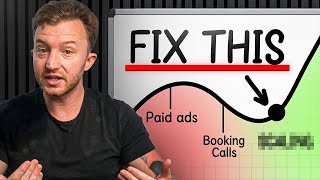
Daniel Fazio reviews 11 agencies and identifies six core mistakes: generating more calls when the real problem is closing or pricing, outreach scripts without clear offers, overly complex pricing, unprofitable niches, unnecessary gimmicks, and selling complex services to cold traffic. He shows how to diagnose your actual bottleneck and fix it.
Chapters
Every week I get on a coaching call with a bunch of agency owners. Some are at zero. We got people at $10K a month, $50K a month, different niches, different offers, different skill sets, yada yada. But almost every single time, all of them are doing the same thing wrong over and over and over again. On my last call that I did last week, there were 11 different people who came up and every single one of them was trying to solve the wrong problem in their business to push it forward. They misidentified their bottlenecks. This video that I'm going to walk you through right now is going to be walking you through the mistakes that all 11 of them were doing, categorized into 6 6 different individual mistakes that all 11 of those people were conducting. If you don't know who I am, my name is Daniel Fazio. I'm the co-founder of Client Sense and AlyssKit. Here's some screenshots of us collecting $27 million in cash. If you include wires, PayPal, yada, just over $30 million right now. What we're going to be going over are the 5 problems that actually exist, the only 5 problems that actually exist, 6 different example mistakes. Now I solved them, so we'll go through the mistakes, a diagnostic framework for solving this yourself, then how to build an AI marketing agency and how you can work with me directly. The only 5 problems that actually exist are here. You either have a booking problem which means you can't get calls booked in the first place for your offer. You have a closing problem, which means you can't close the calls that you are getting. You might have a pricing or offer problem, which means that your offer structure is creating friction, which is independent from a closing problem. You might think these are the same thing, but they're not. You might have a fulfillment problem, and that means that you close but your clients churn super quickly. Or you might have a niche or targeting problem, which means the offer you're trying to sell is being sold to the wrong person. So the main issue you'll have is thinking that you have one problem when you actually have another. And this is what I'm talking about, that how people misattribute their problem. So And then what happens is you think you have an offer problem, but it actually is you have a booking problem. If you make a practice of just watching all my videos about offers, you'll start to get what I mean by this and understand cold traffic offer and where the actual bottleneck occurs. So the rule is pretty simple: identify which specific thing is broken, fix that specific thing, and then don't touch anything. You gotta wait to see if it solves the problem. You do one thing at a time because if you change like 8 different things at a time, you're not going to know what thing did what. So let me show you how this plays out in reality through the actual mistakes. So number 1 is thinking I need more calls when you actually have a closing problem. We're gonna go through tons of different examples of all these different mistakes, but here's a guy who's been in the game for 5 months. He's booked 54 sales calls. 15 were unqualified, 2 were no-shows, 1 canceled. That left him with 35 qualified prospects who showed up live on a call. So he said, should I start running ads to get more calls in the calendar? So think about that for a second. He doesn't have a booking problem. He did this all with cold email, and I asked him how much he spent on total on cold email. He spent $2,250 over 5 months, which means that he was getting a $45 cost per call with cold email. So that's great, like the front end is working. Starting ads is attempting to solve a booking problem. That's not the problem he has though. He's getting calls booked. He has a closing problem or a pricing slash offer problem, or both. Going through the stats of him, when we dug into it, turns out he was requiring clients to commit to $9,000 upfront. So $3K a month in ad spend for 3 months plus what he was charging. So $9,000 in ad spend plus 2, 4, 6— $15,000 upfront. And he's pitching this to 5 to 10 employee companies. He's finding through cold email. So these are small businesses. So $9,000 plus his fee, cool, $15,000 pretty much a bet the farm decision for a lot of these people. Like, they don't want to commit to $15,000 for this guy who has the level of social proof that he has. I'll get into that in a second. But the fix is not just getting more calls, it's making the entry point more accessible instead of just requiring straight up a 3-month contract when this guy doesn't have a lot of case studies to justify being able to do that in the first place. It's too risky for his level of social proof and authority. I told him, do a switch to doing a 1-month test. So it's $3K ad spend, $2K management fee, then upsell to a 90-day sprint if the results are there. This means $5K that the client will have to commit to instead of $15K. This would literally triple the amount of people who might be willing to test it. You could also recognize that the first 3 months of calls were blown because he was bad at sales and hadn't trained. That's fine, but that would make it a closing issue and not a lead flow issue. Again, like, spending money on ads to get even more calls is not the fix here. If you are getting calls but not closing them, do not change your front end. And what I mean by front end, I mean like the messaging you're saying inside of either your ads or your emails. Like, this especially actually applies for cold outreach. Reach. If what you're saying in your script is getting people on the phone, continue saying that. Don't change that. Don't do that. You don't need to introduce more lead flow. You don't need to introduce more different ways of getting leads. Like, that's not what your problem is. Your problem is closing these people. Do not start a new channel. Do not spend money on ads. Fix what happens on the call first. Like, you have to fix that problem first before you start dedicating more money to any more calls that you're just also not going to close. Just a little recap here. Symptom here was 35 qualified calls, only 1 close. The wrong fix is running ads to get more calls. The right fix is a lower barrier to entry for the prospects and then improve sales skills. There was a symptom of $45 cost per call. The wrong fix is assuming the front end are broken. The right fix is the front end is working. Leave it alone. Don't do anything with that. So you could make the argument that he could go just target larger companies. However, I did not foresee this working because of his lack of case study. He'd likely keep facing the same issue with no proof of results. Like he has a small case study, which is fine. I just don't foresee him being able to just make a client commit to spending $15,000 with him when he doesn't have results that are showing that he's made clients hundreds of thousands of dollars. The return per risk is way offset here. It just doesn't make any sense for him. Okay, mistake number 2: nobody's responding when your script doesn't state your offer. This one's painfully common. Guy's doing cold email outreach, he's sending messages to B2B companies, getting literally zero responses. His assumption is that he had a bad niche, he needs to switch industries, and he needs more volume. On the call I said, screen share, let me see what you're sending. So he pulled it up, I immediately knew the problem. The email didn't say what he sells. It was a very generic outreach message where you couldn't even decipher what the guy was trying to ask at all. It was one of those where it's like, what are you even saying in the email. Nowhere in the email did it convey that he offers performance-based lead generation where the client only pays per call that shows up, which is a really good offer. What he came to me saying was like, Daniel, this is my offer, but I'm not getting any responses to this. I think the niches I'm targeting are bad, or I need to change my offer. And it's like, you don't need to change your offer. Nobody knows what your offer is. You're not saying what your offer is. How could it be offer problem? They didn't even know what the offer is. So the prospect who reads this email has absolutely no idea what this person does or why they should care. The fix was not switching niches. It was not sending more emails. It's not running ads. It was rewriting the script to actually state the offer. This is what I had him rewrite it as. It's really just this simple. Hey, name, looked you guys up. I have a performance-based cold email offer where you only pay per call that shows up on your calendar. Is that something you'd be interested in? The difference between this outreach message and what he was sending before is that this conveys a sales argument. It conveys a value proposition. It's a performance-based cold email offer. So it says what it is— performance-based where you only pay per call that shows up on your calendar. That's a value proposition. It's a whole sales argument just conveyed single sentence. What he was saying before was something like, are you guys looking to grow your company? Or something like that. It wasn't saying anything. But you can't say that the niche isn't working or the offer isn't working when they literally don't even know what the offer is. That's it. Say what you sell. Put the sales argument in the script. Your cold email is your offer. That's what you say in the cold email. You just offer them what your offer is. It's really that simple. In the last 3 videos I posted on my channel are all about like offers and cold traffic offers. So you should go watch them. But if the offer isn't in the email, you might as well just not even have an offer. You have a random message that nobody has any reason to respond to. Sending more emails won't fix a script that doesn't state your offer. Switching industries won't help if prospects don't know what you do, and you literally did not tell them what you do. It's a state your offer problem. You cannot say your offer isn't working when the prospect literally does not know what your offer is. This is like documenting client case studies for yourself, never posting them online, never sending them to prospects, and never referencing them on sales calls, and just assuming that every person on the planet just knows your results just by default. Even me, when I pitch you my offer at the end of this video, I'm going to repeat my case and what my offer is. I don't just assume you know what that is by default. Now, speaking of that, if you want to build an AI marketing agency, go to the first link in the description. That's go.clientascension.ai. We show you what to sell, who to sell it to, how to get clients, and how to fulfill for the clients with AI. So if you want to check that out, first link in the description, or you can check it out after the video. Mistake number 3: I need to differentiate. When you have a pricing structure problem, agency owner doing cold email lead gen, he's getting people on the phone, but he's not closing them. His theory that he approached me with is that he needs to differentiate. I think I need to like add something like some kind of AI feature on top, like some unique mechanism, something with Claude code. He was basically saying, I need something that makes me stand out from other lead gen agencies. Here's how I know it's not a differentiation problem that he actually has. They got on the phone with him. If it was a differentiation problem, the prospect would respond to his cold email saying, I get these all the time, not interested, or they just ignore it, and he'd book zero calls. But they're getting on the phone with him. If it was a differentiation problem, they would never agree to the call in the first place. They wouldn't get on the call. It's more difficult difficult to get people on the call than it is to get them to pay you money. So if you're getting people on the call, they want what you have. The fact they're on the call means they want what you're selling. Like, the front end is working. Don't touch the front end. If they didn't want what you have, they'd never even speak to you at all. People don't just get on the phone with you. That's not a thing. What actually is happening? Like, what actually is the problem? This is his pricing model. This offer works. You're screwing something up here. There's no reason you need to append some random unique mechanism. This offer works. What are doing? I'm trying to get the full picture. And this is his pricing: $1,000 setup, $500 a month tech fee, and then $250 per book call. 3 separate fees. That's the problem. So the fix: drop the setup fee, go to $1,000 a month tech fee, and then the performance per call. All he's doing is dropping the setup fee. Stop charging a setup fee. You cannot charge 3 different types of fees. Anytime somebody tries to charge 3 different types of fees— so a setup fee, a performance fee, and a monthly fee— it always goes south for them. It doesn't work. I've never seen this work in practice even once ever. Like, literally never once. And they always have the same exact problem. They come to me, they say, Daniel, they got an offer problem. I think I have this problem. I got to differentiate. It's not it. You're literally trying to rape the prospect with 3 different types of fees. You might be saying, well, Daniel, they end up paying more with this. So like, how is it that even though they're going to pay more, this solves the problem? And the answer is because for some psychological reason, people just feel like they're getting completely raped by you if you charge them 3 different types of fees. Fees. This is the whole thing about Airbnb, this whole fiasco with Airbnb, and the entire internet hated Airbnb. And it was because Airbnb would display prices that were not inclusive of all the fees. And then you would go to check out and there was a cleaning fee, there was an Airbnb fee, there was like a transaction fee. There were like 4 or 5 different fees. And even when you see this, people complain about this on Twitter for like Uber Eats or DoorDash. DoorDash fee, convenience fee, restaurant preparation fee. There's like a million different types of fees. It's so strange. But when you take, say, the fees amount to $10, and then you just call it DoorDash fee, now magically no one's upset because it's just one fee. Even Airbnb did that. There's no like, this fee, this fee, this fee, this fee, this fee. The prices Airbnb quotes is just the total booking price inclusive of all the fees. Now there's none of this severe backlash that occurs all the time in social media against these companies because they just make all of the fees inclusive of the quoted price. You doing this, when you try to charge all these different types of fees, is you trying to do what Airbnb did— the cleaning fee, the the action fee, the convenience fee. There's a million different fees and it pisses people off. Why am I paying a million different fees? But they get paid more money, it's shown as one fee, and like magically it's completely fine. It's just basic psychology here. It has nothing to do with actual mathematical calculation of the ROI. It's just don't charge 3 fees. For some reason you just can't do that. They think it's super greedy, and I've never seen it work for anybody ever, not even once ever. Getting calls but not closing— what they thought was I need to differentiate my offer, what it actually is is the pricing structure has too much friction. Another problem: prospect booking but ghosting after pricing. What he thinks is they don't see the value. What it actually is, 3 fees is too many. Drop to 2. Don't do this 3 different fee thing. A maximum of 2 different types of fees. This also applies if you're selling ads to clients. You can't charge a management fee and a performance fee, and there's also ad spend. Now you have 3 fees. You can't quote 3 different things that they have to pay, even if the fee isn't going to you. 2 types of fees max. Mistake number 4: my niche is good when you can't get results for them. This one is trapped because it feels like everything is working until it isn't. Agency owners targeting commercial cleaning companies for cold email Legion an AI niche finder told him that this was the best industry to go after. In some ways it's correct because cleaning companies respond very well to outreach. They want leads and they get on the phone, but once you sign them, it's a nightmare. Every lead is a race to the bottom on price. The margins are thin, deals are small. This is for the cleaning companies themselves. You pour effort into campaigns and the results are mediocre because the underlying business economics of cleaning companies makes it almost impossible to generate high quality, high value leads for them via cold email. It's just really hard to scale a cleaning company because it's just a low margin business. Business. The AI Niche Finder doesn't have this context. It just knows cleaning companies respond to outreach at a high rate, which is true. It's also irrelevant if you can't get them results after you sign them. Same trap with recruiting and staffing agencies. Recruiters are desperate right now. Their whole industry is down because nobody's hiring. If you approach a recruiting company and you're like, hey, I can get you guys a lot of clients with cold email, they're like, oh yeah, we're interested. And the reason why they're that interested is because all of their businesses are down and performing very terribly. They really, really want lead gen. But when you sign them as a client and try to get results for them, it's really hard to get them results because again, their whole industry is down and they can't get results for themselves. That's why they're so interested in it. Now, this doesn't apply to all niches. It is only a specific case for specific kinds of niches. You just have to understand the current market dynamics because that can easily flip like super fast. The advice is correct from the AI Niche Finder. It's just unaware of current active market dynamics, and there's no way it could ever— high response rates does not mean good niche. You need to evaluate niches on practices is. So will they respond to outreach? So marketing problem. And can I actually get them results after I sign them? Which is a fulfillment problem. Most people only think about number 1, and then once they're actually running this business and it's getting going, you sign some clients with it, number 2 kind of screws them a bit here. Here are some industries that consistently work well for cold email legion: finance, B2B SaaS, commercial roofing for some reason. Like, these are doing very well right now. So finance is inclusive of hundreds of different niches. B2B SaaS is inclusive of hundreds of different niches. Commercial roofing, it doesn't have to specifically be roofing, but it's like commercial services businesses that can work with tens of thousands of different businesses within a specific geographic area, ideally a very large geographic area that just completely crushes. These are high-ticket services where the leads are valuable, the deal sizes are large, and your cold email campaigns can actually produce meaningful pipeline for the clients. If you're currently working with a niche where every client is a nightmare to fulfill for, stop signing more of them. Remove every single one of those clients from your roster and calculate how much additional time you'd have every day. Then redirect that time towards signing clients in industries where you can actually deliver dollar per effort arbitrage. If you can make more money working with a specific type of client because this specific type of client requires 80% less work than the other types of clients, then only work with that type of client. It's dollar per unit of effort exerted. That's what you're trying to optimize for. Okay. Mistake number 5: I need a unique mechanism when you just need to state the offer clearly. Performance-based cold email lead gen where the client only pays per call that shows up. Winning offer. It's always worked. It will continue to work. You do not need to append some random AI tool or Claude Code integration or Dream 100 system on top of it. Here's the thing people miss. If the offer actually gets people on the phone, the offer is fine. You don't need to make it fancier. You don't need a unique mechanism. You don't need to differentiate. I literally watched a guy in this call present his performance-based cold email offer with a guarantee of 10 to 15 meetings in 90 days or a full refund. I've had to correct this mistake multiple different times. He's saying 10 to 15 meetings in 90 days or full refund. What he should say is you only pay for qualified meetings that show up. That is the guarantee. That sentence alone is an implicit guarantee. And the reason he's doing this, because I need a way to, to stand out. Let me promise a specific amount of meetings at a specific amount of time with the refund on top of it. Compare these two. This is more attractive than this. Just stop saying this and only say this. That is your offer. It already has a guarantee implied within it. If it's performance-based, just say it's performance-based. You only pay for qualified meetings that show up. That is the guarantee. That sentence alone implies it. Okay, mistake number 6: trying to sell a warm traffic offer to cold traffic. This is the meta mistake that underlies like half of the problems on this call I did. Guy has a DevOps automation service. He has clients, the service works, but he can't sell it via cold email. So he's getting nothing from outreach. So he's asked, should I switch my entire business model to a cold email agency? Not necessarily. There are only two ways to scale any business. So you have cold traffic offer that converts cold traffic, or you can build warm traffic and sell your warm traffic offer to that warm traffic. So if your service is something like AI automation, DevOps consulting, sales training, CRM builds, anything that's complex requires the buyer to understand what you do before they see the value. You probably have a warm traffic offer. That's fine. But you need to either option A, reposition it for cold traffic, or option B, build warm traffic. So option A is you use the cold traffic framework, new money, de-risk, and done for you. I told him to say something like, we'll build and run your entire pipeline system from scratch to 50+ qualified buyers for your reps every weekend. If we don't, you pay nothing. That's a cold traffic version of a warm traffic offer. Like, test it. If it works, then scale it. If it doesn't, then go to option B. Which is build warm traffic instead. Make YouTube tutorials, post it on Twitter, build an audience of people who understand what you do, then sell to that audience. This is what Alex Hormozi does. He doesn't have a cold traffic offer. Alex Hormozi does not sell a cold traffic offer. He only sells warm traffic offers, and he scales to hundreds of millions of dollars just by selling to a warm audience. It's a completely valid way to go about building a business. His marketing spend is media, is him creating content, and obviously he runs ads, but largely that's probably 90% to people who already are aware of Alex Hormozi in the first place. There's no third option. Like, you got to pick one of these two. If you sell warm traffic offer to cold traffic without repositioning it, you will waste months and thousands of dollars because cold traffic does not buy complex, hard-to-explain services. They buy leads, calls, and sales. That's it. There's the only thing that cold traffic buys is leads, calls, and sales. So this is the diagnostic framework. Here's the decision tree. You gotta use this every time. Are you scaling? No equals you have an issue with your capacity or systems. Are your clients staying? If the answer is no, it's a fulfillment or a niche problem. Are you closing calls? If the answer is no, you have a sales or offer problem. Are you getting calls? If the answer is no, it's a front-end problem. Only one of these is broken at a time. You can only fix one at a time and see if it works, and then it will reveal the next bottleneck after that. You fix it, then you reevaluate it. You don't jump ahead, you don't change a bunch of things all at once. If this is true, people are booking calls, then this is your problem— you have a closing problem. Do not touch your front-end or outreach. If this is true, you're closing but clients churn, then this is your problem— you have a supplement problem. Do not touch your sales process. If this is true, your front end converts cold traffic, then this is your problem. Nothing is wrong with the front end. Do not touch your front end. Leave it alone. If this is true, nobody responds to outreach, then this is your problem. Your script doesn't convey your offer. Do not touch the offer itself. If this is true, prospects ghost after hearing pricing, then this is your problem. Your pricing structure has friction. Do not touch your lead gen. It's working. Does that make sense? All right, so here's how to build an AI marketing agency. If you want my help directly building that, where we show you what to sell, who to sell it to, how to get clients, and how to fulfill for those clients with AI, go to the first link in description, go.clientascension.ai. This is what that page looks like. You'll go to that page, you'll click this, you put their name, email, and phone number in, and then you'll get a full breakdown of the offer pricing, like all that stuff. Here are some case studies of people who have joined that offer and got really good results. We got Daniel Werner over here who went from $0 to $30,000 a month in 3 months. We got James Pimble who went from $0 to $15,000 a month in 2 months. We got Chris Burns who went from $0 to $10,000 a month his first 6 weeks. Cameron Otello collected $50,000 within his first 3 months inside. Doby Lynette went from $0 to $12,000 a month his first month. Matt Huang went from $0 to $20,000 a month in 3 months. Kabryn added $44,000 a month to his MRR in his first month inside. This is what actually works. I'm not promising you get these results. It's highly probable you don't get these results, but I am saying that I can give you the exact resources that I gave to these people who were then able to take those resources and then build these successful businesses. These are all linked to my YouTube channel. You can watch these case studies after you opt in on this page on go.clientassistance.ai. Those case studies will be embedded at the bottom of the page. You can watch them over there. Getting really amazing results with this for people inside right now. Actually, let me pull this up real quick. I keep a Google Drive. Every week we get a bunch of people getting results inside. I can open this up and I have legitimately hundreds of different people collecting a ton of different money, posting inside of our wins channel. People just making a ton of money, just absolutely insane amounts of stuff in here. So like, if I select all these, how many are in here? So I've got 388 screenshots of people signing $2,000, $3,000, $5,000 clients, hitting $20K a month, $30K a month. Some of those people I was just mentioning before, like, here again is Able in 61 days to go from $0 to $20K a month. Kai Lode, he sold a $6K funnel build after being inside. Got Kyle Renz over here, did $12K in a month. All sorts of different people, it's getting absolutely tons of results inside. And again, that's the first link in the description, go.clientascension.ai. Join, you'll be inside the community, you'll be with all of these guys. We can hopefully get you results so you can build a successful business yourself. All right, first link in the description. I'll see you over there. Peace, bye.










