Retainers or Revenue Shares - Which Should You Charge?
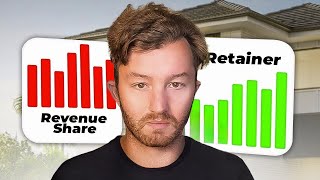
Daniel Fazio explains when agencies should choose performance-based deals (revenue shares or lead/call-based metrics) versus upfront retainers. Using a client story about a commercial mortgage broker, he argues revenue shares are usually poor for beginners because most businesses do not produce reliable revenue and only a minority generate outsized results; revenue-share deals are appropriate only when the agency is world-class and the client is high-performing. He outlines a timeline: early-stage practitioners typically accept performance deals to build case studies, then transition to retainers as authority and proof accumulate.
Chapters
Should you charge a performance basis like a revenue share or a retainer model? Like if you're an agency, what, what makes sense and what deal structure ultimately leads to you making more money? That is exactly what I'm going to explain inside this video before we get started. My name is Daniel Fazio. Make about half a million dollars per month or on Client Ascension, also part of List Kit. So those two companies together make a lot of money there. If you, if you're thinking, oh look, I don't believe you, then just go watch some of my other videos and then you can get over that. Um, so now the way I want to start, this is the ultimate goal of this is for you to make the maximum amount of money in as little time as possible. So it's always a debate like should I do a revenue share with the client in a performance basis or should I just do a retainer? Like which of these ultimately leads to you making more money? Now the way I'd like to introduce this concept to you and my thought process on it is by explaining the story that just happened on one of my clients. That's a coaching calls on Wednesday, two days ago from the filming of this and my student was presented a deal structure from a commercial mortgage broker. Right. So here's how it works. He, he runs a lead gen agency. My student, the commercial mortgage broker wants to work with him. The mortgage broker however has been burned by lead gen agencies before. So he doesn't want to pay anything up front or have a retainer because he doesn't want to lose his money. Right. So what the mortgage broker proposed was a 10% revenue share on the deals he closes. Now this is, this is a commercial. So it's typically very large loans. So it's like it'll make like 50 to $70,000 per loan. So a 10% revenue share on that would be $5,000 to $7,000. Right. Now before, but before, before I explain what I think about this deal, I want you personally just go over that like would, would you take this deal? The context here is that he's a cold email lead gen agency. So, so he has to buy domains, buy leads and then try to try to get a 10% on these deals closed. And keep in mind these deals might take like four or five, six months to close. Right. Would you do this deal? Now I'm going to first explain my justification and then I'm going to give you my answer. So here are my thoughts on it. Right. So the mortgage broker wants zero upfront risk that's what he's saying. He said, I don't even want to pay $1,000 because I've been burned before by somebody else. Zero upfront risk, right? Also another note is that lead generation costs money and time. So the mortgage broker wants to have my student pay the money. Whether it's ads or email accounts or leads pay. My student needs to pay his money and do it with his time, right? So therefore this mortgage broker wants my student to Pay to get 10% of the deal. So in other words, Mr. Mortgage Broker over here wants a 90% cut for doing fucking nothing, right? You're gonna fill out some paperwork and a bunch of stupid bullshit like that, but it's fucking easy. It's, it's, it's not, it's, it, it's not valuable. So this is a fucking terrible deal. So what I told my student to say was basically verbatim is what you're asking is for me to take all of the risk in both terms of money and time to manage a marketing and lead generation system for you. In other words, you take zero risk and I take all of the risk. If you want to take zero risk, then I want half the deal. Not 10%, 50%, right? You're going to make $50,000, I want $25,000. That's how this is going to work if you want 0 upfront risk. So this is important to understand, especially if you are more so a beginner in business, right? Because one, one premise that you should always operate upon is if there is going to be a performance deal, never go negative, okay? Like whether you're doing ads or like you're a lead gen, you need to buy email accounts and leads. Don't go negative for a client that is completely stupid. Don't do that, right? Don't, don't go spend a thousand dollars to try and get a revenue share from this client because you don't control the product, you don't control the sales, the sales team. That is a massive mistake. If you're a beginner now, if you're young, what happens is a lot of older dudes, they'll try to like bully you because they're dickheads. Like this is just a thing. Most people running a company are stupid, lazy, entitled and have zero responsibility. So like now, now, now, this whole situation of my client, I've explained to you now, you can see this from a different light. Like if you're a beginner, you'd be like, oh yeah, you know, like I should probably just take it. But now That I explained it to you. Like this guy's a complete fucking douchebag. Look. Oh, you want to pay $0, do 0 work and only pay a 10 clip on the like. So this is the differentiation that you need to understand. So like a lot of people think running a company is like the work of the deliverable of the company, right? That's not how this works. 80% of the work of running a company is finding customers for the product. That's what running a company is. That's also why. Have you ever seen these movies where like it depicts a sales team like it's a bunch of bros and they're like on yachts and shit. And then it's like all like the back end it dudes are sitting in office and a little slouch neck and there's like losers and shit. What? Why is that? Like why are the sales people and like the marketers and shit? Why are they paid so much money? And the answer is because it's the most important part of the entire business. So this guy is sitting here but go, I'll give you 10. It's like, no, give me like 80, like you're not doing shit. In fact, there is no reason for my student here to even work with this guy at all. If it's 10 because he could just go get his mortgage origination license in like 30 hours. It is not hard. Now there might be someone who does mortgages who just heard me say that they'll go, yes it is. First of all, no it isn't. Because I got a license to be a mortgage originator in Florida. I passed the test in 2019. It's easy. Just like that. Like it, you could just go get the license your self, just eliminate. The guy is a broker, but he could just go to another broker and get like a 80% clip. It's just get rid of this guy. This guy's an entitled prick, right? So you need to be able to recognize this stuff. But now this hasn't answered the question for you yet. Should you do performance deals for a retainer? What makes more sense for you to make more money, right? So there are two sides to this equation, right? The first side of the equation is identifying a good business to be worth the performance deal in the first place. Because you don't want a performance deal with a shitty company. You only want a performance deal with the company that's actually capable of doing performance. Like they actually fucking perform and make money. Because most businesses, despite what you might be under the impression of most Businesses make no money. So number two, the second half of the equation is are you magnificent enough to attract and convert a business that's worth doing performance for? Right. So first side of the equation is where do you find a good business and what does a good business to do performance for look like? And then two, are you worthy and world class enough to even get them to convert underperformed steel in the first place? Right. Where do you find them? Will they convert? Right. So here's a quick delineation of how do you identify a business worth doing performance for? Right? So if a business does not want to give you a revenue share, that is exactly who you want a revenue share from. If, if, if you're like an initial negotiations with the company and they're like, yeah, we can do it on a performance basis. Like, like we, like no upfront stuff, like we will pay you on success, that is exactly who you do not want a performance from, right now. Why is that? It's because winners are very confident that they will continue to win, right? Losers are very confident that they will continue to lose, right? So, so therefore a good quality business knows they'll win and they want a cap on what you're going to get paid when they win. Therefore they don't want to give you a revenue share because they know whatever the they do is going to work, right? So a loser is always under the impression that they're going to lose and they, they typically animate this into reality themselves, right? And therefore they don't want to pay you anything up front because it's a whole scarcity mindset, right? So for instance, Client Ascension, my company, you definitely want a fucking performance or revenue share from Client Ascension if you're working with Client Center. But why? It's a high quality product. We have a shit ton of built out and optimized funnels. We have an awesome sales team, we have great reviews and like a hundred case studies. Like, like quantifiable case studies. We have a high ltv, we have an efficient team that can handle high scale, right? And we can build fast. There's a lot of resources to maneuver around, right? So therefore I never want to pay a revenue share ever. Because anything I do with any service provider I'm fairly confident is going to work just because of the entire nature of the business. Like you could, I could have a dog service provider and then like I can just fix it myself with my team if what they're doing I see is retarded. You see what I mean? Like that, that's that's how this works. I don't want to give a revenue share because it's always going to work. So I want to cap what I have to pay you on the upside. Right. So because of that client Ascension is the kind of company. Exactly. That you'd want a revenue share from. So now. But, but, but some people do get revenue shares. How do you pull this off? I would pay a revenue share only in the event that the person asking for the revenue share is completely an indisputably world class of what they do. And, and particularly their authority level is higher than mine. So I, I have, I have some level of authority. Like I've made X amount of money, I have X amount of clout on the Internet. X amount of people who know like and trust me, maybe you're one of them. So that, that, that it's a literal like status hierarchy of everybody on the fucking planet, right? So I exist at some level right now if you were to take someone like Alex Heroi like that up here, so Alex Rosi comes to me and he, he, he, he could start saying like, hey, I, I'll do this for you. This, this, this, I want a revenue share. And I'd be like okay, it, that's how that would work. Because his, his status is so much higher than mine. His authority is way higher than mine. But dude has made astronomically more money than I have. Therefore I'm, I'm fairly confident that I could get up to that level. Right, but it's just some random video editor agency I'm gonna be, bro, I'm not giving you a revenue share like grow the up. Like why the would I do that? Right? So therefore if you want to be able to, to find a business that is worth doing revenue share for and you want to be able to get them to actually agree to paying you a revenue share, the only thing you have to do. There are only two things you can do. One, become world class at the thing you're doing. Like if you build funnels and low ticket funnels or some bullshit like that, you better become one of the best on the absolute planet doing that. Two is build your authority. And authority is derived from case studies and content and how many followers you have. That's how that works, right? So caveat here. So for you to understand, again trying to go back to the question, should you do revenue share or should you do retainers? Right? So here's the thing. The Pareto principle applies to clients as well. So for instance, 20% of your clients will make 80% of the money, 20% of your clients will have 80% of the success with you as a service. Right? 80% of your clients will have poor performance. 80% of your clients run shitty businesses. So if you're charging performance basis revenue share, 20% of your clients will make you 80% of the money. And what your job then becomes is identifying the 80% of the shitty businesses and either one not working with them in the first place, or two, firing them. Right? The problem with this is it makes your cash flow extremely variable. Right? So I'm going to get into this in a second and I'm going to give you like a timeline of how this elapses, right? So this Pareto principle is the reason why you will find that typically for every 10 clients you sign, you're going to get about two case studies. Why? Because eight of them were piece of shit businesses in the first place that are impossible to get results for. Right? And because you are a beginner and you have no authority, you had no choice but to sign them and you probably didn't even know if they were a shitty business in the first place. So therefore, despite raw statistics, fucking 8 out of 10 of them are just complete dog shit. They were never possible to get results for at all, ever. Therefore, if you want one case study, you need to sign five clients. So this is the problem with a lot of people. They'll go get like one or two or three clients or some shit. And, and they'd be like, yeah, bro, like I'm going to stop. I'm focusing on getting client results. I'm, I'm stopping my legion and say, dude, there's a high probability that none of them get results because they just suck. Like at all. Like it doesn't even matter what your skill level is. Like, they just suck. It's impossible to get them results ever. Go sprint to 10 clients, get 10. Because you're only going to get two case studies when you have 10 clients. It's the only way. So again, as I said earlier, most businesses suck. The owners, they're not fair, they're entitled and they're terrible at running a company and making money. Some people, some people are just, it's hard to see this until you've built something like relatively large that most people running these companies, they are in fact completely fucking right. And when you see it, you, you won't be able to unsee it. Right? So again, I'm gonna. Here's some notes. In general, I recommend against doing revenue share deals unless you are World class at what you do. It's important because I have another caveat to this, right? So my justification, because there's an 80% probability the business sucks and the revenue share will almost always be zero because there is no revenue, right? The 20% of businesses you actually want a revenue share from won't give it to you. And that's assuming your authority is high enough to even get them on the phone in the first place. Quick note, getting somebody on the phone is, is more difficult than getting them to pay you money when they're already on the phone. It's harder to get somebody to talk to you than it is to get them to give you money once they're already talking to you. Right. So. Right, yeah. So timeline. This is very important to understand. Your first 10 to 15 clients are probably going to be on a performance basis because that's all you can get. When you don't have case studies, you have to minimize upfront risk to a client and that what that therefore entails is performance basis. Now it doesn't always have to be revenue share. It can be performance basis on leads generated or calls booked or some like, you can go up a dimension if you were to imagine like a literal vertical timeline. It's like say you were a content agency. It goes, it goes, I get, I, I make videos for people. Well, what is the purpose of videos? It's to get views. What's the purpose of views? To get followers. What's the purpose of followers is to get leads. What's the purpose of leads? Just get calls. What's the purpose of calls is to get revenue. Right. Therefore you can just go up a dimension. You can do performance based on either calls, leads, followers or content. And you can do any one of them, right? You can make your income based off of those, like how much of that you get for the client. So now your first 10 to 15, you have no choice but to do performance and therefore also have no choice but to work with the shitty businesses. It's just reality. Like you're gonna have idiot clients, you're gonna have, you're gonna sign shitty businesses as clients. There's no way to get around this, right? So after acquiring authority, and when I say authority, I mean you have quantifiable case studies and you've been building content online, giving value and being useful to the world, right? You can, you can start switching up to upfront payments and a retainer, possibly like with a slight performance incentive now way down the line, like so, so, so that first 10 to 15 clients that might be like, that might be like a year. Some, some of you psychopaths can make it like in three months. Like I, this happens all the time. But some of you, it could be like three months, it could be a year. Just depends how fucking psychotic you are, right? So then when you're doing like the upfront payments and slight performance, you should, you should probably get to like 100k, 200k a month doing that, right? And then you might find that you, you just like doing that. You systematize the fuck out of it and you just, you just want to do that, right? You like if something's working, you don't have to change it. Like, you just don't. Right now if, if you don't like working with a ton of clients and you are in fact completely and utterly world class at what you do. And I mean, look, you know, if you're world class, there are very few humans on the planet who can do what you do. You are aware of this. Other people tell you this, you get fucking insane results. Then you should switch back to working with a low amount of clients and getting huge performance deals on this, right? Like 10% rev share, 15, 20% rev share. But this only works if you're working with world class businesses. And world class businesses only work with world class people. So if you see someone selling you some offer online where it's like stop charging a retainer or stop doing this, you can get paid 20, you can sign $60,000 contracts with clients. It's like you, Jimmy, Mr. New Agency Owner, you can't because you're not world class. Like you're, you're, you're not good at what you do. Like you're not good how you can't get a client to pay you a hundred thousand dollars if you can't make them like at least 500,000. Like if you can't make revenue appear out of the ether for a client, then you can't get paid by the client. That's called scamming you. Like if you, if you can't understand, like you can't get paid insane amounts of money unless you are able to make somebody else insane amounts of money. That's it. That's how this works. So if you want to make a lot of money doing revenue share, you have to be able to make a lot of revenue. And that requires you be world class of what you do, right? And you should always be doing that. You should always be trying to get better at what you're doing. So here's a quick recap of shit you need to understand. I got some notes here, right? So first thing we talked about with the story is don't let people screw you. Like make fair deals and recognize when people are not being fair. Like that mortgage broker guy. That's not, that's not fair. That's completely not fair at all. He's trying to take advantage of my student. That's what he's doing, Right? Number two, you can only get paid what the market is willing to pay you, right? So people might say, this is my value. Well, it's like, well, it actually isn't because your value is exclusively what somebody is willing to pay you. So I always find this interesting. Some people might be like, yeah, I charge, I charge $3,000 an hour for a console call. It's like, bro, no you don't, because no one pays you $3,000 an hour. Look, you will have the price listed as $3,000 an hour, but no one, the market's not paying you that. Like it just like the checkout page just sits there. No one's ever bought it ever. No one ever will. Therefore it's not worth $3,000 because no one will pay $3,000 for it. Like that. That's what this is, right? So the, the market pays you in direct proportion to your authority level, right? So an authority is derived from case studies and how much content you have online, right? Okay, so number three, you do performance in the beginning because that's all you can get. Right. Number four, you do performance in the end because only in the end is a business worth doing performance for. Willing to pay you performance. You see what I mean? All right, couple things. One, subscribe to the channel if you enjoyed this video, leave a comment if you have a question. Two, go in the link in the description. I have two things there. First is Internet money. That is a low priced group. There's seven courses in there. It shows you how to learn an offer, how to fulfill for clients, how to get clients. It's for, if you're a beginner, it's helping you make your first $1,000 online. Two is client ascension. That is a private group. You have hundreds of agency owners. That is to help you get from like 10k to 50k a month. Some psychopaths hit 100k a month. I'm not promising you hit that much, but you can talk to me directly in there or work with me directly inside there. It's pretty cool. It's pretty fun. Private group. Yeah, it's awesome. That's it. Subscribe and maybe go watch this video. I love you. Bye.










