Entrepreneurship, Faith & Finding Your Purpose | Darrel Frater
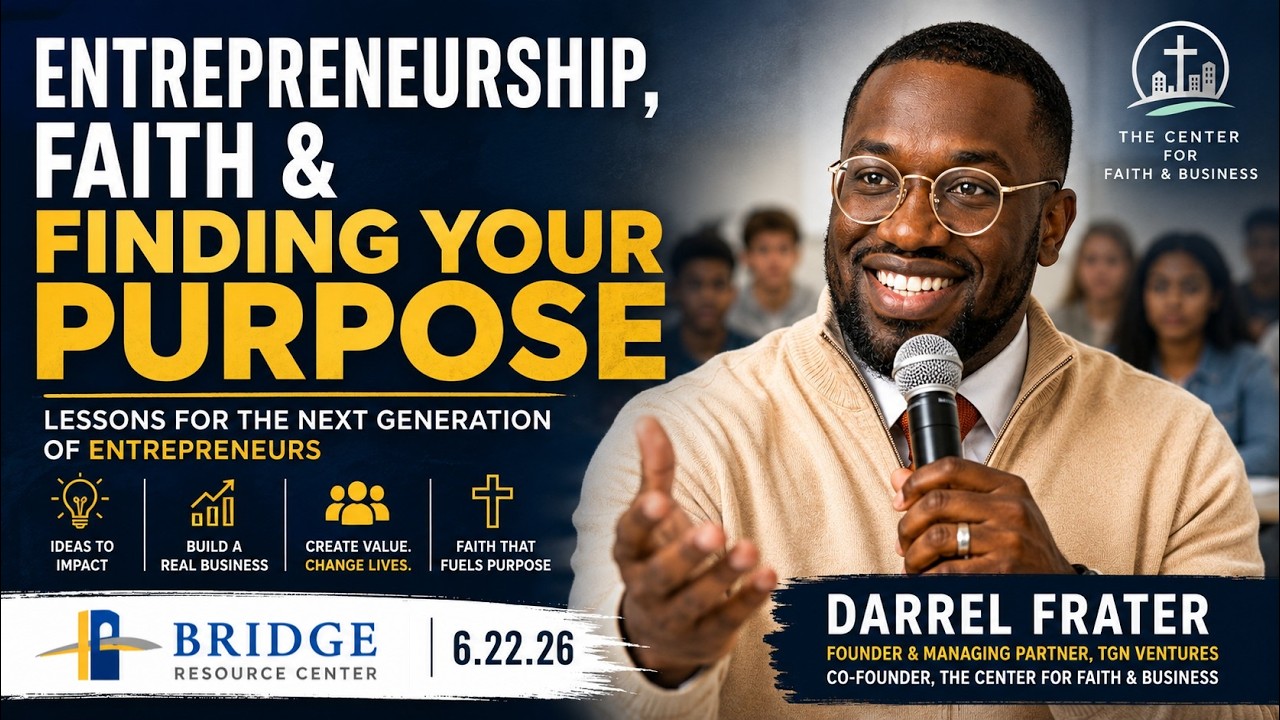
In this live workshop, faith‑driven venture capitalist Darrel Frater shares his personal story—from growing up watching his immigrant father build a furniture business in New Jersey, to studying business, struggling to break into venture capital, and eventually founding the faith‑centered fund‑of‑funds TGN Ventures in Tulsa. He explains why he views venture investing as a ministry, describes his career path (first associate at Visible Hands, senior associate at Serac Ventures, raising a $10 M fund, and investing in AI‑enabled startups such as RightSee, Future Money, and SmartWiz), and outlines the theological and impact‑driven principles that guide his decisions. The session then shifts to a student‑led pitch round where four teams present ideas (an AI‑styled wardrobe app, a hair‑care cream, a sports‑training facility, and a mental‑health counseling robot). Darrel provides real‑time feedback, emphasizing market research, impact storytelling, brand building, and the importance of confidence in pitching. He answers audience questions about his motivations, early mistakes (a costly 2020 MVP built with $70 K in developer fees), the role of AI for young founders, marketing strategy (brand as the most powerful tool), and how faith underpins his entrepreneurial mindset. The workshop ends with encouragement for the participants to align their work with Scripture, trust in God’s calling, and pursue entrepreneurship as a vehicle for transformation.
Chapters
Hi, I would love to get your attention please. Okay, so now we are going to present our guest speaker, Darrel, and, um, first I want everybody to give him a warm welcome.
Awesome, awesome. Is there anything else you want to say?
Um, if you have questions, We're going to be asking questions.
How many?
How many?
2 to 3.
All right.
What a wonderful spot.
Oh yeah.
Good morning, y'all. How y'all doing today? I heard y'all got some great business ideas. I heard you guys are innovators. I heard that you all are here to learn how to pitch your business as well as see your business I would love to learn a little bit about you guys before I dive too deep into myself. I would love to just, by show of hands, how many people have started a business before, or is this your first time? Raise your hand if this is your first time starting your business.
Okay, okay.
How many here have parents or family members that are entrepreneurs?
Anyone?
Nope. Okay, okay. Do you know what your family member does as an entrepreneur, what their business does?
Uh, I think it's like perfume stuff.
Okay, and who's the relative?
Um, Tiffany, and I forgot.
Is that like a cousin?
Yeah.
Okay, so you have a cousin that sells perfume. Wonderful. I think I had some people over here.
Well, they're my parents, so I guess the camp.
Okay, okay, awesome, awesome. Yeah, so ministry can also be seen as an entrepreneur endeavor as well. Yep, that's right. And I think you have also relatives?
Yeah, descendants.
Okay, so you guys are related too? Okay, cool. Okay, that's great. So we have some family members with Businesses. Did you have some too? Yes.
My mom used to have a cake business.
Nice, nice. So she was a baker, had a cake business. That's incredible. Entrepreneurship can be in many different forms. So it's exciting to see cake business, perfume ministries. That's super exciting because a lot of times in life. Some people get exposure to entrepreneurship, others don't, but anyone can become an entrepreneur regardless of your background, and it looks different for every different type of business that's out there. So I'm super excited to share a little bit about myself and then dive deeper into some of the work that you guys are doing and for me to be as helpful as possible with my story, my testimony. And my love for entrepreneurship. So my name is Darrel Frater. I'm a faith-driven investor. Everything that I do, it's by the grace of God, and I lead with my faith in my world of investing. I'm a unique type of investor.
Mm-hmm.
There are different kinds of investors in the world. Some investors invest in the stock market, others invest in real estate, I am a private market investor. I invest in entrepreneurs, and I typically invest in these entrepreneurs when they're just starting their businesses. How do you— show of hands, who has heard of the show Shark Tank? Okay, so Shark Tank, they usually have a panel of venture capitalists or investors that write checks to some of these entrepreneurs that are building their businesses. Their life check may be $25K, $50K, $100K, sometimes even more. So I pretty much do what they do with their own. I'm a venture capitalist. We raise capital from wealthy people and institutions. We find great entrepreneurs to entrust with that capital, and then we give them sometimes $100,000, sometimes millions of dollars. Um, I've invested Millions of dollars into companies. I've raised tens of millions of dollars in capital, and this is what I do. This is what I feel called to by the Lord—to have impact in the world. My story starts with my father's story. So I'm—I live here in Tulsa. I've been here for three years. Prior to being in Tulsa, I grew up from New Jersey. Where I was born and raised. But prior to New Jersey in my life, my father is actually an immigrant from the island of Jamaica. And in Jamaica, just to give a little context of where he comes from, his family was extremely poor in Jamaica. They didn't have electricity, barely had running water. They lived in a one-room shack. Him and his 6 siblings. His mother was deaf by the age of 13, so she didn't work, and his father passed away when he was very young. So they grew up very poor on the island of Jamaica. So one thing that my father did, he made sure that he learned a skill that he can eventually turn into a business opportunity. What was that skill? He learned the skill of carpentry, so he learned how to build stuff with wood with his hands, and he took that skill and he built a furniture shop. So similar to how your cousin, you know, sells perfume, your mother had a baker— bakery, my father built a furniture shop. He built furniture with his hands. and he sold it out of his shop. He did that when he was 17 years old. He moved from Jamaica to America in New Jersey and he started that business. And over time, he was able to grow that business and iterate that business and turn it into what it is today, which is his construction company called GF Builders and Associates. For me, that was the first business that I ever watched, I ever seen, I ever participated in. Some of you guys mentioned, hey, I don't have anyone in my family that is an entrepreneur or has a business. Your parents or people in your household probably have traditional 9-to-5 jobs, as they call them, where they have an employer that they work for. Growing up, my mother didn't work. My father ran the business. So all I knew was entrepreneurship. I didn't actually know that people had regular 9-to-5 jobs. I thought everyone had a business and worked in their business. I thought that was the norm. That's all I knew. So I grew up always knowing that entrepreneurship was an important part of my life. Fast forward, um, I went to college. I went to a school called the College of New Jersey. I studied business management, and shortly after graduating from college, I learned about this thing called venture capital. And I told you a little bit before, venture capital, we're the people that raise capital and invest capital into other opportunities. For me, I always knew entrepreneurship would be an exciting piece of my life, but when I discovered venture capital, it was so exciting for me because I truly believe that entrepreneurs are the people that can change the world. And as an investor in those entrepreneurs, as a venture capitalist, I thought it would be an incredible way for me to scale my impact. So as opposed to being the actual entrepreneur building these businesses, you know, I feel like, you know, as an entrepreneur you have a sphere of influence and customers that you're serving, but it kind of stays right there. You know, these are the people I serve, this is what I do, and kind of stays right there. As an investor, I saw it as an opportunity for me to scale my impact because I can invest in the baker, I can invest in the perfume salesperson, I can invest in this construction company, I can invest in this technology company, I can invest in pretty much any company I want, and they can go out and have a lot of impact in the world. So for me, I saw becoming an investor as an incredible way to scale my impact. And in 2018, that's when I started to pursue my career in venture capital. It took me about 3 years to land my first job at a venture capital firm. Venture capital is a very hard industry to break into. It is not as easy or as straightforward as a go to school, you know, get a job, and you can work there forever. It's a very highly demanded industry, like a lot of people want to do it. But there are very few opportunities to actually do it. So it's a very rare opportunity to become an investor or work for an investment firm. Took me 3 and a half years to land my first job. In 2023, I was working at a firm called Visible Hands. They're a Boston-based investment firm. I was there for 2 years serving as their first associate, which is like a junior level investor. And through that organization, that's actually how I learned about Tulsa. I told you that venture capitalists, we raise capital from high net worth individuals and wealthy organizations, where there is a family office here called the George Kaiser Family Foundation, and that organization actually invested in the firm that I worked for. And after they wrote an investment into that firm, I started visiting Tulsa and coming here pretty often. And Which was pretty exciting. I really got to know the story of Black Wall Street and the entrepreneurial history here in Tulsa, as well as the really strong faith history that exists here in Tulsa. And that was really appealing to me. Had no interest in moving here, but God had another plan. Fast forward 2 years from that, my wife and I— girlfriend at the time became my wife, we got married. In 2022, we had our first child in 2023. My daughter Gianna is three now. But shortly after Gianna was born, the Lord gave me just a message and a vision to move here to Oklahoma. And one thing that I'm big on is obedience. That when the Lord gives you a word or a message, you sit with it. You get clarity from the Lord to help you decipher what that message is telling you, and once you have that clarity, you take action. And for me, that action was to move here to Oklahoma with my newborn baby and my wife. So we did that, moved here to Tulsa in March of 2023. After I moved here, I actually started to build a friendship with an investor here in Oklahoma. He actually lived in the Oklahoma City. He was starting a brand new firm called Serac Ventures, and, you know, it made a lot of sense for me to, you know, work closely with that gentleman. I actually joined his team as his first senior associate, so a step up in regards to my title, my role from the previous firm I was working at, and I was able to help him launch this new venture capital firm. Firm. So in 2023 through 2025, I was with him for a little under 2 years. I helped him raise about $10 million for that fund, and we were able to invest in about 12 companies through that time. Just to get into the details, as a senior associate, I was able to not only raise the capital, but I also had a little bit of authority to actually invest in some of the companies. From end to end, because there's a lot of things that happen in a firm, but it has a lot of responsibility to be able to have the check-writing ability to say, hey, I like this entrepreneur, I think their business is going to be very successful, and I want to give this company, you know, $250,000. That's the amount of money we were writing checks to for the opportunities that I was able to lead 3 investments, one into a local company here in Tulsa. The company is called RightSee. They are an AI-powered career services platform where they help job seekers find their next job, and they work with universities. They overwrote the founder Brandon Mitchell, who's here in town, a $250,000 check to his company. Another company that I invested in is called Future Money, and they are a financial app that allowed parents to invest on behalf of their children. For example, for you all, if your parents, you know, want to create an account to help you invest money to fund your retirement, which is very brave for a teacher, but trust me, if you think about your retirement now and invest in the future early, there's this thing called compounding where your money grows rapidly over long periods of time. So we invested in that company, Future Money. And then the last company we invested in is called SmartWiz, which is an AI-powered tax preparation software where they help tax preparers use AI to help their tax preparation practice. So there are people that have tax businesses where they help people do their taxes And SmartWiz actually helps those individuals prepare their taxes much more efficiently so they can serve more clients. Those are 3 companies that I led the deals on. Then we have a bunch of other companies that we also invested in, but for me, since I was the lead investor on those, yeah, those are top of mind for me. Fast forward, um, 2025, my time ended at that firm and the Lord was pushing me into launching my own firm. And starting this year in January, I had the honor and privilege to start my own venture capital firm called TGN Ventures. TGN stands for The Good News. We are a faith-driven venture capital firm. And when I say the term faith-driven, it means that we allow the Lord to be the CEO of our company. We're not doing it just to make money. We do it because we feel a calling from the Lord.
Amen.
And that we want our business to be surrendered to Christ, to be able to use our business as a vehicle for other people to know the love of Christ and for people to be transformed through the work that we do, which is very unique in regards to being a faith-driven entrepreneur or faith-driven investor, because the world talks about business in a way that's not aligned with how God sees business. The world talks about business as this way just to get rich, and it's for it to be about me, me, me. I want to become successful. I want to be the guy with all the money, or the girl with all the success. But God looks at business very differently. God sees business as a vehicle to push forth his purpose. And God's purpose is one, for everyone to know him, and then for others to be known, to know God. And that's what our commitment is at TGN Ventures, the Good News Ventures.
That's right.
So we invest capital, and just to get a little in the weeds, but we invest capital into other venture capital funds. So we're called a fund of funds. I'm not gonna— I'll spare you the details because it'll probably go over your head, but we invest in other people's funds and we help them invest in other businesses. So a little bit different from what I did previously, but it's something that I'm super excited to bring. here in Tulsa, and we're super excited to be able to do that kind of work. I'll stop right there. Um, like I said, Darrel Frater, founder and managing partner at TGM Ventures, and I've been an investor for the past 8 years. And, uh, I love entrepreneurship. I love what it can do for the world, and I love what the Lord can do through business and entrepreneurship. I'd love to learn more about You guys, I hear you guys have some entrepreneur ideas and some business ideas. So let's go around the room, if I can do that, and hear everyone's idea. And then we can talk through a little bit more about what it means to be an entrepreneur, how you should think about your business, how do you position it to be as successful as possible. Does that sound good? Who's here to talk— excited to talk about their ideas?
Me.
Okay, all right, all right, all right. As you should. We can go around in this order. So it's very important to practice and get great at storytelling and conveying the message of what your business is in a very easy-to-understand way with confidence. You'll be surprised Just how when you practice that and you understand that it's something that takes time and repetition to get good at, how transformative it will be for your life, for your business, for your family, and your career as an entrepreneur. So as often as possible, whether these people or anyone else is asking you to talk about your business, you should be at home practicing it and taking it very seriously because The right pitch can transform your life. Come on. You never know who's paying attention, who's in the room, who's listening here or even on that camera. So you'd be surprised by what the right pitch can do for your life. Who knows? Mark Cuban might be listening to this, and you guys might be future Shark Tank people on this on this show. So let's go around. Let's do our pitches. Introduce yourself, and then introduce your company, and then introduce your why. Why do you think it's a great fit, or why did you call to start this business? Are these teams or individuals? Teams. Teams. Okay, Janae and Keenan.
Hi, I'm Janae. And I'm Keenan. And our business is EcoStyle. It's basically an app that is AI-driven that will help you pick out outfits based on what you already have. And it will basically take a— you'll take a photo of your closet and you can take little snippets, and then you can add details and stuff to better understand what you're trying to do and like to get the style and occasion and stuff.
And then you can add details and stuff to better understand what you're trying to do and like to get the style and occasion and stuff.
And then, um, you can do a survey if you have time to— so AI can get a better understanding, and it will create all the combinations according to that.
Tell us the why. Why did you see— how did you see this idea, and why is it important for you guys to build it?
She told us that even by— like, we had ideas in our head already, and then we had to combine them a little, and I really like that. And also, um, I struggle with this too because I take about 20 minutes to get ready and to choose an outfit. And, um, we've interviewed other business owners that came, and they said they struggle with this, and they were really like Enjoy this action game.
Awesome, clap it up. That was an incredible pitch. One thing I want to highlight is that when I asked why this business, or why is it important, the answer is actually grounded in data. They actually surveyed and talked to people and got customer feedback that this could be a potential market. That is a big enough problem for a decent amount of people to build it and be able to solve for that. And that's huge. That is called market research or just customer discovery, which is understanding, is this a real problem that people need to be— need to have solved before you go out and build it? So that's incredible. Excellent pitch. You both pitched really well. Confidence. I like that. Great job. All right, who's our next team? Hello, my name is Victor. My name is Katherine. And we have—
we're bringing you business, All Purpose Curls. All Purpose Curls is a hair cream made to combat, um, lift it, lift it, combat dry, dull hair for back hair The reason why we made this is because me personally, I have seen a lot of people in my life combat this, and I've heard about it way too much to where I like almost can't ignore it anymore.
Awesome, awesome.
Great pitch.
Um, and tell me a little bit about the impact that you believe that this business will have on the cost of Um, the impact that I believe it will have is that I've actually seen a few of my friends out there who will not accept their natural hair because it's too ugly. They'll put on a wig or they put on a bonnet because they just don't accept their hair. So I believe with our hair paint, it'll allow them to begin to see their hair better in the mirror, feel more confident.
I think it's I going to be a great way to mean, just feel better, pretty much.
I keep on saying better over and over again.
That's great. Let's pull the string a little bit. What happens when people feel more confident, feel better? What happens to their lives after that happens?
After it happens, they feel— they talk more, they act more. I mean, they start— they start—
they stop slouching, they start going up, they start being better, they start And don't you think the world would be a better place for more people that are happy and confident and feel great about themselves?
Yes.
Awesome, well, great pitch. I love that we're able to get to the impact layer to where it's like, hey, I see a problem, that's great, but what happens when that problem is actually How does someone's life become better by our solutions? How does the world look better when we put our solutions into the marketplace and we're actually transforming people's lives? That is the essence of business. It's not just to make money, but it's to transform lives in a very meaningful and powerful way. Great job, you guys.
Thank you.
All right, who's our next team? All right, Team 3. All right. What is Sports Training Academy to help young athletes?
Okay, our business is about a sports training facility that keeps, keeps someone cool and has different sports and helps young athletes train for where Something bad happens, and when their sports is out of season.
Awesome. And, uh, tell us about yourselves.
I'm Patrick.
I'm Olayo.
And I'm Chris.
Tell us why you started the business. What did you see that made you believe this is an important problem to solve?
Um, we noticed that athletes have no one to train with this bad weather.
And we interviewed some people, but they pretended like they were athletes, and they talked about how they have trouble getting sports and getting exercise. So we learned from them and we made an idea together about how we We get a training facility for all athletes to have better training.
We also have our own sports gear and a gym.
Okay, I love that. I'd love to hear a little bit about— this is a great way to think about how to position your product or your business. What was the What is the current state or what is the current service or product that they're using today and the gaps you see in the market? So before you guys, you know, start this, what are they— what are your current customers or what are your prospective customers doing today to solve the problem and where's the gap? What's missing in the current kind of facilities that they're going to? What do you mean? So, uh, your company is not in existence yet, so these people are going to other facilities and they're, you know, doing it on their own, and they're, you know, doing this currently right now, but you see an opportunity to create something better, correct? So tell me about the current facilities, which is the current players in the market, and what those current players were lacking, which would be, you know, an area where, hey, we're building this because they're missing this and we think that customers would appreciate this. If you can share a little bit about that.
What were we thinking about how product changes? We think it has probably better trainers than the others and have more support. Yeah, it's one of our highest priorities.
Okay, so pretty much the existing facilities, one, the trainers are not to the highest quality of what you think is possible. We think that we can create better trainers or have better trainers than Make the experience for the customers even better, as well as the diversity of the types of sports that are available at the current facilities. There are probably so many other sports that people want to play, but they don't offer them at current facilities. And you believe by creating a new facility with better trainers and differentiated sports will attract a different audience that will make your facility very attractive. Is that correct? Yes. I think that's an incredible business. You should absolutely pursue it. I love it. Great job. Before you guys stand up, do you see how I was able to kind of ask the questions around what does the current state of this industry look like and where is the gap in the market that customers will actually see value in something new. And that's where business becomes so exciting because there are customers out there that want the thing that you're going to create and they don't have it today because the existing players in that market haven't built that out within their business, which creates an opportunity for new players to come in and build something new and incredible. So that's a great way to identify potential opportunity in the market. What are the current players doing? What are they lacking? And where can we step in and bring something new, better, and different to the market? Good job, guys. Last but certainly not least, the next team. So we decided to make a counseling robot because we thought it would be great for people to actually talk to people.
Small service robot that helps people change their inner feelings and change their life situations around.
Okay, so also going off of that, our company is called CareBot Counseling, and then our robot's name is Milo. And then the reason why we decided to create this thing is because Millions of teenagers and young adults struggle with mental health issues like depression, anxiety, and the list goes on and on. And so we believe that it is important for them to have some type of system that can help them get through those things, or at least ease the pain of those mental health problems. Um, we searched on ChatGPT like how much teenagers and young adults have problems with this. It was 80%. So Milo is basically a therapist, but it's not taking the therapist job. So when you tell them, it gives you feedback on like how it helps and stuff like that. Awesome, awesome.
So I got some questions. So one of the first and foremost is exciting to hear that you guys are using AI, ChatGPT, and these technologies to do research on the market opportunity and the product you want to build. I think Super exciting that you guys are just leveraging this new technology to build. Tell me a little bit about the tech and the product itself. Is this a physical robot that's going to be, you know, walking around in the river, or is it like an app that can help them, you know, through their already existing device? Tell me a little bit about the application of your product and how it works.
So it is actually a physical robot that is actually AI-powered. It'll be like an actual, like, thing, but it'll also have the screen of the things that we can ask some questions and speak to.
That's awesome. And I heard you mention that you're conscious around taking existing therapists' jobs, and it seems like this is to be a supplement to therapy but not a replacement. Is that accurate?
Yes.
That's awesome. That's very thoughtful. There's a lot of fear around AI. And AI taking people's jobs. So for your product to be a brand that cares about people in a way that you're not out to take people's jobs, but you're also out to actually make people's lives better. It's possible that even for people to start with your robot and then you guys recommend them to, you know, human therapists that can take that next step. So this can be even something that adds to the market of therapy and explains to people why it's important to work with therapists and how it's beneficial to them, to where you're not taking jobs from therapists, but you're actually adding more work to existing therapists and maybe even inspiring the next generation of therapists. So your business could be doing incredible things to help, especially in this time of day where we have a mental health crisis. There's so many people that need that type of support. I think that's incredible. Wow. Now you all are working on some really impressive businesses. I'm super inspired by you all and excited for the next generation of entrepreneurs. You guys are the future, and the future looks bright. We have people like you leading the future in innovation and entrepreneurship. Let's open it up to questions. I would love to hear from you guys. What questions do you have for me? What questions do you have about your business? What questions do you have about venture capital? Chris?
What inspired you to start your business?
So what inspired me to start my business— my business is a venture capital firm, TGN Ventures— I would say I identified venture capital and me starting my own firm as the best way for me to have impact in this world. It also, for me, feels like a divine calling from God that I'm uniquely created and positioned to use my personal gifts to serve other people in the highest capacity. I believe that I'm called to support has helped entrepreneurs. And by being a venture capitalist and being able to give those entrepreneurs capital, mentorship, resources, connections, is the best way for me to fulfill that purpose of supporting entrepreneurs. So it fills a need in my life by allowing me to have a vehicle to do that kind of work, to be in line with my purpose and calling.
I believe it's going to do me How old were you when you first became interested in entrepreneurship?
So back to my father's story, I just grew up watching his entrepreneurial journey. So I believe in a conscious way, maybe by the age of 8, I just knew entrepreneurship would be for me. I didn't know to what capacity, but I just knew entrepreneurship was Away from me. I had no clue that it would be not being, you know, a boots on the ground entrepreneur myself, but to be an investor supporting entrepreneurs. But now even being a founder of my own firm, I am an entrepreneur essentially again. But yeah, I say I was eight years old when I got the entrepreneurial bug from watching my father.
Let's go. What mistakes did you make?
Great question. I made a lot of mistakes along the way, but the beautiful thing about mistakes is that when you view mistakes as a stepping stone to success, you learn from every mistake and it helps you move forward. They call it falling forward because a lot of times people make mistakes and they fall and they think that it's something that's going to stop them from And they actually retreat and move backwards. But the concept of falling forward can help you turn mistakes into something that pushes you forward into your purpose and into growing and learning how to be successful in your respective field. So I would say tangibly, in a specific example, I would say, uh, 2020, 2020, I started a company It was a mobile app. It was called The Club. It was a live streaming platform that helped entrepreneurs live stream their business and to be able to make money online. Because 2020, you may remember me. I don't know if I'm coming out, but COVID just hit, and we were all locked down for some time. And I had a lot of DJs in my network, and I was hearing the same problem over and. Over again that the clubs and parties are shut down. How are we as DJs going to make money? And I'm like, hmm, I saw online, um, just people were having these like virtual events where DJs were doing things and DJs were playing music and stuff like that. And I was like, that deserves its own platform to where people can use the internet to do their job, whether it be a DJ or whether it be a public speaker or a singer or anyone that can put a camera up and connect with their audience in a meaningful way, actually create an experience that allows them to monetize that. So I started that business, and here into the mistake I made, uh, it cost a lot of money, especially back then, to build apps and You know, I was optimistic, I was a little naive, but I hired developers. I'm not a technical entrepreneur, so I don't know how to code myself. I don't know how to write code to create digital products. So I hired developers from overseas, and it was very expensive. Those developers cost over $70,000 to hire to build the first version of my app. And, you know, I didn't have access to venture capitalists or investors. I used my own personal savings and credit cards to pay those developers. So I had about $20,000 in savings, spent that, and then I put about $50,000 extra on credit cards to pay those developers. And I built you know, the MVP with those developers. And what I didn't realize that when you put a product in the market, that first version of the product likely isn't going to be the optimal one that allows you to scale into a lot of customers and a lot of revenue. It takes iterations and improvements over and over again to make a product extremely extremely strong that can allow you to really serve your customers and generate a lot of revenue. So for me, I had just enough money with that $70,000 to release a very basic version of the app, but I had no money to continue to pay those developers to make the additional iterations to make my product great. And I tried to raise capital from investors I didn't have enough traction or enough relationships or even the know-how, how to pitch an investor to get the capital. So the app stalled and I just didn't know how to take it to the next level because maxed out my credit cards, had no more money in the bank. I didn't know what to do next. Um, and God has a plan for everything, so I don't feel like, hey, this was a mistake that I shouldn't have done. I wish I— I wish it was a less expensive mistake, but that experience building that company helped me land my first job at the venture capital firm I spoke about, and it helped me begin my career as an investor. Without that experience, I wouldn't have had the opportunity to build a really strong network To understand what it takes to build a company and to be an entrepreneur, which served me very well as an investor because I know what entrepreneurs go through. I know how to look at entrepreneurs and assess if they have the chops and the experience and the know-how to become an entrepreneur and succeed at it. So very expensive mistake, um, to spend over $70,000 and put a lot of it on credit cards. Today in 2026, it's much easier and cheaper to build products using things like AI you guys talked about, and even hiring developers that are using AI. The costs are much cheaper. So that $70,000 back in 2020 that I spent to barely release my MVP, which is the minimum viable product, first version of your app or your product would take someone much farther today than it did 6 years ago. So that was my big mistake, spending too much money on development and not having more of that capital to get started with my business. I want to go with someone else because you went already.
Alongside faith, what else drives you? Wow.
I would say faith is the first and foremost. Impact is there as well. I really want to be impactful in the world. I want to be able to help transform people's lives, and I want to make this world a better place. And I would say that faith is the foundation, and then everything else is my motivation, the why. Aligns with that foundation to where, hey, faith is here at the bottom, then it's, hey, impact is here, then, you know, the ability for me to take care of my family financially, you know, for me. And my— just, it's fun to be an investor and support an entrepreneur, you know, to just, um, I think that I'm good at it and I think that I've been gifted to do this kind of work. So all those things are kind of my motivating, my why. But faith is the foundation, and everything else aligns with it. And that's kind of how I make my decisions in life. I start with faith, and then I assess what aligns with my faith, what aligns with my divine calling, in other words, and I make those decisions. If it aligns, I say yes. If it doesn't align, I say no. Like, I was saying something just today. I'm a very busy person, but when things are aligned with my purpose, It's easy for me to say yes to great people that are also doing a lot of work. So I look for that alignment, and faith is always the foundation of my why.
Um, how long do you usually spend picking an outfit, and when you find those outfits, are you satisfied?
Yeah, so I try my best to create systems for everything in my life, and even getting dressed in the morning I haven't seen them before. So I like to buy pretty much sets of clothing and color palettes that match to where I can pretty much throw on anything and it works. So that way when I'm in my closet and I'm looking at what I want to wear, you know, I can just grab shirt, jacket, pants, and socks, shoes, and I can just go. So it usually takes me maybe 5 minutes or less. But still, I would say it's still a pain point. When I build more wealth, I'm probably going to hire a designer or like someone that can style me, because in my world of venture capital, I also do a lot of public speaking. The way you present yourself, the way you dress, the way you look, it also plays a role in the experience you provide to the people that you're doing business with and you're interacting with. Um, so for me, that's something I'm willing to spend on, um, because the return on investment when I present myself is great. So I'm going to spend on that because it can impact my ability to build new friendships or to find a new business partner or find a new investor. Um, so there's value attached to how I pick my clothing and how I show up to places. And that's a good way to kind of assess whether your business is valuable or not. Can the person on the receiving end, can your customer derive value that's impactful to their life? We spoke about for your product how it makes them show up as a better person and build confidence. Well, there is a Quantifiable return on investment on when I feel better, I show up to work better. I show up to work better, I make more money. When I dress better, I meet people, and you know, I meet people and they're impressed by me and my experience. When that relationship goes well, I get a new client, I get a new investor. There's an ROI there. So when you are able to quantify The financial return on investment for when someone interacts with your business or becomes a customer, that's a good way to think about are you building something of value or not. A little complicated concept, but hopefully I planted a seed there. Over time you'll catch on to it a little bit stronger. Any more questions?
What were some of the ways you engaged with your partners in What do you think is the most effective form of marketing for your business?
So I would say when it comes to marketing, it depends on the type of business that you have. Every business has different marketing channels that are effective or not effective. I would say at a high level, brand is probably the most effective form of marketing to where you build a brand that people trust and want to engage with the because they know that your brand can solve my problem. And brand takes a long time to build, but can be destroyed overnight if you're not stewarding that brand properly. And brand is impacted by many things. It's not just the logo, it's not just your marketing messages, it's also the quality of your product, the experience that your customers have when they interact with you and your business. And everything that dictates whether someone has a great experience when they interact with your brand. And I think that brand is the best marketing tool because when you have an amazing brand, people talk about that brand. And when your brand and your products serve people well, other people with that same problem come to your brand for that solution and for you to help them with that problem. So word of mouth through an amazing brand is the best marketing. Everything else I say is catalytic to great growth, meaning that, hey, I might, you know, do a Facebook ad, or I might do a flyer, or I might do something else. I think all of those are great introductions to marketing your product or service, but ultimately the greatest growth comes When you have a great brand and people talk about your product or service. Anyone else? Especially anyone that hasn't asked a question yet. Ian, I don't think you have asked a question.
What would you do if you only had $500 to start a business?
That's a great question. Yeah, with just $500 to start over. And it also depends on the industry, but for me, I run a venture capital firm, and I would say investing in great design for your website, for your marketing material, and being able to create a strategy that allows people to understand story of your business. Storytelling is incredible. It's not too expensive to invest in storytelling. So I would say I would spend that $500 to invest in my brand and invest in my ability to tell the story of my business. And hopefully that story can inspire customers, team members, investors, and other stakeholders to support that business. So that $5 million goes towards investing in the story and the branding of that business. All right, if you didn't ask a question yet, who hasn't asked a question yet?
What opportunities do you think young entrepreneurs should pay attention to?
I think young entrepreneurs should pay attention to opportunities in using AI as a force multiplier, as a tool to grow your business faster, to learn about your industry, and to be able to build products and create systems that scale within your business. Learning different AI tools, learning how to use these products to be more efficient and effective in Not only will it be great for your business, it's also going to be great for your personal life. It can be great for any career or job you take on. But learning the skill of AI is a great opportunity, and to not be afraid of it, but to learn it and to be curious about how can you use AI for good. Anyone else that didn't do a question yet?
I have a question. What was your first big purchase for your business?
Can you repeat that?
What was your first big purchase for your business?
First big purchase for my business, let's see. So for this business, first big purchase. So I got pretty lucky, and I would say that the Lord blessed me with some things that would have been very expensive, but through the grace of God, I've been able to get support for free for people that believe in me. And I mentioned that the first thing I recommend people to invest in is their brand, where there is a team that have been just following my journey over the past 3, 4 years, and they're a team of designers. They're actually in Africa. And when I kind of told them that I was starting my new firm, they said, Darryl, we love what you do. We also believe in God. We want to help you out. And they did my entire brand package and website for my company. That firm is called Tony and Co. And Tony and Co did my entire marketing and branding for free. And that really helped me get started. That would have cost me over $20,000 to do everything that they did for my brand, from my website to my logos to marketing materials. Everything would have cost me well over $20,000, plus they were still helping me and supporting me in my marketing, my branding. So that was the biggest thing. I didn't pay for it, but, uh, you know, we kind of borrowed services. I kind of Help them out with other things and they help me out with that. But that was a blessing and probably would have been the biggest expense if they didn't do it in time for me.
In the beginning, you were gaining a lot of leadership. Was there anyone who kept on doubting you over and over again? Was there like one person that constantly would come back saying, you can't do this, or Just give us a quick feedback.
I would say in my past there were people that didn't support my entrepreneurial journey, but as I grew up and matured, I found ways to align myself with people that align with me and to disassociate myself with people that don't align with me. And the things that I'm pursuing. So in the past, I would say 8 years or so, I didn't have too many naysayers or people that, you know, doubt me or don't believe in me or publicly say that stuff to me. And for the few that do, I kind of just ignore them. At the end of the day, when you have a purpose and a mission and you know beyond a shadow of a doubt what you're called to, Can't nobody stop you. You gotta have faith and confidence that you're called to something great and that you're going to continue no matter what anyone say. Only if God tells you otherwise, that's the only one that you should discern whether you should follow that direction or not, is what the Lord tells you. But any person, human, man that tries to stop you, you just keep persevering. So yeah, I would say keep on the path, but No one in recent years. It's been all positive in recent years. I think that's a testament to me being in my faith.
Did you always know your business would succeed?
I've always had confidence that my business would succeed, but success, I would say, is in the eye of the beholder, um, because some would say that my business, the club— I don't know if I'll talk about that I spent $70,000 on developers and it didn't work out the way that I had planned for it to work out. It was a failure. But for me, I call it a success because it was a stepping stone that I needed in my life. And without that failure, I wouldn't be where I am today. So it really is, for one, confidence that you're walking in purpose and that you're doing everything that you're called to. And as long as you're just being obedient to that calling, the outcome really doesn't matter. The outcome comes— the outcome belongs to God, and what really matters is your obedience. So I would say that. Yeah. All right, did everyone ask a question yet? I don't think—
yeah.
So how did I get my first customer? So in my business, our customers are called limited partners. These are investors that choose to invest their money with me. And how we got our first client is through an introduction from an entrepreneur that I mentor. They introduced us to an investor that is going to invest a lot of money into our firm, and they're going to invest $5 million into our firm. And that customer was introduced to me by an entrepreneur that I mentored. And you'd be surprised just by the power of relationships to where when you build trust and rapport with people, people trust you so much that they're able to extend that trust to other people of value. So because I poured a lot of effort and energy into this entrepreneur, that entrepreneur felt compelled and excited to introduce me to someone that can write a large investment into my firm. So trust is super important when it comes to business. Did everyone get at least one question?
Um, if you didn't do what you're doing now, what would you do?
If I didn't do what I'm doing now, which is running an investment firm, I probably would start a church and I'd probably be a full-time minister. But for me, I believe that my business is a ministry, and I believe that God can work through business just like he can work through the church. So I would love I continue to do my work as an investor and a fund manager, um, as a ministry. But if I wasn't doing that, I would start a church and I would preach the gospel every day. Come on. Awesome. What's our time? Have we been on time?
We're good on time.
He's bringing food back for lunch and you did great.
Is there anything else glaring?
If not, I have my phone on Look, I'm just super excited and encouraged by you all. I love all of your pitches. I love the thoughtfulness that you guys have around building your businesses. The fact that you guys are in this room in the summer talking about business— most kids your age or young adults your age are out trying to have fun, but this can also be fun and exciting and something that moves your life and your career forward and for you to have a lot of impact in this world. So I'm super encouraged by you guys. I actually wish— going back to your question— I actually wish that if I could go back in time that I was doing this stuff when I was your age, because you guys are light years ahead of many other people that don't have access to this information at this stage of your life. So don't take this for granted. This is a blessing. And for those that see it as a blessing, you'll be able to steward it in a way that can transform your life and the lives of the people around you. So that's what I got to say. Anything else? That's it. That's all I got. This is great. I appreciate you guys. Hand back to you all. Thank you all for being so inspiring. Like you were saying, never let anyone tell you that you cannot do something, especially when you know you're called to that purpose. So I would challenge you all, speak to God, read your Bible, know God's word, know the scriptures, the holy scriptures in the Bible. And to be able to reflect, does my life align with these scriptures? When the Bible says I can do all things through Christ that gives me strength, do you believe in that scripture? Do you believe that you can do all things through Christ? And when you believe that, no naysayers or doubters or people that want to say bad things about your idea can stop you. So I encourage you, Continue to grow in your faith, learn God's word, and live it out, and believe it. Because when you believe it, there's power in it, and you can achieve incredible things. Good job, guys. This was fun. All right, got it, got it, got it. Well, you guys take my card.
Okay, so for the refiner, we are going to have refiner. Remember, if you don't have it here, all right, this is your chance. Okay, so let us know if you guys are going to take some time, but, um, in the meantime, you're welcome to go. Okay, thank you so much.
I appreciate you guys for having me. Of course.
More from Darrel


Plaza 210: Catalyzing Faith, Business, and Community in North Tulsa | Accelerate North Tulsa Pitch

💰 Get Funded! Founder Interviews w/ Preston Troutt, Founder and CEO at Crowdsurf 🚀 09-27-2024

💰 Get Funded! Founder Interviews by Serac Ventures w/ Rumaiza Ali, CEO at Wedy 🚀 08-30-2024
💰 Get Funded! Founder Interviews by Serac Ventures w/ James Chapman, CEO @ Plain Sight 08-16-2024

💰 Get Funded! Founder Interviews by Serac Ventures w/ Naveed Iqbal, Founder & CEO at Dol 08-09-2024

💰 Get Funded! Founder Interviews by Serac Ventures w/ Serge Amouzou, CEO and Founder 🚀 07-26-2024