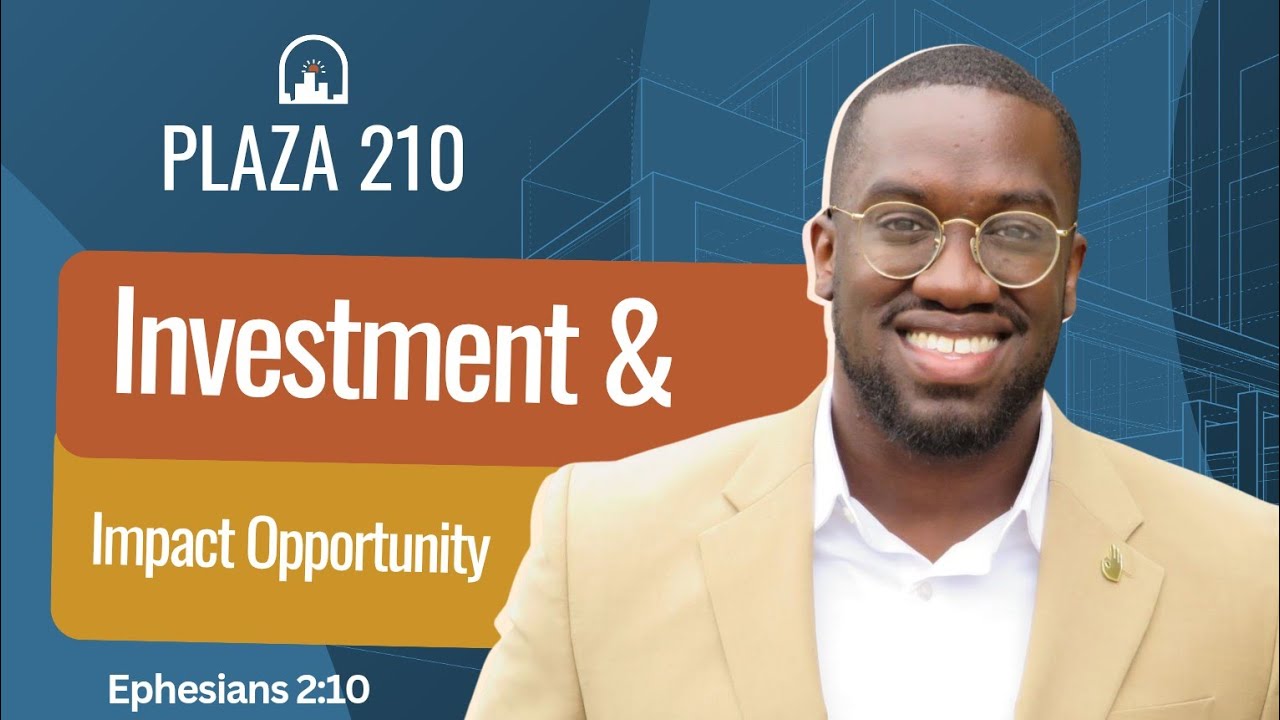
In this Accelerate North Tulsa pitch, Darrel Frater, joined by his wife Rosalie and daughter Gianna, presents Plaza 210 – a faith‑centered innovation hub designed to catalyze economic prosperity and spiritual growth in North Tulsa. They frame the problem as systemic barriers (capital, mentorship, workspace) and a spiritual disconnect that leads entrepreneurs to burnout. Their solution is a mixed‑use plaza anchored by a Center for Faith and Business, offering coworking, mentorship, capital access, and a suite of physical spaces (beauty studio, photography studio, food court, event space, childcare, etc.) that serve as incubators for small‑business owners. The hub operates on a “Prosperity Flywheel” of faith → purpose, education → talent, entrepreneurship → jobs, creating compounding community impact. Their revenue model blends sponsorships, member services, vendor partnerships, and product sales, with a heavy reliance on large donor/sponsor contributions. They project 5‑year outcomes of 500 new businesses, 1,500 jobs, $25 M local economic impact, and 10,000 spiritually impacted lives. Funding needs include a $1,500 grant to produce professional pitch materials that will enable a $65 k seed raise, which in turn funds a $2 M capital raise for land acquisition and build‑out slated for Q2 2027. The business will be a for‑profit entity that reinvests profits into the incubator, while also accepting philanthropic dollars via a foundation. Throughout the Q&A they clarify the use of the $1,500, timeline, inclusion strategy (open to all faiths), market validation, and the broader vision of expanding entrepreneurial success beyond North Tulsa. Community advocates expressed enthusiasm and asked about scalability and inclusivity.
Chapters
Hello everyone, my name is Darrel Frater and I'm joined here with my lovely family, Rosalie and daughter Gianna. We're so excited to be here to present this concept that we have for Tulsa. For our capstone project, we're building an innovation hub for catalytic prosperity in North Tulsa. Now you may be wondering, what exactly does that mean? Well, over the last 8 years, I've worked as a venture capitalist and investor, raising millions of dollars in capital and investing in hundreds of entrepreneurs. Throughout that journey, I've seen 2 things that have consistently transformed lives: that's gaining access to life-changing opportunities and creating alignment with divine purpose. That's the heart behind what we're building.
So what's the problem that we're solving for? In places like like North Tulsa, entrepreneurs are visionaries with grit and big ideas, but they're often blocked by systemic barriers such as limited access to capital, mentorship, and workspace. Even more deeply than that, there's a major spiritual disconnect. Business owners are chasing growth but often without the spiritual foundation to sustain it. This can cause burnout, which ultimately can cause them to abandon their calling.
We believe that business can be a vehicle for both economic mobility and kingdom impact. We envision a place where entrepreneurs are equipped not only to build successful ventures, but to do so with integrity, compassion, and purpose. This isn't just about launching businesses. It's about transforming lives, Revitalizing communities and democratizing access to creating generational wealth, starting right here in Tulsa.
Our solution is called Plaza 210, a strategic development built to fuel business, faith, and community. Sorry, guys. And community. At the heart of Plaza 210 is the Center for Faith and Business. But it's more than just a building, it's a thoughtfully designed hub where entrepreneurs are equipped to grow spiritually and professionally. The physical building is just as important as the programming itself.
The center will be the one-stop shop for aspiring, emerging, and established entrepreneurs, offering coworking and office space, mentorship, and access to capital and community-driven programming. We chose to go the plaza route in terms of building an entire plaza instead of just a standalone building because we intend to use the additional building space as incubators for entrepreneurs to launch and grow their first physical location for their business. The plaza will include store spaces such as a beauty studio for beauty entrepreneurs, a photography studio for photographers, food court for aspiring and emerging chefs and food entrepreneurs, event space, a childcare center, and many other facilities. We're not just offering convenience to these entrepreneurs. We're creating catalytic infrastructure for economic prosperity. We've developed a framework that we call the Prosperity Flywheel. A cycle powered by 4 core elements: faith, which produces purpose; education, which equips talent; entrepreneurship, which creates businesses and jobs, which drives economic mobility. As this flywheel keeps turning, it compounds interest and impact throughout the entire Tulsa community.
Our revenue model is built for sustainability and scalability. It includes sponsorships from aligned partners, member services such as desk rentals and access to amenities, vendor partnerships with on-site businesses, and product sales including books, toolkits, and merchandise. This diverse mix ensures ongoing income while keeping our mission So why did we choose North Tulsa? Well, we'd like to, um, it's Accelerate North Tulsa, so of course that's why. But we chose it intentionally as well because it is a community that is rich in cultural legacy, creativity, and resilience. But it's also been systematically overlooked when it comes to investment. We believe that it's time for more than charity It's time for catalytic investments. North Tulsa is an ideal launchpad for a new kind of faith-driven renewal.
And here's the impact we intend to create over the first 5 years: over 500 new businesses launched, over 1,500 new jobs created, over $25 million in local economic impact And over 10,000 lives spiritually impacted. These aren't just numbers. These are families transformed, communities renewed, and purpose awakened through faith and business working together. We've developed a tiered plan to guide our launch. If selected, the $1,500 from this program will help us to produce Professional material for our initial fundraise. This will allow us to secure $65,000, which will cover architectural design, legal, and capital for our fundraising budget. We will then set out to raise $2 million, which will allow us to secure the property and complete the initial build-out of Plaza 210.
So how can you join our mission? Right now we're taking action, securing the property, onboarding vendor partners, and meeting with potential sponsors. If this vision resonates with you, whether you're a funder, a mentor, or a faith-driven leader in the community, we invite you to partner with us. Let's build the kingdom here in Tulsa together.
Thank you.
Open to questions.
Man, that's beautiful. It's a big plane. Um, I, I wasn't clear on how, uh, the $1,500 would make this happen. I know it's only the beginning, but, um, you said the $1,500 will create professional, uh, presentation and marketing material to raise initial setup and capital. Could you expound on that?
What does that look like? Great question.
Okay, all right, so the $1,500, uh, you said you would use it for marketing material and to raise initial startup capital. So what does that look like?
Yeah, great question. So the $1,500 that will be provided from this program will go towards creating materials that will go towards our initial fundraise, which is a $65,000 raise. So we're going to create a professional pitch deck We're going to have business cards, we're going to have a website, all the things that we need to properly market the vision to raise the initial capital that will give us the money we need to raise the larger $2 million.
And how long do you think it takes to put this project up?
Yeah, so if we secure the $65K that we're looking, we can get started in terms of actual developing of the land. and the building in Q2 of 2027. So it'll be about 2 years from breaking ground, um, to be able to raise the money and to be able to acquire the building and land and get all the permits, etc.
Thank you, guys. Um, what is the structure of this business? Is it a faith-based organization? Is it a for-profit?
So it will be a It will be a for-profit entity, and we will use the resources from the profits to go back into the business to provide resources for the entrepreneurs that are incubated here. So it will be a for-profit initiative, but we will also have opportunity for philanthropic dollars to support our initiative through the foundation that Rosalie and I have started.
Gotcha. Have you guys tested this And yeah.
Um, so we know that there is a great need for it because we understand— we, um, as my husband says, we have a lot of experience with entrepreneurs, being entrepreneurs ourselves in the past. Um, we know we can understand lacking resources is a huge barrier, so we do understand that great need. There are similar projects in other parts of the nation like this, um, not necessarily With the plaza idea that we have, but for a center that caters to entrepreneurs, that helps them grow in their faith and their professional careers.
Additionally, the first business that I ever invested in, in 2018, was an organization called the Urban Entrepreneur Centers of America. We opened our first center in Columbus, Ohio, with my partner Sonny C. Martin, and I was 25 years old, and I took a big I didn't have much money, but I invested $2,500 into that first center and helped Sonny launch it. And I learned a lot from that concept, and I want to replicate what they did in Ohio, but do it with a center that's also grounded in faith. And I think that that can be a huge differentiator to really give people incentive and purpose and a desire to serve and care for others in a unique way. to what we're going to do in Plaza 210. So yeah.
Do you think that— do you have data that there's demand for this versus like Radiant or The Root?
Yeah, so—
And it's the religious component that differentiates?
Yeah, that's one, as well as the incubation and availability of diverse resources for entrepreneurs to be provided in in a really unique way.
Okay, I think it's a really cool idea. It sounds a little bit like a real estate play. I think it would be really interesting to hear how the $1,500 could go towards some type of improvement process versus the materials. What about the demand data?
Can I just add You said it's a real estate play, but part of the concept here that we're trying to bring to North Tulsa is that the entrepreneur, the same entrepreneurs that would come to the Center for Faith and Business, would use this space around us, the plaza, to on-ramp their businesses. So we're not looking for just tech startups. We're looking for people who want to build small businesses here, right here in North Tulsa. And these spaces will allow them to be able to start those. And part of the reason why we're putting the Center for Faith and Business right at the heart of it would be to attract the consumers, the people, for more than one reason.
And to be built in a Muslim kind of a feeling?
Yeah.
It's a big investment, $2 million to buy land and a building.
I raised over $12 million in my career.
Oh, I know you're very effective at raising. Um, but anyways, great job.
Very interesting concept.
I like the idea of incubation amongst the different areas. I also put proof of concept on my paper because I think it's so important before you start printing out business cards and creating a website, make sure that What you think the vision is with what people actually want. And I know that you are strong in your faith, and there's a lot of people who share that faith, but there are others who don't as well. And so how will this be perceived? Will it bring people together? Um, you want to make sure you're not isolating as well. Um, and that's my feedback. My question— the only question I have is Have you thought about the actual plan? I know pitch decks, going before venture capitalists, you've got a great career in it. I'm sure you've assisted. But what does that look like? We take this pitch deck, we take this suite of design and promotional materials that we've created with this $1,500, and then what is the next tangible 3 or 4 steps?
So, Yeah, I can jump in. So for one, in terms of already starting without any capital, we've already formulated a group of individuals and men. Robert is a member of the new group we started, Faith and Business Mastermind, where we meet monthly to be able to build that community before we have the building. So that's already started. Like, regardless of the capital we raise, the impact is happening, the work is getting done. So that's day one, and it's happening already. But the initial capital to raise to be able to professionally put together the materials is going to help raise us $65,000. That will help us be able to develop the architectural design, the legal structure, and just all the expenses that come with actually going on a roadshow and actually fundraising for the full $2 million. Yeah, so the work has already started and every bit counts.
Yeah, and some of the other things, um, We have already tapped into some of our network right here in Tulsa with faith-driven leaders who are interested in this concept, as well as meeting with some of local family offices, you know, explaining our idea to them. And there's great interest from that perspective. And like my husband said, we also have taken steps to understand what are these costs going to be. You know, we We've met with legal, we've met with architectural, so all these things are already in motion.
And also to address, like, the concern about inclusion, we're designing this intentionally to welcome all people. We believe that faith can be something that really helps and supports people at a level that really drives the passion that they have in their art, and we're going to design it in a way that caters to the heart of everyone regardless of their background and providing incentive to where you can come for the office space, you can come for the capital, you can come for any need, but we're doing it in an environment that's grounded in faith. So whether you believe or not, you can come before you believe, and we really care about everyone, and that's super important to us.
So people would pay, right?
Uh, we don't charge our members in terms of people that Come and join. The way we monetize is through the sponsorship of sponsors and backers and donors. So we want this to be.
It's funded through. So it's a nonprofit because you're not actually taking in revenue from members. You're it's through donations and sponsorships that you fund.
So the members, like an actual membership is part if they have a. Yes, for office space, that's a part of the revenue, but in terms of a business model, that's not going to be sustainable for this entire plaza. The real, like, I would say more than 50% of the revenue will come from the big backers and donors putting in hundreds of thousands of dollars to sustain the operations. The additional capital we get from the membership services and rental stuff, that is going to be good just to help us you know, stay afloat and to break even and make additional capital, but the bulk will come from sponsorships.
So those supplement, but the overall business will be paid through the sponsorships?
Yes.
Thank you for clarifying. Yep.
Thank you so much.
Can you just take one question from the audience?
Thank you, Rachel. My name is Mary Williams, and I've been a community advocate in Tulsa for 35, close to 40 years, and a few years ago I was a facilitator at OSU Tulsa under the Tulsa program, and believe you me, before I met this couple, a lot of the North Tulsa citizens had this concept in mind, and it was never put to fruition.
You all had no idea.
I did not know what their presentation was about, but But I am inspired because the plaza concept for North Tulsa is a concept that many North Tulsans want.
And—
Question.
I carried this class for many, many weeks and got feedback from various ones. So basically, my question is, do you foresee This vision, even with the entrepreneurs that take play— take part of this, expanding the plaza, maybe building a business next to the plaza, building up a mall-type facility, perhaps even in North Tulsa, because for North Tulsans, we've been told you can't, that can't happen. But many have that vision that yes, we can.
Yeah, excellent question. So the purpose of this entire plaza in the center is to be catalytic to the entire city of Tulsa, not even just North Tulsa, but starting here in North Tulsa to where as we're incubating startups and companies that they are graduating out of our incubators and actually starting their own physical buildings elsewhere. Whether it be around our plaza or whether it be somewhere else in Tulsa, and us providing the resources and the mentorship and the capital to actually get it done. So we want to increase their likelihood of success significantly and give anyone an opportunity that wants to build a company, to want to build wealth, to have a pathway to do so.