Faith-Driven Capital Fireside Chat with Darrel Frater (BLC26 English)
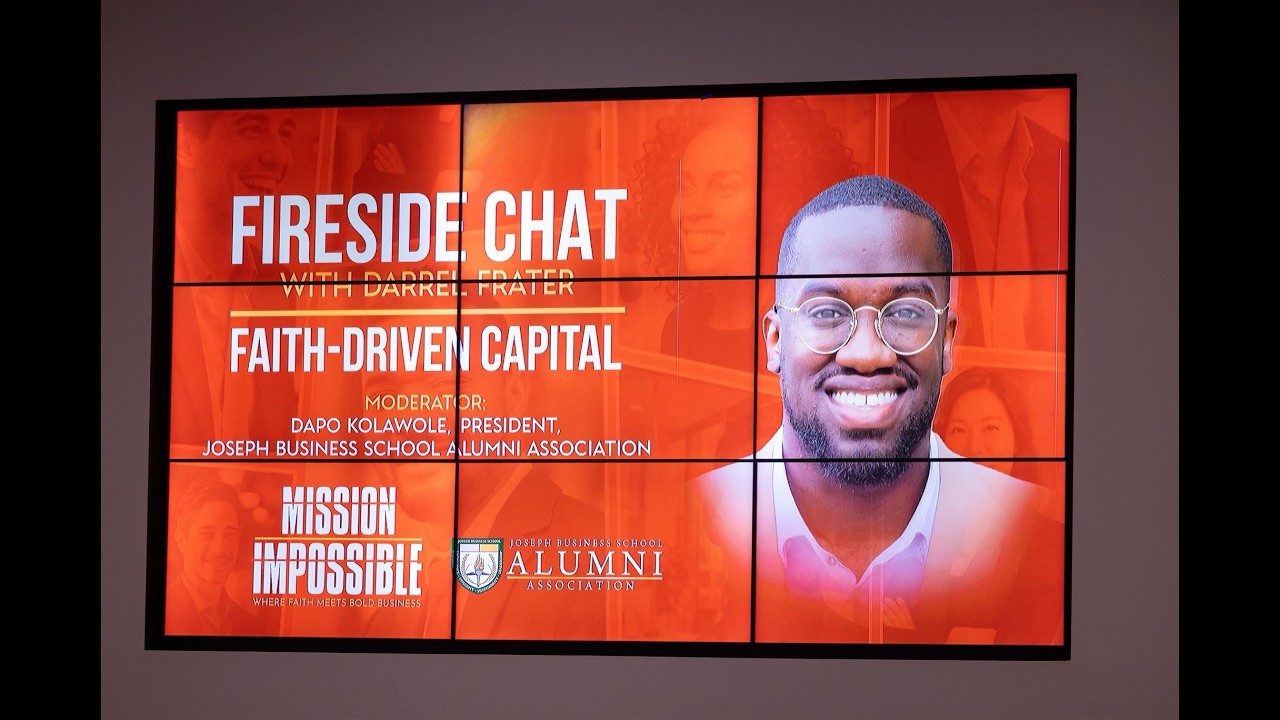
Venture investor Darrel Frater discusses his faith-centered firm TGN Ventures and how Christian conviction shapes his business decisions. He explains why most startups never get VC money, why a day job is your first investor, and his principle of micro obedience, macro impact. His new book funds the Center for Faith and Business.
Chapters
Well, like I said, good afternoon, everyone. Our next conversation is about something every entrepreneur eventually encounters, capital. The reality is that vision is powerful, but vision alone doesn't build companies. At some point, every founder must confront the question, how do I finance the vision when the numbers don't add up? Our guests for this fireside chat understands that tension from both sides of the table. Darrel Frater is a seasoned entrepreneur, venture investor, and capital strategist who has spent his career build— helping founders navigate the complex world of finance and growth. As both a founder and investor, he has seen firsthand what it takes to raise capital, steward it well, and build businesses that create lasting impact. What makes Darrel's perspective especially valuable is his ability to bridge strategy, stewardship, and conviction. He understands that raising capital is not just about the numbers and pitch decks. It's about leadership, timing, courage, and ability to communicate a vision others are willing to believe in. Today, we'll explore what it really looks like to pursue capital with both faith and excellence, especially in those moments when the path forward feels bigger than the resources available. Please welcome Darrel Frater to our event. Awesome. Awesome. So, Darrel, brother, how are you? Before we walk or talk about capital and investors, talk— take us back to your journey. How did you first enter the world of entrepreneurship and venture capital?
Well, first and foremost, thank you, Dapo, for having me here. And it's great to see all of you in the audience. here. I'm super excited to do this talk because being at the intersection of faith and business is a powerful place to be. To be able to integrate God's word into your business is something that gives you a supernatural power that the world doesn't have. Thank you all for being here and for taking this conference seriously. This is where world-changing opportunities happen, and you guys are a part of that. I'm excited to be here.
Awesome. Let's give him a round of applause for that, man. I love that. Awesome. Awesome.
So, a little bit about myself. I'll keep it brief, but I couldn't start my story without telling the story of my father. He's an immigrant from the island of Jamaica, and he came to America just with his skills building with his hands. In Jamaica, he grew up very poor, and he had just clarity from the Lord that he needed to learn a skill. And that skill was carpentry. And he tells stories about how hard it was to go to school and how he would get bullied and just the long walks and the little resources to go to school. But he made sure that he did everything he could to learn his skill of carpentry. Fast forward, he moved to the States when he was about 17 years old and actually started a business in the United States, a furniture shop. When he started his furniture shop, it really was the beginning of his journey as an entrepreneur. That business eventually led into him growing a general contracting business and really was the foundation of his success as an entrepreneur. I got to grow up watching his business. I got to serve and support him in his journey and really see entrepreneurship as a vehicle that takes people from one state to another. As I grew up and tried to figure out what is my career path, where does God want to use me, I saw business as something that was super important that I wanted to not just build my own businesses, but to be a supporter of entrepreneurs and helping them get access to resources and being able to help them in their journey of building businesses. That led me down this rabbit hole of learning about venture capital and learning about high-growth technology. I was able to, after graduating from my undergrad in 2015, start to learn about that world. I read all the books, listened to all the podcasts, and did everything I could to be as well-rounded as possible in this world of venture capital. And simultaneously, I didn't say too much about this, but I grew up in a family of believers. We went to church. And growing up, I always followed what my father and my mother would say about going to church, but I actually didn't have a clear understanding of what it meant to be a follower and disciple of Christ. So, around around 2018, that's around the time that I actually learned about venture capital as a career path. I started this dual path journey of becoming a venture capitalist and also becoming a disciple of Christ. And simultaneously, God revealed to me just how he can position me as an investor and supporter of entrepreneurs, but allow that to be something that glorifies his kingdom, which has led me to really dive into the intersection of faith and business. Fast forward, you know, landed my first job at a venture capital firm and 2021. Spent 2 years there, and then the Lord actually, you know, sent me my wife, Rosalie. She's somewhere in the room. And we got married and started, you know, we had our first kid, Gianna, in January of 2023. And the Lord actually radically removed us from New Jersey and put us in Tulsa, Oklahoma, to begin our journey and to really grow our family in there. From there, when I moved to Oklahoma, I joined a new firm called Serac Ventures in Oklahoma City. Spent a year and a half there. Then last year, I started my journey of launching my own venture capital firm. This year, in January, I was able to start TGN Ventures, which is a venture capital firm that I started myself. TGN stands for The Good News Ventures. My firm is grounded in faith and spread just with the intention of keeping God centered first. I'm super excited to be able to support entrepreneurs through my own firm because Because when you're working at someone else's firm, you got to kind of toe the line of ministry and being able to do the work that your employer is calling you to do. When it's your own and you've given it to God, you can do what you want with your business. I'm just super happy that I'm empowered to do so and be very bold about my faith while being able to support people and entrepreneurs as an investor. That's my intro.
Thank you. So that's why I kept on following him, because of my business, I'm constantly talking to VCs. But he was different. Like, if you look at his Twitter handle, there's a cross in there. I'm like, OK, who's this guy? You know, so—
There's a story on that too.
There's a story. Please share. Please, sir.
I'll be brief, but back in 20— I would say it was probably 2021, there's a church in New Jersey called Restoration Family Worship Center, and that was a church that my wife was attending, and she pulled me into that church, and I really started to be fed and learn just about Christ and radical belief and following of Jesus at that church. And the pastor, Pastor Glenn Wilson, he preached a sermon titled What Does a Christian Look Like? And that sermon changed my life because he spoke about a lot of times when you meet people, like, how do you even know that they're Christian? You see the Muslim, you know how— you know who they are. You see the Jewish, you know who they are. But when you look at a Christian, how do you know? And from that day forward, I made it my business that when people encounter me, they know who I serve.
Amen. Well done.
So, adding a cross to my bio on all my social media, I usually have a cross on me and a pin or something. But regardless if I'm wearing a physical item or a digital icon, the way I treat people, the way I show the love of Christ, people will know that I'm a follower of Jesus by the way I interact with them. And I made that something that I'll do every single day in my life and my business and my family.
Awesome. Thank you. Well, let's keep the conversation relevant for both. So we're going to switch it up a bit. It's more— one of the things I know about our community, the JBS alumni community, is that some of us are still bootstrapping our businesses. And like I disclosed at the top of the hour, I still have my— this is my second startup. My first startup, I left my job, focused on it for 2 years. Didn't make a dime until my wife was like, what are we going to do? I'm like, I'm an engineer. I can always get a job. So I got a job. I'm still there, 6 years now. But that has allowed me to build Roomie without the pressure. So if I need something, the pressure is not there. So, the question is this. When many entrepreneurs hear capital and immediately think VC, venture capital, how should founders think about the different ways to finance the growth?
Yeah, yeah. So, when it comes to getting the initial capital for your business, oftentimes the first thing that entrepreneurs think about is, oh, I need to find an investor. And a lot of times that does send them down a path that's actually counterintuitive to what you should do as an early-stage entrepreneur. A lot of times when you're just getting started, it's actually very difficult to get capital from a venture capitalist because a lot of times, well, these investment opportunities are network-driven. They're looking for a certain amount of traction. They're investing in a certain type of business, and your business may not be ideal for that kind of capital. And also, You might actually not want that capital, even though you think you might want it because you see all the headlines of, oh, this person raised $1 million, or this person received this capital. But a lot of times, it's a distraction from where you really need to be in regards to that early stage in your business. Your business should follow just the ability to serve your customers at the highest degree that you can with what you're already given. And when you have good stewardship of your ability to serve your clients where you're at, you'll be able to unlock capital from different sources, whether that be your customers actually being the ones that fund your business. And that's called bootstrapping, to where you sell product or services and you reinvest that capital back into the business and you continue to grow. There are also opportunities such as grants and different programs, such as accelerator programs and mentorship programs, that actually will give you seed capital to get started. And there's also crowdfunding and many other sources of capital that you can get out to the community to help pour into your business to get you started. But a lot of the times, venture capital— less than 1% of businesses receive venture capital dollars. And a lot of times, founders are chasing after this money, and it actually becomes a distraction to where you're trying to optimize the things you do to receive investment from a VC, and that's actually not going to help you actually build the right thing. You really want to focus on your customers, and when you serve your customers really well, The VCs will come looking for you.
I like that. I like that. That is 100% true. I know customers would tell you how to build your business. So I want to double down on that post you made about your job. Can you just do a deep dive into that? Because I know a high number of our alumni still have a full-time job. So can you just expand on that and share what you were I read it up and down, and I was like— I woke my wife. She was sleeping. I was like, you got to read this. So please.
So I post a lot, so I honestly don't remember exactly what that post says. But if it's anything based on what I typically talk about and seeing your job as your first investor, it's really important to understand that you are a steward of your own resources, and you have the ability to use what you have to get yourself started, as opposed to seeking outside validation and outsized resources to get started. A lot of times, it's a hurdle to believe, oh, I need to get capital before I can get started. A lot of times, people, and even myself included back in 2020 when I started one of my businesses, when you are limited on resources and you're putting everything into the business, but you don't even have your own source of capital to take care of things at home, it becomes really impossible to take care of your business because you can't even focus on the business when your own needs aren't met. Taking an approach to where, hey, I'm going to be strategic about this transition and I'm going to work 9 to 5 or whatever your hours may be and be able to build your business nights and weekends until the point where the business is able to self-fund itself and you're able to take that transition in a much more logical way that works as opposed to, I need to Go all in right now and take this leap of faith. It takes faith, but it also takes wisdom.
Mm-hmm.
You want to be sure that using your own job to fund your business is a really great pathway to do that and transition well. I've seen too many entrepreneurs that just go all in and they take so much risk. Sometimes this risk is so hard to get themselves out of it. It's like, you don't Building a business is already risky. You don't have to take any additional risk to make it even harder for yourself. Some people have families, they have just lives that they have to sustain, and doing a business is risky. So, how do we de-risk that by having a source of capital that gives you back the time and the peace of mind to build on your own time? Because if you're like, say, hey, I got $30,000 in savings and I'm going to go at it all, then you have— Runway with that $30,000. That might be 10 months of runway. That might be longer or shorter. But it's a finite amount of time. And when you have your job, as long as you keep that job, you can continue to build the business as long as it takes to be self-sustaining. So, don't feel like you have the pressure to quit your job and go all in. Be smart. Be strategic. And honestly, let the Holy Spirit guide you on when that transition should happen. Because if you follow what the Lord tells you to do, his timing will be perfect.
Amen.
You don't have to look to the world to tell you how and when you should run your business. The Lord will give you the timing. You just ask the Holy Spirit, Lord, what should I be doing? What am I doing? When should I do it? Give me the guidance. And in those prayers, the Lord will speak to you. He'll give you clarity, and it'll feel right, and you'll feel peace. That's one thing I even talk about in my new book. It's titled Micro Obedience, Macro Impact. It's speaking about how small acts of obedience lead to large impact in God's kingdom. And a lot of times we think it's these big grandiose leaps of faith that God wants us to take, but it's honestly just the little yeses to the things he's calling to you daily, in and out, that you're able to continue to move forward obedience with what the Lord has for you. And when you do that, and when you're diligent in following the Lord in the small, blessed yeses, you'll be able to create massive impact for your life, for your family's life, and in God's kingdom.
Awesome. Awesome. Thank you. Thank you. So, just a quick question to the audience. How many people have raised VC, venture capital, in the room? Okay, you have? All right. How many people plan to raise venture capital? Okay. How many people have bootstrapped in the room? Okay, so a lot of bootstrapped. So I— you said something about early-stage VCs. I think the leap there is when you're early stage, you probably should not be talking to VCs. Maybe more friends and family.
Depends on the kind of business.
Okay, expand on when you say that.
So, some businesses require enormous amounts of capital just to get started, whether it be deep tech or whether it be biotech or something that's capital intensive, where in order to get started, you need $1 million just to prove out the concept or whatever it may be. And in some cases, the people on the investment side understand that risk and they're willing to underwrite that risk. But in many cases, there are a lot of businesses that you actually don't need much money to get started, especially in today with AI and different types of tools that you can now build products. You can get started and validate your idea much cheaper than you ever could in ever history. And looking for that opportunity to get started and learning the skills it takes to build product and go to market and validate your assumptions you can build the traction and the proof points that can justify, hey, I have now done all this work. I have a narrative. I have a story. I have customers. And I see a pipeline of opportunity that I want to go after. I want to raise $500,000. I want to raise $1 million. I want to raise $2.5 million and to execute on this vision that I can build this business and grow it and scale it and return capital for my investors. Because that's all what it is. We don't invest because it's charity.
Right.
We see it as a business opportunity that can yield a return. And just like the Bible says, sometimes 30, sometimes 60, sometimes 100-fold. I'm looking for the 100 bag. And that's the kind of entrepreneurs that we're looking to back and looking to support because we see that their vision aligns with our vision and our goals. Because as an investor, I actually have investors of my own. I raise capital from what we call limited partners. These are high net worth individuals, family offices, and institutions. And I manage that capital and invest in you all and choosing the ones that I believe will return the capital back to us so we can return the capital back to our investors. So, that's the cycle of how venture capital works. And when you understand my business and you understand your business, then we operate as a partnership to where I'm investing in you and you understand what I need so I can continue to grow my business as an investor and allocator of capital. So, getting to know the understanding and the details of what venture capital is will help you navigate the conversations. So, that way an investor could be like, oh, this entrepreneur, this founder understands the business. And I know that they see my capital not just capital that they go waste within their business, but they are a good steward because they understand what will make me successful and also understand what will make themselves successful. So, learning that really helps you navigate the conversations and build a true relationship with an investor.
Awesome. Keyword there is stewardship. Stewardship is that keyword that you're able to display with what you've built so far. They could look beyond the numbers to get a glimpse that this person is responsible with the little they had to build this much. And then they are now interested in pouring some gasoline on it so you could grow some more. So it's very— the keyword is stewardship. As JBS alumni, we have to be better stewards of what— it's like what Pastor David preached on last Sunday. You know, I didn't— I could not attend because I was planning this event, but I watched it online and I was texting my wife who was in church. I'm like, stewardship, stewardship, because that's very important, very important. So I guess the follow-up question I have is, um, when does it make sense to bootstrap versus bringing on outside capital? When does it make sense to do that? What are those signals that you as an entrepreneur would be like, I think I'm ready?
Yeah, so when it comes to bootstrapping, the beautiful thing about not taking on investors is that when you take on investors, you're actually diluting your ownership. Meaning that if you take on money from an investor, they own a part of your business and you own less. But when you bootstrap, you still own 100% of your business. So, in most cases, when you don't need an investor, don't take it. But if you think that strategically you can create more value with the business by taking on strategic capital, that's when it makes sense to take on an investor. Because the ultimate goal as an entrepreneur is to increase shareholder value.
Yeah.
If you ever hear that terminology spoken about when talking about business. And if you think that taking on investors is going to overall increase the valuation or increase the value of your company or the impact that your company may have, that's when you say, hey, strategically, I think I can go further and faster by taking on an investor. But if you don't think that's the case, because venture capital is also seen as jet fuel. It doesn't work in every car. And if you think that, hey, I can use this and accelerate much further than I could on my own, then this might be something to pursue. But you don't want to put jet fuel in a regular car. It'll blow up.
Well said. Well said. I think I may try that, just practically. I'm just kidding. You got me thinking. I'm an engineer, so I'm thinking, can I do that? Where can I even buy Jet Fuel? But I digress. I digress. Well, tell us about a moment in your journey where the numbers didn't add up. The path wasn't clear, but you still had to make a decision to move forward. What did you learn from that moment?
Yeah, I would say for me, it probably is most recently. I would say a year ago, around a year ago from this date, I actually got laid off from my last job at a venture capital firm. And it was at the height of the work that I was doing for my boss at the time, where I was bringing in millions of dollars of limited partner money and bringing in really great investments and investing in really great entrepreneurs. And I felt like I was at the top. I was like, look, we're crushing it, closing deals. Bringing on new investors into the firm and just, you know, had a— in 3 months, I'll be welcoming my second child. It's just everything was like right. And then just out of nowhere, I got laid off. And at that point, I'm like, nothing makes sense right now. And just trying to figure out, okay, what is the next move? And just being diligent and just trusting that, hey, the Lord has— is doing something, and I need to be a part of what God is doing. And not trying to take control and turn this into what I think that I want, but allowing the Lord to take me on a journey that he needs me to be so I can be where he wants to use me. And The first thing I did after getting laid off, I actually started writing this book. And after that, I actually started the journey of building my own firm. And if I didn't— and from 2018, when I told you I just started my faith walk and also learning about venture capital, from that point, God told me I need to launch a firm. But he told me that he had things that he wanted me to learn first. before I started my own. And over that time, I was able to learn as much as I can and really build my brand and my network within this ecosystem. But I thought launching my own firm would be 10, 20 years out. Like, I got videos of me saying, yeah, I'm going to start a firm in like 10, 20 years. I got like— it's out there. And I had no clue that the Lord would push me into launching TGN Ventures this year in 2026. But the Lord's timing is perfect.
Amen.
And we must trust in the Lord with all our heart.
Amen.
Because God's ways is higher than our ways, and his thoughts are higher than our thoughts. So, when you think your timing might be, it's completely different from God's timing. And I would say that it did not add up that I'll be starting my firm this year. But through just God's provision and all the people that he's put in my life and all the opportunities he's put in front of me, he's divinely orchestrated the opportunity for me to launch my firm and feel like I'm in a really great position to succeed at it. And that wouldn't have been possible if I still had my last job.
Yeah.
Because when God closes a door and he has something else that he wants you to go into, you have to operate in confidence knowing that your Savior has a path for you and has something for you that you have to walk in with faith in order for him to use you. Because if you don't say yes, he's going to give it to someone else.
Yes.
And he has purpose. Right now, there are things that you need to say yes to so that way in 2027, you will be prepared for. And it takes obedience in the things today for you to be ready for the things to come. And all these things are tied to what we as believers know is our Great Commission, to make disciples. And when you tie your life, your business, your family to making disciples, you are aligned with God's plan for all of humanity to know him and to love him and to be a part of his family. And when your plans align with God's plans—
That's right. Amen.
Heaven backs you. And you want to be on heaven's side. You don't want to be on the other side. So as you go about your days, as you go about your businesses, think about what ways does the Lord want me to use what he has given me to be about that plan to make disciples, to show people the love of Christ through your actions, through the way that you do business, through your stewardship. How can I love on my neighbor in a way that they get to know Christ through what you're doing? And when you align yourself with that, that opens the gate for the blessing.
Amen. Amen. Yes. Yes, yes, yes, yes, yes. So, Slight transition. As a person of faith working in VC, venture capital, how do you navigate the tension between conviction and financial reality? And you could frame that question in kind of looking at the JBS alumni, like, as a business owner, how do you navigate that tension between conviction and financial reality? financial reality? Like, the numbers are saying this, but I know what God said.
For me, that's easy, man. Like, the way that the Lord has given me wisdom in this industry of venture capital, I see where things align, and I'm always looking for that alignment because there are sometimes entrepreneurs that are believers that I choose not to back, and then I do back the nonbeliever just because I see the alignment to where God could use a nonbeliever to fulfill his purpose. So, just because you believe don't mean you're getting a check.
That's right.
But being able to discern what God has told me in terms of what he needs me to accomplish in this industry of venture capital that's, for the most part, godless, Like, there's not a lot of people that believe like we believe in this industry. It's a lot of people that are so far from God that he needs people like us to step into this industry and to bring light into it. Because business and this world of entrepreneurship, there's so much good that can come out of it when the right people are using it as a vehicle to serve others. You know, when I was growing up and I was learning about entrepreneurship, I actually thought business was all about just making money. If you're making money, you're good and you're a good entrepreneur. And as I matured and learned more about business, I realized that making money and the finances is actually a byproduct of your ability to serve your customers really well. When you put serving first in your business, You have an abundant opportunity to make money. And if you're chasing the money, you'll chase away your clients. So, by putting people first, money and financial blessings become an abundant byproduct. And it's been seen time and time again. This is something that I know for a fact, that where you can look at a spreadsheet, but then look at the entrepreneur, how they steward their customers. And although the spreadsheet looks like it's up and to the right, I can tell where the business is going because of their stewardship. And that's something that I can discern, not because I'm looking at the spreadsheet, but because I'm looking at the heart of the people.
Mm-hmm.
And if their goal aligns with God's mission. And when that alignment is not there, regardless if they believe or not, I can tell if God's using them or not. Because I spend time in prayer, I spend time knowing God's Word, and I can hear my Shepherd's voice in every action that I take. And when you're that tied to what the Spirit is telling you to do, you can hear these things very clearly. And then it's your opportunity and your duty to say yes. And don't be afraid, because God can't use you If you don't give him your surrender. You must be able to allow him to use you so that way you can bless others and be a blessing where the Lord wants to be— have you and use you.
Awesome. Yes, let's give him a round of applause for that. Yes. Awesome. All right. So, um, Switching gears again. Many entrepreneurs feel they've been given a vision that is bigger than the resources they currently have. In your experience, what does it look like— I think you may have answered this, but we'll see if that's the case. What, in your experience, what does it look like to steward a vision faithfully when the capital hasn't shown up yet?
Yeah, I think that a lot of us, when we get the vision initially, we think that, okay, this is going to happen, and they think it's going to happen immediately. But if you look back to the Bible, you think about the story of David. David was anointed when he was very little, and he was a shepherd. He didn't make it to the palace until decades later. And if you understand that it takes a season Of being able to work in the pastures until your time. You may have gotten the anointing or the vision or the clarity of where God wants you to be, but in order to get there, you must be diligent, you must be patient, and you must be a good steward of the things that God has given you today, or he will not trust you with the things to come. So you have to, even when things aren't working yet, still operate in faith, knowing what God will be doing in your life and your business. So, a lot of times, that's what it takes to be an entrepreneur, believing in the unseen, walking by faith, not by sight, and being able to have confidence in what your Savior has for you. Did I answer that enough?
Yeah, but this microwave community, you know, like, I want it now. How can I get it now? Like, if you have that attitude, like, I want it all and I want it now. What's your— as a Christian, how do you filter out— I log into LinkedIn, I'm seeing all this. This person got a million here. I'm like, God, what's going on?
Yeah.
You know, so in terms of you have to wait to listen.
Mm-hmm.
Which is very— it's something we all should do. That's what— in fact, the panelists, our keynote speaker this morning, it's all about waiting to hear what he asks you to do next.
Mm-hmm.
So you don't have to redo, remake. How do you guard yourself against the noise that you're seeing out there?
Yeah.
How do you— what's your thoughts on that?
Yeah, my advice to that would be, Focus on an audience of one, and that audience of one is the Lord. To where regardless of what the world is saying, regardless of the audiences that is watching you, or you want to prove is you're doing great as an entrepreneur, you're winning, you're crushing it, the only person that you should be focused on serving is the Lord. And when you do that well, everyone else will get to see God's glory through you. And when that is the prize, you'll live an abundant life. But when the prize is, hey, people are shouting you out and you're getting all this praise and you're getting all this glory and God's not being glorified, that's a counterfeit blessing.
Wow.
It may feel good in the moment, but it won't sustain eternity. You want to operate with an eternal mindset to where the things that you do are operating for God's kingdom, to where you're not storing your treasures here on earth, but you're storing them in heaven. And when you think with that, no one can snatch that away from you. And you can have the energy, the power, the boldness, and the courage to walk into the things that no one else would do because you are specifically anointed to that task. And no competition in your business. I see my sister right here. She knows her. There's no one that can stop you because you are anointed for that thing. And you will be able to persevere any hardship, but you have to surrender to Christ. God is the only audience that you are to serve. We can't serve 2 masters. You can't serve mammon and serve the Lord at the same time. So, focus on serving the Lord, and that will help you ignore what you see on LinkedIn. So, one thing a lot of people don't realize, because a lot of people follow me on LinkedIn and Twitter, etc. I don't even consume on those platforms. I post and I get back to work. I literally— people tell me about all that. Oh, did you see that post? I'm sorry, I post a lot. I get on and I post and I leave because I get the value and my business grows and I'm honoring God through my posting, not through my consumption in many cases. But a lot of people is like, hey, I see all these people crushing it on social media. So, they're consuming a lot and they think that's where the work is happening. That's not where the work is happening. You need to be working on your business, and you need to align your business with what the Lord has for you. So, I would say, yeah, audience of one is the answer for that. Serve the Lord, and you will be much more happy in your business when you feel pleased that you're getting a well done from the Lord, as opposed to a hand clap or emoji from people on social media.
Yeah, let's clap for that. Let's clap. Let's clap. That is true. That is true. That is true. So, well, Darrel just recently released a new book. He mentioned it briefly, Micro Obedience, Macro Impact. What inspired you to write this book?
So, I would say, When I wrote the book, the Lord gave me a word that obedience matters. And even now, as the book is here and out in the marketplace and I'm presenting it to people, both believers and non-believers, I realize how difficult the word obedience is to people. For some people, it's a cuss word. So, for some people, obedience makes them cringe. And the Lord gave me clarity that I needed to speak on how important your obedience matters.
Amen.
So, the title of the book, like you said, is Micro Obedience, Macro Impact. And it's speaking about how small acts of obedience lead to large impact in God's kingdom. And a lot of times, I'll just think that We should realize how our actions today impact the future and how it impacts eternity. There are actions today— and this is hard to comprehend, but let me just lay it on you— there are actions today that will impact your great-great-great-great-grandchildren.
That's true.
And if you don't operate with the eternal mindset, you're going to miss what God has for you and what he needs you to do right now.
Amen.
This is so important to me that the Lord told me, hey, you need to get this message out. And the best way that he told me to do so was through this book. So I'm excited that it's here. And just divinely, the Lord actually delayed this book. This book was supposed to come out at least 3, 4 months ago. I'm actually just happy just the way that the Lord works because we welcomed our second child 9 months ago. And— Thank you. Thank you. We have a beautiful family, my wife and 2 kids. And on the back of the book, we have an image with all 4 of us. But prior to 4 months ago, it was only my wife and I and our older daughter. So we were able to— speak to our editors and add it, update the photo to include our daughter Mariah. So now Gianna, Mariah, and Rosalie and I are on the back of the book. And I'm just so happy for that. As you guys may have seen them running around, I include my family in everything I do. Because when you live a life of alignment, you're not competing with your business and your family and ministry. All of it works together, just like the Bible says, all things work together for the good for those that love the Lord and are called according to his purpose. When you align your life and you live a singular life surrendered to Christ, you will operate and do things that no one could imagine that you would do. You'll even shock yourself. So that's why having my family involved is just so important, and that's why I'm so happy that Mariah is on the back of that book with us.
Let's give him a round of applause for that. So he's going to be doing a book signing today outside of the— in the fellowship hall after this. If you want to pick up a copy, you should pick up a copy, please do so. He'll be out there.
And can I say something about that?
Yes, please.
And I'll keep this story super short as it ties back to my father. I told you when my father was starting his business after leaving Jamaica, Yeah. He actually came to America, he started a furniture shop. And when he started his shop, he actually created these beautiful set of chairs, which would be like the first product that he was going to sell in his furniture shop. And the Lord gave him a word that he needed to offer those chairs as a first fruit offering. So instead of selling the chairs, he gave it to the local church. When I finished this book, the Lord, just the Spirit of the Lord came upon me and told me, you need to offer this book as a first fruit offering. So, to add, none of the proceeds from this book will come to me. They all will be donated to a nonprofit my wife and I started called the Center for Faith and Business. And the Center for Faith and Business is an organization that's dedicated to helping entrepreneurs see their business as a vehicle for the spread of the gospel and for impact in the world.
Thank you.
Because we're able to teach our entrepreneurs how to love their neighbors by loving their customers, loving their employees, and loving their community. And when you have that mindset, you can do things in business that will shock your competitors, will shock the ecosystem, and you'll be able to run a business that is a blessing to you, your family, and your community. And we're excited because There's so much that we can do as believers in the marketplace, and I want to empower so many entrepreneurs to be able to use their business as a vehicle to honor God. So, when you donate by buying a book, it's not going to Darrel personally. It's going to the Center for Faith and Business, and it's going to the spread of the gospel through business.
Hallelujah. Awesome. Thank you, Darrel. Thank you. Final comment, question to Darrel is, if God entrusts someone in this room with the capital they've been praying for, whether it's $50,000 or $50 million, what kind of leader do they need to become to steward it well? Because, you know, people change when you win the lottery and they change numbers and— They don't call you back.
So, I would say, first and foremost, just because you get $50 million doesn't mean the Lord gave it to you. The devil blesses his children too. So, if the Lord gave it to you, you have already been entrusted with it by showing that you are good with the little. So, I would say, if you got it and the Lord has given it to you, you need to be the person that the Lord gave it to you and not change from that. You need to be consistent. You need to be diligent. And diligence is continuous to where you're operating in good stewardship. You're operating with an eternal mindset continuously. And I would say that just being able to always remember Your why and audit your why and know why you're building this business and who you intend to serve with your business. Because when you lose sight of that, everything else starts to crumble. And like I said before, you should surrender your life to Christ and your business to Christ. And that why should be grounded with Jesus at the foundation. Because when Jesus is the foundation of your life and your business, Nothing can disrupt it. That foundation will always be solid ground to build on top of it. Because if you're building on sand or you're building on stone or you're building on these other things, when the storm comes, what's going to happen? That thing going to be gone. But when Christ is the foundation of your life and your business, nothing can stop you.
Amen. Let's give Mr. Darrel Frater a hand of applause. Mr. Darrel, thank you. Thank you. Thank you. Thank you. Thank you. Let's honor him and just give him a round of applause again. Thank you.
More from Darrel


Plaza 210: Catalyzing Faith, Business, and Community in North Tulsa | Accelerate North Tulsa Pitch

💰 Get Funded! Founder Interviews w/ Preston Troutt, Founder and CEO at Crowdsurf 🚀 09-27-2024

💰 Get Funded! Founder Interviews by Serac Ventures w/ Rumaiza Ali, CEO at Wedy 🚀 08-30-2024
💰 Get Funded! Founder Interviews by Serac Ventures w/ James Chapman, CEO @ Plain Sight 08-16-2024

💰 Get Funded! Founder Interviews by Serac Ventures w/ Naveed Iqbal, Founder & CEO at Dol 08-09-2024

💰 Get Funded! Founder Interviews by Serac Ventures w/ Serge Amouzou, CEO and Founder 🚀 07-26-2024