In this presentation David Belle explains why British investors under‑perform due to a systemic aversion to risk and a lack of basic market knowledge, citing a JP Morgan survey that shows most Brits cannot identify the asset class with the highest long‑term returns. To address this gap he created the Think Academy, a structured course that teaches a momentum‑driven, probabilistic investing framework. The curriculum starts with foundational concepts – how markets move, the role of marginal buyers, executive share ownership, and why US equities drift upward. It then argues that momentum has been the single biggest source of annualised returns over the past three decades and builds a low‑edge strategy that relies on loosely understood, persistent drivers rather than complex, hard‑to‑beat models. Students learn to generate quantitative end‑of‑day signals, screen them in TradingView, manage position size and volatility, and reframe risk as opportunity management. Common misconceptions such as chasing dividends, reacting to 52‑week highs, or over‑relying on options are debunked. The course highlights hot sectors (infrastructure, AI, nuclear) as examples of momentum drivers. Content delivery is concise, ranging from 3‑ to 20‑minute videos, supplemented by continuous updates, a Discord community, and daily morning calls where real‑time market events are discussed. Real‑world case studies – such as profiting from Ethereum during the 2020 US election volatility – illustrate the approach. Belle ends with a call to action, inviting viewers to contact him for a no‑obligation chat.
Chapters
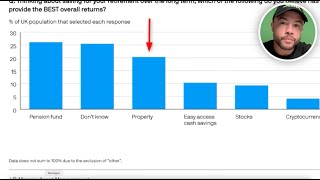
Why did we go to the dark side and create a course/academy? Well, I want to run through a bit of data and then I'm going to show you exactly what's in the Think Academy and why we're doing it. Look, Brits have a massive, massive problem with risk. It starts at the very, very top of government. I mean, take a look at this JP Morgan survey. Thinking about saving for your retirement over the long term, which of the following do you believe has the potential to provide the best overall returns? Now, property is a big issue there, but the bigger issue is this bit. Don't know. How do you not know what is the best provider of overall returns? Then when you juxtapose that— big word for me, I know— against stocks, which have traditionally been the best generator of returns pretty much ever, maybe aside from risk-adjusted returns with Bitcoin, but that's a completely different thing, we start to get a picture of why Brits don't invest. The simple fact is they don't know what they're doing, and there is a disincentive to take on risk in the entire economy. Now, I'm not going to run through this entire presentation. If you do want the entire presentation though, just comment presentation and I'll send it to you. But what we need to get to the heart of is how do we change this? And this is exactly why we created the Think Academy. The overall ethos now is to really, really change this. We can't get any worse in terms of the knowledge that Brits have over investing, especially when we compare to our American counterparts. So I'm going to show you exactly what's in the Academy. If it's right for you, drop me a message and we can get chatting. What we want to do is reframe people's lines into what works. If you take it from a very, very top level, momentum as a factor has been the biggest generator of annualized returns over the past 30 years. Why would you go elsewhere to develop a strategy or an investing thesis anywhere outside of momentum? It is the number one way to generate cash. And so what we have to do is create this foundation whereby we are telling people exactly why we're looking at trend, exactly why we're looking at momentum, exactly how the market works, how the prices actually move. It's a marginal buyer, a higher marginal buyer, right? Most people just think it's more buyers than sellers. It's not. There's aggression and there's people being passive. That's how markets move. Once we've established that foundation and even establishing why the stock market even exists and in US markets, why they tend to drift up over time, executives get compensated with shares, so they have an incentive then to actually improve the company, improve margins, profitability. Et cetera, et cetera. In my view, most people don't think of it that way, but that is probably the biggest reason as to why the US stock market goes up so much. Setting that foundation is so important because most people don't think of these things. Now, a lot of the people who have completed the academy have had is every few videos a light bulb goes off in their head and they say, I've never ever thought about it that way. For me, that's really, really good feedback because it shows that we're really changing minds. Americans might have an already well-established view on how these things work, but I really, really don't think the average Brit or even above average Brit really understands how these things are working from a fundamentally and foundational level. Once we have proven that momentum is the best factor and brainwashed people into thinking about markets in the right way, we then move on to actually executing the strategy. Now, a lot of people think trading is based off of taking different inefficiencies in the market and then exploiting them. We think that that is very, very difficult to do, and so what we want to do is find elements of the market that we loosely know work, such as what I've explained before with executives being paid in shares, and so they have an incentive for their share price to go up. The fact that the US is the largest economy, again, growth will come from corporate profits. And so we're taking a probabilistic view that that will continue. Once you have that risk premium idea in your head, you're then able to build out a strategy that takes advantage of that rather than looking at things like options pricing, flow dynamics, things like this, which are actually really, really difficult to continually get an edge in. We're not necessarily looking for edge in that way. What we're looking to do is take loose ideas that we know make money, that will be consistent through time, and then apply certain factors to create the optimal idea at the right time, then systemize risk management. That is all this is about. So you can see exactly what is going on here. How to enter once a signal is triggered. These signals are pretty much quantitatively generated. It's nothing too complex. However, people need to be told exactly how to do it and how to screen for them, how to understand when to act, when not to act. Then we get through to harvesting volatility. We get through to how much do you actually bet? How to change that position size over time as well, reinforcing the concept of why up and to the right is all that matters. Loads of people love to pile into dividend-generating stocks. Does that mean that the price of the company's shares is actually going to increase? Not necessarily. You might be stuck in a sideways range collecting your 7-8% dividend a year, but really there's an opportunity cost risk there. So getting to the real heart of these issues and reframing them in the right way so that people understand what they're doing at every single point of their portfolio construction or their idea generation or risk management or trade management. That is really what we get into. And I actually like to redefine risk management now to opportunity management. I think that's the better way to redefine risk because Brits have a really, really bad idea of what risk is in my view. We then get through to things like the 52-week high effect. Most people say, oh my God, the market's approaching a 52-week high, I need to sell. Absolutely the worst idea ever. How do you manage risk around earnings season, for instance? Can you introduce some sort of options hedging and things like that? Can you look at volatility in the right way? To understand, okay, well, something's happening here which is out of whack with prior volatility. Is there something that we need to do? Or implied volatility is out of whack. We've realized what happens. Is there anything that we can do there to make sure that our equity curve is smoothed through these periods of volatility? We want people to turn their brain off for about 70% of the time. However, discretion is where you're able to really, really increase that probabilistic advantage. And so once you understand how to bring in discretion in a very objective way, it's always about objectifying that discretion. You're then able to increase chances of having a good trade idea and therefore better portfolio construction. And look, we are looking just for the market to go up and to the right. This might be mirrored, so that might be the wrong way. But once you have an idea of what is a momentum driver based off of these discretionary elements, you are then able to really, really get a good grasp of what's going to work and when. For instance, you are going to want to focus on hot trends. Infrastructure right now is so, so hot and it's going to be hot for a very long time. AI, naturally, most people might say that's overcooked— fair comment— but it's still a hot trend based off of momentum. You've got nuclear as well, another really hot sector. So what you're able to do then is you've got 3 different sectors which are likely to experience higher growth than others. And so the focus really when you're looking for outperformance should be on those sectors. But what we are trying to do with this is keep it concise. You can see that the videos range from 3 minutes all the way up to about, I don't know, 20 minutes, 15 minutes here, that kind of thing. We don't want to tell people everything for an hour because that's useless. You have to be concise and we have to keep people blinkered so they're focused on The actual element of how markets are able to return you the best cash. Basically, once you've done that, we move on to Get Smarter. And this is where we add videos continually. So the most recent we added is inefficiency seeking versus risk premium, which I explained already, the loose concepts behind what drives US markets higher. Once you've done that, there's a lot. There's 15 hours of extra video of a cohort that I spent time with last year. This covered the Trump election as well and where we saw volatility being really out of whack leading into key events such as FOMC. And every single time Volatility was basically overbought and then flattened on the event. Show you how we made money off of Ethereum. Then Ethereum was the pick on the, the election trade. Once you have then completed all of that, we then show you how to build the screener in TradingView. This is really important 'cause you can get sent alerts via TradingView so you don't actually have to do anything. And everything we do is end of day, so there's no anxiety of having to manage anything intraday. We are looking as well at a minimum hold period view. Not necessarily you have to hold it because maybe your risk limits get, you know, put in or whatever, Ideally what we want to start with is a minimum 6-month to 1-year view of holding this stock. That is the way to go because you want signal, you want as much signal with as little noise as possible. And that is really what the focus is. We don't want people pumping around intraday or anything like that. Dan Benton at London Capital Group, you're going to hate me for saying that because I know you love spread betters, but the way that we need to get Brits to do things is to really, really knuckle down and think more like a portfolio manager than a trader. This is still trading though. Absolutely. Then once you've Completed all of that, we then jump into our Discord. So this is a separate room specifically for the academy. So once you've graduated, if you like, you go into this room and this is where the real chat about everything goes on. This is quite interesting because this is all of the, the companies that have been brought up by the model over the past year and a half and their returns. Pretty strong. And there's no overfitting here because the signal is generated end of day. We absolutely will take that signal as it is and then look to put in the data. There is also a morning call every 9:00 AM, which you Join, which is where we sort of chat about all of the daily stuff going on. We don't want people to act necessarily, but it's a really, really good run through. It's about an hour long. And as I said, I want to reinforce the fact that we are doing this to change minds about investing. We want Brits to do far, far better. There's been a couple of stories where someone has told me their IFA has told them to stick 60, 70 grand in a cash ISA back in 2020 and it's made 2.62% annualised over the past 4 or 5 years. That is a joke and that person should be struck off the FCA register in my view. But if this is interesting to you, drop me a message. Would love to have a chat. There's absolutely zero obligation. I like to chat with anyone anyway, but let's see if we can do something, right? Thank you for watching.