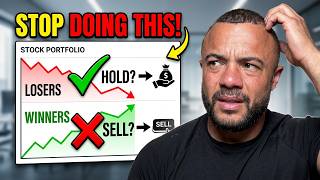
David Belle says 45% of traders suffer from exit paralysis, selling winners too early and holding losers too long. He breaks down two behavioral biases driving this and offers a monthly three-step framework: label each holding by its primary factor (value, momentum, or quality), verify the factor still holds, then ask if you'd buy it today or put money elsewhere instead.
Chapters
Every single time a new customer joins our framework, I ask them one simple question: What is your biggest problem in the market? Now, you might think that it's something like finding the next 10-bagger or timing the bottom of a real steep decline in the market, but it really isn't. It's much simpler than that. 45% of investors, nearly half of the people that we surveyed, say that their biggest problem is when to sell. They describe this sort of feeling of paralysis. They watch a stock go up about 50%, celebrate the gains, and then watch it round trip all the way back to zero, or even worse, into a loss. But it's purely because they didn't have a plan to actually get out in the first place when they first bought the stock. But today we're going to fix that exit paralysis forever. You see, buying is actually easy, is full of hope and potential. But selling, selling is where your ego meets the market, which then meets your bank account. Most people treat selling like a game of gut feel, or perhaps when they see people talk about selling the stock on Twitter or other social media sites. However, you can get much more precise and have much more success if you actually base it around systems. So today I'm going to introduce to you a scientific and factor-based approach to actually getting out the market and making the money that you want, avoiding all of those pitfalls. We're going to move away from 'I think it's time' and move closer to 'Well, the data is telling me' that it's time to sell. But firstly, why is selling so hard? Well, it's because your brain is actually biologically wired to sabotage your portfolio. In behavioral finance, there are two bugs that sabotage our behavioral software, and the first one is the disposition effect. See, it's when we're likely to sell our winners too early to lock in a realized gain, to feel something, you know, that real dopamine effect. But then we hold on to losers for far too long, and we do this to avoid the pain of admitting that we were wrong. And the second is the endowment effect. This is where we place more value on things because we own them. Once that company is in your portfolio, you are going to do everything you can to try and avoid those red flags, even if the price starts going down. And we can call this anchoring. Let's say you buy a stock at $100, but but the price is now down at $80. Many people say to themselves, oh, I'm going to sell it when it gets back to $100. But the truth is, the market doesn't give two fucks about what price you bought that asset at. When you hold a stock because you're waiting for it to come back, you are literally just using hope, and hope is not a strategy. Now, the real reason why 45% of these people struggle with selling is because they do not start from the right place. They do not understand what factor they are actually buying when they buy a stock. You see, factors are the stock's underlying DNA, and we know that specific factors drive a stock's performance. If you don't know why you bought a stock, then you also won't know when it's the right time to leave. So let's run through the 3 main factors that you should be looking at when you first go to buy a stock. Now, the first one is the value factor. Let's say a stock has traded down by like 50%. It's now considered undervalued relative to its peers. Your exit is not necessarily based on price, it's based on value expansion. This might mean that the price-to-earnings now gets overblown relative to the rest of the sector. There is no more value left in that stock, so it's your time to sell it. Now the second factor that we want to look at is momentum. This is my favorite, and it's the one that tends to lead to the most consistent growth of a portfolio over time. Momentum investors do not care about valuation, they care about trend. Research from MSCI shows that momentum can persist for months but can die relatively quickly if the stock breaks something like maybe its 200 daily moving average. You know that the trade is done. Your reason for owning it has completely gone because that momentum factor is no longer in that market. Now, the third key one is the quality factor. You have bought this stock because the business is incredible, so it might have a high return on equity and low debt. Now, the only reason you would sell quality is if something fundamentally changes in the business in a negative way? Did they maybe take on a huge amount of debt? Did their margins change? Did some key fundamental change in that business which now means that perhaps they're overvalued from where you bought them? If the quality is gone, that stock has to be sold and you must exit it from your portfolio. I'm going to give you a 3-step framework right now to evaluate your portfolio so that you can be the judge as to whether you should keep the positions in that portfolio there. Here's the framework we use to judge whether you keep a position or not. Every month, run your portfolio through this 3-stage check. Step 1: the identity audit. Look at your biggest holding, write down, I own this because of X factor. If you can't answer that question, you have a zombie position and you need to revise it immediately. It doesn't mean sell it. It just means you need to understand the reason and go back to when you bought it to understand which factor you attributed to that stock. Step 2 is the factor decay check. Look at the data. If it's a value play, is it still actually undervalued relative to perhaps its sector? Is it still in the bottom 20% of its valuation, for instance? If it's momentum, is it still in a clear uptrend? If the data says that the factor has decayed, then the logic for remaining in the trade has gone. Now, step 3 is the opportunity cost check. This is arguably the most important step, actually. Ask yourself this one question: if I had the cash today, would I buy this stock at this price? If the answer is no, I'd rather buy XYZ stock because its factor profile is stronger, then you've kind of got your answer there. Selling isn't a loss, it's just freeing up your soldier, your capital basically, so that they can go and fight a better battle that they can win. So you're following the data, not your heartbeat or gut feel, which moves you from a reactive trader to a more systematic investor. So to summarize, 45% of people struggle to sell because they're fighting their own biology. By identifying the specific factor that you're trading, whether it's value, momentum, or quality, you're creating an objective exit clause. Remember, a disciplined exit is what separates professionals from amateurs. Amateurs sell when they can't take the pain anymore, whereas professionals sell when the system says to. So it's your call, which one do you want to be? So I want to hear from you. Type in the comments which stock currently you're completely anchored to, and based on the factor check we just did, does it still deserve its spot? For UK investors, we're actually doing a complete ISA check now. And you can book in for 15 minutes over the phone with me so I can go through your last year of investing, see what you've done poorly, see what we can do a little bit better together. And if you want to stop guessing and start following the data, make sure you hit that subscribe button, and I'll see you in the next one.