In Conversation: David Bohigian
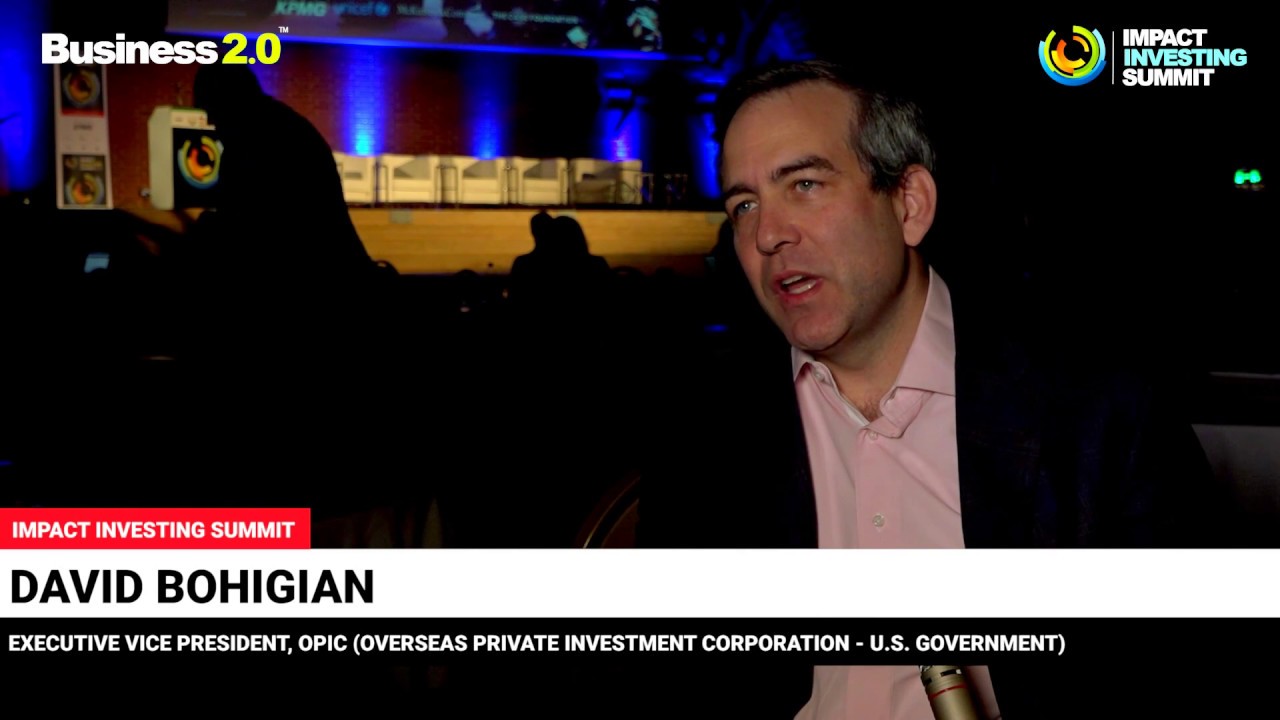
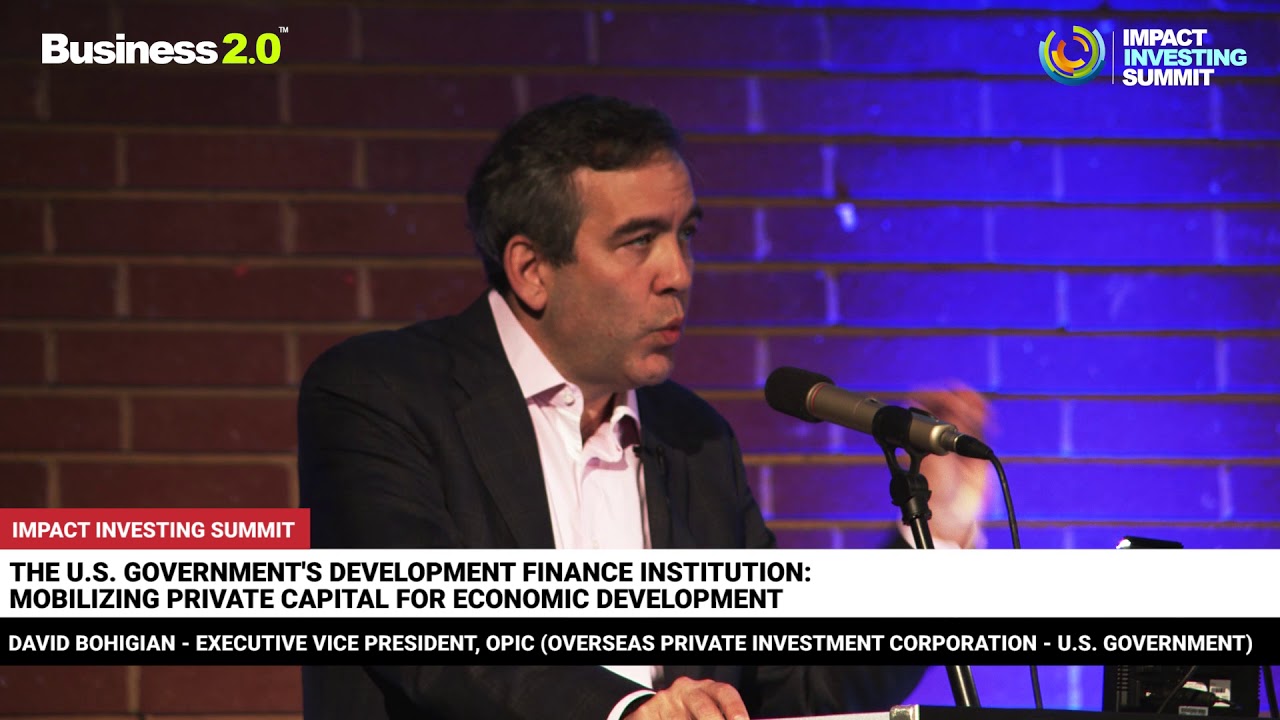
David Bohigian, acting president of OPIC, discusses its transformation into the U.S. International Development Finance Corporation under the BUILD Act. The new agency will grow its portfolio from $25 billion to $60 billion and introduce the Impact Quotient, a framework that prioritizes social impact alongside financial returns in projects from eye hospitals in Cameroon to wind farms in Indonesia.
Chapters
To do.
Let me stand beside you. We're bound to inherit the sins of our parents and all the people we pass through. Now we're down to the last 2. May I have this dance? Please welcome back to the stage Julie Hyman and Acting President of the Overseas Private Investment Corporation, David Bohigian. Hello again, everyone. So David Bohigian is the head of the Overseas Private Investment Corporation, but that's mostly not what we're going to talk about today. We are going to talk about a new agency in Washington, which is a pretty rare thing, first of all, that's called the U.S. International Development Finance Corporation, which is a bit of a mouthful.
I don't know if that brand—
I don't know if you figured out a good, a good acronym for that yet. I don't know. So, David, I just basically would like you to tell us a little bit about it, what it's going to do. It's under your purview of OPIC. What is it going to do? How is it going to operate differently from what you have been doing?
Okay, well, first let me go back to go forward, and thank you for having me today at Concordia, where it's just a great confluence of NGOs and governments and finance here. OPIC is not an oil cartel, right? It's the Overseas Private Investment Corporation. And for about 50 years, it's been doing development finance. And what's development finance? It is helping countries actually move toward being self-reliant partners. It's empowering communities through things like our investments in private equity and project finance and political risk insurance that could help invest in anything from a woman-owned bakery to a major toll road. So it truly is operating globally in about 90 countries in the world. We've got a $25 billion portfolio, and it's actually made money. It invests alongside private sector investors, and for 41 years straight has been able to make money on behalf of the American taxpayers while doing things like helping to stand up Korea, helping to empower women around the world. So it's an amazing organization, and that's been recognized by the U.S. Congress and President Trump. That 50 weeks ago passed bipartisan legislation called the BUILD Act. The BUILD Act is going to create a new era in development finance. Development finance under the BUILD Act is going to allow us to take our $25 billion portfolio to $60 billion. It's going to allow us to invest equity for the first time in private equity and beyond. We've had a We've had a debt product that's been suboptimal. It's going to give us technical assistance. It's going to help us partner with our friends in the U.S. government better at USAID and the State Department and Commerce and Treasury. It's going to help us partner with our allies better in Europe and Japan and beyond. And it's going to help us partner with the business community better.
Right.
Again, the problems that we're solving in the world are problems that only can be solved with the private sector's help. We're investing in countries around the world to be able to create peace and prosperity. And the Development Finance Corporation, or DFC for less of a mouthful, is going to actually put what OPIC's done into the stratosphere.
So doubling of the amount that you're going to be able to put to work. So how are you going to deploy that differently? Is it a matter of more projects? In terms of the number of projects? Is it a matter of larger projects that you're going to concentrate on? How's all of that going to work?
It's all of the above. Again, we operate in 90 countries today. Every year, between $3 and $6 billion worth of investment. We do about 100 to 150 projects every year. And so I'm not trying to count the deals or the dollars, even the dollars catalyzed, which is important. It's not just the money that we're putting in. It's the private sector that's coming with it. I'm trying to figure out how we can have the greatest impact in the world, right? So if that's helping to stabilize a country or that's helping to create infrastructure— I mean, I think about— I went to Cameroon last year and we are helping to finance an eye hospital there that's going to cure blindness for 18,000 people there. And I met a patient who was taken to the clinic by his neighbor on a bicycle. And when his grandson came to visit him, his grandson said after a successful surgery, welcome back to life. I've also visited with our partners in Taiwan. And when you go to Taiwan and think about the foreign policy aspects of preserving their international space, as we talk about the United Nations this week, with just a few countries that are recognizing Taiwan, and being able to see how we're empowering women in Paraguay and beyond with partners there. It really runs the gamut, again, globally, to try and develop impact, to make sure that families are stable, communities are stable, and countries are prospering.
What does the investment decision calculus look like? In other words, obviously you are taking into account impact on the community, on the people it serves. What about return on investment? How does that— what's the sort of weight that you give to that? Sure.
First and foremost, it's about impact, right? We are a rounding error on the federal budget, right? Last year we made about $150 million, the year before that $250 million. It's not an ROI calculation. We've actually developed a groundbreaking system that we call Impact Quotient, or IQ for short. That has worked with 50 different partners around the world to make sure that we are developing groundbreaking techniques for measuring impact, whether that's in the jobs created or the ability to solve for health problems. Truly, it's for the first time a global effort to measure impact in a way that the world hasn't done before. So it's still first and foremost at our investment committee, we are asking the impact question before we're asking the credit question.
And when you're doing these, these impact quotient studies, is it something that you do before you make the investment, or do you then go back and track the impact in the community over the life of the investment?
Well, first, it's a screening mechanism. I don't want to do a deal that's not going to have an impact in the world. Then we go in and do world-class due diligence on everything from the job creation to the social aspect, the environmental aspect. And then we track it entirely through the investment. These investments can last decades, as you know, in private equity funds or infrastructure. A deal we did recently was to approve a toll road in Argentina, and we expect that it's going to increase trade between Argentina and Chile and provide extraordinary economic benefits. It's also going to save lives. Road fatalities are going to go down because this road is a quality road. So we will be tracking those, and with the IQ system, it will feed back into not just our decisions, because this is a social good, it's gonna feed back into investment decisions around the world as the world moves to impact. I think the term impact investing was only invented 11 years ago. And so you've seen major players right now in private equity, you've seen major endowments and foundations start to think about the social aspects alongside the returns. OPIC's been a leader in that for almost 50 years, and Development Finance Corporation really is ushering in a new era about how to think about investing with impact. And I do think, you know, as you think about the challenges that are facing the world today, I think about what Einstein said, which is you can't solve problems at the same level of thinking at which they were created. And so I go back to the NGOs and the governments and the private sector folks who are in this room today. And you think about the siloed solutions we've all tried to take about, hey, government can fix this, or the private sector does this well, or NGOs are going to try and fix those problems. We're getting out of those siloed solutions into a synthesis of those 3 actors, those 3 communities working together. They're going to solve massive 21st century problems and turn those into opportunities.
So on that point, the relationship with USAID and your organization and then this new organization, How exactly is that going to work?
Well, the alphabet soup in Washington, D.C., really you want to think about as a whole-of-government approach. So we think about a journey to self-reliance, where in conflict-ridden states, they're not ready for a private sector to come in. You're going to need humanitarian aid. And that's where USAID has thrived in situations like the Bahamas over the last month, where they go in, with food and medical supplies and what they need. But they also realize at USAID that it needs to run through the private sector as well. And that's where OPIC and the DFC become a tipping point, right? Where you think about the finance world, I often think that investors are driven by what I call the EFGH theory: ego, fear, greed, and herd, right? If we can help investors get over those emotions and into thinking about the impact that we can have by training wheels, by helping the Chicago teachers think about their first investment in Africa. If we can think about an infrastructure fund that might not want to go into Southeast Asia without us, if we can help a bank on-lend so they're producing more loans for women and small and medium-sized businesses, that's where we stand. And what we hope to do over time is no longer need aid, no longer need development finance, and have truly fully functioning capital markets, again, as we've seen in Korea and other places where OPIC's helped over its long, proud history.
You are from the finance world before you came to government. Is this an organization that is— will you invest alongside private equity in some cases? Will there actually be private sector investment along with the investment?
In every single deal we do, there's private sector investment. Over the past 30 years, we've been in about 100 private equity funds. Today we've got about 40 funds that are about $3.5 to $4 billion. We are a limited partner in a private equity fund. Somebody comes to us and says, I have an idea, as I recently visited with 2 funds we're likely to invest in, in Latin America, which are women-owned funds where advisor to the President, Ivanka Trump, and I were able to talk to them about their strategy to empower further women throughout Latin America. When we invest in infrastructure, it's clearly for a return for our partners. We can work with major banks, we can work with major engineering companies, we can work with major insurers and continue to launch platforms so that we can catalyze more private sector than ever. What you'll hear about at the UN today when it relates to development goals is billions to trillions, right? And the needs of the world are great, and you can't solve it without partnering for the private sector. And the Overseas Private Investment Corporation, again, catalyzing now the hundreds of billions of dollars it's done over its life, now is going to be able to take that to the next level under Development Finance Corporation and the BUILD Act.
Now, you mentioned impact investing as something that has really been been gaining steam. As part of that, frequently there's a sustainable element, right? That, that's one of the criteria when you're trying to do this impact investing. Is that something that you are also taking into account with some of these investments?
100%. I think about environmental sustainability, we think about social sustainability, and we are trying to create stable societies. We have a major group that works on clean energy, whether that's a tripling the amount of power in Togo that we did earlier, or whether that's a wind farm in Indonesia that's creating 75 megawatts of power, or whether that is off-grid solar in Chad. We work across environmental sustainability around the world, but it's broader than that. Again, it's social sustainability and social stability that we're looking for. So being able to help, as we did at our last board meeting, create more than 2,000 jobs around the world, helps propel families into prosperity, helps them create stable societies. And with our women's initiative, the 2X initiative that was launched 2 years ago, we've actually catalyzed more than $1 billion toward investing in women. And when you invest in women, they invest $0.90 in their family from their paycheck. Guys, it's only $0.30, right? So we, we are creating sustainability Not just in an environmental sense, but truly at the family and the cultural sense.
Now, I think one thing that we haven't touched on yet are national security priorities as well when you're making these investments. But when you're talking about small businesses, um, how— what's the tie-in with national security priorities?
I think entrepreneurs are some of the world's most engaged citizens. We take for granted our First Amendment rights and our ability to yell at Congress about changing how we can do business in this country. And so to empower entrepreneurs who are some of the owners in their society really helps them exercise rights they might not have otherwise. And so when I talk to a baker in Georgia or someone who owns a dry cleaner who we've invested in and they go to their prime minister and say, in order for me to grow this business, in order for me to hire more people, I need you to have more rule of law. Right, and for instance, in Georgia, it's the only country I visit that has a better Doing Business In ranking than the United States. And it's no coincidence that we have more money per capita in Georgia than anywhere else. And you also think about Georgia's neighbors. They're in a rough neighborhood. So you're advancing foreign policy goals while advancing entrepreneurship in countries that really need it.
And we have just about a minute left. You mentioned the due diligence that you all do in these investments. When you're going into some of these lower middle income countries, some of them may not have the sort of bureaucracy infrastructure. You see corruption in some of these cases. So how do you go about doing the due diligence?
Yeah, well, we have better tools for due diligence and know your customer than anybody else in the world. I work with agencies throughout the U.S. government, with people on the ground in embassies who know the character, who know the reputation, who know the laws better than anyone else could. really in this audience. So I think the due diligence that we do is extraordinary, provides a real halo effect, right? When we go into an investment, you know that we're looking at sustainability, you know we're looking at the social aspects, you know we're looking at the credit. And I think it helps the private sector gain comfort, not only on the front end but on the back end. The advocacy of the U.S. government is really going to help these investments. And that's again why OPIC has a 41-year track record of making money for investors, and we'll continue to do that. So if I had an ask for this crowd, it would be, as you're looking at low-income countries, countries with less than $4,000 per capita GDP, please come to us to help us figure out how we can solve the world's great problems together, because together is the only way we're going to solve it.
All right, on that note, thank you so much, David Bohigian.
Thanks, Julie.
Appreciate it.
More from David

Meridian International CEO David Bohigian at Aspen Ideas Open Diplomacy Needed




OPIC, David Bohigian - Why the US Government is Funding Emerging Market VC with $22B