America's "Nightmare Bomber" Heads Toward Iran! Is Full-Scale War Hours Away?
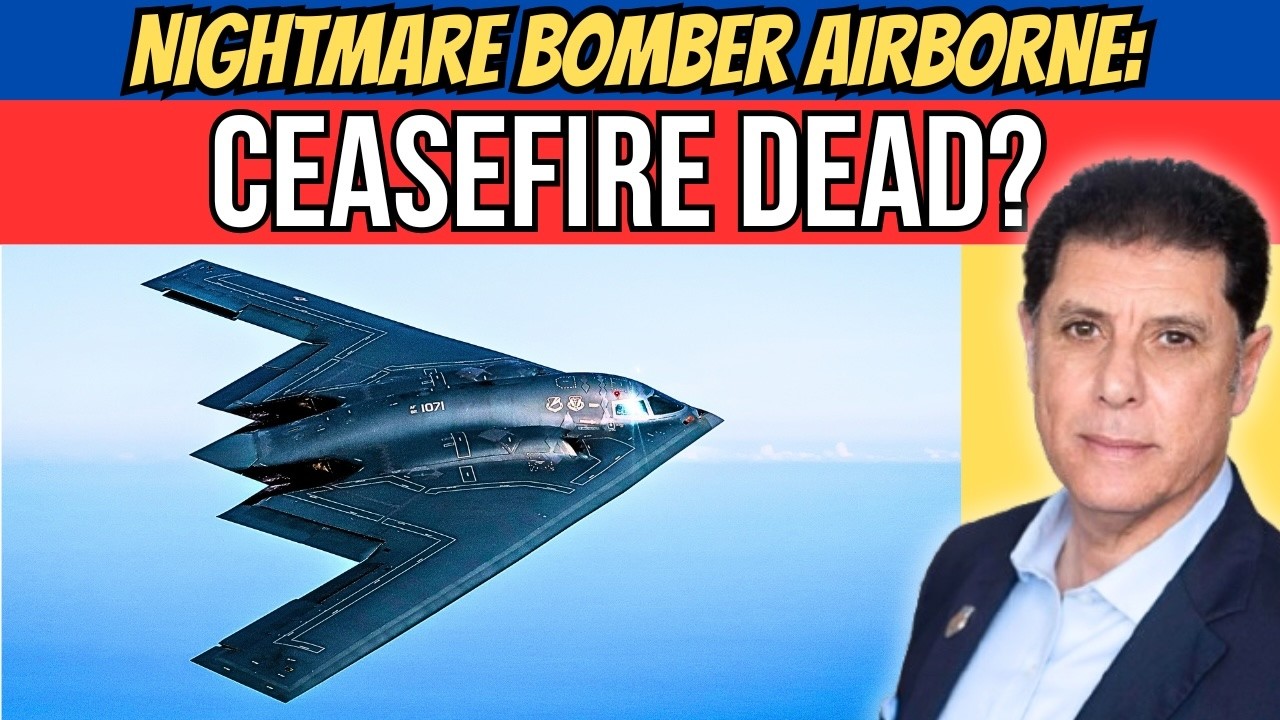
In this live‑stream, the host (Speaker A) and co‑host (Speaker B) argue that the United States is on the brink of a major military escalation against Iran. They claim a B‑2 "Nightmare Bomber" departed Whiteman Air Force Base, accompanied by an E‑6B Mercury command aircraft and an Ohio‑class SSBN (USS Alaska) carrying Trident II missiles, suggesting a coordinated strike capability. The host links this movement to recent Trump statements threatening Iran with annihilation, the collapse of nuclear talks, a failed US War Powers Resolution, and recent naval incidents in the Strait of Hormuz (ship seizures and sinkings). The analysis also covers regional dynamics: Iran’s threatened enrichment to 90%, alleged involvement of the UAE, Saudi Arabia, Kuwait, and Egypt (the latter allegedly sending jets to the UAE), and the EU’s diplomatic statements that the host dismisses as manipulative. The host asserts that Iran is moving toward nuclear deterrence, citing internal Iranian rhetoric and the possibility of acquiring a bomb from external partners. Additional context includes references to tracking sources (Defense Geek, ASN Spree), Russian Sarmat missile tests, and a discussion of US nuclear forces. The stream ends with promotional content (fundraising for an Asia trip, book sales) and a teaser for an upcoming interview with Dr. Warwick Powell.
Chapters
Hello everybody and welcome to Geopolitical Trends, where truth matters. What we have right now, we have some ships being seized, okay? Another one was sunk according to my info. And Trump recently just called ceasefire on live—
on life support.
That's exactly what I'm saying. And his military commanders now are meeting. They've been meeting for the last 48 hours to decide whether to unleash the most devastating bombing campaign Iran has ever seen. This is exactly what is— what's been happening for the last almost 40— yeah, almost 2 to 3 days. So what happens in the next few days? I'm talking about the next 48 hours. There are some reports, I cannot confirm them yet,— and I will let you know that US might strike within the next 48 hours. Some even say 24 hours. I, I can't confirm it. I just want you to know. However, whatever the day is, is it 24 hours or 48 hours, that in itself will change the entire region forever. And this is again what most people, especially here in the US, have no idea how close we actually are to the edge. And that's what prompts me to do this live stream for you, because I need to provide you insights. I'm also going to provide you a recording that shows the tracking of the, uh, uh, B-2 that has left Whitman Air Force Base. And I did a, a short clip for you. I know I went through records, whatever that is, but I was—
that's what it was. And I said I will do and analysis about it.
And that's what I'm going to be doing for you. I looked at the clip, I verified it, I translated it myself to make sure, and that's exactly what I wanted to do here. So, so whatever, whatever they media and otherwise told you, uh, uh, that the war was paused, that ain't true. And even they said, oh, diplomacy was working, that ain't true either. Because why everybody around the world, whoever's paying attention to this, and maybe not those who are just going about their normal life, at the same time, this so-called the mystery aircraft that has lifted off, uh, from the home of America's most secretive bomber fleet, the B-52 fleet in Whiteman Air Force Base in Missouri. That is the harsh reality. And this is why you have now the nuclear talks quietly collapsed. Why? Because Iran also threatened to enrich to 90%. And I'm gonna share a clip with you to highlight to you now that there are voices inside Iran that are saying, we done talking, build the damn bomb and move on. And that's why Trump was waiting till he returns back from China to issue this one-word ultimatum to Iran. This is exactly where, uh, uh, I wanted to provide you my own analysis in putting the pieces together for you. So here is the latest threat from Trump as of May 14th. We're talking about 2 days ago, which is exactly the same day when the, uh, B-2 took off. So Trump declared Iran can either— and I put this in quotes because those are his exact words— it can either strike a deal or get annihilated, which is, you know, some sort of, uh, you know, uh, that's a gangster language per se.
You don't—
as a president, you don't talk like that. But again, that's Trump. And at the same time, guess what happened in Congress? The US Congress, the House of Representatives, failed to adopt an Iran War Powers Resolution in a tight vote. In other words, they didn't agree on the continuation of the war against Iran. And all this follows some sort of a pattern. It has been— I've been doing this for you now for almost 2 months. That's my main focus that I've been concentrating on, on this particular, because I want you to understand the developments of this. And what I've noticed since I did this day one on, on February 28th is that there is a pattern of an escalation ultimatums, especially after 2 weeks when it became clear to the United States, clear to Trump, that Iran is no Venezuela, Iran is no Yemen, Iran is no Afghanistan, Iran is no Iraq. It became clear. That's why earlier Trump issued an expletive, Latin, uh, threat to bomb Iran civilization, uh, civilian— I'm sorry, civilian power plants and bridges. You all remember? If Iran does not open the Strait of Hormuz, so what? He issued the threat and still the control is firmly in the hand of Iran. Tuesday will be power plant day, okay, and bridge day all wrapped up in one in Iran. That's his argument.
That's why he wrote on, on, on, on the platform, uh, Truth Social.
Even the EU, as, as pathetic as the EU is, meaning politically speaking it's weak, has pushed back against this. You have the European Council President called for a diplomatic resolution, which about the same way I won't trust them because they were stabbing Iran behind, behind in the back anyway. Nonetheless, they are going warning that any targeting of civilian infrastructure, namely energy facilities, is illegal and unacceptable.
End of quote.
But here is what the EU left out of this particular statement is that the targeting of the infrastructure is considered a war crime under the international, uh, humanitarian laws. Because under that law, and there is one specific clause that said— and I'm paraphrasing, I remember from reading, uh, back then, something to the effect that the militaries, doesn't matter which one, militaries are strictly required to protect civilians and infrastructure required for their survival. In other words, if you go and bomb, uh, the civilian infrastructure, that's considered war crime. But the European Union was cherry-picking on this. But that's beside the point. And here is where Iran responds, and it falls in line with what I stated for you few days ago, because it's confirmed. And I'm not going to go through that detail. Please go Go back and watch the video that I did about 4 days ago, uh, you, you can, uh, uh, get the exact response from them. What I can tell you is I can summarize it. One is that on all 3 levels, on a military level, a diplomatic, uh, in negotiations, and also diplomatically, all of them sort of concentrate on one specific, uh, possession from Iran, and that possession is we will enrich uranium to 90%. If we are attacked. No ifs and buts. And this is why you have Iran's parliamentary speaker, Mohammad Baqir Karibaf, warned that it will respond to— Iran would respond, that is, to any attack if its power plants are targeted by the US or the Gulf states. You have now the United Arab Emirates is attacking Iran. Quietly. Saudi is also involved in some. Even Kuwait, I found out yesterday, and I'm going to share briefly about this because I want to focus on the deployment of the B, uh, B-2 bomber.
That's the, the, the core, uh, theme of this particular analysis here.
So, so if the US is going to go and target energy infrastructure, uh, uh, in Iran Iran responded by, they will target the entire, entire infrastructure of energy that is throughout the region, not just in United Arab Emirates or Kuwait, or in the entire region. And when I see the region, we are referring to— and I'm going to put it in the map for you here to understand what I'm referring to here— we're talking about these locations right here, except take Yemen out of this, uh, of, of this. Uh, Jordan doesn't have anything.
Jordan is on a life support anyway.
Egypt, Egypt is playing both sides. As a matter of fact, Egypt just sent its fighter jets to United Arab Emirates to conduct the operations against Iran. This is why some Muslim— not all, I shall not generalize— they are so damn hypocrites. Hypocrisy runs deep, you know. They call themselves Muslims and yet they go and stab another Muslim country in the back. This exactly what they did to Yemen back in— and I covered that in my articles back then. I didn't have a lot—
I didn't have a YouTube channel back then.
It shows you, you can trust the— there's not all, of course. Let me just be clear about this one here. So this is from the military perspective. In negotiations, as we all know, and I did the video for you, Iran turned down the US, uh, 14-point document because the demands the US was asking, it's like unbelievable. And diplomatically speaking, this is just, uh, sort of— it's going nowhere.
This is exactly where we, where we are about this.
But here is where the key aspect as to why I wanted to do this live stream for you, because there is one plausible explanation for any tracking confusion, by the way. Whiteman Air Force Base, that is, is home to both the B-2 fleet and the future B-21 operations. And why am I saying this to you? I'm saying this to you because there are reports already coming out of Washington stating that there might be some confusion out there. Oh, we didn't deploy anything, that's just a confusion. For, uh, manipulation of sort. So because so far the aircraft departing from there in support of Iran strikes would naturally be B-2s, and that is why they— meaning those who wrote these reports in Washington saying, oh, oh, the tracking sources of this misidentified or speculate about the B-21 versus B-2, both stealth platforms operating from the same base. Yeah, I understand it could be a reasonable mix-up, but that's not what the reality suggests. And this is why I'm gonna play the— I want you to see the images. I'll do the translation for you, and, and we just go from there. So let me share the screen, and I'll continue after I'll do the translation for you.
I'll continue with my analysis of this.
And, and I wanted to give this credit to, uh, Kanat Atelier, the, the Change channel.
That's the translation for it.
So, so let's, uh, let me do this here. And again, I want you just pay attention to the imagery because I will explain as we move forward. Now here is what it says. With its stealth bombers, late yesterday— that's referring to the 13th— evening preparations were underway for what appears to be another major strike deep within Iran territory. The bomber utilized in these maneuvers was the B-2, dubbed the Nightmare Bomber by American pilots, the very aircraft used during the 33-day war to strike and completely neutralize Iranian nuclear facilities. Which it didn't anyway. Several key sources such as Defense Geek and ASN Spree successfully tracked and monitored this aircraft as it took off from Whiteman Air Force Base in Missouri, the primary home of the strategic B-2 fleet. One of these aircraft flew a trajectory roughly towards Portugal and Spain near the Strait of Gibraltar. During this flight, this aircraft reached a designated communication zone specifically the vicinity of San Maria Station, where it executed a communication link-up. It was this specific transmission that caught the attention of observers and the aforementioned sources. Its signature clearly revealed that the aircraft was gearing up for maneuvers in the region, maneuvers it commenced immediately after departing Wittmann Air Force Base without making any intermediate stops in European nations such as the UK or Germany. A key component of this maneuver involved another aircraft that has arrived in Stuttgart, Germany, located approximately here on the map. This was the E-6B Mercury, a critically important platform responsible for maintaining communications with the US nuclear command structure. The E-6B was present for the exercise, appearing on tracking feeds as the B-2 established contact with it. Having flown in from Germany to reach this specific zone, the two aircraft initiated their communication exchange. The primary function of the E-6B Mercury is to serve as communications relay for strategic bombers, as previously discussed, as well as for nuclear-armed submarines, often acting as the conduit for transmitting operational orders to the submarine fleet for, for launching ballistic or even nuclear missiles towards target— targets designated by the United States. Simultaneously, There was also the appearance of B-1B Lancer strategic bomber. These bombers are stationed at RAF Fairford, uh, in the UK. Furthermore, the B-52 have also made an appearance, uh, aircraft that are by no means insignificant, operating directly out of Britain. They have been observed flying in this manner a pattern that continues to this very day. Consequently, the United States is conducting these maneuvers almost around the clock. These exercises are considered extremely dangerous. But why?
The question.
The E-6B Mercury has arrived in Stuttgart, Germany approximately 48 hours ago. That's from the, uh, the day of 14th, May 14th. Its arrival in the region coincided with the transit of the highly critical nuclear submarine, an Ohio-class vessel known as the USS Alaska, which passed through the Strait of Gibraltar carrying approximately 24 Trident II missiles. These missiles are capable of carrying multiple nuclear warheads, a potentially extremely dangerous payload, and possess a range extending from 7,200 to 12,000 km. Consequently, this vast range allows them to cover the entirety of Iran without any difficulty. The simultaneous arrival of the B-2 bomber, joined here by the B-1B Lancer, which flew from Britain, as well as B-52 aircraft, suggests a coordinated effort. This follows earlier sighting of the B-1B Lancer flying towards the Mediterranean before returning to base. Taken together, these maneuvers and arrangements clearly indicate a state of readiness among all these aircraft, whether the B-2, B-1B, or B-52. Crucially, the presence of the Mercury, acting this time as an airborne command and control center alongside the nuclear submarine USS Alaska, suggests the capability to execute direct synchronized strike deep within Iran territory. It is highly probable that these attacks will not be limited solely to targets such as Tehran. They could also be directed at the Strait of Hormuz. As previously noted, this submarine is capable of launching missiles directly at any point within Iran, while the E-6B Mercury is fully capable of issuing the necessary command orders without any hindrance. Thus, observers view these maneuvers as potentially playing a direct role regarding the situation at the Strait of Hormuz. This is critical issue, particularly given that Iran has reportedly succeeded in activating 30 out of its 33 missile base— bases.— a development confirmed by the US sources yesterday. Naturally, this constitutes an extremely dangerous situation that strategic bombers must be prepared to address, with these bases in place to neutralize the Iranian threat. Prior to any attempted advance into this region, there is of course a high state of readiness on part of the United States to advance upon the Strait of Hormuz. At any given moment, two aircraft carriers are invariably present, in addition to the USS Tripoli carrying US Marines and numerous destroyers. Consequently, US readiness to execute an operation directed towards this region is fully established. Furthermore, current sources of peril for Iran lies in recent announcements, and indeed numerous leaks from authoritative sources such as, uh, Reuters confirming that the United, United Arab Emirates and Kingdom of Saudi Arabia have conducted undeclared operations against Iran during this conflict, acting in self-defense against Iranian attacks. It has also emerged that Kuwait has carried out operations not against Iran directly, but rather against targets within Iraq. And this is the important things that I need you to understand.
Uh, let me see where he's at.
And Kuwait.
Kuwait.
Yeah, that's exactly where he's at.
He's talking about Kuwait as of now.
So I'm going to stop this here and go back to my own analysis. And once again, I want to give credit to—
for the footage to channel, change channel, or in Arabic, so you give credit where credit is due.
Uh, very, very accurate. I, I, I checked it, double-checked it to make sure it's accurate. And that's what I want you to understand. And by the way, I will greatly appreciate if some put in comments as to why you're so late, Dr. O, for reporting stuff. This is the reason why I am late a day or two. It's because I want to ensure the accuracy So I will politely ask you to refrain from putting this kind of comments because it doesn't add anything substantive to the, to the conversation.
And thank you.
So let's continue with my own analysis as far as the next question. And the next question I have to ask, I ought to ask, is can we expect preemptive strikes? It's a legitimate question to ask in light of this development. You don't develop, you don't deploy the B-1B Lancer, you don't deploy the B-2, you don't deploy the USS Alaska. You don't deploy the US Navy— this is for recon, uh, no, you don't deploy this just for, uh, flexing muscles. Yes, you could send in a message, but we already know that doesn't work with Iran, and Iran is not intimidated by this. But I still find myself compelled to ask that question: can we expect preemptive strikes? Because the situation as of now, it's really is on the knife's edge right now. Because you have— and I'm going to cite for you few reasons why I see it going that direction, and it's of great concern to me personally— because ceasefire is barely alive. Ceasefire is just on the papers. Even Trump himself, Trump declared that ceasefire is dead. Well, when you have the guy who is, is his saying, oh, the ceasefire is on life support, that tells you the story right there. Let alone after Iran rejected the peace proposal by the United States because they saw it as unacceptable, and Donald Trump rejected Iran's counter proposal to that, saying that, oh, Iran's response didn't address the nuclear program. Well, wait a minute, man. We weren't talking about nuclear fire to begin with. We were talking about ending the war. It's about reopening the Strait of Hormuz. Why are you overlapping the issues here? Doesn't make any sense. And this is where Trump mentioned during the statements that he's gonna be meeting with his top commanders not only to announce new sanctions on Iran but also to discuss the next steps. That is what prompts me to think in terms— you don't deploy the B-2 just for the heck of it, because you, you have to understand the cost involved with moving an aircraft like that, how much the cost per hour. And I will mention to you towards the end, make sure you stay with me till the end, how much the cost so far, even though I doubt the Pentagon will say the truth, you know. Then you think of the negotiations, they are deadlock. We're not gonna, we're not gonna— because what Donald Trump is hoping, even for the negotiations, he's hoping, oh, we just meet with you once or twice and that's it, it will be quick and easy, a triumph. No, it doesn't work that way, because Donald Trump's thinking, he assumed that it's gonna— Iran's gonna give concessions, uh, especially on its nuclear program. No way, man. And this is where ignorance comes in. Trump doesn't have a clue about the history of the Persian Empire, how it went throughout the, the centuries. It's no different than China, the history of China that shaped its current policies. Iran is the same. And if you don't understand the history, you, you won't be able to understand why they are dealing with the way they're dealing with, with this. And that's where you see this fresh provocations going on right now. So because as of May 15th, yesterday, just yesterday, tensions are flaring up near the Strait of Hormuz. That's why I mentioned at the beginning, a ship was seized, another one was sunk, and Iran— I'm sorry, IRGC targeted a ship that belongs to Thailand, to my knowledge, and I saw the info about it. It's because Thailand thought they could just cross through the Strait of Hormuz. They ignored the warning from the IRGC. IRGC sort of fired at it and it was hit. So, so, but there are those who argue that, well, wait a minute, Dr. O, that wasn't IRGC who did that. That was taken by unknown parties off the United Arab Emirates coast near the strait. I can see also the logical argument for that. Someone else wants to inflame the conflict. You all remember the USS Liberty back in the '60s when the Israelis targeted it and tried to blame it on the Egyptians and so forth, way back. So this way it pulled the US into the conflict. And that is why I'm saying I'm not going to dismiss something like this, but we're gonna have to think about it in, in terms of the, the reality of it. The other one had to do with the Trump and, uh, uh, President Xi and President Trump's summit. So is it— means it means that Trump and Xi are aligned somewhat. Because if Trump was expecting that China is going to pressure Iran in return for concession regarding Taiwan, he's mistaken. And Trump was mistaken because now he's back home empty-handed. And by the way, uh, I'm gonna be addressing this topic in more detail with my, uh, guest on the 18th, Dr. Warwick Powell, We're gonna be talking about this in detail.
Sorry, he couldn't make it yesterday, and, uh, we made the arrangements for, uh, on the, on the 18th.
So, so make sure you join me on that. But this is again where Donald Trump miscalculated, you know, because even though President, uh, uh, uh, uh, Trump and, uh, uh, President Xi when they met on May 14th, 2 days ago, they both somehow in a statement, they agreed that the Strait of Hormuz must remain open. But that, if I am to say, that's more of an American statement than it is a Chinese. Because why, what led me to this? It's the next statement. And that next statement says, in quote, and I kept it for a reason, in quote, Iran can never have a nuclear weapon, end of quote. China never said that. China would never say that. But China will not get involved in that either. And this is why you have— when you realize where the statement is coming from, I found out that is coming from none other than, uh, what's his name, uh, Marco Lu.
You all remember that picture right here.
That's Marko Lulú. He's the one who stated— he stated that. That's why makes you just wonder. You can't trust this individual because they just, uh, uh— did you notice what I said earlier? Trump and President Xi Jinping met on 14th and agreed that the Strait of Hormuz must be open. This is how the— because this source, and I'm gonna share the source with you, it's right here in Washington. See how they put it together to manipulate you in understanding that was almost like a joint statement. This is a pure classic. It's a classic of manipulation. So let me put the link for you in the chat box. And you can read it later on yourself should you decide to do so. And when I found out that was Marco Lu who said that, it became clear to me this was manipulation to, to, to mislead, uh, people, you know. So Iran nuclear program— I'm not denying— or nuclear stance remains the core sticking point, and it will remain As long as Iran is just negotiating, ain't gonna be resolved. Make a decision, make a decision and move on with it. Like I always said, and I am sure many of you will agree, and please, if you don't, share it with the community. If Iran acquired the weapon last year, we won't be talking today about this topic because the US will think twice. Once again, go back to the example of North Korea. I've always find myself referring to this because it's— I used to follow it since the '90s when Kim Jong-un, they— his father, when his father was negotiating at that time with Madeleine Albright, the former Secretary of State, which is another warmonger. So, and that's again for Iran And that's why I found information that now the, the, the conversation inside among the key players inside, uh, Tehran are saying, we've done, you need to move on with developing.
And by the way, Iran has ways of developing the, the, the, the bomb if they want to.
Doesn't have to be inside.
So, and I, I'll share with you in a second here.
So And this is why when you think about this pattern of restraint, to now maybe running out— this is what I'm saying. The deployment of this type of aircraft suggests something different, something in the works. US is not gonna just do that for the sake of it. Yeah, you want to flex your muscle, you flex them differently. And we already did flex our muscles to low Rebel. We flexed our muscles in Afghanistan and it didn't work, in Iraq and it didn't work, in Yemen and it didn't work, in Somalia and it didn't work. What makes us think that is going to work against none other than Iran? And Iran is far stronger than any of those countries combined, or any in the region, except for Israel, because Israel has the nukes. Get the nukes out, Israel will stand no chance.
Against Iran.
No chance.
One-on-one stand no chance. And that's a fact. I'm not— I'm not just saying this. Many, many geopolitical analysts agree, and military analysts as well agree on this assessment.
That—
and I disclosed it in my Iran book. I remember, uh, uh, and even the government, we were arguing, and, uh, you know You, you argue politely, of course, and it's like, wait a minute, that's public information. Well, we just don't want— it's like, no, no, it's public information. If I am to disclose this, I'm not divulging something classified. Is that one-on-one between Iran and Israel? Israel stands no chance, and for that matter, any force in the region. That was the whole reason why all this happening. Because we do not want Iran to be the strongest player in the region. That's all. The, the Gulf States, which, as pathetic as they are, you know, they, they are just, you know, that, you know, I don't need to say much about this because you all know how it is. There's no need to say that. And that is again where you find the importance of understanding these dynamics moving forward. If the truth matters to you, hit like, subscribe, and tap that bell. No spin, no agenda, just the stories they don't want you to know. Don't watch from the sideline, be part of the movement.
Your support keeps the truth alive.
Thank you. Indeed, much appreciate your support. And so to understand this in a much bigger, uh, the idea in much bigger picture, rather, the idea is that this major new US strikes, uh, of course Washington is going to say, well, we can't confirm that, it's not imminent. Of course they're going to have to say that. Why? For a simple reason. You always in the military, you want to maintain the element of surprise. It's like in every, in every raid, in every attack, in every You want to maintain the element of surprise. That's just part of it. But what I'm looking at when I put the facts on the table, I am looking that all the ingredients are present. The ingredients for the collapse ceasefire, it's already done. Then you have the ingredients of the fresh naval incidents in the Strait of Hormuz as of May 15th, yesterday. Then you have the deadlock nuclear talks. Then you have the, uh, uh, Taco or Trump issuing the, you know, the devastating threats. I'm gonna obliterate your country. Then you have the military commanders meeting called in. Yeah, this is why all this, this, it won't be, you know, it will be naive Literally, will be naive of us to think in terms that this happening in vacuum.
No, it's not. It is not.
And here is where I see the concern moving forward. Nothing was said, nothing was done while Trump was about to leave the United States on the 13th, because this one reported citing the US officials that Trump will not, will not take major military steps while in China. But they added that he would take military action immediately after his return. Makes you just wonder. And that is again where you have this kind of back and forth, uh, how it's going to move forward. So, uh, they, they just— because what stands as of today, Iran announced as of yesterday that it has allowed 30 ships to pass through the Strait of Hormuz. As of Wednesday, I am sorry, as of Wednesday evening. And here is the thing, You know what the coordination was and between whom? It was between Beijing and Tehran because Iran allowed all Chinese ships to cross. That tells you right there. The statements coming from the Iranian IRGC said, and I quote, a number of Chinese ships crossed through the region at the request of Beijing after agreeing on transit protocol managed by Iran, end of quote. Why is this, why is this statement important? Because that's Iran's encrypted messages. That's what it is. Remember, the statement came during Trump's visit to China. So because to Trump Trump's visit to China was not just a diplomatic trip, or a diplomatic stop for that matter, in Tehran's view. You know, even though Tehran is watching that trip from a different— under different lenses altogether, because they're looking at it under an arena of exchanging strategic messages. Because what Washington has hoped Beijing will do is to pressure for Beijing to pressure Tehran through the Chinese gateway. In other words, the US will convince China to pressure Iran. No, because at the same time, what did Iran do? It responded by opening the Strait of Hormuz exclusively to Chinese ships. That's another classic of encrypted messages in the world of geopolitics. It because this move was interpreted in Iran's decision-making circles as a coded message to Trump. And you know what the message is? Is that the key to the Strait of Hormuz is in Tehran's hand.
That's what it is.
And the message doesn't just end this— and there, rather, because it added some other aspects of it. And that other aspect is that American pressure cannot exert its influence on the 25-year-old strategic partnership between Beijing and Tehran. So in this context, that's why you have the foreign minister, uh, Dr.
Abbas Aragchi, stressed that coordination for the passage of friendly ships goes exclusively through the Iranian naval forces to ensure the security of navigation. That is the important aspects of it.
So now I told you I will share with you an information about how now Iran is convinced that a nuclear bomb is the only solution for survival. It's because the reality is that the nuclear bomb is the only solution for survival. And this conviction is now taking root within Iran's highest circles of power. With every bombardment that Iran endures and every threat of destruction it faces, why has Iran shifted now its stance? Well, the reason lies with Donald Trump and his policies, of course, which have led Tehran to the firm belief that it erred by delaying the acquisition of a nuclear weapon, as highlighted in many, many analyses throughout the world, from West Asia or Middle East to the West in London and Frankfurt and Paris and Washington and what have— what other— whatever other location is, is that Iran did not possess the nuclear weapon prior to the current conflict nor is there any evidence that it attempted to develop it, to develop one since 2023. Yet despite, and perhaps because of, the relentless American and Israeli strikes, which continue even today under, or through, or during the diplomatic negotiations, the conviction now is now sort of, uh, what's the word I'm looking crystallizing within the IRGC that nuclear deterrence may be and is the only viable option to forestall any future attacks, particularly given the complete lack of trust in Israel and the US. And it was an article, by the way, article written in, in The Guardian, believe it or not, even though I don't read a lot, but I do Uh, from The Guardian, but sometimes I read their articles. It drew the attention to the crucial point is that destroying the nuclear program of Iran does not equate with eradicating the underlying knowledge. Iran acquired the knowledge. Iran may not even need to develop the weapon domestically. Instead, it could acquire it from abroad, specifically through Think about North Korea, for example. Think about another technical expertise from the Russians. Think about the assistance from the Chinese. Because questions are now being raised within Tehran: would nations that lack nuclear weapons, such as Iraq, Afghanistan, which they were invaded, you remember, by the US, which— because will have been attacked? Would these countries been attacked in the first place had they possessed the nuclear, uh, deterrence? And will Iran succeed in acquiring it? That is the key question that now we ought to ask. So I, again, the idea of Iran looking for nuclear elsewhere, it's feasible. I know of a country that has that kind of arrangement So we leave it at that.
It's because it's still on the classified side, so, but it can be arranged.
So, so this is what I wanted to share with you, and I came to the end of my analysis here. I want to share, uh, actually, no, I'll do a conclusion for you, then I'll play some clips.
I have some good clips for you, very, very short.
So that is what I need you to understand, even though we still use the term ceasefire, but ceasefire is hanging by a thread. And we've, we've said this on this channel for, for a long time since it was established, you know. But you have also ships being seized as we speak. As of yesterday, one of them was seized in the Strait of Hormuz. And you have Trump, of course, giving Iran the brutal choice: deal or destruction. Now, with all this, the nuclear talks collapsing and the mystery bomber that is potentially already airborne, and it was, and most likely arrived to one of those locations there because the US military commanders had met, and he wasn't meeting at the Situation Room, by the way. So the next move is going to reshape now the region because with all this dynamics, one miscalculation on either side And it's already proven that who's making the miscalculation in this case, which is my country, fortunately, could trigger a conflict that literally the world— not just the region, the world— has never seen since the end of World War II. That is really what I dread the most. Every night I go to bed, I'll be thinking about what-if scenario, and I can't help it.
So it's just how I see it.
All right, let me play some, uh, very short clips for you because those are very important to understand. Uh, and once again, uh, the reason I play certain types of clips, because they are relevant. This is not about just, uh, I want you to, you know, I will not share nonsense stuff because I don't have time for that. All right, let's play this one here.
It's in English.
Netanyahu is the one person Trump could not say, hey, settle down. Trump could not restrain Netanyahu. Trump could not restrain Netanyahu. Netanyahu is the one person Trump could not say, hey, settle down, or we'll just defund you and your country will collapse in about 10 minutes, which is true. Israel can't defend itself without the United States, despite whatever propaganda you may have heard. Trump said, I want a negotiated settlement. Israel stopped the settlement. Trump refused to even criticize Netanyahu in public. Are you joking? That's slavery. That is total control of one man by another. And it's, you know, that's between Trump and Bibi and God, as far as I'm concerned. But as an American, that's our president, our elected president, whose job is to protect our country and our interests and our economy. And he is looking out for Israel first. That's outrageous.
Okay, I just want to share that with you once again.
It drives the point home.
It's, it's harsh reality, uh, most Americans are, are, are unaware of.
So this one I want to share with you is, uh, just to highlight to you why is it important that the, uh, nuclear, uh, the Ohio class, the USS Alaska, which by the way I I do have a picture. Yeah, right here.
The USS Alaska, uh, uh, went to the region across the Gibraltar.
And that's why I want to share this, uh, clip with you, not about that specifically, but about the whole, uh, US nuclear apparatus, if I may use the term here.
So take a listen, please. This way you'll be aware of what's going on.
Has 71 nuclear-powered submarines divided into 3 main categories. Category 1: 14 Ohio-class SSBNs. SSBN stands for Ship Submersible Ballistic Nuclear. In simple words, it means a nuclear-powered submarine that carries ballistic missiles, usually nuclear-armed missiles. SSBNs are the hidden nuclear deterrent. Their job is to stay undetected and guarantee a nuclear response response if the U.S. is attacked. These subs can carry up to 20 Trident II D5 missiles, the most powerful missile in America's nuclear deterrent. Category 2: 4 Ohio-class SSGNs. SSGN stands for Ship Submersible Guided Nuclear. These 4 subs are converted missile submarines, each capable of carrying up to 154 Tomahawk cruise missiles, giving them massive conventional strike power. SSGNs are missile trucks. They can launch large numbers of conventional cruise missiles and support special forces. Category 3: The U.S. has 53 SSN-class submarines. SSN stands for Ship, Submersible, Nuclear. SSNs are the hunters. They track enemy submarines, protect carrier groups, gather intelligence, and can strike land targets. The U.S. Navy has 70.
Okay, I just want you to be aware of what was— what I found interesting is that 2 days ago the Russians tested the one of the most devastating missiles in the clear, one Sarmat, yesterday or the day before. Very, very, very interesting development.
It makes me just wonder the timing of it.
Why will, uh, why will, uh, Russia goes ahead and, and do that? But anyway, that's, uh, just want to share that with you.
And the last one I want to share with you has to do with this individual right here.
Of course, during his trip too, he did something that is really, really, really Uh, uh, I, I, it's, it's, it's humiliating, humiliating and shameful.
So I'm going to show you the clip what Donald Trump did while President Xi was going to give his keynote or his speech.
So take a look, please. I don't know if there is music to this. Yeah, there is a track into this, uh, uh, I'm not gonna play the sound of it, but, uh, let's look at this one once again. It is Donald Trump.
That's the seats for President Xi when he want to talk.
And look what Trump is doing.
He was caught sneaking a peek at President Xi Jinping's private notebook during Beijing banquet while Xi stepped away.
What a shameful—
don't behave like that.
That, that, that just, that just unbelievable, unbelievable behavior from a president.
So that's why I was never fit for—
and, and it's becoming clearer and clearer. So, and now I want to mention one thing before I'll, I'll, I'll close this out here. I mentioned to you earlier about the, uh, uh, the cost of the war in the, in the US against Iran.
It was a, a recent, uh, hearing in Congress. Of course, the Pentagon provided the number by saying, oh, we've spent so far $29 billion. No, because we're talking about dozens of aircraft destroyed and damaged.
Uh, we're talking about the cost that involves so many other stuff. So far they're saying 29. I don't believe into that, whatever they're saying, but I just wanted to share that with you.
All right, let me—
yesterday, I think I missed someone yesterday put a super sticker. My sincere apology. I saw it later, but I didn't see the name, so my sincere apology for that.
And speaking of that, I want to give you an update about the fundraising for the Asia trip. It was a surprise yesterday. Do you all remember a few weeks ago? It was a major donor, and the name, Dottorisa, you all remember, that donated a major substantial a gift in support of Asia. And he or she stated that he or she will be able to match up to $1,000 if we reach that, at least that, that number. We came short by about $100, but this particular donor said, no worries, I give my word I am going to donate $1,000 in support of this trip to Asia. So I'm incredibly grateful to this person for his or her generosity towards my upcoming trip to Asia. Honestly, and I mean it when I say this, because it is one of those beautiful things in life that transcends explanation. I can't explain it.
I just can't.
So I'm going to show you where we are in the fundraising.
We are about 46% thanks to this donor, which I am so grateful for, in support of that.
We still have another, uh, 54% to go to reach the goal, but one step at a time. Who's to say maybe some other major donors will support this upcoming trip? But this is more about just the trip in itself. This is about someone who believes in what we do in this community.
That is why we receive these massive donations. So this doesn't happen in a vacuum, and I am so, I am so touched and grateful for this. So I can't thank enough, uh, this particular donor for this generosity. So Once again, thank you so much, D Torresa, for, for your kindness, your generosity, and support for my upcoming trip to Asia. I also want to take an opportunity, uh, to say thank you to, uh, uh, Chum Zee, Chum Zee, for supporting the channel. They bought me, uh, cups of coffees in support of the channel. So I am very, very grateful to you for that. And, uh, remember guys, I keep the funding for the Asia trip separate from the funding for the channel. This way I don't overlap, and I will be— and I am transparent, uh, with you about where we are regarding the fundraising, because I want you to be aware of where things are.
And the last thing I want to share with you, to those who might want to, uh, get a copy of my, uh, my books.
Here is the link for it should you decide to get a copy of my, my, my books. Whatever you like to read, uh, you can, uh, just hop on that link, get onto that link, and, and you get a copy. It would be nice if I ever meet you personally. I will autograph the book for you. I would be happy to do that. Maybe one day, I don't know. We shall see. Anyway, I wish you a good weekend.
Remember to join me on Monday the 18th, uh, for my conversation with Dr.
Warwick Pao. It will be at, at 19:30 Central Standard Time, uh, will be the next day 10 AM his time in Brisbane, Australia. So he's kind enough to allocate time for us, and I take this opportunity to thank Einar Tengen yesterday for carving out time for us also to come on, on the air here and share, uh, uh, his knowledge with us. So I look forward to that. I wish you a good weekend, safe and relaxed weekend, and I look forward to seeing you on Monday. As always, remember, geopolitics impacts your daily life in more ways than one. Till next time, bye-bye.
More from David


Beyond the Single Actor: Why the Gulf Isn't Choosing Between the US and China


Iran, Iraq's Militias, and the Houthis Are Coordinating! This Changes Everything




Who Controls the Next Decade's Resources? Latin America and Africa's Geopolitical Crossroads

The Chokepoint Trap: How Washington's Stupidity Triggered a Cascade That Now Controls the World

Trump Spooked as IRGC Unveiled dual-use SLV, Deployed Ghadir Mini-Subs & Hinted at Tactical Nukes!
