APEC Summit: A Diminished Biden Overshadowed by China’s Xi!
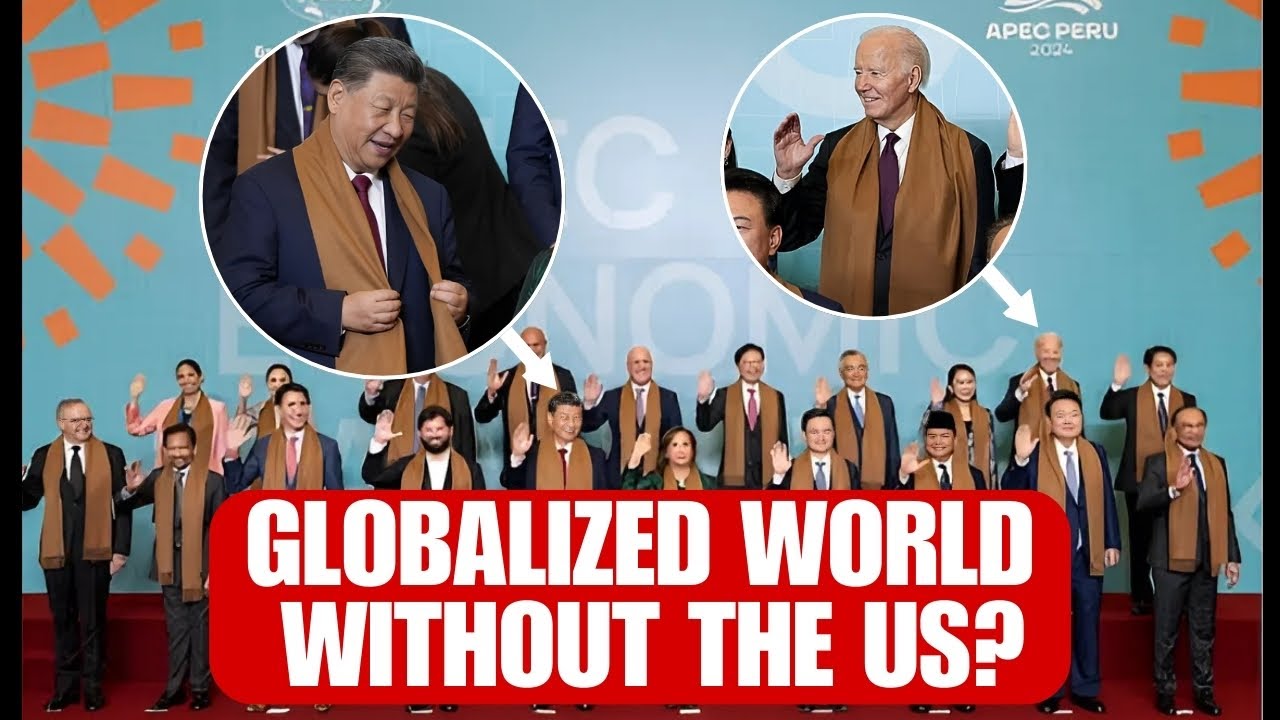
At the APEC summit in Lima, a photo showed Xi Jinping centered while Biden was pushed to the back row, signaling China's dominance. The host argues the U.S. delegation offered empty rhetoric while China deepened ties with Thailand, Singapore, South Korea, and Chile through infrastructure and Belt-and-Road deals, including a newly opened Chinese-financed port in Peru.
Chapters
All right, hello everybody and welcome to Geopolitical Trends, where truth matters. Uh, hope you had a good weekend, a relaxing one. It's, uh, it's raining very hard here, so it's one of those, uh, uh, times of where all of a sudden we went from being sunny yesterday to all of a sudden the rain and all that. Anyway, So in case you notice any flickering, whatever, it's weather related. But other than that, I hope you enjoyed your weekend and you are ready to embark on a new week. So, so excited to be with you. My topic today for you, I'm going to be covering from a geopolitical aspect, not an economics, but from geopolitical aspects. I'm going to be covering or providing you my own analysis about the recent summit, of APEC in Lima, Peru. I know the G20 is on a roll, getting ready to start next few days, I believe. Uh, so, uh, but I'm not going to talk about that. I'm going to be focusing about, uh, the APEC, very, very interesting dynamics. So before I'll do all this, let me just say hi quickly, uh, to our wonderful community, uh, B, uh, good to see you. And I read your comment way back. I had to check in on some technical stuff, so that's where I answered your comment there. So good to see you. Timeline Dunkley from New York City, good to see you as always. Willie Holman, Truth Seeker, thank you. Alistair Oken, John Smith, good to see you. Here's Harry Rukel, haven't seen you for a while, man. I hope all is well. I know what's going on in Amsterdam. As a matter of fact, I just find out this morning that a, a Dutch minister, she just resigned this morning, uh, based on racism and all that stuff. That, uh, so, uh, uh, Carlo, good to see you. And where is Hanging G? Good to see you as always. Taiwan Still, there you are. We miss you, man. I haven't seen you for a while also. Uh, Wonky C, as always. And who else here? Joro, good to see you. All right, let me get into Muslim Revert as always. Uh, Courage Sadiki, good to see you. Jane Juan, good to see you. All right guys, let's get into our topic. As I mentioned, I'm gonna be addressing for you the, uh, a recent APEC summit we just concluded on Saturday, I believe. Uh, So it concluded with some sort of— there is this feel of, you know what, some sort of— the word I'm going to use is détente, la détente, which is a French word also, uh, that, uh, many are also worrying about what lies ahead. Where will the global, uh, dynamics is going to be moving forward now that Trump is being reelected? And we all know those dynamics about the tariffs and the trade and so forth. So, uh, interesting enough is that China proposed to host the upcoming APEC in 2026. I found it very interesting, and I'll tell you why as I move forward in this analysis. Now, here is one thing. First of all, let me ask those questions here, then I'm going to ask you one specific question. I didn't want to put it here because I actually— I did I did, and I want you to answer that one. So, so here's the first question: why did China take the center stage? So, and the question that I want you to answer, if you could, just in one word or two: what does the picture reveal? And the picture I'm talking about is this one right here, guys. Uh, oh, I thought I had No way, I didn't get the picture here. Uh, hold on a second. Yeah, I thought I did have the picture. It's the one I posted in the community. Let me just, uh, uh, for those who did not see it, let me, let me share it with you quickly here because I need you to, uh, uh, answer this one. All right, let me pull up the screen for that. I can't believe I didn't put the picture. I thought I did. So, and I usually check my stuff before I'll come on the air, uh, to share this with you here. So yeah, apparently I put it in the thumbnail. Uh, let me, let me get it quick. Bear with me here, guys. Epic Summit. So And there should be a picture that most of the news outlets, uh, addressed it, but this particular one has, uh, something specific about it. Okay, let me see if I could— if I could get it here. Okay. Oh, I, I— it's not, it's not here. So, oh man, I can't believe I missed this one. Yeah, anyway, let's, let's move on, guys, uh, uh, and, and I'll try to find it for you guys later on, and, and we'll call— we'll go from there. So, and the third question is, what's the geopolitical message? Because there was one in this particular aspects of why all of a sudden you are noticing, uh, especially this picture did say, or did reveal, uh, rather, uh, here, I'm not gonna settle till I get it for you guys. And, uh, yeah, I have it right here. Let me, let me get it for you guys. Let me get it. So I'm gonna have to download it from my other, uh, location and share it with you here., quickly. So, okay, save. And all right, here's the picture coming here. Okay, number 5. All right, let me remove the Better. Okay, all right, here's the picture, guys, and I need you— I'm going to make it bigger, I'm going to make it bigger for you to see. So if you could answer, uh, uh, uh, this for me based on the question that I ans— that I asked, and which was the second question: what does the picture reveal? So Let me just see what your answer is, guys, because I am very curious about your answer regarding this picture here. And then it's clear. So let me see what's your answer here. Hi, Don, good to see you. Don, Don, glory, glory. So, uh, John Wong, you're right. Where is Biden? Biden doesn't matter. Where is Biden? That is the good one. And where Where is Biden? He's right here at the, at the back row, second from your right when you look at the screen. Yeah, next to the PM of Thailand. That is correct. So now when you think of a picture like this, there is a message there, because that's what makes me think about, okay, what makes China take the center front and center stage? This is not a coincidence, you know, because you can be thinking in terms of, oh, just, oh, it's just the picture. No, no, no, no, no, no, no, no, has nothing to do with that. And in my opinion, the picture says or sends the message loud and clear. And this is what I'm going to get into the detail of part of my analysis, what I'm going to be talking about to you about. But before I'll delve deeper, let me brief you about— let me provide you rather brief synopsis about what APEC is. What does it stand for? The Asia-Pacific Economic Cooperation, that's the name, or short for APEC. Uh, it's a regional economic forum that was established. Does anybody know what year it was established? It's not that old, but it was long enough. Uh, let me just see your answer in chat box. Just give me the year if you happen to know. Uh, Like I always say, I always like you to be part of the, uh, uh, picture, part of the conversation rather. So, uh, Alice Talokin, indeed, 1989, that's when it was established, and the whole objective of it was to promote economics. Think of it like ASEAN of sort, if, except that ASEAN is, is, uh, older than that. Uh, so growth, sustainable growth and economic relations among member countries, or economies. So what I found personally, and this is my personal opinion, uh, what I found very interesting is, was the Asia-Pacific Economic Cooperation. Makes you just wonder, even for us, what are we doing in that forum? What does Canada doing in that forum? Yeah, you might be on the part of the Pacific Ocean, so what? You know, I think our presence in that, in that forum is irrelevant. So of course Europeans non-existent there at all. So, so the idea of APEC was first proposed by none other than— does anybody know who proposed this idea, guys? Which country? It was a former prime minister. Let me see again, uh, your, uh, your input. It was a former, uh, well-known prime minister in this particular country. No, it wasn't Canada. It wasn't Canada. Alistair Loughlin, good try. Good try. Uh, Bob Hawker, from which country? It's Bob Hawke. From which country? Uh, does anybody know? That's correct, Bob. It was Bob Hawke. Uh, Alex Tarokin, you got it. Australia indeed is the one who proposed this back in 1989. Let me just tell you something just for you to be aware. Australia used to have some decent PMs. Literally ones who really understood the ins and outs of the global dynamics, you know. And it's just now you are seeing clowns, you are seeing liars like Morrison, like now Albo, and, and, and what was his name before him, uh, I forgot his name, the one before Morrison, uh, it was the, uh, uh, another one that was just flip-flopping. So basically the last if I may use the term, 22 decades or so, you start to see Australia going down. In any event, it was back in 1989 when Bob Hawke is the one who introduced the idea of APEC. So APEC at that time started with about 12 countries. That's all it was. And those were founding members. And of course, expanded like every other global forum, it tends to expand. BRICS is an example. Now we are witnessing the growth and expansion of BRICS moving forward. APEC was the same, so he moved from 12 members to 21 members by 1998. So, and of course, here is where the things are, and I want you to pay close attention because I'm going to share this with you. And then when I do my analysis and share with you the final, uh, uh, draft of the summit and see if you can connect the dots. Here is what APEC works for. APEC works to raise the living standards and education levels and to foster a sense of community among Asia-Pacific members. So, okay, and I'm going to show you, uh, a link. I'm going to share a screen with you here just in a big picture for you to see the, uh, the, the, the member countries. So let me share screen. Member economies. I know, right here, take a look, guys. I'm gonna make the screen bigger. I know it's not very, very clear there, but you can see the countries, uh, that are, uh, sort of, uh as part of where the APEC is. So I just, uh, and I'll put the link for you guys later on to see. So, and this is why the importance of understanding at least what APEC is and what it stands for. But again, just pay close attention to what I just stated to you, and I'm going to repeat it because I need you really to, to pay close attention to this. APEC works for raising the living standards and education levels, and to foster a sense of community. Attention, when I get into the final draft of the summit, you'll put the two and two, you put the dots together, as we say. So now another thing I need you to understand is about the host country, and it behooves us to do a little bit of history, a little bit of geography, like I always do.. And those are important. Some of us here in the US are very bad when it comes down to geography and history. It's not a laughing matter, but I don't shy away from saying it. That's why we don't understand the world as we ought to be. So let me share a screen with you about the map, and I give credit to World Atlas regarding this map here. I've always used World Atlas maps, and, uh, just to put it in perspective for you. So Peru is a nation located on the western coast of South America. It is situated just to the south of the equator and is geographically positioned both in the western and southern hemispheres of the Earth. Uh, Peru is bordered by Colombia and Ecuador in Ecuador to the north, by Brazil to the east, by Bolivia to the southeast, and by Chile to the south. It is bounded by the South Pacific Ocean to the west. I remember when I was in Bolivia, I went to La Paz, and I was about to do another trip to the border with Peru, part of my work back then. It didn't materialize, I didn't go, so that's what it was, at that time. So I was a little bit familiar with where Peru comes in. And this leads us to address the, uh, because I'm gonna be sharing with— Lima, of course, is the capital, just for you guys to know. Also, it behooves us to know a little bit about history of Peru, and I'm gonna do a brief one with some images. Those images are black and white. I had to dig into the historical record to pull this out for you guys, and, and I'll share the links with you later on. So, so, uh, let's start with the pictures here, and, and I put them in order because I, I worked on this stuff here yesterday. Yeah, that's why it takes me time, guys, to put this together, uh, just for you to have, uh, an accurate assessment of historical facts. So Peru is a land of ancient civilizations that developed more than 10,000 years ago, and including certain areas such as Caral, the oldest city in the Americas. Okay, I have another picture here, and, and I moved throughout the history or historical record, that is, to show you the developments of, uh, now this is the Inca Empire, which arose in the 15th century was the largest, by the way, according to historical records, it was the largest and most powerful in pre-Columbian American, which means prior to the, uh, uh, uh, Christopher Columbus arrival here, with a complex administration and culture. That's what it was back then. Then what came after that one? Which, by the way, which European colonial went to this part of the world? Let me see in the chat box if you can. You should know this one because it's well known, it's documented. Uh, all right, which— not the Dutch, good try. David King, you got it! It was Spain. It was the Spaniards Spain, Spaniard colonialism that took, which took a lot, even in Mexico. You all remember the history of that part. So, so let me share the picture with you here about the arrival of the Span— well, the Spanish conquest, which was, by the way, in which century, in your opinion? In which century? You all should know or be familiar with this. And again, this is just to have you part of the conversation. Which century the Spaniard colonialism expanded into that part of the world on in Latin America. Just give me the number. Uh, 16. Taiwan still— Taiwan still— you got it, it was in the 16th century. That is correct, which ended the Inca rule and brought colonial domination, exploitation, and diseases that decimated the native population. Yeah, all this took place. So, uh, let me, uh, move to the next one. Next picture is right here, guys. And, and they are just black and white. That's what I found in the historical record. So, uh, Peru declared independence from Spain in 1821 after a long and bloody struggle led by José de Santa Martín and Simón Bolívar. Those are considered the liberators— liberators in Spanish, pronounce it— of South America. Wasn't just Peru, of South America. So then the next one came in, the, uh, the what— when Peru faced faced economic and political challenges in the 19th century. You all know the 19th century and the 20th century, what took place around that era. You know, you're looking at the war in the Pacific, social reforms, the coup, military coups, and of course was certain faction or, or, or, you know, uh, internal fighting between tribes and so forth. But one of the key out of all this also cannot be ignored is the US role in Latin America. After all, we supported the coups and conducted some atrocities in the past. I document that in my, uh, I think the last book, in the, uh, when I talked about Russia. Yeah, I, uh, I documented that one, uh, to highlight the idea of, uh, yeah, I think I documented in this book, uh, when I talked about the US, uh, uh, uh involvement in fomenting more tensions and so forth in Latin America. So, so Peru has experienced that aspect as well. And this is why I wanted to just briefly, guys, to share this with you. And the last picture I'm going to share with you is this one right here. Uh, yeah, no, no, this one was, uh, during the, uh the struggles that existed, the economic and political challenges that Peru faced at that time. And of course, nowadays, even though for us, the US, we're always keeping an eye on, on that part of the world because we wanted to maintain our dominance, but it doesn't work. So, so now what you know, notice now Peru is now diverse and multicultural nation with the rich natural and cultural resources. And it is a growing economy according to some economists. So, so you can just see why sometimes you notice certain tensions all of a sudden, uh, uh, are, are, uh, raised in that part of the world. To me, it's just like surprising. Well, it was none other than when a comment was made in Washington about how the United States is upset now with China inaugurating the port of Chang'e in Peru because it was that China encroaching on America's backyard. That's an insult, first of all, to Latin America. Latin America is no America's backyard. Those are sovereign states. Who gives us the right to even call it our backyard? It's not our backyard, you know. Here is the deal, guys, and I remember, if I am not mistaken, I remember Warwick Powell mentioned this one, that the US was offered the opportunity to invest in that port and they turned it down. So what did China end up doing? They said, sure, we'll take it, we'll invest in it, will work it up. And here it is now, how they inaugurated the new port, which I will talk about as I move forward in this conversation. Now, the last thing I will mention in general terms about the history is the president of Peru, Presidente del Perú, officially called the constitutional president of the Republic of Peru. Now, Uh, the first president of Peru was none other than José de la Riva Agüero. That was back then. The current president, and I have a picture of her, is Presidenta— that's how they called it, uh, in Spanish— Presidenta Dina Boluarte. So President Dina Boluarte, or you pronounce it in Spanish pronunciation, Boluarte. So this is a picture of her with President Xi., during the, uh, photo op that they took and so forth, with the translator present here. So, because remember, they inaugurated the port, so that's what's important. And of course, Dina Boluarte succeeded Pedro Castillo. She took over from him back in December 2022. That's my son. All right, let's get into my own analysis about— and as I said, I'm not going to talk much economics here, uh, I'm going to focus on the geopolitical aspect. And I'm going to highlight to you 4 countries, that's it, just that's all I'm going to do, uh, to highlight to you who President Xi met with and why. Okay, uh, oh, I saw a super sticker earlier, I didn't get to it, so I'm going to go to it right now. And it's another— oh, Fred Ball, thank you so much, Fred Ball, for your super sticker. I hope you are doing fine. It will be interesting to hear you cover the geopolitical situation of Morocco. The king is a dictator. I will address this one from which aspects. Yeah, there are some issues going on in Morocco as well. Uh, it's, it's no different than others. And as a matter of fact, Morocco They turn an offer by China. Yeah, they turn an offer by China to develop the city of Tangier because, you know, it's not a secret, Morocco is under the thumb of the US. You know what, even Moroccans themselves do not know. Unfortunately, I can't disclose this because it's still classified till today, and I can't. I wish I could. You know, even Moroccans themselves do not even know. When I see Moroccans themselves I'm talking about some elements inside the government. So, so, oh yes, I will address this one, uh, especially pertaining to the issue that's going on with Algeria. So thank you very much for your super sticker here. So, uh, by the way, guys, if you have any question, put it. I'll answer super sticker questions towards the end. So, so let's start with the first meeting, uh, between President— it's not in a certain order, I'm just going this order this way. With the President Xi and the Prime Minister of— let me show you the picture and you guys tell me who is that. The Prime Minister of— let me see, guys, if you guys recognize the picture. Of Thailand, Alistair Loken, that is correct. And this is the, uh, meeting that took place between President Xi and the Thai Prime Minister Pattendongran Sinwatara. Remember, she's the daughter of the former— Sinwatara was involved, I think, in some corruption or something. Uh, uh, funny, the interesting history of, uh, of Thailand. Uh, I was in Bangkok way back, but it was a brief visit work-related, and I was at the embassy, so it was, uh, but it, it, it was nice to visit. So, so now let's put all that aside and think about the geopolitical aspects to why Xi granted an audience to the Prime Minister of Thailand. Well, of course, if you have to think about the relationship between China and Thailand, you're going to have to go back to November 2022. So why is this important? It's because when, uh, President Xi, uh, stated during his visit back then in November that Thailand and China have reached like a major consensus with the Thai side regarding what— this is the building of the China-Thailand community with a shared future— that included the infrastructure aspect. So, and this is where President Xi reiterated during this meeting with the Prime Minister of Thailand that he is content to see the outcome of that particular visit has been implemented. Because you all know the infrastructure that's going on right now, uh, that China is contributing, uh, to Thailand, and the particular infrastructure that's going to facilitate now the movement of goods and so forth between not only Thailand and China, but you include Cambodia, you include Vietnam, and you can just see where the dynamics are. You take this into one hand and you see the tensions that's going on in Philippines by enacting the maritime, which I had the conversation with Anna Manda, so she explained all this to us. It's very, very interesting and fascinating. And this is why I want you to get the geopolitical angle of a summit like this. I know it's— summit is all about economics, but nonetheless, they cannot escape the geopolitical changes that's taking place on the, uh, on the global stage. So, so, and this is why China once again mentioned through Xi, your communication they had, that China is willing to work with Thailand to promote historical Sino- Thai friendship, strengthening the alignments of development strategies, deepen exchanges on governance experience, and advance mutually beneficial, uh, the cooperations between the two. This is not about just Thailand, this is about the rest of the region. Choice is clear because we are entering into a different phase especially between— by the time Trump is inaugurated. And as I always say, a lot can happen between now and January 20th. But rest assured, and I guarantee you this, that US policy towards Asia is going to be shifted. When you consider who the key positions in the Secretary of Defense, the Secretary of State, the National Security, and also the one that's going to be dealing with the trade or or the labor secretary and so forth. So what China is doing is being, uh, pre— proactive, strategically speaking, in setting the ducks on the row as far as countries to understand. This is what Philippines is not getting. And I know some of you, uh, not you here, but whomever— I read all the comments, believe it or not. And I'm not saying they shouldn't voice their concern. Uh, like one comment once said when I had, uh, Anna— and I'm not speaking for Anna here, she is qualified to answer for herself— all I'm saying is that some of the comments were saying, oh, she's pro-Duterte. Well, hold on a second, hold on a second. Tell me the difference that was, and ask any Filipino to tell you the truth, when Duterte went ahead and took care of the drug problems inside the Philippines. You know, I, I, I, yeah, it might be the methodology by which he went about it, but that's what's appropriate in that country, and he wants to clean the streets. Would you blame him for that? You know, look for us here, can we have something like that? I don't think so. But look what the problems, social problems that is created. But on the other hand, if you think about what happened in, for example, Southern, uh, Southern California back in the '70s who introduced the drugs into the communities, especially the African-American communities over there. Facts are facts. So, but nonetheless, to go back to my point here, President Xi was sending a, a subtle message. That's how China's foreign diplomacy operates. No need for confrontation, it's subtle messages. And this is what also that picture President Xi at the center. That's all it needs to be shown, and the message will take care of itself. So let's move to the next meeting. So the first, as I mentioned, not in a certain order, but the first one was about the, uh, the Thai, uh, prime minister. Next one was about Singapore, and you all know this is Lawrence Wong who just took over. Now, Lawrence Wong was very interesting for President Xi to meet with him. He met with him before the conclusion of the summit. It was on Friday, if I'm not mistaken, based on the article that I read. And I will provide you, by the way, all the links to this information I'm sharing with you guys. So now, what's interesting about this one here? Once again, the statement that President Xi stated And it says, and I quote, according to the article, China is ready to work with Singapore to keep the general direction of their friendship and continue to march forward hand in hand on the road of modernization, end of quote. Now, if you couldn't see the message in this, I don't know what will, because the message is loud and clear. So And this is where the meeting, the remarks that President Xi made, you know, because he also emphasized the friendly relations that existed a long time ago and still persist till today, despite— and here is the key— despite you have inside Singapore those who are pro-US, but there are also voices inside that they saying It's not about pro-China or pro-this or pro-that. It's about pro-economic prosperity. And of course, when the— when you mention this, what comes to mind is where is your economic prosperity? Does it lie with China or does it lie with the US? Choice is clear. And again, I am not advocating for China. I am not putting down my country. I'm stating the facts. Simple as that. So she the presidency, that is. You give him the proper respect. Once again, he is strategically using measured words. Those are not words in the whatever. Those are measured, and that's usually a sign for a good statesman. I mean, compare, uh, to our president. No, come on, our president. That's— I'm gonna get into that. Let's not jump the, uh, get out ahead of ourselves. So So once again, President Xi did emphasize that friendship that exists between Singapore and, and, and China, not only as friend but also as good neighbors. And the message wasn't just for Singapore, it was also for South Korea, it was also for Japan to a degree, because he was meeting with Japan. I didn't talk about it here, but also to, to, to the Philippines as well. Because what Marcos Jr. is embarking on is, is destruction. That's basically what it is. So, and this is what's important about understanding the, uh, the Singapore. I had a chance to read a comment from one of our, uh, uh, member in the community by, uh, Jan Bond 7459. That's the screen name, and I'm going to share it with you word for word. Uh, I'm, I have it. I'm assuming I have the permission here. I didn't get the email, but since it was posted on the community, uh, I wanted to share it with you. Here's what he wrote, and I quote: Dr. O, on both sides of the Straits of Malacca, Indonesia, Malaysia, and Singapore, are found millions of ethnic Chinese and also another few million China Chinese working people doing businesses and students. 3% of Indonesia's 280 million are ethnic Chinese. And please, guys, confirm the stats if you could in the chat box. I'm, I'm not doubting, I'm just saying please, just to confirm for whomever knows the information. 20% of Malaysia's 36 million citizens are ethnic Chinese too. 75% of Singaporeans are ethnic Chinese as well. Majority of them would support China if a war breaks out between the US and China, or even World War III for that matter. And to that end, the almost 300 million Muslims in Indonesia, Malaysia, Singapore, and Thailand who thought are not pro-China, they are certainly anti-American. Though Singapore authorities may be— authorities, that's the keyword— may be pro-US, but the majority of its Chinese and Muslims will definitely be on China's side in case of a war scenario, a World War III scenario, at least around the Strait of Malacca. End of quote. You know, I can just see the importance for why President Xi will go ahead with meeting with Lawrence Wong, because again, a subtle message: we are not— this is China's— me thinking outside the box, me thinking how China's talking, you know— we are not going to force you to side with us against the US. We are just highlighting to you where the economic prosperity is, what lies ahead, because we are today very different than what we were 20 years ago, 30, 40, or what have you. That's my thinking from a geopolitical aspects of it. So, and once again, uh, uh, I need to say thank you to, uh, uh, Jen Bond 7459 for sharing that, uh, uh, information with us. Now, who's next? Next in line is, uh, it's not a lot, but you will recognize this quickly. Yeah, very interesting. And again, you ask yourself the question, why will President Xi decide to meet with the South Korean president? Yeo Seok-yeol. That's his name, right? Yeah, South Korea. Yeah, Yoon Seok-yeol. My apologies if I mispronounce it. So now what's important about this one? Again, this one, what Xi, President Xi, was sending the message is of a strategic nature. Yes, the economic is part of it, because look no further than when South Korea was pressured by the US to reduce its, its chip manufacturing or a trade they used to have with China. Its economy ended up being hammered to a degree, you know. Uh, Samsung was kind of like, what the heck? Because most of Samsung, uh, uh, uh, profits, where does it come from? Chinese market. There are some here in the US, I'm not denying that. So, and this is where President Xi, uh, called on China and South Korea to promote— you know, here is the key— steady— and I put this in quote— steady development of this strategic cooperative partnership, end of quote, loaded with two trajectories, of course, the economic and and the strategic aspects of it. So, and this is also makes me also think as to what the South Korean president was thinking when he was meeting with President Xi. He is most likely thinking, and I have to remember what Carl Zajio, I don't know if you guys remember, one of all the conversations we had few months ago, and I asked him question about why South Korea is doing this. And he did mention, and I remember, I'm paraphrasing here, and Carl Zaha was right, that Japan and South Korea goes with the flow. If today China is the strongest, they're gonna switch side. If tomorrow the US, they're gonna switch up. So they just going with the flow, whatever that is. And to me, in my opinion, the president of South Korea is noticing there is no changed the dynamics, that China is moving forward whether the West likes it or not. That now with the election of President Trump and the expectation of the pressure that is going to be put on South Korea— yeah, Donald Trump is gonna put pressure on South Korea to pay up if they want this security or defense of the country. And yet you and I know we're not gonna defend them. We're not going to defend Japan. We're not going to defend Philippines. We're not going to defend Australia or Taiwan. They think this nonsense stuff, you know. Look at just what's going on right now in Ukraine. He's always saying, hey, comedian President Z, you need to sit your behind down and talk to President Putin if you want to negotiate a peace treaty, and you might have to lose some territory. It's the same argument, but for President Xi, he's thinking in terms of long term. So, because remember, their last meeting was in Bali in Indonesia. So, and that's when also the thinking started to roll as to how much we pressure South Korea. Yeah. Because we never wanted the bilateral relations between South Korea and China to strengthen. As a matter of fact, we don't want any Asian nation to do that. Well, it's wishful thinking because you think about, except for the likes of Philippines, and even for me personally, I am questioning Singapore. You know, South Korea of course is, it's gone, Japan is gone and all that, but I'm talking about the— but you think about Malaysia, you think about Indonesia, you think about Thailand, Cambodia, Vietnam. No, they are reversing course because they are seeing the economic prosperity that's gonna, uh, that's gonna sort of emerge from going with China on an economic aspect of it. Philippines could benefit from that if they only use some common sense. But again, the Filipino people will have to make that decision regarding their, uh, their, uh, their country. So now here is the thing, where those changes are, it's just the changes, the geopolitical changes that's taking place not only in that part of the world, Asia, that is, but rest of the world. But we're going to focus on the Asia, uh, realm or the Asia theater, that is, you know. And of course In my thinking, again, it's because President Xi is thinking a little ahead— not a little, far ahead— which is part of the Chinese history. If you go back, they never think about the next quarter or the next year or next— they think in a long term. So that's to me what I'm seeing this. Of course, President Xi is already planning as to how he's going to be dealing with Donald Trump once he is officially a president of the United States. But a second thing, there are also those little nuances, like for example NATO thinking about expanding in Asia. So, and too, President Xi will be thinking ahead, you know, how about if I talk some sense to South Korea? Maybe I'll talk some sense to Japan, but nah, I don't think so. So, so it's not going to work. And this is where President Xi used some key specific wording, like for example, good neighborliness and friendship, and remain committed to the global— to the goal, I'm sorry, of mutual benefit and win-win cooperation, end of quote. This is exactly what President Xi stated. And this, guys, should give you an idea as to What are the— those meetings don't happen in a vacuum. There is a strategic calculation that President Xi, or China for that matter, is taking. And that's part of the— I call it true diplomacy. That's strategic thinking. This is not reacting emotionally. No, no, no, you don't do that. You know, a smart leader won't react emotionally. No, it's disaster. This is why we don't have smart leaders. Next one is none other than the Chile— the Chilean president Gabriel Boric. Very interesting, and I'm not going to get into the history how he came to power, and so very interesting, very young, but, but also makes you ask the question why President Xi granted the audience for, uh, the president of Chile, uh, uh, Gabriel Boric, uh, on the sideline of the APEC, uh, economic summit. So very, very, very interesting. And this one also, you have to think in terms of economics and strategic partnership. That is now with the established— the, the, the opening of the port in Peru, which is going to facilitate now so many things. That means now what? That means it strengthened now the role of the BRI in that part of the world, whether the US likes it or not, because the US always argue, well, it's our backyard. Uh, hold on a second, that's an insult to Latin American sovereign states, you know. And that is the idea of— you have to think strategically. Chile— I wish I had the map of Chile, uh, it won't show up actually. Yeah, it might show up here briefly. Let me, let me share once again the screen. I kept the map here on the screen, uh, but it's not in detail, and I'm just gonna scroll it all the way up. See where Chile is? So this is La Paz of Bolivia, and this is Lima of Peru. And, uh, yeah, and that's when you look at, uh, uh, what, what China is thinking about is the strategic, because Chile, the access to the Pacific, it's going to facilitate all this, and that's the importance of it. So, so in my opinion, those meetings didn't, didn't— it has a calculation. Even the meeting with Uncle Joe, you know, he's, he's a disaster. I don't shy away from saying it. I don't shy away from saying it. Yeah, it's a disaster. You all know what he just did, right? And I know it's not him. He doesn't know day from night. Sorry to say it, you know. Now they got the green light to Ukraine to strike using US missiles inside Russia, you know. If I were advising the Russian president, I'll advise him with one thing: You all know what it is. I'm not going to say it here. You know, you give a warning to the civilians to evac and take care of the rest. You know what it means? Yeah, that's it. It's because what Biden is thinking, you know, it, it, it's, it's, it's pathetic. Want to cause a war before the next president inaugurates. Doesn't matter you like, uh, Trump or not, is irrelevant. Is the idea of why you dragging our country into the destruction, complete destruction, that is, you know. Do you think we will be safe? We will not. And this is what I'm saying, if ever Ukraine launch something into inside Russia, Russian President Vladimir Putin shouldn't think twice about it. Give a warning the first day for— give a, give a— yeah, let the civilians to evac and take care of the rest. You know, I never advocate for stuff like that. That's not me. But sometimes that's what's need to be done. End it for all, once for all. But anyway, let's, uh, let's, uh, talk about, uh, this meeting here. Well, of course to Biden wanted to have that follow-up with Xi, with President Xi. Well, President Xi, of course, he's gonna say why not. The guy is leaving. He might not even make it till the end of next year, or maybe the end of this year, you know. Uh, but nonetheless, it has no value whatsoever except for a follow-up, no more, no less. Uh, even the idea— I took a look, uh, I did a readout on the, uh, meeting that took place. Look at the idiots here. This is the, the first one on the left here, that's Nicholas Burns. That's the ambassador to China, wasn't even qualified for the position. Don't confuse him with William Burns, the, the three-letter agency director, which by the way, I got a word that he might be tapped into that for ambassadorship to China. Won't work. Get some people who have some knowledge, who possess some depth, you know. You know, appointing, appointing amateurs, it's going to lead nowhere. That's part of our problem, has always been our problem. So then you get next to him, that's Tony, then the, uh, Uncle Joe, President Biden, then the, uh, Secretary, uh, National Security Advisor Jake Sullivan, You know, all this, they're not qualified. They're not even qualified to sit there. What are they talking about? You know, and you look at even the Chinese counterpart, they're like, whatever. Yeah, it's, it's, uh, I think it was just a photo op, uh, but on the other hand, China also wanted to send the message in a subtle way through Biden by saying, yeah, doesn't matter, we'll meet with whomever. Will work with whomever. So, uh, and as a matter of fact, it's exactly what President Xi did when he stated, and I quote, President Xi emphasized the importance of the US and China maintaining, and I put in quote, mutual respect. Because here's the thing, President Xi didn't say anything about cooperation didn't say anything about investments, didn't say anything. Just compare the language with the Prime Minister of Thailand, Singapore, South Korea, and— or, or even Chile— and the one with the, with the US. And I'll send you— I'll post the links for you guys to read. That is where the difference— mutual respect. That's all needs to be said. And that's his subtle way meaning President Xi giving a nod for the election of President-elect Donald Trump. In diplomacy, guys, in geopolitics, that's how it works. Messages have to be well-crafted and subtle. So what I found very disturbing, uh, it's the, uh, uh, I had a chance to get my hand on the White House, uh, uh, uh, readout that was published, and I put the link for you guys. As a matter of fact, I am gonna share it with you on a screen, and I'll post it for you, which was posted the same time. Uh, I just shook my head when I read it, and I'm gonna only share one particular paragraph, uh, for you guys to see the language of it. It's— most Americans won't even read this. They're not even aware of it, you know. That's why you have me here, guys, especially for my American audience. So filter facts from fiction, truth from lies. Maybe this is why they are not letting this channel to grow, right? But with your help, that's how we're gonna make it. Hit that like button, guys. You add it, because that's how we're going to make it, because of you. Let me share the screen with you right there, and I'm going to move directly to the second paragraph, and I'll post this for you. I'm going to read it for you word for word, just short here. President Biden underscored— and I quote— President Biden underscored that US investments in sources of strength at home and alignment with, with partners and allies around the world have been central to his administration's foreign policy approach. He welcomed the effort to maintain open channels of communication with the PRC to manage competition responsibly and prevent it from veering into conflict or confrontation, end of quote. You know, it's laughable. It is laughable and it's pathetic, all this flowery language has no meaning whatsoever. It's empty of substance. This is what I call bravado and empty rhetoric. That's what it is. Because an average citizen here, first of all, we not read this stuff. They are not qualified to even read this stuff. No offense, I'm not putting anybody down. I'm stating the facts, okay? And it's meant for domestic consumption. Because it's coming to an end. Here is what we've done with our country. Why didn't they mention about the amount of billions of dollars that's been sent to both Ukraine and Israel? Why they didn't talk about improving the infrastructure here at the expense of the US citizens' welfare? What, what aren't they talking about the inflation that is still going up despite what they're saying? Why the lies? Why the lies? Why state the facts? And that's what I'm saying, the, the, the, the meeting itself— oh, not this one, I'm sorry, uh, it was nothing but just a photo op, no more, no less. That's what I want you guys to get out of this one. Now the next one comes, the final communiqué. Now here's the thing, here's what's surprising. You know what's surprising? There was no final communique because an agreement has not been reached, consensus. And this is what I told you guys, pay attention to what I stated at the beginning of the live stream. Remember that sentence? I'm gonna share something with you here and you put the dots together and you'll reach your own conclusion. Now I had a chance to read, because that's how I find out things, uh, read, uh, an article, uh, let, let me see what I got it here. I gotta get the name of the individual because you give credit where credit is due, uh, by Philip Kure. He's the political editor, uh, for— and I put the link for you guys later on. Well, you know, I kind of liked the flow of his article, but again, he did put some key points that deserves more debate to clarify it to an average citizen. Not everybody can read between the lines. Not everybody is educated in geopolitics. Not— yeah, come on. So when you write, you you're gonna have to ensure that your average citizen who might be interested in this will be able to understand that. If you keep your high horse with this academia terminology and so forth, you're gonna lose all that. So this is where my disagreement with the author is on certain aspects. But let me share something with you that I found very interesting, and I can see why the author mentioned it, and I agree with him. Here is the thing. Although APEC, the Asia-Pacific Economic Cooperation, APEC is an economic summit, Australia and others, the United States included, argued the conflicts, meaning what's going on in Ukraine, were, were having a direct effect on the global economy. Hold on a second, who caused that? Let's just start with that first. In a separate statement released at the conclusion of the APEC— it's not a final communiqué, keep that in mind— on Sunday, the summit chair acknowledged the push by Australia and others in the context of the 31st APEC Economic Leaders Meeting that took place in Lima. Some economies expressed their views on Russia and Ukraine and the situation in Gaza. Some economies— funny, funny to me, was like, well, wait a minute, Arthur, if you're gonna do this, you don't say some economies, you put the name of the countries if you happen to know. Some economies considered that these issues have an impact on the global economy that could be treated in APEC. In other words, it can be dealt with during the APEC Summit. However, other economies do not believe that APEC is a forum to discuss these issues, end of quote. What do you guys think? I need to have your opinion. What do you think? In your opinion, do you believe APEC should address the conflict, military ones, or stick to the economic aspects of it? Yes or no? And I'm just scrolling down here, guys, to see, uh, uh, what your answer is. Uh, Hamid Sidi, you say no. Uh, Rampage, I want you say yes. Uh, Bad Alien, stick to the economics. Uh, Taiwan Steel, uh, where is it? Taiwan Steel, I was reading your stuff, where did it go? Taiwan Steel, APEC should care about economy. Uh, Harry Louquel, no. Truth Seeker, True, true, truth seeker. No, uh, Hang and G, epic. Stay with economics, uh, and 544, boycott, uh, non-military. Alba, uh, YC, uh, I see your point, guys. Uh, GS is my just economics. You got a point there, and I agree with you. I agree with you. Stick to the economics. And this is why, if you notice the conversation, President Xi with the others regarding the economic trajectory, it wasn't stated openly, but that's what strategic thinking is all about, you know. But for the— that's why the, the author, I wish he would have elaborated more on this, will make the article perfect. Nonetheless, I still enjoyed reading his article and I will recommend it and I will put the link for you guys too, if you want to read it, uh, later on. So this is what I found very, very interesting. Now, of course, the attention now it's on Brazil for the G20, which we all know, we all know these forums now, uh, and it becomes very, very— I am even thinking of one bigger question, and the bigger question is, will the globalized world be there without the US. That's what I see coming— globalized world without the US. The possibility is there, given what lies ahead. So anyway, we are on the hour specifically, guys. Please, please, please hit the like button and share this video. Remember, I need to reach that 100,000 soon, and if you can help me out, just share this video with others I will be very, very grateful to you for that. Uh, for those who wants to, uh, support the channel, you all know I don't have, uh, financial backers for, for the channels here, and, uh, I would be very grateful for your support. Remember, that's what I do now. That's what I wanted to do. So I would appreciate it if you could, uh, support the channel. So if you are interested in, uh, uh, reading my work. There are some, uh, books there. I'm gonna upload the next book about Russia, uh, soon, uh, and, and just go from there. Speaking of Russia, I might be doing a topic for you in the next few days. I'm, I'm checking on some information, uh, and, and I just go from there. All right, let me see if there are any Super Sticker questions. Oh, F you. Thank you so much for your Super Sticker, man. Truly appreciate you. Truly appreciate you. And once again, Fred, uh, Fred Ball, appreciate your Super Sticker. So, so guys, yeah, your support means a lot to me, and, uh, I'm gonna be working on some other dynamics as to where, uh, including, yes, including my next year Asia trip. I am going back to Asia, different locations. You will know in due time. And of course, if there is a support from you, I'm gonna do it. If there is none, I'm not. Straightforward. I am trying to figure out the locations, uh, uh, yeah, I'll talk details as I move forward. So, so I'm very grateful for your support for that. So, uh, Francis Tango, Uh, thanks, Dr. O. Please, about UFOs. Speaking of UFOs, do you know there was a, there was a hearing in Congress about UFOs? Yeah. So, so yeah, I might reach out to someone. I, I don't know him personally. I know of him. He knows great deal about this. Uh, I was trying to get the address for Dr. Steven Greer to know, to know avail. But so, so yeah, I'll, I'll, I'll figure it out, Francis Tango. I will do that. So, but thank you, Francis, for your continued support. I'm, I'm very grateful to you for that. So, uh, Hairy Locao, I can't thank you enough, man. You know, you've, you've really been an avid supporter for throughout this past year since I started. So I'm very, very grateful to you. And I promise you, I promise you, the day I make it to Holland uh, which is gonna be in the plan. I will give you a heads up, and, and I'd like to, uh, you know, it will be my turn to take you for a cup of coffee if, if we could arrange for it. Uh, Jane Huan also has been an avid supporter. I'm very grateful. You all know, guys, the information that I bring you, it's not— you know, I don't need the— sometimes I let my work speak for me, you know. I, I don't have, you know, a $5 million budget for marketing and all that. I don't have that kind of money, and I don't have access to those investors and so forth. It's just me and you. It's just us. That's it. So, uh, your support goes a long way, and it means a lot to me. I want you just to know that it's not taken for granted. Never, never was. I just want you to know that. So, so thank you very much once again, uh, uh, Fred, uh, Fred, thank you very much, and I will address that topic in due time. Uh, F you, thank you so much for your super sticker. Uh, Francis Tango, once again, I, I can't thank you enough for your continued support. Hiri Lukel, the same way, man, greatly appreciative of you, man. Uh, Jane Juan, uh, uh, thank you so much for your super sticker. Uh, oh, here you are again. Once again, F you. Thank you so much. No more economic wars from US. Yeah, because we can't be doing it forever, you know. What— this is what bothered me about reading that White House readout, because it's a lie. I live here, I go to the grocery stores, I go to whatever I need to buy and so forth, and I see the prices. I see in the streets, I drive, I see, I walk. I talk to people, not everybody is on what they saying. We investing in a country, what are we investing in? Enough of these lies, you know. But again, that's when you realize the system, yeah, the system is corrupted to its core. That is where the problem. So, so thank you so much, uh, uh, uh, F, F you for your, uh, super sticker once again. Uh, Black Motivation, oh my gosh. Hi, Doc. Raj, this side. I am really enjoyed this live stream, keep it up. So, oh my gosh, thank you so much for your support. And Raj, you know Raj, you guys know Raj is my thumb designer, a very, very hard-working guy. I wish I have the means to, to, to turn his life around. Because that's what's important in life, guys. That's why it's important. It's not what you just take or get, it's what you give also to others. You know, life doesn't center around us, just us. No, no. This is one of the example, you know. It is, you know. Raj, with limited income per se, and yet putting super sticker. Thank you so much, Raj. Truly, or Black Motivation, appreciate you. For that. And to me, that's what life is all about. We're just passing through, literally. What, what the fuss about money and all this and all that, you know? Yeah, you want to live comfortably and so forth, but when you look at, you know, other people might not even have a meal a day. So we should be grateful and thankful and give a helping hand when we can, you know. I am against, you know, I am against If any of you, for example, wants to support channel by going out of your way— no, no, no, no, I will not be content if I ever find out that you are going out of your way to do this. No, by no means. Your kind words sometimes is enough. A kind word can go a long way. I still remember some stranger just talked kindly to me. Still remember till today. So that's what I'm saying, guys. You don't, uh, no, don't go out of your way. If you can support the channel, that's great. If you can't, no worries. So TNT, my gosh, another one. If you only know, TNT has been with me since the beginning of the other channel as well, and TNT has been an avid supporter behind the scenes, quiet. There are some of you do not Yeah, quiet, you know. TNT, thank you so much. Keep up your hard work, Dr. Dave. I will, because that's my promise to you guys, because that's what I promised to do. I decided to give up on teaching here to do this, you know, and I work for living. I am not a millionaire, you know. If you know my background and where I came from as far as family status and all that, I gave all that up. I gave it up. Why? Because I wanted to build something that I did myself. This way I don't owe it to anybody. Oh, I'm the one who paid for your schooling. I'm the one— everything I did, I paid for it myself through hard work. I worked. I used to put in 65 to 70 hours a week sometimes when I was going to college back then. Why? Because I believed in what I was doing as far as wanted to improve myself intellectually. And now I'm in a position to give back. You gain that knowledge, what for? And that's exactly what I'm doing. So, so TNT, I can't thank you enough, man. Truly appreciate you. So all of you guys, no exception, all of you, I'm very grateful for our community. And this is why I get a little bit sometimes if somebody tried to insult our community or just talk a little bit down, I will not have it. I will not have it because it's my responsibility to protect this community, and I will do my best. So to all of you, I wish you guys a good evening, whatever part of the world you're in, and I look forward to seeing you again. I will— as soon as I get off here, I'll be working on the next topic for you. And, uh, uh, I'm gonna reach out back to Einar Tengen. I know it was a miscommunication. He will be back here with— yes, he will be back here with Warwick Powell. So I'm gonna have them both because I want them here also as well. So, all right guys, wishing you a good evening, good morning, good afternoon, whatever your part of the world, and I look forward to seeing you next time. As always, remember, geopolitics impact your daily life in more ways than one. Till next time, guys, bye-bye.
More from David


Beyond the Single Actor: Why the Gulf Isn't Choosing Between the US and China


Iran, Iraq's Militias, and the Houthis Are Coordinating! This Changes Everything




Who Controls the Next Decade's Resources? Latin America and Africa's Geopolitical Crossroads

The Chokepoint Trap: How Washington's Stupidity Triggered a Cascade That Now Controls the World

Trump Spooked as IRGC Unveiled dual-use SLV, Deployed Ghadir Mini-Subs & Hinted at Tactical Nukes!
