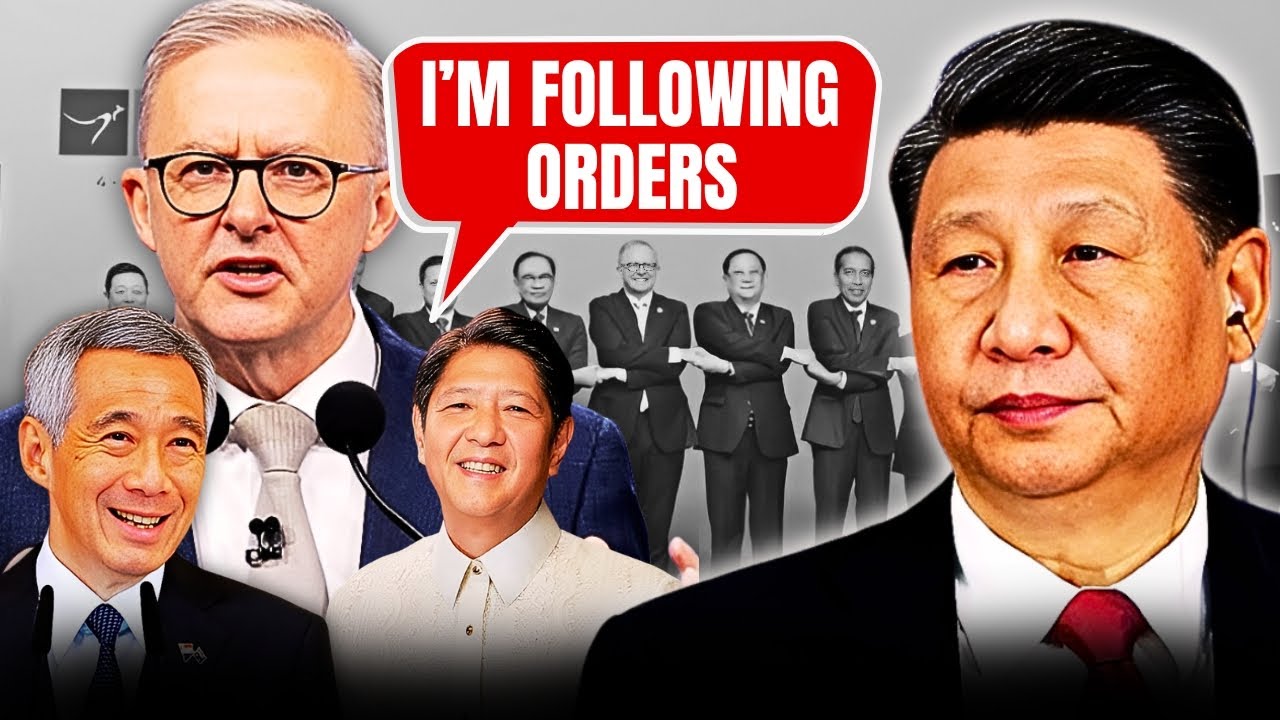
David Oualaalou examines whether ASEAN countries can trust Australia. The video explores Australia's regional relationships and the tensions that shape how Southeast Asian nations view Australian intentions and reliability.
Chapters
Hello everybody and welcome to Geopolitical Trends, where truth matters. Very, very excited to be with you on this March 8th. You know, time goes by so fast. Anyway, uh, I got an interesting topic for you today, and this one has to do with the conclusion of the Australia-ASEAN Summit. This is a part of the dialogue. This is the equivalency of, uh the, the Munich Security Summit, which is every year in, in Munich, Germany, or Munich, that is. Uh, some of you, or one of you at least, sent me a comment asking, Australia, is Australia part of ASEAN? No, it's not. It's just part of the dialogue. That is the reason why, uh, the, the, they've been doing this on a regular basis. But, uh, the importance of this is not about just that. It's about Why all of a sudden Australia picking up on this time? Because to my knowledge, that they can be flexibility as far as the timing. And this is what I'm gonna be getting into a discussion today. But before I'll do this, let me say hi to, uh, Sunny Day. I don't know who this person is, uh, and I don't know why would you start with something like that. So anyway, Uh, Lori, good to see you. Willie, as always. Hey, Raquel, good to see you, honey. I'm glad you were able to join me live here, so very, very excited to see you. Masan, uh, Wong KC, thank you. And thank you very much, Wong KC, for your support. I know you, you, you bought me coffee and tea on the same day. Thank you so much for that. Francis Tango, as always, good to see you. Peng Yu, good to see you. Athene Wu, good to see you. And Po Yan, good to see you. North South, good to see you as well. So, all right, let me get into this topic here, uh, once again. Before I'll— by the way, before I'll, uh, I'll move forward into this, I have one announcement to make, is next Friday I reached out to Warwick Powell. Some of you have sent me a request to reach out to him, and yeah, we kind of talk, uh, on Twitter. So, so he's gonna be here on the show next Friday, and he is in Brisbane, uh, Australia. So I look forward to that conversation. As far as, uh, Vijay, uh, Parshad, I sent an email, no response. So if you guys are a member on his channel, whatever, let him know, hey, Dr. O would like to chat with you if you are interested. So, so we, and we go from there. As I said, just for reference, today's topic is about Australia-ASEAN Summit that just concluded, which marks, by the way, the 50, 50 years of Australian-ASEAN dialogue relations. And, and that begs the question, because they are the key question that we need to ask, and let me put them up for you guys here. On the, uh, on the, uh, post them for you rather. Let me just, uh, change the other old questions from the previous, uh, live stream we did. So, and, and let me show it right here for you guys. Here is, was the summit of substance or just a photo op? Because it's worth asking this question, and, and, and once we get into the analysis, you will know why. So Second question is, is Australia seeking economic gains from ASEAN because of its sinking economy, meaning Australia? And the third question is the timing of it. What's the timing of it at this time to upstage the China-Two Sessions? Or is it a diversion? Or because that's just exactly what happened for us here in state of in the US, in Texas. I don't know if you guys heard about the wildfire that happened. Nobody talks much about— yeah, so because it was diverted, diversion from the, the government, which is another conversation for another day, because I can do something or can talk about that one. Because, uh, as one who lives in Texas, it's not a fire season, so it makes me think, you know, this is similar to what happened in Maui. This is similar to what happened with the earthquake in Morocco. This is what happened, similar to what happened in the earthquake in Turkey. So read between the lines, guys, and we will talk about this one some other time. All right, before I'll delve deeper into all this, let's do some headlines around the world here. And I want to share first one with you is this picture here. I want to just tackle some issues. No, this is Macron-Putin altercation reinforce European fear of a nuclear war. Well, this is not about that. It is about the statement by the incompetent Macron himself when he said that we need to send French soldiers to Ukraine, and the French defense minister Sébastien Lecornu, uh, just rebuked that. Just last week he said that France has no intention of sending soldiers to Ukraine to wage a war against Russia, end of quote. It shows you right there, there is a disconnect within the government in France. And France is not the only example. Germany, now Sweden, because Sweden became officially now the 32nd member of the organization, Finland, you name it, the whole Europe for that matter. So, and with these words, the Minister of Defense tried to catch up with the storm left by the French President Emmanuel Macron remarks at the Kiev summit support, which was, by the way, that summit support was held in Paris. Well, look where France economy is and why the heck would France will be doing that one for the sake of Ukraine? And that's worth asking questions. So, uh, second one has to do with this picture here. These are Russian soldiers, that is. And this one has to do with the warning. Now, the warning from within the Defense Ministry in Russia. They are like, you know, what, what they are witnessing is that this push by Europe could lead to an all-out war in Europe. And this is what the head of the military academy of the General Staff of the Russian Army, Vladimir Zhirudantsky, warned that the conflict in Ukraine could turn into an all-out war. Why? Because we pushing. And this coincided with, again, as I said, Sweden became in now the officially part of NATO. Finland is already there. Two countries that have sort of maintained that neutrality for over a century or two. So makes you just wonder. So, and this is what this General Staff is warning, is that, uh, uh, the likelihood that Russian forces will become involved in a new conflict if the Europeans, headed by the, by the US, will keep pushing into that direction. A third one, this I couldn't, I couldn't wait to share this because you guys need to know about this one here. Gold prices are going up. Yeah, it's a headline. I figured I need to— you guys need to be aware of what's going on in the market. And by the way, we'll be doing major talks about it next week on the big channel, so on the Geopolitics in Conflict. So we'll be talking about that one. Uh, but for now, suffice it to say that gold is continuing its, uh, its record as far as, uh, price increase. Now you have it about over $2,169 an ounce. Once again, why am I sharing this headline with you? It's to put it in perspective for you to start to think, because you need to be thinking financially speaking. Don't assume that, uh, what the market is versus the reality. It's like what our president, our incompetent president, saying yesterday during his State of the Union, which by the way I didn't listen to and I don't listen to that. That the economy is doing great. Oh, come on, man, stop lying. The economy is not doing great. American families are suffering, financially speaking. So we can't be saying this. And this is where I need you to be aware of where things are headed. So, and of course, this comes in, uh, uh, uh, during a time where, uh, really the economy in the US the economic data, uh, still suggest that we are far, far away from recovery. Just the reality of it. And one more thing, I think I don't have a picture of it. Oh, bummer. And I did have, uh, let me see if I can get picture for you here. Because you need to see this one here. All right, let's— I got the picture here. Save it. I just have— excuse me, uh, I have to save it in a different format here so you guys can see it. All right, here is the picture. Picture 16. And this one has to do with NATO. Yeah, this is the picture right there. That's NATO. So, so NATO is currently conducting massive exercises in Norway. It's just, it's just mind-blowing how— mind-boggling rather— how idiotic and stupidity, but also NATO is pushing, pushing. I don't know how much patience Russia will have. Literally, you kind of— so far I'm, I'm wondering how much patience Russia will sort of— at some point they're going to have to, to react to this. So you have about 20,000 troops from 13 NATO members began major exercises in Norway. And if you see the map where Norway is and, uh, Russian border and Sweden and Finland and all that stuff, and all this, this saying in case of a hypothetical attack on the alliance territory. So now Russia is looking at this as provocative to begin with because that's next door. So, and those exercises, by the way, now involves the two new members, Finland and Sweden. They've been— they dug their own graves. There's no other way because they will be first to go should they bear— should there be a military conflict, that is. So, but here is the question that I need to ask you guys, and, and not just you guys, for all of us to think. You, you, you all hear about this NATO exercises and so forth. How come we never hear about NATO exercises right here in the United States on US soil? Not to my knowledge ever. Maybe they were back in the '40s, '50s, whatever. But to my knowledge, as long as I've been alive, never heard of NATO exercises right here in the US soil. Makes you just wonder. Let's conduct the exercises on other countries' soils in case something happens. They will be the one to go down first, not our country. That makes me just wonder. So just something to think about. All right, let's get into our topic here by starting addressing this particular, uh, summit that just concluded between, uh, Australia and ASEAN. So, so for just once again, as background for those who might not know, that Australia, uh, hosted the leaders from Southeast Asian nations in in Melbourne for about 3 days. We just concluded the day yesterday or the day before, somewhere around that. Uh, it started on Monday, so Monday was it. Yeah, it concluded on Thursday morning. So, so the meeting marked the 50 years of Australian-ASEAN dialogue. And this, again, remember, Australia is not part of ASEAN because Australia has always saw itself not part of Asia. And, and I'm going to share with you some quotes from the incompetent Albo himself which contradicts the reality. So, and here's the thing, when you look at this conversation between Australia and ASEAN, uh, they are sort of, uh, conversation includes the, of course, the trade investments, even energy or clean energy and climate change, and it's nonsense. This climate change is nonsense anyway. And maritime security— what I found very, very interesting is that Vietnam and Australia plan to upgrade their relationship to a comprehensive strategic partnership. Why is this? You have to go back a few months ago. It was the visit of, uh, uh, uh, uh Biden to Vietnam right after G20. Why is this again the concern for that? Why did Biden go there? Biden went there because of the concern that Vietnam is getting closer to China. And this is what I want you guys to put this within the right context. And the right context is, is this all nothing but a photo op? Photo op in the sense that the US is dictating to Australia what you need to do to woo some members of ASEAN. Because remember, personally, and I speak for myself personally, I don't see all ASEAN countries on the same sheet of music per se. So if I am to ask you a question, which country in ASEAN do you think will be the weak link or is the weak link? If you can type that in on the chat box, I will greatly appreciate it, and I'll take a look at your answer as I move forward here. And this is why I am like, uh, no, this doesn't make sense. Sort of, uh, the discussions or the dialogue, whatever term you want, is— there's nothing wrong with that. And again, I am looking at the timing of it. I am looking at the real reasons behind it. So, so, uh, Chanel, uh, no, India is not part of ASEAN, uh, but good thinking because probably you were thinking about BRICS. So, Atenwo, you got it. Cosmo, you got it, you know. And again, there is no right or wrong, you know why? Because others will be thinking about other countries as well. Like, for example, uh, I'm one of those that argue, uh, not, not 100% that Singapore— I put a question mark on Singapore. Of course, for Philippines is worse, but for Singapore I will also just question. So this is why there is no straight, uh, right answer per se. But most analysts will agree, assuming they're thinking objectively, that Philippines is considered one of the weakest link inside ASEAN. Singapore, for me, started to raise those questions is because when they impose sanctions on Russia. Well, why will Singapore— look where Russia is, look where Singapore is— why would the heck Singapore will even impose the sanctions unless it was pressured behind the scenes? And this is just FYI, just to think about it in terms of how this can— well, before I move forward, let's take a look at the history of ASEAN just for you to understand, for those who might not know. ASEAN stands for the Asia, uh, uh, Association of Southeast Asian Nations. So it was, uh, founded, uh, back in— what year was it founded? Yeah, let me ask you, I want you to be part of the conversation. Just give me the year. What year was it founded? I know you can look it up, you don't have to just guess. So, uh, I know it takes a while for the answers to show up here, just, uh, so what year do you think ASEAN was founded? Uh, Francis Tango, 2010. No, no, it goes way, way before that, way before. I'm glad you mentioned that, uh, Tango. So a lot of people do not know, and this is the whole reason for why we having this conversation, uh In the '70s, even before that, slightly, but you, you're closer. Po Yansu, no, you went far. I'll go back with the, uh, with this one here, Belly Surf. You know, it was in, in 1967. 1967. Chanel, you got it, you got it. 1967, there were 5 leaders. It was the foreign ministers at that time of Indonesia, Malaysia, the Philippines, Singapore, and Thailand. And what happened with those 5 leaders? They sat down in the main hall in the Department of Foreign Affairs in Bangkok, which is the capital of Thailand. So, and when they met there, they signed this document. So, and by virtue, that document created the Association of Southeast Asian Nations, known as ASEAN. So, so you think about it this way. The 5— those 5 founding members, if I may use the term, who signed it, that included Adam Malik of Indonesia, Narciso Ramos of the Philippines, Tan Abdul Razak of Malaysia, Anarajat Naman of Singapore, and Thanat Koman of Thailand. And this is what gave birth to ASEAN. And I provide you the link, by the way, uh, where you can read up more in it. So fast forward a few years later, and without going into the details of it, it increased because the whole idea of this ASEAN was nothing but a regional, uh, security, uh, and economic, uh, cooperation among the members. So it increased, of course, to 10 members. You have about— let me share a picture with you. I don't have the maps, but I have just, uh, uh, something to see here. Uh, it increased to about 10 members. That includes Brunei, Cambodia, Indonesia, of course, Laos, Malaysia, Myanmar, the Philippines, Singapore, Thailand, and Vietnam. So ASEAN countries collectively, when you think about it, uh, got about a population of about, uh, 670, almost 700 million people, and its GDP amounts to about— the last figure I looked at, it could be different now, but the last one I looked at was about $3.2 trillion. Not much for— in comparison, for example, to the EU, of course, because EU is older than that. Uh, uh, but ASEAN, as it grows into these 10 members, uh, the economy of each country is not where— because you're not going to compare, for example, the economy of Laos with that of, let's say, Malaysia or Indonesia. Okay, so, but the group has played a major role in the Asian economic integration. This is why I need you to think within the context of why Australia is really honing at this dialogue with ASEAN. So now expert, uh, uh, sort of analysts from the West, uh, making the same arguments that they do about BRICS. Yeah, this is just for the sake of comparison for you guys to understand. And what those experts are saying, and those are mainly from the West, you know, they're saying that ASEAN impact is very limited. And the reason being, they argue, which I don't agree with that to a degree I don't agree to a degree. I don't agree because it's not about lack of strategic vision, as those analysts are saying. No, it is about coordinating the effort among all the members that are seeing the same vision. This is why we go back to the point of who's the weak link, not just one country. You know, you have to think in those terms. There is also another argument we can be make is the priorities. So what are the priorities for ASEAN? So when I say priorities, all of them collectively, you have to think about this. Then there is another element which has to do with leadership. There is not a viable, strong leadership that can take the lead, unlike what you have in BRICS. In BRICS, you do have a leadership which is mounted by 2 main countries. What are those 2 countries? Can you guys guess? And again, some will disagree with me, and you are entitled to your opinion and respected, of course, for it. But to me, when I look at the leadership in, in associations like this, there is a reason for why. And I want to see your answer, uh, first before I move forward. Uh, the 2 country— uh, Cosmo Ray, Chanel, yeah, you guys got it right. Russia and China, uh, uh, with the Akram, you got it, Russia and China in BRICS in this case. Now you don't see the same thing when it comes down to ASEAN, and, and, and straightforward, we can't sugarcoat that one, because if you are to think, if I am to ask you, who do you think will take the lead in ASEAN? Can you type in the chat box which country do you believe, or countries do you believe will be the one to take leadership? The reason I am in, in support of the arguments that when it comes down to BRICS, you have Russia and China, is because their economies, you know. The reason I didn't include India, even though India is a founding member, but India's economy is not at the same level as that of Russia or China. I will make the same arguments regarding ASEAN. And ASEAN, this is why that leadership is missing because we don't know as to what. And that's part of where that approach— now, where the challenge of ASEAN, even though they made it clear, however, I am not— I didn't buy their arguments 100%. And the argument is that one of the challenges for ASEAN is that they have to develop a unified position vis-à-vis China? There is none, not at least among all of them. And this is what I'm saying, you think about the weak link or weak links inside ASEAN. Philippines is one. Now others will say, uh, to me I'm like putting question mark on Singapore. So, and just to put this in perspective for you, It's again, I once again, context, always context matters. You have to think of the big picture, the idea about ASEAN or Asia in general. I looked at some stats, some data yesterday and this morning just to update whatever I was going to be talking about, and I found out that China— just listen carefully— China's investments in Asia, not ASEAN, in Asia, reached about 37% last year, 2023. And this is according to Nikkei Asia, which is an outlet that they have some accurate information. I've been reading their article, their analysis, their assessments, and, and always find it spot on, objective. They are not on this or that. They objective, and that's why. So, but here is the key: while China investments in Asia as a whole went up by 37%, guess which country was leading into all this? I want you to guess. It's an ASEAN member. So I want you to type in just your wild guess, your wild guess, which country. And there is a reason for that, because I am going to be talking about something very important pertaining to, uh, this particular country. Oh, Francis Tango, you got it, you got it! Indonesia. In— I'm sorry, here. Oh, not the US. Uh, no, Indonesia. Yeah, and Francis Tango got it. I saw it first. Where is it? All right, what about Yeah, you guys got it, you got it. Here is the first one I saw, Francis Tango, you got it, it's Indonesia. And this is why I'm saying you have to think about the context of this. And that leads us back to our original question: is Australia trying to gain favor, economic one that is, with ASEAN countries given its economy is sinking? And its disastrous foreign policy. So, so when you think about China's influence in Asia, it's large, okay? Because nobody can deny this one here. And this is why the incompetent Albo said that Australia— listen carefully to what he said— said that— and by the way, I found this article, it was written by Rachel Raquel Ward. So I give credit to the individual Raquel Ward for her article, uh, but I'm just, uh, reacting to it based on my own understanding of the region and my own analysis. So, so I'll be picking up on certain aspects to counter-argue that one. That's the whole idea of what we do analysis to begin with. So, so here is what, uh, Albo said. Prime Minister, you give him proper respect because proper— because his title, even though he's incompetent. So Australia, he said, and I quote, Australia's destiny was in Southeast Asia more than anywhere else in the world, and he was concerned about any destabilizing behavior in the South China Sea, end of quote. There is a lot to read right there. Well, first of all, Australia— when I say Australia, the government, I'm not talking about the people. Australia never wanted to be associated with Asia. You all know this, nothing new here. Second one, we also— the outcome of when Australia listened to what the United States was saying to Australia to do against China, look where its economy, uh, end up. Uh, it was one comment from one of you guys, uh, I don't remember what it was, I can't get to it right now. Anyway, someone who put very, very interesting comments, and I am glad, uh, uh, he put that one. He or she, I don't know. Let me see if I can get it because it's worth, uh, it, it's worth, uh, reacting to something like very, very interesting. And this is why, guys, I do read them, and I always say, if you notice, I always write, I hope the community get chance to read this comment because is the importance about it. Uh, okay, where is the— uh, it's right, right, this one here. Okay, let me see the comments. Yeah, I should have saved it, but I didn't. Uh, oh yeah, here it is. It's from, uh, from Punk 9230. He wrote, and I quote, Australia is great country, but it chooses to be the lapdog of evil hegemonic US that's causing its economy to sink by going against the rise of China. Uh, unfortunately self-infl— no, actually it's not this one. Anyway, I gotta move on. So anyway, what was the arguments into this, uh, in this post, which was interesting? They said, well, Dr. O, the economy of Australia is not sinking because the issue with Australia is in the housing market. I see the— I see the point and I understand that. However, I went ahead and used the term sinking, and I give you an analogy to all of you here just to understand. When a boat sinks, how does it? Does it sink right away quickly, or does it go slowly down, down, down till it disappears? That was my point when I used the term sinking. Yeah, the economy of Australia still hangs in on there, of course, with its housing market now, but I had to think about the big picture of the entire economy because the housing is part of that economy. Look what happened in China with the Evergrande, how it dragged the Chinese economy. Look what happened in the US back in 2008 with the GFC, the Global Financial Crisis. What was leading to that? The housing market. So the entire economy ends up being dragged down, and this is why I use the term sinking. And to me, it is sinking because if you only look the right data to see the drop in the trade that was between Australia and China. And this brings me back to the original question: is this why Australia now is gaining— wanted to gain favor with ASEAN countries? Why? ASEAN have a major economic trade with China. So to gain favors, per se, and it's worth considering because we ought to think in those terms. So, and this is why, uh, when I looked at the final communiqué of their declaration, interesting the wordings of it, you know. And this is again, I am very perplexed at some countries inside ASEAN that they are trying to be wishy-washy. Where do we stand? I do know some countries came forward and declare that we are not going to side with China, we are not going to side with the US, rightly so. Others are saying, oh, we are going to have economic ties with China, but they want behind China's back and strengthen the military ties with the US, you know. And I'll give example of Philippines in this case, because it was— no because that's a double play. And usually in international affairs, that looks so bad. It's like for us right now on the global stage, we saying one thing and doing another. It looks so bad. It is bad. You lose more credibility than ever. So, and this is where I see when in their declaration for this, this summit thing, uh, stressing the need to maintain peace in the shipping lane, or shipping passage, that is which is bound by the Indo-Chinese Peninsula and islands of Taiwan, and caution against unilateral actions without mentioning China. That's to me very, very, very manipulative. Why don't you come straightforward? First of all, what are we talking about Indo-Chinese Peninsula? What is that? What are we talking about islands? Of Taiwan. What are we talking about unilateral actions? See what I'm saying? You have to understand, this is why you need to put it in context within— interesting, because Australia is seeing where it's headed. So the declaration here is what I found. Again, I won't use the term— I found it very Uh, I just didn't buy the argument. And this one has to do with, uh, the declaration continued by saying, and I quote, it was also extended beyond the region, calling for an immediate and durable humanitarian ceasefire in Gaza, the release of civilian hostages, and condemns attack against civilians. Once again, it's vague. There's no specifics. And without specifics, I won't buy it. And this is why I'm saying the incompetent Albo looked at it as a way, first of all, to do US bidding, because he is serving his master. And second, look what he did in his own— for he— to his own country regarding the housing market. Ask any Australian. And well, I will be talking about this with my guest next week, uh, Warwick Powell. When he comes in. And if you remember, guys, last time we had Robbie, Robbie Barwick, you know, he addressed some of this. So here is what Albo, Prime Minister incompetent Albo, said on Wednesday— on Thursday. I quote, I am very concerned, and Australia is concerned about any unsafe and destabilizing behavior in the South China Sea. He added, it is dangerous and it creates risks of miscalculation, which can then lead to escalation, end of quote. Well, here is the logical question: why didn't he disclose that the introduction of the nuclear— US nuclear submarine to Australia is considered dangerous also? Is destabilizing the region? Also. And this is what I'm saying, is he doing the bidding for the US, or is it just a photo op? You know, the Foreign Minister of Australia, which is another incompetent politician, Penny Wong— you know, that's to me incompetent— anyway, acknowledged that, well, among ASEAN countries, every country looks at it different. In other words, they are different viewpoints regarding that. And why is she referring to— here she's referring to how each differing point deals with Chinese, and she used the term aggression. I put it in quotes because that's her word. Makes you just wonder. And this is why, if you read the detail about what they agreed to between Australia and ASEAN, Australia agreed to allocate about $67 million into some scholarship funds. Something has to do with think tanks. If you always think think tanks are funded— the National University of Australia, or Australia National University, whatever that is, uh, it's— it gets its funding from Washington. This why the, the, uh, the, the analysis and white papers that coming out of that It's geared towards— I told you last time I didn't trust the, uh, analysis that was coming out of that regarding Indonesia. Oh, Indonesia is going to be caught in the middle between— no, no, no, no, no, no, no. They creating that because they want to create that doubt. So, and this is why sort of, uh, uh, uh, when you look at this picture, guys, I know you can look at it closer, uh, it's a little bit too far up. When you look at this picture, not all but majority ASEAN leaders, you know, gave no hint of any concern as far as what the Foreign Minister of Australia was saying or the Prime Minister of Australia was saying. Why? Because they just smiled and posed for the photo op. All this following closed-door discussions. That makes you just wonder. This is to me why you have to understand. And if you look at the numbers, what Australia wants to do— Australia outlined these commitments of about $61 million to strengthen— listen to this, and I quote here from the article— to strengthen connections with Southeast Asia, including funding for cultural centers, university scholarships, professional placements and cooperation on energy. Yeah, what to me really— what was troubling about the incompetent Albo was troubling is this statement here. He said, and I quote, more than any other parts of the world, Southeast Asia is where Australia's destiny lies. Mr. Albo told ASEAN leaders, end of quote. It's a fat lie. Australia never wanted to be associated with Asia because Australia has always thinks of itself as an Anglo. And, uh, no, they don't want to because they always looked down upon Asian nations. I'm very familiar with the history. I'm very familiar with the conversation regarding the elites in Australia. This is why I'm now starting to be even concerned for New Zealand, because New Zealand is following the footstep— in the footsteps of Australia. And incompetent Albo continues when he said, and I quote, this is why we will continue to support your ASEAN outlook on the Indo-Pacific and ensure the stability and peace of our region, end of quote. What's important about this statement, and I repeat it, this is why we will continue to support your ASEAN. You see how he's putting the keyword there, yours, which means I am not part of, I don't want to be part of your ASEAN outlook. But when he wanted to continue the Indo-Pacific and ensure the stability and peace of our region. It— I found it very, very manipulative. That is what it is, the way I look at it. So now, like I said, the question is: is Australia the wind in the bearing for the US? An average person who knows a little bit about geopolitics and international affairs, it will become clear So even though in this saying that Australia has far strong and far-reaching ties with the region, yeah, it does to a degree, but now that, that is changing because as a bloc, ASEAN, believe it or not, is Australia's second largest two-way trading partner because it used to be China. China, of course, took the top. China cut off that relationship to a degree. There's still certain things that traded, whatever, but it's not as it used to be. And this is why you have to think about the out— what, what this, uh, what this conversation, what they agreed upon, what did they decide to sign on and all that stuff. And I read up the declaration and so Here's the four elements that I'm going to share with you. One of them, uh, the four elements rather. What they agreed upon is that one, boosting economic engagement— you can interpret that any way you want. So second, supporting an accelerated clean energy transition— you all know why, right? Third, increasing practical maritime cooperation. And fourth, supporting the region's current crop of emerging leaders. Now, no, no, no, no, no, no, I don't buy this. The first one, boosting economic engagements, is because you, Elbow, in this case, very concerned as to where the economy, global economy that is, but especially when it comes down to China's, what they disclose in the, the two sessions that is still ongoing. But the first statements by Li Qiang when he talks about the economy, and I did this for you guys in the video, where is the focus on technology, right? And strengthening supply chain. Elbow, it has to sort of— this is why I use the term gain favors. B1, he wants to gain favors with the ASEAN, which means what? Using ASEAN to support his economy. Well, wait a minute, wait a minute. You say you don't affiliate, you don't associate, you don't link, you don't want to be part of Asia, Yeah, you still can do business and all that, but on the other hand, you can be on both sides of the fence. I know every country thinks about its own strategic interest. I understand all that. I have nothing against it. But if you are to declare publicly that you are in support of the region, and at the same time because you want stability and security, but you are allowing a nuclear submarine deal that's going to destabilize stabilize the regions. Because what do you think other countries in the region is going to be thinking or doing? You think North Korea is going to be okay with it? You think China is going to be okay with it? Or Malaysia for that matter? Or Indonesia for that matter? This is what I'm saying. We have to think in terms of, okay, is he talking about, uh, so, so, so sort of sincerely Or is it just whatever that is? So, and, uh, and I found something also very interesting, and that one is who were the honor guests? Honor guests, because there is always, when you have a dialogue like this, there's always some honor guest of sorts. Well, the incompetent Prime Minister sort of honored to host the official guest. Well, here is the first one, Marcos Jr. of Philippines. Second one, Anwar Ibrahim, Prime Minister of Malaysia. Third one, Sonexay Siphandon, Prime Minister of Laos PDR. And the fourth person is Mr. Pham Minh Chinh, Prime Minister of Vietnam. What, what does strike you about all this? The importance is that to understand what is the type of relationship the US had with these countries. So, and this is where I said earlier, when you put this within the context and you really think through the, the quote and the statements by, by Albo. Like, for example, and I quote, Australia is proud to be ASEAN's first dialogue partner, sharing 50 years of mutual respect and cooperation with our friends in Southeast Asia. Another one, building Australia links with the countries of Southeast Asia is priority for the government. Third one, the special summit commemorates our shared history and focus firmly on the figures— on the future, rather, and how we can deepen our ties in Australia's engagements with our neighbors. Yeah. Uh, then when I dig into the information elsewhere, not here in the US, not from Canberra, because it has to be worded certain way, what I found is the opposite. For example, Australian Prime Minister said he is con— and I quote— he is concerned by unsafe and destabilizing behavior in the South China Sea. You all know what he's referring to here, right? This has to do with the Philippines and China's Coast Guard vessel that collided recently near the disputed shoal, leaving 4 crew members injured. So And this is what I found, the double standards, is how this is going to work, you know. When he said, and I quote again, it is dangerous and it creates risks of miscalculation which can lead to an escalation. That, uh, it, it's very, very troubling. So now there are some Hints as to what lies ahead came out of all this. One, for example, and I look at it this— Burma. You all know the country of Burma. Burma was officially excluded from, from the Melbourne gathering. However, neither the Australian government nor the Burma embassy in Australia would comment on reports that Burma was still represented at the summit by Australia-based diplomat Ted Toon. Another one that I found very interesting, there were about 200 protesters that demonstrated outside the summit on Monday. And why? Because it was against any Burma represent— representatives being present. And the last one that I found very interesting has to do with East Timor. Prime Minister Zanana Kusamo also attended the summit as an observer, official observer, after ASEAN agreed in principle to admit Asia's newest country. What does it tell you? It tells you where things are going. And this is why Australia, uh, sort of— it wasn't a routine dialogue, whatever. But again, for me as an analyst, I have to think about the timing of it. It's not coincidental, because with this kind of summit stuff, you can push them forward, backward, whatever. It's not set stone. This is not G20 or whatever. And this is why I am thinking in terms— no, there is more than meet the eyes for this one here. And I am wondering, how will ASEAN approach now this summit? Because ASEAN countries know they are really between a rock and a hard place. Not all of them, of course. Those who decided to take a step forward, or stand for that matter. But not all countries did. Not all the 10 countries did. So Philippines is one of them. Speaking of Philippines, while I'm thinking about it, did you guys know that Philippines now is going to change the laws inside the country as far as granting divorce? So it's going to become now, I think, official, whatever. So, but Philippines, it became clear to me, I had high hopes Yeah, I had high hopes for Marcos Jr. when he took over, and I said I'm gonna wait, give him 100 days and see what transpired, because that's usually same thing with Probó right now. What is the concern about Probó is that the finance minister, she's gonna resign from the cabinet, and most analysts now are saying is corruption is going to come back full force inside Indonesia? I don't know. I'm going to keep my eyes open on it, and I will do an update for you. The same thing, I'm going to do some topics like, for example, Malaysia now is in a plan— and not a plan— Malaysia is considering reviving the rail plan. It was a major one. I took a look at some of the content that started in 2021. So now Malaysia is reconsidering that. Same thing I will do about China's part of Panama Canal. Does China own Panama Canal? So, or stickers or whatever. So, so this is what I'm gonna be addressing for you next time. So You guys let me know which one you would like me to do, and I'll put a, a survey question for you whether to do China or do Malaysia, because I found that topic very, very interesting. So, all right guys, I'm going to take a few questions, but before I'll do this, I'm going to have to say thank you, give a shout out to some channel supporters, members, and those who bought me coffee and tea, whatever. But the first one that comes to mind, the, the two other individuals Drag88, which is Osiris Great, and TC Quan. You know, TC Quan, those two have been buying me coffee every day, guys. And I, you know, you give credit where credit is due. You all know this by now. I know some don't like it when I spend time saying thank you. Well, you don't like it, sign off and take off. I don't shy away from it. So I'm, I'm kind of— to me, gratitude is so important. And if you couldn't be patient enough to— for this, then that means— I don't know, I can't judge you for that. If you don't like it, that's too bad. So, but I am going to do this no matter what. So there is an individual here by the name Lang Wong. You know how many cups he bought me yesterday? 55 cups of tea, and bought an additional 5 cups tea on the other, uh, uh, on other link, then became a platinum member on Buy Me a Coffee. So how do you thank somebody like that? I know words are not enough sometimes, but giving gratitude is very, very important to me personally, and I'm sure it is to you too, but I can't speak for you. So this is why I wanted to say thank you, and to all of you, those who buys me coffee on a regular basis and, and those who buy me coffee once, whatever. Still, your support means a lot to me, and I want you to know I do not take it for granted. So, and, uh, that's, that's, that's where things are with me regarding this. And I wanted to do this just to thank the supporters. So the links for if you want to support the channel, here are the links here. And I have those ones, and I have let Let me share them with you on— oh, I can't get to it here from here, but I also have the one for PayPal if you are interested here. So, all right, let me see a question or two from you guys. And oh, majority of you saying Indonesia. Okay. All right, just type in, uh, put in Q so I know it's question, and I'll answer a few questions, uh, for you guys. And I, I intend to, uh, depend on my time for tomorrow. If I get to it, I'll, I'll do the live stream tomorrow for you, either for China or for, uh, in, uh, Malaysia. So But again, the, the bottom line to all our topic for today is, is how much, uh, uh, truth was into what the, the incompetent, uh, Albo, Prime Minister Albo, was saying. I don't know. I'll let you guys be the judge on that. You, you're smart enough. You've been around now with me at least, uh, long enough to know now how to read those kind of statements. So the, uh Uh, so, so there is question from, uh, Mirko Stanek. A question, uh, are they concerned or are they concerned of losing control? Now when you say they, who are you referring to? So, so if you can just clarify this quickly here so I know how to answer, because if I answer this, this to me right away is about Asia. So, and I could be wrong, but that's why I wanted to know if you can just specify, uh, uh, who— what are you referring by they? So, and I'll be happy to, to answer that one. And I'm looking to see if another question there, guys. Uh, Cosmo, that's a lot of caffeine. Yes, it did indeed, but that's tea. So, and, and I am interested. I do drink tea once in a while, but not the way we do it here in the US with a lot of sugar. I don't touch sugar, by the way. Stay away from sugar, guys. That, that's your worst thing. Stay away from sugar. My advice to you, because I care for you, stay away from sugar. Uh, so I intend to, because I understand the culture in Asia and how it is linked to tea. The importance of tea. This is why when some of our foreign, foreign, foreign affairs or foreign diplomat, whatever that is, when they go to Asia and meet with the locals, uh, diplomats, what is— they just have no idea that the importance of holding that teacup and drinking, and, and they just drink so fast and talk so fast. Asian culture is different. There is a reason for that, because we don't understand the depth of understanding what does tea represent for in Asian culture. So, so I intend to do that one and just go from there. Uh, question from Cosmo Ray. Question: do you think the summit is also used for indoctrination? I won't be surprised at that, but at the same time, I do know that ASEAN countries, not all of course, are smart enough to know this, seeing where the trend is headed. That's why I'm only putting the two about the— my, my concerns about the two the two countries, Philippines and Singapore. Now I have to think about the other ones, not all of them of course, but if I am to think in terms of, uh, uh, uh, uh, uh, Laos for example, Myanmar for example, Vietnam for example, I haven't seen yet, but also I haven't digged deep enough. And, and I intend to do one about Laos there's something going on in Laos economically speaking, I intend to do that. But for the Philippines and Singapore, to me it became, uh, clear. So the question is, yeah, the— yeah, I can see the rationale in your question and there is a possibility to that. So, okay, let me see. Farhad Zavi, good to see you. Question: will a war between China and US end up with nuclear war. Yes, if it does, but the war in itself, I don't see that happening. It will be, uh, it will be, it will be no winner for that, that's for sure. And the devastation will be, devastation will be. I had a chance to listen to Mr. Wang Yi. Of course I listened to his speech, then I listened to the, uh, President, uh, Biden State of the Union, which was nothing but hypes. Our economy is not doing good. So why, why is he lying about that? So I listened to Mr. Wang Yi because I wanted to see, especially when it comes down to foreign affairs, to see what the Chinese, uh, strategy or thinking is moving forward. And I saw the rationale, and one of them was this point about the possibility of, of why it would not be a good idea, uh, for the US to push, uh, towards this intensifying the conflict, whatever, because it will be no winner in, in, into that. And that's very, very, very troubling. So yes, it could end in this same way that I'm seeing right now in Europe pushing, uh, Russia. I mean, how far can you push the Russians? At some point they're gonna snap, and if they snap, it's not going to be pretty. So that's the way I see it. Uh, question from Francis Tango. Question: if we get If we got a war in Europe, what kind of war will it get in the world? Or war, or war like World War II? Now it will be far devastating than that, you know. Yeah, Europe will be gone, will be done for. So, so us here and over, it's not gonna be because now you have technology that can reach from whatever. And let alone for the Russians and the Chinese, both of them have the hypersonic technology. So it, it just, uh, it will be devastating. And this is what concerns me about, uh, uh, Washington. Our system is corrupted, and I don't shy away from saying it. Uh, the next president ain't going to be any different. The, you know, he's not qualified to be president, already declaring his support for Israel to move forward with whatever. So that tells me right there When you don't see a correction of course of action, then that becomes clear where are we headed, and that's not good sign. So, uh, last one I'm going to take here, uh, uh, Markam Joseph. Hi, Dr. O, uh, love the show, much love from South Africa. Thank you. So question, uh, just want to know when the petrodollar is coming to an end, will the US still be able to sponsor Israel? Yeah, we still could to a degree, but not as much. It's because when the petrodollar ends, that ends with the hegemony of the US, the financial one. If the financial one collapses, so is other dimensions of the US foreign policy or US global dominance and so forth. So it will come to an end. Petrodollar is the key. The financial sector is the one that is helping us, uh, really have this so-called dominance, uh, around the world. But it's coming to an end anyway because the world is moving— has already moved into multipolar. Now it will be just the question of how do we manage this new multipolar order. That's, that's the way I see it. So, all right guys, I hope you find this very informative, and I look forward to seeing you next time. Once again, thank you all for your continued support. I am very grateful. And I don't know yet whether I'll do it tomorrow or not. If, if so, I'll post for you, and if not, I'll see you guys next week. As always, remember, geopolitics impact your daily life in more ways than one. Till next time, guys, bye-bye.
More from David


Beyond the Single Actor: Why the Gulf Isn't Choosing Between the US and China


Iran, Iraq's Militias, and the Houthis Are Coordinating! This Changes Everything




Who Controls the Next Decade's Resources? Latin America and Africa's Geopolitical Crossroads

The Chokepoint Trap: How Washington's Stupidity Triggered a Cascade That Now Controls the World

Trump Spooked as IRGC Unveiled dual-use SLV, Deployed Ghadir Mini-Subs & Hinted at Tactical Nukes!
