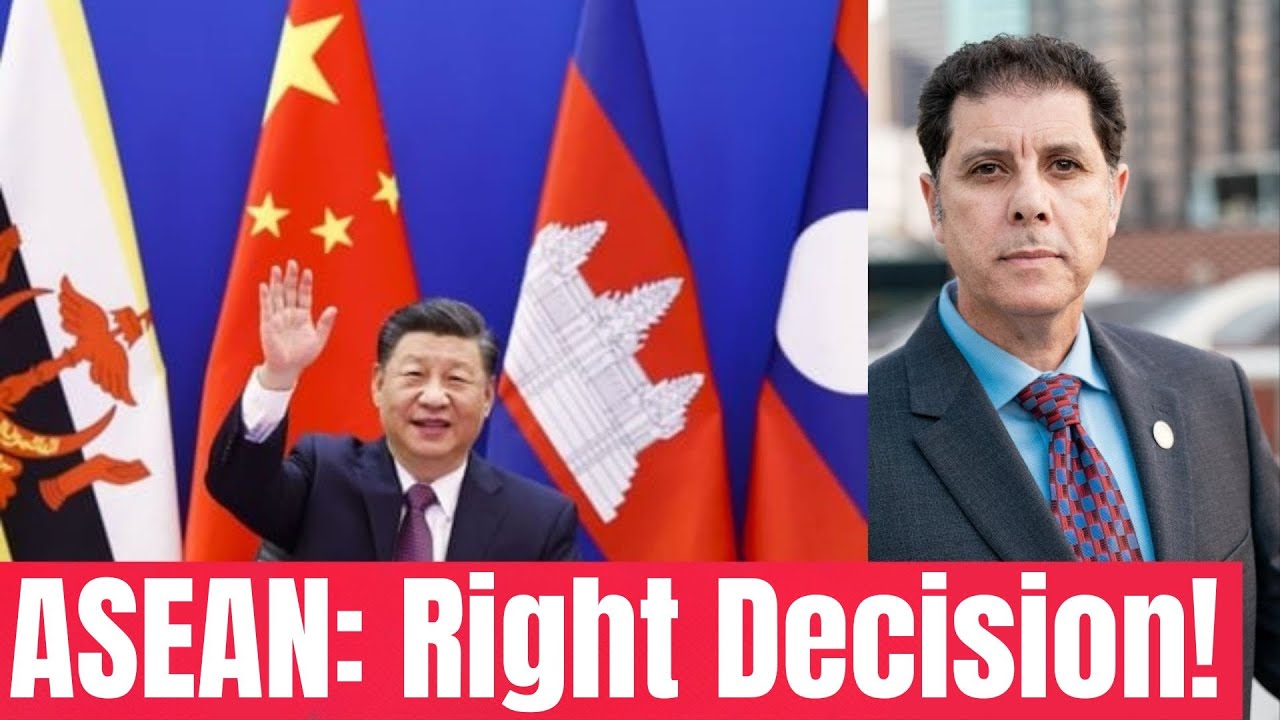
David Oualaalou breaks down why Southeast Asian nations are tilting toward China. A recent survey shows 50.5% favor China over 49.5% for the US, driven by China's massive investment in infrastructure, trade, and Belt-and-Road projects across Malaysia, Indonesia, and the Philippines.
Chapters
Hello everybody and welcome to Geopolitical Trends, where truth matters. Very, very excited to be with you as always, and I mean it. So I hope— by the way, I hope you guys enjoyed the conversation yesterday with Larry Johnson. So we'll have him back here on the show, uh, on both channels for that matter. So he's a very, very informative guy, and I enjoyed my conversation with him as as well. So anyway, very excited to be with you because I have an interesting topic that just came under my radar last night. And I was gonna say, well, wait till the beginning of next week. I said no, I'm gonna do it this— on this Saturday here because next week I got something else I'm working on for you guys and I'm gonna share it with you later on. So, uh, first let me, let me just see who's here, say hi to everybody like I always do. Uh, Holman, good to see you. Danny D, good to see you. Philippine, uh, Hamad City, good to see you. Uh, AC, good to see you. CLO, good to see you. Uh, oh, I see your questions. If I am a member of the party, bad party, right? Timeline Dunkley, good to see you. Jerome Lazarus, good to see you as always. And, and Kurosh Babi, good to see you. And hi to you all. Go. All right, let's talk about what are we be covering here today before I delve deeper into all this. So Uh, and by the way, as I mentioned earlier, I'll be working on something for you for next week, and this one has to do with Japan, believe it or not. I'll do a live stream for you guys on it because I have to gather some information. Uh, Japan now is boosting its defenses, and if you only know where— and that's the, the magic of it all— that's why I'm gonna be sharing with you next week. So All right, today's topic, you know, I'm gonna be talking about ASEAN. This is like about an announcement, but to me it wasn't about just the announcements. When it's, uh, for me, I titled it that way. That's why I put the title, 'Is ASEAN ditching the US for China?' Because that is what the announcement is all about. But to me, it's not about just that. It's about what about the Philippines? What about Singapore? More so Philippines than Singapore. And this is what I'm gonna get into, uh, detailing today. Well, most, uh, I'm sure most analysts will agree with me on this, that we are all noticing— I'm sure you guys too, you don't have to be an analyst to notice this— that we are noticing the shift now, really shift that is taking place before our own eyes, away from the United States George China. It's common sense, it's economics, as we always say. Now the key question we're gonna ask about this, which I have them right here for you guys by the way, because I always put the questions, is because you need to consider this stuff. What is the significance of this announcement? I know it's not new per se, but at the same time, when it becomes public, that is a big deal. It will hold a significant significance of some sort. This is why I'm asking the question: what is the significance of the announcement? Second, will it hold? This, this shift from the US to China, or from Washington to Beijing, will it hold? And again, you think about the weak links inside the, inside the, the block, or the alliance, that is. Third question: what about Philippines and Singapore, as I mentioned earlier? Because you can't think about the progress or the challenges that lies ahead for ASEAN without considering this, and without considering this aspect. And I am going to be talking about some of the challenges that lies ahead for ASEAN moving forward. Then the key question here is, what about the regional security? Remember, economics— for economics to prosper and, and, and, uh, sort of flourishes and so forth, you have to have a force that can protect that growth, that economy, that whatever you want to call it. That's like the idea of, for example, uh, uh, uh, the Strait of Malacca. You know, what would happen if Strait of Malacca gets choked? What's going to happen to, uh, China? So China will have to ensure that it have enough security to to ensure the safety of its goods transiting through that. That's my point. What, what is— how about the regional security in Asia vis-à-vis Taiwan issue, vis-à-vis Japan's boosting its defenses? And that's what I'm going to be talking about this last part next week. So those are basic questions we have to think about, uh, considering what we're going to be discussing today. But before this, I'm gonna do a headline to you, uh, headlines for you today. They're very brief that I have only two. The other three, I post them for you guys in the community. So just check out the community and you will see that there. So let me share the first picture with you regarding the headlines, and it will make sense to you why I decided to talk about this topic today. So, so here's the thing. The first first quadruple military exercises in South China Sea. And once again, as an analyst, I'm going to ask, why now? Why there? So, and here's the thing: the United States, Australia, Japan, and the Philippines announced today— this is what strikes me, uh, very important— announced today their intentions to hold the first joint naval and air military exercises in the waters of the— according to Western analysis or, uh, publication said, uh, it says, and I put this in quote, uh, in the waters of, in quote, disputed South China Sea, end of quote, in what appears to be a show of unity in the face of China, China's or Chinese naval influence. This is according to what they're saying. So And this, by the way, the statements, it was a joint statement by all the defense ministers of the four countries: US, Australia, Japan, and Philippines, seeking to counter— listen this carefully, guys— to counter Beijing's influence in the region. This is what the purpose of it. Well, if ASEAN— and again, it makes more sense to wonder If ASEAN is to shift to China— when we say ASEAN, we're talking about the whole bloc— then where does the Philippines fit into this equation? Where does Singapore, to a degree, fit into this equation? Once again, this is like in a matter of how you move the, the chess pieces within the geopolitical chessboard. You have to understand this dynamics. You have to see where it's, it's headed. And, and I'm gonna keep an eye on those because, uh, I might do a recorded video for you guys about this one here. Uh, the second headline, which is very brief also, but it's a very, very, uh, interesting one. You know, this one has to do with Iran. What the picture you're looking at, uh, this is the display of Iran because now there are concerns in Israel, embassies around the world that some of them have been shut down or been evaced from certain countries, not all. So, so what are you looking at? You're looking at Iran sending a message. By the way, it's sending a message to America because here is what happened. The United— Iran, Iran, under the— by the name of its spokesperson for the presidency, his name is Muhammad Jamshidi, an aide to the Iranian president, said that Tehran warned the United States in a written message not— and I put this in quote— to be drawn into the trap, end of quote, of the Israeli Prime Minister Netanyahu following the raid on the Iranian consulate in Damascus, which killed 7 prominent Iranian military personnel. Very interesting. But if you look at the picture, what are you looking at here? I'm pointing at the missiles. Those are long range that will reach Tel Aviv. But this is not about that, because here is what the media is not disclosing. I gotta adjust the camera here. There we go. What the media is not disclosing, and I got a confirmation of this by the way, guys, is that the United States reached out to Iran through a third party. You know what they said? You know what the US said to Iran? It says— he said, we are not gonna get involved if you attack Israel. What do you make out of that, in your opinion? Let me see your answer before I'll give you mine. What do you make out of these statements that the United States is saying to Iran We are not going to get involved if you attack, uh, uh, Israel. Oh, Juniper Lee, thank you so much for your super sticker. Juniper Lee has been an avid supporter since we started both channels, so thank you so much, Juniper Lee. First one who bought me coffee, I remember, you know, and I will never forget. I know some guys have left now because their financial situation changed, and, and I truly understand and sympathize. I wish, I wish I had a lot of money. I'll help, I'll help. So, uh, Laura Powers, what you said, it's a trap. It is indeed. It is a lie for what the US said, that Iran told Iran, yeah, go ahead and attack Israel, we won't intervene. It's a lie. So Iranians not going to buy into this. And this is why I wanted just to share this with you as we move forward. All right, let's get into our topic here. Now, uh, let me show you a picture of, uh, this is an old picture, by the way. This one goes back to the 23rd Summit. I think it was in 2017, if I'm not mistaken. Don't quote me in this because Duterte at that time was still the president of Philippines, which, by the way, Many Filipinos miss Duterte, given what this new guy— another new guy, Bongbong, is doing. So, but anyway, uh, what's going on with— and this is what we're going to be getting into. Well, of course, they're not— this is my reaction to an article that was written by, and I give credit to, Subhasa Suruga. He's the, the Nikkei Asia staff writer who wrote the article, and I am reacting to it because when I read it and checked the, uh, the economic data in it, it was accurate. So, and, and to me, I got to give credit, of course, because it's the right thing to do. So, so here's what happened, uh, of course, this— the article came on the heels of the survey. It was a survey that was conducted which over half of Asian— Southeast Asian nations, we now— listen carefully— we now prefer to be aligned with China over the United States. And at the same time, if— this is a big if— if they are forced— they meaning South Asian nations— forced to choose between, uh, the US or China, there are some surveys the numbers, and I'm going to share all this with you, that's saying no, we will— pardon me— we will side with China. So, and this is what the regional survey, which by the way was based, uh, from a think tank in Singapore, uh, revealed. What is reflecting now is the growing influence in the region of China. Well, I mentioned to you last time, guys, I'm sure you remember the percentage of how much China invested in Asia as far as, uh, uh, uh, uh, foreign direct investment. Can anybody remember? I am— I hope you remember it, guys. Can you write down in the chat box the percentage of how much China spent in 2023 as far as foreign investments in Asia? We're not talking about the Western world, in Asia. And I put a number for you, and I put the link to the article back then. So let me just see in the chat box if you guys will be kind and just put the percentage, even if you have to guess. But I did put an accurate number for it. Let me see what you guys, uh, came up with. And I know sometime, uh, sometimes it takes time for the numbers to show up here. Just put in a number, whatever comes to your mind, even though there's data for it out there. All right, let me see what you guys came up with. Uh, uh, Jane Wong, you say 42%. That's a little bit too high, but you're on a ballpark. Hey, Francis Tango, good to see you. Matt Backy, good to see you as well. So what is the percentage of the foreign direct investments of China in Asia? How much China invested in Asia in 2023? What is the percentage? That's my question for you guys. So Jane said about 42%. It's, it's a little bit higher. All right, I'm gonna have, uh, oh, oh, oh, uh, Dennis Lee, 35. You are so close. It was 36% according to some data, and I put the link for you guys. Uh, 37. Kara Kulak, you got it. You must, uh, uh, read the article I posted for— anyway, that's what it was, 37%. And this is why now the survey that was conducted in 2024 of this year, and this, what they found is that 50 50%, 50.5% of the respondents opted for China, and 49% preferred the US. So, and if ASEAN had to pick sides, the first time Beijing edged past the United States, or Washington, since the annual survey that was conducted back in 2020. And I did find the link for all this data, and I'm going to share all this with you. But before do this, I'm going to jump into geography because you need to know a little bit about the geography of ASEAN. It's very, very important to understand along with its history. Even though I did talk about this before, I don't mind repeating it this time around. And, and that's one time I'm going to do this, and, uh, just for you guys to See this one here, and I give credit to World Atlas, of course, because that's the, uh, map that I'm sharing with you, right? It's just a flag and the location of the countries. Let me make it bigger for you guys right there. There we go. So what you're looking at here, ASEAN countries. Well, ASEAN, to those who might not know, and again, I don't like to assume, stands for the Association of Southeast Asian Nations. As its name implies, it is the, uh, grouping of countries in the region of Southeast Asia. The organization began with 5 members, and those 5 members were Thailand, Malaysia, Indonesia, Singapore, and the Philippines. Yes, Philippines was one of the founding members. But over the next 50 years, however, this membership will double. That's why they are about, uh, uh, how many members are in ASEAN right now, guys? If you type in, in the chat box, just the number. So, uh, it is now including Brunei, Vietnam, Cambodia, Myanmar, which is Burma, and Laos. But here is the interesting about it. Collectively, the membership of ASEAN has a population of approximately 650 million people and a GDP that is almost $3 trillion. I, I find it very impressive because very, very important to, uh, see, uh— oh, Abu Bakr Siddiq, 10 members, you got it right. Hamed Sidi, you got it right. Mr. Shafiq Islam, you got it right. Francis Tango, 11— that was 10. Glenn Farrow, 10. 10. You guys got it, you got it. It's 10 members. So, and this leads me to talk about the history of the ASEAN, because its history is very, very important. And I'm gonna share, uh, let me stop sharing this one here and share a picture from the archives. I have to go and dig for it to find that. This is the art. This is the original members of the ASEAN. Uh, the, the way when it was, uh, when it just started. And it goes way back, of course, goes way back to what year? Anybody know what year these, these individuals met? Those are the 5 foreign ministers of the ones that signed for the birth of ASEAN. Let me see your historical knowledge on this. Just, just type in the year if you could in the chat box. What year this meeting take place— took place? Hamad City, 1967. Indeed, indeed, that's when it was. And it was in, uh, uh, it was exactly on August, uh, 1967. So you got— you're looking at the 5 leaders of Indonesia, Malaysia, the Philippines, Singapore, and Thailand. And all of them, they met together at the hall, uh, of the Department of Foreign Affairs in Bangkok, in Thailand. That's when it was, and that's where the document was signed. Uh, of course, the moment they signed that document, the Association of Southeast Asian Nations, known as ASEAN, was born. And of course, uh, and you all know, I'm, I'm gonna mention the names here just for the record, for you to know. And the 5— the picture you're looking at, uh, uh, the ones who signed, you have Adam Malik of Indonesia, Narciso R. Ramos of the Philippines, Tan Abdul Razak of Malaysia, and Rajaratnam of Singapore, and Thanat Koman of Thailand. And that's where they issue the pictures of the, uh, I'm sorry, the founding of ASEAN. That's how it's all started. I will put the link for you guys in the description for a full detail, uh, of the, uh, of the, uh, the history, the history of ASEAN. There's another picture I need to show you, this one here. Uh, of course, that was during the, uh, uh By the way, I give credit to this picture to, uh, what's his name, uh, Richard Madero. I give credit to him because it's the right thing to do. This is the picture that was taken in 2017 of ASEAN summit at that time. So, and we're gonna get into some details. So, all right, let's move on into understanding now, of course, uh, why is this important. Is ASEAN really ditching politely, uh, uh, uh, the US in favor of China? And if so, how would we explain the odd members? You notice I didn't say a member, I said members. I'm referring here to two countries, Singapore and Philippines, mainly is the Philippines, because It is now the first time— that's why I'm saying it's the announcement— it is the first time that now Southeast Asia's preferred choice is China over the United States, you know. And why is this? Like I mentioned earlier, China's investment in Asia. China has increased its economic, uh, clout in Southeast Asia. It's because the funding that they have provided but also it's because it's a reaction to its rivalry with the United States in that part of the world. So, and this is why now, as I mentioned, uh, I, I shared already the percentages with you. Uh, here is the thing. If you go back to 2020, and this is according to the survey that was conducted because they had to use data from, from previous years, 2020 showed that 50%, as I mentioned, of respondents opted for China, and 49.5% opted for the United States. It's almost 50/50, you know. And this is what I'm saying, when the question was asked if the ASEAN had to pick side, for the first time— and this was back in 2020— for the first time, Beijing edged over Washington regarding this. But if you compare this to previously, here are the stats. The year before, the survey showed, you know, it was 38.9% preferred China and 60.1% choose the US. The new one, 50.5% prefer China, 49.5% prefer, uh, uh, the US. And by the way, the, the think tank flagship poll, uh, which was, as I said, in Singapore— that's where it was done, uh— the research by itself was conducted from a variety, and many have been included, have been involved in it, including both the private and the public sector, the academia and researchers in Southeast Asia. There's one thing I need to share with you as one who went through the process of acquiring PhD. You do the research, and part of the research you have to do a methodology. Part of the methodology you have to do either qualitative or quantitative, uh, research application to it. And this is where the surveys came in. Well, in, in this case The survey included different segments of society. For example, when I did mine, I was mainly within the average people as far as analysts— does I have to be qualified academically? But also there were other academicians. But I didn't ask people in the street. It's just because research, when you do a survey, you have to have the quality of the sample. The same thing this entity did here. Because what it shows right now, the reason for including all this, because now this is shows prevailing some sort of a strong attitude among those in possession to inform or influence policy on a regional level. This is what it means for ASEAN now to almost announce officially now we are going with China instead of the US. And this to me, and even according to the article, and even to a scholar by the name Danny Quah, he's the Dean of the Lee Kuan Yew School of Public Policy in Singapore, I couldn't agree more with his assertion. And I said, and I quote, it seems like this is the beginning of a trend This is the first time China has actually edged over the US. But on the other hand, it doesn't take genius to see because our failed policies in different parts of the world are not boding well for how the world is perceiving the United States. You all heard my conversation yesterday with Larry. He was spot on. And I know some people here in the US do not like to hear that truth. But it's the fact, because of the failure of our economic policies and foreign policy, that is, which we don't have any, this is why you're seeing the change right here. And here is the thing, among the 10 countries of the ASEAN, there are 10 members, that is, now you're seeing the possibility of this alignment to China was most evident among respondents from Malaysia, you know, guys, what the percentage? Yeah, about 75%. It was followed by Indonesia and Laos for about 73.2% and 70% respectively. It just speaks loud. It's loud and clear what the message is. And of course, this has— is tied to two things. The two tanks are BRI, the Belt and Road Initiative, of course, and the other tank is the robust— the trade, not tensions— relations between these countries, ASEAN as a whole. But this is where I, I come back and I say about the idea of Philippines shot itself in the foot When Bon Bon— and I said this many times, I usually do not like to repeat, but I have to state the fact— made the mistake when he went to China the first time, but his intentions weren't true. He went there to give President Xi lip service, shot himself in the foot. And this is why you're seeing why in, in the, uh, some Asian countries— and I'm going to show you, a graph here. By the way, here is the graph, and I, I got to give credit here to the, uh, uh, the source of it is the ISES, which is the South Asian Nations Source, uh, and the credit goes to Youssef Ishak Institute. So the numbers speaks for themselves, guys. What you looking at? Look at it in 2020. Where the ASEAN people come to prefer China over the US in percentages. Look where the US was in 2020, almost 55%. Where was China? About 48-something, uh, moving to '21, the preference for China dipped down and for the US raised or rose slightly. It was still about 2023 Look where it went, almost, almost 60% for the US, and it went down to almost 43% for China. That was just a year ago. Then now look where it is at 24. It's crossing— China's going up, crossing 50% mark, and the US is dropping below the 50% mark. This is what I'm saying, very important. And why is this important? Because you have to consider the idea of the Chinese investments into this. So I'll give the example of Malaysia, why you saw the 75%, you know. Why, why is that? Let me, let me ask you the question. Why is that? Why did we notice the high percentage in Malaysia? There is one reason and one reason only. If you guys can type in that in the chat box, I will, uh, I will appreciate it. Whatever comes to your mind, what do you think is led into that? And think from an economic perspective here. We're talking economics here, in your opinion, because you couldn't see that, for example, with Philippines. You couldn't see that with Singapore. You couldn't see that with Laos. You couldn't see that with even with Indonesia to a degree. What do you think that is? Yeah, there is one specific key, uh, that happens between China and Malaysia from an economic perspective. If you guys can type in high-speed rail, Hamad City, that's one. That is one aspect of it. The FDI to Malaysia, that is correct. And this one also tied to the trade, the high speed, the FDI, the foreign direct investment. That is all of them tied to economics. And of course, China has been Malaysia's top trading partner for over a decade. This is why you're looking at the investments That's, for example, a Chinese company automaker, Geely. Geely, I hope I pronounce it correctly, is G-E-E-L-Y, which hold about 49.9% stake in a local partner, Proton. Those who live in Malaysia, you know what I'm talking about. Well, guess what? This Chinese company, we're about to invest $10 billion in Malaysia's automaking hub in western state of Perak. That is why you see in that move to Indonesia, for example. Indonesia also reflecting strong economic ties, uh, with, uh, with China. Because who was recently in China? Anybody can type in, in the chat box. Just, just about a week and a half ago, who was in China recently? An official visit. Ah, let me see in the chat box here. Wow, it takes a while for the— your comments, guys, to show up on the chat box. Yes, yes, MD Shafiq. Yes, president of Indonesia, the new president. That is correct. Prabowo. He went to China and had a visit with President Xi. And this is very, very important because you have to put the geopolitical, uh, aspects within the big picture of the economic prosperity of— so Subianto went to China and met on Monday with President Xi for his first overseas trip. Notice he didn't go to the US. He went to China. He didn't go to Malaysia. He went to China. He didn't go to South Korea or Japan. He went to China. He didn't go to Australia. You got the idea, you know. And because what happened also last year, Indonesia opened up also a speed, uh, high-speed, first high-speed railway, which was a joint venture with China. This is what I'm saying, you have to think about it in terms of, uh, of, of trade. But if you put the two countries— the two meaning Malaysia and Indonesia— and vis-à-vis their trade with China, what you're going to be looking at— I'm going to share another, uh, graph with you here, guys, economic one. And what you're looking at, you're looking at by nations, Malaysia, Indonesia opt for China. So look at the percentage there. The blue one is the US, the red one is China, and look at where the Philippines is. This is why I'm saying— and I usually don't say things for just the sake of saying them, I'm saying them for a reason— why I keep saying I have been— I'm— I have become more convinced now that the Philippines is the weak link in ASEAN. It's going to drag it down. The same argument I've been making about India in BRICS, because look at the, uh, Philippines vis-à-vis the US, look at Philippines vis-à-vis China. And as you move Vietnam, Singapore, Myanmar, Cambodia, Thailand, Brunei, Laos, then you go into Malaysia and Indonesia. And look at the percentages of how much they have with China in comparison to that of the US. And by the way, I give the source credit to the same source, uh, Yusuf Ishak Institute. So, so this is what you're looking at, and it's very important to put this in perspective, otherwise it won't make sense to you as to Why, for me personally as an analyst, I was very, very, uh, uh, specific in my wording, using the term ditching. Why ASEAN ditching the US for China? You know, I don't use the words randomly. You know, as an analyst, you develop the understanding of certain keywords. This is why I always, uh, always, uh, uh, uh, sort of alert you guys If there is an article out there that is misleading, like what I read last time from the Amer— the Australian National University about Indonesia, which was misleading, I still refer to that because it was a lie and it was misleading. It was no, uh, creating— they wanted to create— the article intention was to create a wedge within Indonesia. And I got, you know, kind of, well, you don't like this, you don't like that. That's nonsense, is the truth, because I know how to read that, uh, to read that article. So that's my point to you guys, to understand this. Now, where is the issue with all this? The issue with all this has to do with this one also. Like I mentioned earlier, the first quadruple military exercises in South China Sea. Why now? Why right after this announcement was made and the article was published about ASEAN ditching the US for China, all of a sudden it was announced that the four countries— United States, Australia, Japan, and the Philippines— announced on Saturday— today, today, guys— that's where they announced their intentions to conduct those, uh, uh, first joint naval and air military exercises in the waters of the so-called disputed South China Sea. Once again, nothing happens in a vacuum. You have to grasp this, this concept, guys. In geopolitics, nothing happens in a vacuum because that one will have an impact on the economic aspects, on the financial, uh, aspects, on the trade aspect. You look at now for what Iran had just announced about, uh, targeting, uh, retaliating— not targeting, retaliating against Israel. Do you guys have any idea what's going on inside Israel now? The panic that is going on, and the shelves are getting empty. People are stocking up. The Israelis inside are stocking up on food. People are leaving Israel. The Israel is evacuating its, uh, staff members from embassies around the world. 7 of them, to my knowledge, have shut down completely. I don't know which countries. That's the thing, they did not disclose the country. This is the same thing. All it is because Iran announced the retaliation. The same argument for this. The moment the article came up as far as ASEAN ditching the US for China, all of a sudden today The 4 countries: United States, Australia, Japan, and Philippines. Now, would it make more sense if the Philippines could step in and say, you know, we don't want to join this one here because we just have no interest into this? What? That's to me when leadership matters. If you couldn't make a decision when it matters, it's useless. It's useless. You look at our politicians, it's useless. You look at the Europeans, they're useless. You look at NATO, it's useless because you couldn't make a decision when it matters. And this is why I'm saying, guys, you have to consider these aspects of, of, uh, certain dynamics. The next, the next aspect you need to consider is what Japan's going to be doing soon, which I will address for you next week. So why will Japan go and beef up a military, especially in one particular island? And I'm gonna— I want to keep it surprise for you, uh, till next week. So, and this is again, you need to understand this dynamics, ASEAN, because this is where I see the future of the global economy moving forward. We already know It's a fait accompli that Asia as a whole, it's the, the, the, the economic hub of the world now. It's not the West, it's not the EU, it's not the US. Yes, our market's still big. Yes, we still play a major role in the global economy, but it's going down gradually. Asia is where the future is economically. Now you see why I am considering teaching in Asia now, and I am serious about it because I just had a talk with, with my wife about that. So, and this is why I'm saying, if you notice the thumbnail that I put, what did I use the term? Good choice, Asya. That's what it is. Now I have a very another arguments for you that I've read some analysts are saying here in the West, of course, they're saying that China is wooing the world, especially the Global South, through economic— then they will dominate after that. I just don't see the rationale of, of, of something like that. First of all, why will China do this? Second, if you look at China's history And speaking of history, I am going to be bringing back Dr. Hammond sometime soon. So, and if you look at the Chinese history, when was the last time China invaded a country? If anybody knows, you guys can tell me. I know there is one country, but it was not an invasion, it was an intervention. To me, I won't call it an invasion. Invasion is when you go and take over. Intervention is when you prevent something. When was China did that? It was one time. Let me see, test your knowledge in history. Oh, you got it! Yay, you got it! Vietnam, for a reason. And what was the reason, guys? What was the reason? You're correct, Stephen. Matt, You, uh, yeah, what was the reason? There is a specific reason why China went in. Who was— who did Vietnam— was influ— was Cambodia. You got it, it was Cambodia. That is the reason why China went in. Other than that, if you look at Chinese history No. And this is where, again, where you're seeing the difference as to why ASEAN— and now it's open. That's what I wanted to do this for you guys, is, is, is to keep you, uh, uh, not only informed and aware and so forth, but for you to see how things go parallel. Here is an economic announcement of magnitude, of significance, that is also tied to the geopolitical, uh, path that they go in parallel. Because anything impacts, uh, one impacts the other and vice versa. And that was the reason why I wanted to say, uh, share this with you. So when you think about the, the first quadruple military exercises in South China Sea, mark my word, it is tied to what just been announced. That is the reason for it. So now there is another issue that we need to think about, and this one has to do with the challenges that ASEAN might be facing. And anytime you deal with an economic bloc, you have to think about the challenges. And this is why I am not in favor. And I know I got a comment from someone saying I am biased against Nigeria. Why will I be biased against Nigeria? Because I said Nigeria is not a good fit for BRICS at this time. I say the same thing about Egypt. Egypt is not a good fit for BRICS at this time, even though I did a video on it and I said yes, he could change the trajectory. But the recent, the recent decisions that the, the, the president of Egypt, who just by the way won the election again, and if you only know how this guy Sisi, that is Abdel Fattah Sisi, came to power, they all know the history, right? Does anybody know? Can you type in, in the chat box How did Sisi came to power in Egypt? And so he won the third term, of course. And what was very troubling, it was that he got a $50 billion loan from the IMF through the EU. What does it mean? And you become a member— Morsi coup, that is correct, Matt. Yeah, he was the one who deposed Morsi. As a matter of fact, I am thinking of doing a full detailed video for you if you only know who was involved in that behind the scenes. So, and this is why I said, you know, why will BRICS— BRICS will have to be careful moving forward. You can't rush into— I would have invited Malaysia or Indonesia than Egypt. I would have invited Algeria than Egypt. Yes, Egypt has a strategic location has a big population and so forth, uh, economy is so-so. What does it have to offer? Access to the Red Sea, access geopolitically, uh, geographically well located. And no, that's not enough. It's the same argument I made about Nigeria. It's not enough just to be the top economy in Africa and OPEC member and so forth. No, ain't gonna cut it. I'll bring in Malaysia, I'll bring in Indonesia, They have something to contribute— large segment of population, good strategic locations, and so forth. You know, even Turkey— I would not consider Turkey in BRICS right now because Turkey playing both sides. Anytime you have someone playing both sides, you can't trust. It becomes the issue of trust. This is exactly where India is. And again, I have nothing against India. I have nothing against Nigeria, I have nothing against Egypt, I have nothing against whatever, even Australia. If Australia was in a good position, it would make more sense for them to join BRICS, but Australia can't. Australia has to follow what the US dictates, no questions asked. The same thing for Korea, South Korea, the same thing for Japan, and now even the Philippines. I look at it with this Quadro, uh, the, uh, the joint military exercise. The Philippines is a sovereign state. They could say no, but apparently it's not. The same arguments can be made about Australia not being a sovereign state by saying no to AUKUS, no to the submarine deal that's going to sink in that country into debt and trigger a conflict. Because if, mark my word, if a conflict erupts, Australia will be first to go. And to me, that's where the logic is, you know. To those who say, well, you don't hate, you don't like this and that— no, that's a weak argument. That is a weak argument. You have to provide the facts. And the facts that I see is that BRICS has to make sure its expansion is pragmatic with countries that you can trust. And develop with. That's the way I see it. You can't have a weak link because now, now BRICS and ASEAN now are stuck. So they're gonna have to figure it out. Yeah. And this leads me talk about what do I anticipate as far as the future challenges for ASEAN, because there will be. It's growing economy while the West is going down. It has to be some other ones that emerge on the global stage. But if that one emerged in global stage with no credibility, with no assertion, doesn't assert itself on the global stage, it's because it has— its house is not in order internally. So, so here's the thing, the way I see it, and again, some analysts will agree with me, some will disagree, and that's The beauty of getting into a conversation about topics, you don't have to agree with me. No, no, it doesn't work that— as long as, you know, your disagreement and you sort of— it's in a respectful manner, you know what I mean by that, uh, by that, guys. So the major long-term that I predict or foresee or think about or assess that could the ASEAN be facing It has to do with— one of them, the first one, has to do with economics. Economics. I'll put geopolitical aside now, or geopolitics, that is. Economic integration. What do I mean by that? Now, when you look at ASEAN as block, it has really emerged moving forward because the dynamics on the slowing global economy. But ASEAN has a majority population there and a rich area. It naturally. And with the Chinese investments, it's moving up. So, and this is where I— where is that picture? I need to show you that one. Uh, even though it's an old picture, guys, uh, just, just bear with me here. Uh, so what ASEAN did— ASEAN was able to increase the trade between its members. Yeah, this is just within the block itself. Now, can the same thing be said about BRICS? What do you guys think? Because now, if you think about Russia getting, uh, rupees for oil, but it ain't gonna benefit Russia, then where is the benefit here? In ASEAN, we could say at least Uh, not conclusively, to a degree that the amount of trade between the members is, it's good, it's moving forward. However, the intra-ASEAN trade as a percentage of the bloc over trade was 19% in 1993. This is what I'm gonna put the link for you guys where this information came from here. This is why I'm saying you have to look over a period of time, 5 years, 10 years, as to the progress of— and to me, when I look at BRICS as an example, I've been looking at BRICS for a while, but if I am to look at the— in the past 5 years, you know, I am not noticing much. It's not making a dent on the global economy or on the global stage, that is. Why? Because internally is not succeeding. So in the case of ASEAN, you go back to 1993, that trade among ASEAN members was about 19%. Do you guys know what it was, uh, about, uh, in— since 1993? In 2017, it reached about 23%. Yeah, 17. So my point is, what you're looking at, you're looking at more than about 90% of goods among those members are traded without tariffs. That is one of the key to all this. Not all of them, majority. When you have— it's like what we have here in NAFTA. The North American Free Trade Agreement between Canada, US, and Mexico, to the point now we threatened Mexico if they will allow the Chinese BYD car manufacturer to be in Mexico, then be shipped to the US, because we will impose 100% tariffs. Well, isn't Mexico a sovereign state? Isn't Mexico can do whatever it wants? It's its country. And this is why to me NAFTA, it's useless. Who's benefiting from it? Same arguments I can make about ASEAN. 90% of the goods are, are, are traded without tariffs, which is very, very important. However, And like I mentioned at the beginning, if you think about ASEAN as block, that economic integration is not fully developed among the members. Why? Because their economies are not the same level. Are you going to compare Philippines to Malaysia, or Philippines to Indonesia? Are you going to compare Laos to, let's say, Vietnam, or Vietnam to Thailand? What do you guys think? It's because these disparities, economically speaking, still exist. So they have to work internally on remedy that one first. Then, then you move collectively as a, as a cohesive team— economic bloc, that is— for a much better, or, or up your game to a different level. Why? Because you want to have a presence on the global stage. How do you expect the Global South to be looking up to you if you couldn't get it together, per se? This is again my warning about BRICS just hiring whomever or admitting whomever. Can't do that. They are about now 80 countries wanted to be part of BRICS. You have to slow down. You can't do that. The second aspect to the challenges that I foresee has to do with geopolitics. And again, you can't separate geopolitics from economics or finance or trade or oil or energy, whatever, you know how it is. The second one has to do with where this is going to be moving forward. What am I referring to? You're referring to the one I just mentioned about the, the first quadruple military exercises in the South China Sea, as an example. Because what are they saying? They're saying that we wanted unity. We, those four countries, wanted unity in face of— and I put this in quote— of Chinese naval influence. So the same arguments I see ASEAN moving forward. Why? Because you have a weak link inside that is going to be always at odds with the entire team. So, and of course, that's where South China Sea comes in, and that's why you're seeing what you're seeing with this announcement today by those 4 countries that they're gonna be announcing, uh, so, and, and this is where my, my, uh, my analysis would suggest that It behooves China and ASEAN to work their differences regarding the islands. And I know there's always these tensions over the Shaohao Islands. The same was with the Ryukyu, the ones— the same with Okinawa, the same with certain islands near, near the— in South China Sea. All this can be worked out because this is the— will be the weak points for ASEAN to move forward. Why? Because we doing— we taking advantage of, for example, the area in Pradesh that we went ahead and said, oh, it belongs to India, when it's not. Historically, it is not. You're gonna have to check the facts. But we are using this because we want to ensure that we ferment tension between India and China. But India, in my opinion, is already a lost cause inside the BRICS. You know, even that's why I said last time it was nothing but a rumor, and I wanted to— I do not, I do not just, you know, do a show based on rumors. If it's not on facts, I won't do it. And that's why I told you I'm gonna go and check on this, and so far it didn't pan out, it didn't confirm. So Now to go back to the beginning of this, uh, of this live stream here, when we talked about the survey at the beginning. Within the survey was one question there, and the question asked, which side do you want to pick, meaning the US or China, because the rivalry, you know. So, and of course The reason for why the question had to be asked, because there is an intent, there is the intensified rivalry between China and the US. We all know it's because we are losing the hegemony over the world, because the world has got tired. And frankly, it is tiring. How many conflicts we can create? How much waste of US tax dollars we can waste? When the country is, is struggling right here. I'm telling you, there are people here now leaving the country. I am considering my options. So it was worth asking that question back then because this intensification between a rival— the— in the rivalry between the US and China will lead us to ask the question when it comes down to the survey in Asia. You know what, here is the thing, guys. If you think about it, back then just 8% said that ASEAN had to choose between, between China or the US because there— because— and there are arguments, this is according to the article also, and I can see the logic of it— because remaining neutral is impractical. At the same time, 46.8% said it should prioritize bolstering its resiliency— or, or resilience, rather— and unity to counter pressure from both China and the US. So I'm going to ask you, what do you think? Because first of all, Who's pressuring who? Is it US that is pressuring ASEAN, or is it China that is pressuring ASEAN? What do you guys think? Please leave me the answer in the chat box, and I will announce that— I will read up your answers while I'm going at this. Within the survey itself, that's why again it's very important to understand how surveys are done. It, it gives you an idea. Some other findings of this survey You know what it included? It included that about almost 60%— to be exact, is 59.5%— of the respondents see China as the most influential economic power in Southeast Asia, far ahead than the 14.3%. Meanwhile, you have about 43.9% said China is the most influential political power in the region versus the United States, 25.8%. Choice is clear. You don't need to have a PhD in economics or, or geopolitics for that matter, or international security. Choice is clear. We are losing that because of our failed foreign and economic policies. Uh, yeah, yeah, it's just the idea of it, because you can't, you can't, you can't pretend we are doing well on the global stage. This is what you see and what you're seeing. The world has about had it with the US. We American citizens have had it When you hear the voices, the likes of, you know, Larry, like I had yesterday conversation with him, and there are many, many others out there. There are people you never hear about because they don't come on YouTube, whatever, average people with some pragmatic and logical thinking. And they're saying, we had it, because you're seeing the, the incompetency in Western leaders. None of them is able to take stand on issues that matter and when it matters. So what's the point? You got the like of, uh, one that is appointed, not even elected, like the incompetent idiot Sunak. You got the, uh, Secretary General of NATO, warmonger. You get our Secretary of State who is clueless. You get, uh, prime minister in Canada who is a dictatorship style. You got Penny Wong in Australia that is, you know, pathetic. You guys got the idea. You got even in South Korea now they're gonna be getting up for the elections. You got the Prime Minister of Japan, you know, leaders that can't take stand. What's wrong with you guys? Those leaders, that is, you know, it's pathetic. And this is why I am saying, uh, when it comes down to, uh, ASEAN, they're gonna have to figure out internally first. As long as you have the like of Marcos— and again, Junior, that is— I have nothing against the guy and I don't care. But I do see where the livelihood of Filipino people— because I talked to some Filipino people, you know, a good friend of mine is originally from Philippines. Wonderful guy, you know. And I talk, I talk to people there. So, but be— as long as you have the likes of, of Marcos Jr., yeah, nothing is going to move forward. And, and as you know, one, you have to understand how team works. If there is no cohesiveness, there will always be a breakdown in the chain of communication. It's the same thing that I've been saying about BRICS. Till they resolve the issue with India, I ain't gonna move forward. You can, you can admit whomever, you're only compiling more problems because now you are sidetracked. You, in this case the leadership, sidetracked with focusing on whether this country that are we gonna admit is qualified, can bring something to the table, can add something. Have assets, or are you bringing just a headache, trouble, or countries that still controlled by Western entities? This is what, this is what I said about Nigeria. It's not about the Nigerian people, don't get me wrong, guys. One of my former professor was from Lagos, Nigeria, wonderful guy. Nigerians are good. But the government members, because who controls their energy sources is the ExxonMobil, the Shell, Dutch, and you got BP, you got the idea. So how can you have a country like that inside BRICS? The same argument, how can you have a country like Philippines inside ASEAN even though it was a founding member? Well, just because you were a founding member doesn't give you the carte blanche to just do whatever. Well, are you either here or here? You can't be on both sides of the fence. And this is what I see the challenge, one of the challenges that, uh, ASEAN is going to have to be dealing with and face, and they need to figure that out before they move forward. So this is, by the way, the— I didn't want to get into the administrative setup of ASEAN, uh, but this is, uh, their secretariat in Jakarta. That's where it is, that's where the headquarters. So, all right guys, I am going to take few questions from you. And, uh, once I thank you very much for, uh, I know one of you guys without, uh, and I'm not gonna put the name out here, uh, somebody lost temper here, but it's okay, it's okay. As long as it's maintaining civility in the conversation in the chat box, I would greatly appreciate it. And, uh, one of you guys mentioned, by the way, last time there you put some comments and it didn't appear here. So, so I'm asking YouTube, please let my viewers' comments be displayed. I will greatly appreciate it, and I'm asking politely here, so please do that. So, uh, by the way, guys, should you decide to, uh, support the channel, I want to show you both links here, and I put him on the, on the chat, on the description. So, and I want to extend my thanks as always to those who buy me coffee, buy me tea, the ones that do it on PayPal. Thank you all for your continued support. I know I noticed some are leaving. It's— I understand their financial situation changed. No hard feeling, and I will never forget we never forget their support no matter what, because that's how it works. You can be, you can be grateful and gratitude only when you are receiving support. No, and when things change also. So I'm very grateful and I say thank you to all of you. So, but this is the link, this is the other one for PayPal, uh, should you decide to support the channel through that way, or you can do it through Buy Me a Coffee. I'm very grateful. Either way. So, all right, let's look at some questions here. And, uh, I'm gonna scroll all the way down, then work my way up and just go from there. So just please put Q so I know it's question. Uh, oh, MC, good to see you. MC, good to see you. Uh, MC, ask, uh, I'm not gonna say that word there because they are, uh, YouTube is, is, uh, climbing down on it. I found out. So, but you guys can see, attack Lebanon or still— no, it just hypes. It just hypes. Here is the thing, what the US said about having, uh, sent the message through a third party to Iran that, oh, you can go ahead and attack Israel and we won't get involved, it's a lie. It's not a lie that it didn't happen, it did happen. But it's a lie as far as the content of it. US has no intentions. US will come to Israel aid in no time. Why? Because the, uh, Congress is controlled, the presidency is controlled, our whole government is controlled. You know, that's why I said there are no leaders in America. And even for Trump or whomever, there are none. Till you take down and rebuild the system, nothing's going to change. So, so, so I don't see that happening. It just hypes, uh, Israel actually fears Hezbollah the most. They won't go in, into, into— they won't. And yeah, I just don't see that happening. I don't see that happening. Uh, HW H question: is Indonesia under the thumb of US just like— no, no. And I, when I had a conversation with Carl Z, you guys might want to go check out that, that video I did with him. And I did ask that question, you know. Yes, Indonesia has security ties with the US. That's why they went ahead and bought the F-15, which is like useless anyway. But again, if Indonesia stays the course within 3 or 4 or 5 years, I'll be asking the same question. That means Indonesia will be no, no different than Philippines. As of now, I don't see that on the economic front. So that's the— that's how I see it going. All right, uh, Uh, William N. Kishore Mabubani. Well, I did reach out to his office, they never responded. I move on. As to, uh, uh, Mearsheimer, Professor Mearsheimer, that is, uh, I am yet to find out his latest statements about China, which was a little bit off. I was very surprised, and I'm I'm not— I'm holding my conclusion till I found the fact. And I'm trying to reach out to him to bring him on the show, but to no success yet. So we'll, we'll try it at some point. All right guys, uh, I wish you a good weekend and, uh, be on a lookout next week. I'm gonna do a live stream for you about Japan, what it's doing. Uh, please, when we're done here, please give us a thumbs up. I would greatly appreciate it. Hit the like, uh, and, and share the video with whomever. If this is your first time here, I will appreciate if you could subscribe. As always, remember, geopolitics impacts your daily life in more ways than one. Till next time, guys. Bye-bye.
More from David


Beyond the Single Actor: Why the Gulf Isn't Choosing Between the US and China


Iran, Iraq's Militias, and the Houthis Are Coordinating! This Changes Everything




Who Controls the Next Decade's Resources? Latin America and Africa's Geopolitical Crossroads

The Chokepoint Trap: How Washington's Stupidity Triggered a Cascade That Now Controls the World

Trump Spooked as IRGC Unveiled dual-use SLV, Deployed Ghadir Mini-Subs & Hinted at Tactical Nukes!
