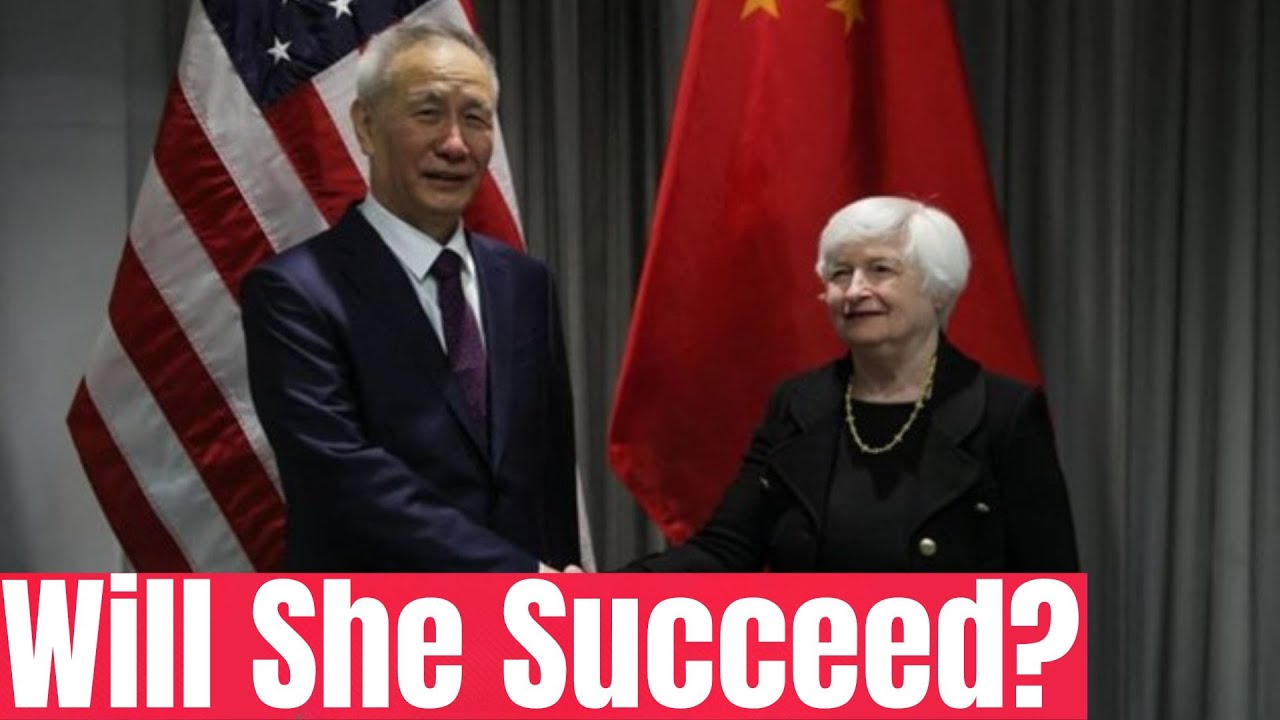
This content was created by David Oualaalou. This content was uploaded by David Oualaalou. This is a YouTube live-stream/talk titled "Borrowing More Money from China??" (published July 3, 2023). The recording is a single presenter (labelled SPEAKER A) delivering a geopolitics/economics commentary with live audience interaction via chat (thumbs-ups and comments referenced). The host discusses Janet Yellen's upcoming trip to China, U.S.–China relations, de‑dollarization, China selling U.S. Treasuries and buying gold, BRICS and possible yuan/international currency issues, energy and strategic chokepoints (Malacca Strait), regional notes about Singapore and ASEAN, and domestic U.S. economic/political criticisms; there are also brief technical/sound issues mentioned during the stream.
Chapters
How are you? I hope you're all doing well. So good to be with you as always, very excited to be here. Uh, uh, I got a great show for you today, so I'm gonna share some very insightful information about, uh, the Secretary of Treasury upcoming trip to China. But before I'll do all this, I'm Uh, today I'm going to share with you a health tip, by the way, and, uh, there are some other things I'm going to share with you. I want to keep them a surprise for you. So first of all, like I always do, let me express my sincere thanks to the channel's members and supporters. And there are new members. I just took a look at the, at the membership there, so I want to give a shout out to the new members. I'm calling on Bobby Ang. Thank you so much for your support, becoming a, a channel's member. I also want to give a shout out to Susan Darling. Thank you so much for your support. So we are so far at about 39 members or so. So like I always promised you, once we reach the first 100, I'm gonna do an exclusive Q&A just for the members. So I will, uh, so if you want to support the channel just, uh, either become a member or supporter. So if it is your first time landing on my channel here, please make sure to subscribe. I would really, really appreciate it. So, uh, all right, today's topic is about Janet Yellen, Secretary of Treasury. Janet Yellen's upcoming trip, which will be from the 6th to the 9th. And this is the reason why I wanted to do this, is because I confirmed it also to check from over in Beijing, and it is confirmed. So that is the reason what prompts me to go forward and do the show for you today. And, uh, so one of the key questions we're gonna ask, of course, like I always provide you with the first key questions before I get into the conversation, is will the trip be a success? No, we're gonna get into that, uh, but first, always, uh, make sure to let me know where you are joining me from— let me take a look quick here if I could, uh, uh, see where you are. Oh, Hang Tua, good to see you as always. Boon, good to see you as always. Coach Ohoy, good to see you from Malaysia. Good to see you as always. Uh, Coach Ohoy is a member of the channel, has been, has been with me since I started. So there are some of the like Boone, they are like, uh, Hongwan. There are some, uh, individuals, they've been with me since the beginning on both here and the other channel as well. So I can't thank you enough, guys, for your continued support. It means a lot. So— oh, the sound is choppy. Uh-oh, that's a problem. Let me check on Okay, is it better? Can you guys hear me? Okay, let me check the sound here. Can you hear me? Okay. All right. Okay, I just wanted to let you know that. Okay, thanks. Wow. Setting, setting audio. Test, test, test. Mando. Okay. Let me try this again. So if the sound is back, if you guys can hear me, if you will be kind and just give me a thumbs up to see what, what's going on with this. No sound. Wow. Okay, let me find— all right, okay, the sound is back. Bernard, Jose, you know, guys, do a thumbs up on the chat on the chat box. So I— that's how I will be able to— because there's so many comments, I can't— if you do just a thumbs up, I will know it has to do with the sound, that the sound is mute. And no, no, white screen, the CIA didn't mute me yet. No, they won't. You know, they have better things to do than just worry about my sounds here. So that would be ridiculous of them if they ever get to that. So Okay, now we can hear Ravi. Thank you so much. So I'm gonna go back, you know, I just, you know, for the last 20 minutes we missed the whole bulk of the conversation, but that's not a problem at all. So I really don't know, guys, what happened, because everything— when I, I just flew back last night, I didn't touch the setup here, that I just plug in the cable and that's it. So I don't know why It's, it's odd, it's weird. And, and so thank you for— and I couldn't see the screen because I was looking at also thinking about my talking points to make sure. And so I'm glad it is back. So let's, let's— I'll go back up. Now, did you hear about at the beginning as to why Janet Yellen— I asked the question, why is she going to to China? Let me just see if anybody of you will type this. At least I know where to pick it up from. Yes. Oh, thank you, thank you, Must Play Go. Thank you very much, guys. So it's working perfect. So I'm gonna go back and, and just pick up from earlier. So, and that's fine with me. I don't mind going all this through again. So, so here's the question. So, so as I said earlier in the— during the 20 minutes that you didn't hear, so The idea of Janet Yellen saying, oh, we— I'm gonna go to continue to stabilize relationship with the China— with the, with the, uh, to stabilize the US-China relations. How can you stabilize relations when you are sort of, uh, sabotaging it or creating, fomenting the tensions from behind the scenes? It defies logic. It's what I call hypocrisy. You can't be saying to the Chinese in their faces, oh, we want to rebuild the relationship, then you go behind their back. And it's not like Japanese are not smart enough to know. It's common human behavior. You will know when someone is playing zigzag with you, and what becomes on you to take stand and say, hey, knock off that nonsense. That's the way I look at it. In international diplomacy, it's no different. You just deal with it in a diplomatic setting. And this is why it doesn't make sense when you have, for example— let me show this picture here— when you have, for example, uh, uh, the president, President Biden, calling President Xi a dictator. How do you expect the Chinese is going to take that? You know, and yet you are— you, the President of the United States, sending your Secretary of State say, hey, you need to go to China so we can rebuild, continue to rebuild the relationship. Well, it doesn't make sense. China is going to push back, of course. But the idea of why Janet Yellen is going to China, it has to do with this guy here. That's Jerome Powell. The head of the Fed. So because the idea of the increase in interest rate is coming, whether we Americans like it or not, the big problem for that is for the other countries overseas that have borrowed money from the IMF and the World Bank. That is where the issue is. So, and my thinking is I'm gonna have to go back. Okay, just to check on the sound because I want to make sure. Okay, all of you guys giving thumbs up, that means it's working. And by the way, I did see someone I want to say thank you to for the, uh, okay, I'll get to it later. I'll get to it later soon. So the idea of now the Treasury Secretary is going, which by the way By the way, it only is coming after 2 or 3 weeks from the last trip by the Secretary of State. So the only difference in this case is that her trip is confirmed by Beijing. I checked on her this morning before I— that's why I decided to go ahead and move forward with the live stream, because it's confirmed. Now, can, can the trip be canceled? On the 6th or the 5th, whatever, 2 days from today, possibly, possibly not. But as long as there is an official record— this is where I said last time about the Secretary of State, uh, was yelling, was— he didn't speak truth when he said, oh, I canceled my trip. It wasn't him, it was the State Department saying Secretary of State canceled the trip. It was not— no, it was no official record for the trip from the Chinese to begin with. So basically it was a lie. In this case of Janet Yellen is different, it is confirmed by Benji. But like I said, I am not here to focus on that. I'm here to focus on really the purpose. Why is she going to China? We create intentions and yet we going— well, yes, of course we are going to. And I would not use the term asking for, but rather begging for money, because Most Americans do not know, despite what they hear about these tensions with China and so forth, we still borrow money from China. Yeah. So when you read, this is why I always tell you guys, you always pay close attention to the wording. If one thing you, you know, you get out of this channel, besides the content and so forth, is to start to understand how to read the, the messages within international diplomacy, because it's worded certain, certain way, and those wordings have, have a specific reason for it. So in this case, when the official statement says that a top US official is going to China in an effort to— and here's the keyword— to continue to rebuild the two countries' relations, well How can you continue to rebuild when you are sabotaging it from the other end? So basically it's a facade, no more, no less. You know, Chinese not dumb, they're smart enough to know. Yes, come on. We, we think this is one thing we always used to think wrongly about it in the Western world. I used to travel a lot to the Middle East. I spend a lot of time, part of my work. And I speak the language and I know the culture. And then again, and it was always— I, I used to explain to some colleagues who never been there, their first trip to— when they see somebody, uh, let's say hanging out in a desert, you know, just, just with the turban and sitting and just— and we think those people are dumb, they have no clue about— which, by the way, they can shock you when they answer you in English. Yeah, you know, that, that just— I, I never get surprised because I never assumed that the person— and I had a personal experience, and I'm going to tell you the experience. I stopped at a supermarket to buy one specific item, and, uh, I was speaking— I didn't speak the language at that time, so the individual, uh, the person who works in that couldn't understand what I'm referring to. And here is this woman standing by my side in full cover. You could only see her eyes, that's it. And she told him, oh, he's trying to tell you he wants to buy cashews, in perfect English. And I couldn't help it but ask her. I said, that's very impressive, ma'am. Where do you learn English, by the way? Oh, she said, I live in the United States. So why am I sharing this? You never assume. Never assume. So to tie it to this, never assume, because for us in the West, we think, oh, the, the Asian, the, the Chinese, or whatever, if we can tell them just, oh, we are here to continue to rebuild the relationship, they're gonna buy it. No, no. Because the next question that becomes is, do we need China more than China needs us? Who needs whom the most? What do you guys think? Leave me an answer in the chat box. Who needs more— more— who needs— who needs each other the most? Does China need the US more, or the US needs China more? What do you guys think? So, so the question is beside asking for money, there is another reason that I believe. And as a matter of fact, one of our viewers also mentioned this one, because I like to give credit where credit is due, and a good point to that. And this one has to do with— you're all familiar that China has been selling US Treasuries, which means what? Dumping it, getting rid of it. Which means what also is that— pardon me— by the time China dumps that, China turns around right away and gets gold instead. So in other words, instead of holding the US dollar, China prefers now to hold the gold, which also raised the question Why is China raising gold that much? And that tells you right there, something is in the pipeline, something is coming. And I can only think of one or two scenarios. One of them has to do with BRICS— Brazil, Russia, India, China, and South Africa— and the other one has to do with the intra- having, for example, the yuan becoming an international, uh, an international currency. Now, for the second one, I am not 100% certain that China wants to do that at this point, because having your currency becomes the world reserve currency comes with responsibility, and there's a lot of issues with it. Look what's going on right now with the US. Dollar, that is. Even Janet Yellen herself last week, and I read, I listened to her speech in Washington, DC, when she disclosed, and I quote here, I paraphrase it here, not paraphrase it, she said, we are aware of the fast de-dollarization. And all of a sudden, week later, you're planning a trip to China. As an analyst, I just put the two and two together and figure out this is exactly what's going on. So is she gonna be— and again, do we use the term ask or beg? I'll let you decide on that. For me, I'm gonna use the word request. So is she gonna ask China, or request from China rather, not to dump U.S. Treasuries? And again, to me, when you think about it in terms of what's going on, what lies ahead moving forward, it makes perfect sense. You're gonna have to ensure financially, beside the issue of trade, which by the way, we are the one created the issue. No, thanks, we're moving fine. Both countries were benefiting, you know, we were benefiting from low prices. You know, this is a reality some of us Americans do not want to admit. Mike, my word, when they start having shoes that cost $600, $700, they're gonna start to think twice. It's because now we are able to go to Target and Walmart and Home Depot and, and Lowe's and you name it, you know, and buy the stuff that we can afford. No, will I go and buy shoes for $700? No, because it's going to become an issue, you know. And I am sort of fine, if I may use the term. Think about a person who does not have money, given how our society— 60%, 60%, that's the one, the number that I saw in the, in the chapter, in the, in the article that I read. 60% of Americans live paycheck to paycheck. I just put things in perspective. So when you hear the statements coming out of the White House saying, oh, the Secretary of Treasury is going to continue to rebuild relations, that just defies logic. It doesn't make any sense at all. There is also the idea that countries in ASEAN— and by the way, just came to my attention something about Singapore, which I'm gonna have to dig deeper on it, or about it rather, and make a video for you guys. Because two things that I am— one of them I was very surprised, I did not know. I did not know. And again, I am not jumping to conclusions here. I never do till I found the facts. But this is based on what I've been reading so far, and it says like this. I'm going to share it with you, and please, if you are from Singapore, please share your, your thought because you are from there, so you will know. They're saying that some, or as a whole, Singapore thinks of itself as an upper class in comparison to other Asian nations. Is this true? Meaning in sense of arrogance. I do know that Singapore system is slightly better than, let's say, Philippines, let's say, uh, Vietnam, let's say Cambodia, let's say Indonesia, let's say Malaysia, as an example. Is there some truth to this? Second issue is that inflation is so high in Indonesia to the point that the government is not disclosing the accurate, the accurate numbers about it. So if you are from Singapore, if you will be kind and just put a comment for— not, not just for all of us, for the whole community, because we're here to learn from each other. And again, when I bring up something about a country, I'm not pointing fingers. Like, I've been seeing some comments from some individuals from India, oh, you talk bad about India. Like, hold on a second, you know, you are misinterpreting what I'm saying, whether it has to do with your intellectual level or not. And I usually don't put people down, never do that, but I call a spade a spade. I have no tolerance for nonsense. Like what I saw, comment from somebody who stated, oh, you shouldn't say that, when I did the video about military, the naval base of China in Cambodia. And this person put a comment saying, you shouldn't say that. Who the heck are you to be telling me what to say and not to say? I got no tolerance for that nonsense, because it's nonsense. Because the reason is, when you say the truth Some is not gonna like it. Well, I am not here to share the knowledge with you based on what you want to hear or what sounds good or what sounds intelligent. No, no, no, no, no, no, no, I don't do that nonsense. I'm here to say it as is based on my knowledge. So for a person to put a comment like that, well, you shouldn't say this, you know, stop, please. That just tells me a lot how you think. So I'll give the, I'll give the, the credit and, and the opportunity. You know, your opinion matters to me. I learn from it, guys. I want you to know this. I truly learn from it, and I have no objection for you criticizing me. I respect that as long as the criticism makes sense. When you start talking nonsense, I'll put an end to it. That's just how I see it. So, so back to our topic, because it's tied to this. And again, why am I saying this? Is because we, as an— as a government, as a country, as administration, whatever you want to call it, going asking China, say, well, we want to, you know, sort of put our relationship on the right track. Well, you can't do that if you are not being honest, if you are not being straightforward, if you are not able to put the issues on the table and talk about him honestly, openly. Yes, I understand there's something called strategic interest. Yeah, we have to look for our interest. Well, what do you think Chinese is going to do? They have to look for their own interest as well. What makes it very interesting in this case here, and the reason why, beside what I mentioned to you, why Janet Yellen is going is because we are concerned about the shift in the global order that sooner or later that the Chinese economy will overtake that of the US. It's not going to happen tomorrow, but it will happen one way or another. I am now in the process of, uh, finalizing some research about, uh, my next analysis that I'm going to do. I usually do this on the big channel. Uh, I— those are, guys, if you get a chance to watch them in their entirety, I know it's a little bit long, but I, I, I spend time putting that stuff together. And the one I'm working on right now, it has to do with India and China. You've been hearing about, oh, India's gonna take over China economically. It's nonsense. I'm here to say it's nonsense, and I'm gonna prove to you why by providing you the examples. So that's what I'm working on to put it together. So to tie it back to this Uh, it's just the idea of, uh, how we are saying, well, we want to continue this one. No, no, no, no, no. It's because we are concerned. Janet Yellen, a week and a half ago in Washington, said this: we are concerned about de-dollarization. Because they are seeing the world is shifting. More and more countries are re— are rethinking their fin— their fiscal policies. And for us, we're still maintaining our printing and, and, and borrowing and all the heck, we go into China, ask for money. Let me just see in case there's some— oh, I need to remove this one here, remove the image. So that is where, where the idea of why all of a sudden Janet Yellen is heading out to China to meet with, with the Chinese officials to discuss this. You know, it's not about continue the relationship. No, no, no, straightforward. It's about asking for money and about requesting from the Chinese not to dump the US dollar, which to me, uh, why will China respond to the US request? You know, just common sense. You can be fomenting tensions in Taiwan Strait and expect China to say, sure, we will do this, we'll do that. That just won't work. So then that leads us to the next question. And again, guys, just, uh, I know I said this before, but if the sound is good, just give me a thumbs up because I want to make sure, you know, because I don't want to waste your time and my time here. So I'm gonna keep an eye on the chat box. Just when I see thumbs up, I know it's working. So I'm gonna keep talking basically. So the idea of the, of, of the, uh, Secretary of Treasury going there, and, and interesting enough, she didn't go to the EU, Europe, because look where Europe is, look where we get Europe. Yeah, let me rephrase that one. Perfect. Thank you, Athan Wu. Appreciate it, man. So look where we got Europe. And, and that's why, again, to tie it to what's going on in France, is this a reaction to, uh, uh, Macron's recent or latest visit to China, by which he— this— I don't know if you guys got a chance to read the statements that he was issued after the trip. I did a video on it, but I, I did not did a follow-up or an update. But if you ever get a chance to read, and I'm thinking This is kind of a reaction to that because France start to look for its own economic interest because they realize what just took place with this Ukraine saga that we created. And now they are— they, NATO as a whole— you also, I posted for the community yesterday, I don't know if you saw it or not, about the, the energy in Mauritania. Again, you put the two and two together and figure— that's why, that's why I do certain videos, for a reason. I'm trying to build the big picture for you guys. That is the reason why I do certain videos. Some videos might not appeal to you, but there is a reason. Now, if there's one thing I want you to learn about me— you don't know me that well, I understand all this— but there's one thing I'll share with you: I don't do random. You got the idea. I don't do random. So, so now you seen why NATO wants all of a sudden to move to the Sahel area, starting in Mauritania. So energy is at the heart of it. So, but also speaking of energy, we have to think about China's consumption. And again, I am tying this to Janet Yellen's visit because China's energy consumption— and I am in a process again of, uh, researching one particular aspect, and this one has to do with the Malacca Strait. Why will it be a choking point for China strategically? So, and again, if you like me, guys, to do either a live stream on it or a video I'll be happy to do that. So, uh, I was going to share one image here, uh, as, as a follow-up to my conversation. And the reason about China's energy— this is why you're seeing now the US administration, believe it or not, many might not even know, you know, they're not going to understand— there is a shift in focus in— inside Washington, not about China, they're focused still on China, but direct towards Central Asia. And why is this? Because it is tied to China's energy consumption. That's what the heart of it— because only if you go back in history, if you go back in history about, uh, China's, uh, Silk Road back then— now it's different, it's going to be with trains. Railroads, rather. So, so you can just see why we are really, really concerned about this shift, that it's not gonna bode well for us. That is one of the key information. So could it be that China's going— uh, China, I'm sorry, uh, could it be that Janet Yellen's going to China besides talking about these points to find out if there is You know, of course Chinese not going to disclose their information. Those are strategic of nature. But again, it becomes— it behooves now the advisers of the president. You have to have individuals who understand the big picture. If you got yes sir, yes ma'am, you're defeating the point. It's like whomever was advising the president to— for him to say, describing presidency as a dictator. Again, dictator or not, it, it just, it defies odds, diplomatically speaking. So that is one of the key, uh, uh, uh, information that I want you guys to understand. Because it's not something you do. So, uh, and also, interesting enough, and, and I read up on things before I come on the air. So, and again, just to highlight to you and show you with examples, real examples, yeah, academically speaking. And the way you do examples is by providing evidence for the statements that is emanating from the White House and the Treasury Department saying that The Secretary of Treasury is going to China to continue the relationship or improve the relationship, uh, uh, between, uh, China and, and the US. And at the same time, you get the other side of the arguments that says, for example, well, one clear area of concerns involves China's new national security and espionage law which by the way entered into effect yesterday. Yeah, yesterday or the day before? July 1st. So the day before entered into effect. And the arguments from the Washington establishment— oh, the implications of this. This is exactly what Australia end up structuring their strategic review for 2023 by putting at the headline of it, China is a national security threat. It's no different than what we have. And I even found the quote that I wanted to share with you because I have to put it in a context for you. Here is what the quote said from this official who remains anonymous. That just shows you right there. The quote goes like this: We have concerns with the new measures and how it might apply, that it could expand the scope of what is considered by the authorities in China to be espionage activities, end of quote. So what are they talking about? What they're talking about basically is the one is saying, oh, there is the possibility that this could spill over into the a sort of a broader investment scope and economic relations between, uh, China and, and, and, and the UN. This couldn't be far from the truth. You know why? You only look who went to China 3 weeks— the last 3 weeks from the business side, not the administration. It was Tim Cook of Apple. It was Bill Gates, evil Bill. And it was, uh, what, Elon Musk. They didn't request permission from the government. As a matter of fact, those are the ones who are dictating to the government behind the scenes, among those behind-the-scenes elements that influencing the government's decision. And they all are saying no, no, we're gonna go and we're gonna manage our operations in China whether you like it or not. The US understands they can't sanction those countries, those, uh, those, uh, companies, because it will be suicide economically speaking. Yeah, so when they say, oh, the national security, and, uh, first of all, who are we to sort of reframe what the concerns of the national security are for any country. That's like the way— I'll give you a brief basic analogy, and the basic analogy is, uh, let's say you are professor, okay? And I, and I even say this to my students. I'm the one who's dealing with you, with the students in this case, on a daily basis for a whole semester. So do you expect the vice president of the university, or whomever will come and issue the grades for the students? How will he or she know the level of the students? He or she never spent a day with the students. I'm the one in the classroom with the students. I'm the one aware of their strength and weaknesses. I'm the one aware of their issues. I'm the one aware of their challenges. I'm the one aware of their aspirations, academically speaking. So when I grade, I grade based on those elements, not just the test. The tests are, are useless, are irrelevant. I never ever ever issue the grade based on just the test. That just doesn't make sense. I teach differently. So that's the same example. How can we be saying, oh, the national security is doing this or doing that? Well, how do we know what the interest and the needs for the country is? They can build their own national security review or strategy based on what they want to achieve. It's no different than us. Do we want to have a, a country like Germany, for example, come to us and said No, you guys shouldn't do this or shouldn't do that. Well, Germany can't do it anyway. Germany has no backbone. You know, I don't sugarcoat it. We all know it. It's the truth. So the whole idea that we have this concern about these new measures, ah, it just doesn't make sense. Doesn't make sense. The fact is, the fact is that relations between the US and China— and I usually, when I write books, especially in the— I'm going to do the same in this case for the China book— I devote an entire chapter Because I go back some 100 years and see the developments of the relationship, how it evolved over time. We had an opportunity last century to make it right, and we choose not to. I'll say straightforward, academically speaking. And the opportunity we have, it was after the visit of Nixon to China. We could have sat down at the table on an equal footing and figure out how we can move together for the new global order. We choose not to because we wanted only us to be at the helm of the table, and we did. And now time has come for things to turn around, and that's what's at the heart of it. And I'll use the term because that's the only way I can describe it. There are those who want to minimize the impact. I don't, because at least for you guys, for you, that's what you will expect from me. No sugarcoating. I'll say it as is. The deterioration of the US-China relations, yes, it is deteriorating quietly despite what you hear. So when you read a statement like Janet Yellen is going to China to continue improve relations. It's nonsense. And of course, the deterioration got even worse for the last 2 or 3 years, especially after the, the what took place with COVID and all that stuff. Even now they are coming out and saying, oh, it wasn't China after all. It's no different than the weather balloon. The Pentagon just issued a statement that, that, that water balloon had— didn't spy on the US. It did have some US equipment, so what? And second, if that entered the US airspace from California, why would you let it all the way to North Carolina before you, you, you shut it down? I just didn't make sense. If you are— then the other arguments that they are making here in Washington about that, beside the COVID part, it has to do with the Muslim Uyghur in Xinjiang, which we all know turns out to be a farce. Yeah, now this is again why I provide you the idea of two sides of the arguments for you to see the big picture. Here is one side that says, oh, we are going to the— we are going to China to continue improve relations. There is the other side is, oh, we have no intentions of changing our policy in fomenting tensions and so forth. You see the opposite. That is exactly why I pointed this. And just to highlight this and wrap it up for you guys, Uh, the idea of when you hear statements like this, you always have to go back and see, was there a trend of this? Yes, it was, especially from, uh, none other than the Secretary of Treasury herself, Janet Yellen, when she said back then— you already— I don't know if you— I'm sure you do— when she said the inflation is transitory, when in reality it was not. Like I said earlier, look no further than what's going on in Singapore. Even Singaporean government is not disclosing the truth, which makes me wonder. And I'm going to intend to— and by the way, I don't know if you guys heard. I'm sure you didn't hear what I said about Singapore back then during those 20 minutes. You didn't hear— is that the idea of, uh, uh, correct me if I'm wrong, because this has to be from within Singapore. I've read that some in Singapore, whether the government or the people or a nation as a whole They think of, of themselves as high mighty in comparison to other Asian nations. Is this true? Because I'm going to be looking into this. And I look at the other issue is the inflation. So this is why, again, another lie that Janet Yellen said at that time was that the US labor market is exceptionally strong Once again, look for the wording: exceptionally strong with 6 million jobs added in 2021 and unemployment rate below 4%, which we all know it's a lie. It's because an average Joe, average Jane here not going to understand this wording stuff, let alone have the energy, the mental energy for them to sit down and sift through the information to find out. And this is, by the way, what I bring you guys in this channel and the other one as well. So when you hear the Biden administration's economic growth strategy is guided by modern supply-side economics, which prioritizes labor supply human capital, public infrastructure, and investments in sustainable environments. All this means nothing. There is no infrastructure. You know, we all know how crumbling infrastructure in America is. You know, as I was flying yesterday and I'm like, oh man, here it is. We couldn't even have a speed train that can connect the east to the west. So what is this infrastructure, public infrastructure and investments? So that's when you realize it's a lie. And most Americans, sadly, they, they have no clue. I feel sorry for my fellow citizens, my fellow Americans. I really feel bad. I hope one day they can wake up before— I think it's too late. So that's the way I see it. So, all right, let me see, guys. Oh, all right, let me— oh, that's interesting. I'm gonna share this with you guys right here. Look at that. Singapore has superiority complex over the other Asian fellows, even China. Well, especially China. Because it is the, the America of Asia. That's interesting. So I'm, I'm going to be looking into this because I'll admit I didn't expect this. I was thinking Australia is, and I know it is, but not Singapore. So it's like what the, the, the incompetent Prime Minister Albonau is doing. You guys know what he's doing, right? He's shifting the blame to the, uh, generation, uh, the millennials, something has to do with the environments and all that nonsense stuff. That's what he's doing. When you shift, anytime you shift, especially in, in politics, that, that shows you the failure of the policies, which means the person was never honest to begin with. And in human relations, when When people shift back and forth quickly, that's a sign of mistrust, and I'm talking from experience. So that's why my advice to you guys in all this, and again, I can't tell you something that I am not doing: do a lot of listening and less talking, because you'll absorb more Once you listen, a lot of people like to be loud. A lot of people want to talk a lot. Yeah, you can talk a lot as long as you have— your talk is of substance. This is what prompted me to go with all this, because I watch, I see on YouTube, I see who talk loud, and I see who's making it up as it goes along. She's very bad. So that's why I want to make this different. And the community is very— excuse me— the community is very important to me to understand, uh, uh, uh, where things are headed. Because this is not about just geopolitics. That is a reason why I end my videos with, remember, geopolitics impacts your daily life in more ways than one. Because there is a truth to it. And I want you to know. All right guys, let me take a look, see if you have any questions, and I'm gonna sign off because I am gonna go and do more research. My apologies for the sound. There's nothing I can do. It's, it's, it is what it is. I'm sure you guys are flexible. Thank you for sticking out here. Otherwise you could have signed off and, and gone, but so I truly appreciate you for that. So And, uh, and if anybody from Singapore here, please, if anybody from Singapore would like to be willing to share information, and I trust your whatever you share with me till you give me a reason not to. So I trust till otherwise. So because I'm going to be looking into this. All right, let me go back up first. I'm going to go all the way up and, uh, And if you didn't get a chance to, uh, share where you're sharing, uh, where you are joining me from Oh, Brown Man from Jamaica, good to have you. Where are you, in Kingston? Uh, okay, so I'm gonna look for, uh, if there are any questions, and if not, I'm gonna sign off here, uh, because I'm gonna have to go and do some research for the next one. So, uh, I hope you guys like the video I released today. Be on the lookout for a video soon about Uh, there is one topic, by the way, and I don't mind giving you a heads up on it, uh, about Japan. Japan, and I'm not going to spoil it for you, Japan is about to do something very, very catastrophic. So, and I'm not, I'm not dramatizing, it is. That's why I say be on the lookout for a video I'm going to be releasing soon. And for that video in itself, if you would like me to do live stream on it because I got a lot of information on it. I'd be happy to do it. So, all right guys, I hope you find this very informative, and I look forward to seeing you next time. As always, remember, geopolitics impacts your daily life in more ways than one. Till next time, guys. Bye-bye.
More from David


Beyond the Single Actor: Why the Gulf Isn't Choosing Between the US and China


Iran, Iraq's Militias, and the Houthis Are Coordinating! This Changes Everything




Who Controls the Next Decade's Resources? Latin America and Africa's Geopolitical Crossroads

The Chokepoint Trap: How Washington's Stupidity Triggered a Cascade That Now Controls the World

Trump Spooked as IRGC Unveiled dual-use SLV, Deployed Ghadir Mini-Subs & Hinted at Tactical Nukes!
