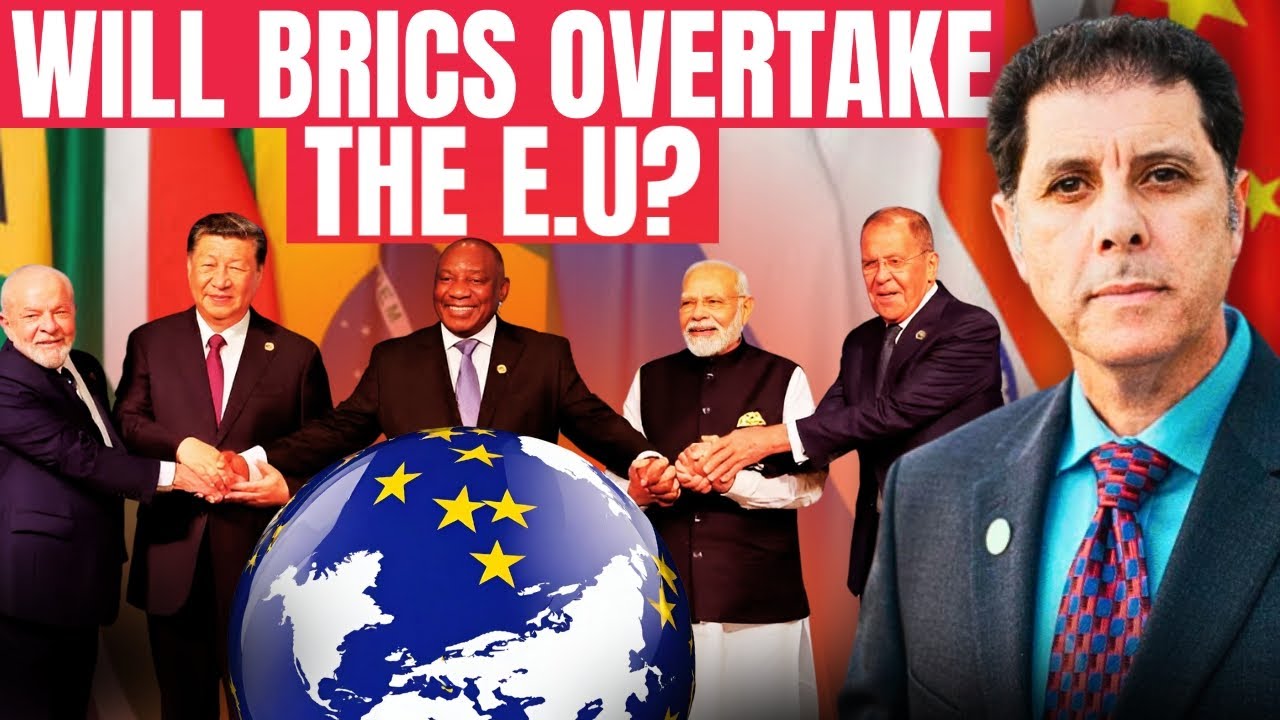
In this geopolitical commentary, the presenter surveys public opinion across ten EU member states, revealing that roughly half of Europeans believe the EU could disintegrate within the next 10‑20 years. He then links this perceived fragility to the recent expansion of the BRICS bloc, which now includes Saudi Arabia, Iran, Ethiopia, Egypt, and the United Arab Emirates, raising its share of global GDP to about 36% and covering nearly half of the world’s population. Citing an IMF forecast that BRICS will account for over 50% of global GDP by 2030, he argues that the bloc is positioning itself as a multipolar counterweight to the United States and the G7. The video outlines both challenges (potential dilution of EU influence, intensified competition in resources, technology, and manufacturing) and opportunities (new markets, investment, collaboration on climate, security, and development) for the EU in response to a stronger BRICS. The conclusion urges the EU to adapt, engage constructively with BRICS, and recognize the shifting balance of power as essential for maintaining relevance in a rapidly changing world order. The segment ends with a standard call‑to‑action for likes, shares, and subscriptions.
Chapters
Hello everyone and welcome to Geopolitical Trends, where truth matters. As a geopolitical analyst, I ask, will it be fair to say that the European Union will eventually collapse? Some say sooner than later, others are saying no way, that ain't gonna happen. Whatever the case may be, the fact is that when asking Europeans, half of them say that the EU is likely to collapse within the next decade or so. This was the result of a survey conducted in France Germany, Italy, the Netherlands, Austria, Slovakia, Romania, Greece, the Czech Republic, and Poland, where most people surveyed argued that the EU disintegration is a realistic possibility within the next 10 or 20 years. The next question becomes: What will replace it? Well, Many are stating that BRICS—Brazil, Russia, India, China, and South Africa—will eventually overtake the European Union, the EU, in terms of global influence and economic power. It is becoming increasingly pertinent as the alliance expands its membership and reach. With the recent addition of 5 new countries that includes Saudi Arabia, Iran, Ethiopia, Egypt, and the United Arab Emirates. The BRICS alliance has significantly bolstered its position on the world stage. This expansion, in my opinion, is not merely a numerical increase. It represents a strategic shift towards creating a multipolar world where the dominance of the United States and its Western allies is challenged. The inclusion of these new members propels the BRICS' share of global GDP to an impressive 36%, while also covering nearly half of the world's population. This is a clear indication of the bloc's growing economic clout and its potential to reshape the global economic order. Furthermore, with dozens more nations expressing interest in joining the BRICS, the alliance is evidently positioning itself as a formidable counterbalance to the G7's influence. The potential growth of BRICS to 18 members in the future presents both an opportunity and a challenge. Opportunity for these countries to amplify their collective economic and political power. This expanded alliance could foster a stronger coalition that leverages its diverse resources, strategic geographical positions, and varied industries to exert a greater influence on global affairs. The varied composition of BRICS, spanning different continents and cultures, adds to its strength, offering a platform for collaboration that transcends traditional geopolitical alliances. For the European Union, the rise of an empowered BRICS BRICS bloc presents both challenges and opportunities. On one hand, the EU might find its global influence diluted as BRICS nations assert their interests on the world stage. Economic competition could intensify, particularly in sectors where BRICS nations have significant advantages. Such as natural resources, technology, and manufacturing. On the other hand, the expanding BRICS alliance offers the EU an opportunity to engage with a new, dynamic coalition that is increasingly shaping the global economic landscape. Developing partnerships with BRICS countries could also open up new markets for European goods and services, facilitate investments in innovation and technology, and also promote collaboration on global issues such as climate change, security, and sustainable development. The International Monetary Fund, known as IMF, estimates that BRICS nations will account for over 50% of global GDP by 2030, underscores the shifting balance of economic power. This projection highlights the urgency for the European Union to reassess its strategic priorities and engage more proactively with emerging economies. The EU's ability to adapt to this changing global order will be crucial in maintaining its relevance and influence. Here is my conclusion for you. The expansion of the BRICS alliance represents a significant development in the global economic and political landscape. As BRICS countries continue to grow in economic power and strategic importance, they are poised to challenge the dominance of traditional Western alliances, including the EU, the European Union, that is. So the European Union must recognize the opportunities and challenges presented by this shifting balance of power and actively seek to develop constructive partnerships with BRICS nations. One thing is sure: in a rapidly changing world order, the ability to adapt and collaborate will be key to shaping a prosperous and stable global future. If you like the content of my video here, please like, share, and subscribe. And as always, remember, geopolitics impact your daily life in more ways than one. Thank you.