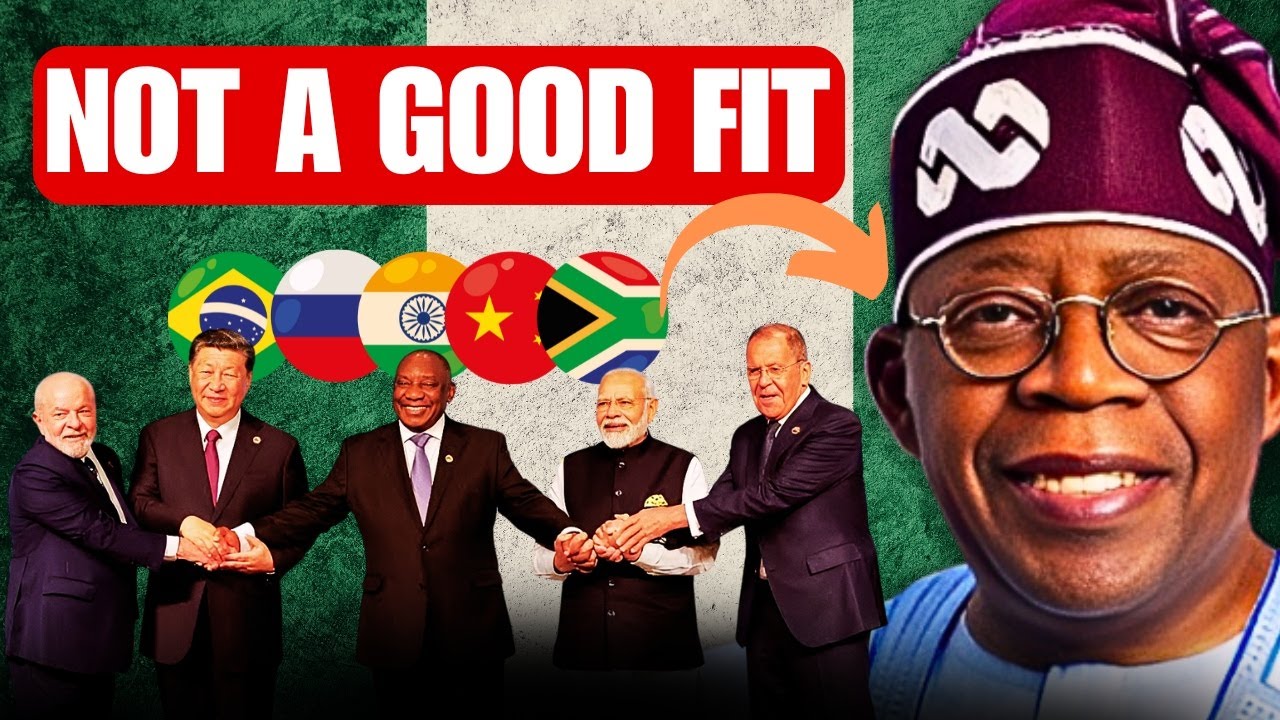
Nigeria's Foreign Minister announced plans to apply for BRICS membership, a move that would add 3.5 billion people and $28.5 trillion in GDP to the bloc. The country is pursuing nuclear energy cooperation with Russia through Rosatom and pushing de-dollarization in trade, but corruption poses a risk to BRICS cohesion.
Chapters
Nigerian Foreign Minister Yusuf Tugar, who is in Moscow for talks with his Russian counterpart Sergei Lavrov, says Nigeria intends to apply for BRICS membership.
Hello everyone and welcome to Geopolitical Trends—where truth matters. Nigeria's strategic pivot towards the BRICS alliance as articulated by the country's Minister of Foreign Affairs, Youssef Taggar, underscores a deliberate and assertive move to diversify its global partnerships and reduce its dependency on Western alliances. This move, in my opinion, is not just a quest for economic diversification but a bold statement of Nigeria's sovereignty and its readiness to chart a new course in the new global order, irrespective of external pressures. The question we need to ask: Is Nigeria's BRICS ambition a calculated move? Nigeria's, uh, intentions to join the BRICS group comprising of Brazil, Russia, India, China, and South Africa, in addition to Egypt, Ethiopia, Iran, Saudi Arabia, and the United Arab Emirates, who were invited to become members on January 1st of this year, is a calculated move aimed at aligning with economies that share a similar ethos of challenging the traditional Western-dominated economic order. The inclusion of Nigeria, Africa's largest economy, into BRICS could significantly enhance the group's collective economic weight and geopolitical influence, furthering its agenda to reshape the global economic structure. But it could also hinder BRICS progress given Nigeria's massive corruption from within. But what does BRICS— why does BRICS matter? BRICS countries include major world powers such as China and Russia, and countries which are influential on their continent such as South Africa and Brazil. The expanded group has a combined population of about 3.5 billion, or 45% of the world inhabitants. Combined members' economies are worth more than $28.5 trillion, or about 28% of the global economy. With Iran, Saudi Arabia, and United Arab Emirates as members, BRICS countries can produce about 44% of the world crude oil. A pivotal aspect of Nigeria's foreign policy recalibration is its intent to bolster relations with Russia, particularly in the energy sector. The collaboration between the Nigerian Atomic Energy Commission and Russia's Rosatom on nuclear energy projects exemplifies Nigeria's strategic approach to diversify its energy portfolio and reduce its reliance on traditional energy resources. This partnership extends beyond energy to encompass medicine, agriculture, and industrial applications of nuclear technology, indicating a comprehensive engagement strategy with Russia. Speaking of Russia, as an analyst, I wonder how will Russia, which will host, by the way, this year's BRICS summit in Kazan in October, use its 2024 BRICS presidency. It is no secret that President Vladimir Putin stated that he wants to increase the role of BRICS in the international financial system, develop cooperation between banks and expand the use of BRICS currencies, promote collaboration between tax and customs authorities. Along with BRICS, Russia will want also to show the West that it still has friends and allies in the rest of the world, despite its military operations in Ukraine. What about the impact on the global energy market? Nigeria's potential addition to BRICS and its deepening ties with Russia could have profound implications for the global energy market, especially given Nigeria's status as a key OPEC member. This move In my opinion, could lead to a realignment of energy alliances with Nigeria leveraging its BRICS membership to negotiate more favorable terms within OPEC and beyond. The collaboration on nuclear energy projects with Russia could also introduce new dynamics into the global energy mix. Reducing the market's volatility and enhancing energy security. Nigeria's BRICS ambition is not limited to energy. The country's push to join BRICS is also motivated by the desire to promote international trade using national currencies, thereby reducing dependency on the US dollar. This aligns with BRICS' broader objectives to challenge the Western-centric economic order and could significantly impact global trade patterns, particularly in Africa. Nigeria's membership in BRICS could also serve as a catalyst for other African countries to reevaluate their economic alliances and trading practices, potentially leading to a more integrated and self-sufficient African economy. Here is my, my conclusion for you. Nigeria's deliberate stride towards BRICS membership, coupled with its efforts to strengthen ties with Russia, represent strategic reorientation of its foreign policy and economic alliances. This move could not only redefine Nigeria's role on the global stage but also significantly impact the global energy market, trade practices, and the broader geopolitical landscape. As Nigeria navigates this transition, the international community We'll keenly watch the ripple effects of this realignment, particularly in the energy sector and global economic structures. To support this channel, please hit like, share, and don't forget to subscribe for more content. As always, remember, geopolitics impacts your daily life in more ways than one. Thank you.