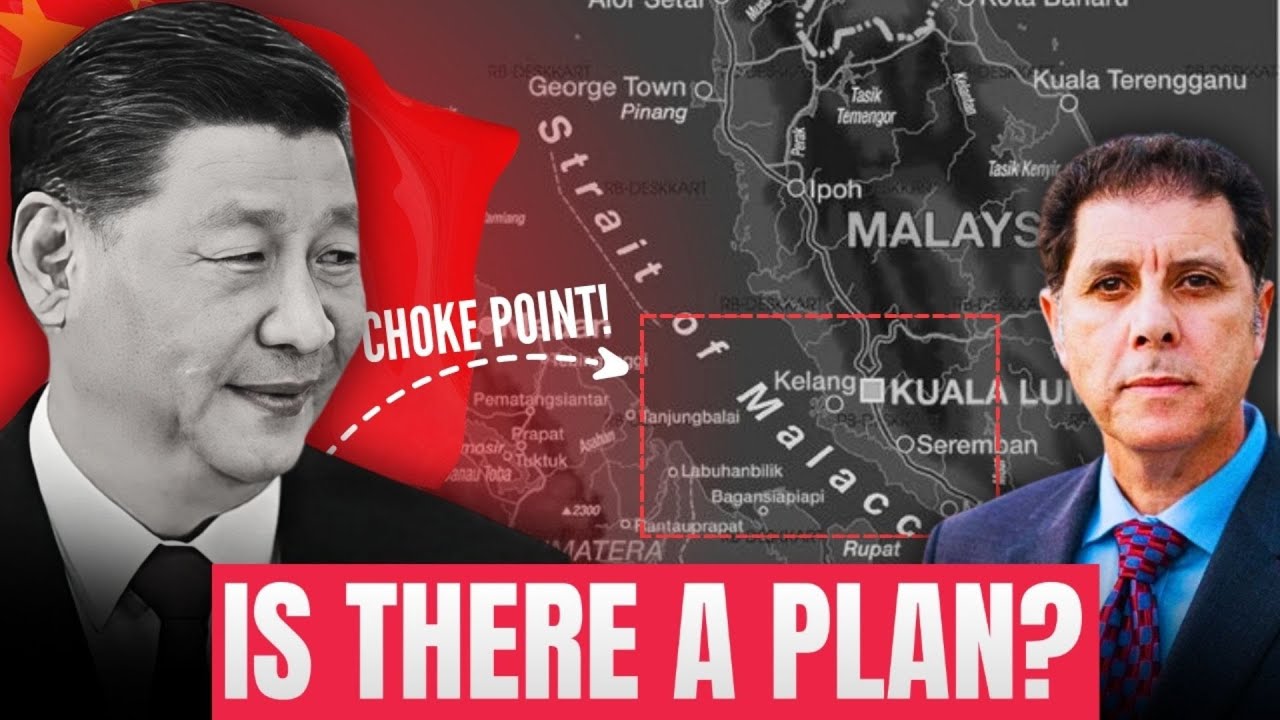
China depends on the Malacca Strait for most of its oil imports, but a blockade there could cripple its economy. David Oualaalou explores whether China can build alternative routes by sea, pipeline, or rail to reduce that vulnerability.
Chapters
Hello everybody and welcome to Geopolitical Trends, where truth matters. Very, very, very excited to be with you given the topic that I decided to address today. And by the way, this is nothing new here because I've been sitting on this topic for a long time, and I have my reasons, and I will share them with you today. Well, I got an interesting show for you. A very, very interesting, uh, uh, uh, topic to understand the long-term geopolitical and strategic implications of it. And this has to do with the Malacca Strait. To those who are in the region, you are aware of the importance of Malacca Strait. So today I'm gonna delve deeper into the, uh, the ins and outs of it, especially when it comes vis-à-vis China. Which we all know why. And by the way, I'm only going to stay on this platform here today, so I'm not doing any other extension of this conversation elsewhere. So we're going to be staying here, uh, on, on this platform. But let me first see who is here. Uh, Willie Holman, as always. Wow, you've been here at 11:57 AM. That's good to have you, Willie, as always. Muslim Revert, Good to have you. How can we live in a world that doesn't care? That's a profound, man. That's very profound. Wow, thank you for sharing that. Truly appreciate it. LMC from Ontario, as always, Canada. Wong KC from Malaysia. Francis Tango, uh, Carmel, good to see you from Australia, guys. Here is— let me share the screen with you here, guys. Check it out. From Australia, good to have you here, man. Uh, Jay, good to see you as always. Hello, Doc, and thank you for sharing your insight. Thank you so much, good to have you here. Uh, uh, Alam, as I always say. Lucio Delgado, uh, Dorsey, good to see you. Sam Stone, good to see you from Scotland. Yeah, let me show you here, guys, so you see. From Scotland, very, very excited to have you. Wayhan from UK, good to see you as always. Uh, Adam Morocco, good to see you. North Carolina, if I'm not mistaken, right? You know, Hamad City, as always. Steve from England. Uh, Pikachu 5M from Manchester, I'm assuming UK, right? So good to have you guys here. So anyway, very, very excited, uh, to be with you today because it's an interesting topic, as I mentioned earlier, I'm going to be addressing today. And before I delve deeper into the content and the questions and so forth, I have some just— some housekeeping items to share with you. Remember to join me tonight with, uh, when I do my conversation with Carl Zah at about 19:30 Central Standard Time. I know it will be early AM for some of you overseas. It will be recorded there anyway, but those who can join me live, it would be great because I'm gonna do 2 or 3 questions, uh, for, uh, from you for Carl to answer, uh, if, if there are questions there. So remember to join me, and here is the link. Let me share the link with you guys for those, uh, who might not be aware of. I'm gonna put it in a chat box for you guys right there. That's the link to the live stream at 19:30 this evening. So, uh, also wanted to share with you, uh, about the, uh PayPal that I set up now. It's, it's good to go. As a matter of fact, I received some, uh, donations for the Asia trip through that. So to those who, uh, might not, uh, do it through Buy Me a Coffee or Buy Me Tea, you can do it through PayPal should you decide to do that. And I am very grateful to you for that. So let me put this link also for you guys in the chat box. So you guys can have it. Then we'll jump into our topic. All right, let's get in into our topic. Let me remove this one here, and we'll get into our topic. Well, first of all, uh, just to give you a background about what we're going to be talking about today, you know, no one in a right mind can ignore the fact or the reality that yes, China's growing influence on the global stage While it is happening, I am certain policymakers in Beijing are thinking about how we're going to deal with Malacca Strait. Why is this? It's because it's a choking point. We know it, the Chinese know it, and the whole region knows that. But mainly, who's be— who will be of who will be more concerned about this, you only have two countries. The main one, China and the United States. Of course, we're not going to ignore Malaysia, we're not going to ignore, ignore Indonesia, we're not going to ignore Japan, all of them economically speaking. I am talking from a strategic perspective here. Two countries that matter when it comes down to this, China and the US. And this is what I'm going to get in into addressing with you. But here are the questions that we need to ask, and those are legitimate questions. Here's the first one. First question: why is Malacca Strait so important? Okay. Second question: how will China manage dealing with Malacca Strait from the perspective of being a choke point? I mean, China, we know how to deal with it. So is, uh, so other countries. But I'm talking about what kind of preparation China will need to do, and I'm going to share something with you, uh, about this one. Third question is, are there other alternatives? Which we all know what's going on right now in Asia. You think about the corridor between China and Pakistan, the Gwadar. You think about the conversation between China and Thailand regarding the, uh, the, the, uh, the economic, uh, zone or economic bridge or whatever you want to call it. You think about Myanmar, that's what comes to mind. So that's what I'm saying, are there other alternatives? And the fourth question is very crucial in my opinion as geopolitical analyst: will the neighbors— I'm not going to name names— will the neighbors undermine China on behalf of the US when it comes down to this. That's what I found it very, very interesting, uh, to consider and think about. Now, the reason why I didn't address this topic few months ago— I had it in my, uh, in my laptop here, I had the information. Of course, I had to update it. I had it for about 3 months, but I decided not to do it. And the reason I decided not to do it, because I was reading some reports and analysis at that time from different sources, not just here in Washington, including the Pentagon Strategic Review and the Japanese Strategic Review and the Canadian, the Canadian Strategic Review, including also the EU/NATO. And that's what prompted me to wait. Why wait? Is because I wanted to see what China will do. And before you know it, my instinct was right because China just did something 2 days ago pertaining to this, in my, in my, in my assessments. And that's why I didn't want to address this topic way back. So I was aware of it, but I decided to hold off on this. And this is what I'm gonna be sharing with you today. So before we do all this, like we always do, we're gonna do the headlines. There are some interesting, uh, interesting picture or interesting headlines that I'm going to share with you. By the way, it is just quick image of the map of the Strait of Malacca, which I will detail the geography and history of it, uh, uh, in, in, in a second here. And of course, this is President Xi, that it's one of the main issues that he is thinking about beside what's going on is the Strait of Malacca. It's a big concern to Beijing. So No, they're not talking openly about it. This is one of the topics I intend to address when I am in Asia. Uh, I hope to have a chance to talk to some government officials regarding this topic if I'm granted the permission to do so, and I intend to address this one. So, uh, let's do the headlines. Here's the first one, and this first headline, this is a picture of a 23-year-old Filipino individual who was a born Israeli soldier. His name is Cedric Green. He died about along with other 20 other individuals. But that's not the, the point in this. Is this now the question that is emerging right now in Philippines, which is kind of controversial? Why is for those even inside Israel, for those who are not Jews but were killed in a war waged by the government are hardly recognized. They have not been recognized by the Israeli government. So becomes the question, are the Filipino soldiers in this case, or any other nationals who wants to become Israeli citizens joining the army, which either withdrew the army, which by the way we have, we have that too here in the US, uh, is it the best solution in this case for Filipinos? And, and you can just see it's a heartbroken for a mother to lose a son, you know. Regardless, whatever, guys, let's, let's snap one fingers on all that. So let's be compassionate somehow, you know. Emotions, we're all humans, we share all this. But this now is triggering a far bigger question, you know, especially for Philippines. I just wanted to share this with you. So second question, uh, second question Second headlines has to do with— this is a little bit, uh, troubling. And again, we're not pointing fingers at India. Do not, please do not jump. But I, I mean, I don't shy away from saying, for example, when it comes down to BRICS, I don't feel personally— I mean, to them, to the BRICS, my opinion doesn't matter. And again, I'm saying it to share with my viewers, to provide you the counterarguments to the narrative. To me, I've always said that India is the weak link inside BRICS, and it will only become more, uh, uh, uh, uh, visible as the bloc, uh, or, or BRICS expands. So, so what happened with this? A Russian newspaper stated, and I read the article, and, and to me, I came to the idea of why will Russia even say this or disclose this? I mean, it's not about creating tensions or whatever unless it is true. It says that India seeks to throw— to, to thwart China's initiative in the Middle East. You all know what this is reference to. And this, as I said, was, uh, was disclosed by the Russian newspaper called Nezavisimaya. I hope I pronounced it correctly, which reported that United Arab Emirates and India have signed a framework agreement to create a trade corridor linking New Delhi to Europe via the Middle East, which by the way has received approval from the United States and the European Union. But that was just on paper. Details of how have not been announced, which means there is nothing there. So if every government can talk, well, as we say, talk is cheap.. It's in concrete, uh, application where we're going to see whether this project will work or not. So, and this is where that assessment comes in. Is this meant to undermine China's BRI? That's what I found very, very interesting about this. I, I checked it and confirmed that one. It's an article, it's an assessment. Now you can disagree with it should you decide to, and you are entitled to your opinion for that. Uh, this individ— can anybody tell me who this individual is? You know, he's not well known yet, but he's coming up. To those who live in the— in Asia, you will know what I'm referring to here. Let me see if anybody can guess, just a guess. Uh, Yeah, you guys might not know because he's not well known yet. Uh, let me see. Oh yeah, HYYB, that is correct. This is from Indonesia. I won't call him president yet, but it is from Indonesia. Uh, Anna Kiblis, thank you so much for your super sticker, truly appreciate it. So So the picture you guys looking at, that's Anis Baswedan. He's a Yemeni-born politician who aspires to become Indonesia's president. So of course, Anis entered the world of politics through the academic window. He's an academician, uh, and, and run for the presidency for this year, 2024, from an outside party circles. And traditional political salons in Indonesia. We all know it's something I'm going to be addressing tonight with Carl Zah because he's in Bali, as you may know, and it's worth talking about Indonesia as well. So Anis Rashid Baswedan, who is of Yemeni descent— so, well, yeah, his ancestors are from Yemen— quickly rose into politics, achieving his greatest achievement in 2017 when he won the governorship elections in the capital, Jakarta, and continued his rise by running for 2024 presidential elections based on his high popularity during the 5 years in which he led the capital. And by the way, his ancestors trace back their roots to— let me remove this picture— to Hadramaut. To those who know about a little bit of history of Yemen, Hadramaut is a very, very old city. Hadramaut, there is a lot, a lot of civilization went through, uh, the city of Hadramaut, and that's where his ancestors are from. So of course, uh, uh, Anis was born in Indonesia, to be, to be just clear on this. He was born on May 7th 1969 in Kuningan, west of Java, and he's the oldest of 3, uh, children. So that's, that's, uh, what's interesting. Uh, another one that I want to share with you, something different, very different. Look at this gentleman here. This gentleman is about 100 years old. Yeah, 100 years old. Uh, and this one is an Iranian diver. He is setting the world record in Doha as we speak. His name is Taki Ashkari. He's 100 years old and sets a master aquatic championship, becoming the oldest ever contender at the championship after taking a jump from a 3-meter podium at the World Aquatic Championship in Qatar. Very, very impressive. 100 years old. So it shows you it's all about the spirit, guys. Yeah, we all age and all that, but it's just how you can keep a positive thinking. Of course you have to take good care of your health. Like I always say, if you don't have your health, you have nothing. Your health is your best asset. So 100 years old, I It's impressive, and that's all I can say. Um, one more thing, uh, to share with you is from the— from Africa. This is La Réunion des Ministres de l'Alliance des États du Sahel. Basically what it says here is that the Sahel ministers met in Burkina Faso, Ouagadougou. Why? It's because they're gonna form an alliance of the three countries. So Mali, Burkina Faso, and Niger proceeds to form tripartite federation. Another word, forget about the rest, they're gonna join. Mali now— foreign minister said that Burkina Faso, Mali, and Niger, uh, countries ruled by military regimes, uh, are, uh, moving forward ahead with the union. And of course, this comes on the head on in the wake of the three countries strengthening their ties through the alliance and threaten the integration of the wider West African nation. Well, of course, don't forget what happened with ECOWAS. You all remember the Economic Community of West African States that threatened to invade Niger on behalf of Western imperialists. Now what do you have with this? You have neighboring countries now. Yeah, you have neighboring countries in Africa, uh, the impoverished Sahel, all of them announcing now that they will withdraw from the ECOWAS. They don't want to be part of it because ECOWAS was exposed doing the bidding of the European, European colonials. So That just shows you where things are headed. So, so I found it very, very interesting. So, all right guys, let's get into our topic, Malacca Strait. Well, first we ask the first question: why is Malacca sort of important? Because it's, uh, let me show something right here. And by the way, we give credit to Fleet Moon, uh, trafficking, uh, The Seven Seas, that's a platform where those maps are from, so we give them credit for that. Another one I need to share with you is this one here. So why would it be important to understand the importance of Malacca Strait? Well, it's because, for a simple reason, and here is that simple reason, is that in maritime, you know, in maritime language, sort of there is a saying that goes like this. And again, you can agree, you can disagree. And it says, and I quote, 'Whatever happens in China affects global shipping,' end of quote. So, and I, I don't need to go far, uh, way back in history. I can just go back a few years ago when we had the, the, uh, uh, you know, the COVID stuff and all that. What happened? China shut down, closed all of its ports. What happened to the rest of the world? You all got the idea. So that shows you just basic that the, the charter rates of the tankers at that time plummeted more than 70% because of the Malacca Strait. They couldn't go through. Why? It's because China shut down all that. This is why it's important to understand why this Malacca Strait is very, very important. And that brings us to talk about the geography of Malacca Strait. So I'm going to do a little bit of geography, and I'm going to do a little bit of history about Malacca Strait. Then I'll go into my own analysis about it. So let me share a screen with you about— we will give credit, by the way. It's not a map, it's just open space. I'll share open, uh, open, uh, waters per se. And I'll give credit to, uh, World Atlas. That's where, that's where I always get those maps there. And as I said again, just open water for you to see. And I'll share the other picture with you. So it is— this is part of the Malacca Strait. Okay, well, geographically, the Strait of Malacca is a long and narrow stretch of water located between Malay Peninsula, which is West Malaysia, and the Indonesian island of Sumatra. So the strait has a width of about 890 kilometers and a depth of about 25 meters. The Strait of Malacca's name was derived from the Malacca Sultanate, who governed the archipelago from about 1400 until 1511. So, but the importance of this is to understand the significance of this strait. Let me see if I can share this picture here. Yeah, right there. Is to understand the economic significance. Well, here's the thing: the Strait of Malacca, it is a vital global shipping lane. There is no way about it. And given now how Asia is becoming now the, the, the hub of the global economy— it's not the West anymore, it's Far East— the Strait is a major shipping connection between the Pacific Ocean and Indian Ocean, and it represents a major link between large Asian countries like China, like South Korea, like Japan like India, okay? The connection— and I might even add Australia, okay? But here is the interesting thing about Australia. Before I forget, I need to ask you this question. Exit full screen and stop sharing. You know, is Australia— and you can say yes or no— is Australia a continent or is it a country? I found it interesting that when the, the, the history and geography of Asia, Australia was not mentioned. And yet Australia has always refused to associate itself with Asia. So, and that's beside the point. I'm going to ask you the question: do you consider Australia a country or a continent? So, and I'll, uh, I'll, uh, I'll check out your answers later on as I move forward into this. So continued with the geography. So this number of the, uh, where is it, right here, the importance of the economic, uh, of it. So the connection of these countries, the one I mentioned— South Korea, China, Japan, India, and others and so forth, uh, uh, the connection of these countries had had a major impact on their shipping companies. Furthermore, large portion of the world shipping routes use the Straits of Malacca. Many of the goods shipped through the strait are manufactured products from China, from Indonesia, from like, for example, coffee, like, uh, palm oil, like other, other commodities. And the interesting aspects of all this, understanding the geography of the Malacca Strait, is that in ancient times Traders from Kedah used the monsoon winds of November and June to sail from shore to shore, and then use December and the May winds to travel back. Very, very interesting dynamics. I do find it very interesting. Uh, make no mistake, guys, piracy was known inside, uh, when it comes down to Malacca Strait. It's not strange, so, because piracy was a common problem. And I, if remember, I'm using the term in the past, was, because it was not anymore, at least to an extent. The frequency of the attack has gradually decreased from, uh, sort of the 1990s to 2004. 'cause there were a lot of piracies over there. So a third of the world piracy occurred in the Strait of Malacca. Yeah, a third of it. However, Malaysian, Indonesian, and Singaporean naval forces began to police the strait. As a result, the number of piracy cases went down. That is what I found very interesting. Let me see your answer, guys. What do you consider Australia, a country or a continent? Okay, uh, Karma, you said Australia is a country, UK colony. Okay, Terry K, you say Australia is a stolen continent. Interesting, very, very interesting. David King, crown colony. I see your points because they still refer to themselves as the Commonwealth of the UK, which is— I found very, very— it's crazy. Very, very crazy. Uh, Fight Back, hello to you as well. Uh, yeah, but here is the thing, guys, and I'll tell you straightforward based on the record that I found. It's considered both the country and the continent. Yeah. Now, to me personally, I kind of struggle with that. You either or. I personally, and again I speak for myself, I would not consider Australia a continent. I won't. But Australia also made it clear they don't want to be associated with Asia, doesn't want to be associated with Asia. Why? Is because its ties to Britain. Remember, if you look at Australia, you look at the indigenous people, what happened to the Aborigine? The owners of the land. So I don't know, I just— food for thought. No, because to me that's the whole idea of having a conversation here, guys. It's because we need to explore the things that are not talked about openly as to how the white person came to Australia, took over the land from the Aborigines, and now we all know where it is. And that's what leads me to talk about it. So now let's talk about a little bit of history of— pardon me— the Malacca Strait, because it's important to understand its history. So there are two cities, two historic cities. One of them is Malacca, Melaka, and the other one is Georgetown. And those are two historic cities of the Straits of Malacca. So both of them, those historic cities, have developed over 500 years of trading and cultural exchange between East and West in the Straits of Malacca. The influences of Asia and Europe have endowed the towns with a specific multicultural heritage that is both tangible and intangible. Why is this important? It is important for you to understand the colon— the, uh, not the colonies, the colonials who moved into this part of the world. And I'm gonna share some images with you. For example, I can share with you what the Portuguese have done. Then after, here is a city here that reflects, uh, yeah, look at this one here, guys. This is the— I know the picture is not as clear, guys, as it can be, but that's the best I could find. And this one, it's like from way back in time. Uh, let me share another picture. Yeah. So the influences of Asia and Europe have endowed the towns with specific multicultural heritage, as I said, that is both tangible and intangible, which its government buildings, churches, squares, and fortifications Malacca demonstrates the early stages of this history originated back in the 15th century Malay Sultanate and the Portuguese and the Dutch periods beginning in the early 16th century. And this is what you're looking at, you look at the residential and commercial buildings. So Georgetown represents the British era of the— from the end of the 18th century. So the two towns, Malacca and Georgetown, constitute a unique architectural and cultural townscape without parallel anywhere in East and Southeast Asia. That's what I'm saying. When you look at, guys, those images here, and, and I find architecture— when I go to Europe, for example, and I'll go to Eastern Europe to travel through the, the towns. And I look at the, the architecture of those, uh, old history, old history. Uh, for us in US, we only about 200+ years. It's nothing in comparison to thousands of thousands of years. The same thing that happens in this part of the world. So, and this is what I wanted to share with you just briefly about the history, uh, of, uh, of, uh of, uh, the Malacca Strait to put it in, in perspective. Well, now this will lead us back to the importance of the Malacca Strait. Why is it important? As I said, one of the most important— I have a— I have some pictures here for you, got a lot of pictures on this one here. Very important to understand the Malacca, which is sandwiched between Malaysia and Indonesia's island of Sumatra. So the Malacca Strait serves as the main shipping routes connecting Indian Ocean and the Pacific Ocean, as you notice. But all this beside, what's important about it? You're looking at about 100,000 vessels annually that are crossing through the strait. An estimated of about 25% of the world trade passes through this narrow strait. This is what one of the important aspects of it. You look at it also vis-à-vis China, because that's the whole reason of why I'm doing this talk, is about— because historically for China, vast majority of its oil imports from the Persian Gulf, Venezuela, and Angola go by this route. Now you can understand Why, if this becomes— not becomes, has already became a problem for China, because they need to figure out a strategy. I am sure there is some sort of a plan of sort, and I think it is— this is the reason why I didn't want to talk about this 3 months ago, because I was waiting to see what China's gonna do, and I did find it, and I'll, I'll talk as I move forward. For now, suffice it to say, when you look at, for example, the type of ships that goes through, the importance of all this, because there are those tensions, their territorial tensions over the islands between China and some other regional countries there, you know, especially when it comes down to India, Philippines to a degree, Indonesia and Malaysia, things can be worked out. For, for India is different, you know. And why is all this? Because these countries recognize that the economy of China, you can over— you can, you can, you can't ignore it. And this leads me to go back to my, my, my original question when I asked, will the neighbors, neighboring countries in the region undermine China on behalf of the US regarding the the, uh, the Strait of Malacca. What do you guys think? Yes or no, given what's going on? And, and once again, you've been around with me long enough to know we've addressed certain countries. All those dynamics you are seeing taking place, are this meant to undermine the economy of China vis-à-vis the, the Strait of Malacca? What do you guys think? Because it's worth asking. You can't ignore that one. If we are to ignore it, that will be a problem. So when you look at all the traffic, the ships that go through there, and this is why even I'm gonna go as far as saying— let me remove this— I'm gonna go even as far as saying the main country that has a major— which country, by the way? Let me just ask you this. Which country, in your opinion, that will have more concern— let me rephrase this— which country, in your opinion, will undermine China when it comes down to the Strait of Malacca? Let me see your answer before I share a picture with you. Oh, oh, good to see you. Thanks for being here, man. Yeah, let me see your answer, guys, because you guys need to understand this dynamics. But nothing happens in a vacuum when it comes down to geopolitics. Remember this, no matter what, always remember, nothing happens in a vacuum when it comes down to geopolitics. So the question to you, in your opinion, which country do you think will undermine China vis-à-vis the, the, the Strait of, of Malacca? In other words, will create some hurdles, or on behalf of the, of the US, or collective West for that matter? Oh, JD, interesting, you saying India. I'm sorry, the JD is right here. Very interesting. Apong Yon Chu, you saying Malaysia. Very interesting. Hmm, Partha is saying Philippines. Farhad is in Japan. Uh, Anna Kibless, Britain. Uh, Dorjeen Tan, you say in India. Well, actually, I'll have to concur with those who said India. Singapore won't do it. Indonesia won't do it. Malaysia won't do it. Even Philippines won't do it. India will. And here is why. Because India— and again, guys, we're not bashing India here, we're just presenting the arguments. And, and India has to look after its own interest. But that's— I am not here to defend this or bash this. I am here to present the arguments. That's all it is. So, uh, but here is the thing. Even as you and I know that China is a larger economy than India and any other country for that matter, the only regional country in the region that is remotely will be concerned about this more so than any is India, because India has always been thinking in terms of how to protect— this is, by the way, an Indian Navy's, uh, uh, uh, Vikramaditya. That's the, the, the aircraft carrier. To protect its territorial, uh, funny how the Western narrative always comes up with this, uh, statement. The protection of its territorial integrity, sovereignty, and freedom of navigation. This is the Indian Ocean, the Indian Navy has well-developed a naval port in the Indian island of Andaman and Nicobar. But this has to go back also to what, what, uh, what was that election of the new, uh, the Maldives. The new president of Maldives, his first order of business was to ask India to leave. It's because they are realizing if they let India in the Maldives that's going to undermine the, uh, the sovereignty of the Maldives, in addition to undermining China, of course, because we didn't want the Maldives to get closer to China. Remember the deal we signed with PNG, Papua New Guinea, a military one, for a reason, to woo them away from, away from China. So India is thinking in the, in this term. So So those islands, the Andaman and Nicobar, are in close proximity to the vital Malacca Strait and could well be used to cut off the vital shipping route in times of war, stagnating the Chinese economy. That is the reason why you need to understand these dynamics. And this is why I'm saying You look at the trends that is play— taking place, and one of the trends that is taking place right now is what is the establishment of the logistic hubs of the United States in the region: Philippines, Japan, South Korea, Australia, and India, in addition to PNG to a degree. That is the reason why you have to think the larger picture. So When you see, uh, what is that map? I'm sorry, this right, uh, right there. When you look at— again, that is why I asked, will the regional countries there undermine China by doing the bit— by doing— by, by doing the bidding for the US over there? So now, as I mentioned Is there a plan for China? What do you guys think? In your opinion, and just hypothetical, yes or no, do you think China has a plan to deal with the, the, uh, uh, Malacca Strait? Let me see your answers here. And again, this has nothing to do with— it's just hypothetical one. If you are to think, let's say somebody ask you Muslim Revert, you saying yes? Okay, yes, I think China has a plan. David K, uh, uh, uh, 7E, Myanmar and Pakistan. Okay, but don't forget Thailand. So, uh, you guys got it. Yes, there is a plan because there will be, uh, uh, it will be, uh, what's the word I'm looking for? It will be a strategic mistake Yeah, I'll use the term strategic mistake if China did not put a plan in place. Policymakers in China are staying awake now to think about how, because that is one thing we are focusing on. Why do you think we are increasing our, uh, submarine presence in the region? Why do you think we decided to shove down the throat of Australia as far as the nuclear submarine class that we're gonna sell. We sold them already for $380 billion. And by the way, they ain't gonna be operating that. We are. No. So to me, my point is all this, because even though you and I know a military conflict with China ain't gonna happen, we know what's gonna— we know what the outcome is gonna be. We're not willing to take that risk. And I tell you this, China is also not willing to take that risk because China thinks in terms of the economic aspect first. That's why you won't make any sense. And this is one of the topics I intend to address when I am in the region because it's very important. And now you know why I had to wait, not addressing this one for you. So, so the plan for China, which has already started And that plan is BRI, the Belt and Road Initiative. This is why during the last G20 summit, the initiative was right away, let's build a— let's establish a countermeasure to the BRI, which you and I know it will not work. Yeah, because first of all, India doesn't have infrastructure to do so. Second, it was nothing but talks. And remember, In, in international relations, context matters. The fact that the, the, the final communiqué of the G20 was, oh, now Europe and US agreed to allow India to build a route from India to, to the Middle East, uh, it's nothing but hype. It's not gonna work, and it will not work. The BRI has been in the works for over, what, 13 years now? So what makes us think— because by the time, let's say, even this India project works, by the time in 20 years, where do you think BRICS is going to be by then? Where do you think the economy of the EU is going to be? Where do you think the US is going to be? And all this is important for us to understand. So, so the BRI, the $200 billion that has already been spent And even now you have analysts, analysts within the West itself, and I checked some facts, they are now saying we'll be looking at about $1.2 to $1.3 trillion by 2027, 2 years from today. Just take a step back and think. Don't think from just an economic perspective, think from a strategic aspect of it. And why is this? Is because that is the plan for China to ensure— because if as of today, hypothetically, the conflicts emerge, which we are, by the way, working on fomenting through Taiwan, through Philippines, South Korea, and Japan, and Australia— those are, you all know, you know— hypothetically, if this happened today, yeah, we will choke China's economy. You shut down this— of course China is not gonna sit idle. They're gonna, they're gonna react to that. But we all know, we know for us here in the West the consequences, and we're not willing to take that chance. But just to imagine, because in geopolitics you have to imagine the scenarios that what if— and this is why China's been thinking. When I wrote the Iran book, I remember I met a former admiral here in the US. It was a military event that I attended and so forth. One thing led to the next and we start to talk and, and, and, and, uh, till he came up to talk about Iran and all that. And, and I mentioned, well, yeah, that's exactly what I addressed in my book. He said, oh, you wrote a book about that? And I said, well, yeah, but it wasn't just about that. I also addressed the issue of the Indian Ocean vis-à-vis the Strait of Malacca. And his eyes got this big because he was stationed with the 7th Fleet. Oh, he said, I would love to have a copy of that book. And I said, sure, give me your address and I'll be happy to. His, uh, person in charge of his affairs provided me the address and all that. And I did send him the book because I gave my word, you follow through. But to me, it was just the idea of how shocked he was, surprised. Because what I mentioned, which I told him, is that the idea that China is not going to wait till the last minute. China will already embark on a strategy. The BRI is one of them, uh, for, for, for that aspects of it. So because China has also— let me share a picture with you here. This is one particular picture here. What you looking at here? This is the port of— can anybody guess? I know the picture is not clear. Sorry guys, that's— or like it found. But this one of the initiatives of China, can anybody guess what it is? Let me just see. And again, guys, it's just to get you involved in the conversation here. That's all it is. No, uh, oh, you got it, you got it, Cheesecake! May I ask, how did you know? I'm sorry, not this one, right here. Show. Yeah, yeah, cheesecake. The Pakistan port of Gwadar. That is very interesting. And why is this important? Because that's part of China's plan. And it was the idea of if you develop the port of Gwadar instead of, instead of going through the Malacca Strait You know, because here's the thing, those ships, those cargoes and all that can unload at Gwadar, and from Gwadar they will be sort of brought in inland through the China-Pakistan Economic Corridor, or CPAC. But you all know what we are doing to this initiative. Remember where Gwadar is. Remember the tensions and who's fomenting those tensions. And again, my point to you is to highlight that the initiative of what China is doing to ensure some sort of, uh, let me remove this one here. All right, where is Gwadar Port? That is, uh, I'm trying to remove this picture but it's not— anyway, it's there. Uh, hold on, let me— right there, here we go. So it's the idea of, uh, what we're doing to do is to undermine any initiative that will pave the way to go around, uh, Gwadar, uh, around the Malacca Strait to ensure that China does not get, uh— so to me, the Gwadar port is going to benefit both China and Pakistan economy, which we all know where Pakistani economy, I mean, is. But we're gonna, uh, try to undermine that one, one way or another. Now there is another thing that I need to bring to your attention also. You have to understand, because the question is, uh, uh, yeah, is this one here, right there, that picture you're looking at. And the question is— excuse me— now what if— just think What if Gwadar Port is not enough? What if Gwadar Port doesn't do it or doesn't cut it, or it's not, it's not meeting the needs for China? What other alternatives will be out there? And there are about 3. 1 in the re— 2 in the regions and 1 somewhere else. Okay, let's start with the one that is far away from the region. Which area am I talking about here? Can anybody guess? Looking at this picture, what can you guess? There is one, and there is this. These pictures are two important ones. What can you guess? Let me see your, your answers, guys. Oh, Hushya! Oh, you— where is— uh, because that's the first one that I saw right there. Hosia, yes, yes, the Arctic Route. Uh, you, you got it. Po Yan Su, Russia. This is in, in, in, in conjunction with the Russians. North Sea Corridor. Alim, uh, David King, Thailand, Thailand Canal. That is correct. That, that, that and Myanmar on two sides. This one is outside the region, so, uh, nobody. The North Sea, you got it. Nobody right here. You got— you guys got it. The Arctic Sea. See what you looking at? You are looking at, in the case that China had to think, what if this Gwadar Port— because they understand, they— the Chinese policymakers understood that they will be under— they will be entities undermining this development. So what China end up doing is they have to highlight the importance of a Northern Sea Route in conjunction with Russia. So, and this one will connect— I did, I argued this when I wrote the Russia book, that the Arctic is the next front now, geopolitical front confrontation between the West and Russia, except that the difference now is that you have to add China to the mix because China is counting— what China has put in money in the Arctic investments because they will be a route once they put in the icebreakers. This is what you're looking at, the picture you're looking at is the icebreaker. It's called, uh, Yulong or Qulong. It's XU— let me— yeah, I can get the name of this one here. Copy. Let me put it in the screen for you guys so you know how to pronounce it. Yeah, that's one of the icebreakers. So China was thinking already ahead. So, and by the way, this one, China dealt with it, and I found it in my own research back then. Anyway, I knew about it back in 2017. Because in 2018, China announced the policy, and Chinese policymakers were planning at that time to build a, a Polar Silk Road via the development of the Northern Sea Route. So this is why China has been investing, and by the way, it's been investing since 1994. And in 2018, China launched the successor to Xue Long, was the Xue Long 2, which is also a country first. This is China's first locally built icebreaker. This is the second one. Let me show you the first one. And the first one is this one right here. So you can just see the second one is the upgraded version of it. This is why it's important to understand this dynamics. So with all this, you take this into consideration, with all these measures in place, because China had to think, with all these measures in place, China's dependency on Malacca Strait won't be there anymore. In other words, it will decrease soon. I'm not going to say it will decrease tomorrow. I'm not going to say even next year. I'm not even going to say next 2 years or 3. I might go even as far as 5 years. So, so Malacca Strait will continue to be a major route, so not only for just China you're looking at other countries that benefits from it, the likes of South Korea, the likes of, uh, Philippines, the likes of Malaysia, Japan, India. So, so regardless, regardless of whatever development China made, the importance of the Malacca Strait— this is what I want you guys to get— will remain for some time to come because you can't ignore it. Uh, let me get another picture here that I have, which is the first one I shared with you. This one here. Why is this important? Because this one has to deal with what's coming as far as, uh, the China-Myanmar Economic Corridor. As you all know, and I think I am going to do a video about Myanmar down the road. So not now. Again, the reason I wait sometimes is because I have to check on certain things. Like I mentioned earlier, I sat on this for about 2 and a half months. So, uh, the Chinese seeks to build a port now in, uh, Kyaukpyu. My apologies if I mispronounce this. In western Myanmar and connected it by a highway and a railway to Kunming in southern China. And by the way, it was a great article written by Abdullah Khan. I wrote an article and I provide you the link, guys, to all this. Uh, very, very interesting. I read it in its entirety and was spot on. So I applaud Mr. Khan for really, really— he zoomed in exactly. Uh, for example, he said, and I quote, most of China's imports derive from the Middle East and Angola, and currently about 80% of China's oil has to pass through the Strait of Malacca. He's, uh, he's, uh, he's spot on, which we all know that's, uh, between Indonesia island of Sumatra and Malay Peninsula. So now with Singapore, which is a major US ally that frequently participates in US naval drills located at the mouth of the strait's eastern opening. The Strait of Malacca becomes a natural strategic choke point. And in the event, uh, Mr. Khan continues in his article, in the event that a conflict erupts, the Malacca Strait could easily be blocked by rival nations, cutting off China from the crucial energy sources. I don't see that happening because that will be a major, uh, developments that's going to lead to some major, uh, consequences. And I don't think so we are ready for that because what we planning on doing is we planning to create the tension and push the Japan— the Japanese, the South Koreans, the Filipinos, the Australians, forward. Even Taiwanese soldiers, you know, which you and I know Taiwan part of China, but Wang not be looking at it that way. Just put them forward into that. And this is what I'm saying, you have to understand this dynamics as to really how this is going to develop moving forward. Now, why did I wait all this before I share it with you? It's because, as I mentioned earlier, there is one specific, uh, aspect that China end up doing just about 3 days ago. And this one has to do with China. Let me, let me share a picture. Sometimes picture says a lot. Right there. Excuse me. You all didn't know what this is, right? So this one has to do with China recently. Now China is seeking a submarine presence in the Sea of Japan. China doesn't care whether Japanese likes it or not. China has to think about its own strategic interests. Like I always say, in geopolitics, it's all about national strategic interests. So for China to go ahead and increase its presence in the Sea of Japan, that just put question marks. Of course, the Japanese and the US, South Korea to a degree, uh, Japanese and Japan and South Korea don't count them. We tell them what to do, we tell them not to do, whatever we decide for them. That's, to me, it's like no sovereignty. But that's not beside the point. The idea that now Japan is concerned, its defense officials— of course the US will not be the one to, uh, uh, address those concerns, because the logical question is, what the heck are you concerned about? You are on the other side of the globe. Why are you worrying about this? So what we do is we let the local country does that. So, and this is why China is thinking about deploying its nuclear ballistic missile submarines, which by the way, when you look at this new submarine, and I had a chance to read briefly, not extensively, briefly about the characteristics of this submarine. Of course, China will not disclose the, the sensitive information, and no, no country does that. Uh, what they are looking at is the next generation of the JL-3 missile. If you know anything about this, you know what I'm referring to here. And where it's going to be? In the Sea of Japan, you know. So, and this is what Japanese now making the argument. But you think about this within the context of AUKUS. You think, you think about this within the context of India allowing, uh, US logistic hubs, uh, in on its territory, closer, uh, to geographically. When you look at the big picture, the geography, you know, where India is allowing this particular— I'm pointing at it, you guys gonna see, you're not gonna see, uh, I believe that logistical hub is going to be on the coast of the Bay of Bengal. Bangal, whatever that is. So to have access to the Malacca Strait, that is the reason why. And like I said, all this doesn't happen in a vacuum. But if you are to think about the alternatives, China already embarked on it in a plan. The China-Myanmar Economic Corridor, China-Pakistan Economic Corridor, China-Thailand Canal. I didn't address the detail of it yet, because that's one of the things I intend to address when I am in that part of the world, because there are some other issues that you guys need to be aware of, and I'm not gonna detail yet till in due time. In due time. It's going on in Thailand, by the way. So, so, so this is what I wanted to— this is what I wanted to share with you today, and that is the reason why I had to wait for all this time because I was waiting for confirmation. What will China do? And I got the confirmation 3 days ago. So, so now, now, and I'll do, by the way, I'm gonna do a recorded video for you guys which will be an analysis of this, and I'll share it with you. Anyway, guys, let me take a few questions from you. And by the way, let me share again the link to the— for those who wants to support the channel, uh, here is the Buy Me a Coffee. Here, the first link is for support for the channel. The second link is for the support for the Asia trip. Speaking of Asia trip, I'm going to share with you to let you know where we are as far as the fundraising for it. Uh, I'm I still have a long way to go, but it is what it is and it's moving, and that's all I can say at this point. Uh, let me log in into this one here because I want you to see where we are at. So whatever you guys can, uh, uh, donate for the, uh, the Asia trip, it will be greatly appreciated. All right, let me share the screen with you because you need to see it to know where your donations are going. Here we are so far. This is where we're at. So, uh, as I said, I have a long way to go, but that's, you know, whatever. So, uh, please, the only thing I ask, the only thing I ask, do not go out of your way. You can afford to donate, please do so. You cannot afford to donate, that's fine, because I, I just, you, I won't feel good about if you are going out of your way to, well, I got to support Dr. Oualaalou. Yeah, if you can afford it, that's fine. I would greatly appreciate it. Uh, I also want to share the link to PayPal for those who wants to use PayPal. Uh, and I have also Zelle, but that's only for the United States if you live here in the US. So I'm grateful for, for that one. So for now, we stick with the— and I'll put all this for you guys, uh, on the link, uh, in the description. So, so let me answer a question or two from you guys and we just go from there. Uh, once again, a reminder, be on the lookout for my, uh, uh, interview with Carlza tonight. And, uh, of course, I did send a request for, uh, what's her name, uh, I hope I pronounced it correctly, Li Zhengjing. I did send her request, uh, for Professor Sachs. Uh, his schedule doesn't allow that, and I understand he's busy. And for Professor Mersheimer, uh, I'm gonna have to find the direct email for him. So far, the edu, the one associated with his institution, I didn't receive a response to it. So, uh, I do have another guest coming up next week, uh, and I'll, I'll share this with you when we get into that. All right guys, let's see. I'm gonna go all the way up to the top and let's see if there's any question, uh, from you there. And, and we just go and insert this one. Okay, let me see. I saw someone here from Djibouti. It's very, very interesting. I do have something in that country that belongs to me, so the government of that country is holding something that belongs to me, so they need to do the right thing and return it. Oh, I'm sorry, uh, Prata, it was your answer. I saw just Djibouti, I thought someone from Djibouti. Uh, all right, let me see if there is a question. And please guys, make sure to hit the like button on this and share the video with others. I would greatly, uh, greatly appreciate it. So, why— a question: is Malaysia a sovereign country? Well, that's a hard one, you know, given the history of Malaysia and what we have done in Malaysia. If you know what I'm referring to here, I'm referring back to the '70s what we've done in Malaysia and so forth. It's, it's hard to answer, and I can't— at least in my opinion, I will not compare it to, for example, South Korea or, or, or Japan or Australia or even Philippines to a degree, because Malaysia does not have the presence of US military in similar fashion or way or large numbers like the one in South Korea. So it's one of those hard questions. What do you guys think? Is it a sovereign? And I intend to address Malaysia and Indonesia, uh, when I do the conversation with, uh, Kaza this evening. So, uh, a question from, uh, Organ Snake. Question, Dr. David, do you think it's realistic that Thailand will be forced to stop construction of the canal? I won't be surprised, and that is one of the reasons why I do not want to talk about Thailand right now in a video setting because there is something going on behind closed doors. I can't disclose right now because I have to confirm certain things, something that is very sensitive. And when I am in the region, I don't know whether I'm going to go to Thailand or not. I've been in Bangkok before and I'll confirm all this. But the short answer, yes, they could undermine it through whatever is taking place right now. But for now, I don't see any indication yet, uh, and, and, and, uh, great, great question. So that could happen. All right, uh, all right guys, I am gonna sign off here. Uh, remember to join me, uh, at 19:30 with Carl for, for a great and fascinating conversation. As always, guys, remember, geopolitics impact your daily life in more ways than one. As always, see you later. Bye-bye.
More from David


Beyond the Single Actor: Why the Gulf Isn't Choosing Between the US and China


Iran, Iraq's Militias, and the Houthis Are Coordinating! This Changes Everything




Who Controls the Next Decade's Resources? Latin America and Africa's Geopolitical Crossroads

The Chokepoint Trap: How Washington's Stupidity Triggered a Cascade That Now Controls the World

Trump Spooked as IRGC Unveiled dual-use SLV, Deployed Ghadir Mini-Subs & Hinted at Tactical Nukes!
