Can Countries Remain Neutral as the World Order Shifts? | W/Dr. Pascal Lottaz
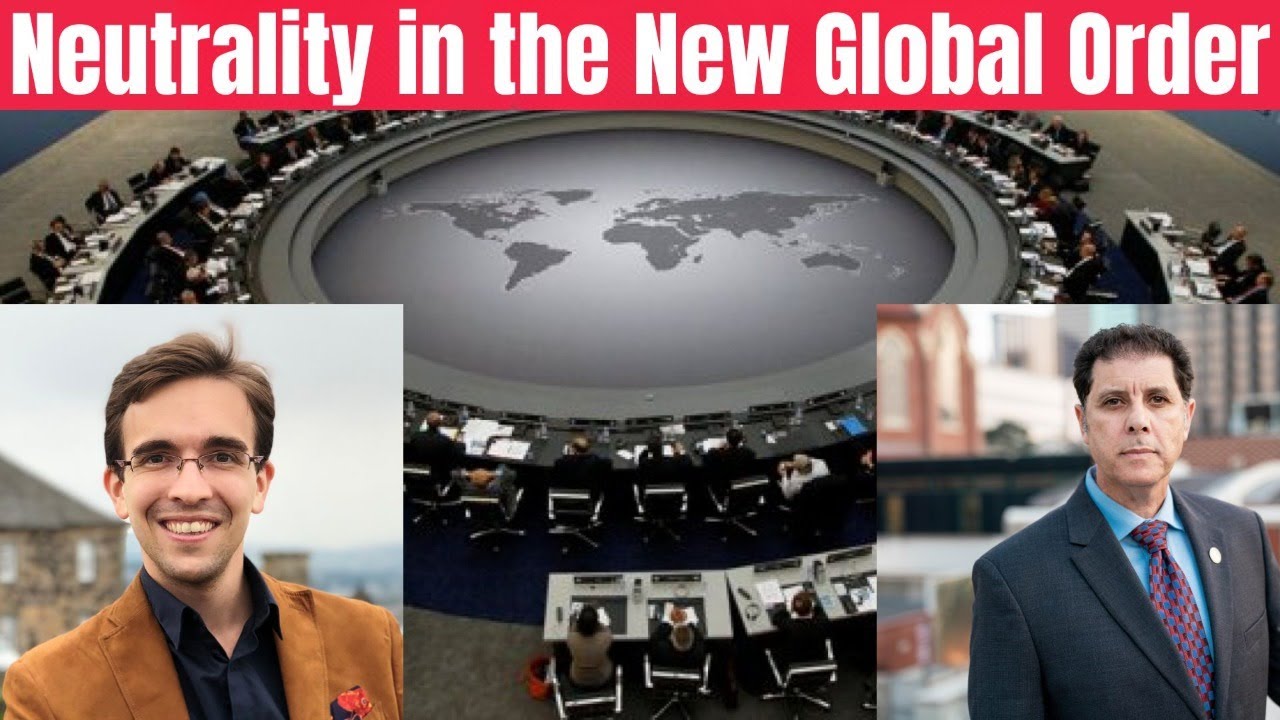
Dr. Pascal Lottaz argues that classic neutrality like Switzerland's is rare. Most neutral states like India and Brazil pursue pragmatic non-alignment, which works better in a multipolar world. Sweden and Finland abandoned neutrality for NATO, while the US hub-and-spoke system pulls allies into satellite dynamics.
Chapters
All right, hello everybody and welcome to Geopolitical Trends, where truth matters. Very, very excited to be with you because of my guest. So as I promised you, I said, you know, my, uh, guest Dr. Pascal Lottos would be here, or he's here. So we're gonna— you are in for an interesting conversation. This is something you're not gonna find anywhere else. And I'm not about bragging about the channel and all that stuff. That's nonsense. You all know where we stand here on the channel. So let me bring in my guest because I don't have time to waste here. Let me bring— hi, Doug, how are you?
Hello, David. I'm very fine. Thanks for having me.
My pleasure. My pleasure. The community is very, very excited to have you here. So, uh, to those who are joining me here, Hongwan, good to see you as always. Willie Holman, Grand Can, good to see you all. So let me first share with you a brief background about, uh, Dr. Pascal Lhotez. And by the way, guys, I put the full bio along with the links, everything in the description. For now, I'm just gonna be providing you a brief description about Dr. Pascal Lhotez. So he's an adjunct researcher at the Waseda Institute for Advanced Studies in Tokyo, Japan, that is, and an adjunct professor for European politics at Temple University Japan campus. So he's, he's based in Japan, so we are live with him directly from Japan. So among Dr. Loether's books, he wrote so many, many articles, and I looked at his research, very, very impressive. His latest book is— I have a picture of it if I'm not mistaken. Uh, let me see if I get it here. Yeah, no, I put it in the description there. So his latest book includes Sweden, Japan, and the Long Second World War, and that was published by Routledge in 2022. So, uh, let me ask you, Pascal, and I'm gonna start with this. You and I, you're a faculty over there. I used to teach International Relations for the graduate program at Texas A&M. Can you please just provide a brief description for my viewers here to understand what IR are all about, International Relations?
Sure, happy to do that. And just one addition, I recently switched to Kyoto University, so I'm now in the, in the, in the Kansai area of Japan, which is absolutely beautiful, but still in Japan. And I still work on IR and history over here and International Relations. Is the academic study of how the international world, global politics, works. And there's different ways of doing that. There's several traditions, especially in the United States. You do, you work a lot with data sets and analysis of trying to understand when conflicts happen, why they happen, what kind of politics states take. You have different schools of thought. You can also work historically, you can dig back and try to make sense out of repetitive occurrences, great wars, small wars, aggressive behaviour, submissive behaviour of states, and you try to kind of understand the globe as a system and figure out whether there are rules to the system and if you can somehow then conceptualize those in order to forecast what happens if we do X, then what will happen on the other side? And there's a lot of disagreements. So it's more, it's an academic study, but it's very, very different from, let's say, physics or chemistry or biology in the sense that IR, just like all the humanities, is discursive while the natural sciences are all about, you know, hard facts on the ground. But even those, I mean, talk to any physicists, they, they will tell you they have problems with conceptualizing, uh, um, quantum physics because the observer matters. But that's just to say, like, it's kind of— it's a, it's a humanities subject. I usually think of it as contemporary real-time history, trying to understand how states behave. Yeah, indeed.
Well, especially here in the US, there's always the focus on the three main, or the major theories, if you may— if we may use the terms— as far as realism, liberalism and constructivism. This is— have always has been here the push in the US for most of the universities that teaches political science will focus into the aspects of— well, speaking of this, and thank you for providing this really, really, uh, uh, brief background about IR just for people to have an understanding, some sort of reference points. Uh, how can we now, uh, let me just take, take it to your, your wheelhouse, your academic research. And I know I've read that briefly and not extensively, but I know you wrote a lot on this subject. You addressed the neutrality in this, in this field, which is a very— I found it very fascinating. The reason I'm saying it is because I never expected to come across something like this. As the world changes, how did you come about with this concept of neutrality in international relations?
So I myself, I am Swiss, and I think the only thing Switzerland is famous for is probably chocolate and neutrality. So I had to choose which one to work on. I chose the IR one. And, you know, when I did my PhD in Tokyo, and one of my professors told me, you know, Pascal, we actually don't really know what neutral states in Japan did during the war. And that was curious to me. So I looked at it and indeed, nobody ever tried to research what the legations or the diplomatic representations of Spain, Sweden, and Switzerland did over here. Everybody researches Europe, but nobody researched this. So I said, like, let me look into it. And what I found is like an absolutely fascinating tale of how states who are not at war can act in these in-between spaces. And, you know, these are three very different neutrals. I mean, Switzerland and Sweden were very very similar. But Spain, Spain was a fascist dictatorship by the time the Pacific War broke out, but they were able to do the same thing and they acted in coordination with each other for several purposes, including, you know, in Europe spying and so on, over here for humanitarian work and for money flows to still make that one possible, which for trade and other things. And it is fascinating. So the fact that you're not at war then allows you to do other things, and it allows for a network to emerge even during war. So because often we conceptualize war as this moment when, you know, two nations or several nations break apart and this absolute, you know, shoot at each other, but there's always in-between spaces, always, even during the World Wars. We've never had a moment, never in history, when everybody was at war with everybody else at the same time. So the World Wars are really a misnomer, right? And this position, this neutral position, I then investigated further. And what you can see is that it emerges over time, time and again. And Switzerland is actually a very bad example of neutrals, because usually neutrals are not neutral like Switzerland, they're more neutral like India right now, or like even Serbia at the moment, or other states, Brazil, you know, the BRICS, even like China, the way that China is neutral in the Ukraine-Russia war. That's the regular kind of neutrality. And this form of political non-siding has a very systematic impact. And that ought to be understood better. And it has a big potential to help us in this future that we are going into in this multipolarity, which is going to be way more conducive to neutrality than the unipolarity that we are coming out of.
Yeah, except that this last part you mentioned about the how the multipolarity will be more conducive. Except that I am seeing a behavior from countries that really surprised me. And I'll give you a quick example here, and we can address it. As a matter of fact, you did talk about this in one of your books. Sweden. I'll give just a quick example about Sweden. I think you addressed it in this book right here, if I'm not mistaken, when you talked about the neutrality part of it. The idea of— I remember a few years ago when I was doing the research for my Russia book, Back then, of course, Sweden and Finland were neutral. All of a sudden, I mean, I used to always think of them, if we know the history, both Finland and Sweden have lived with the Soviet Union back then, Russia, for over decades in peace. All of a sudden, they've been sucked in into the NATO. What do you think led to that? And how do you categorize this kind of move? By Sweden and Finland in this case.
I was surprised too that it happened so quickly in 2022. We already saw, you know, Sweden and Finland move toward NATO for the last 20 years. So they've been doing that under the hood, but they let go, for instance, of the word neutrality ever since the 2000s and replaced it with non-alignment. They had this catchphrase, especially the Swedes, non-alignment in peacetimes for neutrality in wartimes. But, you know, you could see that the cooperation that happened happened all with NATO and they got sucked in little by little. And then they let go in 2022, very suddenly, when this mental shift also in the population started. And we see the same tendencies actually in Ireland, in neutral Ireland, in neutral Switzerland, in neutral Austria. There's a very good paper by Philip Eddius about this. He calls it crypto-Atlanticism of elites in government who are thoroughly pro-NATO and would like to see their countries join NATO, but because the popular opinion is against that, they don't do it openly, but they start to cooperate. And we see this happening. Now, in world historical terms, it's actually not something special. Every war and every big war always destroys some neutrals and it gives birth to new neutrals. So what we are seeing at the moment is how this neutral concept is actually moving out of Europe and moving into the wider world, also into Southeast Asia, where countries are officially thinking about what to do and how to be non-aligned or not. South America, also a lot of African states who say like, we are not choosing sides, but they don't necessarily use the word neutrality, right? But they start using these neutral policies in order to play with both sides because it makes very good sense to them. So Sweden and Finland, in this sense, are captured, and the Swiss too, and the Austrians too. Elite discourse is clearly captured by this Western narrative of everything coming from Russia is evil, Russia is solely to blame for everything that happens. This kind of idea that this is not an escalatory spiral, this is not a problem, a reciprocal problem, it's a problem of Vladimir Putin's imperialism. And the discourse functions like that over there, and that then leads to these countries trying to be close to the good side of history. And NATO and so on, of course, loves that and tries to encourage it, because the history of neutrality is the history of belligerents trying to convince neutrals to join them and not the others, or force them to do so, or like attack them in order to do so. So, you know, in a war you always have two belligerents, or at least two big sides, And then the in-between ones, they're kind of the enemy of everybody. So everybody tries to either pressure them or carrot and stick approach, right, to work with them more than with the other one. And then because political neutrality is a form of not choosing sides, but it is never out of neutral. The neutrality of a country always serves one of the two belligerents more, usually the weaker one. And the other one tries to convince them to stop that. You know, this discourse of, "Oh, if you don't send weapons to Ukraine, then you're helping Russia." That's the mindset. That's how the stronger force then tries to put pressure, moral, ethical, and so on, on neutrals in order to fall in line. And this is a very natural thing to happen because, you know, being neutral is difficult because it means you don't play along with the others. So you have to stand your own ground. And, um, and as such, actually, you know, the problem— the main problem that neutrals have is that they will never be on the side of the winner. They will never— if they remain neutral successfully, they will never lose a war, but they will also never win one. So they will never belong to the winners of history, and there will always, you know, it will always rain down criticism. And, um, if this criticism becomes part of how you see your own position, then naturally some people switch to saying like, oh, we don't want to stand on not on the right side. We want to be on the right side of it. We don't want to stand on the wrong side of history, so we want to join the right side. It's a very European thing, actually, this good versus evil category. And in a good versus evil mindset, there's no space for neutrality. Space for neutrality is in the Clausewitzian realism, where, you know, politics is the extension— war is the extension of politics by other means. If you think about war like this, then neutrality is the continuation of politics with the same means. So if you look at war as a tool of international politics, then there's space for neutrality. If you look at war as a moral endeavour, then there is no space for it. So it depends on how you think of what's happening at the moment.
Well, that's well said. Given that, if we put this within the context of what's going on in Europe, You know, I have family lives in Europe, scattered all over Europe from France, Italy, Germany, France, Holland, and London and all that. It's the idea that when I have a conversation is kind of what is happening to Europe? What has been happening to Europe? I mean, if we look at the history of Europe and US, the so-called transatlantic relations since World War II, it became clear to me that the Europeans are so weak They can't extend politically speaking, let alone wanting to build their own security structure, which I believe they won't be able to anyway. So, and this is where, just to go back to your point about how some countries now, even inside Europe, mainly I will say Eastern Europe, they are kind of on both sides of the fence. Would I be fair in my assessment if I say this, that they are on both sides of the fence? They want to keep good relations with the Russians.
The Europeans?
Yes. Yeah. Some countries in Eastern Europe, not Western Europe.
I mean, Europe, the NATO Europe is clearly on one side. The only two exceptions are Turkey and Hungary. They are not as clearly committed. They are NATO members, but they chart independent foreign policies that don't fall completely in line. They're also the two that are beaten the most in in terms of like, "Oh, you should do more what we tell you to do." Turkey less so than Hungary. But the only European countries at the moment not falling clearly in line, also ideologically, are at the moment, in my view, Serbia, Moldova, the— Armenia and Azerbaijan for— I mean, they're having an internal, like they just had a war, right, as well. This one is a bit different. But the rest of the European countries also ideologically, they are very much in line with Euroatlanticism, even Switzerland and Ireland, not necessarily the populations, but the political elites. They are firmly behind the interpretation of reality as the United States portrays it. A lot of nuances also in public debate are currently being switched off and ignored. About the complexity of these several layers of warfare that we are seeing in Ukraine. Because Ukraine has a civil war going on, then a war with Russia, and it is also a proxy in a great power conflict. And all of these layers are being condensed into a very simple narrative, which actually outside of Europe doesn't fly that much. Outside of Europe, a lot of people in Africa and Asia and South America actually understand that this is a This is a complex affair. The Europeans are the ones like, no, no, no. We have had 4 general wars in 400 years, 4 times. But this time we need to go to war with Russia for a good cause. This time we are right. So it's a very European thing to be that dumb for the 5th time in 400 years. And it makes me very angry. The Europeans, we don't learn. We don't learn from our history, unfortunately.
That's the sad part. Same for us here in the US. You would think we would learn from the past events or conflicts we've been involved in. I'm a former military, so I've been traveling back then when I was working in Washington. You know, I spent years in Afghanistan and Iraq and Yemen and in any country in between. So you kind of But I always was with that notion of, you think we will learn from history. You don't win conflicts in the manner we are approaching it, but oh well. So that's why I left.
I mean, if we learn something, we usually learn the wrong things.
The wrong way. That is true.
You know, I find it so interesting that at the moment everybody is justifying the war, even sending troops to Ukraine at the moment, which is the big discussion with like, you know, Hitler. Hitler, you know, Putin is Hitler and therefore we have to fight them. And I was like, Jesus Christ, we are going into another European war in the name of Hitler? I mean, the guy must be really happy in his grave that the Europeans, I mean, still use him in order to try to kill each other.
Well, here is what's interesting. Last Saturday, the US passed the legislation regarding the $95 billion aid to Ukraine. That includes the one for Israel and Taiwan. Did you know that it happened on the 135th anniversary of Adolf Hitler's birth?
Well, you know, history, history sometimes has funny ways of expressing, uh, sarcasm. This is pure coincidence, but yeah.
Well, we did it on purpose. We did it on purpose. That's why they passed legislation on Saturday non-business day here in the US. But anyway, uh, let's shift to Asia because you mentioned about NATO, and I want to, uh, sort of, uh, get your thoughts and insights about, uh, what do you make out of NATO now wanted to open an office in Tokyo, out of all places? And even for Japan in itself, that is now moving forward with increasing its defense budget What are we— what can we read between the lines here?
So this is a new strategy of NATO, which we see not only play out in Japan, but actually in Switzerland too. It's now been confirmed that there will be a liaison office in Geneva open not to discuss with the Swiss, but discuss with the international organizations in Geneva. But this is kind of a soft approach of NATO to try to create more connections left and right, because of course, as soon as you have these offices, you can then start to to wine and dine and schmooze and create all of the other, like the non-official kind of ties that you need. And Japan itself has, of course, been very, very, let's call it Western-file or Euro-file, like the connection with the United States. The security treaty with the United States is the backbone of the entire Japanese security thinking about its own security. We must understand that, you know, what NATO is to Europe, is the US-Japan alliance to Japan. And Japan has always been a country that wanted to be Western, including Europe. And this is a way for them to create these connections that they've been seeking and also the validation that Japan is seeking. And in their security, in the security thinking over here, the idea is that you're part of this alliance of democracies and values and all of the stuff that the transatlanticists believe they stand for. The thing is that this, at least for the moment, at least for now, this has little operational value, because it is pretty clear that Japan cannot become a NATO member unless NATO changes drastically. But it has value for, you know, creating connections for procurement and and standard setting and joint military exercises. But not necessarily on a political level and an actual operational level for how you would implement security. But it is part of this new long-term strategy that is actually, you know, it's a US strategy of the hub-and-spoke system to make sure that its allies are all connected, not only to the US, but also to each other. In order to increase the network effect. It's a smart strategy. I don't like it very much, but I do think it makes sense from the perspective of NATO and also for the Japanese, although they're going two ways at the moment. One is more collaboration with the US and NATO. The other one is also strengthening their own capabilities. They recently changed the security strategy and also said we're going to increase the GDP, the expenses for, for the military to 2% GDP, same standard as NATO. And we will have attack, the ability to have to send missiles not only to intercept other missiles, but also shoot down targets, especially in North Korea, if they should launch something at us, which is a big change for the Japanese, which then also means that they're not that dependent anymore on the United States. So they are building the capacity at the moment. Everybody's interpreting this as Japan falling more into line in order to make itself useful to the US. But this capacity here, that could be used in order to distance itself and not necessarily do what the US says in the future. So Japan kind of has a parallel strategy at the moment.
Yeah, but at the same time, I do know for a fact that Japan— and I had a conversation one time with some retired rear admiral way back a few years ago— that Japan now is thinking in terms of, okay, this is no more about North Korea as much as it is about China. And we find it convenient that we could push Japan and South Korea and soon Philippines and Australia to the forefront. To me, I'm seeing a replay. I'm gonna use the term here. I'm seeing a replay of what's taking place in Ukraine. We're going to be seeing it in South Korea.
That is true. That is true. But I tell you one thing, which is here in Japan, Dying for Taipei is not a slogan that will rally, you know, large crowds behind you. The Japanese are in this sense, in my view, healthily nationalistic that they wouldn't be willing to go and fight a war with China over Taiwan for the United States. But Japan, I mean, a war in Taiwan, over Taiwan is a worst-case scenario for Tokyo because the US has so many military bases in Japan and has a very big and important one in Okinawa. And Okinawa is just right next to Taiwan, right? It's really, really close. If the US started using that base in order to launch operations against the Chinese Navy and army or something, the Chinese would automatically strike that ground, which would be striking Japan, which would engulf Japan immediately. So this is a worst-case scenario. And Tokyo actually is is afraid of that very much and wants to avoid this. And the good thing is actually that the Japanese-Chinese relationship is doing a bit better than the US-Chinese one. They also last year, or 1.5 years ago, they opened a telephone line, a direct connection between the two ministers of defense, China and Japan, so that they could phone each other up to make sure that no incidents somewhere in the ocean actually then leads to more. And they still have high-level talks, the ministries of defense, which is a good thing. Japan doesn't want this. This is pretty clear. They are not willing to be a spear tip for the United States. But Taiwan is very, very dangerous, extremely dangerous, and could be the— I mean, if something happens in the Pacific, Taiwan is going to be the flashpoint.
But at the same time, Japan is not doing sort of— it's counterproductive as far as some of its deployments of its military near Taiwan. I'm aware of a unit that is gonna be dispatched to, right on a closer to Taiwan. So makes you just wonder, why would Japan be sending some units some 2,000 miles away or whatever that is distance? So that's to me, you can't be playing both sides because in international relations context matter, as you know, The fact that the optics of it, that Japan is sending this, I don't see the same arguments now for Australia and Philippines. Philippines is a basket case. My big concern, Pascal, my big concern is with what we are doing, we're going to be destabilizing the security of Southeast Asia. Will I be wrong in this assessment?
No, I agree. I mean, the US is clearly following a strategy of They call it deterrence, but this is really more of— this is the classic security dilemma in which the US militarizes its outposts with the consent of some of these states, especially the Philippines. And the Philippines is also caught in a very, very difficult position. And I do agree that China is bullying the Philippines or has been bullying the Philippines unnecessarily so. I don't understand it. I really thought a couple of years ago when under the Duterte administration that China would then start, you know, giving, giving the carrot. But it still used to stick. And that then led to a backlash. And now the Philippines is inviting the US to, to, to send more and more troops and have more, more base agreements. And this then in turn the Chinese are perceiving as, okay, they're really trying to encircle us, they're threatening us directly. Even some US military personnel in on Taiwanese islands, which are, you know, like 3 miles away from Chinese mainland in Kinmen. This is all very escalatory. And, and this only makes the situation worse. But what I'm, what I'm saying is that A, the Southeast Asians, ASEAN countries have no appetite, have no appetite for this. B, Japan has no appetite for it. But the Japanese and the Philippines, both of them have territorial claims with China. So they claim China and Japan and China and the Philippines, they claim the same islands and same features. So there are open questions there, and that is also quite dangerous. And you know, for Japan, you must, you must understand, like, there are Japanese islands which are actually closer to Taiwan than they are to the Okinawa mainland. The, the small ones, they're really, really close, a couple of hundred miles only, and they're still officially Japanese territory. And that's not even the ones that China claims. I mean, China and Japan have disputes over other islands between them. So there is a very delicate conflict going on. And conflict itself is not bad, that's normal. The important thing is to keep it under the threshold of using military means to resolve them. At the moment, it's still being managed. The problem to me is that I see the United States as a factor that tries to escalate them and not de-escalate them. I would like them to do that, try to make this find a peaceful settlement and not a military one.
Well, yeah, because we are— for us, if there are no conflicts, there will be no economy here in the US, because everything depends on creation of conflicts. That's been the norm for us since 1953, when a meeting took place in Washington, DC, behind closed doors And the decision was made back then. And again, I used to work— I was a— I'm a former military, so I was in the circles of high-ranking official officers and so forth. So we used to talk. It's the idea that it was always the decision from 1953 moving forward to get involved in conflict, not necessarily to win a war. That's why we've been in the— the only one, the only war we won was World War II. We got, we got involved in Korean War, Vietnam, Gulf War, Gulf War II, Afghanistan, now Ukraine, and soon to be I'll see Asia as the next theater. That's what concerns me the most. So I want to go back to one point you mentioned about the dispute, the territorial disputes, and what I don't understand is how come China was able to work out its differences with, let's say, Vietnam was able to work out his differences with Indonesia. So the case with Philippines, especially about the Spratly Islands, which historically— I didn't read the record for historical— that they have been presence of the Chinese back then. So yeah, what the US is doing there, I don't know. How about if we let them figure it out? Let the Chinese and the Filipino people or government work out their differences. Why are we getting involved?
The Philippines is in a very, very tough position. I mean, while they're— I mean, especially the Chinese side, also in their legal arguments, are always saying that we have proof that there were Chinese fishermen and Chinese people present in or near these islands. But under international law, these historical cases that go back 400 or 500 years, they are not an official source of international law. So what China is trying to do is it's trying to open what could be an actual claim to land under the current system as we have it, which is one more reason, you know, it's actually very reminiscent of the claims that Israel has on the land of Israel. It's a historical claim, you know, because 2,000 years ago we were here, therefore it belongs to us now. The Chinese do make a very same similar claim, um, 500, 600, 700 years ago we have— some of our people have been there, therefore it's ours. The thing is that the, the undercurrent international law, like, um, especially the official documents that we have, like the United Nations Convention on the Law of the Sea, UNCLOS, And it is pretty clear that, um, these, these waters and also some of the features, um, in the waters, which are not the same as islands, but, you know, high tide, low tide, and so on— this creates like legal issues of what, what, what creates a boundary. And under the current system we have, it is pretty clear that this belongs to the Philippines. There has also been a, uh, an arbitration, uh, arbitration ruling back in 2016 which China doesn't recognize. So we do have Chinese great power behaviour trying to take what it can't get under the current system within a legal framework, which is also a normal thing to happen for states to do. And then the smaller party, the Philippines, has to figure out how to deal with that. And the natural reaction now is to invite an even bigger party, which can though be a poisoned chalice because the bigger party then tries to push you, like Ukraine, into a war. So it's a complex action-reaction mechanism. And I remind you, also your viewers, Don't think of it in terms of morals. And when I say the Chinese are bullying the Philippines, I don't mean this to say that the Chinese are mean. I'm meaning to say that they're pushing, um, that they're pushing something that, that they believe is, is rightfully theirs, and while the Philippines does the opposite, does the other one. And that conflagration then creates the conflict that we are seeing. So, um, I think we should demoralize international politics as much as we can, but of course of course, if you're Filipino, if you're Chinese, if you feel very hotly about even small things and even small islands. And one more thing, these waterways are very important for the Philippines, for fishermen. This is an economic resource that actually must not be underestimated.
So it's also for China regarding trade. This is why we're seeing what we're seeing as far as the tensions that the US is trying to create. I mean, I criticize my country when it does wrong. Of course, I don't shy away from this as one who used to be inside Washington. So I kind of, the argument has always been, I always got the example about the signing of the 1972 regarding the three communiqués, '72, '74, and I believe '79, as far as the recognition that the One China policy regarding Taiwan and so forth. So why are we going and doing about-face, taking a different position when we signed the documents and under international law, if we are to go that route, we do recognize that China has the sovereignty over Taiwan. So why are we going and weaponizing the islands and all that?
But you do— the important thing is to understand that the conflict about Taiwan has radically changed from what it was in the 1970s. That's true. Because it is correct that Taiwan is recognized as part of China. But back then, the question was, who is China? So I suppose you know the official name of the government of Taiwan, right? The government that rules Taiwan in Taipei. The official name of that government is Republic of China. The government ruling over mainland China, that thing is called People's Republic of China. We have, you know, the problem is that back then, because this is the outcome of a civil war in '49 when Chiang Kai-shek retreated to Taiwan and then he took China with him, the old China, and Mao Zedong created a new China, the People's Republic. And back then Mao Zedong, Chiang Kai-shek said, I'm going to take it back at some point. And you had 30 years or so when you had two entities that said, I am China, I am China. So the One China policy is based on this idea that 'Okay, let's agree that there's one China, and we recognize that Taiwan is part of China, but we disagree on who rules it.' Now, that has been settled. Even the people in Taipei don't want anymore to be the rulers of China. Now what we have is a new identity there, and the question is, is Taiwan its own thing, its own state, or is it not? And that question hasn't been settled. And what I find very disingenuous, especially of Western media, is to constantly talk about Taiwan as if though there was a Republic of Taiwan. Republic of Taiwan does not exist. It's not there. We have a Republic of China that rules it. That's the whole problem. And this needs to be understood because it is an old conflict. It's an unsolved child of the Second World War, an unresolved Second World War conflict that has morphed. It's a different conflict today than what it was in the 1970s. And there are solutions for this. And actually, Taipei and Beijing have been very good at managing this because you must understand, although they are still officially in a state of civil war, mainland China is the largest trading partner of Taiwan. I mean, they're very pragmatic about the fact that they don't have a perfect solution, but they have a way to live. And all we need is this to continue for another 30 years or 40 years, and then the conflict will transform again. Naturally and hopefully toward a more peaceful solution. What we don't need is escalation and a hard solution. We need independence because that's the only red line. If tomorrow the President of Taiwan decided, I'm going to declare the Republic of Taiwan, that's the moment when the Chinese would attack. That's just it. They could do that.
Yeah, I hope it doesn't get to that because I do understand that the red line is the call for independence of Taiwan, which We have warned the Taiwanese behind closed doors, you don't want to do this because here is where the problem that I see personally as geopolitical analyst. What I see is that we're going to be pushing the envelope behind the scenes to the point that the Taiwanese thinking that we're going to come to their defense. We are not.
We have not. The good thing is the Taiwanese have a way more capable foreign service than the Ukrainians. Ukraine has been in the pockets of the United States for at least 10 years. The Taiwanese are not. The Taiwanese have a 112, 113-year-old foreign service because that's how old the Republic of China is. And they have very, very capable diplomats. They have very, very capable international relations people and a defence, Ministry of Defence as well. And that actually is also quite pragmatic. So that's my hope that I have. The hope is not in the United States, militarizing these places, the hope is that there's going to be enough pragmatists in Taipei and in Beijing to find a non-solution that works. Not something that solves everything, but something that allows both sides to live with it and that shuts out the negative influence of the US trying to push for a war. That's how I see it. People who disagree with me tell me, "Oh, you always think the US is nefarious," and so on. It's like, well, you know, there is people in the United States who would be very happy to have the Taiwanese do with China what the Ukrainians are doing for them for Russia. There are people who think like that, the neocons, and they try to pursue such strategies. That's not the entire United States, but there's a good part, there's a part of those. And these people are very dangerous. But my hope is that the Taiwanese, and I know they do, they have very capable people and I met some of them and they are really, really brilliant minds. The problem is that they're also in a weak position toward China. I mean, China doesn't just treat them nicely just in order to break them away from the US. But again, there's pragmatism. This little island of Kinmen, where there's now some US troops, which is like 3 or 5 miles from Xiamen, it gets its sweet water from Xiamen. I mean, the Chinese could at any point in time just switch off the tap and there would no more be any drinking water. But they don't do that. So there is pragmatism in order to somehow keep things under the level of outright conflict.
Yeah. Well, I agree with you about the assessments of, or the categorisation of the neocons, because those are the ones pushing the narrative as to what China is going to invade Taiwan. How can a country invade itself? That's just, it's beyond me. It doesn't make any sense. That's like us going to invade Hawaii. You know, I ain't gonna, you know, that just doesn't make any sense. So I hope it doesn't.
It's a very good comparison. I mean, how would the United States react if you had a Hawaiian state government that says, you know, we don't recognize this annexation in 1899, we're actually still a kingdom legally, and we want to be our own thing? What would the United States do. If that was the government in, uh, in Hawaii, I am pretty sure they wouldn't react very understanding and let's sit down and talk. I'm pretty sure you would have to move first. That's true.
That is true. They will send in the military. I'm, I'm aware of that, especially in the state of Texas where I live, that if the state of Texas declares independence, we will have the military. But what the federal government also understand that in Texas, in every household you go in, there's a minimum of 5 types of weapons in that household. So Texans will fight if they need to, but we all know what that outcome of this— nobody wants to see that one.
So we don't want another civil war. No civil war, please.
No, no, no, no, no, no, not at all, not at all. Let's shift to— while we're still in that part of the world, I want to shift to Australia and New Zealand to get your take on the recent— the changes in the Australian policy, of course But the shocking, or the shocker for me was New Zealand. New Zealand has always been sort of, I can categorize it as a neutral country. I've always viewed New Zealand that way, but not recently with the new prime minister. How do you assess the changes in policy, especially when it comes down to the foreign policy of both countries in line with what the US is promoting in that part of the world?
Well, honestly, I don't know enough about the political level in order to give you or anyone a decent insight. The only thing I can tell you is that, uh, there are— I had discussions with Australian diplomats and, and also researchers from New Zealand, and they are worried. Um, they are clearly— the mindset is clearly in the, in the Western camp, as in China is a potential enemy, and we need to do everything we can to strengthen Western democracies and alliance and la la la la la la la, you know, the whole spiel. But they don't really want a war. I mean, a war with China is also for Australia a very, very bad scenario. And at least the diplomats I talked to, they, they try to think about how to de-escalate. Now that can be, you know, diplomats a lot of good diplomats, career diplomats, are naturally— have a natural tendency to be rather peace-loving and not the neocon types. So I cannot say that this speaks then for the entire country. And I don't know what's going on on the political level enough. I just know that in the entire kind of, you know, how to put— I don't know how to put it other than in kind of what the white Western world These are also emigrated Europeans, both of these countries. And we see a coalescing now around this ideology of— I don't know what to call it— like this current brain virus that is eating up elites in all these countries, their brains, saying like, we need to fall in line in order to build this arsenal of democracy or whatever you want to call it against everybody else who they paint as bad. But this seems to be going on, especially also through media in these countries. So it's a falling in line at the moment. But I don't know how deep it goes under the hood and how much of it is political posturing. I can't tell.
Well, for Australia, I tell you, they are just following orders from the US. I mean, I'm sure you know about— what's that place? Pine Gap. You're familiar with it, right?
No.
Pine Gap? No. Pine Gap is a joint base between the US and Australia, but Pine Gap is serving as the eyes and ears of the, you know, the satellites and all that stuff in that part of the world. But here's the key, is that inside Pine Gap itself, there is a section in the base that is not authorized for Australians, even though it is on the Australian territory. Why am I sharing this with you? Is to highlight to you the significance of the influence Washington has on Canberra. Decisions regarding Australia, whether to go to war or not, are not made in Canberra. They are made in Washington. And this is where I wanted to just to get your, you know, just your understanding of where things are. As far as where Australia all of a sudden pivoting into the direction that I used to see them again, Australia and New Zealand, almost like a neutral. They were fine, especially Australia with China, till the issue that happened 3 years, 2 years ago or so. All China needed to do was to cut down certain trades, shut down the economy. We came in, build up AUKUS, as you know, between the UK, US, and Australia. It is nothing but to sink them into the hole or the orbit of the US by having them sign in now into the $300 billion nuclear submarines. What is all that for? And that's back to the question of—
It is a ganging up. It clearly is a ganging up. The question is how formal do you make the ganging up? And would a state then also choose to actually go along? Because what we see in Ukraine, for instance, is that, okay, while all of the European and NATO countries support Ukraine With everything, they haven't actually declared war. So there's these several levels of escalation and how far countries are willing to go. And an actual war then has the tendency of, you know, this is when push comes to shove, right? And certain decisions will be made. And I am not sure how far Australia would be willing to go for the US. I mean, post-String of Pearls, like all the grandstanding and so on, and the talks and the agreements and the submarines and so on, yes. But then the actual decision to push the button and go, I am not sure. But again, there's no way that we actually would know how the thinking in these highest levels, also in Canberra, work and how good the US influence on that level is.
My own contacts in that part of the world are indicating that in the, for example, the Prime Minister's office, the incompetent Erdoğan, and I don't shy away from saying this, you know, he can't do a squat without the US approval. It's almost similar setting that I am noticing with Europeans, the likes of Olaf Scholz, the likes of Sunak in England, the likes of even Macron himself. Merkel would just come out in the air, sort of shout, but All that, it's nothing.
Alexander Mercury said it quite right on The Duran the other day, these are now clearly satellite states, the Europeans and Australia and New Zealand too. But they have the same problem as the Eastern European satellites of the Soviet Union back in the Cold War, which is it all depends on the hegemon and what their decisions is, which is why they're so afraid to lose the United States if like a change with Trump or something should come, because if they were on their own, Well, as soon as the Eastern European states were on their own, they collapsed in rapid speed. And these, these, you know, underlings at the moment in Europe and also Australia and so on, they are afraid of that too, because like their populations are not necessarily, at least not all of them, a good part, but not all of them are behind this. And there's very diverse opinions actually. And we can see that we have academic research that shows that what's being published in mainstream media and that's what's being discussed on social media are significantly different. So if it actually came to actual democratic decisions of what to do, a lot of these straightforward militarist policies might fall apart, which is a wonderful outlook. I mean, it still gives me hope into populations of countries. But yeah, I think they are quite scared. So the biggest question is what's going to happen in Washington in November. That's the very big one.
Yeah, well, for us is, I can tell you as one, you know, who's, you know, I live here. So the US is, we are on the last leg of the hegemony. That just, it's a fait accompli, comme on dit en français d'ailleurs. It's done deal. It's a done deal. It's just how we're going to go down. And we are not, you know, are we going to go down quietly or are we going to drag the rest of the world? And I know one of the arguments about this has to do also with the financial aspect of the status of the dollar. That goes in parallel. And how much are we going to drag the world into? That's remained to be seen. This is, to me, in my opinion, what's at the heart of it, is that the shifting from a unipolar to multipolar, in which the US will not have the final say, does not bode well with Washington.
I see it in the same way. And you know, this is where I would like to offer this concept of neutrality, because, you know, the United States, before it became what it is now, the hegemon, it had a neutrality policy for 150 years, and it served it really well. It was a very good one. And the United States could go back and rediscover this and just go to the words of Washington, you know, Washington, his farewell speech, 1793, we are not going to get involved into European quarrels and so on. You know, there's a lot of history to go back to that served the United States very well. But I know this is the opposite of what the globalists want. So the globalists always try to portray those people, like Washington and so on, as isolationists. They were neutralists. They understood that geopolitical neutrality in Europe and so on serves it very well. And they combined it with the Monroe Doctrine and, you know, As unfair as that is, it served the United States, the legal concept, the legal entity of the United States, very well because it gave them enough time to eradicate the natives on their own continent and then become what it is today. So, and again, this is not a moral argument, this is just to say that this policy of not intervening everywhere can be power politically a very smart choice. And if enough people see that, then maybe we have a chance Because, you know, the Russians even throw that out. I was very surprised hearing Lavrov the other day saying that, America, you should care about Haiti more. You know, Haiti is now ruled by gangs. You should clean up your own front yard. I was like, whoa, I mean, you're throwing Haiti under the bus? But this is clearly Lavrov saying, like, look, we know that you have your own sphere of influence and you have your hemisphere to care about. Please do so. 'Just don't try to break Russia apart and tell us what to do in our near abroad.' And this is a— yes, it is a great power mindset. And yes, this is not how the world should work under international law. But this is how these powers behave. And the Russians are telling the Americans, 'Actually, look, just be fine with your hemisphere, and then we'll manage the rest. And with the Chinese, we get organised.' And that could be a structure in order to avoid war. Yeah, so that's part of why the United States—
yeah, since again, ah, let's hope. But, but to me, this is why the Chinese have succeeded. It's because if you notice the history, they have not get involved in conflicts. The only one, of course, was the one in Vietnam back in 1965, if I'm not mistaken. And, and is that, that discipline of not getting involved in far land conflicts is what paved the way for them to be where they are today. Yeah, the US would have done the same.
If you do it strategically, then you have time to build up a huge industrial base upon which you can then do other things, which is just what the United States did. It's 100 years of building up an industrial base and have its own hemisphere and then be very powerful, which then actually makes them go and become a hegemon. So which is kind of, you know, it's, it's a back and forth, but This can be very, very powerful. And if you see where the United States is at today, like domestically with poverty levels and public infrastructure, you would really think it might make sense to invest at home and actually accept that there are places in the world that are better managed through diplomacy than through hard deployments. I keep saying, you know, when the US says, oh, we need to send more troops to Iraq and to Syria and so on because our troops are being attacked 'Our troops are under attack and our troops in East Asia, our bases are threatened by China.' I keep telling them, 'Look, for some reason, I don't know how they do it, but the Swiss had no of their military personnel killed in Syria. Nobody killed in Iraq. Nobody is threatening Swiss military personnel in the Pacific. How do the Swiss do it?' 'Oh, they don't have people there. That's how they protect their military personnel from being attacked in Iraq.' So there are strategies. This is just a stupid rhetoric of trying to portray yourself as under threat in order to justify more war and more power projection. But I think your viewers, of course, they understand all of that. I mean, we are preaching to the converted.
Yeah. And I'm very grateful for the community that we have here because they are very, very savvy. And now how to read the landscape, and, and that's part of what we— what I'm doing. For, by the way, guys, if you can prepare a question or two that we're gonna ask, uh, Dr. Lodas about it later on, and, uh, and I'm gonna scroll through and go from there. So, uh, one more thing I want to address with you, uh, Pascal, if I may, before I'll give you the floor for final, uh, uh, comments from you here. India, you mentioned India earlier as a neutral. A lot of people do not see, I'm one of those, I do not see India as a neutral. Will I be fair in my assessment?
Well, India has, it clearly has not an official neutrality policy. That's not what it has. India used to be a founding member of the Non-Aligned Movement. And India is even at the moment, in my view, using a policy of self-interest in foreign affairs. So India also differentiates these different theaters. So when it comes to the Chinese, they're very happy to cooperate with the Americans because there they can use US hard power much better. But when it comes to Russia, They are very happy of buying all the Russian oil and then refine it and resell it to the Europeans. And they do not fall in line with the sanctions, and they are part of BRICS. So India is actually one of these states that very skillfully manages all of its international relations, even with the states that it has a big potential for conflict, which is China. I mean, China and India are both part of BRICS, and BRICS itself is a forum that kind of tries to bring together geopolitical rivals, which is why they extended an invitation to Iran and to Saudi Arabia at the same time. This is a very different model to think about. It's not an alliance building, it's more a management of conflicts. And in this sense, I see India way more in this Cold War tradition of non-alignment than, let's say, Japan or the Philippines, which are now falling in line with the US at different degrees though. I mean, Japan too is not completely on board and everything, but this is different positions. I see India as a more independent Poland. Actually, the foreign minister kept saying that time and again. There was this very beautiful interview that he gave in one of these Western forums where the anchor tried to push him to— but at the end of the day, you have to choose sides. Who are you going to choose? Is it going to be China or the US? Who are we going to choose? And the guy had to lean back and say, look, I don't agree with your premise. I am 1.3 billion people. I think I deserve my own position. I'm not going to take one of yours. He he actually said that like 1.5 years ago or so. Very smart guy, the foreign minister, you know. And this is the traditional kind of way, you know, being neutral doesn't mean you do nothing. It means you do your own thing. You're the third part in a triangle. You're neither this one nor this one. You're your own part. And you do that and you try to manage your relationships with the others. And the Indians are doing that skillfully at the moment that they benefit from it. They extract, they extract benefits from all sides. So as long as they can do that, and don't go ideological on their foreign policy, I think they have a future as a non-aligned part of the game.
Except that there are some saying that approach is not working for them within BRICS as an economic bloc. It's because you can't be the odd player within the team. And especially this came up, to my knowledge, when the BRICS was talking about the common currency.. And India opposed that vehemently, saying, nope, we're not going to agree to that. So of course they're entitled to say whatever they want, it's their country, they can decide.
Yeah, I view it as a different way of managing the world affairs from trying to get unison on everything, try to accept that you have differences and then do what you can, a little bit like ASEAN, which makes you institutionally weak, but it might be a way forward.
Yeah, yeah. But in the case of ASEAN, you're already seeing the emergence of two weak players. That's, that's, we're talking about Philippines and Singapore. You know, to me, yeah, there are those who are saying, well, maybe that's how the ASEAN doesn't want to come forcefully and, and declare its stance regarding whether to go with China or to go with the US. But majority of the countries in ASEAN made it clear they want to go with China because of economic opportunities.
So, so, and there's no clear decision. I mean, the Philippines clearly is not on board of that, and others have also their problems with this approach. The interesting thing is ASEAN is institutionally blocked because each of the 10 members, soon 11, has a bit of power over the common decisions. But the interesting thing is ASEAN wants to be together and ASEAN perceives itself together. I was very fascinated, you know, there was this Japan-ASEAN talks in December in Japan and currently Myanmar is suspended, right, because of the civil war that's going on and the coup. It's suspended, but ASEAN during the negotiations with the Japanese demanded that there is a seat for Myanmar and the seat would just be empty. It's not filled, but the other ambassadors were all there and were sitting on their seats, but They say like Myanmar currently suspended, but member of us, don't forget about that. And there is an idea that you belong together. And I think maybe something similar could be for BRICS. Even though you have internal differences, you still have an overarching idea that you want to work together, a little bit like the G7. It's an informal club that tries to push world politics toward a a positive way for the members.
Yeah, very, very interesting. I'll give you the last word, Pascal, before I'll open it for questions, if that's okay with you. So I would like you just to— your outlook for how the geopolitical landscape moving forward, let's say the next 5 years, the next decade, what do you see?
Very hard to predict, but what we are seeing right now is still a heating up of the conflict in Ukraine. We still have no de-escalatory rhetoric coming from Washington, or Moscow is stronger right now on the battlefield. So this still has the potential to blow up into a general European war if the Europeans don't come down from their high horse. There could be open warfare between individual NATO members and Russia, and that could be the next stage of escalation. I hope they don't do that. I hope that at some point people get seriously scared, because at the moment nobody is scared. Everybody thinks, you know, we click on a button and then rockets fly and then everything is over. They are not scared of the actual process. And maybe they will be at some point. I can't predict which way it's going to go. With China, my big hope, because I'm an optimist, is that they manage the conflict with Taiwan and Japan independently, and that the US cannot push them toward enough war, because I think that's what what's going on, what this escalatory rhetoric is doing and what the escalatory steps are doing. I hope it's not going to be the next flashpoint. And my hope is that in the US, whatever is going to happen in November will actually lead to a process where the United States focuses more on itself than on its extended empire. But as you correctly said, this is a hard sell. And historically speaking, when great empires go down, A lot can burn. A lot can burn. I hope it doesn't. I cannot see the United States Gorbachev yet, but maybe somebody is around. But yeah, the system in the US with the military-industrial complex is just one that pushes into a very certain direction. So it's difficult to be optimistic, but at the end of the day, my hope is that fear, blank fear, even in the US, when we come again like one second before midnight, and the nuclear question is real, that then some rationality will set in and overwrite this ideological moment. Because we are going through an ideological moment, a very strong ideological moment, which just as always, you know, with the Cultural Revolution in China and with communism in the early stages of the '50s and so on, these things usually eat their own economy, their own economy, economies and their own people, their own societies up. They're targeting the inside as much as the outside. And this is happening currently to the US and Europe, the Western Alliance. And I hope they come out of it, but I can't be sure. And if they don't, then God help us.
Yeah. Wow. Well, very insightful. All right. I'm going to take the first question here from Matt Becky. Good to see you, Matt. By the way, Matt, an avid supporter of the channel. Question: you mentioned the Taiwanese Foreign Service have over 100 years of experience. My question is, what is the perception of its public? Have they been bombarded with propaganda from the West, in your opinion?
So there's propaganda from all sides in Taiwan, and I don't speak Chinese. I cannot watch their local TV news or read their newspaper, so I couldn't give you a firsthand insight. The only thing I I can say is that the Taiwanese try to monitor public opinion quite well. They do surveys, in my view, very trustworthy surveys of public opinion about independence and the political decisions. So Taiwan is actually a pretty good, pretty proper democracy, even with some or had some direct democratic instruments. I mean, they're clearly developing their own system.. And you can see that the public opinion is very diverse, but the biggest chunk of people wants to keep the status quo. I can't tell you how much it is. You find these surveys pretty clearly, but the biggest chunk is keep the status quo, don't go for independence and don't go for joining the People's Republic of China officially. Keep things as they are. And when I ask my friends, my Taiwanese friends, what they tell me is a lot of them say, especially young Taiwanese, we would like to be independent, but the worst case would be a war. So let's keep it as it is for now, because it works. Taiwanese are very pragmatic, luckily, about the most important thing is to be alive and well and everything. And political preferences, also independence and so on, take second rank. So this also gives me hope that in the political process inside Taiwan, You won't have a clear majority for, like, let's do war to be alone. This at the moment, I think, from how far I can see from somebody who doesn't speak the language but only reads the reports, also influences the government at the moment, which is from a rather pro-independence stance, but they wouldn't do that because, I mean, you don't have enough support on the ground. It's what they believe what's going on.
Interesting, interesting. Uh, next question from Hong Rong. Uh, Dr. Pascal, how can we be neutral when the American government body is threatening countries left, right, left, right, and center with sanctions and threats if they continue doing business with Russia and Iran?
Very, very good question. Neutrality is never a perfect state. You're never perfectly in the middle. You're always somewhere closer to the other. And you always have to decide on how far you play along and where you don't. And the optimal neutral always sells to both parties that, you know, I do whatever you want, but, you know, I just can't. You know, I have these constraints. I would love to help you more, but, you know, and then you go to the other one. It's like, I want to buy more of your oil, but I have these constraints. And then you need to convince both of the other parties that you're doing your utmost, you would like to do more, but you have these constraints. They need to understand your position and then actually let it go, even if they try to give you the stick, saying, but yeah, but we let it go. It's still better you do this than you go completely to the other one. So it's a very difficult balancing act. And again, perfect neutrality in a sense of like standing perfectly between two sides doesn't exist. So there's always like this question of where do you work with more? And also the question, which one offers you the better deal? So it's a very selfish way of organizing international relations, but in my view, a good one, because if everybody looks out for their own best benefits and for their own peace, then oh, maybe we will have world peace by nobody going to war for others. Indeed.
Indeed. I'll do one more question, guys, here. And because I want to be respectful of Dr. Lothar's time as well. So a question here from— where was— now I can't because there are so many comments here. I can't see it anymore. So I guess I'm gonna have to let it go. Right here, I think this one right here. So what do ordinary Japanese people think of what's happening in Ukraine, Gaza? Are they buying what is selling them? NHK. I'm sorry, couldn't read that. Are they still anti-NATO and pro-PAL protests? What do you think?
So NHK is the national broadcaster over here. And, you know, one thing is NHK is using the pro-Western narrative, but they do it in a more nuanced way. I mean, at least from what I've seen. I'm very surprised when I see NHK doing an entire, you know, 1-hour show on trying to explain what these conflicts are about and actually don't moralize very much. So, um, I hope you're still there. What I want to say is that the Japanese Japanese public is conceptually, narratively in the Western camp, but it boils on a much lower level. So a lot of Japanese people that I talk to, they would frame the conflict in similar terms, but they would say, "Oh, but it's a conflict and it's a tragedy and it should be ended and it's very complicated and complex," which is a much more nuanced understanding as far as I can see it. And again, it just boils on a much lower level. People are not super hot here, except for a few, about what's going on and blaming Russia for everything. The general understanding is Russia bad, Ukraine victim, but we should restore peace. That's something that I like about Japan's depoliticised way of public perception in international relations.
Wow, very, very, very interesting. Uh, where can my viewers find you, Pascal?
On my YouTube channel, that's Neutrality Studies. Um, if you should just search for that, it's Neutrality Studies. Or I have just Google Pascal Lotta, and I have a couple of books and papers and so on. If anyone wants to read them, please tell me, I'm happy to send PDFs. And, um, uh, a couple of the books are also on Library Genesis, which is is this Russian homepage to download books, pirated ones. But, you know, I hope you know that. Find me on my YouTube channel. I'll try to upload stuff that makes sense with guests that can speak good analysis as far as possible from all over the world. And thank you all for your interest, and thank you for the wonderful interview.
Of course, of course. And by the way, guys, I put the link for you in the description as far as Pascal's YouTube channel, also his books on Amazon, and the updates about the European Leadership Network. So you'll find the link directly in the description, so just check it out over there. Well, Pascal, I can't thank you enough, man. I truly appreciate you carving out time here. Thanks for sharing your knowledge, and I look forward to having you again. My pleasure, my pleasure. You take care.
All right, you too. Bye-bye. Bye-bye.
All right guys, I hope you find, uh, uh, the conversation with Pascal very, very informative. Here's somebody who knows what he's talking about. And I usually, you know me, I'll bring somebody of value that can add more knowledge to you to broaden your horizon in understanding, because this is what you need to know as far as how the world is changing. And somebody like Pascal has that kind of, you know, when you spend the years and acquire your your, your doctoral studies and so forth, uh, you, you become sort of well-versed in, in explaining to average people and, and about how, how global affairs operate. So I hope you find it very informative, and I look forward to seeing you next time. As always, remember, geopolitics impacts your daily life in more ways than one. Till next time, guys. Bye-bye.
More from David


Beyond the Single Actor: Why the Gulf Isn't Choosing Between the US and China


Iran, Iraq's Militias, and the Houthis Are Coordinating! This Changes Everything




Who Controls the Next Decade's Resources? Latin America and Africa's Geopolitical Crossroads

The Chokepoint Trap: How Washington's Stupidity Triggered a Cascade That Now Controls the World

Trump Spooked as IRGC Unveiled dual-use SLV, Deployed Ghadir Mini-Subs & Hinted at Tactical Nukes!
