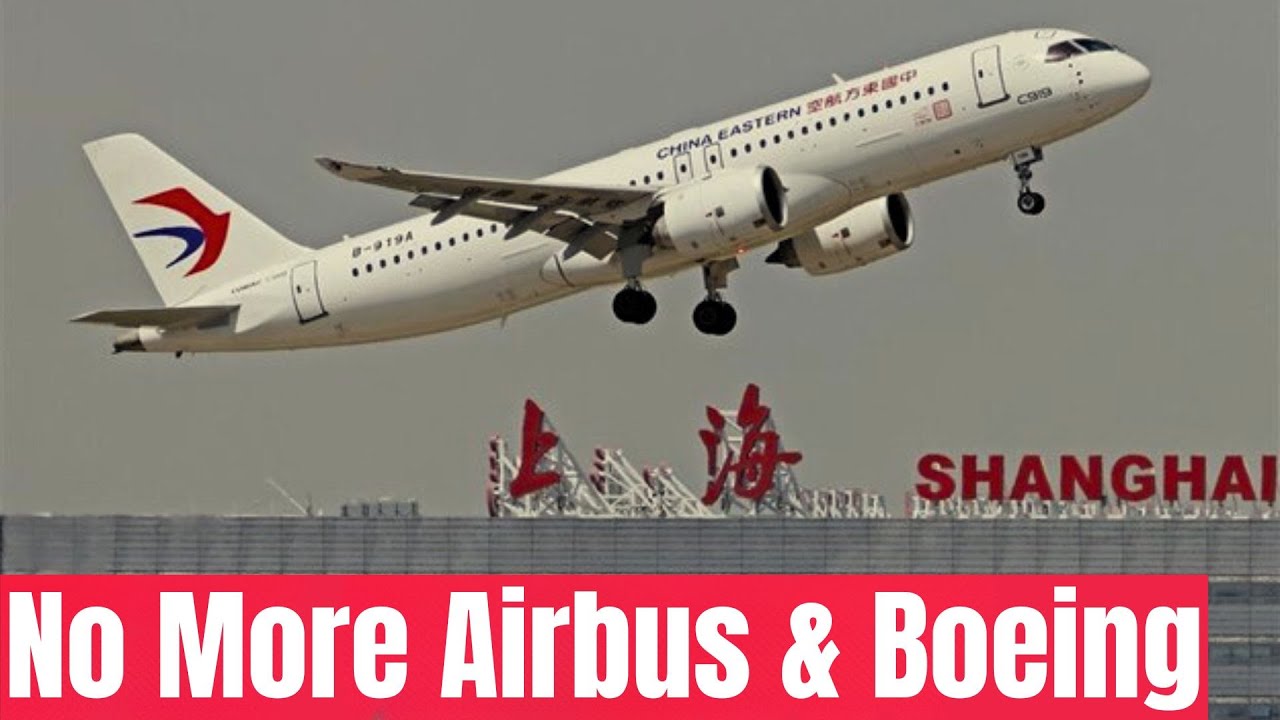
David Oualaalou breaks down China's C919 jet, a domestically designed commercial aircraft that completed its first commercial flight and has over 1,200 orders from 30+ countries. The plane underwent 200+ flight hours of testing, double the Chinese regulator's requirement, and marks a shift away from Boeing and Airbus's decades-long dominance of the global aviation market.
Chapters
All right, hello everybody, good to be with you on this live stream from home. Finally I am back to the States. I was about, what, yesterday, the day before? So, so excited to be here with you guys as always, and I mean it. So, uh, anyway, what I'm gonna be talking to you about today is a China's development of its own aircraft. How is that going to shape— now, it's going to shape the, uh, uh, what am I call it, the global aviation for that matter. It's a big deal. It is a big deal. So, but before I'll get into all this, as always, I like to express my sincere thanks to, uh, members and supporters and to all of you. And if this is your first time landing on this channel, please make sure to subscribe. So, and I truly appreciate it. So, so here is, as I said, topics for today. And, and, and I put it for you guys in form of questions. That's usually how I start my conversations. So the question is, is China now reshaping the future of global aviation? And I'm going to tell you why as we move forward. But these questions you need to think about. Second question about this topic is how— if it is the case, how is that going to happen? Okay. And the third, uh, question or consideration, you have to think about it from both the global economic and geopolitical landscape. So if we are to talk about reshaping the future of global aviation, well, both of them will have an economic component and they have a geopolitical one. That is So that is the key to all this. But before I'll delve deeper, let's do a tour around, uh, uh, quickly here. And I'm going to share some pictures with you. Let me get my reading glasses here so I can see what I'm putting here. All right, the first one is— let me see here. Yeah, it's, it's sad, but it's here. Take a look at this, guys. That's President Biden. He tumbles and fell during the graduation in, uh, I think Colorado at the Air Force Academy. So it's, it's sad. It's not about making fun of that. That's— we don't do that because that's, that's not good. So, but it's something that it's worth, you know, when you are a public figure, uh, let alone a president of a country, You can't shy away from disclosing this kind of stuff, and that, that, that's how, that's how I see it. So second one is, has to do with the Turkey's elections. I'm sure you guys been paying attention. I'm sure that Erdoğan won now the third term here. So what's important about this picture? This is a picture of Istanbul, by the way, uh, because it's going to be now very dynamic as far as that the, the, the PD, it's called, I think the political party there, it's called the PGD. Yeah, or PJD. Yeah, uh, because they lost these elections in 2019. Now that Erdoğan won this, how that's gonna now retake Istanbul? And Istanbul is, is, if you know anything about Turkey, everything moves through Istanbul, of course. Them. Uh, third one I want to share with you, it has to do with the recent disputes in Kosovo. Now, you're familiar with the, the history of what took place in, uh, 2006, or 1996, I think, '97, with the tensions that took place and NATO gets involved and, and, and the bombing of the Chinese consulate. You know, they said— NATO said it was a mistake. And, and all this. But now the tensions are rising. And why is this? Because you see different conflicting stories about this one. So the disputes in Kosovo erupted after Pristina, which is the capital, uh, decided to revoke, uh, its recognition of Serbian number plates for cars. They display them on a car, you know, in the northern region inhabited by the Serbian minority. You know, it's kind of ridiculous. Why will they even revoke that if it has been for the last decade or so? Why are they doing this? But to me personally, I don't think so just happen on the whim of the, of the, of the, uh, officials in Pristina. I think somebody's been fueling this kind of tensions. That's my personal opinion here. And the last one I share with you is this one here. Now this is very interesting, uh, this is considering the tensions between, uh, uh, US and China. By the way, guys, be on a lookout for a video as I promised you, uh, I did record one yesterday, the editor is putting it together, and I will release it for you as soon as I get it back. Uh, be on a lookout for why China has turned that actually China refused— not turned down, it refused to meet with the US. Well, what's interesting about this picture, um, when you consider the tensions between China and US, you know, the general, General Li Chengfu, and General— uh, General— Secretary of Defense Lloyd Austin just shook hands. That's about it. That is it. You know, it was no conversation, it was nothing else. But what's important about this is the secret visit. Yes, which by the way you won't hear anywhere else because they have not disclosed that CIA Director William Burns went to Beijing. When I was in Europe, I kind of get a word that he is on his way to, uh, Beijing, and he met with his counterpart, the chief of the intelligence agencies in China. And the whole reason For this is the— they want to ensure to keep the communications open. Uh, I don't know to what degree, but here is the thing, the interesting aspects of it. First of all, the question we need to ask is why General Li Chengfu was sanctioned to begin with. Well, that decision was made in 2018 when Washington imposed the sanctions on the Chinese defense minister, uh, Li Chengfu. That is Why? Because China at that time, based on the decision of Beijing, of course, but it was represented by the, the Secretary of Defense in China, Li Shangfu, for buying Russian weapons. And yet you sanctioning the guy and saying, no, we want to sit down and have a talk with you, just doesn't make any sense. So I don't know who's advising the Secretary of Defense for this kind of, uh, And this is why that visit of the CIA Director William Burns to China— it was in, I think, second week of May. It was quiet, nobody knew about it at the time, uh, because the White House is very, very concerned about the deteriorating relations between China and the United States. So anyway, let's move on to our topic. Uh, I'm not going to do the health segment today here because I have to cover a lot. And by the way, guys, just to let you know, I am in a process of, uh, considering doing a channel just for health tips. You know, I won't be alone because I am not an MD. I might have someone else with me who knows a great deal about this kind of topic. So, but I can share, like I always say, share with you, uh, the, the stuff that I do health-wise for you to stay in good shape. So, all right, let's talk about, uh, let me first of all check the, uh, see, uh, where are you guys joining me from? Yeah, make sure please you type in where you're joining me from. So, uh, Afi Ahmed from UK, good to have you here. Of course, TNT, good to have you as always. So, and I'm gonna get back to this, just type in in the chat box where you are joining me from, because there we have a lot to cover on this one here. So, so here's the thing. China now has built its own aircraft. Okay, now to some who said, okay, what's the big deal? Well, it is a big deal because when you consider the only two, uh, uh, main, uh, aircraft builders, Boeing and Airbus, controlling the global market, now you got a third player And as a matter of fact, believe it or not, and again, the media is not going to disclose this, and I'm going to detail this for you, it was already an order in Germany for the Chinese, uh, C-919 already. So, so we're gonna get into all this as I move forward. So as I said, China has built its, uh, first domestically developed and manufactured aircraft or passenger aircraft, that is, it's a big deal. So, and now China will be in a position to take on the two main giant competitors, Boeing and Airbus. And here is why I always say, guys, whatever happens doesn't happen in a vacuum. You all remember the video that I made for you guys about the, the French President Emmanuel Macron visit to China. Why do you think he went to China for? To shake hand with President Xi? No, because he was concerned about Airbus, which has a major manufacturer in France. That's going to now impact the economy in France, especially when it comes down to aviation. That is the reason why he went to France. And now China is moving forward with this, and the, uh, uh, especially with the, the, the test flights that it went through rigorous, uh, testing and all that, but they finally did the official, uh, trip. And, and I'm going to show— share with you some pictures about this one here. So the commercial flight, uh, because to me, the way I see it now, China saying, ah, the sky is the limit, now we developed our own. And you and I know how China operates. When China puts its mind into something, they'll get it done. It doesn't have to be done next year, but there is a plan. Because if you think about this, the process how this project started— and I'm gonna walk you through the chronological steps briefly here— when it all started, it started back in 2006. And what happened back then— and, and I looked into all this and checked the information, that's why I'm sharing it with you— China State Council established a major special command group for major aircraft. So what they did, they allocated a group of individuals specifically to focus on, on that project. 2007, the approval of the official establishment of a major scientific and technological major aircraft that was approved at that time. 2008, China Commercial Airline Corporation is established. 2009, code name was given, which called the COMAC C— or COMAC 919, COMAC AC 919, for the first model of the large passenger aircraft, which took place on May 28th when they did the first flight, the testing. And I'll show you the picture later on here. 2010, Civil Aviation Administration of China, the equivalency of the NTC for us in US, officially approved the type certificate application for it. And between 2011 and 2016, that's when the design approved and, and, and sort of the, uh, at the beginning or commencements of the aircraft part production and testing started at that time. 2017, the aircraft successfully makes its maiden flight in Shanghai. That was the first one between 2018 and 2020, start of a series of test flights. Because you can't just take, uh, uh, an aircraft to the sky, you have to go through a rigorous procedure. And this is exactly what China was doing starting in 2006. In 2021, China Eastern Airline officially signed the contract for the purchase of the aircraft. Okay, 2022, the Civil Aviation Administration of China issues a type certificate first for the first aircraft when it was delivered to the operator. And 2023, which is this year, of course, the large passenger aircraft C919 successfully completed its first, uh, its first, uh, commercial flight. Let me show you the picture here, guys, for, for, uh, yeah, it's right here. This is, this is the plane that was taking off from the Shanghai International Airport there. So that's the first one that took place on, uh, May 28th of this year. So, so again, but remember, there is one thing you need to know You need to know this. Still, with the production of this aircraft, China did cooperate with foreign entities or foreign corporations. I have two in mind. One is the US Honeywell, and the second one is France called Safran. That is, uh, why? Because China, uh, sort of, uh, they aim for this. Why China did all this is because he wanted to reduce his reliance on foreign aircraft manufacturing. Yeah, you all know what happens when a country is sanctioned. No spare parts for aircraft will be shipped to that country. This is exactly what China was thinking about way back, because it was just a matter of time. Of course, it will be economically a suicide if the United States sanctions China. What's going to happen is Americans will feel that in their pocket big time. And anytime you have economic sort of, uh, what's the word I'm looking for, uh, tensions within a country, when prices go up so high, people tends to get very, very nervous. That's usually will lead into more social tensions inside because the government will be unable to kind of lower prices because the markets where they get the products are a the cheaper prices, it's no longer there. That is where, uh, the, the challenge that the US cannot sanction China, and it won't be, it won't be a smart thing to do. Because my belief that if the US sanctions China, China will retaliate, and we all know what it means. Look no further than what's taking place in Australia right now. Even though the government in Australia is lying to Aussies about the true economic conditions in Australia. So like I said at the beginning, guys, the first question: how that's going to now impact the global aviation? Well, it's because now China has forged its path into sort of getting into the global market, especially in aviation. Why is this? It's because you're gonna have countries now I mean, placing orders from China, let alone one key component that I do see, it has to do with the tag price of the aircraft. China will not be charging what the US— I mean, what the Boeing— I'm sorry, what Boeing and Airbus are charging other countries. So now you have competition, and competition is good. Why? Because you don't have to buy an item at a high price if there is a competitor will— willing to sell it at a reduced price a little bit. Still, don't get me wrong, China still have to make profit, which is the, the, the core of what a business is all about. You know, China's not going to do it just because it wants to. No, it has to be some sort of return investments, and rightly so. But what it's going to do to the market in China is going to increase employment, of course, the jobs and so forth. I just read an article which I will share with you later on. I'm going to figure out how I'm going to do this for you. It was a scholarly article, very, very heavy on literature as far as where the challenges for the Chinese economy is. And again, I tie— personally, I tie economics to geopolitics, you know. And when I was reading this, when I was flying back to the States from Frankfurt, I was reading that and I was like, hmm, that is very interesting for the channels, uh, or for the community, for all of us to really understand and see the other perspective of how things are. So in my opinion, based on what I read, and of course there's the stats and all that, to me right now China's, uh, conquering this, uh, the global aviation market, it's a big deal. Because China doesn't want to be relying only, only on a financial aspect or the real estate or technology. They're gonna have to diversify. And this is exactly what I see, uh, that China's decade-long dream has come true now. That, that's the way I see it. So, and again, this aircraft was developed by the Shanghai-based Commercial Aircraft Corporation of China. COMAC, it's called, uh, the, the stock ticker, I think it's COMAC for it. So the plane in itself, just brief characteristics about the plane. Plane carries about, uh, 168 passengers and has a range of over 5,000 kilometers. So that's usually, uh, why is this important? You know, those are not, uh, sort of random, they vary because now This, this range is sort of throwing down a challenge to the global domination of the Airbus 320 and the Boeing 737. And I flew on those two aircraft. They are amazing. The ones in France, when I flew from Paris to Poland, the aircraft was— it was, it was a 320. I tell you, for somebody my height, I was a little bit cramped in the seat. So because there's not enough, you know, for tall people per se, but that's not the point. The point is that now by China create, uh, sort of, uh, building its own, uh, C919, now it's going to be dom— challenging the, uh, Boeing and Airbus. So, uh, the interesting aspects of it with this China Eastern Airlines first commercial flight, you know, which, uh, by the way, he went from Shanghai to Chengdu. I wish I could have put up a map for you for that, but sorry, I forgot. So, which is the capital of the southwestern province of Sichuan. Sichuan, I hope I pronounce it correctly, and please correct me if I mispronounce this one. It's called Sichuan. It's S-I-C-H-U-A-N. So the achievement, in my opinion, is the result of collaborative efforts. This is not one entity dominating the whole thing. No, no, no, no. It was a collaboration. And, and, uh, when I say collaboration, what do I mean by that? We're talking about the involvements of over 1,000 companies. Yeah, okay. And 300,000 researchers for over a decade. So this is to me where teamwork comes in, you know. And I take this concept and truly like to apply it to the global geopolitics, you know. Just imagine this for a second: if we would have had cooperation with other countries that we might have tensions with, how will the world be? You know, it's kind of common sense. To me, I see the example of this. So, and here is where the concern of the Western world now— why Boeing and Airbus is going to be now really thinking, what do we, what do we need to do? How are we going to manage this? Here is why. Excuse me. The reason being is because China is expected to sort of surpass the United States by 2040 to become the world's largest aviation market. And this is of course just an estimate and predictions. And, and the prediction, by the way, the one I found, it's from COMAC itself. Now there are those who will say, well, it's the, the company that is promoting its stuff, so it sells stuff. Yes, there is that possibility. I'm not denying this, and I will not deny that most companies here in the US will do the same. We're gonna do this and do that. But on the other hand, I am looking at evidence on the ground. Here is the, the work of a decade translated now to the establishment of China's conquering the global aviation markets. So, so this is where I see that challenge to the West now that China is able to build its own. So when you consider, just consider this, you can see there are over 40,000, yeah, 40,000 large and medium-sized commercial aircraft are needed globally in the next two decades. 40% large and medium. So if you are to say, well, it's only Boeing and Airbus going to dominate this market— no, not anymore. Now you have the third option, and countries will have to decide based on where they want to purchase or place their orders from. Cost is going to be a factor into this. Delivery time is going to be factor of this. Quality of the aircraft will be factor of this, you know, insurance on it, the spare parts and so forth. All this will make certain why it's going to impact— why, I mean, the Chinese development of the aircraft is going to have an impact on the global economic order moving forward. So, so when you think about 40,000 large and medium-sized commercial aircraft will be needed globally in the next two decades. And here is the thing: Chinese market will count— will account, rather, for about one-fourth of that 40,000 total. So you do the math. And this is why I put a question for you in the description about this. How will Boeing and Airbus is going to react to this? What will they do? That is the reason why I asked that question. So for Boeing, it's a little bit different than Airbus. Why? Because Boeing is involved also in some projects for the Pentagon or regarding the military dimensions. But I can see personally that with China building this commercial aircraft, you know, is going to only hone on its expertise when it comes down to the military aspects. It's no-brainer, just common sense. So, so, and this is why, uh, in the past, the sort of, uh, uh, uh, for China's aviation has relied heavily on purchase of planes from Airbus and, and the Boeing. That's been the norm because Boeing and Airbus have a lot of, a lot of market. So, so like I said earlier, the Chinese aircraft, the C-919, has already received— and get this, and I did fact-check this one here, you know, from the company. Now, could the company be lying about this? Possibly, possibly not. But why will they do that? Because if it turns out that they were lying, their credibility will go down. Forget about it. This is why credibility matters. And this is why, for example, you look at now, uh, and I tie it back to the— this why China refused, uh, US request to meet is because of the issue of credibility. The US will tell China, yeah, we want to sit down and have a talk with you. Then on the other hand, they'll do— the US will do the reverse, you know. So where is the credibility into that? It's no different than in a business, and in a business setting, once you lose credibility, it's over because that trust has been broken. That, that's the way I look at it. So, so the, uh, uh, this aircraft, this, the C919, already received 1,200 orders already from over 30 customers, which means 30 countries. You know, I'm sure there are some of them inside China, uh, they'll, they'll like airline in the, uh, company or whatever, they will place the orders. But what's interesting about this statement, this is what prompts me to come on the air and share this with you, because Western media is not going to be covering it accordingly. And I already saw something that says, oh, this is nothing but a hype. I already saw this, so, uh, I'm gonna get into that. So, and, and what's important about this 1,200 orders is among them is Germany. There's a company or airline called the, uh, Puran, P-U-R-E-N Airlines. You have also— so you got Germany, you have Thailand, Siri Airways, okay? And you have other Asian and African, uh, Asian Pacific and African carriers or airline carriers that have order or place order for this aircraft. So COMAC, the company that built this, the Chinese one, is predicting an annual production of the C919 will reach 150 aircraft soon. This is why I said it's gonna be a big change to the global market. First of all, domestic in China, because with what happened, with what happened for Evergrande, you remember the real estate stuff, China's government start to think we can't put all our eggs in that basket, it's time to reconsider other options. And to me personally, China wants to diversify its economic portfolio to ensure that the domestic The growth will keep going because, mind you, that China's economic growth has slowed down in comparison to what was predicted a couple years ago, you know. But even with the, the pandemic and all that, still China posted, I think, a 4% growth in comparison to the rest of the world. It was better, but still not at the 5 or 6 or even 7, uh, uh, percent annual growth. So, so this is why this is very important. And the— like I said last time, there will be, uh, or previously, I'm sorry, uh, there will be reasons for why some other countries will want to place orders. The cost, one of them. Then you got the so-called climate change, because this, uh, uh, aircraft, it has something better in comparison, in comparison to its competitor. And it has to do with the reduced carbon emission. Yeah, yeah, that is— and I'm not going to get into the technical because that's not my area. So I don't talk about something I am not certain of, and it's not my area anyway. So this is where I see the interesting aspects of all this. And again, I don't want to focus mainly on, uh, uh, on, on, on just the technical side, but having the understanding of the impact on the global economic and geopolitical landscape. So, so far, the test that— let me share picture with you— the test that, uh, or, or the flight rather, I'm going to show you here. This is the pilots. Those are the pilots that flew the aircraft here, the Chinese. Uh, and they're, uh, uh, they— it was based on what the passengers have described is that it was the, uh, uh, first of all, the aircraft was spacious enough and also comfortable cabin space, and the aircraft smooth taking off and landing. So thanks to the pilots, of course, uh, that, that's one of the, uh, the, the key aspects to all this one here. So the idea of, uh As I said earlier, I, I double-checked certain information to make sure, you know, and this is why I'm going to share this with you. I, I am planning probably a trip to China. I don't know when, uh, there are some times when you do this kind of analysis, okay, it's like what we, we did in Europe. We had to go to Europe physically. We're gonna do the same for China. It's because When you provide analysis, you have to at least be on the ground to see with your own eyes. This way, your assessment is objective, accurate, and to the best of your knowledge, based on what you saw, not based on what the media has reported. So this is one of the reasons why I said earlier I had to double-check the information to make sure, because here is why. Foreign media already, already expressed skepticism and raising concern about safety standards and noting that many parts for the new plane came from overseas suppliers. There is some truth to this, and the two things that I'm talking about is Honeywell Company, which is an American, and you get Safran, uh, which is a French. Yes, they did participate But the bulk of the work was conducted by China. So how come all of a sudden Western media will sort of lump everything into one, one, one, uh, one package and say, wait, wait, wait a minute, you know, we doubt that China— we have doubt that China built its own aircraft? You know, it's no different than what happened with the space station. When China wasn't allowed to be in, in the ISS, the International Space Station, China said, that's fine, we will build our own. Within a year and a half, with 3 flights, the modules for the space, uh, station, the Chinese space station, went up. And all of a sudden here you have a space station now that is running. So what makes that different than this one here? For— and the media, by the way, they couldn't claim that it was no Chinese space station because they know it's true. There is a space station out up there that belongs to China. So this is to me, and again, I'm just trying to be pragmatic here and objective when presenting assessments, we call a spade a spade, you know. So why, why foreign media would already be expressing this? And like I said earlier, in geopolitics you have to always think about the context, and nothing happens in a vacuum. The fear that the West has, including headed by the US, that is, is that we couldn't compete with the Chinese. That is what's at the heart of it. And now you see in these examples step by step. What do we expect? Do we expect the China of today to be the same as the one it was 30 years ago? That's not the case. You know, we— how long can we be living in denial? You know, the shift in the global order is upon us whether the West likes it or not. That's just a fact. So to me, if I were advising a head of state, whatever, the president in this case, which I am not interested in that anyway, uh, it's because they're not going to end up doing what you recommend for them, is, is cooperation. Everybody wins. The whole world will win, for that matter. Yes, you're gonna have to make profit. Yes, you're gonna have to think about your interest like every other country. But heck, come on, wouldn't it be nice to cooperate so can move forward? That's the way I— that's the way I look at it. So why the criticism from Western media? Uh, and, and, and here is the thing, the other thing that I heard and I read, by the way, is that some of this report saying that the C919 is a mere imitation of Boeing and Airbus models. Well, what do you expect? It's a model. So, but at least they build it, it belongs to them. You know, we, we probably did the same of something that belongs to some other entity, whatever. We just had to develop it differently and, and we got it. So, but I think the fear is now that China sort of conquering the global aviation market. That is where the fear in the West. And, and to me, uh, it will be just the idea of matter of time before you start to see more countries moving into that direction of placing orders from the, uh, the, the Chinese company that just built this one here. Yeah, because the West doesn't want competition. Well, there is nothing you can, you can do about that. The country, China in this case, is moving forward. It has been moving forward for the last 30 or 40 years. You know, would have made more sense if we would have cooperated back in the '70s instead of taking a hard stance. You know, the whole global order, how we moved. There were three main players back in the '70s, in the last century: United States, China, and the Soviet Union back then. Can you just imagine if they would have sit in together, three of them back then, and coordinate and cooperate? Will we be seeing these tensions that's going on right now? No, we won't. Now, in face of this criticism, China is saying, listen, the C919 was subject to the most rigorous testing and validation procedures, and rightly so, because again, credibility of the country lies and hangs in a ballot. Can you just imagine if that aircraft took off and all of a sudden something happened, then it went down? Yeah, that's why they had to do the testing and, and all that, to the point that, based on the report that I read, those procedures exceeded the international safety standards. That's, to me, it shows me the— and again, I am an uprising China here, whatever. Don't— you guys know where I stand. What's subjective is objective. So you give credit where credit is due. They took— they, China, took an extra step to make sure that the testing is as rigorous as it can be to ensure the safety. And you applaud them for this if they exceed international safety. You all remember, uh, a few years ago when the planes were falling from the sky because of some malfunctions in one of, uh, it was a technical All I remember is some Ethiopian Airlines, which was, by the way, Boeing or Airbus, one of the other, fell down. So, and to prove this to you is that the aircraft, the Chinese one, the C919, was subject to more than 200 hours of test flights. 200 hours of test flights. Usually, based on my understanding, and I am not a flight engineer, I don't understand that world, Uh, you won't need 200. That will be for aircraft, for, for, uh, uh, 5 pilots, and they have to go through training and they have to have so many hours, you know. But for testing, you probably would not need 200 hours, but they did. So, which by the way, this one doubled this amount, 200 hours doubled, uh, the requirements of the Chinese aviation Administration, uh, or the Civil Aviation Administration of China. So what's interesting now is that despite all this, uh, let me share this one here with you. No, no, I'm gonna wait. Uh, uh, what's interesting is that now C919 has yet to receive airworthiness What do I— certification. And guess where that recommendation will have to come from? Now you'll be shocked and you'll ask yourself why. You know, it has to come from none other than the Federal Aviation Administration in the United States, the FAA, and also the European Aviation Safety Administration, which we need to effectively compete globally. Now you don't have to be an analyst to figure this out. You put the two together and you figure out— now, are they, are they both the FAA and the European administration will move forward and certify this aircraft, or they're going to create hurdles for it? I'll let you— you can leave the answers in the, in the chat box., if you like. So, so, and as I said, uh, it's gonna be a challenge. It's gonna be a challenge moving forward because now China has sort of put a foot in a global market that was only dominated by two main ones, Airbus and Boeing, because Time is changing. That is just part how, how it's moving forward. That's the way I see it. Now let me share some pictures with you guys here because I want you to see, uh, certain aspects of it. Uh, of course, the— where is the— right here. Where is the first slide? Now this one here, of course Now this is again C919 operated by China Eastern, takes off from Shanghai Hongqiao International Airport. Okay, that's the first one. Second one is the— this one here is the pilots celebrating inside the cockpit, uh, pose in the cockpit of the C-1 before its maiden flight on May 28th. Yeah, that's when Uh, I, I was aware of it, but I was in transit. I couldn't do a video on it and so forth. So then you have the next one here, guys. This is the top officials. This is the top officials from the Civil Aviation Administration of China, Commercial Aircraft Corporation of China, and China Eastern, uh, were among the dignitaries of the C-919's first commercial flight. Those are what you see there. Those are all belong to the three entities. Those are not regular passengers. Those are from the companies that put that stuff together. So, and you can just see, look at the space, it's very spacious. So I, I truly, I hope one day to fly on that one. The next one is the flight attendants here, you know, uh, flight attendants were as excited as passengers to be part of history because it's a big deal. This is no small matter. So to me, it was like the idea of Western media already putting skepticism. Why? Why would you do that? Why not say congratulations, we applaud your effort? You know, that, that's to me the, the decent things to do. I understand the world of competition and so forth, But come on, you know, I just don't get it. I really don't get it, guys. So I knew this will happen as far as the comments from, or statements from Western media and so forth. And the last one I want to share with you, the last image rather I want to share with you, is this one here. This is a prototype of China's domestically developed CJ-1000 engine. Which, by the way, to be used on the C919. Now remember, at the beginning, of course, during the process, China did include Honeywell and Safran. That's a French company. You know, they did— they played a role into this, but not 100%. You know, the work, the, the load was conducted by China. Those companies had at that time, part of— because it's a business decision, has nothing to do with politics, you know. But now with this image here, and I can only see what's coming as far as the global aviation. And this is again why I said what I said earlier, as far as, uh, the, the competition that's going to be created in the aviation industry. So Um, so it will be very, very, very interesting, uh, uh, where this is going to move forward. All right, let me see where you are joining me from, and I'll take one question or two. Uh, then I'm gonna have to leave because we got a, uh, uh, get-together with the entire team because we all are back to the United States here, and we are planning on doing probably a live stream on the other channel uh, for the, the trip that we took overseas. And, and there's a lot to share with you, so we're working on how we're gonna, uh, provide this. And we're gonna resume our activities, so we count on your assistance and your help and your support, especially if this is your first time landing on the channel. So just make sure to subscribe, which we appreciate it. All right, let's see, I'm gonna start from the top here and see, uh, where are you guys joining me from here. Uh, oh yes, uh, uh, ARA about the, the deadly train crash in India. Yeah, it's, it's very sad. It's very sad. And this is again, you know, to those who really— we talk negative about— no need for that. No need for that. That's a human life that was lost in a tragic accident. So we need at least to show a little bit of compassion. You might disagree with what India policies and so forth and And but, but, you know, in a moment like this, you show compassion. That's the decent thing to do. But also, this highlights the need for India to truly work on its infrastructure. That is, to me, you know, it's common sense. You have to build a good infrastructure and so forth. All right, let's see where you are joining me from. Just type in the, uh, uh, where you are joining me from here. So Oh, okay. Raymond Lee from Vancouver, good to see you. Um, uh, let me see again who is, uh, uh, Tommy Putra, as always good to see you from Jakarta, Indonesia. Speaking of Indonesia, by the way, it came to my attention, I'm gonna dig into that and do a video for you guys. Indonesia proposed, uh, uh, uh, uh a peace process to end the war between Ukraine and, and Russia. There are 3 main, uh, uh, talking points to it. So I'm gonna look into this and what it tells me— more countries now truly wanted to push for a peace agreement to stop the conflict, and yet the United States and the global, the collect— the collective West are still pushing for that. You know, Germany has no say. Germany is so weak. UK, of course, has to follow its master. Australia can't even move an inch. As, as I said on, uh, on the video, you will see it, that, uh, uh, uh, Prime Minister Albanese, Albo, he's the one who gave the keynote speech at the Shangri-La Dialogue. You know what he's gonna say? He's gonna be saying whatever the United States and UK wants him to that's it. Nothing creative on his part because Australia has surrendered its sovereignty already. So, so, L, as always from Montreal. So I will be visiting Montreal this summer, by the way. So TNT California, good to see you. Uh, Peter Kwa from Manila, Philippines, good to see you. Uh, let me hear. Albert Beck, hello to you as well. Uh, Aritha from South Africa, Speaking of South Africa, they are preparing for the BRICS summit, so there will be some interesting developments during that meeting, or that summit, that is. And I will keep you informed about all that by providing brief analysis, and we can even do live on it if you guys, uh, uh, uh, feel like it. Just let me know. So yeah, TNT, you cut the live stream. Good to have you. Good to have you. All right, let me see. Uh, Athene Wu, good to see you too. You know, happy to be back here to the state. Yeah, and I will share with you the, the entire trip. I snapped some pictures, I did some videos, uh, recorded on my phone, and I'll share all this with you, provide you some, uh, uh, real assessments on the ground as I was there. So, all right, let me see. Uh, and I'm going to answer a question or two for you guys. So if you have a question, just put it there, please. Just put Q, question, so I know it's, it's a question. Oh, let me say thank you to, uh, Casa de Fogo. Thank you so much for your super sticker, truly appreciate it. Uh, if you can let me know where you are joining me from, I would really appreciate it. But thank you so much for your support, it really means a lot. Uh, oh, TNT! Oh my God, TNT, thank you so much. A small contribution to you for your report on your first C919 flight and report on it. Thank you so much. Yeah, yeah, because I actually, when I was flying back and I found out about the, the test flight, I said to myself, as soon as I get home the next morning, I'm gonna do live. And that's exactly it. I got home yesterday, the day before, you know, jet lagged and all that. Now I'm back to, to my regular schedule. And I said, no, no, no, no, no, the viewers needs— our community needs to know about this. And that's what prompted me. Thank you so much, TNT, for your continued support. I truly appreciate it. So, uh, okay, let me see. Oh, Tamputra, there he is! Thank you so much for your support. Russian Airlines will be using China C919. Mark my word on it, because the spare parts— this is why, and I'm glad you said this, uh, Tempo, I'm glad you put this statement here. It's because here's the thing, the challenge that the Western or the West is going to find out is that now China, by conquering the aviation markets, they're gonna have the third alternative to Boeing and, uh, Airbus. In case of sanctions. This is what's going to be the key that's going to put China on a different path completely from— and mark my word on this— most countries. It's going to go with the Chinese model, you know, proven that China ensured the safety and the efficiency of the aircraft. And I am sure they're going to keep an eye on that. Because their credibility hangs in the balance. That is it. So mark my word, yes, Russia is going to be getting the spare parts and other countries very, very soon. Thank you so much for your super sticker, truly appreciate it. Uh, let me see again if somebody from other play— other part of the world. And if not, I'll take a question, uh, of, uh question or two. So if you have a question, just put— Steph Lynn, good to have you as always. Steph Lynn is a— she becomes a channel member. Thank you so much for your support, we truly, truly appreciate it. So, uh, I think— woo, I get Chinese planes could get certified. I think we'll put— hello David, I get the Chinese planes could get certified in Europe. But very possible not in the US. Yeah, there is that possibility. And, and wait until you, uh, see the video that I'm going to be releasing soon about, uh, why China refused to meet, because I tackled one aspect of it, and this has to do with the credibility. You know, the— this is why I'm like, why, why the heck is already putting negative energy about, oh, we discredit what China has done? Why? It's there on the ground. They tested the plane. It went through rigorous testing and it passed all the tests. Why not say congratulations to China and move forward and move on? It's almost like that concept of live and let live, you know. And again, this is what I'm coming now to the conclusion as to what is at the heart of these tensions between the West, especially United States and China, is that we are not willing to accept that another rising power is moving up to the top, which means any further negotiations or talks between the United States and China will have to be on an equal footing. That's something we're not willing to accept. Well, guess what? The world is moving on. The geopolitical landscape has shifted, whether the West, including the US, likes it or not. That's just fact of life. That's just how it is. So, all right, let me see here. And I'm scrolling down, guys. Uh, uh, I'm scrolling down here to see if there's a question. I'll answer one or two for you guys. And by the way, like I always say, I thank you so much, guys, for really keeping this civil. I truly— I read all the comments. I truly appreciate it. Uh, Abel Malcolm, good to see you as well. I said good to have you back, Dr. O. We need some sanity in America. We do, we do indeed, we do. I'm not laughing, I'm laughing out of sadness to to see what has become of my country here. You know, I get criticized, of course, because I'm talking negative about America. It's the love of the country that prompts me to talk, because somebody has to take the ball and run with it. Somebody has to say something. To me, that's what leadership matters. You know, if you are sitting in the comfort of your home and everything is fine, but when hard time comes in and you couldn't take step then what's the point? And this is why I never got— I never understood this kind of statements from those individuals. I forgive their ignorance. That's all I can say. Good to see you, Abel Malcolm, as always. All right, let me see, uh, Uh, let me see any questions. If not, I'm gonna sign off because we have to go for a special lunch today on the weekend since we all just got back, and I just got back. So that's what we're doing. So in any event, I hope you find this very informative. And once again, guys, just to remind you, if this is your first time landing on our channel here, please make sure to subscribe so you can support this channel, because without your support, there will be nothing. And I'm saying it straightforward. That's my way of saying to you, help the channel, and that's one way to do it. So, uh, be on a lookout for a video within the next 48 hours or so. Uh, I'm gonna be tackling that, and I am working on a list of topics that I'm gonna be presenting to you this coming week. And, and, and back to our regular schedule. As always, thank you so much for your kind support and for being here sharing your time with me. It means a lot to me. As always, remember, geopolitics impacts your daily life in more ways than one. Till next time, guys. Bye-bye.
More from David


Beyond the Single Actor: Why the Gulf Isn't Choosing Between the US and China


Iran, Iraq's Militias, and the Houthis Are Coordinating! This Changes Everything




Who Controls the Next Decade's Resources? Latin America and Africa's Geopolitical Crossroads

The Chokepoint Trap: How Washington's Stupidity Triggered a Cascade That Now Controls the World

Trump Spooked as IRGC Unveiled dual-use SLV, Deployed Ghadir Mini-Subs & Hinted at Tactical Nukes!
