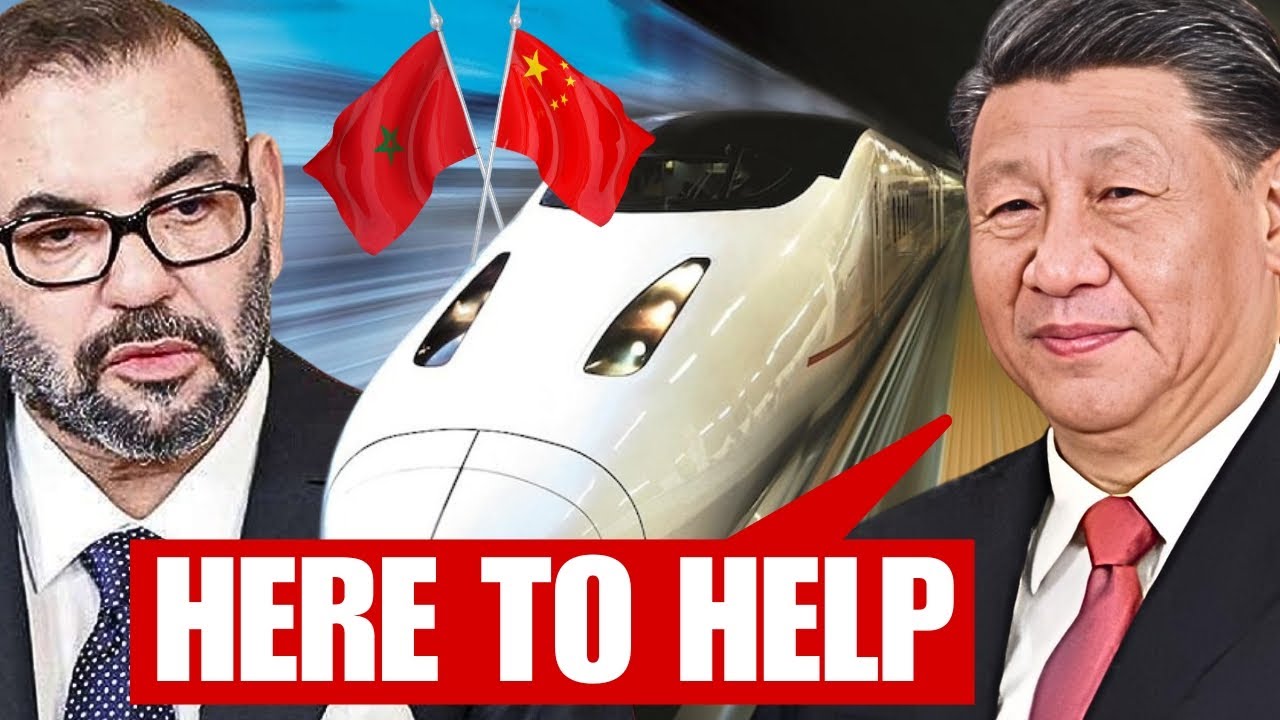
This content was created by David Oualaalou. This content was uploaded by David Oualaalou. This is a YouTube video titled "China to the Rescue: Reviving Morocco's Economy?" (created 2024-11-26T19:36:25+00:00). Based on the title and metadata, the video likely examines China’s economic engagement with Morocco—trade, investment, infrastructure projects (e.g., Belt and Road-related activity), and whether Chinese assistance could help revive Morocco’s economy. No transcript or speaker information is included in the provided excerpt.
Chapters
All right, hello everybody and welcome to Geopolitical Trends, where truth matters. Excited to be with you as always on this glorious day of November 26th. Two more days for Thanksgiving here. So, uh, I, I, I'm not a big fan of Thanksgiving, uh, because to me, I don't always believe you don't have to wait for a particular day to be thankful. You can be thankful every day. Every day you wake up, you have to be thankful. So, so anyway, 2 more days for Thanksgiving, and here in the US, for those who celebrate it, so I want to wish you a happy, happy Thanksgiving. So I got an excited, uh, exciting rather topic for you. I will be talking about the strategic stopover this technical stopover in Morocco by the Chinese president, President Xi Jinping, on his way, on his way back to China when he was attending the G20 and the APEC in Latin America. On his way, he made a stopover in Morocco. Very, very, very, very strategic. So, so that's what I'm going to be providing you my analysis about. It happens to be an area I am very, very familiar with. Uh, I also will talk to you about geography and history of that part of the world because it's very, very interesting to know certain dynamics. So, uh, first let me just say hi quickly to the community, see who's here. Uh, Muhammad Mazhardin, good to see you and good evening to you as well. Taiwan Steel, as always. Truth Seeker, good to see you. Alba Beck, good to see you. Peng Yu, Uh, Thunderbolt, Thunderbolt, I haven't seen you for a while. Hope everything is all right. So Poseidon, as always, uh, we are thankful to have you. Dr. O, uh, you're most welcome, you're most welcome. Francis Tango, as always, an avid supporter of the channel. Um, Timeline Dunkley from New York City. Uh, see you, good to see you, and hello to you. KL, greetings from Singapore, good to see you, and Speaking of Singapore, while I'm thinking about it, I noticed the video, guys, uh, the interview I did with, uh, with Anna, uh, Mandok, uh, got a lot, a lot of views on it. And it seems to be a lot of people, some were upset about what she said. And so I am going to bring her back for part 2. Believe it or not, we're going to do that because I am also digging out some other information And I am gonna be asking her, uh, of that. So I will be coordinating with her, and we just, uh, once we set the time, I guess let you know, and, and just go from there. But I was very surprised. But again, to me, she seems to be, uh, logical in her arguments, and, uh, I truly enjoyed listening to what she had to say. Learned a lot also from her, and I will, I'll bring her back, uh, soon in due time. So also want to let you know about my interview was supposed to be scheduled today with Dr. Michael Krupa. Something came up to him personally, I understand. Of course, he, he text me, we talked, and, and we rescheduled it for tomorrow. Uh, Dr. Krupa is a, is a historian by training, uh, his PhD is in history, uh, so somebody you really want to listen to what he has to say. Very insightful. I had a chance to have dinner with him in Wrocław when I was in Poland last year. Very, very wonderful human being. So I look forward to that conversation tomorrow. Also remember to join me on Saturday for my conversation with Carl Zha. I know we missed last month. I was in— I just came back from China at the time. I wasn't ready for that. And also for our community discussion, which will be on Sunday, last day of the month. So this is what I'm going to be, uh, uh, talking, uh, to you. But this is our community the conversation. All right guys, let's get into our topic. Well, as I mentioned, uh, recently President Xi Jinping, which was 2 days ago, made a stop. It's called the technical stopover. In other words, in a simple language, this wasn't scheduled by the state. This wasn't— it's just kind of, I'm passing by. It's kind of like, yeah, there is something we can talk about. And once you know, uh, really what took place 2 years ago this might make more sense to you, and this is what I am going to be, uh, talking about. So if you have— by the way, if you have specific questions, I will answer the, uh, Super Sticker questions, uh, later on towards the end. So this was on his way to President Xi's, uh, way back to China. And this is what I'm like, okay, this is not a coincidence of sort, because on two fronts, on the geostrategic aspects and on the economic front, and I'm going to be addressing those too. So, uh, suffice it to say, for now, I feel comfortable as an outside observer. I would be comfortable to say, uh, that Morocco is reversing its position vis-à-vis China, what it did 2 years ago. And I'm gonna detail to you what the real story is all about. So, so first, let's ask the key questions uh, pertain to this particular topic. And I'm going to get you the questions here, guys. All right, here's the first question: is why did President Xi make the stopover? Because remember, this is not just for China, it's also for— and this is not just for Morocco, but also for China. China also has to think strategically about all this, and there is a strategic calculation that China has did, and rightly so. Because any smart leader will be thinking in these terms. We're not talking about confrontations and fighting and tensions and all that. No, no, no, no, no, no. We're talking economics, economic prosperity. That's where the strategy is. Second question: is this an opportunity for Morocco to reverse its, uh, stand or position? Because remember, way back, China expanded— extended, rather, an economic venture to upgrade the city of Tangier, which is up north. I'm not gonna— I'm going, I'm going to share with you the geography, but Morocco turned it down. And I bet you, you want to know why? Because of pressure from the United States. I know this for a fact because there were other— even when I was in Washington, DC, I was away because I'm very familiar with this part of the world. So we were familiar with the policies that what Washington will dictate. As a matter of fact, I'm going to share this with you. It wasn't reported openly, uh, and about literally almost around 2 years or so, a year and a half, 2 years ago, Morocco wanted to float its currency against the dollar. And guess what United States did? It pressured Morocco not to do so. So Morocco end up not floating its currency. This has to do with the finance because of the debt and so forth. This is why you see in the, the conversion— I was in Morocco about, whatever, 8 months ago or so before I went to Spain on my way there, and the conversion was about $1 to about 9 or almost 10 dirhams. Dirhams is the Moroccan currency. So you're almost the equivalency of $1 for $10. That shows you right there. So when Morocco wanted to float its currency, Washington threatened Morocco. Because here is the thing a lot of people do not know, uh, uh, uh, Washington is protecting Morocco. There are certain things that even people inside the government do not even know. I can't disclose that no matter what, and I don't care what some of— some might say, well, if you don't disclose, if you are not going to disclose it, don't say it. Well, sorry, I, I'll be breaking protocol. We're talking about some major sensitive stuff. I can't disclose it, I'm sorry. But I can tell you there is something going on that is protecting Morocco, and that was one of the reasons why the two main events— one when Morocco reversed its decision regarding floating the currency, and second one when it, when it told China no, we don't want to move forward with the project of upgrading the city of Tangier because China wanted to have 50% in return for that investment. And rightly so. That's like you when you go enter into a business transaction with someone. You want— if you pay for something, you want the product. Simple as that. So, and, and third question into this is, what will the US reaction be? Yes, it will be a US reaction for this because some might think, oh, what does the US have to do with this? A lot. So, so suffice it to say that Morocco and China now sort of kind of trying to achieve some sort of, uh, uh, development, growth, uh, whatever term you want to use in their relationship. Because always remember, 2 years ago, uh, Moroccans, I think authorities ban Chinese visitors from visiting. I do not know why. I do not even— I didn't even dig into this because when I went there about a year ago or so, of course, for me, I'm, I'm an American citizen, so I shouldn't be an issue. But I wasn't even aware of that. I'll admit it because I wasn't aware of it. Why would Morocco ban Chinese from visiting? But now apparently the government in Morocco reversed first course. So now the Chinese are visiting. Is this why only 4 months ago Morocco reestablished cultural exchange with China? Makes you just wonder, whatever that is. So, but anyway, during this recent short meeting between, uh, President Xi and the American side, which was represented by the Crown Prince— his name is Hassan, I believe, uh, uh, his dad couldn't make it, his dad is is health-wise, it's a little bit sick, whatever. I don't know what the circumstances were. In any event, the Crown Prince attended this meeting with President Xi in Casablanca. It wasn't in Rabat, the capital, it was in Casablanca. That's very well. So the conversation centered around the, you know, the economic, the diversification of trade and so forth. But there is one key to all this, and this key comes from the Chinese side more so than the Moroccans. And this one has to do with China strategically pushing the EU away from Africa in general and Morocco in specific. That's a strategic move, because if you think about it, guys, from Morocco, North Africa, all the way to South Africa meaning the whole continent, all the projects are involved by which country? The US? No, China. And when you look at what's going on in the Sahel region by trying to create a confederation of the, the three— Mali, Burkina Faso, and Niger— after kicking the French out, all of a sudden it became clear. As a matter of fact, the EU reached out to Morocco for gas that comes through a pipeline from Nigeria. And I'm going to address this particular aspects of it. So one thing that I need you to understand, China capitalized on its relations with Morocco because remember the trade between the two countries reaches about 60%. There is a good relationship out there, but when it comes down to Morocco being pressured by the US, of course he's going to have to bow, uh, to the Americans for that matter. But also Morocco gets something in return, and I will explain to you what does it mean when we talk about the Morocco and Israel relation, diplomatic relationship. So, so let's talk about geography, uh, briefly here, and then I'll, I'll get on, on to, uh, the history. Then I'll do my analysis for you and answer any Super Sticker if you might happen to have one. All right, let's do geography here. Let me share the screen with you, and I'll give credit to, uh, World Atlas. All right, let's share the screen here. Okay, it's not showing here yet. There we go. All right, Morocco. What do you think about Morocco? Where is located? North tip of Africa, northwest. So it's considered North African country. Uh, uh, they're just using the term north because it's north of Africa. It's an African country as well. So it is located in the Maghreb. Maghreb region is known in, in, in the part in, uh, uh, uh in, in the African continent. So the Maghreb, that's how it's known in certain literature. So, so it is located in the Maghreb region in the northern and western hemisphere of the Earth, and it is bordered by two main countries of the Western Sahara to the south and Algeria to the east. It has coastlines of the Atlantic Ocean, uh, to the west and the Mediterranean Sea. So the countries that borders Morocco, uh, that includes Spain, Algeria, Western Sahara— that of course used to be Mauritania in the south, and I'm gonna get into that. Uh, two things you need to know about its GDP: it is about $118 billion on a yearly basis, that is, and the GDP per capita is about $3,200. $4. That's usually where, uh, where, where that is. So, so when you look at the country right here, this is Gibraltar, this is Portugal and Spain, uh, but if you go all the way to the south, this is a city called Tarfaya, and this is Western Sahara. If you look at the map, the way it is structured, this is an, uh, the, uh what you call it, World Atlas has it there. In other maps, you see Western Sahara as part of Morocco. That is one of the things I need you to understand regarding the maps. So, and there's a reason for why, and I'm going to explain why that is the case. So, so when President Xi and the Moroccan side, represented by the Crown Prince, addressed one of the key aspects, and this key has to do with two terms: maintaining a national security and stability. So why that is? For two reasons. Because Morocco has almost similar issue that it could exist for China as well. And two things that comes to mind is Taiwan on the side of China and Western Sahara on side of Morocco. So both countries agree because Morocco does not recognize Taiwan as so-called independent. And the same thing, China recognizes the Western Sahara as part of Morocco. This is what you need to understand, the strategic calculations of China in this aspect, but also for Morocco as well. So So, and, and, uh, one thing you need to understand is that, uh, the, the conversation that took place, uh, between the Crown Prince and President Xi, uh, sort of focused on those two aspects in addition to the economy, because President Xi made it clear vis-à-vis the relationship that exists between Morocco and China sort of have been developing nicely. Over time. Morocco and China never had any, any tensions, despite China understand that Morocco is under the camp of the US. It's always been, because Morocco was the first country to recognize the independence of the United States, just for a historical record to guys let you know. So of course, President Xi acknowledged the last visit of the king, King Mohammed VI, the current king, uh, to China back in 2016. I think I have a picture, uh, for you guys to see, uh, uh, if I still have it. Uh, no, I don't. Sorry. So anyway, uh, uh, so President Xi addressed that he is willing to sort of work with Morocco as far as, uh, implementation of what China did regarding the China-Africa Cooperation Summit, which was at the 10th Ministerial Meetings of the China-Arab State Cooperation Forum. You all remember that one that took place in China. That's a big deal. So, so China's kind of— may— wanted to make it clear, uh, to Morocco, this is what we are planning on doing regarding this aspect. So now let me get into a little bit of history for you to understand how Morocco came to be. So it's— and by the way, I'm gonna put a link for you because there is great article by, uh, uh, Alistair Buddy Evans, and I remember reading some other articles, uh, pertaining to history. Very, very insightful. Uh, so when you think about Morocco in the classical term, way back, so Morocco has experienced a lot of invaders. Yeah, and throughout its history, from the Phoenicians to the Carthaginians to the Romans, Vandals, and Byzantines, you know. And of course, with the arrival of Islam, Morocco kind of changed. It developed, that is, developed into some sort of independent states. They were different. Uh, it was till the first dynasty when we'll start with the Berber. The Berber is B-E-R-B-E-R. It's known, they have their own language, uh, or dialects. I'm sorry, not language, dialect, the Berber. So this one goes back to 702. That's how far back it goes. So the Berber sort of submitted to the armies of Islam and adopted Islam. That's how far back it goes. So the first Moroccan states formed during those years, meaning over back in 702 forward. So, but many were still ruled by outsiders at that time. So, so, and I'm gonna just move briefly here in history because it's so long, it'll take me too long to cover everything. So I'll move back to 1056, and this is where an empire, a Berber empire, rose to power. However, under the Almoravid dynasty, which is known in Arabic to those who speak Arabic, it's known as Almoravidun. So, uh, under that dynasty, and for about 500 years Morocco was governed by Berber dynasties. So you're including the Almoravids, Almoravidun. You include the Almohads, which is Almohadun, and you include the Marinids from— and all those starts in 1056, 1174, 1296, and the last one was Al-Wattasid in 1465, because you have to go back to this. So it was during the two main dynasties, the, uh, Almoravid and Almohad. Almoravid, Almohad, that's known in Arabic history if you happen to read that one. So, so there's two controlled Morocco and much of North Africa. This is why— when I say North Africa, I am also including part of that region, Portugal and Spain. And in 1238, to be exact, Almohads lost control of the Muslim portion of Spain and Portugal, which was known at that time as Andalus or Andalusia. And here is one thing I'm going to share with you. Usually I don't talk about my private life. My ancestors are from this part of the world in Andalusia. We're talking about way, way, way back. So the Marinid dynasty attempted to regain it but never succeeded. So the siege of Sevilla— it's known in Spain as Sevilla or Seville, S-E-V-I-L-L-A. There is Seville and there is Andalusia, which was between 1247 and 1248. Yeah, which was about almost a 16-month successful investments during the Reconquista of Seville by forces of Ferdinand III. He's the one who sort of, uh, uh, took over this. And he was known as Ferdinand III of Castille or Castilla. That's how he's known. So what happened? Although perhaps eclipsed by the geopolitical importance, and this has to do with the rapid capture of another major city in Spain, which was under the Muslim rules at the time, is known as Córdoba or Córdoba. Cordoba, which was in what year? 1236. What does 1236 mean to you? The, the, the rise of the Muslim, uh, uh, empire at that time, which expanded all the way to the east, which means including Sevilla, Andalusia, Córdoba, and, and the southern tip of Spain. This is what's important. And it was almost the last major operation Ferdinand III conducted at that time, and till he lost, uh, the, the city. So this paves the way for the revival, uh, go to go back to Morocco at this time, the revival of Moroccan power, because all those dynamics impacted the country. So in the mid-1500s, a powerful state arose in Morocco under the leadership of Saadari dynasty or Saadi dynasty, and that one has taken over southern Morocco in the early 1500s. So, so what happened? The Saadis defeated the, uh, the Wattasi in 1554 and then succeeded in holding the incursions by both the Portuguese and the Ottoman Empires at that time. Fast forward to 1603, a succession dispute, uh, led to the period of unrest which lasted until 1671. That's when he with the formation of the Awalids or Alawites dynasty, which is, by the way, the current king traces his roots to the Alawites, which still governs Morocco till today. So during this unrest, Portugal has gained, has again gained a foothold in Morocco, but it was again thrown out by the new leaders. Then comes the European colonialism. And this started in 1800. So at that time, the influence of the Ottoman Empire started to fall down, and that gave, gave a rise to which country? These two main countries in Europe at that time vis-à-vis Morocco were taking interest in Morocco. Can you name those two countries, European countries, and did it have an influence in Morocco? Let me see if you guys can, uh, type in which Which two countries? Just remember, remember the era or the time, that is mid-1500s and mid-1800s forward. So which one, which two countries? Uh, oh, Spain. Oh, Advent, you got it. Advent, you got it. It was Spain and France. Indeed, absolutely correct. So, so what, what happened with those two countries? They began taking a great interest in Morocco. So, and this is where there is an island. Let me— oh, I took the map out. Let me see. And I doubt it you will see it here, guys. Yeah, it's not on the map, but anyway, I'm going to mention it. There is a place called— and I used to go to that when I will cross— it's called Algeciras or Algeciras Conference which took place now, this Algeciras Conference took place in 1906, which followed the first Moroccan crisis in formalizing France's special interests in the region. At the same time when France was doing this, it was opposed, this particular conference was opposed by none other than Germany. Why is that? Because Germany was also colonizing certain parts of Africa, except that, uh, uh, uh, Germany didn't focus on North Africa. They went all the way south. So Germany, France, Spain, Portugal, all of them, the Dutch, the British, all of them had their claws sank in into Africa. So then comes one particular treaty, and the treaty took place in 1912 in the city of Fes. F-E-S. Fes is considered the spiritual and cultural city in Morocco. It's well known. It has one of the oldest universities, uh, in, in the Muslim world, I believe. One of the oldest, very, very old. There are a lot of Westerners who wants to learn Arabic language, they go to the city of Fes. So, and this one, what happened in this, uh, uh, uh, treaty? In 1912, this treaty made Morocco a French protectorate. So, and this is where the Spain— Spain gained control over an area called Ifni, which is in the south of Morocco, in addition to Tetouan. Tetouan is a city in the north. There are two now, still till today, two enclaves is called Ceuta and Melilla. Those are, even though they are under Morocco, but it's still somehow involving Spain in that for some other reason. Two, Ceuta, C-U-T-A, and Melilla, M-A-L-I-L-L-A, in the north of Tétouan City, to those who are familiar with Morocco. So Then 1912, 1920s saw the rise of the Rif Berber of Morocco. This is up in the north in the mountainous area. It's still known till today, the Rif. They call them the Rif. Those are, uh, sort of consider them like— I'm just gonna give you an exam, a comparison of sort to make sense to you. Think of them like the Houthis in Sa'dah in Yemen, the Rif. This is why Morocco till today, there is not a good love between, uh, uh, the center of Morocco, Rabat, and the Rif in the north. There's very tensions there that always existed. So what happened with the Rif? They rebelled against the French and Spaniard or Spanish authorities. So, and, uh, and this was of course crushed by the French and Span— and Spaniards Task Force in 1926. And I'm gonna move you forward to the independence era, which started in the '50s. 1953, that's when France deposed the national leader and the Sultan at the time, the King Mohammed V, who is— by the way, I have a picture of him. I got you guys a picture so you can put a faces to a name, if that makes sense to you. This is Muhammad V. Now this king, this guy here, he passed away. He is the grandfather of the current king. This is why the current king's name is Muhammad VI, uh, just to give you an idea of how the names in monarchies, they, they go by like Muhammad V, the current one Muhammad VI, his son is now Hassan is going to be Hassan III. Then if his son has a kid, he will be named Muhammad VII, and so on. So that's how monarchies are. Uh, do I agree with that? No, I don't, but it is what it is. So, uh, so what happened after this one? Uh, so after the return of the king from his exile, which was, by the way, in none other than Madagascar, And where is Madagascar? In the south, all the way south in Africa. What is Madagascar known for, guys? Does anybody know? There is one specific thing that Madagascar is really known for. I bet you might not know because it's hardly even mentioned. Let me just talk about it and we'll move on. It's known for vanilla, the pure vanilla. Very, very, very— oh, there is one of my— hi, Simo! I want to say Simo— hi, Simo! Good to have you here on the show. Simo is, uh, I know this person. You guys will not know, this is the first time he's here. Good to see you, Simo. So, so, and this is what happened after this. So on the second— and, and the return of the Muhammad V was in 1955. And what happened on the 2nd of March, 1956? That's where the, uh, Morocco gained its independence from France. Now, this is on the French side, was done. Then there is the issue of, of Spain. Why? Because Spain maintained two enclaves, as like I mentioned, the city of Ceuta C-E-U-T-A, and Melilla, M-E-L-I-L-L-A. So, and those were also gained independence in 1956. So, and of course, as you know, Muhammad V was succeeded by his son, uh, I'm going to show you a picture. Now, when Muhammad V passed away, his son Uh, Hassan II took over till he passed away in, I believe, 1998 or '99, one of those years. Passed away, and his son, the current King Mohammed VI, took over. And by the way, I have a picture here of the current king with his son. This is the, uh, this is the current King Mohammed VI and his son, uh, Prince Hassan. And Prince Hassan, he was the one who met, uh, on behalf of his dad with President Xi, uh, Xi Jinping. So just for you guys to have a little history in understanding. And by the way, uh, upon the death of, uh, uh, Muhammad V, uh, in 1961, right after that, Morocco became a constitutional monarchy in 1977. So which means what? Monarchy, uh, constitutional monarchy. That's where the reign of power pass on to the next, uh, in line regarding the throne. And this is why, uh, uh, Muhammad VI took over from his dad Hassan II, who took over from his dad Muhammad V, and the cycle goes that way. So that's how, that's how it works. For monarchies. All right, let's go into understanding now my own analysis that I'm going to be providing you about this idea of why the importance of the China-Morocco relations. I was in China, as you all know, guys, spend almost 3 weeks there. You can just— for me, it was understanding how for example, the development in infrastructure and all that, how will make more sense for countries to jump in into joint ventures. Remember, there is nothing free when it comes down to geopolitics or international relations or even economics. You know, if China's gonna invest in Morocco, it's gonna have to have something in return. So, uh, but suffice it to say, and I'll tell you this, I was even surprised when I was in Morocco, I got a speed train from the city of Rabat to Tangier, which took me about 1 hour and 5 minutes. Speed train, which we don't even have here in the United States, but not as fast. The speed train in Morocco was not as fast as the one I, uh, rode in, in China. Those are very, very, uh, advanced per se. Nonetheless, there is a work in the process right now between China and Morocco regarding economics, and I'm gonna— this is what I'm gonna tackle, uh, uh, this aspect from two angles. One is geostrategic and the other one from economics. So let's start with the geostrategic, uh, uh, uh, first aspect of it. When I see geostrategic, I am also referring to the geopolitical aspects. Why? Because Morocco, like every other country, will have to think about its own strategic interests. Now, of course, Moroccan foreign policy, it's kind of ambiguous, if I may use the term. It is clear on certain issues but is confusing on others. For now, suffice it to say that Morocco aims at one particular aspect when it comes down to geopolitics. And that aspect is solidifying its dominance when it comes down to the issue of Western Sahara. Why is this, you may ask? Because it's a very contentious issue. But you need to understand also the history of how the problem came about. So I'm gonna take you back to 1976, to be exact, or '75, that is, somewhere around that time. Actually '75, I'm sorry, '75. Why 1975 is important? Because you need to understand that in mid-October of this year, of that year, 1975, the International Court of Justice, the ICJ, at The Hague in, in the Netherlands, declared, and I quote here, The Hague declared that there existed— listen carefully, guys— there existed legal ties of allegiance between the Moroccan throne and the Sahrawi people, which means in a simple— end of quote— in a simple language, there has been a record of the allegiance of certain tribes in that part of the Sahara that have pledged allegiance to the monarchy in Morocco, they traces back their roots, is the same arguments I can make about Taiwan and China. When I was in Taiwan, I asked locals there, and I found out— of course, when I found out that the Qin Dynasty, which was a Chinese dynasty, had a presence in Taiwan, so automatically it makes sense that even Taiwan It's not this new sovereign country, which whatever they say, which doesn't exist anyway. It's a province of China. The same arguments can be made about Morocco and the Sahara Desert. The tribe in the Sahara, and this is according to ICJ, in other words, they looked at the documents, they looked at the records, and they found that's what it is. And it says right here in quote, and I'm going to share another quote. The materials and information presented to the court show the existence at the time of the Spanish colonialism of legal ties of allegiance between the Sultan of Morocco— the Sultan meaning the king— of Morocco and some of the tribes living in the territory of Western Sahara. End of quote. So, and this is why you have to understand what came after this one here. So following this ruling, at that time King Hassan II decided to launch what they called at that time the Green March, okay, which was on October 16th, 1975. I have a picture here I'm going to show you. Uh, those are the people, they were, uh, taking pictures. And at the time, they went to the, to this, to the desert, to the Sahara. That is, they were about, uh, based on my, uh, research here, they were about 350,000 volunteers from across the country went over there. And once again, you need to understand this aspect. So, and this is where that Green March, which was launched by Morocco sort of kind of pushed Spain and Mauritania. Remember, Spain used to claim certain territory there, but both Spain and Mauritania signed an agreement. And where was it signed? It wasn't signed in Nouakchott, which is the capital of Mauritania. It wasn't signed in Rabat, which is the capital of Morocco. It was signed in Madrid. The capital of Spain, which as a result Morocco regained its southern provinces. This is what I need you to understand, because without understanding this, nothing will make sense to you guys. So, and this is where the king addressed his people back then, about 350,000 and so forth. And this one brings now for me the question of, uh, uh, there is one particular question that comes to mind, especially with what's going on in Gaza. And you guys know me, I don't sugarcoat things. You kind of project, uh, provide an objective assessment, and I let you, the viewers, decide for yourselves. The key question that we're going to ask, given what's going on in Gaza, which is a common question— you're gonna have to think in these terms If you are to think about a well-cohesive foreign policy, you're gonna have to ask questions that matter. And one of the questions is, why is Morocco not cutting ties with Israel? Because remember, Morocco is among 4 countries that established diplomatic ties with Israel. How this happened, you may ask? Well, because you have to understand that when Trump was president, It was Trump that pushed for the establishment of the diplomatic ties between Morocco and Israel in return for the absolute recognition of Morocco's sovereignty over the Western Sahara. Now, some will say, well, Morocco shouldn't do that. Don't jump to conclusion yet. You know why? Because you don't know what's under that sand. And I'm going to detail to you what's going on there, whatever I can share, of course. So now you also need to remember, it was apparent from the Rabat veto, because Morocco exercised veto, uh, in addition to Saudi Arabia, United Arab Emirates, Bahrain, Sudan, Mauritania, Djibouti, Jordan, and Egypt on November 11th that blocked a proposal to cut ties with Israel at the Arab League summit in Riyadh. Now, this is what I always say, guys, guys, in geopolitics you can't think emotionally. You know, there were Moroccans demonstrating in Morocco about what's going on in Gaza. The monarchy understand that and they let them be. As a matter of fact, When I was in Morocco, and I have pictures, there were demonstrations inside the capital. I saw it with my own eyes, with, with the leaflets about the labor laws and so forth. Did the Moroccan government oppress those? No, no, they let them demonstrate in the streets as long as it was peaceful. You gotta give credit where credit is due, you can, you know what I mean? We, we got to be fair. We have to understand in terms of— there are two— one other things that's very important for you to understand. Morocco has a large Moroccan Jews community. Those are Moroccans, but they are of Jewish national ethnicities. And Moroccan Jews, believe it or not, this might surprise you, are one of the most influential individuals financially They are Moroccan Jews. So, so that other thing you need to understand is that when King Hassan II was alive, who was his advisors? There were some Moroccans, but those are just formality. He had 3 main advisors, and of course it will never be disclosed and it's not classified. I can share it with you. They were Valéry Giscard d'Estaing. He was usually a former French president. He was Henry Kissinger. You all know the late, you know, Henry Kissinger with all his history and in, in, in Cambodia and so forth. And who was the third person? It was Shimon Peres of Israel. Those three were the advisors to the king, King Hassan, back then. So you can only understand the relations between Morocco and the State of Israel. Second thing, when you look at geography, you know, because there is a long history between Morocco and Israel that goes way back. As a matter of fact, some members of the parliament, of the Knesset in Israel, are of Moroccan descent. So just to let you know. And this is where, as I said, Moroccan foreign policy, uh, I don't know much about the, uh, their Secretary of Foreign Affairs or whomever that— I'm sure they are qualified to— so whatever, I, I don't care. Uh, it's just the foreign policy in general, uh, to me as a, as again, an outsider who is observing from outside, and given my background, academic background in international relations, It is becoming clear to me that the foreign policy of Morocco is somehow ambiguous. It's not clear-cut. Of course, in international relations, there is no such thing, there's no such thing as clear-cut, because you have to adapt to the geopolitical landscape. Simple as that. Morocco is no different. So because Morocco is kind of the kingdom, that is, or the government, whatever term you want to use, is pragmatically showing, has always shown this over the years, some sort of a quasi, if I may use the term, secular approach. When I say secular approach, I am referring to the kind of decouple religion from the secular aspects of. This is why you have now the— I read an article yesterday about the former prime minister who is a religious figure. Uh, he's from, uh, some Islamic, uh, party, whatever, you know. And, and again, to me, the guy is clueless. You know why? He's just using the term God and religion and Islam and Gaza and all this has nothing to do with the foreign policy of Morocco. It has to deal with stirring the pot because Moroccans, like I always say, in every other Muslim country, religion tends to to really influence your perception about things. So that's why this foreign minister, uh, to me was like a, a weak argument, using Gaza as an opportunity to score political, uh, uh, uh, uh, victory. Shame. Anyway, however, the Moroccan government is kind of very, very pragmatic in separating the religion from the secular, you know, secularism, that is. Of course, as a Muslim country, it will have to support the Palestinians, and they are not denying that. And this is why you see demonstrations inside Morocco because of what's taking place in Gaza. So on the other hand, Morocco has also need to think strategically about the integrity of its territory, especially when it comes down to economic development and the Western Sahara. So you play both sides. So when you think pragmatically, you're gonna say to yourself, do I cut my ties with Israel or do I maintain it? But also because I have other much bigger issues. And again, we are not judging here. Like I always say, looking from outside in might be slightly different when you are in. And if you are a head of state, you don't think about your emotions, you think about the welfare of your people. So, because Morocco has some issues economically, Morocco is also running into some major economic issues coming up. And I have my people that I talk to in Washington. I used to work in Washington, I had access to files I used to read. So you kind of see where the issues are. So, and this is why also Morocco play that political strategic card by ensuring the inclusion of the Palestinians, involving, uh, when involving the Palestinians when it comes down to the Abraham Accords. So, so this is what I need you to understand. What the geostrategic aspects of why. So to tie all this to President Xi's visit, it's the idea of, uh— oh, thank you very much. Oh, my tea, guys! I got my tea. Thank you. In your honor, Chinese tea with the, with the, with the, with natural honey. And ginger and lemon. And the tea itself is the one I brought from, from China. All right, pardon me. And now, where was I? I lost my train of thought. Uh, oh yes, yes. Anyway, this is where you have to think when it comes down to geostrategic You're going to have to think about the long term. This, this regarding the issue of the Western Sahara is not new. That has been passing through general, from a king to his son and so forth. And it will— it's, it's getting different because why? Because Africa is changing. Morocco will have to change with those dynamics if he wants to keep up economically speaking. This is where China comes in. And why? And this is where I'm going to move into the economic aspects of my analysis here for you. So, so let's talk about the economic aspects here. Uh, it was one aspect that was really, really important to understand, that, uh, uh, uh, Morocco is gonna— I'm sorry, not Morocco, but rather, uh, China China is going to invest, uh, in, uh, in Morocco regarding the batteries, and to the point of they're gonna be building a, a major factory in the city of, uh, Kenitra. So Kenitra is about, uh, if I am to, you know, about, uh, 200 miles, yeah, somewhere around that, uh, from the capital city. So Why is this important from an economic perspective? Because these initial investments will involve about $1.3 billion, very crucial to Moroccan economy because of the unemployment. Now, like I always say, in every country in the Arab world, or the Muslim world, that is, when you have unemployment very high and the government is not providing job opportunities, that's a recipe for disasters to come. In the case of Morocco, is very crucial. Why is this? When you look at the pyramid, the structural, the demographics of Morocco, the population, it's not aging. Morocco has a large population, not in the numbers as far Morocco is about, uh, if I am to guess, 33 million, 35, uh, please correct me guys if I'm wrong, but the majority are between the age of 18 and 28. Now just take a step back and think about it. If you have a large segment in a society at this age with nothing to do, what do you think is going to happen? And Morocco is not the only country. Think about Pakistan. Think about India, think about Bangladesh, think about even Saudi Arabia, except Saudi Arabia, it's keeping its population. This is what I argued in my book, in the Saudi book, that the society has been taken care of from the cradle to the grave because the government is providing a stipend for the citizens to never think about unemployment and so forth. Maybe the Saudis are able to do it because it's rich in oil. Morocco is not. This is also where the Sahara comes in and the economic, uh, uh, because here is the thing, did, uh, and this, by the way, I checked out this, uh, investment, initial investments in— I have my ways of finding these things out. This is about a 20-gigawatt hours of lithium-ion batteries and cathode material that this factory is going to produce. And this one will create about 2,300 jobs. Because no matter how you look at it, even for us here in the United States, those recent elections, what do you think has to do with, with how the Democrats were supporting Israel in its, uh, atrocities against the Palestinians or in Ukraine conflict, whatever. Yeah, to a degree, but it has to do with economics. People here will voting with their pockets. Morocco doesn't have that, uh, that, uh, uh, option of the— you're gonna have to vote for the king. It's, it's a monarchy. It's different system altogether. But nonetheless, they both converge on the same issue. Economics. Simple as that. So, and this is where China comes in. But this is also the bigger picture regarding the, uh, how China is strategically positioning itself to push the EU out of Africa altogether. We saw it in the Sahel region, and we saw it recently Regarding Morocco, with the recent visit of the French president Emmanuel Macron to Morocco, who received a red carpet treatment and the signing of many agreements. Why? Because France realized that it's gonna be the loser if it doesn't coordinate its economic things with its economic ventures with Morocco. In return, because French was playing both sides regarding the, the Sahara issue. Emmanuel Macron was playing games, and Moroccan government won't have it, to the point that they were even considering severing ties with the French. Also because France restricted the immigration visas from Moroccan— of Moroccans to France. And if you know the history of France in both Morocco and Algeria, you get what I'm talking about. So, so for, uh, uh, for, uh, Morocco is thinking in those terms, but also for China is thinking strategically. So then there is the major venture that Morocco is involved in regarding, uh, a pipeline, the gas pipeline between the Nigeria-Morocco pipeline, which is going to be delivering gas to the EU. Because you all know the EU is screwed. The EU is screwed. No more gas from Russia, even though India still selling some. Uh, and as a matter of fact, I did find even some other countries were selling some of the gas to Europe. But even for us Americans, we're selling gas to Europe, 5 or 6 times the price. That's how dumb the Europeans are. So, and, and this is where that aspect of it— because what you need to understand is this pipeline, uh, has to do with, uh, with Nigeria. Uh, let me open the— see if I can open it, uh, for you here to see. Uh, yeah, it's gonna be about initiated the gas pipeline. And as a matter of fact, the announcement aligns with the 2025 action plan, uh, and that was issued by the— I think there is an office in Morocco that has to do with hydrocarbon, something like that, and mine. So, so basically the first phase of this particular— it's a major undertaking project, that is— the first phase of this project will involve Morocco Mauritania and Senegal. And if you think about it, I still have the map, I saved the map, guys, for the Sahel region for you to see. Just think about the, the— here's Nigeria, you know, you think about it. So it's gonna go through Nigeria, Senegal, Mauritania. This is the first phase of, of this one here. That's part of where that is. And that's going to be now, uh, uh, uh, uh, the agreements of this gas transport will be signed next year. And Europe can get— because, uh, Qatar, for example, said, no, we're going to sign a deal with China. And they signed a 25-year contract with the Chinese, the delivery of gas. However, I did find out that later on Qatar signed another deal with France. It's all about national interest, uh, and, and this particular pipeline, which is about 5,600 kilometers, it's a long one, uh, uh, the— there are some estimates based on some analysts, uh, that I read their, uh, white paper, white paper rather, regarding this topic. They're saying that this is going to bring about, uh, the involvement of 16 countries. This is not just Morocco and Nigeria— 16 countries, including those in Europe. And it will benefit about 340 million people. So, but Morocco will play the key aspects of it because that's where the, uh, the big port, significant portion of it will be built. Uh, this is why it makes more sense for Morocco to really pivot east. I'm not saying they forget about US, whatever. No, no, and it won't happen anyway. And like I said, there are certain things that it's not, it's not public knowledge, will never be public knowledge, uh, that I believe even people inside Morocco won't even know, uh, that might be just at the level of the king, and, and maybe that stays that way. Anyway, uh, has to do with the US. Uh, but on the other hand, for us, the US, we are not building infrastructure for Morocco. We're not building whatever, whatever. We are just providing security, if I will, if I may say. We're providing weapons. Well, yeah, all that good, but how does that translate to the average citizen? It's all about economics. So now there is one key aspect before I close this out, uh, has to do with, uh, why the Sahara issue is very, very important. Well, there are two things there: oil and uranium. That is why it's important. It was a conversation back then between Ronald Reagan and Hassan II, the late king, about the investments into the oil. And at that time, the Americans advised the Moroccans not to do it because it will create a war with Algeria. So Morocco return, uh, retreated from that project and left things as they are. So this is what's at the heart of it, and I'm sure the Chinese has already figured this out. They can do the calculations, strategic calculations that is, and, uh, uh, just move on. Uh, that's, that's why I believe, uh, uh, President Xi made that decision to make this technical stopover. So it's very, very crucial. Uh, I want to share some screen with you here, uh, that I get from my dear friend Richard Turin. You all know him, right? The financial guy from Shanghai. He's always on a show here, and I wanted to share one particular screen that he, uh, uh, posted on, uh, uh as far as the, uh, global output, economically speaking. So, so check out this screen, check out the screen, guys, for this picture here, and I'll show you some numbers. And Richard Turing is the one who shared this with me on my, uh, on my X account. So, all right, check this out. This is the output of certain countries. China with about $3.3 trillion, the US $2.2 trillion, and the rest is in no one else except Germany, $1.6 trillion. And the rest, this is about the exports. So when the US says we're gonna put tariffs on China, we are, we are miscalculated. Trump is, Trump is reacting emotionally to this. When you consider the output of China's exports. Meaning what? Basically, guys, we will be paying high prices for commodities. That's where the issue is. So, so just look at these numbers here. Anyway, I just wanted to share this with you to put things in perspective for you. So All right, let me see if there are any questions here. And, uh, as I said, remember, join me tomorrow for my conversation with Dr. Krupa. Uh, hopefully things will work out for him, and I look forward to that conversation tomorrow. So, and on Saturday, I will be joined by Carl Zah from Bali in Indonesia, which, by the way, I am planning— I might be going to Indonesia next year. So I'll let you guys know, and we just go from there. All right, let me share the first Super Sticker from Fred Ball. Thank you. Thanks for this topic, boss. I hope we get peace once for all. US Empire stuff is over in a couple of years, decades. Democracy in the West, they said. Uh, first of all, thank you so much for your Super Sticker. Appreciate the support. And second, I couldn't agree more with you because it's my country, but I will criticize it when it does wrong. And it is doing wrong. There is no ifs and buts. You know, I am not about to be sort of this cally in my wording regarding the wrongs that my country is doing. To me, that's what the duty of a good citizen. If you want a citizen who just applaud the government no matter what it does, you're doing the government a disservice. You have to criticize the government with a constructive criticism when criticism is due. Simple as that. So thank you so much for your Super Sticker, and I couldn't agree more. For peace, yes, it will make more sense for us to have this one. Uh, also want to say thank you to, uh, A Luv Zay. Thank you so much for your Super Sticker. Appreciate your kind support. It means a lot. And of course, Francis Tango, can't thank you enough. Have you also been to Hercules Cave in Tangier? Yes, I did, uh, uh, Francis. I made a stop there. I am not big on— sometimes when I travel, uh, most of the tourist areas and all that, uh, sometimes I go, sometimes I go, I don't, uh, uh. Of course, like for example, when I was in China Well, you have to go to, for example, the, the, the, the, uh, Padang. You can't be in Shanghai without visiting the Padang, you know. You can go to Shanghai without getting on a maglev, the same thing. So, so I did, Francis. So I, uh, it was very nice to visit and, and learn about it. So thank you so much for your super sticker, truly appreciate you. Well, once again, guys, I look forward to seeing you next time. And as always, remember, geopolitics impact your daily life in more ways than one. Till next time, guys, bye-bye.
More from David


Beyond the Single Actor: Why the Gulf Isn't Choosing Between the US and China


Iran, Iraq's Militias, and the Houthis Are Coordinating! This Changes Everything




Who Controls the Next Decade's Resources? Latin America and Africa's Geopolitical Crossroads

The Chokepoint Trap: How Washington's Stupidity Triggered a Cascade That Now Controls the World

Trump Spooked as IRGC Unveiled dual-use SLV, Deployed Ghadir Mini-Subs & Hinted at Tactical Nukes!
