China Warned Japan of a "Crushing" Military Defeat if it Intervenes in Taiwan! Geopolitical Trends
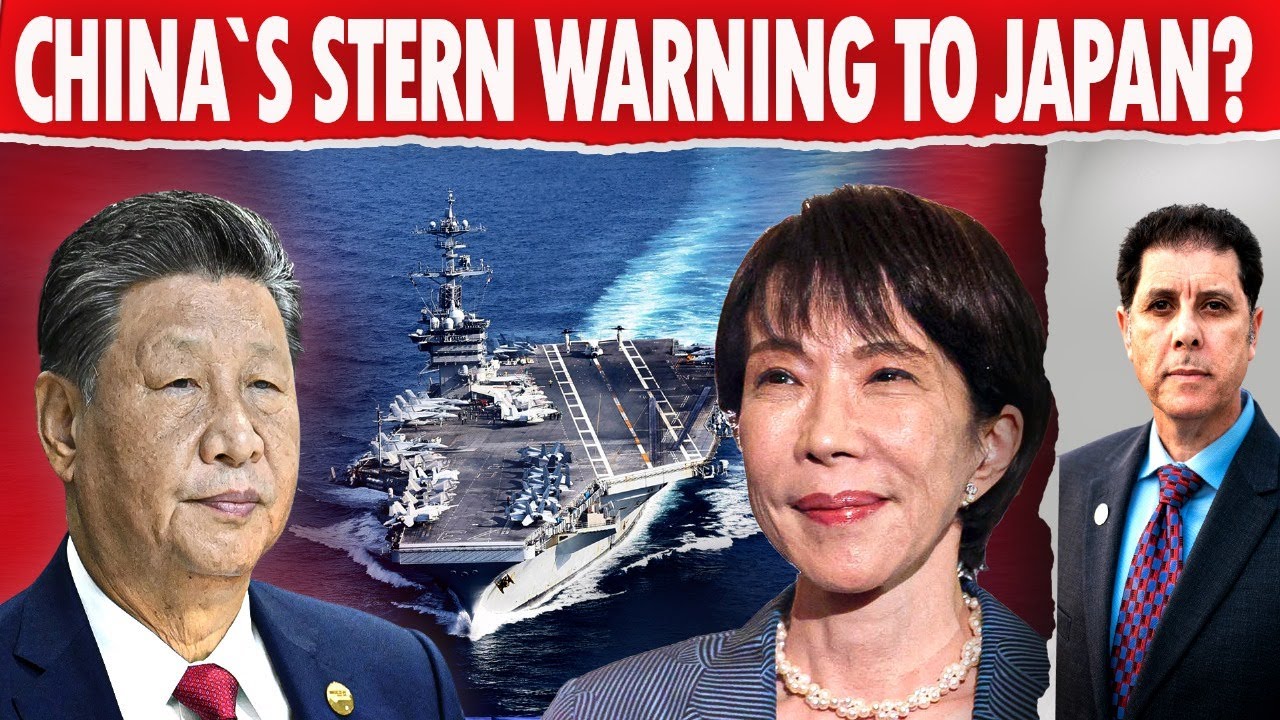
This content was created by David Oualaalou. This content was uploaded by David Oualaalou. This is a YouTube video titled "China Warned Japan of a \"Crushing\" Military Defeat if it Intervenes in Taiwan! Geopolitical Trends" (published 2025-11-17). Based on the title and metadata, the content appears to be a geopolitical news/analysis piece discussing tensions between China, Japan, and Taiwan and warning rhetoric about military intervention. No transcript text or speaker information is included in the excerpt, so participants (host, commentators, or interviewees) cannot be identified from the provided data.
Chapters
Hello everybody and welcome to Geopolitical Trends, where truth matters. I'm your host, Dr. Oualaalou, excited to be with you. Hope you had a, a relaxing weekend and you are really ready and, and geared up for the new week. So I am going to be providing you an update regarding the escalating tensions now between Japan and, and China, given that the, the, the former, meaning Japan, went ahead and lodged a protest against China. I mean, did they forget that they were the one, meaning Japan in this case, who initiated all this saga and these problems to begin with? And all of a sudden they are lodging a formal complaint against China? Things don't make sense here. But anyway, this is what I'm going to be providing you my analysis on, on the bigger picture. Geopolitically, strategically, from a security perspective, from an economic perspective, regarding the not just China and, and Japan, but we're talking about the whole region for that matter. So, so let me say hi quickly to our wonderful community, and I'm gonna jump into because I got a lot to cover. Lian, good to see you. Zhaoyan, as always. Willie Holman, YTT, good to see you, and good morning to you as well. Farhad Razavi, haven't seen you for a while, good to see you. Sikmanduz, good to see you. Who else? Oh, Athin Wu, good to see you here, finally you make it, or you made it rather. Alice Talokin, American citizen and Francistango. Farhad Razavi, good to see you here. Khadijah, good to see you as always. Taiwan Steel, Good to see you here. So let's get into our topic because we got a lot to cover. First of all, some housekeeping items before I forget. Uh, remember to join me on the 20th for my conversation with Professor Yan Lian. So I will, uh, I will let you know about the time of that interview because we haven't, uh, finalized the timing of the interview, but the date is set for that. So the other thing is I am working on a topic regarding India. Which has caved in to the United States, despite what the Indian government are stating in New Delhi, that, oh, we take our stand, we are going to push against the Americans. But none of that is true. It's just hypes coming out of India. So I'm going to be sharing with you one particular aspect, uh, and I confirmed some aspects of it. So I will do it in the next few days. So as to the headlines, I have one headline for you that is of great importance. Yesterday there were massive explosions in Dhaka. This is the capital of Bangladesh. So you all know why, because there's tensions, uh, in Bangladesh in the eve of the Sheikh Hasina sentencing, which by the way happened today. Today the Bangladeshi court sentenced Sheikh Hasina to death for crimes against humanity. So let's just quickly here be fair, you know, we— I mean, the Bangladeshi government has to make sure to give her a fair trial, you know, being, being involved in corruption or what have you, it's beside the point. Of course she has to pay for her crimes, but she had to be given the fair trial. That's one. Second thing is that India shouldn't be, because if India needs to let her return to Bangladesh because the Bangladeshi government have formally requested from India to extradite, uh, uh, Sheikh Hasina to stand trial in Bangladesh. Of course, India refused, and the Bangladeshi court, high court, went ahead with the deliberation and sentenced her to death. Now the question is whether India is going to honor the treaty for returning, uh, uh, Sheikh Hasina to Bangladesh. So, so anyway, we'll, uh, I'll keep an eye on this as we move forward. So let's talk about our topic today, which is the analysis regarding the, uh, what's going on, uh, between, uh, between, uh, China and Japan. And things are going into some other directions, and, and at least I feel comfortable, uh, talking about this particular aspect because I remember when I did my master's degree and we had the— because it was in international security and one of the aspects I had to study was the Asia security concerns or Asia security issues. And back then I remember highlighting the idea that the, of course, the historical tensions that existed between Japan and China could come to the forefront. And now I'm finding myself You know, asking once again the legitimate questions, because if these two going in wrong directions, China will not hold back given the grievances they have. Because I'm sure many Chinese people, the current one in modern day, never forget about what happened to their ancestors. You know, maybe the second, third generations, and they're not going to forget. Second thing is that China today is not China 40, 50 years ago, militarily speaking, and I am going to be addressing this aspect of it. So when we think about the rising tensions between Japan and China now, which is to me, it's escalating, you know, of course, all this has to do with Prime Minister Sanae Takashi. I have a picture of her here. So when she, of course, issued this controversial statements about defending Taiwan militarily, you know, which by the way, the statement she made was a break from Japan's traditional strategic ambiguity. It's well known to those who studied international relations especially in this part of the world, it's common sense. And this is why it infuriated the Chinese and angered the Chinese, and rightly so. That's why China responded now with the Coast Guard patrolling near the Senkaku Islands. In addition to that, China issued the travel warnings to its citizens. And in addition to that, there is a diplomatic protest. So if we are to think logically, and again, I am not against Japan and I am not defending China. I am with what's logic. What's logic to me is that Sanae Takashi, she's the one who initiated that statement. And all of a sudden now is sort of lodging a complaint against China. It just doesn't make any sense whatsoever. This is why Japan went ahead and lodged a counter protest against China's retaliatory measures. As a matter of fact, if I am to think, China didn't even use any, any other retaliatory serious one, like for example the economic aspect. You all remember what happened to Australia. All China needed to do is stop certain type of trade on a certain commodities And we all know what happened to Australia. Japan is no different, and China didn't even get there yet. So, and this is why, in my opinion, what I'm saying is that this, this situation now reflects in a much deeper geopolitical conflict, not only about or over Taiwan. We're talking about the regional security. We're talking about what is going on with this certain territories there. We're talking about the other subservient states in, or countries in the region, South Korea, Philippines, and Australia to be exact. And this is why I am thinking in terms, why I wanted to do this update for you about the tensions that is now have significant ramifications in my opinion, you know, on what? On the US-Japanese alliance. That's not, China is on the side. You have now voices inside Japan criticizing the prime minister for this recklessness. So, and if we are to look on the economic front, we're going to have to look at the Asian supply chains. And as I mentioned earlier, the stability of East Asia. So, and this is why now inside Japan, which by the way, the media is limiting the information regarding this. Is that domestically, Takeshi's remark drew some sort of criticism from not only Japanese opposition parties, but even from former prime ministers who are still alive. So, and this is why some media went ahead with the facts on the ground, and the facts on the ground is that they viewed these statements by Japan as diplomatically reckless. So, and that is why China gets angry and infuriated by such statements. And this is why, to those who say, because there is this argument, because I can see China could play that card if it wants. And you know which card I'm referring to? Okinawa, because China could, you know, I say could, weaponize the fringe of Okinawan independence movement. Now, there are those who will say, well, this is no different than Taiwan, Dr. Oh. No, no, no, no, no, there is a big difference. Okinawa has never been part of Japan. Taiwan is part of, has always been historically part of China. This is where the difference is. And I know some will argue from that perspective, and they are entitled to their arguments, but the facts on the ground speak volumes and say otherwise. So, and this is where, to China, it has the upper hand, has so many cards to play. If we are to go with this fringe of the Okinawan independence movements, because it will be a strategic lever that China can use against Japan. Because we all know Okinawa never wanted to be, uh, sort of assimilated into Japan. They always— they still have some movements going on regarding its independence. And I am going to be talking in this live stream about some of the challenges that that particular movement is facing. Suffice it to say that that idea of the independence of Okinawa, China could play that card if it wants to, because there is the public support for it inside. Some will say, oh, Dr. Oh, the public support remains negligible. Maybe, maybe not. So the overall picture is that these developments, in my opinion, as a geopolitical analyst, the way I look at it is it underscores how strategic— so ambiguity is eroding in East Asia. We all know, like for us Americans signed three communiqués and we remain some sort of ambiguous about Taiwan issue, yet we signed the communiqué, three communiqués, recognizing the sovereignty of mainland China over Taiwan. So Japan had the same ambiguity process per se. They understand that Taiwan is part of China. And this is now where it's going to be, in my opinion, what's coming ahead. Maybe this is a blessing in disguise, who knows. But what I see coming is that now some countries in the region will be forced Because we're talking about regional actors now forced into becoming clear as to where they stand on this issue because there are some high stakes involved. That's the way I see it. Of course, the situation is complex. So, but like I said earlier, because the Prime Minister's statements broke protocol, it's an important diplomatic norm in Japanese political landscape, to those who are familiar with this. And this is why China has always made it clear that is a red line, made it clear to the Americans. And this is why I was convinced that the Americans might have pushed the Japanese, since Xi is not mature enough, diplomatically speaking, not savvy enough politically speaking. They just pushed her over the cliff with such statements. That's, that's the way I see it. And this is why you have now the Chinese Coast Guard— and I just have a picture here— but the Chinese Coast Guard sort of sent about 1,300 vessels, conducted patrols within the territorial waters. I mean, we're talking about the Diaoyu Islands. So, and here is where the— thanks— the way I see it is that this was a lawful patrol operations carried out by the Chinese Coast Guard. Why? Because it's in defense of its right and strategic interests. And this is what I see also coming. That's how I also see it coming. The idea that we'll be looking now at a new normal— Japan didn't think far enough because now you're going to have Chinese vessels, naval ones, you know, the— for— from the, uh, coast guards. So they will be now making their way through waters in Diaoyu you know, and Senkaku Islands. So of course some of this is administered by Japan. No more. Japan created this problem for itself. So, and this is why now I believe this is a much bigger problem that Japan didn't consider, or its prime minister didn't consider in its deliberation. So it's no, it's, it's not a news. It's not, you know, China consider Taiwan as renegade province. I've always looked at Taiwan as a province. It's like for us, state of Hawaii, state of California. It's no different. And I was there on the ground, you know, thanks to the community who funded my trip to China there. I was there on the ground and I asked people. As a matter of fact, I have a video for you there. I'm sure you've watched it with that individual who was sitting with a flag, you know, saying the corrupt Tsai, the governor of Taiwan at that time, for lying about her PhD and so forth. Suffice it to say that even people in Taiwan are not sort of content with what the government, their local government, is doing. So now, if you notice, I had the word audacity. Why the audacity of Japan? Because they went ahead and protested China's warning to its citizens against visiting Japan. Well, it's the right of Chinese to do so. So, you know, why would you protest that? Obviously, you created some problems, meaning on the other end, on Japan. And of course, this in reaction to the escalating tensions that existed between the two countries over the comments made by the Japanese Prime Minister. One aspect we need to understand here is that now the language that China is using is very strong because here is the thing: China warns Japan of a crushing— and I put this in quotes— crushing defeat if it intervenes in Taiwan. There are those who are saying, oh, Japan has naval capabilities. Nobody's denying that. I'm not denying it. I'll be the first one to say yes, I agree with that. But does it— the question for you— does it stand a chance against Chinese naval assets? Which, by the way, I am going to do. I had a conversation with a dear friend of mine, uh, somebody in the know, and I might end up having to do a special video for you about the naval capabilities of China. Within the next 5 years. So that is the reason why I am sharing this picture here. It's not for the sake of just picture, is the technology involved in this aircraft carrier. This is Fujian, Fujian, the third aircraft carrier. And it's not about the numbers, it's about what's in it technologically speaking. That's a conversation for another day. But suffice it to say, when China went ahead and issued this warning, so because it will be a crushing military defeat if Japan ever considered or get involved in intervening in Taiwan. And this is why first order of business is China issued this order of its people not to go to Japan at this moment. So You have the defense, uh, Chinese defense minister spokesman, Jian Bing. I have a picture of him, I believe. Yes, this is a giant man, which by the way, a very interesting fellow. I, I read up on his background, very fluent in, in, in foreign languages. You know, that's, that's very impressive for, uh, sort of individuals who speak on behalf of government. So, and he holds the rank of a senior colonel and was appointed the Deputy Director General of the Information Office for the Ministry of Defense. So, and he holds a master's degree, by the way, in International Military— Ministry of National Defense. That is where— but his degree specifically, which was obtained from the UK in Birmingham,, the University of Birmingham in England. Uh, he has a master's degree in international studies. So the reason I'm sharing all this is to highlight to you the qualifications. That's very important. So suffice it to say, uh, he spoke on behalf of the Chinese Defense Ministry and described the Japanese Prime Minister remarks about any Chinese attack on Taiwan as irresponsible and extremely dangerous. He added, and I quote, because I found this very important, if the— this is the quote— if the Japanese side does not learn the lessons of history and dares to take risk or even use force to interfere in the Taiwan issue, it will have no choice but to suffer a crushing defeat at the hands of the steel-willed People's Liberation Army of China and pay a heavy price. End of quote. Those are, ladies and gentlemen, those are very measured words, tends to send a strong and clear message to Japan. Yeah, because here is also the other reason for all this. Why again, why I decided to do this, because I need you to understand where the trajectory of this going. China possesses a strategic weapon that allows it to control not only that area but the oceans in general. And there was a report that was released. This is what I'm going to be talking in some other video in detail. About how the naval mines, okay, are the backbone of the Chinese naval force. So because what the Chinese capabilities are, they have the capabilities of concealing and rapidly— this is the keyword— rapidly deploy, uh, uh, uh, uh, makes them strategic surprise weapon. So we're talking about, in, in, in addition to that, hypersonic missiles, fifth generation fighters, new aircraft carriers, and anti-ship ballistic missiles. All this along with the new military resources deployed by the, the, the PRC. What it all means, it demonstrates an ongoing development towards armaments. And like I mentioned last time, because you guys took a survey— and thank you for participating in the survey of the community— when I asked you the question about, uh, in your opinion, the Chinese— uh, I asked the question, is the Chinese military industry surpassing the American one? 85% of you said yes, 8% of you said no, and 8% of you said I don't know. This is enough to make a point here. Suffice it to say, I will talk about this some other time in more detail about the Chinese ability. Now let's talk about how significant now the Chinese Coast Guard sailing through Japanese administered island— islands, per se. It's very significant. It's not a laughing matter. But again, Japan caused these issues. So, so the significance of this Coast Guard's, uh, action is very considerable, you know. Of course, we have to put it within the proper context. So the Chinese patrolling through the The Senkaku Islands, as of yesterday, was part of China's sort of responding to the escalation coming from Japan in response to the statements issued by its, I don't know, novice prime minister, ill-qualified, naive, whatever term you want to use. So, and because here is why it matters. You're talking now about the patterns of escalation. China and Japan, of course, have repeatedly throughout history faced off. Nobody, no, nobody is ignorant of this. Of course, we all know the atrocities Japanese ended up committing. I'm not going to get into that, but suffice it to understand about these specific islands. So of course, China calls Diaoyu and Tokyo called it Sincako. There's two distinctions there. So, so the importance about of this now is the timing and the context of it. That is what's important to understand, because this ain't just a routine patrol. This is calculated measure by the Chinese demonstrating in a subtle way their capabilities. That's all China needs to do. China doesn't need to speak loud, doesn't need to bark, doesn't need— no, no, no, no, no, no, no. And, and usually Chinese don't do that. Their cultures, they are settled quietly. So you have to think also about the strategic thinking of the Chinese navals. We looking at a coordinated pressure. It's pressure. Settle. The Coast Guard action now, the Chinese one, is part of a multi-prong response from Beijing, long-term, beyond the patrol. This is what Japan didn't think. Its Prime Minister didn't think of the long-term consequences. And this is why the first thing China did was summon the Japanese ambassador. It's the first time they did that in 2 years, to my knowledge. So, and that's where the Chinese Defense Ministry declared that any Japanese intervention will be doomed to fail. So it's common sense. Then becomes the strategic messaging, because there is— China's not doing this in a vacuum. And China doesn't do— FYI, at least to those who are familiar with its history— China doesn't do things just off the cuff. There is a reason. There is always a strategic messaging in its behavior. This is no different. By conducting what China called now a rights enforcement patrol That's a key word. Beijing now, it's basically asserting its territorial sort of confirmation of the part of the island. Yeah. Because if Japan is saying, we will, we want to announce it publicly, we will come to the defense of Taiwan, you know, okay, let's start first with your administered area, then we'll talk about Taiwan later. Because there is now a backlash inside Japan from the population, which I will get into that. So the Coast Guard in this area, by the way, the patrolling, the, the, the patrolling of the Coast Guard, it's not a, a first time. No, no, no, it's not unprecedented. Once again, the timing and the context of it, this is what I need you to understand about this aspect. Specifically. Liking this video so far? Don't just be a watcher. Go ahead and hit the like, share, and subscribe button. And don't forget to tap the bell so you will not miss any of my videos or live streams. This way you will be supporting a channel that stands for the truth and objective reporting. The choice is yours. Thanks for your support. Now I'm going to talk about economics briefly here, just give you one example. And the example that, that Japanese didn't— Prime Minister— when I say Japanese, I'm referring to the government, of course, not the people, and not anyone else inside the government but the Prime Minister, uh, because I don't understand who advised her to move forward with this unless once again she was pressured by the US. Suffice it to say, Japan doesn't have rare earth elements. Where the rare earth elements gonna come from? You all know it's gonna come from China. So this is what I'm saying. One aspect which China, by the way, is not playing that card yet. Can China— can impact Japan's economy only by limiting the export of rare earth elements. So because that's what Chinese economic leverage it has over Japan, because China has absolutely the capability to impact Japan's economy through rare earth elements and other trade restrictions. So because it is a vulnerability for Tokyo, and you will think that Tokyo is the same stupid mistake Canberra in Australia made back then. Once again, because at the time when that, uh, uh, decision was made in Canberra, it wasn't made in Canberra, it was made in Washington. We pushed Australia to take that stance against Chinese. I see the parallel here with Japan. So rare earth elements specifically, as you all know, and I did a video for you, it was a sponsored video It was a, an entity reached out, uh, to us here to ask if we could do analysis for them, and I decided to address that particular aspect. So China controls vast majority of global rare earth elements production and processing. So, and this is once again, you talk about China accounts for 60% of global rare earth element production and about 90+% of processing capacity. All these elements, you know, sort of are critical for Japan's electronic, automotive, and renewable energy industry, in addition to others. So, so if China wants to really sink the Japanese economy, all it needs to do is restrict export of this. Take my word for it, Japanese, uh, manufacturers on semiconductors, electric vehicles, and everything else, high-tech production and so forth, will face major disruptions. Ask the Germans. And we're not even getting to beyond this because this is just a sort of, uh, a small example. If you think about the broader trade leverage You know, beyond the rare earth, China could theoretically restrict other strategically important exports or even limit them completely, or export to Japan. Because why? To those who do not know, or who don't know, is that Japan is heavily dependent on China's manufacturing supply chains and markets for its products. And once again, there are those who come with the argument, like what we say here in the US, oh, just bring manufacturing here to the US. You know how many years it will take for us to go back to that level? Because that thing doesn't happen in 3, 4, or 5. You need a decade, 2 or even 3, to get to that level of production. Once again, ask the Germans, ask the French now. That their industries are sinking down, you know. But there is one other aspect, and I want you to be aware of, which it's almost the way I see it. I, I cannot ignore that. I cannot ignore it for the fact that I see also the other side of it. And this one has to do with why China's not doing that. China doesn't want to use this weapon. This is again where you see the logic of the thinking process inside Beijing. They don't react emotionally. It's not like us here. We send in true, uh, the aircraft carrier Gerald Ford to Venezuela's coast, which, by the way, you know that Donald Trump now wants to talk to Maduro. So The Chinese don't do it that way. The Chinese don't react emotionally. And here is the reason why, in my opinion. So because if China does that, they are thinking long term, it could harm itself significantly. Because also, we cannot ignore that Japan is also an important market for the Chinese products or exports, and disrupting that trade will sort of also impact the Chinese companies. So China is logical. It reasons logically before it takes an action. Second, such move by China, hypothetically, if it goes into that direction, will trigger coordinated— this is one thing China is concerned about because it will trigger well-coordinated strategies from the West collectively 'Cause remember, Japan, South Korea, Australia are subservient to the US. Remember, I did tell you about 2.5 years ago that NATO was considering opening an office in Tokyo. Why the heck would NATO go all the way to Asia? And this is why China's thinking strategically, because doing so will potentially accelerate efforts to reduce the dependency on the Chinese supply. Then there is a third element as part of this analysis. You have to consider all this. So Japan might be working on reducing its vulnerability, and this is why you see Japan now is moving into that direction. It will take it a while, but also this could impact how the trade is conducted in the region. So this is why I'm saying what the Chinese come to realize is that using this leverage is a double-edged sword. It's with significant cost also to China. They're not willing to do that. So they're smart enough to know how they— meaning Japan, I'm sorry, meaning Chinese, strategic Chinese officials. I'm sorry. This is why for now China is depending heavily on diplomatic pressure rather than outright economic punishment. There is a reason for that. This leads us to ask the question, what are the security and the geopolitical ramifications to these tensions now between Tokyo and Beijing? Of course, there is significant tensions from a security and geopolitical aspects of it. So let's just talk about the regional security escalation. One of the key to all this will have to do with the most immediate concern of these tensions could trigger a broader security dynamics in East Asia. So because when Japan, broke protocol and came forward by saying we are explicitly willing to defend Taiwan, that to China's— and how China's perceived that is a major shift from its traditional cautious approach. Ask any former, whoever's still alive, except Shinzo Abe, I think. Shinzo Abe, that was different. And this raises sort of the stakes considerably. Because no matter how you look at it, like I always say, in international relations, context matters. The fact that the statement was made in this fashion, Japan is coming to the defense of Taiwan, it signals that Japan might be willing to directly confront China militarily. This is once again why the Chinese use the term crushing defeat. And let alone— and I'm not gonna not say this— let alone that this might provide an opportunity for China to settle some old scores. Let's hope, by the way, it never gets to that. But again, ask any in China, they will tell you, we will never forget forget what the Japanese have done to our ancestors. There is no way they will ever— they might forgive, I don't know, but they will never forget. So, and this is why once again China made sure the red lines will be a violation. This is why the US, even the US, it was behind closed doors conversation with some Taiwanese politicians, and the word we gave them, and this was few years ago, I was aware of it. We told them straightforward, whatever you do, do not declare independence. We told them that. So, so this is how, and, and do you think the US will come to the support of Japan? Because any movement by the US is automatically perceived in Beijing as encirclement. What those subservient states in sub— with the United States trying to do is they trying to encircle China. So which, by the way, could increase tensions. So, and this is why you have the idea that we have the idea now that you have to think about how this is gonna evolve moving forward. Then you come to the idea of this supply chain. It's very important. Economic security concerns are of great importance, no importance, besides just the rare earth. So once again, what this highlights is that the geo— the tensions highlight how geopolitical conflicts directly threaten global economic stability. It goes beyond just China and Japan. You think about semiconductor production, you think about automotive manufacturing, you think about other supply chains. Which, by the way, where are they concentrated? In the US? No. In Europe? No. They are in Asia. So that's why a military conflict will be catastrophic for the global economy, not just for China and Japan, or the US for that matter. So suffice it to say, you're gonna have to see now the broader the big picture of the Asian alignment. If, if those who think, oh, this is not going to impact that alignment, you are mistaken. Because you have the likes now of the subservient state like South Korea, you have the Philippines, you have Australia, you know, are watching closely. It's because if Japan is sent to the slaughterhouse those going to be now deciding what to do. You get involved, you're gonna be— you're gonna get burned. And if the idea— any of those four— Philippines, South Korea, Japan, and Australia— think that we're gonna be sending our troops to die for them, they are mistaken. Use Ukraine as your case in point. So that's why those countries are watching closely. So, and this could push for the so-called an alternative security arrangement, which I don't see will happen for a simple reason, because if this moves forward into that direction, those countries will become a target directly. Any, any conflict they will be first hit. Simple as that. Why? You have the presence of American bases there, and anything that will threaten the mainland security, they're gonna have to eliminate it. Like we always say, for us, you eliminate the threat, then we'll talk later. So, so on the other hand, this could also push some of those countries into betting their head or hedging their bet, if I may use the term, hedging their bet on whether to really side with the US or clearly stay neutral. So then you bring in the nuclear dimension. Of course, you know, Japan doesn't have a nuclear weapon, right? So you have to think both Japan and China have significant military capabilities. I'm not denying— nobody is denying that, because if you deny that, you'll be— you kind of— your assessment is not balanced. Japan has some capabilities, militarily speaking, you know. The question is, can they stand a chance against the Chinese? So, but at the same time, Japan is a non-nuclear It has some sophisticated military equipment, you know. That's why any direct military confrontation carries with it inherent risks of escalation, and that could involve nuclear-armed powers. So especially when you consider the United States has sort of sort of provided the security umbrella for Japan, commitment that is. But also you have to consider Russia and North Korea. And China in itself with its nuclear capabilities. So, and this is why I feel comfortable enough to— I'm going to be reaching out to someone very knowledgeable about the naval capabilities because what I see coming regarding China's naval capabilities within the next 5 years. I won't even go 10 years, 5 years. Then there is the other elements that we all now is going to be faced with and we are facing with it. You're going to be now looking at the normal military posturing, normalization of it. It becomes the norm now. China is going to be sending its Coast Guard to a, a, a rocky island. See, so the posturing will be the most concerning in my opinion. Yeah, why? Because this is not about just show of naval assets or whatever. This is about confrontational posturing. And not just in that South China Sea, or East China Sea, or the Sea of Japan, we're talking about the East Asia as a whole. So, because here is the thing, if this happens, the— for the diplomatic settlements, will take few years to reach its objective. This is why, because you're gonna have some other elements playing into this. So the fundamental geopolitical shift here is that we might even be looking similar to what happened during the Cold War assumption of stable, prosperous, integrated East Asia is being tested. That's what I see coming. Because Japan's willingness to be explicit about defending Taiwan suggests the era of strategic ambiguity has ended, which will force— it will compel regional countries now, or actors, to make some commitments as well. So I mentioned earlier about people inside Japan are pissed. Japanese people are very concerned now following what their prime minister's provocation— they use the term provocation of China over Taiwan. So Japanese public opinion and domestic politics now have been a crucial factor in this crisis. The search result— it was, it was a survey— search results show that there are actually been significant domestic backlash within Japan itself against Takashi's remark, which is an important sort of factor or context that we should consider in this discussion. So the domestic opposition within Japan You have, for example, former prime minister— let me see if I have a picture of, uh, uh, no, I don't. Sorry guys, I didn't put the picture. Uh, Yukio Hatoyama, he's a former prime minister. You have the Japanese Communist Party, the JCP, and you have the media outlet inside Japan including the Tokyo Shinban. And you have the many shimbans have all criticized Takashi's remark as extremely, in quote, extremely reckless and imprudent, end of quote. So with some, by the way, calling them as an extremely dangerous statement. So, so you have, for example, the former Prime Minister Ishiba. So called her comment, and I put in quote, very, uh, very close to claiming that a Taiwan contingency is Japan contingency. That means he called her on this comment because you remember she said that. The opposition party, Hiroshi Oguchi, of the Constitutional Democratic Party demanded she revoke the remarks, meaning she withdraw that. And as I did mention this before, whether she will have the capability to formally and publicly apologize to the Chinese government. And by the way, forget about her ever meeting with President Xi Jinping again. In my opinion, because such declarations are equivalent to entering into a war. So, and by the way, some former members of the cabinet, past cabinets inside Japan, have been cautious about making such statements. That's why you never heard it from previous, uh, uh, this why she broke meaning, uh, what's her name, uh, Sanae Takashi. She broke with protocol. She broke with the tradition. That's a dangerous precedent. So, because Takashi's late mentor— who was Takashi's late mentor? Do you guys know? Can you type it in the chat box? Does anybody know who Takashi's mentor, late mentor was. I just want to see if you are familiar with it, if you happen to. And one who didn't have also a good relationship with China. Let me see if, uh, anybody know which one I'm referring to here. Oh, oh, David, you got it! David, you got it! Shinzo Abe! You guys got it. Shinzo Abe. It was Shinzo Abe. That was her mentor, late mentor, if I may say the term. So this is again where the problem, because Takashi's late mentor, former Prime Minister Shinzo Abe, made similar comment about Taiwan. However, where the difference is, he made the comment after he left office. So he didn't do it while he was in office, because he knew. Takashi, on the other hand, broke with this precedent altogether. And that, in my opinion, suggests the basic lack of diplomatic sense. Why is she— she is a Chinese hawk. I've read up, I read up on her. Her ideology towards China. She's a hawk. She's the like of Marco Rubio. She's the like of, uh, here in the US, of Lindsey Graham. She's the like of some hawkish individuals here in Washington. So that's— but that's why she doesn't have the depth to understand the ramification of such a statement. We're not talking about you being afraid or scared of China. That's not what we're talking about.. We're talking about understanding the ramification of statements like that. So it's because here is what Takashi wanted to do after the storm. You know what? She wanted to damage control, to embark on a damage control process. So after the firestorm, Takashi clarified that her statement was merely hypothetical and did not signal a policy change. And yet she has not retracted her remarks entirely. You all remember last time when I told you sometimes words, especially coming out of the mouth of policy officials or whatever, tends to turn into a policy. Now she's saying, oh, I didn't signal any policy change. Liar. So, because here is the big picture inside Japan, the broader picture is that Takashi's comments have been widely viewed within Japan as unnecessary, provocative, and diplomatic reckless. So it wasn't not just by China or those with common sense. The US won't say a word, by the way. Australia won't say a word. South Korea won't say a word. Philippines. The, the subservient states of Western Europe like Germany, France, UK, and Italy and all that, Spain, they won't say a word because they can't. Or Finland or whatever. So we're talking about Japanese people inside Japan, Japanese officials. So this is why Japanese political figures Across the spectrum, from former ministers to opposition parties and all of them, to left-leaning commentators inside Japan, so have all, have all expressed this concern that she crossed an important diplomatic line. Once again, it's not about being afraid of China or— no, has nothing to do with that. It has to do with diplomatic protocol. When you are a prime minister, when you are president, when you are whatever, foreign minister, whatever, you have to weigh your words. And this is what suggests, in my opinion now, the anxiety that exists within or among Japanese people. Not only about their anxiety, it's not about her statements. Their anxiety not only about China's response, but about whether their own government acted wisely or not. This is where the difference is, because in their opinion, this could pave the way to much bigger problem internally. And what am I referring to? I am referring to Okinawa fighting for independence from Japan. Because here's the thing, I remember one of you in the community— I'm sorry, I didn't, uh, remember the name, uh, vaguely. I remember, uh, that when I read this— that's why I read your comments and I respond to them, because we learn from each other. You know, this channel is not about, you know, hypes and all. I don't do that kind of stuff. If you can't learn anything from me, then I will, I will finalize all this altogether, be done. I'll give 110% of my efforts because I want you to be well armed with knowledge, with information, accurate information. If we think, since we're talking about Okinawa here, if you recall the Cairo and Potsdam Declarations, which was by the way signed by the US the UK, and China. There's 3 countries in which Japan has sovereignty only to 4 islands. One is Honshu, second one is Hokkaido, third one is Kyushu, and the fourth one is Sekoko. Sorry if I mispronounce it here, but it has no sovereignty over Okinawa and the other two islands. What happened? To those who know history, the US handed Okinawa and the Daiyu to the Japanese control without consulting the other two signatories. And who were the two other signatories? China and the UK. So basically what the US did was illegal. And this is why Japan didn't think— could the call for independence of Okinawa now move forward? China could weaponize that if it wants. I don't see China doing that because China doesn't get into this petty stuff, because this is petty. China acts with wisdom. The government that is, when it comes down to dealing with international matters, objective assessments, honest dialogue, not getting into this petty stuff. So for the, could Okinawa gain independence? Well, the answer is not as easy as we may think. Yeah, of course the Okinawan independence movements exist as of today. Actual independence is on the table. But it is unlikely, just for the foreseeable future, because Okinawa is undermined by one specific aspect, and that aspect is the presence of many US bases on Okinawa. So the issue is more complicated than you can think. Or that it might initially appear. So, but the public support for it, give or take, depending on who you ask, some will say there is support for it, others say the support is limited. So public opinion in Okinawa as of 2022 put support for independence at that time as only at 3% of the local population. But the local population where is in on Okinawa or the local people inside Tokyo and so forth. Of course, the outcome is going to be different. And I don't think so, this survey was conducted fairly in the sense that you included the Okinawans. You asked people in Tokyo. Of course, people in Tokyo is going to say no. You have to do the survey inside Okinawa. That's where the Okinawans live. So, but there is a vocal criticism. The vast majority wanted their independent— independence from, uh, so, so, but the independence movement of Okinawa is real to those whom I— you just don't hear much about it. Of course, media is not going to give it any coverage. This is where you have the idea, a small but a vocal group, mostly of older activists are reclaiming Okinawa's history as the Ryukyu Kingdom. I remember when I had my friend Dr. Ken Hammond, he's a Chinese historian scholar, and I asked him this about the Ryukyu Kingdom, and he said, yeah, it was never part of Japan. So this Ryukyu Kingdom is sort of the pushing for independence from Japan. And this was disclosed by the Japan Times, and I'm going to put the link for you so you know where it's coming from. So there is still a conversation. I put the link for you in the chat box, uh, just for you to see. So, so the, the, the, there are organized groups like what they call the Kariyushi Club, which formerly known as the Ryukyu Independence Party. Advocating for this independence, but their efforts have not succeeded thus far. They have failed in the electoral efforts due to lack of support, but the historical grievances are what's keeping them going forward. Because if you all know, the atrocities also been committed. So their movement in itself is rooted in a genuine historical circumstances, because the Ryukyu Kingdom— and I'm gonna do one time at some point, I'll do a video for you about the history of the Ryukyu Kingdom— was once an independent maritime state that maintained some sort of a good relationship with China. They call them the tributary relationship with China, at the same time preserving its autonomy. Before Japan annexed it in the 19th century. So, so this history, it creates some sort of a basis for a cultural distinctiveness and some sort of resentments of Japanese assimilation policies. So, and this is why I'm saying to those who argue that China can play this card I don't see China will use that because China had went through some very painful history to where it is today. And this, something similar to this, it went through the history of China. And this is where, at the same time, when you think about the complications of something like this, this is where things become geopolitically interesting. So Because here is why. In recent years, these independence activists have found an increasingly vocal— they became more vocal, so, and they found an ally. And which one is this ally? Is China. So, but again, is China gonna weaponize this? No. But in my opinion, what China will do and can do is to support something like this. Once again, I know to those who's gonna be watching this video, they're gonna say, Dr. Oh, you are favoring one side over the other. And basically what their argument is gonna be, well, you're saying that Okinawan can have independence but not Taiwan. Taiwan. The difference— once again, I'm gonna clarify it— the difference is that Okinawa has never been part of Japan. In the case of Taiwan, historically Taiwan has always been part of China. This is where the difference. And of course, I welcome your opinion. You have— you can disagree with me, you are entitled to it, as long as it's respectful. You maintain respect. That's something I don't tolerate. But I will welcome your different opinion and we can exchange ideas and figure out, move forward with that. So, and this is why sort of funny that Xi Jinping has referred to the independent Ryukyu Kingdom's tributary relations with the Chinese Empire. And conveyed to Okinawa governor, and you know who is, none other than Danny Tamaki, that he was personally concerned to improve relations with Okinawa. This is what President Xi Jinping said. Read between the lines. Read between the lines. Suffice it to say, as of today, the independence remains unlikely. But things take time because Okinawa depends economically heavily on Tokyo. So this is almost the equivalency of Greenland with Denmark. Tokyo is controlling Okinawa through the funding, but also the presence of the US military bases in Okinawa. And of course, we all know the history horrible histories of rape and by some US service members. And, and, uh, you know, it's, it's, it's, it's unbelievable. Uh, you all know what's need to done, you know what's need to be done with somebody who conducts himself like that. There is no trial, there is no— you all know what's need to be done. All right, now And I disagree with those analysts I read. I spent time reading, that's why I'm sharing all this with you guys. I agree with those who saying, oh, now the tensions between China and Japan will actually reinforce Okinawa ties to Japan rather than loosening them. I disagree with that assessment. This assessment was put out there just to push the narrative to put the narrative, because they argue that, oh, most Okinawans, despite frustration with Tokyo over US military bases and economic dependency, likely see the remaining part of Japan as preferable to facing China alone. Well, Okinawa is not going to face China alone fighting. First of all, there will be no issue for that. Why will China fight Okinawa? Why will Okinawa fight China? As a matter of fact, Okinawa will benefit and prosper economically if it aligned with China. It's the same argument I made about Bhutan. You know Bhutan that is controlled and influenced by India? Bhutan will be much more prosper economically if it aligned with China. But they are so freaking scared of India. So to those who are issuing this kind of analysis, while I respect their efforts, I respectfully disagree with their assessments on this. So that's the way I see it. So, so here is my conclusion for you, because I'm going to conclude this here and see if there's any question. And I wanted to keep the best for last, and the best for last is What's next for China-Japan relations? It's, it's a, it's critical question. If you are an analyst, you're gonna have to think in this term. So what's next for Japan relations? It's a crucial question because now we're talking about it depends where the trajectory is going because it will depend on several key variables. So you think about, for example, and I'm gonna provide you with 3 or 4 First one, for example, you think about the short-term, short-term escalation dynamics, which we are seeing the beginning of it. The immediate outlook suggests that it's going to be this continued tit-for-tat actions. China will likely and most likely continue the coast guard patrol over Senkaku Islands because it becomes now the norm. Japan didn't count on this. And I wouldn't even be surprised that China might increase its diplomatic pressure. It has the means to do so. And of course, maintain the travel warning and other economic measures. So it's because, uh, uh, that, that, that's what the Prime Minister of Japan, Takashi created regarding her remarks about Taiwan. So, so it's gonna be an— it's not gonna be an easy one. And, and this Prime Minister of Japan, it may take her a while before she will walk back those statements without losing face domestically. Because remember, in the tradition of Japan, to those who are familiar with Samurai, you don't want to lose face in shame. You might end up taking your own life for that. There's tradition. And this in itself will create a cycle where both sides feel compelled to respond to each other. But China has the upper hand. This is what Japan didn't count on, the same damn mistake Australia made. Stupidity, because the decision wasn't made in Canberra, it was made in Washington. Then you think about the potential of ramp— way off. So of course both countries have incentives to avoid any complete breakdown. The way it works in international relations, you might have tensions with countries, but the last step is to withdraw your ambassador from each country and you sever the diplomatic ties. They are not there yet. I don't see them going to that direction yet. It won't. So, so this is where, uh, uh, uh, for of what you're gonna be seeing is that Japan's is gonna be thinking in terms of a multi-layer communications between the two governments, between Japan and, and China. So behind the scenes, diplomacy will be taking place because it will be more active than it will be in public. That, that just is how it's gonna work. The back channels, very important in, into this context here between Tokyo and Beijing. So because it could help defuse the tensions and, and both sides, mainly Japan, will find some sort of a face-saving way. The question is whether the Prime Minister of Japan, Sanae Takashi, will have the gut and the courage to come forward and say, "I apologize, I made a mistake. I didn't weigh my words. I wasn't sort of measured in my statements." I don't know. And I can't answer that at this point. So far, it doesn't appear to me she will have that kind of courage. Because remember, she's a China hawk. Then the third element, you're going to think about the structural uncertainty that exists within this setting. And this, in my opinion, the fundamental problem is that Japan has publicly now committed to position potential military intervention for Taiwan. That directly contradicts China's core interests. This isn't easily resolved. There is no way through diplomatic niceties. You're just gonna have— I don't foresee, at least in the near future, President Xi Jinping ever meeting with her. Maybe she, when she leaves office, maybe if she's taken out like Shinzo Abe, who knows. But I don't see, or maybe before Xi Jinping even retire. What if? Because there is also one key point for Xi Jinping, President Xi Jinping, you give him proper respect, is that to me, if I were advising President Xi Jinping, I would say, you know what? This is the perfect time to retire. Why I'm saying this? Xi Jinping has moved China to the top. In a span of 15 years or so. Far better than any— at the equivalency of now, what happened back then. You want to leave your legacy at the top. That's just my opinion. I'm thinking outside the box. So, and that doesn't mean he will disappear completely. He will be behind the scenes because he's been through the process, gained substantive, uh, experience. That's the way I see it. So, but at least for now, I don't see him meeting with her anytime soon. So, so this is where it's going to be about this structural uncertainty is that both sides, Japan and China, will have to figure out a way to coexist despite this disagreement. Then you have the— this is on short term, you have the medium term, medium term possibilities. What could happen? There's, there's also a lot. One scenario, you can think about it, is a Cold War-like relationship. And I use the term Cold War figuratively here, just to give you an idea, an example. And this is where tensions simmer at an elevated level but do not boil over into some sort of a military confrontation. Same one we had with the Soviet Union, tensions over sphere of influence, but it never materialized into an open, direct war. It was through proxies. So both sides, China and Japan, could manage the disagreement in this case through diplomatic means or channels without, or while at the same time, they could maintain economic, maybe, maybe people-to-people Ties, whatever is possible. The other one, it has to do with a slow and gradual normalization. This is going to take time for this. So because to China, Taiwan is non-negotiable. This, this, it's, there is no need to even be talking about this. China drew the red line, first of all, on the independence for Taiwan. If Taiwan declares there, China will move in militarily. That's one. Second, if any country will get involved in China's internal affairs, China will retaliate, which is its right. Do we want anybody to come here to the US and say, you know what, the state of Texas never wanted to be affiliated with the US government. We're gonna support the state of Texas, which is true, by the way. We never cared for the federal government. Ask any Texans there. We don't care for the federal government. But we didn't go as far as saying, hey, we want independence. If opportunity presents itself, we will. And this is why I'm seeing this gradual normalization. So on a long-term issue, there will be some sort of— it will hide much deeper problems. Very, very deep problems. And this will be about the territories, the island Senkakus, for example, Japan alliance with the US, China's rise as a regional power, and now the explicit Taiwan questions, of course. Those are long-term, you think about it, and those won't be resolved quickly. Anyone tells you otherwise does not know what he or she is talking about. So this is why I see it. China-Japan relations will remain tense for some time to come. So, and this will be in itself oscillating some sort of periods between managed coexistence and of course renewed tensions depending on the incidents or the statements or whatever. So But there is the wild factor, and that wild factor depends also on what's taking place inside Taiwan. The puppets inside Taiwan are given the talking points from Washington. It's no secret. I'm not saying something that is— you guys don't know. So, but on the other hand, at some point China is going to have to make a decision, you know, and this for good. So China prefers the peaceful reunification, which makes more sense. You look at the case of Macau, you look at the case of Hong Kong. So, so, and because this, any move, because Japan will be looking at this, any move from China will kind of dramatically reshape Japanese calculations, geopolitically speaking. This is where I see this, this, uh, uh, uh, uh, long-term aspects of it, because domestic politics in both countries, in Japan and in the US— I'm sorry, in Japan and in China, in both— matters. So Takeshi, her rhetoric and all this may have been partly designed for domestic audiences, and if it does, I will say it's very stupid. And again, it's no different than what we do here in the US. Look now what we are talking about. What are we talking about? Donald Trump's gonna meet with, uh, with, with Maduro, uh, or, or, or the US gonna sell weapons to Taiwan. But they're not wanting to talk to you about how the economy is going bad, the recent email that involved Donald Trump in the Epstein stuff. Which, by the way, I'm going to do a survey question for you if you want me to do this video for you. Some very disturbing— it's not, you know, it's disturbing. On the Chinese side, they're going to need to show that they are standing up firm to perceived Japanese provocation. This is for the long-term aspect. And because you're going to have to consider, and I'll close with this, the potential, which will happen one way or another, the changes in leadership in both countries. Because that could shift the tone. However, the policy might remain the same. That's how I see it. And the most likely near-term is a period of heightened tensions that gradually becomes the new normal. That's exactly what you're seeing now. The patrolling of the Chinese Coast Guard is the new normal. And with that, I'm going to conclude right here. So hope you guys enjoyed this, uh, analysis here. Oh, FU, man, I can't thank you. Have a blessed day, Dr. Oualaalou, and everyone in the chat. So thank you so much. By the way, just to guys let you know, if you Most of the time, if not, it's about almost 90% or 95%. Anytime he's in a chat, he will put a Super Sticker in support of this content, in support of this channel. So, so, and it is people like him, that's Rudy, and you of course in the community, it's what keeps me going. And I'm not saying it to be Mr. Nice, you guys know me by now, I don't do that kind of stuff. It just means a lot, and I want to acknowledge that and say thank you, thank you very much. If you truly appreciate you, so, so should you decide to support the channel, I'm going to provide the link for you right here, and I'm going to put it in a chat box if you decide to buy me a cup of coffee in support of the channel and the content that I do for you, the analysis that I provide you. This is not information that comes, uh, you all know. By the way, you guys gonna have to be very careful about what you are watching on YouTube. You have to be very careful. You can listen to whomever, just be very careful. Don't fall for that trap of sensationalism, because that's what it's most of what I, I, I don't watch anyone else. I don't, I'll be honest, I Uh, I sometimes I get a chance to listen, but I will listen about the first 5 minutes will give me an idea, and I've been around long enough to know what I can look for. So anyway, I wish you a good day, good afternoon, and good evening, whatever part of the world you're in, and I look forward to seeing you next time. Make sure please to hit the like and share this video with others, and I look forward to seeing you next time. As always, remember, geopolitics impacts your daily life in more ways than one. Till next time, bye-bye.
More from David


Beyond the Single Actor: Why the Gulf Isn't Choosing Between the US and China


Iran, Iraq's Militias, and the Houthis Are Coordinating! This Changes Everything




Who Controls the Next Decade's Resources? Latin America and Africa's Geopolitical Crossroads

The Chokepoint Trap: How Washington's Stupidity Triggered a Cascade That Now Controls the World

Trump Spooked as IRGC Unveiled dual-use SLV, Deployed Ghadir Mini-Subs & Hinted at Tactical Nukes!
