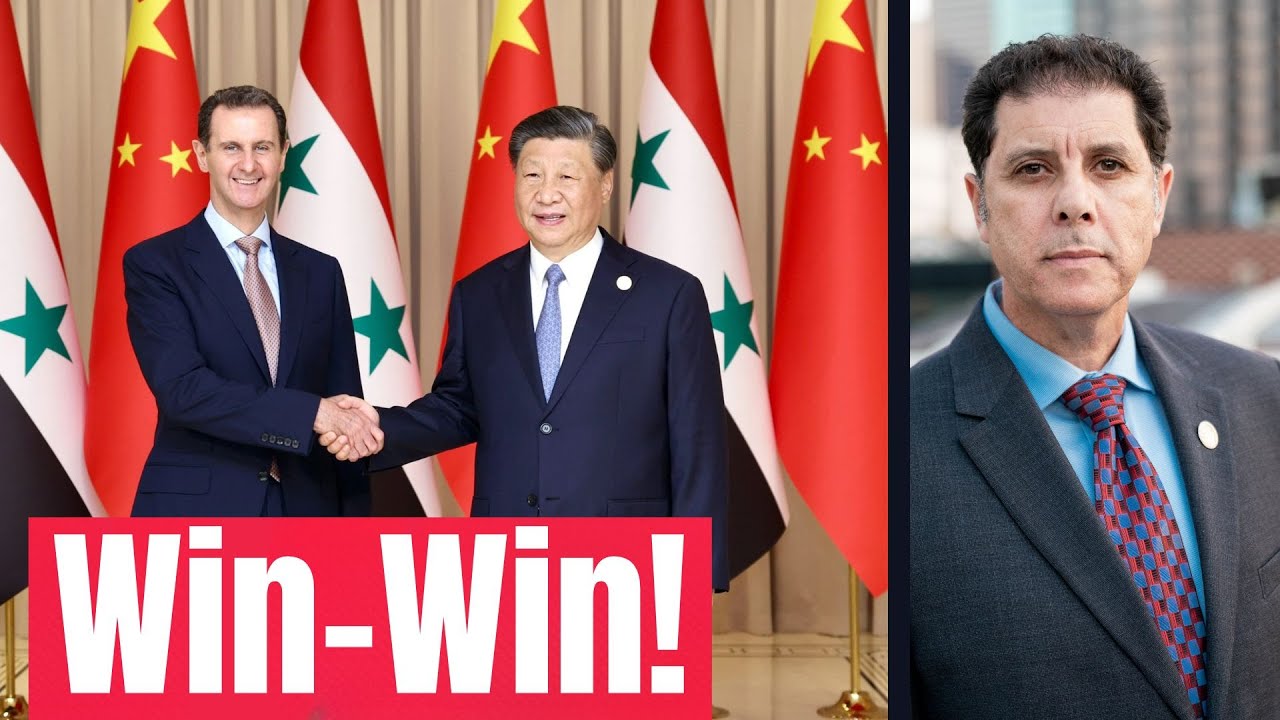
In this extensive YouTube monologue, David Oualaalou (Speaker A) examines China’s recent announcement to rebuild war‑torn Syria and situates it within a broader geopolitical shift in the Middle East. He begins with a personal introduction, noting his military background, time spent in the region, and previous publications on Middle‑East politics. Oualaalou then outlines Syria’s historical, geographic, and ethnic‑religious landscape, emphasizing Damascus as the political hub of the Arab world. He argues that China’s reconstruction pledge, announced alongside President Xi’s strategic partnership with Syria during the Asian Games, is a calculated move to expand Beijing’s influence via the Belt and Road Initiative (BRI), secure energy supplies, and fill the vacuum left by a declining U.S. presence. The speaker contrasts China’s economic‑diplomatic approach with the United States’ militarized foreign policy, highlighting China’s recent mediation between Iran and Saudi Arabia, its investments in Iran’s hydrocarbon sector, and its non‑interference stance in sectarian conflicts. He also discusses Russia’s role, the legacy of U.S. sanctions, and the strategic importance of Syrian ports and the Tartus naval base. Throughout, Oualaalou interweaves personal anecdotes, references to his earlier books (including a 2014/15 prediction of China’s growing footprint), and critiques of Western misunderstandings of Middle‑East sectarian dynamics. The talk concludes with a call for the U.S. to reassess its strategy, a preview of upcoming investigations (e.g., Kashmir), and typical channel sign‑off remarks.
Chapters
Hello everybody and welcome to Geopolitical Trends. So excited to be with you on this Saturday. I got an exciting topic for you, and this is also because of my familiarity with not only Syria but the Middle East writ large. So I've spent a lot of time in the Middle East when I was working still in Washington at that time, and my, uh, previous military units used to rotate in one of those countries in that part of the world. So anyway, and I did write a book about Middle East, and Syria was part of the conversation. So this is what I am going to be talking to you about today. This is more depth, more analysis on my part based on my research again, but also because some of you have also requested that. And it's topic that is worth talking about. I know the media here in the West is— it's not even— they didn't even talk about the Asian Games, wasn't even covered here. So that just shows you. But in any event, uh, before I'll do all this, like I always like to extend my sincere thanks and appreciation for you guys because your time means a lot to me. So I'm so, uh, thankful and grateful that you are spending time here with me., learning about this fascinating development. So, uh, so if this is your first time here, please make sure to subscribe. I would greatly appreciate it. And I'd like to give a shout out to a new channel member by the name of BM. This is the, the abbreviation. So thank you so much for becoming channel members. We are closer to 100 members because I promised you that I will do an exclusive Q&A for the channel's members and, uh, supporters. So So if you consider to support this channel, please do so at this time, and I will greatly appreciate it. Uh, just few housekeeping stuff. Watch out for, uh, the— my conversation with Dr. Stewart on Monday. It's going to be on the Health channel. The— I think the topic is going to be about migraine. Why do people get migraine headaches? You you know, what's, what's the leading part of that. And of course, Dr. Sears is going to provide some insights given his, uh, back— his health background and understanding about the human brain and the chemistry of the brain. So that will be a topic you don't want to miss. So, uh, the second thing I want to let you know about the course— I'm still teaching the course, so if you are interested in, uh, in, uh, signing up for that. So here's the link for it. Uh, I teach about the government, whether it works or doesn't work. So, uh, usually for the course I can talk openly per se, and because it's off of the platforms here. So if you are interested, just check it out. I posted the link there for you. So, uh, the other thing— it was what, it was a third thing that I was thinking about. Yes, I'm gonna get you guys a link to sign up for free newsletter. And here's the reason why: because I will be giving a free copy of one of my books. I think the Saudi book and so forth. So I just don't have the link with me here. I will get it for you, and you guys just sign up for it if you want. It's— there is no spamming, there's nothing. And usually I don't do that kind of stuff. I'm, I'm against that. So, uh, but I am gonna be giving up free copies of the Saudi book. It's worth reading and worth spending your time learning about that topic. So anyway, let's get into our conversation here. Well, first of all, I want to say thank you to— yeah, In My View CCM. He said, hello David, so nice to be able to join on this chat. So, well, welcome. So, and to all of you, Tony, good to see you too. Tony usually puts a lot of comments. I do read your comments, Tony. I want you to know. So, uh, most of you guys here, so I'm very, very grateful and appreciative to you for supporting, for supporting the channel. Uh, Boone, as always, thank you very much for your continued support. Here's Boone here. So, Athene Wu, good to see you. Good to see you all. So anyway, let's, let's jump in into this, guys, because there is a lot to cover and I wanna cover everything to the best because I don't want to take you too long either because it'll become boring. And I don't like to get my, uh, my conversations, presentations, discussions, or whatever you want to call it, to the point of becoming boring. I don't do that. So anyway, here's what we're going to be covering today. And like I always do, I'll start with questions, then I'm going to cover the history of it and geography because it is important. It is one thing off the bat, from the get-go, a lot of people do not know, especially in the Western world I don't know about the East. They might, they might not. Most likely they won't either, but it's worth saying. And here's the thing, as one who spent time, uh, in, in, in that part of the world, I speak the language, I know the culture, I'm very familiar with the, with how things work politically, domestically, and so forth in a variety of countries. All politics in the Middle East goes through Damascus. Damascus is the capital of Syria, and you will know why when I talk about the history as to why that is. So let me repeat this, just keep this in the back of your mind: all politics in the Middle East goes through Damascus. So, so the questions I'm going to be asking here, or, or just putting forth for our conversation, is first of all, what is the significance of these announcements by China that's going to rebuild That is, to me, it's sending a message right there, right there, because we all know how devastated Syria is. A decade-plus of civil war, it's not— it's devastating for any country for that matter. Second thing, second question rather, is China flexing its diplomatic muscles? Because this reconstruction thing, yes, falls under the economy and so forth,, but it is part of a diplomacy. So for us in the US, we have militarized our foreign policy. China is using sort of economic ventures, and this is why I'm using the term diplomatic muscles. So is China flexing its diplomatic muscles? And third question is how this is going to change, or it's already changing the geopolitical landscape in the Middle East. More than you can even imagine, and especially when you consider what China just did. What am I referring to here? I'm referring to China bringing the two arch enemies, Iran and Saudi Arabia, together. They are reestablishing diplomatic ties and so forth. They already open up embassies in each country. But what is important about this? Because Syria is client of Iran, that's one, and second, Saudi Arabia just readmitted Syria into the Arab League against the wishes of the, of the, of Washington. So that tells you right there. And the fourth consideration we need to keep in mind is, is this announcement by China considered, or would you— I'm going to ask you for that— would you consider it as a strategic partnership? So you can leave the answer in the, in the, in the chat box as we move forward. So So here's the thing, this is to me a groundbreaking development, you know. First of all, when you receive a red carpet, when you welcome a head of state with a red carpet, let alone one that was supposed to be removed from power but he's still here. So that's to me, that's why China calculated this move, and there is nothing wrong with that. Every country will have to look out after its own interest. China's going about it this way, but mainly in the Middle East. And again, because I did the research on, on that part of the world, I wrote about 4 or 5 books on that. So I kind of back then— and I'm going to share one thing with you that I argued back in 2014 or '15, and it's becoming a reality today, especially about China's involvements in the Middle East. So, and this is why I feel comfortable using the term groundbreaking developments especially when President Xi announced that it's going to be rebuilding the devastated country of Syria. So, well, interestingly, it came, of course, on the sideline. Just background for those who might not know how this happens: during the Asian Games that just took place in the eastern Chinese city of Hangzhou— hope I pronounced it correctly— so And this is where, on the sideline, it was, it was a day before, it was on Friday, I recall, last week when President Xi proclaimed the establishment of China-Syria strategic partnership. So, so to me, it's a really momentum milestone, very, very, very significant and sending a strong message for the bilateral relations, but also for the increasing footsteps of China inside the Middle East. Why? Because that is pushing given the decline of the US leadership in the region. So now you're seeing China coming in with ventures, not with military. This is where the difference is. So the timing couldn't be, couldn't be crucial as the world grapple now with this unprecedented instability, if I may use the term. And I can add another term, which is the uncertainty. Those, in terms of geopolitics, those are very, very crucial. Because any policy will have to move that direction within the confinements of this sort of instability and uncertainty. It's always very, very delicate dance, that is. So, so what I found interesting about President Xi's statement was when he stated, and I paraphrase here, that he emphasized China's— and here is the keyword— unwavering commitment to stand alongside Syria. That is sort of an open message to the West that we will support Syria. As a matter of fact, and again, it's not reported in the West, and I found out about it last night, that China has announced that it's requesting from the West to lift sanctions on Syria. That says a lot. That, it says a lot. So, and this is why, if you look at the statements, and I, I, I read it, so, uh, it was poignant, and I did share this with you in the video, especially when President Xi mentioned about fostering friendly cooperation with Syria while upholding international fairness and justice. What I found interesting, President Xi didn't say upholding the rule of law, or whatever else. It's fairness and justice. Those are keywords, keywords. Of course, China had to think about its own strategic interest, and rightly so. Any country will have to. Russia sent military to Syria not because of Syria, but because of Russia's interest in Syria, especially when it comes down to the, uh, naval base in Tartus. Which Tartus is on the, on the eastern part of Syria and on the eastern side of the Mediterranean Sea, see, access to the sea. So this is what I found very important. So for China, it has to do with one thing, and one thing mainly, not only, but mainly, it's BRI, the Belt and Road Initiative, which I'm going to get into that as I move forward. So So, and again, like I mentioned earlier, I found it very interesting that the West didn't even mention about the Asian Games that just took place in Hangzhou. So, and I saw the opening ceremony, it was very, very, very interesting to see. So, so the next question we will ask is, what the— what do China and Russia want out of this relationship? Because Syria is also interested in the relationship. That, that's almost like a lifeline if, if we are to think of it that way. So why is because both of them, Syria is going to benefit from China's involvement in reconstruction, but China also will benefit from playing a much bigger role in the Middle East. Usually it was a sphere dominated by the United States. But we all seen the decline. I've been watching this for the last 15, 20 years. I argued against the invasion of Iraq because I said it's going to turn the Middle East upside down. And if we think we're going to gain footholds, we will not. And I said, by the way, if we go in, we are not coming till about 15, 20 years. And that's exactly what happened. So I've been in Iraq. As I said, I speak the language and I understand the culture and so forth. I've been arguing through it, but You know, that's— there's something, as for us in former military stuff, there's a chain of command. So when you got the boss come down and said, well, we're gonna consider this one, I'll say, well, sir, you might want to reconsider. Oh no, Mr. O, we can consider this. And I said no, because the outcome, it will be this. Well, I think we're gonna go this. So when it's been repeated 3 times, that's when you realize the boss is saying, you know, shut up and move on with it. So, but we are living the consequences of it. China is thinking about it strategically. This is why China is going to be playing a much bigger role beyond— that goes beyond, by the way, just trade and business. That's why I use the term for a reason. Is China flexing its diplomatic muscles? So I don't usually use random words. There is a reason why I use certain keywords. But again, because you have to put it within the context of China brokered the deal between Iran and Saudi Arabia. You have to look at it also in the terms of China rebuilding parts of Iraq. Yeah, which we don't hear much about. It's China that is rebuilding certain schools, and I still have my contacts in that part of the world. So you have to look at it also for China's access to energy or oil fields in Iraq. Building, uh, so certain, uh, uh, infrastructure there. So all this, it goes beyond just, as I said, trade and business ties. So, so what we can see is that, uh, with the emergence of BRICS, of course, the expansion of it, and this is why to China it makes perfect strategic sense to go ahead and rebuild Syria because Syria is going to be playing a major role when it comes down to BRI. That is one of the keys. So, but before I'll move forward, let's talk about geography of Syria just for those— and I think, guys, it's worth always knowing at least geographically what are we talking about. So let me gonna be share some pictures with you here, and I got a lot this time. It's just because I, as I said again, I did the research on it, so I still have my, uh, uh, this is the image of the first book that I wrote about the US foreign policy in Middle East, in which I tackled, uh, about Syria. So that goes back to 2014, and I argued about the role of China coming down the road. And I even said, and, and it's in the book, I said about within a decade or so we will see the footprints of China increasing in the Middle East. And here we are. So, so let's start with the geography here. I'm going to share some maps here for you, and I'm going to leave the maps here. I'll rotate back and forth just for you to see. So Syria, uh, which is approximately, for those who are familiar with the United States, it's about one and a half size bigger than the state of Pennsylvania. I used to live in Pennsylvania up north, back then. So Syria is about time and a half the size of it. So bordered on the east side by the Mediterranean Sea, as you see on the map there. So Syria also shares borders with countries of Turkey, Iraq, Jordan, Israel, and Lebanon. So there is reason, especially when it comes down to the two last two, Lebanon and Israel. So, and I will get into that as I move forward. So more, more than half of Syria is covered by the Syrian desert because there are all like rugged terrains and so forth, which stretches into several other countries in the Middle East. So, uh, and I'm not going to get into the mountain stuff at all, that we, we just need to move on to what is very, very crucial. So, uh, what's important is also to understand about the, the people and the culture of Syrians. It's very, very— because Syria is very old civilization, so, and you will know why. So most of the Syrian people, uh, here is, here is again where the West misunderstood the difference between an Arab and a Muslim and a Persian, or, or, or a Syrian for that matter. So, so most of the Syrian population are Arabs or originally from the Arabian Peninsula. Okay, and its neighboring territories, but there are sort of minority groups living in countries like, for example, Kurdistan. Yeah, those are minority group, ethnic group from the mountainous region called Kurdistan, which is way up north in Iraq. You know, I've been in that part of the world. I spent about, I think, 3 weeks in Kurdistan over there. So then you get, which some of them also live mostly in the northeastern part of Syria. Then you have the Bedouins or the nomads, uh, uh, that, that, that's, that's part of how they are moving throughout the north, uh, uh, parts of Syria. So, so majority of the Syrian population lives on the coast of the Mediterranean Sea or in the Euphrates River Valley. That's very, very important. Let me share another picture with you guys to see again, because those maps will show at least the boundaries and, and, and to have at least an understanding of it. So most Syrians are Muslims, or, or, or people who practice Islam, that is. But some Syrians are Christians. And here is the thing that a lot of Western do not know, Bashar al-Assad believe it or not, he was protecting Christians. Same thing Saddam Hussein did in Iraq back then. And I am very familiar with this because I was there. So I used to talk to Christian Iraqis living there back then, that if you harm a Christian, you will feel the weight of the government coming down on you. So Saddam was protecting the Christians, minority, because there's minority— they were minorities. Same thing in, in Syria. So there were some Syrians who are Christians, they are not Muslims. And even smaller part of the population follow what they call the Druze. Now, the Druze is a religion that combines Islam, Christianity, and Judaism. Judaism, that is part of it. This is why we don't understand the, the, the, the ethnic religious mix of how it is, but it's mainly in Lebanon and Syria. You got a lot of sects, you know, a lot. You got the Maronites, the Alawites, the Sunnis, the Shiites, the Druze, all of them living. This is why we never understood in Lebanon back in the '80s. You all remember, I'm sure some of you who know a little bit of history, when it was the, the bombing at the barracks in Beirut. Why was it bombed? Because when we went in, in the '80s, we didn't understand those dynamics. We were going, oh, we're gonna impose our will. No, back then and still till today, those kind of societies are mixed with so many ethnicities, and we couldn't understand that one. So, uh, Damascus, of course, is the Syrian capital, which is considered the main city. When it comes down to religion of Islam, and one of the oldest continuously inhabited cities in the world. So that is what's very, very important. As to languages, and by the way guys, I'm gonna provide you the link later on in the description, you can look it up there. The official language of Syria is Arabic. So if I am to go to Syria and speak classical Arabic, which called the MS, Modern Standard Arabic, they will be able to understand me. So, but they do also have their own dialects. In every country in the Arab world, it has its own dialect. That's like in, in, in, in China, in, in, in India, in Pakistan, in, in, in even Russia, in you name it, in, in the Caucasus. Every country has certain regions where they have their own dialect. So, so the important minority languages include the Kurdish, which is, by the way, it's from an Indo-Iranian branch of Indo-European. Then you have Armenian, which is an Indo-European on the Greek branch. Then you have Arabic, which is another Semitic language. And you have Circassian, which is a Caucasian language. So, so, and in addition, by the way, to all those tongues or languages Most Syrians speak French. Why French? Because— can anybody tell me why French? Let me test your knowledge on history. Why do most people speak French in Turkey— in Syria? I'm sorry, let me see. And this has to do with something about, uh, let's say— I want to give you a heads up here— but after World War I, So I just want to see if anybody— colonialism, of course. Yes, that is, but it was one particular deal that was got because of the post-World War French protectorate. Why was it French protectorate? You're on the right track. Why was it a French protectorate? Yes, it was a French colony. Yes. But it was one particular thing I'm looking for. Okay, it's Sykes-Picot Agreement, you know, and I'm gonna get into that. That was one of the reasons for it, why it, it, it was that way. So let me show another, uh, map here. Syria, this is again with other boundaries here, that's for you to see. So Uh, so the French is because of after World War II. It's also because of the Sykes-Picot, uh, agreement. So now let's talk briefly about the history before I'll jump into my own analysis about what's going on. So, uh, Syria, one thing I need you to know, I'm going to talk about three eras here. Uh, one is, uh, one is ancient Syria, the other one is during the World War I, World War II And the last one has to do with after World War II, or actually after the '60s. That's mainly what it is. So let me see. I had a picture here somewhere, but let's just go with our— the last picture here, because you still can— it will make more sense to you to listen to what I'm saying. So modern-day Syria, which is again, as I said, located in the Middle East, east of the Mediterranean Sea and so forth. Here is the important thing I want you to understand. The oldest human remains— yeah, the oldest humane, uh, human remains rather found in Syria— this is according to archaeologists who did the digging and the testing and so forth— they dated back to roughly 700,000 years ago. And once again, this is according to the archaeologists who have uncovered skeletons and bones of the Neanderthals back then. So, so there is another city in, in Syria called Elba. Now Elba, this city thought to have been existed about 3000 BC. That's before common, uh, uh, or before Christ. That's, that's how the refer to it. So, so throughout ancient times, Syria was occupied and ruled by several empires, including the Egyptians, the Hittites, the Sumerians, the Mitanni, the Assyrians, the Babylonians, Canaanites, Phoenicians, Arameans, Amorites, Persians, Greeks, and Romans. That is why Uh, that is why, and here is why I want to show you a picture here that reflects how ancient Syria is. So it's a lot of history there. So, so ancient Syria was a region referred to often, believe it or not, in the Bible. If you, some of you who read Bible or are Christians and so forth, so in one window account, that's what it was referred to. So the road to Damascus, so So when the Roman Empire fell, Syria became part of the Eastern Byzantine Empire, because that's how it was till about 637 AD when Muslim armies defeated the Byzantine Empire and took control of Syria. And that's when the religion of Islam was spread quickly throughout the region and, and, and And that's how he rose to power. So Damascus eventually became the capital of the Islamic world, but it was replaced by Baghdad. This is why Baghdad in Iraq, the capital of Iraq, is another ancient city. This is why all the history of the civilization of the Arab world really emerged. All the scholarly writings and, and in mathematics, science, physics astronomy and so forth was all based in Damascus and moved into Baghdad. And this was around 750 AD. And this— with this, it changed the economic decline in Syria. And for the next several centuries, the region became unstable and was ruled by various groups. Fast forward to 1516. Why 1516? Because that's when the Ottoman Empire conquered Syria and remained in power till about 1918. And we all know what happened in 1918, right after it, one year after that. Then you got the Sykes-Picot Agreement. So, well, it was during World War I, French and British diplomats secretly agreed to divide the Ottoman Empire into zones as part of the Sykes-Picot Agreement. Which was agreed upon in 1916. So under Sykes-Picot Agreement, most Arab lands under the rule of the Ottoman Empire were divided into British or French sphere of influence with the conclusion of World War I. This is why, this is why you get a lot of division within ethnic and religious sects in the Middle East. That's something we couldn't understand. This is why we couldn't understand that going into Iraq will not be a smart thing, because you are reviving, uh, 1,000-plus years history. That's, you know, you got people consider themselves foreign policy experts who read in a book or two and start to call out the shots about, oh, we can go and conquer this and without taking into account the historical fact about parts of the world that way. This is where part of what— where that mistake, uh, was made. So, and of course, in 1918, the British and Arab troops captured Damascus. That's how things start to, uh, uh, change, because he, he went from the Ottoman Empire for 400 years into the ruling of sort of— now you get groups, and that was formed between modern-day Syria and Lebanon. This is why you have a close proximity, uh, political views, that is, between Lebanon and Syria. So this is why, you know, it's very, very, very important to understand that. So, so of Fast forward to World War II, uh, so British and, and Free French troops occupied Syria, but shortly after the war ended, Syria officially became an independent country in 1946. So fast forward to 1963, that's when the Arab Socialist Ba'ath Party came to power. This is where, uh, the, uh, what's his name, Bashar Assad's father, his name is Hafez Assad, took power, seized power in a coup. At that time, it was about revolutions, which was, by the way, not just in, in Syria. It took place also in Iraq, and it took place in Egypt at that time with Gamal Abdel Nasser. So this is why it's important to understand this historical— of course, we can't ignore what happened in 1967 with the Six-Day War, uh, when Israel seized the Golan Heights, which still today— which is a rocky plateau, by the way, located in the south, in the southwestern part of Syria— and the conflict still resonates till today. So, uh, Hafez Assad took over in 1970, uh, was in power for almost 30 years. It was still, uh, of course Uh, for Havid Assad was part of Islam Alawite. That's why I'm saying there are so many sects— the Alawite, the Druze, the Maronite, the Shias, the Sunnis— and, and all this will have to be taken into consideration to understand. Here is what's interesting: when China decided to get involved, it didn't care about this. It didn't care about, well, I'm gonna favor this group over another. This is the mistake we made the Middle East is we favor one group over another. This is why I think China was able to broker a deal between two arch enemies. And when I say arch enemies, I'm referring in ideology, you know. A religion is the same but two different sects, Sunnis and Shiites. They never see eye to eye on certain things. Overall, they all agree on the principles and so forth. China didn't think of that. Didn't even talk about that, didn't approach it from that aspect. What approached it from is the ability for them to work together, and he succeeded where we failed. Straightforward. So, so fast forward to 1982, it was the rise of the Muslim Brotherhood. As you may know, it was major in Syria, it was major in Egypt as well, and it was quashed by Hafez al-Assad at that time because Uh, he was very, very, uh, some atrocities were committed, you know, let's not sugarcoat things. Hafez al-Assad was very, uh, controlling in sense of— because that's how it works in that part of the world, you have to control things with firm hands. Otherwise, I mean, you look at this civil war, how it's all start currently, it's because things get very, very loose a little bit. So, so then came Bashar al-Assad, his son, When Hafez Assad died, Bashar Assad took over at the age of 34. And by the way, the moment Bashar Assad took over, they amended the constitution to move the presidency age from 40 to lower it to 34. That is the reason why. And this is why we have today— it was till 2009 or '08, somewhere around that, when start to have the Arab Spring. Of course, tensions start to arise in Syria. We have supported certain groups against the governments. It's because Syria is of geo— of a strategic location, and that is one of the reasons why, by officially 2011, the civil war started. I remember I had a call, a conversation with a friend of mine back then, and I was still in Washington, and I said, mark my word, this is going to drag for for, for over a decade or so, because my understanding of the, uh, the, the makeup of society. So, and that's exactly what ended up happening then with the emergence of certain terrorist groups like the Islamic State, which by the way we were funding or supporting behind closed doors. And all this led to where we are today. But the, the, uh I'm going to be moving here to the analysis part. Uh, this is where we were hoping to topple Assad, but Russia stepped in, sending troops to stabilize and keep Assad in power because it's of interest, strategic interest to Russia. Access to the water is very, very important. And this is where China comes in. And that's why I'm saying, when you roll the red carpets for a head of state that that shows, you know, the message is right there in the picture. This is how important for you to understand the dynamics of how geopolitics operates. So, so let me get in into my own analysis about all this because there is a lot to cover. Well, first we're going to start with why Syria is important to China, and for one reason, one, one of the main reasons It's BRI, the Belt and Road Initiative. By the way, I have a friend. This is his book. His book is, uh, my friend is Da Shan Fang, Dr. Fang. I call him Da Shan directly. We're friends. So he wrote a book about China's millennium, the title China's Millennium, uh, Transformation: The Belt and Road Initiative. It's worth reading. Uh, Da Shan holds a PhD in physics and he went to school in Singapore, also in Minnesota, uh, it was in Macau. He's of, of a Chinese ethnicity. So very, very interesting book if you get to read it, guys, very informative. So it gives you an idea. So I was very— and by the way, he autographed it for me, so I'm very grateful. So what is this BRI, the Belt and Road Initiative? So, uh, it's known within China as— you hear it in different terms, uh, One Belt One Road. Sometimes in our language, in Western, we refer to, uh, one, uh, sometimes One B, One R, One Road, One Belt One Road. I always refer to it as BRI, Belt and Road Initiative. So, so, well, what is it? It's a global infrastructure development. The strategy was adopted by the Chinese government in 2013. That's when President Xi announced that, and its objective is to invest in about 150, uh, countries. And I have some maps here to show you guys. Here is one image here, you know, and usually, as we say, uh, picture is worth a thousand words. So, uh, the objective of it is to invest in 100 countries and international organizations. It is considered the centerpiece of the Chinese President Xi Jinping foreign policy. I think it's gonna be when he's gone, you know, when he serves his term or pass away down the road, or— and we're all gonna die at some point— it's gonna be one of his legacies. Yeah, the BRI. So, uh, so the BRI forms a central component of Xi's major country diplomacy. Once again, there is a reason why I use the term diplomatic— is, is China flexing its diplomatic muscles? So the strategy calls for China to assume greater leadership role for global affairs. And this according to what? It's according to its rising power and status. This is something we are struggling in the West to accept, that there is an emerging power on the global stage And, uh, some said, oh no, China will take forever. No, it's not going to take forever. We're looking at about a few years from now to officially overtake the US economy. It's reality. Most Americans, most of my fellow citizens are not even aware of what BRI is, you know. Uh, it's because it's, you know, they just don't know. So, uh, as a matter of fact, uh, there are some who have compared it to the Marshall Plan. Uh, I have to push back against that one because what was our— can anybody tell me? Because I like to get you engaged in this stuff here. What was our objective with the Marshall Plan? Can anybody put down the answer on the chat box, please? Yeah, because it is worth, worth mentioning. It's worth discussing. You know, most people here in the West do not— oh, Marshall Plan, oh, we helped Europe. Really? Was it about helping Europe? You know, I mean, literally, let's just, uh, say, you know, call Spain Spain. What was the Marshall Plan really about? You know, rebuild Europe? Yeah, to a degree. But what was the objective of it? Because we wanted to prevent USSR at the time from moving, uh, over eastward. That's one. And second, we never wanted Europe to get closer to USSR at that time. This is why you had Eastern Europe under the Warsaw Pact at that time. So the idea was, let's do Marshall Plan. Later on, we're gonna have to keep Europe under our belt, our thumb, per se. When you put a country into too much debt, which is exactly what the IMF is doing right now, you know, why do you think IMF does care? You all know what happened to Sri Lanka, right? Why do you think that happened to Sri Lanka? For— it's because the IMF did that. You all know what's going on right now in Pakistan. You know, it was the same argument. So for those who argue— some analysts, not all, I shall not generalize— some argue that, well, we're going to look at this BRI like the Marshall Plan. No, it's a different approach altogether. Yes, China is investing in, in many, many countries around the world. But the objective is different, you know. Could China want to take over the world? What for? And even if it does, at least it's through economic ventures which other countries will benefit from. This is why you're seeing the pushback in Africa. The pushback is not because France now has been kicked out. No, it's because the expansion of China in Africa through economic ventures. This is why you see in the Ukraine conflict, because we wanted to ensure that Europe does not get closer to, to Russia, the Russian Federation, because of energy. So, so I disagree with whomever argued this point, but I had to read it as is, so for you guys to know. So here's the thing I want you just to know. As of last month— and by the way, I provide you the links to all this As of last month, 155 countries were listed as having signed up to the BRI, including those two, uh, Syria and Saudi Arabia, by the way. So that's what I found very interesting. So which means what? Also, you're looking at about 75% of the world population which translates also to high, uh, world GDP, or global, uh, yeah, gross domestic product for the world. That's what it means. So as to Syria, let's get into our analysis briefly here. So the idea of Syria, why Syria is important, is because, as I said, at the beginning. All politics in the Middle East goes through Damascus. That's how Syria played a major role. So, so the social dynamics in the Middle East, which continued to change for me, because it was one reason and one reason only, you know. And I argued this so many times in my writings and my books, my articles. I used to— I was always hoping some figurehead in Washington will read the article and said, hey, Dr. O, can we sit down and have a conversation about your article? It's because I didn't sugarcoat it. I was pointing to the shortcomings of the US foreign policy, and I argued back then that American foreign policy is stuck in an old mentality of standing back and depending on key allies. Well, where are they now? You look at— this is why China was able to broker the deal between Saudi Arabia and Iran. As a matter of fact, Saudi Arabia now is pushing back against some of US, uh, foreign policy initiatives when it comes down to the kingdom. Why? Because Saudi Arabia is shifting eastward. You know, Saudi Arabia is going to be conducting— I'm final— I'm finalizing certain information about the upcoming, uh, joint military training between Saudi Arabia and China. And I, and I will, uh, uh, I will report that to you, uh, once I confirm that information. So, and the whole reason for this is because the political system in the Middle East is changing, the geopolitical landscape is changing, and we are not willing to change with it. That is where the problem— so the changing events, the limited vision You know, and of course the gridlock in our establishments in Washington, all this is pushing the US down when it comes down to we don't have basically a strategy in the Middle East. So China and Russia, they are seeing a vacuum here and they step in and fill it up. Do you blame them for that? No, because that's what any country will do that has the means to do so. So China, in this case, since we are talking about China, has the means to do that. So, so that is why it's very, very important to understand. Of course, because we were trying to always maintain the division between the Sunnis and Shiites, because that was our way of, uh, divide and conquer. It's the same thing now we are doing when it comes down to Southeast Asia between Pakistan and India, you know. And speaking of Pakistan and India, uh, I'm gonna be confirming certain information from directly from Kashmir And I will, I will do a live stream on this because that, that, that issue needs to come up to the surface and, and we can disclose exactly what the Indian military is doing in Kashmir, in certain parts of Kashmir, not all. So, and I am confirming all this anyway. So this is one mistake we made. We never understood how to manage this kind of differences. Those are religious that goes way back thousands of years. China was able to understand that. That's why they never getting into the middle of this at all. As a matter of fact, China didn't step forward and told the US, hey, don't invade, whatever. Russia did, but China didn't. China was like, it's your problem. You want to go invade, go invade, but you're going to deal with the, the consequences. Well, guess who end up getting, for example, oil contract? It was China, not the US. I was there. I was in Iraq when a decision was made by the Iraqi government to kick Exxon out and hand the contract to China. We all at that time were at the embassy. Everybody was pissed and all that. I was like, yeah, well, you saw what you— you reap what you saw. So, and this is why you're seeing the dynamics in Syria. This is why Syria was always important. So what we were trying to do during the Arab Spring is to sort of destabilize and, and, and, and, uh, uh, uh, remove Assad from power. We couldn't. That's again because, remember, Syria is a client of Iran, but Syria is also client of Russia. That's why Russia end up sending, uh, uh, the, uh, its military over, over there. So, so, and this is why if you go back to 2015, and that was exactly the time when I wrote, uh, when I wrote the, the first book about this Middle East issue and the foreign policy that was chaotic. I mean, we just had no clue what we were doing, thinking we can just forge our way militarily and we're going to solve the issue. No, we couldn't do it. We couldn't do it. So in 2015, that's when you started to see the Middle East continue to implode. And with each new event, what is suggested? A greater threat to its people or the whole region for that matter. So because at that time Syria was in the midst of a civil war, but no one could predict what the outcome is. You know, we all know how divided certain parts of Syria. As a matter of fact, I did— I'm gonna share one video before I forget with you about what the U.S. is still doing in Syria when it comes down to oil. You know, stealing oil, which is very problematic. So, and again, we're not gonna judge here. But we all know it's not the right things to do. Uh, but, but there's— in, in, in foreign policy, sometimes you don't think about the right things to do, certain countries in terms of. So here's the image here. This is a footage by a satellite. Now, I couldn't confirm one thing, by the way, guys. There's— so those are images There's no sound on it. There's, uh, where the satellites were coming from, because those are not military satellites. I know this for a fact. So, but which civilian entity that had access to this? Now, could this be a foreign country's satellites taking images? I don't know. And I can, I can assume, and I can just, uh, so here is what's interesting about this. Back during 2015-16, It used to be the same convoy by the terrorist groups at that time, ISIS, stealing oil and taking it to Kurdistan to sell it. And what did Russia do? It bombed all the trucks, targeted all of them. Of course, now the US doing it, the Russia is not doing that because we all know it's going to end up creating a major— but at the same time, why the US is stealing oil from another country that doesn't belong to us? So you can't take stuff that doesn't belong to you. So, so, so here's the thing, uh, uh, uh, even, even the sectarian— sectarian, not sectarian— sectarian tensions that existed in Iraq at that time after the removal of the former Prime Minister Nouri al-Maliki, which by the way I never trusted, and I was in those meetings when— pardon me— when he was giving just the, the, uh, lip service to the American officials And I was like just shaking my head. It wasn't my place to get involved in the conversation. My role wasn't into that. But I was like just shaking my head because I know the culture and I understand the language. And when you word certain things certain way, I know what you are referring to. Well, he was giving lip service to the Americans at that time. And so you explain, and, and, but nothing changed because that's why we never understood this dynamics taking place. So But there was one thing for sure we were aware of at that time, and I argue it openly. So, uh, when I wrote in some articles, because I remember, uh, at that time I said that, well, the collective West, mainly the US, Western Europe— but you don't count Western Europe, Western Europe is so weak— mainly the US didn't want to see China and Russia take the lead in the Middle East. And the reason why, because the risk was there. It was there because the, the indirect influence of the policies in the, in the region. So, and this is why we're seeing the outcome now for why the Russian President Vladimir Putin decided to order naval exercises at that time in the Mediterranean Sea and the Black Sea. See, in the Mediterranean and the Black Seas. This is why we're seeing now President Xi rolling out the red carpet for the Syrian president. So all this sending a message clear, loud and clear. So, so because even with Syria civil war, still the reception— as a matter of fact, I found out that the, the, uh, uh, uh, the Syrian president's family stayed back for another week So they're still there, I think. So, so Russia at that time was having geopolitical calculations which suggest having a naval force in the Mediterranean. That's why it's important for them when it comes down to the Tartarus naval base. So China didn't want to go that route with the military, but rather through the BRI, the Belt and Road. What a best way to do it is You rebuild the country, that country will never forget what you've done. This is why Africans are so grateful to China, not to France, not to England, not to Belgium, not to the Dutch, not to the US. They are grateful to China and Russia for that matter. China, of course, because of the ventures, economic ventures and so forth. So, uh, uh, and even back then, we're looking at 2015, I argued, so the embattled Syrian president Bashar al-Assad, should it become clear that his ouster is inevitable. And here it is. And I said should ever, because it was always that possibility. What the West might not be able— yes, we impose sanctions and so forth. This is why China now is calling for the lifting of sanctions on Syria. But you look at it also on the other side. China's appetite for energy has caused it to extend its investments not only in the Middle East but all corners of the region, including the Caspian Sea, Iran, and Turkey. That is what's important. And at the time of this conversation here, guys, there is a meeting in Berlin, and you know who's invite— who's invited to that? Countries from the Caucasus, mainly Kyrgyzstan, Kazakhstan, Turkmenistan, Uzbekistan. So why is Germany inviting these countries in the Euro-Asia or Caucasus? So I intend to, uh, really dig into this and, and, and let you know. Uh, I mean, I could tell the reason why they are doing it and by whose orders they are doing it. Germany can't do squat on its own unless Germany is really serious about distancing itself from the US. There's possibility because now— and I'm still waiting for confirmation about German— Germany's request to China to fix the Nord Stream pipeline. We shall see. So, so, and even back then I argued that the United States must have a systematic understanding of China's long-term strategy for two main reasons. One is the expansion of China's sphere of influence in the greater Middle East is and will be perceived as a challenge to American leadership in the region, which is exactly what it is right now. So, and because why I argued back then is because this will allow China to forge a strong, and even back then I wrote the keyword, strategic partnership. It's in my book, you guys, there's a record for it there, with key players in the region like Iran, Iraq, Turkey, and Saudi Arabia. So, and again, as geopolitical analyst, you're gonna have to think and anticipate what are the, the, what are the next move. And this is exactly, uh, what China is doing. So back then, China needed to work on a strategy to develop a partnership with these countries to maintain an economic and strategic presence. And here is the thing, and I had all the facts, I had all the— because I did the research on it, uh, the last couple years China has invested an estimated $120 billion in contracts with the Iranian hydro— hydro sector, hydrocarbon sector. So And it is hoped that because the United States understand that China strategy in investing in Iran. So, but we are thinking in terms of fomenting more tensions in South China Sea. And, and this is the reason why when a declining power does not have strategy, it start to embark on irrational foreign policy decisions. This is exactly what we are seeing. So, and of course, to China investing in Iran, it wasn't done in a vacuum either, because China, uh, understand that Syria is client of Iran. So, and that's why the agreements for signing to the BRI, the Belt and Road Initiative, took no time. Even Saudi Arabia signed up to it. So So, and it is also the reason for why China did it— access, or ensuring access to energy, Middle Eastern oil. And my undermine also the two objective: undermining US hegemony in the region, but also securing access to, uh, energy. So now there is one thing, uh, uh, uh, that you need to understand that China's vision in the Middle East— and again, like I said, and I'm going to repeat myself for third time here, if that's okay with you guys— all politics in the Middle East goes through Damascus. So, so China's vision in the Middle East is not limited only to establishing economic and military ties with Iran in this case, but rather includes forging ties with main US allies such as Saudi Arabia. So, so, so Saudi Arabia and Iran have dramatically improved their relationship over the last decade. That is what's problematic for Washington. So, and this could not become more evident than in the energy sector, actually the military as well. So on the economic front, Saudi Arabia, okay, uh, uh, more Saudi oil exports is going to Asia, mainly, uh, uh, China, and is going to specific refineries in China called, uh, uh, uh, Qingdao. There are two of them in, in two provinces, Qingdao and Fujian. In those two locations, they are oil refineries that process oil coming from— raw oil coming from, uh, Saudi Arabia. So On the military side, China has sort of in the past provided the kingdom with CSS-2. Those are nuclear-capable missile technology. So of course we were very, very livid when we found that out. But Saudi said, we don't give a damn, we're going to move forward. So, and there's the reason why. Because the Saudis are realizing that despite having the United States as a main guarantor for the kingdom, the latter is quickly realizing the decline of American hegemony and leadership in the Middle East. That is why, as a result, Saudi Arabia decided to cement a partnership with China as soon as possible. So Similar arguments could be made when it comes down to China in Iraq. While the United States' unnecessary invasion of Iraq led to major losses in both blood and treasure, China continues to reap the economic benefits as a result of the invasion. So, so to serve its energy interests in Iraq, China invested in infrastructure Once again, that is why I titled that thumbnail for win-win. So Syria is going to benefit from, from this one. And even back then, I argued that, uh, there are plan, uh, back then at that time between Beijing and Baghdad to have direct flights. Yeah, because China was building infrastructure, so that was what's important. About this. What was even more impressive for the Iraqis that they had sort of in hotels inside Baghdad, they were Chinese delegations and so forth who speak fluent Arabic. The Iraqis were very impressive, the officials, and even some, some of those Chinese officials, to my knowledge, with conversation with some Iraqi officials. Some of them were able to speak Iraqi dialects. That's what was impressive. So, so this is what I'm saying, you need to understand these dynamics of, uh, and of course when I wrote the book, when I wrote this one and I highlight the importance of China, uh, where is this one? I don't know where the book is. Yeah, right there. Uh, when I wrote this one, what I found very inter— because I argued back then about the possibility of China expanding its presence. Guess what I get the book review from? It was from the Australian National University. I still have link to it. And at that time, the argument was because the person who wrote this was at that time, uh, Maria, Maria, uh, wrote, and I quote here, she wrote, despite the criticism, Oualaalou does not want the US to take a back seat, asking to play its part in order to secure its vital interest. He discusses in great detail the ingress made by both Russia and China in recent years under the pretext of economic interest. China has earned itself a favorable status due to its non-interference in domestic affairs of the country. Russia cooperation with Iran and Syria coincidentally, uh, coincidentally rather, uh, two countries that happen to oppose the US, is based on pragmatism, yet seems to be working quite well. Taking a realist perspective on the situation, he, meaning me, does not approve of it and fear that this may harm US interest. He advises the US to win over the support of the people and leaders in the region before China and Russia firmly entrench themselves. He sees the situation in a zero-sum term, still considering the US as the sole power in the region, though towards the end of the book he mentioned the US taking a reality check and adjusting to the multipolar world, end of quote. Now you see why in my previous videos I argued about Indonesia, because the articles written about Indonesia were coming from the same institutions, because these institutions inside, inside the Australian National University are funded from Washington. So, and I will, uh, I will put the link for you guys now. Now there is one last thing I want to share with you before I sign off here. Uh, it has to do with one particular event that took place inside Damascus back in 2008, and I was very aware of it because I disclosed it in my book. And at that time I was still in the government and they said, okay, that's fine. So What this one has to do with this individual here. Yeah, he passed away. He was, he was assassinated. This guy, this guy's name is Ahmed Mugniya. Ahmed Mugniya was, uh, uh, he was a military tactician, you know, and, uh, he was engaged with Iran with Hezbollah, Lebanon, and Syria. And this is part of— he was well trained also. And this is according to both the US and American intelligence services, meaning Mossad and CIA. So even though they said the CIA kill, it wasn't the CIA, it was the Mossad. There are two different stories here, but the Mossad doesn't work by itself. The Mossad will have to work with the, the CIA. So they were involved in Syria because Ahmed Mughniya was involved in some bombings Kidnappings, of course, and some assassinations. So as a matter of fact, he was a journalist, if I recall back then. He went to Beirut, wanted to interview his family, and he was— that journalist was gunned down in the middle of the afternoon downtown Beirut. Why afternoon? Because that's where people take the afternoon nap, and all the stores will open till after mid-afternoon prayer. So, oh, whomever decided to do this to send the message, you don't come over here and ask about Ahmed Mughniyeh's family. So, but he was still, as a matter of fact, the CIA was looking for him for about 25 years. No, you know, he changed his appearances, names, and so forth. But it was still one night on February 12th, 2008, it was a car bomb in Damascus when he was, Ahmed Mughniyeh was passing in the street, uh, uh, in the area of Kafar Sousa. Kafar Sousa is a region in Damascus, and that's where the bomb— he was vaporized right away because there were a lot of TNT in that particular vehicle, the detonation, because it was intended to permanently, uh, neutralize the guy. So, so this is what I wanted to just to share with you. So the complexities of now Uh, uh, for just to wrap up this, for China to, uh, rebuild it, it, it— China has strategic calculations to all this. The BRI comes at the forefront, but also the establishment of credibility, because China doesn't get involved into the ethnic tensions and all that. It's not its business. Uh, they just negotiate based on whatever they want to achieve. So, so this is why I found it very interesting for you to at least understand a little bit about, uh, history, about Syria and geography, and, and put this in perspective. So, all right guys, I hope you find this very informative. Like, uh, George Galloway— oh, somebody put, uh, you know, Doc, would you consider doing a collab with George Galloway? I would be happy to. I did send him an email one day, never received back, By the way, guys, anytime you suggest a name to me, I do reach out and they don't respond. I know they're busy. Well, I'm busy too, but I don't like to chase after people because to me it's, uh, I, I get a little bit of, you know, your time is no better than mine, you know. That's why when somebody reach out to me, I respond right away. If I'm able to do the interview, I'll do it. If I'm not able, I said I'm sorry, I can't. But, but I would love to have a conversation with George. I'm Of course, I know George. I don't know him personally, but I know of him. I'm very familiar with his political career. I'm very familiar with him. So I would love to have a conversation. So George, if you are listening, let's coordinate and we'll do a show for our viewers on both channels. So, or anyone for that matter. So I will be happy to do that. So thank you very much, uh, uh, uh, Papkujan, for suggesting this and And, and once again, I will try, and let's hope, let's hope this time, uh, Mr. George will— Mr. Callaway rather— will see the email response. So, ah, at least not— so, oh, Ariel, what did you put here? Oh, Ariel, at least is not BlackRock, David. Yeah. Uh, yeah, Ariel has been a member of the channel for— and a supporter. Thank you so much for your continued support. So, so anyway, guys, I hope you find it very informative. But as I said, I am working on some stories, the first one to be Kashmir, because I need to address that issue once for all. Uh, and again, we're gonna have to be very objective in, in our conversations and so forth. I do expect a lot of, a lot of negative, uh, those kind of nasty comments and But again, what do you do? You forgive. You forgive people's ignorance. That's all you can do. No need to harbor bad feelings or nasty emotions. And, you know, always think positive energy. Think positive energy. It's very important, very important. Don't waste your time and energy. Life is too short. We're just passing through. So, all right, guys, I wish you, uh, enjoy your good weekend and look forward to— oh, let me remove this picture here. I still have this one here. Uh, I wish you a good weekend and, uh, be safe, uh, and look forward to seeing you next time. As always, remember, geopolitics impact your daily life in more ways than one. Till next time, bye-bye.
More from David


Beyond the Single Actor: Why the Gulf Isn't Choosing Between the US and China


Iran, Iraq's Militias, and the Houthis Are Coordinating! This Changes Everything




Who Controls the Next Decade's Resources? Latin America and Africa's Geopolitical Crossroads

The Chokepoint Trap: How Washington's Stupidity Triggered a Cascade That Now Controls the World

Trump Spooked as IRGC Unveiled dual-use SLV, Deployed Ghadir Mini-Subs & Hinted at Tactical Nukes!
