China's Worst Nightmare Just Got Real — The US-Indonesia Defense Pact Explained
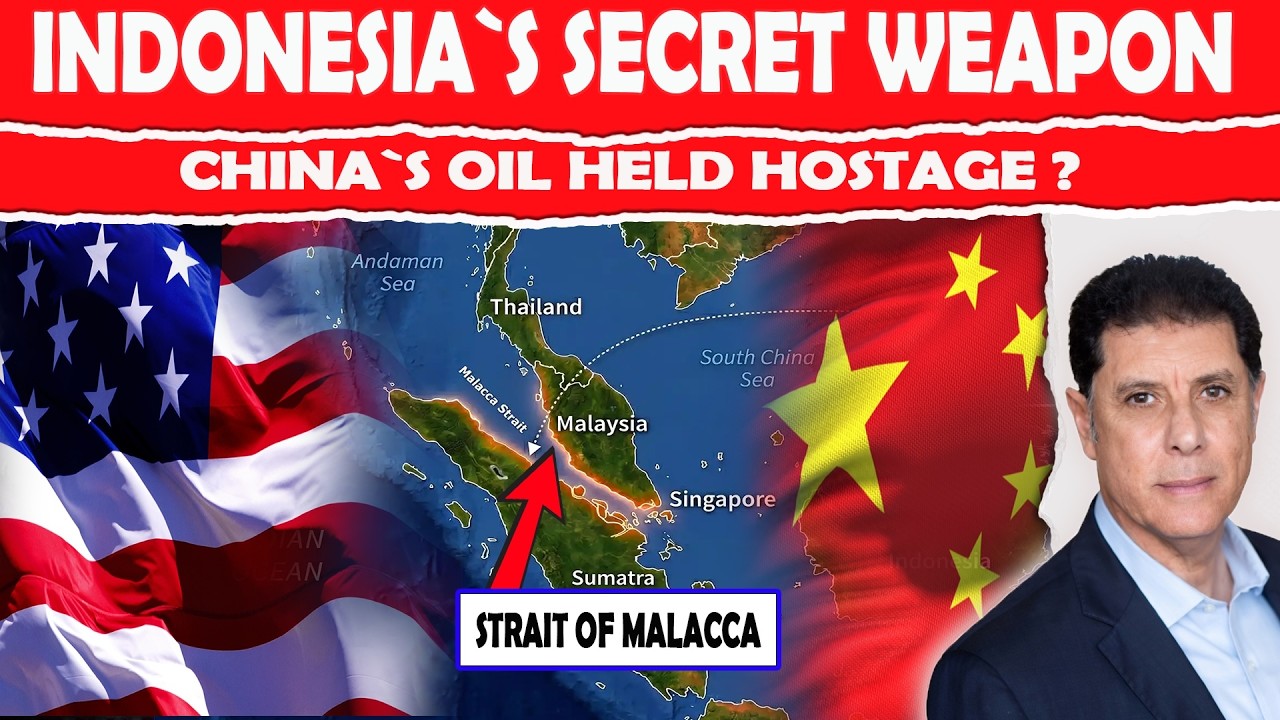
Dr. O breaks down Indonesia's 2025 moves: a finance minister's proposal to toll the Strait of Malacca, a secret US defense pact, and Russian oil purchases. The strait carries 22% of global maritime trade and over 80% of China's oil imports, making any toll a direct threat to Beijing's energy security.
Chapters
Hello everybody and welcome to Geopolitical Trends, where truth matters. A tiny strait, that's the one we're talking about here, very tiny one, and about 80% of China's oil. And the country that just put itself in the middle of the US-China rivalry while at the same time cutting deals with both Washington and Moscow on the same day. Now, in my opinion, this changes everything. And this is exactly when you consider that China moves about 80% of its oil through a strait that does not control. That's raised serious concerns. At the same time, America just moved in. Yes, the US just moved in through a subtle way, and I'm going to share all that with you. And this is why Indonesia went ahead and pulled off one of the most, in my opinion, not a smart but a dangerous power play in modern geopolitics. And yet nobody's talking much about it. And that's exactly what prompts me to talk about this particular topic today. Now let me be honest with you, as I've always been. I knew of this story about 2 and a half weeks ago. I decided not to talk about it because I was moving around traveling at the same time, and I wanted to ensure the accuracy of one particular information. And I found out about it because it was on the classified side. Part of it got declassified as to the special memo that was dealt between Indonesia and the US. And I'm going to share all this with you as I move forward. So some might say, well, why didn't you talk about it before, Dr. O? That was the reason why I didn't. So in any event, what I'm going to be providing you in this, uh, uh, live stream here, I'll provide you my own analysis about really the long strategic impact of the Malacca Strait and how things are moving forward in light of the Iran war. I wanted to do something different for you. We've been talking about Iran And of course, Iran, uh, uh, conflict is, is important to talk about. And as a matter of fact, tomorrow I will be talking to you about some major updates regarding that issue, so, or that topic rather. So let's talk about now really what is going on with the Malacca Strait. Very, very important to understand because in a single week, which all happens within one week, Indonesia went ahead and threatened to toll the world's busiest shipping lane. At the same time, he signed a secret deal with the United States. That's the one I was waiting on to confirm, and it confirmed that indeed it did. Uh, the Prabowo government went ahead and signed that secret deal, deal with the United States. And at the same time, Indonesia went ahead and bought oil from Russia. From Putin and somehow managed to make every major superpower nervous at the same time. So basically what Indonesia is doing is playing the three main players, which only three main players that matter on the global geopolitical landscape: US, Russia, and China. Simple as that. And this is where when Indonesia stunned the world by floating that idea of the toll fees on the Strait of Malacca, became like, okay. And by the way, just Malacca is that narrow, uh, waterway carrying 22% of the global trade— that's for global— and 80% of China's imported oil. That is how strategic and important that is. And then Indonesia went ahead and signed the landmark US defense partnership, giving America access to what? To two main things: submarines and surveillance systems, right at China's, uh, uh, uh, sort of most critical energy choke point. Let that sink in for a moment and think to yourself, was Indonesia smart in this move? Or was he pressured to do so? All the while, Indonesia went ahead and cut a deal with Putin on the same day, the same day that signed the landmark US defense partnership with the United States, giving the US access. And this is where it begs the question: is Indonesia playing the most dangerous diplomatic balancing act in the world. So what I'm going to try to do in this live stream here, break this down for you and provide you my own insights to how I see it. And like I said before, I was aware of the issue. I didn't want to address it because it happened on April 23rd, I think, somewhere around that time. It was during the same time I think I was leaving, uh, the US, and I decided not to talk about it. I wanted to wait till the right moment. So just to give a background, back then what happened with— it was Indonesian Finance Minister, uh, uh, Sidawa. I think I have a picture of him, uh, oh no, I didn't. I thought I had a picture of, uh, this is the foreign minister if I'm not mistaken. Yeah, anyway, the, the, uh, for the, uh, finance minister Probya Yudi Sidewa. He's the one who floated the idea, and here is what he said, and I quote, because I have the link for you for the article: Indonesia is not a marginal country. We sit along a key global trade and energy route, yet ships passing through the Malacca Strait are not charged. End of quote. And of course, the moment he announced this, this created a sort of— and by the way, this came in response also to what's going on in Iran, because this debate was partly sparked by Iran's own push to levy fees on ships transiting the Strait of Hormuz, which it succeeded in doing so. And this sort of, at the same time, the Indonesian President Prabowo, which, based on some of, uh, recent conversation I had with some people in the know, uh, most Indonesians are not content with this guy. You know, I, I'm aware of his background as a former military guy, but also on his dealings with the US behind closed doors, including the agency. So you put the two and two together and figure it out. But here is the thing, uh, Prabowo also made related remarks in a televised speech, and that speech was on April, I think, 9th or 10th, somewhere around that time. Don't quote me on this, but what are important— what is important to understand is his statement. Here is what he said, and I quote: Are we aware that 70% of East Asia's energy needs, and 70% of trade pass through Indonesian seas, end of quote. And this is why the immediate backlash was rapid, rapid. Nobody waited. You have two main countries in the region, they didn't hold back and they didn't wait. One of them is Malaysia and the other one is Singapore. They just didn't have to wait for that because it was of great concern as to the statements coming out of, uh, Indonesia. And the both countries, Malaysia and Singapore, stated their opposition within hours of that statement. And of course, within 24 hours after Singapore and Malaysia sort of, uh, made their position clear The Indonesian Foreign Minister Sugiyono, that's his picture right here, he went ahead and disavowed the comment by saying, and I quote, because here is what he said: as a trading nation, Indonesia supports freedom of navigation and expects open sea lanes. 'Indonesia is not in a position to impose such charges that will be— that will not be appropriate.' End of quote. Makes you just wonder about the quick reversal here. And by the way, this is again where you have the Indonesia later on shutting down The conversation about the Malacca Strait, tall talk. And I'm going to be providing you an article, uh, that was published on, uh, as a matter of fact, published last week. So should you decide to read it, it, it really highlights the importance of this particular development. Of course, now everything is quiet, that's why you don't hear much about the topic, but it already raised concern. And the next question that becomes within this context is, will it be illegal for Indonesia to do? Well, here is the harsh reality as it exists based on facts. Under Article 38 of the United Nations Convention on the Law of the Sea, the UNCLOS, vessels enjoy the right of transit passage through straits used for international navigation without obstruction or interference from bordering states. That's what exactly Article 38 says. Then you have another article, which is Article 44, and that Article 44, in it, it further obliges coastal nations not to hamper or delay transit. And crucially, Indonesia itself benefits from these same protections as an archipelago state, or archipelago state imposing tolls could undermine its own legal standing. And some of you will say, okay, Dr. Oh, if we are looking at this, how can we compare it to the Strait of Hormuz? Completely different scenario, completely different setting. Nobody want and sort of start pounding in Indonesia, unlike in Iran. The US and Israel went ahead and start pounding, so Iran had to do what it had to do. So, so why this matters enormously, you know, sort of, uh, you have to think about it in these terms, and for simple reason. Three reasons. One is that the Strait of Malacca handles roughly 22% of global maritime trade and nearly 29% of seaborne oil flows. You have about 100,000 ships passing through, uh, the strait, uh, on an annual basis. That's no small matter. Number two, Malaysia Maritime Department recorded more than 100,000 ships transiting in 2025 alone. And number 3 is that you have now analysts warning that if such a toll were imposed, oil prices could spike above $100 a barrel. Well, we already saw this with the Strait of Hormuz. Now imagine adding, uh, the Malacca Strait to this. And by the way, the shipping route could divert, adding another week to 2 weeks delay into this. And one of the logical questions to ask as an analyst is what's really behind all this? Because in my opinion, this is no coincidence. This is not a coincidence that the idea about— the idea Indonesia was floating by through its finance minister. Because here is the harsh reality. That's why I'm saying some people inside Indonesia, and I have it on good authority from people in the know with connection into that government, is that the country, Indonesia, in this case, fiscal position looks increasingly shaky. Prabowo turned out not to be what everybody was expecting. Because you also have the S&P Global Rating flagged Indonesia as the regional country most at risk of a credit rating downgrade. This is the harsh reality. And if you add the 2025 budget was already strained by generous new welfare programs and increased military spending even as the government revenue dropped. This is why Indonesians are like shaking their heads at the policy, uh, President Prabowo and his government is embarking on. And yet embarking on an idea such as putting fees on the, uh, on the Malacca Strait, basically choking China's 80% of energy flows Hey, it's not gonna bode well. And this is why, even if you go back into 2000s, I was there in, in, in, in Washington at that time, and we heard the idea of Indonesia flirting with the idea. And it was during the same time. And if I am to be correct, I recall in 2004, in 2004 China start putting the blueprint for the scenario of what if Malacca Strait is shut down. This is why China has already, already put a plan in place from way back. I was in DC starting in 2001, and the idea was floating at that time because Indonesia started to think about this, and we were like just shaking our heads back back then. So now we are the one probably encouraging it behind closed doors, meaning government in Washington, DC. And why Indonesia brought this up back in 2000s? Because during that time, piracy became an issue. And this is when Indonesia suggested that the ships passing through must pay for escort through the strait. This is exactly what Indonesia suggested at that time, which was, wait a minute, what is he trying to do here? And at that time, you have Malaysia and Singapore teamed up to squash the idea. Those two countries are saying, no way this is going to happen. Of course, this was never a formal policy. Because it was raised as a— what do we call it— as a conceptual proposal in public forum. Basically, the government in Indonesia, in Jakarta, was trying to test the waters, but it was never a government official statement about it as to make it a policy. But the speed with which it rattled diplomatic and shipping circles underscores just how fragile global trade infrastructure will be. And of course, one thing you, if you have learned anything with me for the last month or so when we do in Iran, is that leverage geography gives any country. So, and at the same time, Indonesia started thinking those. Iran moved forward with it. Because Iran is using geography as a wild card and it is succeeding at it. So, and this is why you have to put this in, in perspective. It is best understood, this particular, uh, dynamics regarding Indonesia considering putting a toll, it has to be understood as a combination of a fiscal desperation, that's one, as a geopolitical signaling That's true. And as I said earlier, perhaps the Minister of Finance was testing the water to see how this is going to be, uh, uh, uh, uh, responded to. And that's exactly the next question we had to ask is, how did China see this move by Indonesia? Not in the short term, but in long term. Because China, as I said, I was aware of back then in mid-2000s, Chinese start to think in terms of we're gonna have to have a strategy in place dealing with the eventualities of what if the Americans force Indonesia and of course pull its subservient, uh, uh, ally India into supporting this. And as a matter of fact, which I will share with you in a second here, India is part of this from a different angle. That shows you India's playing both sides, can't be trusted anyway, no matter how you look at it. And to Beijing, it's so crucial for one specific reason, and rightly so. And that reason is Malacca Strait sits at the heart of one of Beijing's most persistent strategic anxieties. That is why Beijing's been working on this for decades, ensuring that there is a plan in dealing with this eventuality. And that is why it became known as the Malacca Dilemma. So, and I address this in my upcoming book about China, I, I, I give it a, a good section in the book to address this because that's considered— and I don't care what others say because I see it— not that I don't agree, whatever. I mean, everybody's entitled to his or her opinion. It just no matter what someone say, oh, that couldn't be. The way I see this Malacca Dilemma as China's core vulnerability because it's reality. So, and to understand China's reaction, you have to start back in 2003. That is why I said around that time I was made aware. I was in Washington, DC. I was— because that was part of what I had to do is to maintain what was going on around the world geopolitically speaking. I used to— as somebody asked me one day, I was flying to, uh, I don't even remember where I was flying. I had the first stop in Frankfurt and keep going to Asia, and somebody was sitting near me in the business class asked me, what do you do? I say, I gauge wars. Of course, the guy got perplexed with my question, which is true. You gauge war in the sense of understanding the geopolitical decisions those countries make, whether it's going to pave the way for a war or not. And at that time, back in the mid-2000s, The preparation of the Chinese strategy regarding Malacca highlight to me that if they don't take care of this, it could become one of the core vulnerabilities for them. And this, once again, you have to understand, part of China's prosperity was built on the sea lane it does not control. This is, again, it does not control and it cannot be monitored. Or disrupted, or even— because it can be, it can be disrupted, it can be blockade by rival powers at any time. And that is exactly the point. So the numbers are staggering when you consider, and I'm gonna share some with you. Two-thirds of China's total maritime trade, that means more than 80% So two-thirds of its maritime trade. You have also more than 80% of its oil imports. You have also roughly 16 million barrels of oil per day pass through the Strait of Malacca. Those are not small numbers. And this is why, when you consider also that China is the world's largest energy consumer, accounting for about 25% of global energy consumption, and nearly— literally nearly, we're looking at about 92%, give or take, give or take the, the numbers that I read— nearly all of its oil arrives by sea. So think about this one, okay? Think about this one, okay? Think about this. And that is why you have now some conversations regarding different routes. Whether it's going to succeed or not, I do not know at this point. And the alternatives are costly, that's what I meant. But I do not know, because a journey, for example, from Saudi Arabia to Japan via alternative routes like Lombok Makassar Straits, which is the picture that I showed you earlier, just as an example, is more than twice as long. And if forced to reroute, China is estimated to face costs of up to $220 billion per year. That's no small change. So, so far, with Indonesia backing down from that, at least verbally, to China, its short-term reaction is a kind of a quiet relief. Of course, China welcomed Indonesia's swift reversal, but at the same time, it's not just China, because such a proposal will face strong opposition from the likes of Japan, the likes of South Korea, Vietnam, Singapore, Malaysia, and, and, and other countries, because their economy is particularly reliant on the free passage through the strait, Strait of Malacca. But this is on a short term. But if you look at the long term, the long term is a different reading, and I'm talking about China, Beijing's approach to this one here. The long term has some sort of deeper alarm to it. China is not naive to think that just because the short term doesn't show any concern, it should ignore the long term. No, no, no, no, no. And this is where it gets strategically interesting. Even though the idea was walked back by Indonesian government, in Beijing it's a different story. Beijing will almost certainly sort of mark or file this episode away as a warning signal for several reasons. Number one, it proves the vulnerability is real, because for decades China has been this, uh, disturbed by the fact that the vast majority of its energy import European-bound exports must squeeze through the Strait of Malacca. That's sort of centering around the scenario in which the US might leverage its naval blockade of the strait. And that, if that happens, it's going to impact China's industrial economy, especially regarding the fuel it needs to manage its economy. And that is why when the finance minister of Indonesia raised the possibility of charging a toll, uh, this is like, seems to Chinese, based on how they read it, as the first step down that path, the path of the vulnerability. Number 2 is that Indonesia is signaling strategic assertiveness, whether it's Indonesia or the US pushing Indonesia behind the scenes. And this is when you have the Indonesian Maritime Security Agency chief call the strait a giant sea toll, in quote, toll road, that is, that Indonesia has not fully utilized. And that's, to me, this language, it suggests a growing appetite, in my opinion, among some in Indonesian government to leverage geographic possession with the support of the United States, of course. And number 3 is the US factor looms large into this picture. And this where it gets into the core of why I decide to do this for you, because it has both implications— economic, of course, but we're talking about the security and the geopolitical ramifications. The United States has long maintained a presence at strategic points surrounding the Strait of Malacca. Why? Because look at the map. All you need to do, look at geography. You're looking at Guam, you're looking at Diego Garcia, you're looking at Okinawa, Luzon in the Philippines. All those locations will give you an idea as to why the US might be behind this. Recent US partnership with Indonesia are designed to— here is what the US is saying— strengthen maritime domain awareness, including monitoring of surface and subsurface activities connecting to the Indian Ocean and South China Sea. Those, uh, uh, Uh, if, if, if you read between the lines, you know, China is seeing this as a deepening of the US-Indonesian maritime cooperation that could really spell trouble for China down the road. And with this becomes the key question, this China strategic response. So while already China has embarked on some, for example, the BRI, the Belt and Road pipeline alternatives, China has been investing in overland pipeline. That was the reason why we also went ahead and, and wanted to ensure tensions in Central Asia, because some of the pipelines going through there. That is the whole reason for why we went to Afghanistan to begin with. Uh, when we went to Afghanistan, had nothing to do with Afghanistan. It had to do with Central Asia. So, and also China will have to also consider part of this strategy is the buildup of its PLA, the, the, uh, the People's Liberation Army Navy, uh, structure. China's Navy has been expanding its blue waters capabilities, and partly within Malacca scenarios in mind. And rightly so, you're gonna have to think in those terms. And the other strategic approach that China has done already, and remember the visits of Prabowo to China, and I think when President Xi Jinping went to Indonesia, is courting Indonesia bilaterally. In other words, China has extensive investment ties with Indonesia, which is important. But what you need to understand with this is that China views this episode through a dual lens, and rightly so, because China's not going to want to take any chances, uh, with this. Short-term relief that it was swiftly quashed, the decision to put tolls on, on the Malacca Strait, okay, especially at the moment when the Strait of Hormuz is already under stress on the global maritime order is visibly fraying. So to Beijing, just to leave you with this note here, for Beijing, the Malacca Dilemma just got a very, very public reminder. China never forgot about this. So except we have to think in terms of what, what can we expect from China to do. Well, what you can expect is that for China to quietly accelerate its alternative routes investment, it will also deepen its diplomatic engagement with Jakarta. Whether Jakarta Prabowo was going to bow to the pressure from the US, I don't know. It depends, and I can't ascertain for a fact. How Prabowo is going to do. All I can tell you is that during his time in the military, there were some contacts with the intelligence agencies in the US played a role into what Prabowo did back then in the military. Uh, whether this is going to materialize or not, I cannot ascertain for this at this moment. If the truth matters to you, hit like, subscribe, and tap that bell. No spin, no agenda, just the stories they don't want you to know. Don't watch from the sideline, be part of the movement. Your support keeps the truth alive. Thank you. And indeed, much appreciate your support for the channel. I'm very, very grateful to you. Uh, now let's talk about the US and Indonesia, and this is again what prompted me to wait I'm not talking about this week and a half or two weeks ago. Is the Major Defense Cooperation Partnership known as MDCP. And this, the US is saying, oh, we just want to bolster regional security in the Indo-Pacific or Asia-Pacific, uh, but at the same time, this one creates anxiety in the region, not just China. And China doesn't have to It's not— when I say anxiety, it's not out of fear. Anxiety is as far as you need to come up with the strategies. So first of all, what is the MDCP, the Major Defense Cooperation Partnership? And this happened when the Secretary of Defense of the US and his counterpart from Indonesia, uh, his counterpart, when he visited the United States on April I think 15th, if I'm not mistaken. When he visited there, Pete welcomed his counterpart, and it was April 13th to be exact, because I have, uh, I have the report from the US Embassy, and I'm going to share it with you so you, you know where the information is coming from. So, and that's where the two announced the Major Defense Cooperation Partnership. And this is where they are completing more than 170 exercises together each year. Let that sink in for a moment— 170 military exercises every year moving forward. So the MDCP is structured around 3 main pillars. Number 1 is that the military modernization and capacity building for Indonesia. Number 2, training and professional military education. And number 3 is joint exercises and operational cooperation. But when you combine all 3, what do you see? All of them carried out with mutual— this is what the US is saying— mutual respect and national sovereignty. As a guiding principle. That's on the paper, because when you look at the deeper significance of this, it lies beneath the diplomatic language. And the most important line in this new defense partnership is not the reassuring about peace and stability and promotion of democracy and the freedom of navigation and what have you. No, it is one about maritime, subsurface, and autonomous systems. That is what's at the heart of it, because here is what was not disclosed openly, and that was the reason why I was waiting to confirm certain aspects of that particular document. You know what's added to this? It's added the promise of maintenance It's added the promise of repair and overhaul, uh, overhaul support. And the third one is the commitment to expand joint special forces training. That in itself, when you look at this, you start to think that the documents read less like a ceremony than a capability. That's exactly what I read from the embassy, the US Embassy, uh, uh, release about this one here. Because what you're looking at, you're looking at a multi-alignment on display. And wait until we add India into this to get a big picture as to how this works as a cir— encircling China. And this is where, uh, uh, uh, the, uh, Indonesians decided to go ahead with this aspect. Because on one side of the planet, you have the— the— or you had, rather, because it took place on April 14th, you had the defense minister, uh, uh, Jeffrey, stood at the Pentagon This is the picture you're looking at. Let me pull it up for you guys. Stood at the Pentagon to sign that MDCP while simultaneously you have Prabowo held a marathon 5-hour meeting with Vladimir Putin at the Kremlin in Moscow's Driven. That's the meeting took place in Moscow. Which was driven by the cold pragmatism to secure Russian crude of an estimated $59 a barrel to shield Indonesia from the acute energy inflation. So, so this, in my opinion, wasn't an accident. This is the, the, the chess moves by Indonesia Multi-Alignment Doctrine, as it is known in, in, in the jargon of the geopolitical terminology, signing a defense pact with Washington while buying discounted oil from Moscow all in one day. Is the same scenario the pathetic Marcos Jr. did of Philippines when he came to power, flew to China met with President Xi Jinping, flew back to Manila, and signed the military agreement with the United States. At that time, it was Lloyd Austin, Secretary of Defense. So is Prabowo playing the same? I will say so. And this is why China is alarmed by this, because now this so-called Malacca Dilemma is sharpened right on focus right now. It's almost like you put it under the microscope and you see it with its real image. Because consider what China's doing economically through the strait. It imports about 11.6— to my knowledge, 11.6 million barrels of crude on a daily basis. And that's what exactly last year— that's over 90% of which arrived by sea rather than pipeline. So the Strait of Malacca, in my opinion, remains the world's largest oil transit choke point. It's, it's so important. So, and even the estimates in the United States by the, the, uh, Energy, uh, Energy International Agency estimates that 23.2 million barrels a day flows through the, the first half of 2025. That's roughly 29 to 30% of maritime oil trade. It's no small numbers. And that's exactly when you consider why China will have to be alarmed when approximately 75 to 80% of its imported crude oil transit through that narrow corridor. I can see why the integration of maritime and airspace access which done under this agreement between Indonesia and the US under the MDCP framework sort of create— because what is going to create is creating persistent monitoring of vessel movements, right? What does it do also? It creates a data-driven operational environment. It creates also a real-time situational awareness that can be translated into strategic leverage during period of heightened tensions without requiring an overt escalation. That is where the concern of Beijing is, and rightly so. And I had a chance to read an analysis, a white paper from a defense security entity here. I'm going to put the link for you in the chat box and you can read it later on. Then you have the, the over— the, the big question, which is almost for China, it will be the hidden nightmare. And, and, and again, we can't shy away from, uh, you know, China. You have to understand that I'm learning more as I do the research about the upcoming book and the what I've been reading about China for the last 2 decades or so. Historically, Chinese tends to be quiet. They don't, they don't, they don't sort of, uh, want to draw too much attention. Not that they are timid or what— no, no, it's just their personality, the culture, how it is. But I would say I'm starting to feel I need to say this out loud. So if there's a Chinese official watching this channel, time has changed. You're gonna have to be a little bit more vocal, a little bit more forceful, a little bit more aggressive in your approach. You can't be timid anymore. Why? Because the landscape, the global geopolitical landscape, has changed, and it changed to the favor of China, not the US, to the likings of China, not the US. Even in communication, China cannot be sort of, uh, limited. No, no, no, no. You have, you have, you China in this case have to communicate your ideas openly and, and for the world to know. You can't be shy about it, you can't be limited in it. And this is why the big concern to, to Beijing, the way I will, the way I see this moving forward, is that if the US demands an overflight, a blanket overflight rights from Indonesia, if the US demands automatic military transit through Indonesian airspace. And this exactly where that classified document— I didn't have access to the classified one, I had a chance to read the desanitized version of it. Because the classified document is titled Operation, uh, Operation US Overflight, which reveals the Pentagon desire for rapid transit corridors from the Pacific to the Indian Ocean to respond to Middle East crisis. And Indonesia voiced concerns about this so-called alliance trap. Well, if you are voicing concern, why the heck are you going and signing the, uh, MDCP, the military, uh, partnership? That, that doesn't make any sense. You're playing both sides. Are you becoming India, Indonesia? So, because here is once again the dilemma for China, and I'm looking at the big picture here. If granted, this will give the US rapid aerial access across the entire Indonesian archipelago, directly above China's most critical shipping lanes. Let that sink in. And without Indonesia being a formal treaty ally, so for Beijing, that's nearly as alarming as a formal alliance. And I think Chinese concerns are warranted, and rightly so. I mean, just, just, it'll be concerning. That's all I can say about this one here. Then comes the long game. And where is this long game? The interoperability. That is the long game. Indonesia has not suddenly became an American ally. But in Asia, the most consequential shift often arrives without any treaty or drama or what have you, because those, they are built through habits, hardware. And that's where the interoperability comes in. That is why the US added this kind of special forces, uh, uh, exercises, and on 70 military training exercises per year. All those pieces will add up and create this. And that is what China has understood, this logic, for a long time. Every joint exercise, every shared communication system, every piece of US-compatible hardware Indonesia acquires quietly it deepens the integration that will matter in a crisis. I mean, I can think of Philippines is gone, it's a lost cause because we sucked in Philippines into our inner operability. Philippines won't function without the US, militarily speaking, because we control certain key aspects. And that in itself from a geopolitical and security perspective, it fits this scenario. In my opinion, it fits a tightening ring encircling the MDCP, this military partnership with Indonesia, between Indonesia and the US. No, no, no, no, no, doesn't exist in isolation. Like I always said, in geopolitics, nothing happens in a vacuum. Because what it is, this fits into a rapidly expanding US network. That is why I'm going to be bringing India into the conversation. That's why Pete Hegseth, the Secretary of Defense, and his counterparts from India, what they want to head and sign a 10-year US-India Major Defense Partnership framework. Remember, they did it last year, and I think I did a video about this one. And what is that aimed at? It aimed at a deeper deterrence, and once again, inner, inner, at one thing and one thing only: challenging China's growing expansion or assertiveness, whatever term you want to use. So from India, all the way to Indonesia, the US methodically is building some sort of, uh, interlocking partnerships that together, when, when you combine them, form or encircle China maritime lifelines. Yeah, just think about it. That is the big picture. That I need you to understand about all this. And with this will become what is China's expected response, because China have to respond to this. Uh, but the response from Beijing ain't going to be some sort of a direct confrontation. No, that one China is smart enough to know. Then when you realize your enemy is making— let, let your enemy follow in his own mistakes. You know, it's not going to be direct confrontation, but rather intensifying the economic diplomacy. That is what's going to be the leverage for China. Not that China is afraid or can't fight. As a matter of fact, China will have, based on what we're seeing right now in the Persian Gulf, a war with China. China will have the upper hand easily, easily, because the diplomatic— I'm sorry, the economic diplomacy that China will embark on, will offer even larger strategic infrastructure investments to keep Indonesia's economic orientation tied to China rather than flipping to the US. Because with the US, they're not going to get any economic ventures whatsoever. What they're going to get is trouble and more issues and so forth. And our Indonesians are already not happy with the performance of Prabowo. Uh, uh, in, in office. And this is why this defense cooperation between Indonesia, uh, as a matter of fact, and the US, uh, it's gonna now raise some serious concerns. Some serious concerns. It's going to be very, very problematic. So, but it is also not just China. You have the concerns and the anxiety goes beyond just China. And you look at also this particular MDCP, the military partnership between Indonesia and the US, sort of creates an ease now in the wider ASEAN, the Association of Southeast Asian Nations, neighborhoods, which by the way, the Philippines, I think, is chairing this year. And this for subtle reasons, why the anxiety among ASEANs? So, uh, because particularly when you take two main countries, Vietnam and Malaysia, those two countries, because those two countries practice almost the same non-aligned balancing act Indonesia does, but Indonesia doesn't seem to. So, so they are watching, they are watching, meaning members of the ASEAN are watching closely, uh, whether Jakarta has tilted or whether they will face similar pressure to choose. So, but to me, a formal— because that is what it is, a formal defense pact in the— in Asia-Pacific could alter China's assessments of its future strategic positioning. That's the way I see it. So the bottom line to this, and I'm gonna conclude with this one here, The, the bottom line that I need you to understand for the, the future of the strategic positioning of China— and, and we no longer call it a rising power, China is already there. Let, let's, uh, excuse me, I personally probably is going to refrain from ever mentioning this word rising power. China is already there, it's no more, it's not rising, it's there already. So, uh, when you think about China as a power because he will perceive this window is closing, because he can be very, very dangerous nonetheless. And that in itself is gonna— now Beijing might feel compelled to act before options are foreclosed. They can wait till— well, wait and see. No, no, no, no, it's not gonna cut it. So, and that's why I want you to understand that this MDCP, this military partnership between Indonesia and the US, some will call it as a masterpiece in strategic ambiguity. No, no, no, no, no. I'll call it stupidity. I call it lack of vision, of deeply thinking for the strategic consequences of an action. This is as the, as, as the saying goes, don't ever look at the end of your nose. You have to look very far. And apparently Indonesia didn't look far enough. So because if Indonesia thinking we're gonna gain US technology, we're gonna gain training, we're gonna gain deterrence capability without formally abandoning non-alignment, they're mistaken. The US will look what's going on right now in Australia. How mess Australia is right now because the US get too involved with that. Look what's going on in Japan, in the Philippines, South Korea. So what you have, you have the US gaining privileged access to the world's most critical maritime chokepoint, and at the same time you're going to have to think into what China's going to have to do. China will have to gain a sharper, more immediate version of the Malacca dilemma, because China has been thinking about this for the last— to my knowledge, for the last 15 years. Because remember, back when I was in DC in 2004, 2006, this starts to come up in a conversation in Washington about the Chinese concern about the Malacca So it's nothing new, it's just they have now— and it's a different ball game. And especially when you have now American submarines, when you have American autonomous systems, surveillance infrastructure steadily embedding themselves into the waters with Indonesia, that's going to become very crucial for China because its entire industrial economy depends on ensuring that doesn't happen. And that's— so let me know what you think, uh, how do you see it moving forward. So I just want to wrap this up for you, uh, so far the way we read it, it's just Indonesia has turned now geography into a leverage, following in the footsteps of Iran, maybe. Or maybe the US has convinced Indonesia to follow that path because the US was shocked and surprised to see how Iran end up using geography. And when Indonesia said that is threatening to toll the world's busiest shipping lane, signing a landmark defense deal with Washington, and buying oil from Moscow, all the while keeping China guessing. So no country of its size has ever played this kind of, uh, game between these, uh, uh, uh, major powers simultaneously. We give credit where credit is due. Well, now, was Indonesia shrewd in this, or was it stupid of them to go that route? You decide. So one thing is sure is that the Strait of Malacca Let me put it up. Strait of Malacca was always the jugular vein of global trade, similar to that of the Strait of Hormuz, and Indonesia just reminded everyone it holds the knife. That's basically what the statements of Indonesia, uh, so here's the question I want to leave you with, if you feel comfortable enough answering it in the chat, in the, in the, in the, uh, a comment section. I would greatly appreciate it. Is Indonesia a brilliant strategic mastermind carefully protecting its independence, or is it playing a dangerous game that could pull the entire Asia-Pacific into conflict? Once again, is Indonesia a brilliant strategic mastermind carefully protecting its independence, or is it playing a dangerous game that could pull the entire Asia-Pacific into the conflict? So make sure you drop me your thoughts in the comment section. I would greatly, uh, appreciate it. So, uh, let me say thank you to, uh, Kevin Baptist as an avid supporter of the channel. As always, truly appreciate you, Kevin, for your, uh, support of the channel. This particular topic was one I was not aware of. Excellent analysis. You're most welcome, uh, Kevin. And that is the reason why, uh, just for the community, uh, I know Iran issue is, is relevant, whatever, but I also have to do topics for you to keep you informed on other parts of the world. Uh, that's very, very important. Uh, for, for example, I'm, I'm working on a case right now uh, that it has to do with, uh, uh, uh, North Africa. What is going on in North Africa? Why do I mean by this? Uh, let me just share a picture quickly here. Why is this important? Because you have now— Morocco has become the largest arms importers in Africa. Yeah, Morocco is buying a lot of hardware from the US. And, and this, you don't look at it just in, in, in, in the void. Is there a looming danger on the horizon? Why all of a sudden Morocco will embark on this? And in my opinion, it's worth knowing, at least for you to understand the dynamics, when you consider that Algeria just purchased an Su-35 from the Russians. So it's worth— and I'm gonna do a live stream for you. Of course, with Iran, I will keep up with this because We have also another developments in the works, and again, till I confirm stuff, and this one has to do with Iran's allies. Iran's allies, I'm referring to three main ones here: North Korea, Russia, and China. And the word I got is there is a possible mobilization of naval fleet from those allies to support Iran. I mean, just think about the meaning of this. So something like this. Yes, I am going to do a live stream for you about it. So, so once again, thank you very much, Kevin. Truly appreciate you. I also want to say thank you to Alice Chong for becoming a channel new member. Welcome to our community here. And I'll give a shout out to Andrew Wong. Uh, thank you for buying me cups of teas in support of my upcoming Asia trip. You wrote, and I quote, thanks for being a necessary and authentic voice for the region, end of quote. You are most welcome, you're most welcome. And that is the reason why I'm gonna go to that part of the world, because there are some key things that I need to report to you from the ground. This is not through me reading analysis. Well, I'll be on the ground and reporting that for you. Also want to give a shout out to Citycom 8362, uh, thank you very much for, uh, buying me cups of teas in support of my upcoming, uh, Asia trip. And to those who wants to support the upcoming Asia trip, uh, here is the link. And by the way, I updated the, uh, the fundraising, uh, just to let you know where we are. We are now at a 31% Uh, so we move in. I wish it would move faster, but it is what it is. I'm very grateful for whatever. And just to let you know, if I don't reach the 50% mark, at least because of the cost involved in where I intend to go and report to you, once again, I just want to put this on record. I like transparency, you know. This is not tourism for me, whatever. If I want to go on tourism, I'll go on my own dime, which is the right thing to do. This is for you, for the community, for all of us. So, so I'm very, very grateful to those who, uh, decide to support my upcoming Asia trip. Uh, I, I can't thank enough the, uh, uh, uh, the, uh, individual who, uh, was so generous, uh, to put in, uh, a three-figure donations in support and willing to match $1,000, $4,000, $1,000 to that. So I'm very, very grateful to that. Here is the link for the, uh, channel if you are interested. I would be greatly appreciated. And as I said, I will be working on, uh, the next two stories for you, and I will report to you as we move forward. Hope you enjoyed it. Please, please hit the like and share this video with others, and of course subscribe if you have not done so. Already, and thank you for your support. As always, remember, geopolitics impacts your daily life in more ways than one. Till next time, bye-bye.
More from David


Beyond the Single Actor: Why the Gulf Isn't Choosing Between the US and China


Iran, Iraq's Militias, and the Houthis Are Coordinating! This Changes Everything




Who Controls the Next Decade's Resources? Latin America and Africa's Geopolitical Crossroads

The Chokepoint Trap: How Washington's Stupidity Triggered a Cascade That Now Controls the World

Trump Spooked as IRGC Unveiled dual-use SLV, Deployed Ghadir Mini-Subs & Hinted at Tactical Nukes!
