Cuba Conducts Military Exercises & Affirms its Readiness to Confront any US Aggression!
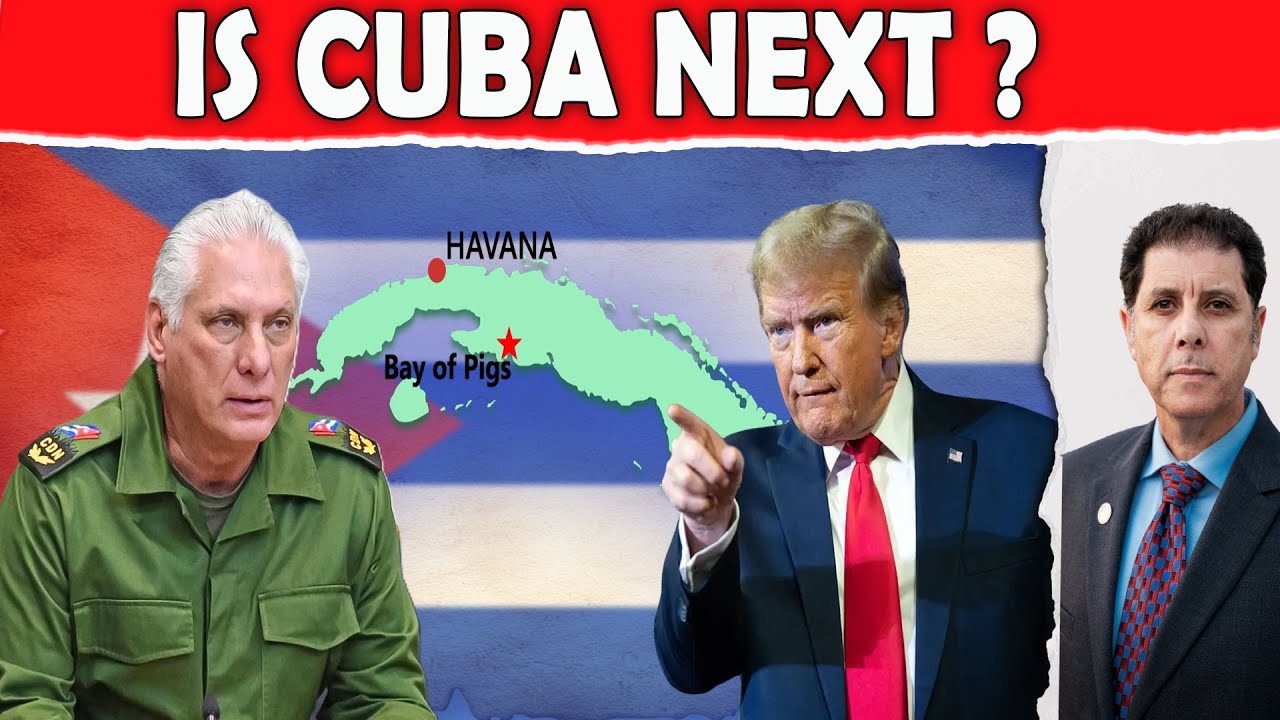
This content was created by David Oualaalou. This content was uploaded by David Oualaalou. This is a YouTube livestream (title: "Cuba Conducts Military Exercises & Affirms its Readiness to Confront any US Aggression!") posted January 28, 2026 by the Geopolitical Trends channel. A single host delivers a long-form geopolitical commentary and analysis of Cuba's recent military exercises, US–Cuba tensions, and Donald Trump’s alleged regime-change strategy. The host provides geographic and historical background (Spanish colonialism, sugar/slavery economy, Platt Amendment, Batista, 1959 revolution, Bay of Pigs, Cuban Missile Crisis), assesses the impact of Venezuela’s lost oil subsidies, and outlines possible nonmilitary US tactics (economic pressure, diplomatic coercion, internal defection). The video references key actors (Miguel Díaz-Canel, Donald Trump, Marco Rubio) and discusses responses/implications involving Russia, China, Iran and other powers. The livestream also includes community shout-outs, links to academic sources, fundraiser/support appeals, and plugs for upcoming streams (including one on an incident involving a Chinese general).
Chapters
Hello everybody and welcome to Geopolitical Trends, where truth matters. Excited to be with you as always. Today's topic, we will be talking about our neighbor to the south, Cuba, what is going on there. So I know a lot of people might not find it very interesting, but you need to know the developments that is taking place, uh, in, in, in, in Cuba vis-à-vis Donald Trump's statements regarding, uh, the possible regime change and so forth. So, uh, this is what I'm gonna be providing you my analysis about. But first, let me say hi quickly, our wonderful community. American Citizen X, good to see you here. Uh, Ed Lewis, good to see you, and hello to you as well. Uh, who else? Say It Like It Is, good to see you. Willie Holman, as always. Hanging G, good to see you here, and thank you for your contribution to the conversation on the comment sections on the videos. So I appreciate you for that. Athene Wu, good to see you. Casey Wong, here you are. Lock1970, good to see you. And Ramples01, good to see you here. Some housekeeping item: remember to join me tomorrow for my conversation with Carl Zah, which will be around— it's not around, it will be at 1900 hours Central Standard Time. Hope you all enjoyed the conversation yesterday with Ina Tangen and Warwick Pao. Was— it was very, very insightful, and I'm very grateful to them for carving out time for us here. Um, headlines— I'm not gonna do headlines today, by the way. I'm just gonna get in into, uh, uh, the topic. But also, I want to remind you that I will be doing live stream for you regarding the events of the general, the top general in China, and to what's going on with that particular incident. So I had to wait till I, uh, fact-check the information, and I'm gonna be doing a live stream for you about that. So, uh, as I mentioned, today's topic about Cuba. What are we going to be looking at? And I'm going to do geography and history in this livestream to put it in perspective for you. But first, we think in terms of what is Cuba facing right now. Well, it's not just now. Cuba has been facing sanctions from the US forever. That was one of the key things why the US couldn't believe that Cuba's still standing on its feet. Yes, its economy is, it's not as strong as you might expect. Affected. It's no different than the case of Iran. But these two countries, Iran and Cuba, once the US imposed sanctions, it was under the assumption, oh, they're going to cave in and regime change will be there. None of that happened. So Cuba has been facing this economic and political pressures from the United States for decades. So, and now with the Trump administration aggressively persuading regime change. Why do you think he's doing that? He's doing that because you have his Secretary of State, Marco Rubio, of Cuban descent. There was even a joke, politically speaking, that we might see Marco Rubio as the next president of Cuba, which will be pathetic anyway to even suggest something like that. So, but the harsh reality is this, is that with Venezuela's oil supply cut off now to Cuba with the inflation ravaging the economy. And you have Cuban people, some of them fleeing the country. But despite all this, you're going to say to yourself, why will Cuba be interested in conducting military exercises? So of course, like I always say, in international relations, optics matters. The fact that Cuba is conducting military exercises demonstrating that it's ready to deal with whatever. But it also highlights its historical resilience against the Americans. So of course, you take, as I said, the economic conditions in the country, and you take also the mass immigration, and you take the US pressure tactics, you know, except that this time they'll differ sort of fundamentally from the past interventions or even failed interventions by the Americans. And I'm gonna share the history of the Bay of Pigs just to put things in perspective for you. So now you look at what is the outcomes gonna hinges on. So it's gonna hinges on whether Cuba can maintain some sort of a cohesiveness within its own government, some, some sort of a security control and some sort of nationalistic legitimacy. This is what's going to be very challenging for, for Cuba moving forward. So let me do some geography for you first. I'll do a little bit of history, then we'll move on into the analysis. When you look at the geography of Cuba, Cuba is the largest island country that is located in the northwestern Caribbean at the confluence of the Atlantic Ocean, the Caribbean Sea, and the Gulf of Mexico. It is, uh, its geographical possessions in both in northern and the western hemispheres of the Earth. This is where its location is very, very strategic. Cuba is also situated in the east of Yucatán Peninsula, which is on the Mexican side, as you see on the map there, to the south of Florida and the Bahamas, to the west of Hispaniola, which is Haiti and the Dominican Republic, and to the north of Jamaica and the Cayman Islands. So I remember when I was in Cayman Islands, you know, I used to be a lot of Cuban people traveling over there. I And I'll ask and see, yeah, Havana and all that. So I wish we could visit because it's barred for American citizens to travel there unless you are going for education, if I am not mistaken. So Cuba as an island, it is surrounded by the Atlantic Ocean, the, the Cayman Trench, the Gulf of Mexico, and of course you have the Straits of Florida and the Caribbean Sea. Cuba also shares its maritime borders with the US Haiti, Honduras, the Bahamas, Jamaica, and Mexico. Very, very interesting location, uh, to say the least. But when we look at the history of Cuba, and I'm gonna share, uh, I share a link with you from an academia, uh, because academia tends to have a much more elaborated, in-depth history, which I'm not gonna get into because it's too long. So I'm gonna just share with you, uh, the, the basic understanding of historical facts. So, so when you think about Cuba history, so it's history, you're gonna have to go back to even before the Spanish colonialization. And you go all the way back to 1462. Some historical record puts it at 1462, some other puts it at 1492. So the one I'm going to focus on is from 1492 all the way to 1990— I'm sorry, to 1898. Why is this important? Because that's when the Spanish colonialism took place. And that Spanish colonialism from 1492 all the way to 1898 was driven by some sort of key aspects of, of, of the economy or commodities whatever term you want to use. One of them was sugar. Second one was slavery. So, and all this, of course, we cannot ignore that the struggle that existed back then for independence, and that culminated in the US occupation and eventually the republic status that followed by in 1959 by Fidel Castro's led revolution. So that's where they established the Communist Party or state and so forth. But what I wanted to do here in this brief historical snapshot, I'll go from the beginning just briefly. This way you have at least a framework. So we go back to 1492. Of course, the one key you need to know about the indigenous people, the Tiano, To those who are familiar with Cuba's history, or even Central and Latin America's history, Tainos and Guantahabe peoples, those are the indigenous people that inhabited Cuba before Columbus even arrived to that part of the world. And in 1492, that's where Columbus claimed Cuba for Spain. Because Christopher Columbus was funded by the monarchy in Spain at that time. So 1511, in 1511, that's when the Spanish colonialization began, and it happened under none other than Diego Velázquez. It's known in history, and he's the one who established the settlements and exploited the native labor. And that led to what? Population decline in Cuba at that time. Right after that, the next period was the period of the colonialism and the era of the sugar and the economy. So sugar and slavery, those two, you have to understand the role of this. The island, Cuba in this case, became a major sugar coffee and tobacco producers still till today. Think about the Cuban cigars, you know, that's, that's one of the reasons why tobacco industry was very, uh, uh, still till today prominent in, in Cuba. And this was relying on what? The enslaved Africans. So, and especially when this take place, it took place after the Haitian Revolution, which if I am not mistaken, that goes back to some 17-something or 1811, somewhere around that. The French didn't do good. You know, there is a, there is a, an in-depth history regarding this. I'm not going to get into that for maybe we can do it some other time. So then came the British, the British interlude. This is when the British briefly occupied Havana and that was between 1762 and 1763, period of 1 year, was very, very brief. Why? Because the, uh, they returned the island back to Spain. Remember, back then, these 3 players in Europe, the French, the, the, the British, and the Spaniard, they all were being and fighting for domination. So that's why the Brits returned that to Spaniards. And that's right after that when you start to see the growing nationalism And by the 19th century, what happened? You had the Cuban nationalism grew stronger and that fueled by the Spanish control and of course the American interest in annexation. So for us, we've always been eyeing Cuba for a long time. Then came the era of the wars, the wars for independence and against the US influence. And this, you think about the first one yet, you have to think— if you don't remember anything, remember this one: the 10-year war in 1868 to 1878. It was 10 years, a decade, 1868 to 1878. And that's considered the first major independence war So, and that ended in a truce with some sort of unmet promises. In other words, the Cubans were given promises, but they were never being fulfilled. So, and this moves us to 1898. Why 1898? Why is this important? Has nothing to do with Cuba. It has to do with the American-Spanish War. So this is why a lot of, a lot of— when I used to teach the government, I have to, to touch, to touch on the historical aspect of state of Texas, because Texas was never in America. It belonged to Mexico, so historically speaking. But this is important for you to understand, the 1898, the Spanish-American War and U.S. intervention led to Spain ceding Cuba. And that's where he ended the Spanish rule in that part of the world. So came the US occupation between 1898 and 1902. That's the period where the US occupied Cuba and in which the US established some sort of a control. Not— it established control and influence through measures like, for example, To those who are familiar with the amendments and agreements that have been signed back then, there was one particular one called the Platt, P-L-A-T-T, the Platt Amendment, which allowed for the US intervention. And after that, you had the establishment of the republic, dictatorship, and revolution that took place. The early republic in Cuba gained independence. What year? Does anybody know? Do you know what year I'm talking about? The Cuba gained the national independence, the early republic. Let me see if you happen to know. And again, the purpose of asking is just to have you part of the conversation here. If you know what year this happened, way back, way back. Oh, oh, Jack, Jack 12, you got it. 1902. You're absolutely correct. It was in 1902. And then even it was some sort of the nominal independence. It wasn't fully because Cuba remained under significant US influence. And that led to the next era. And the next era was none other, under none other than, I have a picture of him right here, This is Batista, because during Batista's rule, which was a military figure, he dominated the Cuban politics. And it was first in 1930 and later when he took over between 1952 and 1959. Of course, the historical record will always pit him as a dictator. So then comes what comes after that. 1959, it should be a key turning point in the Cuban history. That's when the Cuban Revolution started, and none other than this individual here, Fidel Castro. And by the way, just, uh, you had rumors stating that Justin Trudeau looks exactly, or looks exactly like Fidel Castro. That's just a rumor. I don't know, I can't speculate and stuff like that. But suffice it to say that what Fidel Castro did specifically on, on July— it's called the 26th of July Movement— he overthrew Batista. And that's when he, he, uh, uh, Fidel Castro established the communist government and transforming Cuba into a Cold War flashpoint. Because you all know what came after that, 1962. And that's what the next era about the post-revolution. And this is where you have the Soviet ties start to be sort of strengthened. Castro's government aligned with the Soviet Union at that time. And that led to the US severing diplomatic ties with Cuba in 1961. Why '61? Is because in '62, that's when the Cuban Missile Crisis erupted. It was a tense standoff between the US and USSR over the Soviet missiles in Cuba. And I'm not going to get into the detail. I'll mention something later on, because you're— especially when we talk about the Bay of Pigs, uh, time frame. Then comes after that the modern era. So the country continued today under the, the communist rule, of course, with Fidel Castro until he was— his death, 2008, succeeded by his brother Raúl. It's a picture right here, his brother Raúl, and later Miguel Díaz-Canel. This is the picture of Miguel Díaz-Canel. Raul didn't live long enough to be in power. So that's just what I, uh, I'm gonna share a link with you because this is from an academia, especially from a university, Florida University if I'm not mistaken. And, and it has a really great information. I read it, it's academic tone to it and so forth. If you are interested, you read it. If not, that's fine too. So just for you to know. Now, let us ask the key question. Is Cuba ready to confront US or any US aggression by conducting military exercises? Once again, it's the optics. Of course, there is no match for Cuba against the US. But at the same time, let history be our guide. Didn't we say the same thing about Afghanistan? And I was there on the ground and we saw and we couldn't defeat the group over there in Afghanistan. Didn't we see the same arguments about the Red Sea when the US moved the aircraft carriers and so forth? So why this should be any different? But at the same time, we're going to have to think in terms, just to lay out the arguments, Then we go from there because what Cuba is doing and what the US is stating will have significant geopolitical implications. And that's why the president of Cuba, Miguel Díaz-Canel, let me put up his picture once again. That's why he made sort of, he defended what these military exercises are all about, which was conducted over this past 3 or 4 days, so, because he wanted to send the signal that they will deter any potential US aggression. So, and of course, the timing of it, the timing is notable given the recent escalations and tensions between the two countries following what took place with Venezuela. So the context is very, very important, so, because what happened A few weeks ago, Donald Trump warned Cuba, you know, and here is what Donald Trump said, in quote, "He's ready to fall." I don't think so. And here is what he, Donald Trump, said to Cuba, "You need to make a deal or face consequences similar to Venezuela." And in reference to the kidnapping and abduction of Nicolás Maduro. Who was brought to the US on January 3rd of this year. So Venezuela has been, because here's the thing, Venezuela has been a critical ally providing oil for Cuba and even financial support. And this is nothing new with Maduro. It go way back to when Hugo Chavez was in power and even before him to a point. And this is where you have to think about what Cuba is doing right now is that it is taking broader defensive measures. So yeah, even as small as a country it might be, it still have some structure in place. And that's why they are thinking of two things, preparedness and cohesiveness. Those two, are the key if you want to face whatever. And this is why the, the Cuba's National Defense Council, believe it or not, they have one. And I read their statement, you know, they agreed to transition to so-called state of war. This way they follow the, their own constitutions and so forth. So these exercises that just been conducted recently, and I think I have a picture of their military right here. Yeah, the recent one. Those exercises are part of preparation under the strategic concept of the so-called War of the Entire People. That is the reason why it kind of draw my attention to address this. And share the knowledge with you so you have an idea at least what's going on in this southern part of the United States. And this is where Cuba now is mobilizing not just the military, civilians in the events of an armed conflict with the US. So basically the situation right now reflects some high-stakes dynamics between Washington and Havana. So, and of course Cuba is not backing down. They are demonstrating their military readiness, no matter how limited it might be. The optics, always remember, the optics, because what it signals, my opinion, that Cuba is signaling its determination, its willingness to resist any potential interventions by the US, especially in light of what happened in Venezuela. And the next question we ought to ask is, will Trump use some, now a new method for regime change in Cuba? Because what we tried before failed miserably. And a lot of analysts agree that Trump is approaching this differently. He's pursuing multi-dimensional path. We're talking about Economics, we're talking about diplomatic pressure and so forth. That goes away from the traditional military method. That's why I am leaning more towards— I don't see a military intervention because it doesn't make any sense whatsoever. So the overall strategy of Donald Trump is that it is now actively seeking with the push from the Secretary of State, Marco Rubio, because he's the one pushing for what's going on in this part of the world, from Cuba down all the way to Argentina. It's Marco Rubio behind the scenes, just FYI. But for when it comes down to Cuba, it's personal for him because his ancestors, he fled, his dad fled from Cuba, whatever. They never forgot. That's why he's, he's been after regime change forever. I used to listen to the Foreign Relations hearings in Congress, the Foreign Relations Committee. I'm sorry, that's what I used to, and he was, because he was the chair of that at some point. So because here is the overall strategy, you know what the strategy of the Trump administration is? That they wanted to have a regime change in Cuba by the end of 2026. That is exactly where the planning is. So, and basically, why is this, do you think? It's because what the administration want to do, to enter the history books by saying, by saying, we have accomplished what President JFK failed to do in 1960. This is what you have to think, the broader aspect. What Kennedy did was to prevent a nuclear disaster. That's why he ended up negotiating with Nikita Khrushchev. It wasn't out of fear, it was not— it was out of pragmatism. As a matter of fact, that's why they took him out, part of that, because he wasn't supporting certain policies, especially when it comes down to what the IC, the intelligence community at that time was doing. So if we are to think about this strategy that Donald Trump is embarking on, what kind of methods that's gonna be used? Rather than having a direct military invasion like what happened at the Bay of Pigs, the approach seems to be some sort of involving several tactics that have nothing to do with military. And there are three elements that at least in my research, what I looked made more sense to me. The first one is the internal defection, which is always one of the key. Remember what I said last time in one of those videos, you need two things. You need the military on your side and you need the intelligence community on your side if you want to have successful regime change. This is why internal defection is going to be from within. This is why whomever betraying Maduro was from within, somebody with power to not allow radars to see the planes, to not allow any retaliation against the violation of the sovereign, of the airspace of— you got the idea. And this is why what the administration, the Trump administration is currently doing is that It's looking from within the Cuban government insiders who will be willing to cut a deal with the Americans. The same way what happened to Venezuela. It's just they might go about it slightly different. Now, if the opportunity presents itself, of course the administration will take it, meaning Trump, that is. The second one is the economic pressure. And the strategy has been in works, but it didn't succeed. But the strategy will include escalating sanctions. It's the same scenario we saw with two other countries, with Venezuela and with Iran. In this case, cutting off oil subsidies and supplies from Venezuela and potentially targeting Cuba's overseas Maricon missions. This is what Donald Trump is wanting to do. And the third element has to do with the diplomatic coercion. Because what the White House and what the Trump administration is seeking right now is to identify Cuban officials inside the UN or some other diplomatic corps that are willing to cut a deal as part of a regime change bid. This is exactly what is taking place. And this is where you see the response of Cuba. What is the Cuban response? Of course, the president, Canel, and the whole government in Cuba rejects, yeah, rejects any overture with the US administration. As a matter of fact, Cuban President Miguel Díaz-Canel, he stated, and I quote, "There is no surrender, no capitulation possible, nor any kind of understanding based on coercion or intimidation," end of quote. This is what he's saying. And that makes more sense. So, and this is why when the administration, Trump that is, is being too optimistic about sort of, oh, oh, Cuba is easy to deal with. No, it's because threats don't do it, don't cut it because threats alone You take the case of Iran, didn't topple the Iran government despite Trump efforts. The threat alone didn't eliminate the group in Afghanistan, the Taliban. And this is where the importance of history comes in. And I had a chance to read an analysis by a writer by the name Jamal Khassem. He specializes in writing Middle Eastern studies. So was very interesting comparison he did vis-à-vis the Mullah Omar. You all remember Mullah Omar in Afghanistan, right? So, and the comparison he made, it was between Mullah Omar and the Nicolas Maduro as far as the outcome. But for me, I wanna highlight to you as one who was on the ground And I kind of saw this is going nowhere. We're gonna be bogged down here for years and with nothing to show for. This is why, for those who are familiar with the history of our presence in Afghanistan, why General McChrystal was fired. Because General McChrystal at that time said the truth and the White House didn't want to hear it. So when I think of what took place with Mullah Omar in Afghanistan versus what's taking place with the, with the Cuba, makes perfect sense to highlight to you this. And, and also from the perspective of the writer himself. And the idea is that when September 11 happened and all that, you all know about the military power that the U.S. launched, about the war on terror and so forth. So, and that takes us to one specific point. And that specific point was in 2001, of course, after the event, but for the United States, Afghanistan was an opportunity to showcase its massive military power and air force in the hope of detaining or abducting or killing or whatever, Mullah Omar. And none of that the US succeeded in achieving. So, and that's where the United States was very disappointed in achieving none of those goals, the 3 in 1, either kidnapped, killed, or removed, whatever that is. They couldn't. And the movements in Afghanistan remained cohesive despite the enormous differences in military power between it and the United States. So, and I'm just bringing this up to highlight to you as a historical point of reference. And this leads me to address also the history of the Bay of Pigs. To those who are not familiar with the Bay of Pigs operation, the botched and failed, it was the invasion which was a failed military landing operation on the southwestern coast of Cuba. Let me put it back here for you to see, on the southwest, southwestern coast of Cuba. And this took place in, on April 1961. So, and there were two players in this. It was the United States and it was the Cuba Democratic Revolutionary Front. Those two, you know. And of course, this party or front consisted of the Cuban exiles who opposed, at that time opposed Fidel Castro. And I'm going to show you, I went to the archive and get some pictures for you here. Those are the, the fighters in Cuba. And this is the detained individuals who were taking play, who took part of that particular failed invasion. And that is, of course, the operation was clandestine one and it was directly financed by the US government. And this leads me to ask the question, Will the US suffer a similar fate to what happened with the Bay of Pigs fiasco? To me, it's worth asking. It might not even happen, but it's worth asking because there is a— I'm not denying today's contemporary political landscape is different from what it was back in the early 1960s. So there's no, no, no, it's clear. However, we still can ask that question. So because the risks and the potential outcome for any attempt remain very high and uncertain, and when you consider the key differences that took place from Bay of Pigs to now. Because the current strategy is fundamentally different from that of the 1961 invasion. And this is where Trump and his people believe that Cuba's economy is near collapse due to losing Venezuela oil subsidies. As a result, you don't need to do any military, to take any military actions. Because this outcome could trigger internal unrest, which is the same what we were hoping with Iran, but it didn't work on many occasions. And that is again, when you have some analysts, they are agreeing that this critical distinction between what took place 1961 and now is that it could sort of work against repeating the same event, softer approach per se, because Cuba is different than Venezuela. Because why? Cuba remains tightly, tightly controlled under single-party state. So No, that's their regime, that's their system. Who am I to criticize? You know, look how our system is corrupted to its core. But anyway, they have a single party and they have no tolerance for dissent. That's the difference. That's why it's going to be much tougher to break in into that. And this leads us to the conclusion that a direct military action doesn't make any sense. It seems unlikely. As a matter of fact, even Trump himself is saying, "Well, military intervention in Cuba is unnecessary." And when they asked him why, he said, "Well, because the island appears ready to fall on its own due to the loss of Venezuela." oil income. Which means what? It means that Donald Trump's administration and Marco Rubio and all the, the rest of the incompetent individuals, they are, they are betting, they are betting on the economic collapse rather than invasion. And that's again, when you think about the analogy of the Bay of Pigs as an instructive for them to learn from because the failed 1961 invasion is what pushed Castro forward and prompted him to seek the Soviet nuclear weapons for protection. And that led to the direct Cuban Missile Crisis, which was a near nuclear catastrophe. That is there. And here is for you just to know, I wanted to share this because it's declassified. One thing you need to know as to what Kennedy did at that time, because it was Kennedy that refused to provide air support, okay, to the invasion forces who were stranded at that time. And that was Well, it became one of the most infamous episodes of US foreign policy. This is why you had those individuals captured, because no air support was provided. And now you can think as to why Kennedy was taken out after that. I'll let you reach that conclusion yourself. So, and again, I am not denying or minimizing, not denying, minimizing the potential unintended consequences if Bay of Pigs is repeated again. Because here's the thing, because you always think, what if, if the economic pressure fails to topple the regime and Cuba survives, it could strengthen the government's narrative of resistance to imperialism. This is the same scenario we're seeing in Iran. How many times we try? Never succeeded. So, and this in itself will sort of strengthen or entrench the alliance with other anti-US power. That is why you have to put the military Cuba military exercises within their proper context. If you are to analyze that, of course, there is no match. We know this. It's not a— there's no match, but that's not the— it's the context. Because the defiance right in your face, America, that's exactly what the Cuban government is doing. And this leads me to ask, uh, uh, the last question in this livestream here. And this has to do with what other major powers, how do they see it, how they are assessing this development. Don't tell me the other powers are not looking at this. We might not read about it on the newspapers, of course, because it doesn't grab the attention, but that's beside the point. Because other key players, and we all know which one are we referring to here, are viewing Trump's move, especially in this part of the hemisphere, with some sort of, what's the word I'm looking for, significant alarm. And this particular, like what Einar, remember yesterday he talked about this regarding the implications for international law, and even Warwick, broke down that aspect of the international law, sort of the violation of it, which the US is doing on its own. And that is again, how those countries are looking at the US behavior, the implication for international law and their own regional interests. So if we are to take, for example, Russia assessment, And take a step back and say, well, how are the Russians looking at that? Well, Russia quickly condemned, of course, what took place with Venezuela because of violation of sovereignty and international law. I know there are those who saying, well, if you have an ally that is just standing and watching, what good is that? That's like you having a friend and in time of need, that friend abandon you. Well, might not be the case. We don't know the circumstances. Because how the Russia sees this, they seeing it as Trump some sort of rendering this Monroe Doctrine into form of operations. It's like what we have with foreign policy. We have foreign policy not just now through the diplomatic channels, but through the military. So basically what we have, we have a militarized foreign policy. That's how the Russians are seeing this one. Because they seeing this active policy to render the Monroe Doctrine operational. And this is not just some sort of rhetoric, it's action. Because what Trump wants to show according to the Russians, is that Trump wants to show that Monroe Doctrine is now guided by action. And you all know what Monroe Doctrine stands for. So because what Donald Trump did in Venezuela, basically some sort of shredded what little left of this international norms. There's no international norms anymore. So from Greenland all the way now to, to Cuba, there's no more. Why? Even though there are those who, who argue that, well, now you're paving the way for other countries to behave in that manner in their own respective regions, like Russia and China. I don't see that happening, especially when it comes down to China. I've read some analysts right here saying, well, now that China is going to just does whatever he wants in Taiwan, similar way US did. No, no, that will be unrealistic to even think the Chinese will think in those terms. I just don't see it happening and it won't. And I'll bet on it. I'll bet my credibility on that. China will not behave that way. Because you already have US policymakers now, even with Donald Trump's action, they are criticizing him. And that's what paved the argument for, well, now we're going to pave the way for the Chinese to do whatever they want in Taiwan and the Russians to do whatever. No, no, no, no, no. They are moving accordingly. They, Russia and China in this case, are moving accordingly. They have a plan, they have strategy. They're not going to go into that. And plus, in the case of Ukraine, Ukraine is done for. So give it the next 6 or 9 months because it's reached a point there is nothing beyond that. Either Ukraine will have to give up Donbas, all Donbas region, or there will be no peace. Simple as that. But in the case of Russia vis-à-vis Cuba, remember, Russia's had some sort of practical capacity to help Cuba and Venezuela, but it appears to be limited at this point. Is that because the Russians do not want to escalate with the Americans? Possibly. But also Russia has its own dealings, a war to deal with and so forth. What about China? What China's concerns? Well, China has a different angle to this. Of course, you can see there are other countries like Iran, like North Korea, but will suffice to think, to talk about China for now. What China is arguing is that there is now these operations or whatever the US is thinking about similar to what we did in Venezuela, it's a violation of sovereignty first, then international law, two key hallmarks that define borders and so forth. Because remember, China has some strategic stake in Cuba's survival. And why is that, you may ask? And I was aware of it from way back. I'm gonna share a picture with you. That's me back then, and I'll tell you what it was and what it is. This is a naval, and this is on the outskirts of Cuba. Okay, nearby, without, without going into more detail. So why is this important? It's because in this area behind here, you're not going to see anything behind there, where some intelligence listening post assets that the Chinese purchased back then. It's not a secret, you know, we know it, everybody knew that. And that is why the Chinese has significant strategic stake in the survival of Cuba because of the building of that intelligence infrastructure there. So, and the other thing, uh, uh, there are those who saying also that, well, because The Chinese also were concerned about the flow of oil coming from Venezuela, but China doesn't depend completely on Venezuela. It's only about 2 to 4%, to my knowledge, nothing more. 3, almost 350,000, between 350,000 to 480,000 barrels of oil a day. That's it. That's nothing when you consider 4 countries: China, South Korea, Japan, and I think India also. Just between those 4, they import about 10 million barrels of oil, especially coming from the Middle East or West Asia. So that's why it's a drop in the bucket for them. Iran also had to weigh in into this because to Iran, is now or never, the opportunity, because the global order shift. And for now, any country doesn't play a role will be left behind. This is why the US is struggling to maintain its control and dominance, but it won't be able to. It's the reality. So the idea Iran is also stated about the violation and so forth, but Iran has its own domestic issues it needs to deal with because Iran's case is much more complicated than you can even imagine. And this is not about a fear from the United States. No, no, no, no, no, no. It has to do with the idea of it has to purge its intelligence services because it got a lot of moles inside Iran. It has to deal with that. So the broader implication to all this is that the most significant concern, in my opinion, looking from outside in, from those key players— uh, uh, uh, do you want to call them power? Do you want to call them player? Whatever term. And the thing is is that they are seeing how Trump's willingness, determination by any means to openly assert US dominance in Western Hemisphere. And of course, push or exclude any rival. We all know who he's referring to here, referring to China, especially when it comes down to critical sectors. And that in itself sort of signal a shift towards spheres of influence that's going to be happen where the great powers is going to dictate the affairs near their own borders. Remember what I said few months ago that the new multipolar order, it's not going to be determined by military power, but rather by economic block. And that's exactly what we're seeing. And that in itself creates reciprocal risks. If the US can invade its neighbors to enforce its regional interests, what prevents others from doing it? But in the case of Cuba specifically, so to China, it still cares deeply about Cuba. They might not say it openly because its survival, meaning Cuba, is the survival and the maintenance of the Chinese intelligence infrastructure in that part of the world. It's very important for you to understand these dynamics. And again, this is nothing new. It's not a secret. China did purchase some posts. I think I have a picture of those, but I don't have it here. Other elsewhere. And that is again what you need to understand, why Cuba's survival benefits the other key players. So except that, how the US is going to proceed remains to be seen. I, I can't speculate because there are a lot of dynamics are taking place behind the scenes. All right, that's all I have for you for today. Is, uh, hope you enjoyed this here. And remember, I am gonna be, uh, I am gonna be working on, uh, doing the live stream for you regarding the incidents of the general here in China. It's very important for you to understand, uh, also the way how the Chinese government handle this kind of stuff. I wish we have similar approach to dealing with corruption and so forth. But there is more than meets the eye on this, so just be on the lookout when I decide to do this. I hope you, you, you can join me into this. I'll take this opportunity to say thank you to Ramzi Abdurrahman for buying me many cups of coffees in support of the channel. I'm very, very grateful to you, Ramzi, for your continued support. So So those who want to support the channel, here's the link here. Should you decide to do this, you know the type of information you are receiving. I know somebody has asked me, why don't you do lectures online and charge for it and all that stuff? I don't know, I don't know. But you know the type of information you are getting here. So that's all I can say. If you feel like supporting the channel, that would be great. If you don't, that's fine also. So, uh, for my upcoming trip to Asia, here is the link for that should you decide to do that. We are still at about 5% so far, so I hope we start— we can start moving the needle up because I only have few months, uh, to set up the dates for that one, and I hope you can help me achieve that target funding for it should you decide to support that. Anyway, I hope you enjoyed this and I look forward to seeing you next time. As always, remember, geopolitics impacts your daily life in more ways than one. Till next time, bye-bye.
More from David


Beyond the Single Actor: Why the Gulf Isn't Choosing Between the US and China


Iran, Iraq's Militias, and the Houthis Are Coordinating! This Changes Everything




Who Controls the Next Decade's Resources? Latin America and Africa's Geopolitical Crossroads

The Chokepoint Trap: How Washington's Stupidity Triggered a Cascade That Now Controls the World

Trump Spooked as IRGC Unveiled dual-use SLV, Deployed Ghadir Mini-Subs & Hinted at Tactical Nukes!
