Dysfunction Beyond Belief: The US Loses $55 Billion after the Longest Government Shutdown!
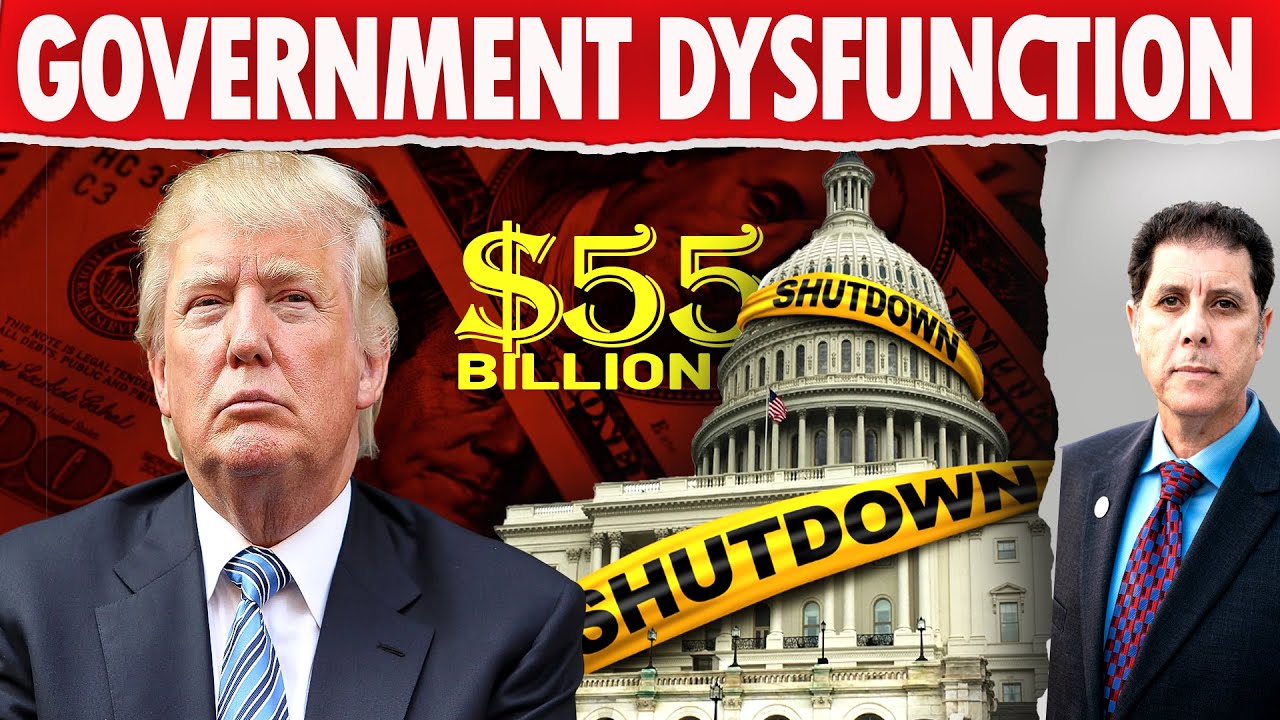
Dr. David Oualaalou breaks down the $55 billion economic hit from the 43-day government shutdown and its ripple effects on SNAP recipients and unemployment. He traces U.S. political dysfunction through history and examines whether capitalism is collapsing, touching on AI job losses, wealth inequality, and America's fading influence in a multipolar world.
Chapters
Hello everybody and welcome to Geopolitical Trends, where truth matters. I'm your host, Dr. Oualaalou, excited to be with you as always. I have an interesting topic because I'm going to go into the details regarding the mood in the United States, especially with the population now, as to questioning about the loss of the $55 billion during this shutdown. Which, by the way, was just sort of resumed today as far as the operation of the government. But the damage is already done. But there is more than that, especially when I get to the second part of this livestream in which I'm going to be asking or trying to answer the fundamental questions: is capitalism on its last leg, and is it the end of the United States? So make sure to stay all the way till the end, and, uh, because it's, it's, it's an important, uh, uh, developments that you need to be made aware of, and that's why I decided to get involved into this. So before I'll do this and dive in into everything else, uh, quickly I'm gonna say hi. I have, I have a long, uh, uh, uh, analysis to do, so I'm gonna just jump into our conversation quickly here. Some housekeeping items. Remember to join me. I got a confirmation from Professor Yanlian, Dr. Yanlian, that is. She will be here on the 20th, so I will keep you posted regarding the timing of the interview we're gonna be— or discussion. I don't like to call them interviews. So also, for those who might be interested, I will be joining Dr. Wilmer Leon on his channel, uh, around about 3 Eastern Standard Time. So I'm gonna put the link for you in the chat box for those who might be interested in listening to that conversation we're gonna be having. And the third thing is I'm working on— there is a major development coming out of Tokyo, and to me it's very concerning. Why is this concerning? Is because it triggers the fury of China. And the reason, because Japan is provoking China. So I'm gonna try to confirm certain information, uh, this afternoon and tomorrow morning. If I can go do the live stream for you tomorrow, I'll do it. If not, it's going to be on Saturday. Very, very serious concerns, uh, and, and all this came right after the new Prime Minister of Japan, uh, Sane Takashi, I believe, met with Donald Trump. I don't know if she got the marching order or not, but this very, very provocative what she stated regarding Japan, regarding China. So I have headlines for you. I'm going to do 2 headlines for you or 3, then jump in into my conversation regarding— once again, to those who just joining me now, I will be talking about the dysfunctional, the dysfunctional rather, of the US government, given that we lost about $55 billion just in these 43 days of shutdown. Very, very bad news for an average American family here. So my first headline will be coming from Cyril Ramaphosa, and he's the South African president. And here is what he's stating. In response to Washington. Washington stated that it will boycott the upcoming G20 summit, but the South African president, he said, we don't care whether you show up or not, we're gonna be moving forward, so it won't change any— this is the exact wording of the president of South Africa— Washington's boycott of the G20 summit will not change anything, end of quote. And this is what the South African President Cyril Ramaphosa asserted, that the United States' decision to boycott the G20, which is scheduled to be held in Johannesburg November 22nd to 23rd, will not affect the convening or its outcome. So, which is to me, it's a strong message back to the United States that your role on the global stage, uh, countries start to shrug their shoulders now. Who cares? So, and that's why Ramaphosa stressed that the meeting will take place as scheduled and a number of important decisions will be made during it, even in the absence of Washington. And he added, and I quote, if they are not here that's their business, end of quote. Straightforward. So, and, and it makes more sense why— who cares whether the US attended or not? So, so he's spot on. Here is what I found very interesting about this. You got this crazy guy, you all know who that is, right? If you know the name, type it in the chat box. I call him the crazy guy, you know, because when he came to power I knew it's going to be disaster for Argentina. So the interesting thing about this particular individual is that even he's following in the footsteps of Trump by announcing that he will not attend or participate in the G20 summit. Well, who cares whether Argentina attends or not? It just shows you where things are. You got an idiot, uh, you know, I'm not shy of saying this, this is an idiot following another idiot, which is the, the president in this case, Donald Trump. Both of them, both idiots. So, so anyway, uh, the second thing has to do— a second headline, I'm sorry, this one has to do with Boeing. Now why is this important? Just to understand, U.S. companies made billions of dollars from the war on Gaza. And this was disclosed by Wall Street Journal, uh, uh, stating that these two years, the, the two-year Gaza War was not only a massive humanitarian tragedy but also a huge deal for American companies that made billions of dollars in sales to Israel. And this now with a broad political economic support from Washington. And this according to the author of the article, his name is Benoit Foucault. Then his analysis is stating that the US State Department data showed that Washington approved arms sales to Israel with— for more than $32 billion since October 2023, representing a significant increase in usual military aid, which is basically the US taking part in the genocide that took place in— or still taking place in Gaza. There's no other way of looking at it, simple as that. We can't— we can't— it's just the way it is. And the last one I have to share with you, once again, this is the picture of the corrupted, uh, Hasina, who is now, uh, being, uh, protected by the Indian government, another corrupted government, uh, for Modi. Uh, the idea that, uh, the verdict is expected now in Bangladesh against Hasina And the prosecution is calling for the— for her execution. What do you guys think? In your opinion, yes or no, should Hasina be executed for the corruption over the last 15 years? So, and, uh, uh, because as a matter of fact, the verdict, to my knowledge, is expected on Monday, this upcoming Monday. So I'm going to keep an eye on it. I might even do an update for you, uh, because you have to understand what's going on right now, uh, in Bangladesh and also how India is trying to manipulate what's going on there and keep its hand on the two other countries, Bangladesh and Bhutan. Nepal is start to lose its grip, uh, India start to lose its grip on Nepal because Nepal decide to go unilaterally I hope Bhutan will do the same. Forget about this Buddhism and all that. I respect all the ideology and all that, but you're going to have to think about the welfare of your people. Bhutan will be well served if it gets investments from China than it does with India. Doesn't matter landlocked or not. That's just my belief. But so suffice it to say that Bangladeshi court now is gonna, uh, sort of issue the verdict on Monday. And calling for the carryout of the death penalty against the corrupted Hassina. All right, let's get into our analysis here as to what I'm going to be talking about today. But today I'm going to do geography and history for you, as I promised, because you need to understand the history of the United States, not only from how it came about, but also the dark side of the US government's history against the indigenous people. So, and you need to understand this one. But for the main theme of the, what's going on with America is that the, it faces now a transformative, a really transformative moment in its journey because we're looking at a political dysfunction, we're looking at economic stagnation, we're looking at a geopolitical decline coverage, and we're looking at a social discontent. So given that the largest government shutdown in history, uh, which devastated over 40 million people, so especially with the SNAP recipient for food. It also paralyzed agriculture and nutrition programs. It also deepened the public distrust in the institutions at historic lows. And this is where you're seeing the US is also facing another seismic change or shift, but not domestically. That's from a global level. Because the world is moving from a unipolar or has moved into a multipolar order. So, and this is where you have the challenges America faces from all aspects. And we don't know— when I say we, I'm referring to the incompetent government— doesn't know how to react to this. This is why Trump was never fit for office. It's becoming now clear, and I'm going to share with you the recent polls that were conducted recently and, and, and share this with you in numbers. So, so the US leverage and so forth, it's going down. And this is why, even though the government shutdown has ended today— as a matter of fact, federal, uh, employees returned back today— it, it, it, it, it ended without the resolution of the political disputes, meaning the problem is still there fundamentally. So there is nothing. Here you are shutting down the government for 43 days, paralyzed a number of vital sectors, deprived 800,000 federal employees from their salary, lost about $55 billion in economic output, lost about $1.7 billion in paychecks. So, so despite this resumption now of the government, there is a deep political division that triggers now the crisis because it's remain unresolved. That's usually how we deal with things. We never look for, uh, to the long term. We're always looking for next quarter. Well, this is not going to cut it this time around. So, so what I'm going to do, I'm going to do geography, I'm going to do history, then jump in into the the other parts of the analysis for you. So let me share a map with you. This is from the World Atlas, uh, to whom I give credit for this particular map here, because I always use World Atlas for this. Uh, but briefly, to understand the United States, its location, it's within North America, as you know, with Mexico to the south and Canada to the north. And it is found— the United States, when you look at, uh, uh, for the where it is located in the hemisphere, it is in the north and western, uh, hemispheres. And the US is also bounded by the Atlantic Ocean in the east and the Pacific Ocean in the west, as well as the Gulf of Mexico to the south. This is not a Gulf of America, as Donald Trump was saying. The guy is, is, is, is incompetent. He doesn't understand geography. To begin with. So we don't call it the Gulf, it's the Gulf of Mexico. That's what it is. So the states, just to give you a brief idea, and I'm not going to state all the 50 states, suffice it to say that the states are divided into counties, and even further, that these counties are subdivided into municipalities. So the District of Columbia, this is why you see Washington, DC I know some people might think it's, uh, it's the DC referred to diplomatic capital. No, it's referred to the District of Columbia, which is the federal district in which now considered the country's capital. So Washington, DC, that's why I refer to as DC. So you have the US has also 14 territories. You're looking at Puerto Rico, you're looking at Guam, US Virgin Islands, Northern Marina Island, American Samoa, Midway Atoll, Baker Island, Howland Island, Harveys Island, Johnston Atoll, Palmyra Atoll, uh, and, uh, uh, Kingman Reef and Wake Island and Navassa Islands. So it's almost like we're doing what the Brits were doing. So why are we having territories for, you know, let them have their own sovereignty, and, and we worry about what we have here in the United States. Now, when we come to, uh, history, uh, it's, it's a different ball game. So the history of the United States began with the settlements of whom? Not the Brits, of the indigenous people, which were over thousands of years, and that followed by the European colonialization starting in the Does anybody know which century the European colonization started in the United States? Let me see in the chat box. And once again, I just want you to be part of the conversation here. Does anybody know which century the European colonization of America, of the United States, started? I know it takes, it takes a while for this to show up here. Uh, uh, Loguan, 13th? No, it started on the 15th. Good try, good try. And that's how we learn, guys. That's how we learn. Started on the 15th century, and the establishment of the British colonies in the 17th century. And how is— though, how all the emergence of the United States is because the tension over taxation led to the American Revolution. It's the same thing that happened in French Revolution. And this is now exactly what is going on right now in America, because Americans are feeling squeezed with— we paying so much taxes, and yet the corruption going on so massively, not only inside Washington, but we send in our tax dollars to the likes of Argentina, the likes of Ukraine, Israel, Jordan, Egypt, and all that. Why? So, and in the history of America, these tensions over taxation is what led to the Declaration of Independence in 1776, to be exact, July 4th. So, so the creation of the United States, that's what it led to. So, and you have the key developments, uh, includes the westward expansion. It was no western side of the United States. It was just the North and South on the eastern part. So then of course you have to consider the Civil War and you have to consider the Reconstruction era. Then of course the industrialization and the country's rise to global superpower. And of course we cannot ignore the Great Depression, World War I and World War II. So, so I'm going to divide this into three sections, then I'll talk about the dark side of the US government's dark history that you need to know. And if you are an American, you should understand the atrocities the government committed against the indigenous people. So we start with the colonial period and the revolution, and this one had to do with the indigenous people. The land, what I mean, in America, the United States, was inhabited by diverse indigenous grouped for, for tens of thousands of years. I got some old pictures here, and those are just a reflection of the indigenous people that were back then. So this is recent, like the last few decades and so forth. So, but the main one is, is this one, the older generation there. And this before the European contact. And when the European came over, you talking about the first Spain because Spain established the first permanent European settlement in San Augustine. Where is San Augustine? To those who know geography in the US, is in Florida. So, and in 1565, it was followed by the British. So there were the Spaniards first, then the British came after them, who founded the main city in Virginia, which is Jamestown, in 1607. I used to live in Alexandria So I used some time— used to drive, uh, to Jamestown if I need to go in the area and so forth. Then you have the 13 colonies that came after that, and this started in 1760. In 1760, they were about 13. That's why if you look at the map of the United States, and especially, for example, the Oval Office, and you see the arrows with 13 stars there. So the 13 colonies. This is where the— there were 13 British colonies sort of on the Atlantic coast. That's why everything was on the East Coast of the United States. The Southern colonies developed an agricultural economy based on slave labor, of course, forcibly bringing millions of Africans to America. This is why slavery— all slavery was about the economy. Slavery was about the US dollar, just FYI. Then came the Revolution, and of course, after the French and the Indian War, British Parliament imposed new taxes on the colonies, which the colonists viewed as a violation of their rights. And of course, this led to the Revolutionary War with the Declaration of Independence on July 4th, 1776. Then came the new nation and expansion, and of course we're talking about the formation of the United States. The U.S. was established as a republic with George Washington as the first president in 1789. The reason why we wanted as a republic, because we didn't want to follow the footsteps as the British monarchy, because we never wanted to have a king here. So But what's important about this was the western, uh, the, the westward expansion. And this is where the United States at that time grew dramatically through land purchases. For example, we purchased land, uh, the Louisiana— Louisiana was purchased from the French. This is why if you go to Louisiana now, there's a lot of French culture inside there, you know. And of course, you have the Mexican-American War. When you think about the state of Texas, the state of Texas never belonged to America. The state of Texas always belonged to Mexico. And eventually stretching this expansion of the US, stretching eventually from the Atlantic, mean Atlantic Ocean, all the way to the Pacific. Then came the Civil War. And the Civil War was between 1861 and 1865. And this had to do with the growing tensions over, once again, slavery and the states' right. And those led to the Civil War between the North and the South. That's why when you go to— if you live in New York or Massachusetts, whatever, you will sense that is different if you move to Georgia or Alabama. And so the lifestyle is very different, and that's a reflection of what it was back then. So the Union victory resulted at that time in the abolition of the, uh, the abolition of slavery, you know. But as I always say, slavery was not— oh, slavery was always about economics. So you need to keep that in mind. Then the third era or period was the industrialization or global conflicts and modern era. And this one was known by the industrialization and immigration. Because in the late 19th century and early 20th century, the United States saw rapid industrial growth and a massive influx of immigrants, immigrants who came and contribute to society. It's not like what you're seeing right now in England or even what we see right here in the United States or what you see in Europe. And once again, I am not against immigration. You know, I'm an immigrant myself. And I'm proud to say it, you know. But if you are to— if you, you immigrate to a country and not contribute, then we got a problem there. I'll be the first one to tell you, pack your stuff and get out. Simple as that. This is why you have some— a lot of Western countries now pushing against immigration from India. They don't want the mindset of the— some India to be brought into the Western. And, and no criticism to India, There are some doctors here, there are some heart surgeons from Indian descent. I'm not, I'm not saying otherwise. It's just there's a big concern right now in the West regarding that aspect. But immigration, the influx of immigration back then in the United States played a major role in leading to significant social and economic changes. Then you have the Progressive Era, and this period was between 1890 and 1913. And this was marked by reforms, and those reforms were aimed at one aspect— it's to address the social and the political problems. So, and of course, we can't ignore World War I and World War II and the Cold War in itself, in which the US played a major role, even though the US did not win World War II. It It was the Soviet Union. You know, we are manipulating history here in schools. When I used to teach the government and I came to address World War II, I'll make it clear to the students. And I, of course, I see the students looking so lost, thinking, um, uh, you know, thinking to themselves, what is Dr. O talking about? It was the US that won the war. And I explained to them, break it down for them. And they realized, whoa, we've been manipulated. That is a fact. It was the Russian— the Soviet Union that won World War II, because if the Soviet Union didn't enter the war, the US would have not entered. Simple as that. So World War I, and that's where the US played that major role in World War I, and became a superpower after World War II. And that led to the period of rivalry between the Soviet Union and the United States leading, which led to the Cold War. So then you have in the '60s in the United States the civil rights and the, of course, the recent history. Well, the 1960s in American history saw the rise of the civil rights movement. And even when you think about the rights right now, there are still some rights being deprived, being suppressed. You look at now how the government can shut you down if they don't like what you're saying. So where is this freedom of speech and the right? You know, we're seeing it across the Western world. The 21st century began, of course, as you all know, with 9/11, which— that's another conversation for another day, if you know the roots of 9/11 and how it was all portrayed. So I'm not going to get into that. We'll talk about it some other time. So, but suffice it to say, this is where The, uh, you think about the wars that led into the Middle East, and of course, as the United States faces the worst economic crisis in 2007, the financial crisis, and you know, the rest is history, as we say. However, with all this said, you still need to know the dark side of the history of the United States government and the destruction of the Native American people. So let me put that picture once again because you need to understand this one. The destruction of the Native American people, their culture, and the language. And that's what has characterized by some as genocide. Yeah, because that's what the historic, uh, historical facts indicating. So, and debates are ongoing as we speak to whether the entire process or only a specific period, uh, events that sort of met or meet the definition of genocide. I'll let you decide for that yourself. However, there is, uh, sort of facts that support this argument, and I'm going to start, for example, with the historians like Ned Blackhawk. He's a historian, you know, and, and some of the historians have been debated long, long time, the pre-European population of the Americas. For example, in 2023, which is only 2 years ago, historian Ned Blackhawk suggested that North America's population, including modern-day Canada and the United States, of course, have halved, meaning divide in half, from the population from 1492 to 1776. It was about from 8 million people, and it was halved, uh, which was all native in 1492 to under 4 million in 1776. And here is the surprising part to all this, by the way, is that I checked I checked the information about this specific stats, corroborated that, and found out that is its exact numbers, and I'm going to share it with you also as I move forward. So you have another historian by the name of Russell, uh, Thornton estimated that by 1800, some 600,000 Native Americans lived in regions that would become the modern United States and declined to an estimated 250,000 by 1890 before rebounding a little bit. And this is where this dark history of Native American genocide in the United States, because when the European colonizer arrived in North America in the late 15th century, as I said, an estimated 5 to 15 million Native Americans inhabited the continent. By 1900, this population has been reduced to approximately 250,000. Of course, you have to think about the disease and early contact. And here is what's surprising: between 1492 and 1700, which was the initial catastrophe, was partly an intentional What do I mean by this? Diseases introduced by the Europeans, like smallpox, like measles, like influenza, devastated the indigenous population because the indigenous people, they didn't have the— they had no immunity to this because they are not allowed— they are not being accustomed to that. So however, the colonizers deliberately used disease as a weapon, including documented instances of distributing infected blankets to Native Americans or Native communities. Then you have the forced removal and the broken treaties, which happened in 1800, and this is when the United States government expanded westward. So the government systemized the removal of Native American people from their ancestral lands. How, how so, you may ask? Because it was the Indian Removal Act of 1830 which authorized forced displacement, culminating in events like, for example, the Trail of Tears. If, if you know history, you would know what I'm referring to here. So where thousands of Cherokees Creek, and other nations died during forced marches to designated reservations. You have, for example, this is Navajo people, and this one, this is the natives, part of that. So, and that's exactly what happened at that time. Then you get the military campaign and the massacres that took place. US military conducted some sort of numerous campaign against Native resistance, including the massacre of 1890. It's in history. When I used to teach, uh, the government, I'll touch on this one, uh, because I wanted students to understand. So the US soldiers back then killed over 150 Lakota men, women, and children. Those are part of the Native Americans. And also there were massacres at Sand Creek and Fort Washita, which is in— jeez, I draw a blank on the state— Missouri. That's what it is. And countless other locations that targeted civilians and so forth. Then if this wasn't enough, they moved into the cultural genocide. So beyond the physical killing, US government also pursued cultural elimination through Indian boarding school where the native children were forcibly assimilated, forbidden from speaking their own languages and practicing their own religion. And the motto at that time, it's in a historical record, stated that kill the Indian, save the man, in quote. And by the way, Canada did the same. Canada genocide Canada conducted against the native was no different than what the United States did. So, and, uh, so this is where you have, uh, and of course the, uh, dispossession and reservation systems. Yeah, we created reservation systems. This one specifically, the Dawes Act of 1887. And this is where you're breaking up communal lands, because the Native Americans were confined into so-called reservations, often the poorest lands with inadequate resources, and that leading to widespread poverty, malnutrition, and disease, because it was this act The Dawes Act of 1887. And this is where the legacy of the ongoing impact was. This sort of the genocide of the Native Americans was not a single event, but rather a centuries-long process of deliberate extermination and cultural destruction. So, and there is one particular historian. His name is Donald Fixico, and I read some of his work. He's right here. He's from the university. He's a distinguished professor of history at Arizona State University, and he's the author of 18 books on the American Indian and the West. So I have a link to some of his articles. I put one for you guys if you ever want educate yourself and understand the history, uh, of what was going on. So, so basically, when Native Americans were slaughtered— this is what Donald, uh, Fixico, uh, narrated— uh, were slaughtered in the name of civilization. So, and by the close of the Indian War in the late 19th century, fewer than 238,000 indigenous people remained of the estimated 5 million plus living in North America before European contact. So it just shows, because I know it's a dark history, but we can't shy away from not disclosing that. It's, it's, it's important to understand what was going on. Liking this video so far? Don't just be a watcher, go ahead and hit the like, share, and subscribe button, and don't forget to tap the bell so you will not miss any of my videos or live streams. This way, you will be supporting a channel that stands for the truth and objective reporting. The choice is yours. Thanks for your support. All right, uh, let me see something here. Now let's talk about what was going on with this $55 billion loss after the longest government shutdown. So yeah, the US economy lost about $55 billion, and as a matter of fact, the shutdown also cost families, you know, just in about 40, 43 days. So, so despite what the Senate or Congress is doing right now— I mean, are you going to trust what Congress is doing anyway? They're saying the shutdown is over, but the damage is already done. And when they say that just to appease the American people, because the Republicans are realizing they are slaughtered now in some local elections, you know, because they're realizing what Trump, a Republican, has done to the, uh, uh, to the economy and to America for that matter. So So the economic impact was widespread, and Washington for all sort of experienced, uh, uh, this unemployment above the national average. So with local businesses now down about 50% compared to before the shutdown. So then you have almost over 42 million people Okay, I thought I, I froze, but it did not, so it's working. Then you have the idea of, uh, the local people, uh, uh, that depends on SNAP program were also suffering. And I'm not going to get into this because we talked about this before. So, and this is why now this shutdown, even though it's over, but it's not over, it became now political contentions over disagreements about some other issues. And this is how incompetent the politicians in America— because the politicians are never representing the constituents, the US, the citizens. So, and if this is not enough for you, you're going to think to yourself, for example, how does a country like Ukraine get printed cash from the United States? And I have the picture to prove it. Right there. And if you look at that, if I make it bigger here for you, you look at this is from Georgia, Atlanta. This is a printed brand new dollar bills that's been printed for Ukraine. Why? Why are we sending more money to corrupted Ukraine government? So, so the US is keep sending more money to Ukraine. And this was a secret— literally a secret truckload of cash straight from the Fed's printer. It's the same way we did in Afghanistan, because this money was confiscated. So, and this is why even you have ministers inside the Ukrainian government now have been sort of They've been, they've been, uh, relieved of their duties because of the corruption they've been found to involve. The Ukraine Anti-Corruption Agency revealed Monday, two days ago, that some close associates to the comedian Zelensky, or President Zelensky, were allegedly involved in a plot to scam, to scheme about $100 billion. If this is not enough, why are we sending another $40 billion to this, this lunatic in Argentina? And all this money is coming out of the paycheck of the average American citizen. So this is why I'm saying this shutdown had a major direct impact on families, average American families. So because he created the real hardships for American families in several ways. For example, the food and basic needs. For example, the unemployment and income. The economic ripple effects of all this. And you think about the healthcare uncertainty that exists. So because the shutdown represented for the average American the loss of income. The reduced access to food, the economic uncertainty, and of course the stress that comes with it, not knowing when essential services or support will be restored. And this is when you realize the incompetency of a government that does not work for its own people. And this in itself is now— this outcome is leading to the erosion of trust in the institutions. There is no trust in institutions, absolutely no trust. The shutdown is significantly contributing to the erosion of trust in institutions, particularly within the context of this broader long-term decline of America. So, and I'm going to share some numbers here with you. You think about American confidence in federal government institutions remain near historic lows. This isn't new, but this event, like the recent shutdown, reinforces that notion. For example, comparison to previous shutdown between 1995 and in 1996, in 2013, and of course the shutdown of 2018 and 2019 reveal a pattern of temporary economic contraction. And this is where you have this general erosion of public trust in institutions. This is why you ask an average American, you know, I'm not talking about politicians. You don't ask politicians because they are part of the problem. Average American will tell you, I don't trust. For us here in state of Texas, we have no law for the federal government. As a matter of fact, if you are to think about Oh, oh, I think I have it here. Let me get it. Hold on a second, guys. I'm gonna get this one for you just to show you something here quickly. Oh, where is the pic? Right there. Sorry. So when you think for us in state of Texas, this is what start now circulating in Texas. I went ahead and bought a t-shirt Look what it says. Republic of Texas. That should give you an idea as to how now things are perceived here. So the growing partisan divide. This is striking how trust now has become even deeply polarized. Or politicized, if I may even add. Because in the 1970s, you had about 64% of people who opposed the sitting president party but still trusted the government to manage international affairs, domestic issues, and so forth. Today, that number has fallen to just 20%, from 64% to 20%. So trust in the government's ability to handle domestic issues has dropped from 54% to only 18%. And this is why, even worse for the, the, the confidence in the executive branch has plunged from 49% to 7%. You know, we have a dysfunctional, incompetent government. Because this is a fundamental shift, and that's exactly— you think about the broader implications of this, because this recurring of the threat of the shutdown of government serves as a reminder of a political dysfunction with cumulative, yeah, cumulative effects of the political instability and fiscal uncertainty that exists within American society, because this will have long-term consequences for not only the economic growth or investor confidence, but also for the social stability within the United States. So, because what the shutdown demonstrates to Americans, especially those already skeptical that institutions cannot be reliable, cannot reliably function when political gridlock takes hold. And when institutions of the government cannot meet the basic needs of a hungry family in America, we got a problem. We got a serious problem because this will reinforce that cycle of mistrust. Which making future political compromise even harder. So, and this is why this shutdown was revealing. Are you blaming? Because that's what the public are saying. So despite— here is what Americans are feeling. When I say Americans, I'm really— I'm referring to average American from all walks of life. We're not talking millionaires and billionaires. Those are not impacted by all this. Or the politicians. Oh, those are living in a separate world. We're talking about an average Joe, average Jane, and here is how they are seeing it. Despite controlling the presidency and both chambers of Congress, the upper house and lower house, or the Senate and the House of Representatives, Republicans bear more public blame than ever. It was a poll conducted by Reuters showed American blamed Trump and the Republicans over Democrats by about 53% to 37%. And don't get me wrong, Democrats and Republicans, two faces of same coin. I don't differentiate between the two because this is where, uh, you know, even a Washington Post, uh, Washington poll rather, showed 47% of American people blaming Republicans compared to 30% blaming Democrats. They both the same. And even the American support for Trump now is going down, declining. A new poll, and I'm going to share the link with you, conducted by the Associated Press and the Center for Public Affairs Research shows a significant decline in Americans' approval or rating of Donald Trump handling the country since the start of his second term. So according to the poll, here is which was conducted after the Democrats won the recent local elections and before Congress moved to end the longest shutdown. Here is what it shows. It shows only 33% of Americans approve of Trump handling of a government, which is down from 43% in a small poll conducted last March. And this decline is mainly due to the falling level of satisfaction about the competency of the government. In a simple word, American average citizens start to realize maybe the government is not cut off— is not cut off— cut off for this job. Maybe it's above them. Maybe they are incompetent. Maybe they are not capable. So this is exactly what he's referring to. And this leads me to the key aspect. As I told you, I will address this towards the end of the live stream here, because you need to understand this reality. And I feel I speak on behalf of these average Americans who maybe they are They didn't go to school, they are illiterate, whatever the case might be, for a basic understanding. Because those issues need to be brought to the fore. And this leads me to much bigger questions. Are we witnessing the end of capitalism as we know it? I know it's contested question. Some will say, oh yes, Dr. O, this might be. Others say no. Of course, depends largely on your timeframe, the timeframe we're talking about and the perspective here. But the real debate exists as of today among academia, among economists, and of course, analysts of global affairs. Because when you think about the fundamental crisis that took place in 2008, GFC, the Global Financial Crisis, of 2008. You know, the G7 economies have failed to regain their former dynamics with metrics for business investments, output, living standards, and labor productivity. Everything went down after that era. I don't know if you noticed or not. I'm sure you've been around long enough. The US is barely, barely achieving a 2% growth while others hover around 1% or even stagnate altogether. The profit rate across the G7 has fallen by roughly 40% over the past half century. And this is where I concur with those analysts in the know with credentials and expertise. They are not talking on the top of their heads. I agree with them that this AI-driven job displacements, growing wealth inequality, and ongoing geopolitical tensions are creating conditions for capitalism potential collapse. Or we can use the term transformation, depends how you see it. And when I say this transformation, because you are You know that those who've been calling about UBI, the universal basic income, because that's what they're saying about this transformation, by the way, they're referring to it into different systems like UBI and post-colonial economies. We all know the UBI, you will be controlled by the government because they control the source of the digital money for you to spend whatever. The post-capitalism economies, you're gonna have to look at other system that's been working in other countries. There's even a third option to all this, which is the techno-feudalism. You know the feudalism, you know how it works. Now we have the techno-feudalism, and this feudalism could pave the way where this small group of tech corporations control the vast wealth and power. And we are seeing this emerging right here in the US. The other thing, you think about the structural arguments for this transformation, there's a possibility to that. So there are those who are saying, no, the American economy resilience. How? How when you have now every citizen is struggling to make ends meet? When the end of the month gets closer, they don't have enough funds to, to, to live on. And we are in the richest nation on Earth. I mean, that's like becomes like a, uh, some sort of a cliché. We are not. Let's just be honest about it. Yeah, we might have some conveniences here that other countries don't. But we are not the richest. If you are the richest, why would you have homelessness? Why would you have hungry people? So, because here's the reality: we are witnessing a fundamental transformation of capitalism as we speak, rather than its immediate end. I agree, it's not going to end overnight. It's like the, the end of the US hegemony is not going to end abruptly. But, but it's been rolling for the last 15, 20 years. It's no different. I, I understand that argument. And when you look at it about the current model, for example, that is based on manufacturing-driven growth, where is it? Where is the manufacturing here? We don't have any. You know, we don't. It's just they have They have us believe— the government have us believe that, oh, the economy is working. Because what's going to be replacing all this is uncertain as of now. It could be a reformed capitalism with some stronger regulations. How can you do that when you have massive corruption inside the government and you are not dealing with it? You know, you all know for me where I stand on when it comes down to corruption and how will I deal with it. I will say start, start doing that and you will see. Some others have talked about a hybrid system in which blending market mechanisms with planning or something more radical. No, no, till you change the foundation, the foundation is shaky. So, and that in itself will lead us to ask, or I speak for myself here, I can't assume many of you will be thinking in these terms, or even for my American viewers. So as to what lies ahead for America as the world now shifts from a unipolar, has already shifted from unipolar to a multipolar order, because it is a crucial geopolitical question, make no mistake about it. So you think about America's multipolar world of 2025, global geopolitical shift, because that's what the US is facing now. Profound geopolitical transition from a position of uncontested dominance to one of managing competition in a multipolar world. So that becomes the question. Are you going to cooperate with other countries, or you're going to just seek war and conflicts and all that? Because the other country is not going to retreat, they're not going to bow to you. They will fight for their strategic interests because there is something called the reality of decline. This is what Washington is in denial about. That's exactly what is happening. The multipolar world is already here. It's not a future scenario as they might have you believe. Yeah, the US still play a role into the global affairs. The question is, is it essential to that role or not? What do you think? Is the US remain essential to global affairs? Yes or no? If you will be kind and just share your answer in the chat box with the community, that is. Because here's the reality: its unilateral authority to make decisions is increasingly being limited. And by what? By a better systems emerging to the forefront. You're looking at an upcoming middle class elsewhere. And you're looking at also at divided alliances. Countries now are reconsidering their alliances. Yes, the US remains stronger in a sense, but I don't know how. Yeah, we have this 10 or 11 aircraft carriers. So what? We couldn't even defeat Ansarullah or Afghanistan. So this so-called legacy of power, just a legacy, no more, no less. But what belies all this, there is the, the incredible complexity of the system, the global one. And if the US thinks it's gonna just bark orders, another country is gonna listen, it's mistaken. It is mistaken. So, and because what you are witnessing right now is this emergence or emerging power structure. And what do I mean by this? On one side, there is the Western bloc. You have the US and its vassal states and and, and incompetent states— leaders, that rather, not states, leaders. You know, this is why, this is why I'm going to do the video for you about Japan. I could not believe Japan will go ahead and provoke China. For what? Wait until I get the details for you. So just make sure, uh, uh, to join me either tomorrow or Saturday. I will let you know. So when you think about the Western Bloc, the US, Europe, and some in the Indo-Pacific. When you think Indo-Pacific, who do you think about? You're going to think about Japan, South Korea, Philippines, Australia. That's about it. Then you have the Eastern Bloc, and this is not led by one country. So then there are the dynamics of the middle powers, which is very increasingly asserting its influence through diverse blocs. BRICS, ASEAN, as an example. And in both on a regional level and on a global level. So you think about, for example, and I was in China and I saw, you also, the September 3rd military parade. China is rapidly expanding its military capabilities. In the Indo-Pacific, by the way. So of course the West is going to say, well, because he wants to seek regional dominance. It is not. China's preparing to defend itself in case. And it's the right move. Did you see that China want to open bases in, in whatever country? No, didn't. But on the other hand, the Europeans are facing internal challenges. From a rise in populism to decline in economy to increased poverty, you name it. I mean, the stats coming out of UK right now is horrible as to where that country is going. And even for the Europeans, because they are now caught between the decline in American security commitments and the increase in China. And Russia's influence. Then you have to add to the big picture, this geopolitical landscape, the Global South. You cannot ignore the rise of the Global South. So a striking development is the emergence of the Global South. And when I say Global South, it's not what India said, oh, I want to be the spokesperson for Global South. Hold on a second. India, you have no right. First of all, you have no qualification for that, and your economy is not where it needs to be to take the lead, to be the spokesperson for Global South. And second, Global South doesn't need someone to represent it. And this is where this emergence of the Global South as an active architect, if this, of this sort of new alliances, if I may use the term. But it's not, as they might have you believe, as a passive arena of great power competitions. Look at where Africa is right now moving forward. And look at where Argentina is when it decided to step outside the BRICS and look where it is today. Some say it's good. It was a blessing in disguise. So when you think about countries like Brazil, like Indonesia— and I will not include India in this because India is subordinate and subservient to major powers. Indonesia, not so much. Brazil, not at all. So But at least in the case of Brazil and Indonesia, they are leveraging their resources and strategic position to maintain this so-called autonomy. Yeah, this is how it's move. Then it becomes the strategic constraints on the American power per se. Yes, the The US remains constrained despite its power, and that's why it's used tariffs to pursue foreign policy goals, but is waking up to its dependence on China's rare earths, for example. While Russia has ignored what the US demands were to end the Ukraine war, highlighting the limits of American foreign policy. So there were some polls conducted shows that 52% of Americans say the US should pay less attention to problems overseas and concentrate on problems here at home. And that includes 67% of Republicans and 58%, uh, percent of those under age 50. So, and with this comes the risk of an— of uncertainty, because there is a risk into all this. So there are those who saying, well, you need to have a dominant power. No, you don't. You don't. You know, because the global norm needs to be protected. Well, wait a minute, when we are a global power, where the global norm respected? I mean, look at what the US did. You know, we pulled out of the JCPOA. We didn't sign on on the ICC, the International Criminal Court. So, and we are, you look at the, like I posted for you yesterday, Donald Trump now is asking the Israeli president to pardon Bibi Netanyahu. What the heck? Why are you worrying about a foreign official? Why don't you worry about what's going on here in America, Donald Trump? Which, by the way, that triples the wealth of his family 3 or 4 folds since he came to power. Basically, the White House is used as a money machine to enrich themselves. Shame. So where is the US neutrality in disputing conflicts? He can't because US is not a trusted— it's not a trusted country to lead such thing. And this is where all this is accelerating the geopolitical fragmentation of the so-called unipolar, because unipolar is no longer. And that's exactly what is now moving into the international order. At the same time, Americans are suffering. So, and this leads me to my last part of this livestream with the question of what America must do or what Americans must do. Yeah, because the US success, and I will use the term success here, will depend not on its unilateral capacity, but rather on its ability to cooperate with other countries, accommodate global changes, innovate some sort of new diplomatic tools instead of just appointing, appointing people with no qualifications to key sensitive positions. It's because the world is changing. You know, Donald Trump is not equipped for this because Donald Trump is not the type that— Donald Trump will not understand embracing multipolarity by encouraging, for example, uh, you know, other, other countries to cooperate. He's not going to understand that. And Donald Trump apparently either being blackmailed, uh, by some entity of sort or whatever. I mean, his behavior is kind of very, very, very troubling. Very troubling. So I don't see that the US will be in a position to maintain the global order as it once was. Because that era is gone. The world has changed and we need to change with it. Simple as that. And, and this ends my conversation here. So let me see if there is any super— any, uh, questions from you guys. Oh, there are super stickers here from you guys. Army with Harmony: Why did the founder dress up like women? Thank you first of all so much for your super sticker. And let me address something very fundamental about the Founding Fathers. The Founding Fathers, if you think, especially for American audience here, if you think the Founding Fathers weren't thinking for their own interests, you are mistaken. We are in this illusion that the Founding Fathers, it was the Founding Fathers that were selecting individuals to the Senate, individuals who could serve their own interest. So what you see in today is no different than what it was back then, except in a different time and a different setting. I understand the Founding Fathers had the vision of republics and so forth. All is good, but the Founding Fathers also were merchants, were landowners, bankers of sort. This is why you have today big corporations controlling Wall Street, controlling Washington, you know, big corporations controlling decisions. The Pentagon cannot make decisions, is the, is the, the, the MIC that decides for it. So as to how the Founding Fathers would dress up in women, I don't know. I wish I have an answer for that. So thank you so much for your super sticker, American Citizens. Pendulum, thank you so much for your, uh, oh, thank you, Dr. Oualaalou. You are most welcome. Truly appreciate your support. Truly appreciate you for that. So, uh, AFU, once again, here is the one I just talked about it. Thank you so much for your continued support and your generosity in support of the channel. So I'm very, very grateful to you. So once again, American Citizen, the reason— thank you for your super sticker. Uh, the recently tested, uh, uh, uh, Burfishnik missile, are you aware of any radiation spikes? No, I'm not. I have to look at— I won't be able to answer till I, I dig into and call some of my people who are in the know of the physics of missiles and all that stuff. So I'm sorry, I won't be able to answer that one. So, so, but thank you so much for your super sticker. Truly appreciate you guys. It's your support that matters because I don't have official sponsor. You all know this one here, so, uh, uh, it's you. So if you, uh, I'm very, very grateful for your support, and, uh, I'm doing my best with the resources I have. And should you decide to support the channel, I'm going to put the link for you in the chat box and put it here on the, uh, in the screen. If you decide to support the channel, I will be grateful. If, if there is a sponsor would like to sponsor this channel, let's talk. I will be happy to do it. So remember to join me later on with Dr. Wilmer Leon. We'll be having a conversation on his channel. And again, I will be working on that topic for you regarding both the AFD and Japan. And I'll decide whether to do it tomorrow or Saturday. I look forward to seeing you next time. As always, remember, geopolitics impacts your daily life in more ways than one. Till next time, bye-bye.
More from David


Beyond the Single Actor: Why the Gulf Isn't Choosing Between the US and China


Iran, Iraq's Militias, and the Houthis Are Coordinating! This Changes Everything




Who Controls the Next Decade's Resources? Latin America and Africa's Geopolitical Crossroads

The Chokepoint Trap: How Washington's Stupidity Triggered a Cascade That Now Controls the World

Trump Spooked as IRGC Unveiled dual-use SLV, Deployed Ghadir Mini-Subs & Hinted at Tactical Nukes!
