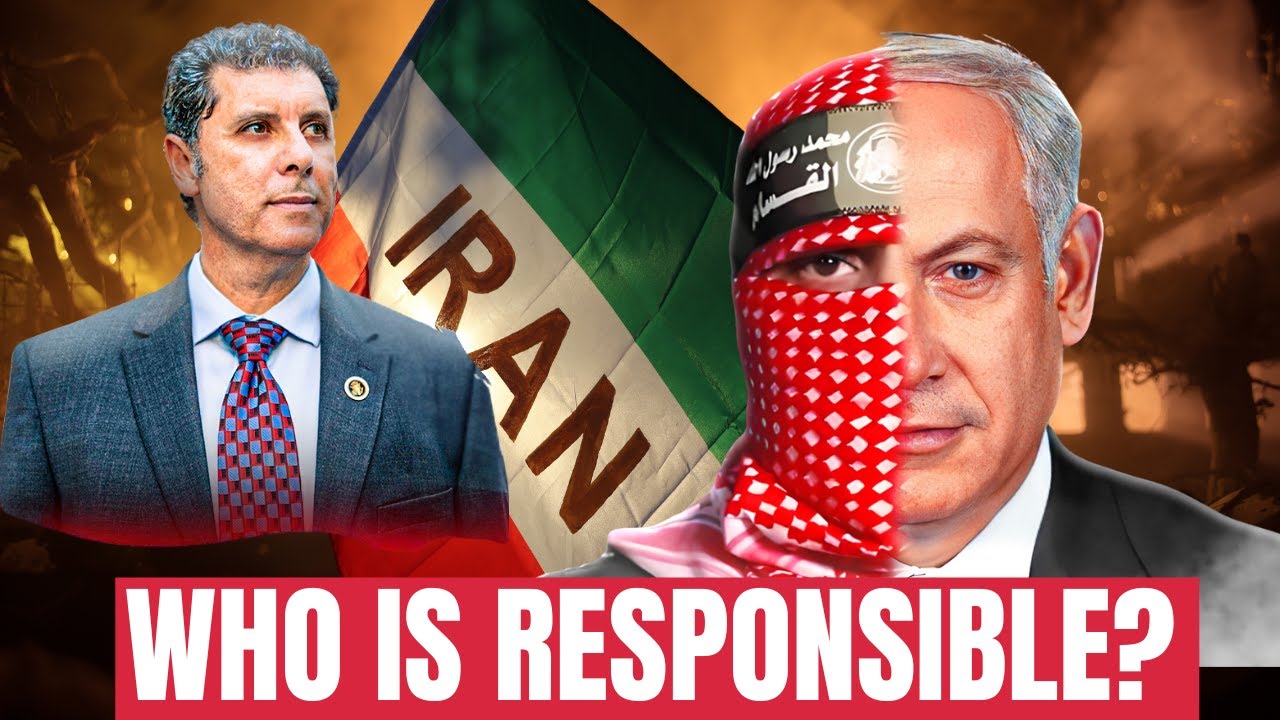
David Oualaalou examines the Israel-Hezbollah border clashes and the risk of wider regional war. He covers Hezbollah's military capabilities, Iran's potential intervention, U.S. involvement, and spillover effects across Lebanon, Syria, Iraq, and Yemen, plus the humanitarian and economic costs including oil-price risks.
Chapters
Hello everyone and welcome to Geopolitical Trends—where truth matters. Have you wondered what the global consequences will be if the conflict between Israel and Hezbollah escalates? In this video, I am going to provide you my own analysis and try to answer this fundamental question for you. For the past 9 months, Israel and Hezbollah, backed by Iran, have been engaged in a dangerous exchange of fire across their shared border. What began as isolated skirmishes now carries the risk of spiraling into a full-scale war that could not only devastate the immediate region but also ripple across the Middle East and far beyond. If an all-out conflict erupts, its consequences could be far-reaching, possibly pulling in regional powers like Iran and even entangling the United States. The international community watches anxiously as the tension hovers on the brink of chaos, with many security analysts warning that any significant escalation could irreversibly reshape the geopolitical landscape in the region and beyond. The Context Behind the Conflict: The roots of the current tensions between Israel and Hezbollah are steeped in decades of hostility, with multiple wars and conflicts over territorial and political issues. Hezbollah, which wields considerable power within Lebanon, is closely aligned with Iran, both ideologically and militarily. Israel views Hezbollah as a significant threat not only because of its proximity but also due to its well-documented support from Iran. Hezbollah's military capabilities are formidable. The group is estimated to have tens of thousands of rockets and missiles, many of which are supplied by Iran. These weapons have the potential to strike deep into Israel territory, threatening major population centers and key infrastructure. On the other hand, Israel has one of the most advanced military forces in the world, with significant air, land, and sea powers, along with advanced missile defense system like the Iron Dome, though the latter proved ineffective in stopping the Houthis' and Hezbollah's rockets and missiles of late. A direct conflict between these two forces could be devastating for both sides, leading to massive loss of life and infrastructure. What about the risk of escalation? Well, the current conflict has remained mostly contained to the border region, but it has the potential to spiral out of control. Small-scale exchanges of fire could easily escalate into larger confrontation, particularly if either side miscalculates or if outside forces become involved. Should Israel or Hezbollah take more aggressive action, the other could retaliate in ways that quickly push the conflict beyond the border scrimmages we see today. A broader conflict would likely draw in other Iranian-backed militia groups operating in Iraq, Syria, and Yemen, among others. Effectively turning the region into, into a multi-front battlefield. These groups, many of which have significant combat experience from the wars in Syria and Iraq, would not hesitate to attack Israel or Western interests, further complicating the conflict and expanding it beyond Israel and Hezbollah. This would turn the conflict into a wider regional war, a conflict with multiple fronts and multiple actors, all with different motivations, goals, and yes, agendas. What about the role of Iran? Iran's involvement in this potential conflict cannot be understated. As Hezbollah's primary supporter, Iran provides the group with financial, logistical, and military support. Iran's leadership has long viewed Hezbollah as a key component of its broader strategy to challenge Israel and expand its influence in the Middle East, or West Asia, that is. In the event of a larger war between Hezbollah and Israel, Iran will face a crucial decision: whether to intervene directly or continue its support from the sidelines. Direct Iranian intervention could come in the form of missile strikes, cyberattacks, or even the deployment of Iranian military forces. Such actions would significantly escalate the conflict and could lead to retaliatory strikes by Israel or the U.S., both of which have the capability to target key Iranian military and nuclear sites. This, in turn, could provoke Iran to launch attacks on the US interests in the region, potentially drawing the United States into the conflict. I do not see, however, how the United States or Israel will embark on attacking Iran. That would be— that would be a suicide. The role of the United States. The US has long been the only key ally of Israel providing military aid, intelligence, and diplomatic support and cover. Any large-scale war between Hezbollah and Israel will almost certainly draw in the United States on some capacity, whether through direct military intervention or by providing even greater support to Israel. While the United States may be hesitant to get directly involved In another Middle Eastern conflict, its close ties to Israel makes it difficult for Washington to remain on the sideline, particularly if Iranian forces are involved. Moreover, United States forces are already stationed across the Middle East, from Iraq and Syria to the Persian Gulf. These forces could quickly become targets for Iranian-backed militias or groups, further entangling the United States in the conflict. An all-out war between Hezbollah and Israel, with Iran involvement, could quickly escalate into a broader regional conflict that the United States will find hard to avoid. The broader geopolitical impact. Any major conflict between Israel and Hezbollah would have significant consequences for the broader Middle East and beyond. Such a war will destabilize Lebanon, a country already facing severe economic and political crises. Lebanon's infrastructure and civilian population would be devastated by any large-scale conflict creating humanitarian disaster that would further strain the country's fragile political system. Syria, on the other hand, still reeling from its own civil war, could also be drawn into the conflict, particularly if Iranian forces operating in the country are attacked by Israel. This could lead to further instability in Syria, which in turn could lead to a resurgence of extremist groups like Daesh, which thrive in a chaotic environment, as we've seen before. The conflict could also have significant economic consequences, particularly in terms of oil prices. Any disruption to the flow of oil from the Persian Gulf to Iranian attacks on oil infrastructure or broader regional instability could lead to a spike in global oil prices. This would have a ripple effect on the global economy, raising prices for consumers and businesses alike. The Path Forward. As the situation along the Israeli-Hezbollah border remains tense, the international community must grapple with the potential the consequences of an all-out war, which is a possibility. Diplomatic efforts, particularly by the US, the Europe, maybe China, will be critical in preventing further escalation. However, diplomacy alone may not be enough to prevent the conflict from spreading, particularly if either side believes it has more to gain from war than from peace. In the end, the best way to prevent this conflict from spiraling out of control is through a combination of diplomatic pressure, military deterrence, and a commitment to finding long-term solutions to the underlying issues that drive the conflict in the first place. The stakes are simply too high, for the international community to ignore, which they are to this point. What happens in the coming weeks and months will not only determine the future of Israel and Hezbollah but could also reshape the geopolitical landscape of West Asia for years to come. Here is my conclusion for you, because I like to keep it short and concise. The potential for an all-out war between Israel and Hezbollah is a grim reminder of the fragility of peace in the Middle East. If the current conflict escalates, it could have catastrophic consequences not just for the immediate region but for the entire world. The involvement of Iran, the potential for US intervention, and the broader geopolitical implications makes this conflict one of the most dangerous flashpoints in the world today. So preventing escalation and finding a lasting solution to the underlying issue must be the top priority for the international community. Only through coordinated efforts can the region hope to avoid a devastating war that will leave no one untouched. If you like this video, please hit the like button and don't forget to subscribe. As always, remember, geopolitics impacts your daily life in more ways than one. Till next time, thank you.