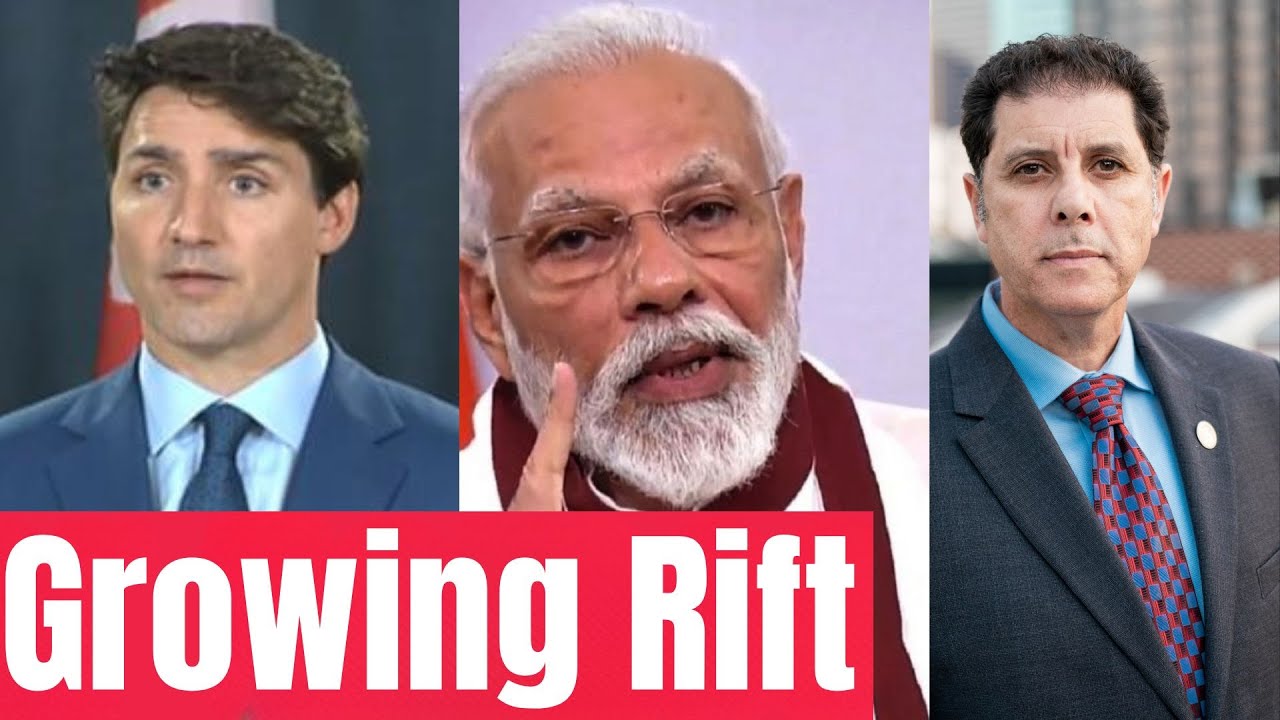
This content was created by David Oualaalou. This content was uploaded by David Oualaalou. This is a YouTube video titled "Escalating India-Canada Rift! Here' why!!" published on 2023-09-22. Based on the title and metadata, it appears to be a news or commentary piece about rising diplomatic or political tensions between India and Canada. No transcript or speaker information is provided in the excerpt, so participants and specific context are not identifiable from the available data.
Chapters
geopolitical trends. So excited to be with you. I got an exciting topic for you, given the tensions that are on the rise between Canada and India. How this came to be— I mean, Canada was just in G20 in New Delhi, so— but anyway, the picture back then between The Prime Minister Dictator Trudeau and Prime Minister Samhai Dictator Modi was also telling a story. So, so this is what I am going to be detailing with you today. We go into the detail, then the depth of it. And by the way, I was supposed to release a video for you this morning about it, but I'm gonna, uh, I found a minor error that I asked my editor to correct that before I release it for for you tomorrow. So, well, let me first, like I always do, I want to extend my sincere thanks to all channel members, supporters. Uh, we are short of about 15 members or 20 for us to reach the number 100, so I can do an exclusive Q&A. So if you consider becoming a channel supporters or members, I will greatly appreciate your support. So, uh, just few announcements. I'm gonna be doing probably a live stream for you about Azerbaijan, what's going on in that part of the world. A lot of people do not know that the, the ins and outs of that, uh, uh, part of the world and what's going on historically speaking. So also for, uh, my, uh, private course, just for those who might be interested, I am gonna share a link with you. I started already the course last week. And the, uh, this coming Tuesday is my second chapter that I'm going to be doing. And by the way, the links for all what I'm going to be talking about, I already posted in the description. So this way we won't waste time, uh, on, on going back and forth onto this. So, all right, let's get in into our topic. So what I'm going to be talking about today, it's, uh, really what's at the heart of the rift between India and Canada. So, and the other thing is, did we see this coming? You know, some will say I didn't, you know, straightforward, I didn't, nobody did. Because here's the thing, whatever the Prime Minister is accusing India of, whether it did happen or not, we're not getting into that. And first of all, because we can't judge that till we see the evidence, you know. Uh, the point is this happened way back, so why is it just coming out right now? And this is where you gotta put question mark on things. So Second thing, this, this, uh, topic of Kalistan, you know, issue— can we compare this one to the issue of Kashmir? Would it be fair? It's just question out there. So because Kashmir is also another, uh, hot topic, and I intend to address that at some point. So I've been in that part of the world, especially in Afghanistan, so we're closer to the border with Pakistan, so I'm very familiar with what's going on. And I have some close friends, uh, it are from that part of the world. So, and the third question we need to ask, and here is the key, is India, you know, through this act by Canada, is India now finding out that it cannot play both sides with the West and the Global South? Because this is what it's coming now out of the West Canada. Canada is representing the West. So is India going to be feeling the wrath of the West through this? That's just a question for us to ask. So, uh, and this is what I intend to detail for you as we go through the, uh, the, the process of— not the process, rather, but the brief analysis that I'm going to be doing with dealing, or I'm going to I'm losing words, guys, you know, that I am going to be sharing with you. So, so this is what we're gonna be addressing today. So, so here is at least a background, a brief background. So, because the way I look at it as an analyst, I'm looking at a geopolitical showdown now because it's unveiling itself. Yeah, to those who might say, well, India is not at the, uh, at the, at the, what the world, at the rank of, let's say, developed, uh, countries like Germany, like China, like, you know, but it's still India and Canada, they do have some security arrangements, they do have some trade, they do have some sort of bilateral trades that now, you know, are we finding ourselves or at least India and Canada finding themselves in a geopolitical showdown. So, because here's the thing, this diplomatic storm that is has brewed now, uh, between Ottawa and New Delhi, uh, which, as I said, because to Canada, India was considered some sort of a steadfast security and trade ally. Same thing for India, they consider Canada like a good market and so forth. Plus, the— I, when I lived in Canada back then, it used to be a lot of immigration from India into Canada, mainly on the western part. There are some in Montreal, Quebec area and so forth, but mainly in the west part. So, and this for Canada and India facing off now is because the claim that Canada, which connects India to a high-profile assassination of Nijjar. So, so what are we looking at here? We're looking at the complexity of all this. And again, because we need to be fair, there is one thing about what I like to do is always be objective. You know, we can't be blaming India, we can't be blaming Canada, you know, but we'll present the arguments. And, and, and this is what this forum is all about, is to exchange ideas without pointing fingers and so forth, you know. Because here's the question that I need to ask: by all of a sudden this emerge into the scene, Is Canada acting on behalf of the United States to retaliate against India? Some of you might ask why. Well, it's because India just dumped the dollar. You know, I'm gonna take you back to what took place with the chief financial officer of Huawei, Meng Wanzhou. You all know the story, and I covered it a lot on, on on, on, on the other channel, the big channel. I didn't have this channel at that time. So because Canada acted on behalf of the United States to legally detain Meng Wanzhou, who was on her way to, I think, Mexico or Latin America or something. So the second question we need to ask also is, could this strain, meaning this rift between Canada and India, uh, could it, uh, uh, beginning, uh, signal rather the beginning of a strained relationship? So, and the other major one that I do see, India is going to have to really be careful how it proceeds because it was sending some signals that it's moving west. Now all of a sudden, I believe India is going to be navigating a challenging terrain moving forward because it needs now to balance between the Western and Global South interests. So, well, like we always say, you can't be on both sides of the fence, you know. Here it is, now all of a sudden Canada turn over on, on, on India. So it's very important to understand. And why is this to understand it? It's because the statement by the Prime Minister, who by the way just said this two days ago in Parliament, you know, what was— what I found very interesting, it was And I'm going to leave this to the analysis first, because first I need to give you a brief history about Khalistan, and second thing, a brief geography on it, a brief, of course, a bio about Justin Trudeau, just to understand the background, to put things in perspective. Then I'm moving into a brief analysis for this one. So, so historically speaking, and let me see if I have any map here. And once again, guys, for the maps You know, remember, there is no mention in other world maps where Khalistan is independent state because it does not exist. Let's just put the dots on the letter here before we move forward. So, so Khalistan is a term used to refer to the proposed homeland for the Sikh community in India. So here is a map here, but once again This is not recognized by the entire world. I just had to use this for reference, just to put things on, but just also to highlight to you where the location of the Sikh, uh, and this what it was before. So the idea of, uh, the, uh, the community, the Sikh community in India. So, and by the way, the word, uh, Khalistan is derived from two Punjabi words. One is khalis, which means pure or free, and the other one is stan, which means land or country. This is where, just for you to know the, the, the terminology and the origin of the term. So, so the idea of Khalistan emerged back in the 1940s. Yes, in the '70s and '80s start to be clashes between the supporter of the, uh, proposed homeland or develop, uh, or the independent independent state and the Indian military, of course. But the idea, it's not new, it goes back to 1940s. It was almost around the same time when Pakistan gets its own independence as well. So, so, and this has gained momentum in the 1970s. So, and with the demand of a separated state that will be gaining widespread support among Sikhs in, among Sikhs in India and around the world. This is why you have a large community in Canada, especially in western part, British Columbia, Vancouver, and so forth, mainly of Sikhs. So, so just to understand, and again, I put all the links for you guys in the description so you can look it up later on. So, and this what it highlights is the ongoing struggle that this particular entity, the Khalistan movement its historical background, its emergence, its ongoing struggle for the establishment of an independent state. So, uh, and it's also highlighting how the Indian government responds to the movement. And again, we can— and let's be fair and objective, guys— we can't be pointing fingers at Indian governments, you know. We all know how Modi, for example, have dealt with the Manipur atrocities. So, uh, Modi is no saint, you know, and I don't shy away from saying this. It's no different than the Prime Minister dictator Trudeau is no saint either, after what he did for the, the, the protesters, the truckers in Ottawa, after all the policies he's enforcing, after the mandates about the vaccines, about this, about that, you know, he's no saint. And I'm gonna tell you part of his bio to put it in perspective for— so what I see here is like both India and Canada are finding themselves, finding themselves now facing off head-on, and they're gonna have to figure out how to manage this. The one thing that I can lean towards is that India will have to proceed carefully, because if India was thinking that the West will embrace it, it's mistaken. The West doesn't care for India. This is the reality of it. And to me, the action of the Prime Minister Dictator Trudeau sort of supports my argument. So, so here is the historical background, of course, for the, the Khalistan movement. It is essentially important to understand the history of the Sikh religion and its role in India's independence movement. You know, because without understanding the history, this won't make sense to you guys. So, so Sikhism is a monotheistic religion founded in the 15th century by Guru Nanak Dev who believed in the equality of all human beings regardless of their caste or religion, which is a wonderful concept. Uh, I'll, I'll share this with you. My financial advisor is a Sikh, you know, wonderful human being, you know, without disclosing the names here and so forth, and, and very smart with numbers, you know. Despite the downturn in the markets, you know, I didn't lose much, little in comparison to— he's a wonderful being and he is a Sikh. So, uh, so the Sikh community played a significant, uh, role in India's struggle for independence from Britain rule, or British rule rather, during the 20th century. So we can ignore this fact, you know, they take part into the independence of India. So, and at some point they wanted to have their own state. Now that's an internal matter for India to handle and deal with. That will be the same argument for Kashmir, you know. And I did see that India embarked few years ago on some tactics in Kashmir, and I was talking to people from the area, and those tactics weren't pretty, very oppressive. I'll say straightforward, once again, nothing against India. What's fair, it's fair. So moving on, now in 1947, that's where the Partition of India came in, which created, of course, the separate states of India and Pakistan. This is why it's important to understand. And this led to widespread violence that took place and the displacements of millions of people. So the Sikhs, who had hoped to form their own state within India— this is why I had to highlight this map here. But remember, this is not recognized by the entire world as of today because there is no such thing. This is just the, the drawing lines as to where Kalistan was hoping to establish its own state, per se. So, so then fast forward to the 1970s, and I'm not going to detail too much here because I need to get into the analysis of it. So the demand for the separate state of Kalistan gained momentum in the '70s, uh, with the establishment of the Anandpur Shaheeb Resolution by the Shiromani Akali Dal, known as SAD, so which is a political party that represents the Sikh community in India. So the resolution called for the creation of the federal system in India and demand more autonomy for Punjab. This is why you're still seeing India struggling with those domestic ethnic issues. And this is why I, I argued this before and I will argue it again, and I don't care what others think because it's the truth, that India cannot be calling itself the spokesperson for Global South, cannot call itself a superpower when it can't even resolve its own domestic issues. So, and again, I'm not judging India for this. It's their country, they can do whatever. But at the same time, if the Sikhs were calling for an autonomy, that will be similar to what other places have, you know. And again, it's the decision for India to make that one. So, and this momentum gained, uh, sort of, uh, uh, uh, support in the '80s with the rise— of course, that becomes problematic— with certain groups like the Babbar Kalsa. Now, the Babar Kalsa has been— Kalsa, rather— has been categorized by the Indian government as a terrorist group. So again, is their problem, is their decision. So it became now— and the Khalistan Liberation Force, known as KLF. So, so these groups advocated for the establishment of a separated state of Khalistan and resorted to some degree to violence to achieve those goals. Now be careful also as to where you read certain— when you do the research, be aware of where the source of certain aspects come in. So I'm— what I'm doing here is just providing you the landscape to understand at least first of all what is going on here. So now to those who understand a little bit the history of India you will understand that the assassination of the Indian Prime Minister Indira Gandhi— who committed the, the, uh, the— who killed her? Can anybody tell me if anybody aware of the history of that part of the world and with Indira Gandhi? Oh, let me say thank you to KL. Thank you so much for your super sticker, truly appreciate it. Yeah, can anybody tell me who assassinated Indira Gandhi. And again, not to pass judgment here, okay? Please, guys, please, no judgments here, because we're trying to understand the complexity. This is what we are lacking in the West, because we don't understand the complexity of certain parts of the world. So it's not of us to pass judgment. We can't, and, and we shouldn't. As a human being, we shouldn't be passing judgments on others. We don't like to be judged, so who gives us the right to judge? Yes, we can provide our arguments. Yes, we can provide our assessments, but we leave it open to discussion. So, uh, oh, I did see it here first. It was by Cam. You're absolutely correct. And some of you also have answered that one. So it was a Sikh bodyguard. That is indeed how it happened in 1984. I remember that one. So And of course, why you assassinate— once you assassinate a prime minister like that, what's going to lead? It leads to more tension between the Sikh community and the Indian government. And in retaliation, of course, thousands of Sikhs were massacred in the anti-Sikh riot that followed, primarily in Delhi. That is the sad part about all this. And then again, I put all the link, uh, for you. Now the next question is going to lead us to ask Who is, uh, who is Singh Najar? And I have a picture of him right here. So who is he, uh, this gentleman here? He's deceased now. So just briefly, Hardeep Singh Najar, so he's a Canadian citizen, so of Indian descent, and he was involved in the Sikh Khalistan movement. As a matter of fact, he was leading the group in, in, in Vancouver, in Canada, British Columbia. Now, there are certain literature or certain, uh, reports suggest that he was wanted by the Indian authorities, and I did confirm this one. Why? Because it was a list of names that was submitted by the Indian intelligence agencies to the RCMP. RCMP, part of the intelligence of Canada, and the name was included in that. However, we cannot jump to conclusion and say what— it was the Indian government that assassinated him in June. And if it was in June, why this issue didn't come up last month or the month before or right after, uh, June 18th or June 20th when he was assassinated? So we gotta be fair. Okay, so where's the proof? Because personally, for me, and this is my personal opinion, I can't trust what dictator Trudeau is saying. Why will I? You know, I can also trust what the Prime Minister Modi is saying. So I gotta wait till see where the evidence or investigation may lead to. But the timing, what I found very, very interesting, so So anyway, he was wanted by the Indian authorities because he was designated as a terrorist. And, uh, and this is what it was, the legislation passed in India, as a matter of fact, uh, under the so-called India's Unlawful Activities Prevention Act. So why? Because according to the intelligence services, uh, in India, this suggests that, uh, And Nijjar was involved in the murder of a priest, a Hindu priest in Punjab. So, and this is why I found a big— you, you can, for events like this, you can jump to conclusions right away. Oh, India did it, or, or no, no, no, no, you can't jump. We can't jump to that. So, so, and this is where, at least to give you a background without going more into details Uh, as to, uh, uh, of course, in 19— I'm sorry, in 2018, the Indian government has accused Najar of multiple targeted killings in India. Uh, I don't know, I do not know how far, uh, this claim holds some truth to it. So, uh, uh, because Najar claimed that the Indian authorities were falsely implicating him in criminal cases. I can see how governments sometimes can do that, including ours, by the way. You know, this is no different. So, but again, I can't pass on judgment and say, oh, Indian intelligence service did this one. No, I don't, because I don't know. So, and this is— here is the thing, what I told you, uh, in 2000, I think on April 13th, I'm sorry, on April 13th of this year, the Surrey unit, the Surrey unit is part, part of the intelligence within the RCMP, known as the Royal Canadian Mounted Police, RCMP. So because they briefly detained, uh, Nizar— I'm sorry, not this year, 2019, yeah, April 2019— they detained him briefly for questioning, but he was released within 24 hours later on, uh, without being charged. There were no charges filed against him. So, uh, in March 2019, he was charged with an assault in Surrey, but the case was dropped later that year completely. So this is where I see a part of what you need to understand about him. So now, uh, let's see the bio of Trudeau, because you need to understand. Prime Minister— did you know that he had no background in international affairs? Geopolitics or global, uh, international relations? You know, none, zero. So Trudeau, Prime Minister Justin, Prime Minister Dictator Trudeau, uh, usually he's the son of one known politician in Canada known as, uh, uh, Elliott Pierre Trudeau, who was a very brilliant guy, you know, don't get me wrong. And I read his bio But as a matter of fact, you created the good relationship back then, at least when I go back 5 years ago before Canada was pressured by the United States to reverse course. They had a good relationship between Canada and China. And you know who you have to thank that for? Elliott Trudeau, Pierre Trudeau, Justin Trudeau's dad, because he's the one who opened up Canada to China and vice versa. Had a good relationship with the Chinese, except that, uh, one of the, uh, literature that I looked into, uh, Pierre Trudeau was somehow a little bit arrogant. And what do I mean by arrogance here? Intellectually, he was well educated, but sometimes when you try to show off your intellectual, that comes across as being arrogant, academically speaking. You can see this with some people when you meet them and said, hey, I am Dr. So-and-so, you only call me Dr. So-and-so. That to me is arrogant. So I never hardly ever introduce myself to people when I meet them. Oh, I'm doctor. Oh, I'm just David. That's about it, you know, who cares, you know. But he was arrogant, he was condescending in some speeches, and I had a chance to read that too. But beside all this So how did Justin Trudeau become a prime minister? Well, of course he went through school, he pursued his degree in Jean-Dieu Prébeuf, which is a private school, the same private school his dad went into, uh, with, uh, to study French language, uh, in Montreal. That's what it was. So later on he acquired the bachelor degree in literature. Exactly in English language from McGill University, well-known university in, in Montreal. So, so he then worked as a snowboard instructor while earning a degree in education from the University of British Columbia. That's where the link comes in as far as the Sikh community in Vancouver. Uh, after that, he taught as, as a teacher in high school he taught French and mathematics. So he wanted to pursue a master's degree, but he couldn't complete it. So until he ran into, uh, sort of became involved in politics and running for office and won the elections with a landslide because it was the seats and all that. For now, by the way, guys, do you know what this hype is all about also, which I'm gonna get into the analysis? But I just want to tell you, it's because there are upcoming elections in Canada, and he's ranked second after Paul Bière. Domestic politics might have something to do with it. So, so, and we will get into that. So now, one thing I need you to know and understand why dictator Trudeau is embarking on this woke policies in Canada and climbing down on protesters, even though He champions so-called freedom of speech. You all remember a few years ago, I don't know if you remember or not, there were some demonstrations in India by the farmers. Why? Because the Indian government, I think they allowed the spray of pesticides, chemical stuff that was killing, uh, the, the farmers' land and so forth. So when protesters, uh, farmers protested, the Indian government came down hard on them. But what Dictator Trudeau said, oh no, Indian government should allow freedom of speech. I don't know if you remember this. Then when demonstrations took place in Ottawa, he came down hard on the protesters, jailing some of them, closing their bank accounts. Yeah, yeah, because he was also pursuing the policies of the World Economic Forum. Because he is a globalist, a young globalist within the global, uh, uh, the World Economic Forum. That's why he's been groomed into that. The same like Jacinda Ardern, the former prime minister, the another dictator, because that's how she is, you know. The same with the former prime minister of Finland, Sanna, who used to work for— and now she's, uh, joining forces with none other than The idiot Tony Blair. You all know the history of Tony Blair, a liar. Uh, you know, I, I don't shy away from saying this. Usually I don't use, you know, negative stuff, but, but when it needs to be known, I don't shy away from it. The truth matters. This is what people are having a hard time hearing, the truth, and accepting the truth. You know, there's the saying goes in a religion, the truth sets you free. Well, besides the point of religion, You know, the idea that truth matters, that's just part of how it is. So we can't hide and shy away from it. So, so Dictator Trudeau's been pushing the agenda, and this is what's ruining Canada. As I said, I used to live in Canada before, wonderful country back then. It's gone. It's the like of Germany, the like of Australia, which just yesterday I read an article that its economy is collapsing. And this is what you need to understand, because what's lying ahead in Canada, could this have to do anything with it? Why? Because Pierre, Pierre, the guy who's running against, uh, it's more preferred by the Canadian for prime minister than Justin, Justin Dictator Trudeau. So most of the polls that been conducted in Canada suggest that dictator Trudeau is trailing, uh, Jean Poilievre. Could this be a distraction? Because there are some truth to all this, and I'm gonna get to the analysis I promised you, but I need to do geography for you because you need to see certain images here that— I'm sorry, certain maps. Once again, don't interpret this because some of this stuff is not recognized on the international stage. All I'm showing you here is just to put in perspective, to highlight to you, for example, the acreage of the, of the, this Palestine region. So this is what you need to understand. So geography, the, uh, uh, the, the Palestine, the geography of Palestine's land is, is very variable. So there are several propositions that have been made by different groups. This is what makes it problematic. So, but all plan which have been primarily considered involve that currently form the Punjab. That's the reason for that, you know, if it's part of the Punjab area, the, the Chandigarh and some other parts of neighboring states in India. That's what you're looking at on the map. So that the territorial ambitions of Palestine have at times included Chandigarh, which is sections of the Indian Punjab, and including the whole north of India and some parts of western India, which means right here. You don't see me, you don't see my cursor when I point to it. So I found also another map, and again, this is just to highlight to you. So, and this is why you're seeing, and I'm gonna touch on the issue of Kashmir. It needs to be also addressed because we can't shy away from, from all this. It's very, very important to highlight this one. So, so here is my analysis for you as to really how I see things moving forward. Now, I am not suggesting that the, uh, the, uh, the death of, uh, uh, Najar didn't happen. It did happen in June, and I checked it and confirmed it and so forth. What I ask is why it took this long. If, if— and here is why, guys— if Dictator Trudeau said in a parliament, we're gonna get to the bottom of it, which means what? No investigation has been conducted yet. Well, how come all of a sudden you bringing this up to the floor 3 months later? Unless there is a specific objective. For this one here. And the one that I can think of, it has to do with what just took place few days ago when India dumped the US dollar. There are too many events for this, and I put the link for you already in, in the description. India bought 1 million barrels from United— of oil from United Arab Emirates paying with rupees. Europe is still purchasing more energy from India than is getting from Russia, but not using the US dollar. So, so could it be— and again, we're just thinking outside the box here— could it be that the US pressured Canada to move forward so Canada-US would not be at the forefront? I am leaning to say my answer is yes. And the reason I say yes is because I've seen this movie before. And the one I saw before was with none other than the former— oh, not the former— the financial officer of Huawei, Meng Wanzhou. You all remember her story, right? When she was illegally detained by the Canadian authorities because We, as a matter of fact, at that time it was a secret memo from the White House that leaked at the time ordering Canada to arrest Meng Wanzhou on her transit, because she was just on transit. So, which spent about 3 years in house arrest in Canada before returning home. But we all know it's not a— it's about the manner by which Canada just conducted an act because its master has asked it to do so. So because the arrest was, if I recall, in Vancouver, 2018, you know, because it was like, you know, what, what, what this is all about. And this is why I'm saying I am leaning more towards— I bet you this— that Canada is acting on behalf of the United States. States. Because here's the thing, I have one picture here for you, how awkward that is. Despite what you see here, it was very, very, very awkward, let alone the image, uh, during the G20, uh, which was between the two. Uh, this is, by the way, an image of Meng Wanzhou flying back. Yeah, the image wasn't clear here. Uh, it is was still, uh, in, in Canada at the time. This is Meng Wanzhou, which is the daughter of the, of the founder of Huawei. So the idea of, uh, dictator Trudeau saying, wait a minute, who are we gonna have now to stop, you know, sort of, uh, accuse Well, how can you accuse without evidence? You know, you have evidence, show it. You know, I'm, I'm sure they're going to run to the same— we all do it, most governments do it, you know, when they said, oh, it's classified, we can't share this. That's easy way out, just use the term for the government justifications for certain things. And I'm not denying that is not the case, because I'll tell you a case that I was very familiar with, and it was through classification or classified methods by which we found out that the prince of Saudi Arabia did order the killing of Jamal Khashoggi. Why? Because the CIA was listening to his communications and we kind of kept the, the, the audio recordings. And this is why you have the rift between MBS and the United States. It's not about just moving towards China or, or pivoting east. Also has to do with MBS didn't like the fact that the CIA was spying on him. So I'm not saying that could be the case here, that Canada has something, but at the same time, this is far major. Same thing with what happened with MBS and Jamal Khashoggi. But, but the timing of it, what I find very, very, very, very problematic. So, and this is why it started, by the way, not just 2 days ago when he announced it, but rather during G20 Summit. It's because the rift emerged even back then. You all remember Dictator Trudeau had to stay in Canada one more day because he couldn't fly his plane. There was some issue. I'll let you reach your own conclusion with that. So, so, and even when, uh, Dictator Trudeau met with Modi, the encounter was very frosty. You know, I saw one image of them shaking hands. It wasn't, it wasn't pretty. It wasn't pretty. You can just see, uh, and right few days later— here's what's interesting about this— just few days later after G20, Canada canceled a trade mission, uh, to India, was planned for the fall. That's why all this is not happening in a vacuum. So, so basically the trade between Canada and India now is on hold. So, and this is why we shouldn't be jumping quickly to conclusions here. At the same time, India didn't hold back either. India retaliated by issuing its own statements, and rightly so. They're gonna have to sort of defend themselves, whatever. They have the right to do that as well. Now, as to whether, uh, they are committing also atrocities inside the country with certain ethnic groups, yeah, it's been documented. You know, as I said, I had access to the report issued by the UN, uh, that what took place in, uh, in, in, uh, in, uh, what's the place, Manipur. Those are not— those were atrocities, you know, committed against ethnic groups in the region. But again, it's, it's, it's the Prime Minister, uh, Modi, which to me was like, okay, well, if you don't even address this kind of issues, that tells me something is off. To me, you are not a prime minister for whole, uh, India, but rather for certain, the, the Hindus maybe. Yeah. And again, we just have to evaluate, uh, on both sides. So So what happened? The Indian National Intelligence, or investigative agency rather, also said it has intensified its crackdown on Sikh insurgents operating in India. That's what I found very interesting because they just announced it on Wednesday. So, so now Indian government is issuing or providing a reward of 1 million rupees, the equivalency of about $12,000, for information leading to the arrest of 5 insurgents, one of whom is believed to be based in neighboring Pakistan. Yeah, it's, uh, of course, just FYI, India is sort of accused them, accused these groups of extorting money from businesses for banning for banned Sikh organizations, the Babbar, uh, uh, Khalsa International. So, and of course, they add into that, to the list, that there were some targeted killing inside India. I, I, I can't, I can't, I can't confirm this kind of stuff. I'm just sharing with you what has been reported there, because to me, this, those kind of statements, most governments will do this, you know. And what I found very— also the Indian government statement when it says, and I quote, they also have established— they meaning the insurgents, the 5 insurgents— they have established a network of operatives in various countries to further their terrorist activities in India, end of quote. And this was said without naming which country. Okay, well, which country are we talking about? So that's why for India, India is also accusing Pakistan now for supporting insurgencies in Kashmir. Well, wait a minute, wait a minute, wait a minute. If we are to look at the history of Kashmir to begin with, which is very troubling to me personally, what took place few years ago when the Indian government went ahead and cut off the internet access and, uh, uh there were some atrocities committed in Kashmir, including killing in Kashmir. It's the same thing that I noticed in, uh, in, uh, Manipur. So where is the objectivity of the Indian government? And again, we're not pointing fingers here, just highlighting the, the complexity of this kind of issues. And I'm yet to do, uh, and talk about Kashmir because you need to know about that one. So This doesn't resolve Canada. Canada still have to provide evidence of the— of India's, uh, Indian government involvement in this assassination. Yeah, Justin Trudeau cannot just issue statement willy-nilly just because he feels like it. Well, the guy has no credibility either, you know. Ask Canadians— not all of them, of course— when he's dragging Canada now. And that's why I'm saying I am looking at this, first of all, as being directed by the US to do the US bidding for India dumping the US dollar. And second thing has to do with the domestic front in Canada, because food prices are going to the roof and housing prices are going to the roof. Canadians are struggling. You guys don't hear much. I was in Canada just 2 months ago, and I read, and I know where to look for information. Canadians are struggling. This is why we need to understand, uh, uh, statements emanating from both, uh, locations have to be very, very, uh, uh, taken, uh, uh, assessed very carefully because we can reach a conclusion just on the top of our heads because we feel. No, in analysis there is no feeling, there is objectivity. That's what matters. So, and as I said, uh, again, I'm using history as my guide. I did see what Canada did with the, uh, uh, the chief financial officer of Huawei and how all of a sudden Canada just disregarded any international law In, you know, how can dictator Trudeau be talking about the rule of law when, you know, where's the evidence? Where is the evidence? So like I said, Canada has yet to provide evidence so that it can back, uh, dictator Trudeau's allegation. So, and if they say, well, we're gonna be digging into it, well, wait a minute. The incident happened on June 20th, so why, why is taking all this time? And, and what I found very even disturbing is that the Canadian ambassador to the UN, Bob Rae, indicated that it may not come very soon, meaning the evidence. So, and he said, and I quote, oh, this is very early days. Which means we don't know when the evidence will show up. And that's what he told the reporters at the UN, insisting that while facts will emerge, they must, and I put this in quote, come out in the course of the pursuit of justice. That's what we call the rule of law in Canada. End of quote. That's what he said. Yeah, where is the rule of law? When the Canadian, the, the, the administration or law enforcement, who by the way, the RCMP themselves were following unlawful orders issued by dictator Trudeau to freeze the account of Canadian citizens who were demonstrating in peace. So where is the rule of law here? How come the rule of law only apply to others but not within? So to me, that's hypocrisy, uh, at the highest order, simple as it is. So, and this is now why you are seeing the tit-for-tat between Canada and India. It's starting on the diplomatic front, especially when it comes down to the visas, because that, uh, uh, India now sort of suspended the visas to Canada, which means that Canadians who don't already have visas will not be able to travel to India until this issue is resolved. And by the way, uh, I did some research and I found that about 80,000 Canadians traveled to India for tourism in, in 2021, which was right around that time. So, so it's very, very problematic. But one thing is sure is I want you to make sure, guys, you do not jump to Yeah, here is that image, by the way, guys. I forgot to show you this. This is the awkward one in G20. You can just tell. So, uh, this is an image of the funeral of the Sikh, Nijjar, after he died. They were carrying him out too. Uh, and this is an image of the RCMP. So, which to me, some of their, you know, used to be highly respected Not anymore because they're following unlawful orders. I remember this image which I couldn't get out of my head with one of them on a horse walking over a female. She tripped and just, you know, no sensitivities, no, you know, that's inhumane. That's inhumane. Why? Because people are protesting. Now you got issues in Canada with, which by the way, I did find one. Uh, I'm going to share it with you. Very disturbing that even now you got, uh, the, the guy by the name, uh, another Singh, his name is Singh, uh, I'm trying to get his, his name here, uh, he's supporting, uh, uh, Canada for the, uh the woke policies, forcing, sort of educating children on, on aspects that have nothing to do with, uh, with what the parents want. I'm trying to get you guys the picture here so you can see it for yourself, which was very, very troubling. That's right there. Yeah. And even the arguments for this— Justin Trudeau says India killed someone in Canada. Well, he offered no proof, and, and rightly so. So, you know, what I found very interesting, that they already bringing in China into the conversation for this. That's what I found very disturbing. So all of a sudden They mix and match in this for that, and, and Ali just tells you there is no credibility sometimes when you read issues like this, because those are very, very disturbing, very disturbing. And it can be, uh, it just— it can be. This is the image I wanted to share with you because you need to see it, and this is in Canada. And you will see who is leading the march is another Sikh who is politically involved. And by the way, this— his name is, uh, Jaman Singh, if I'm not mistaken. This guy here is a member of the parliament, I think. So, but look, the rise of hate wars LGBT. This is what they are forcing on the Canadian, uh, society. And by the way, we're seeing it right here in the US too. The Biden administration is forcing this kind of policies. You know, I, I don't have small children in school, and if I did, I would pull them out of school. Forget about it. You know, the education system is corrupted here in the US. So, and this is what I want you guys to really understand and, and And, and just to put it in perspective for you, so before you start reading, you're going to be reading a lot of stuff, and, and, and you'll be at least well informed of really what's going on. For, uh, uh, yeah, you're absolutely correct, Phil. Melanie Joy, it's, it's useless. It is useless. That's the like of, of Annalena Burbank— of, uh, Burbank rather— of Germany is the like of, uh Prime Minister Albo of Australia, the like of, uh, uh, what's his name, the guy Prime Minister for New Zealand, not the foreign minister, Prime Minister, the useless, the Prime Minister of Korea, South Korea, Japan, uh, Marcos of Philippines. You got the idea, uh, the whole Chancellor of Germany. They all, they all are useless. So Canada is no exception. Gone, kind of Canada that used to be really well respected around the world. When I was a kid, I used to hear a lot, a lot of good stuff about Canada. Very, very neutral, very, very peaceful. Everybody would love to just go and live in Canada. It's a big country, doesn't have a lot of people, but Canada is gone. But at the same time, you don't just blame the government, you blame the people that voted him on. It's no different than what we have here. We end up voting for Uncle Joe, who just doesn't know what he had for dinner last night. And not to make fun of the guy, I don't do that kind of stuff, but he needs to retire. He needs to go spend the rest of his life at home, enjoy whatever days remaining for him on Earth instead of just dragging us into confrontation on a massive scale. And I know it's not him. He doesn't even know what he's doing. The guy is forgetting things. So, so just, uh, the reason why I wanted to talk to you about all this is because I wanted to— I was gonna do Azerbaijan for you guys, but I decided to do this even though I didn't release the video on it. I'm gonna release it tomorrow morning. Uh, just make sure to take a look at it and hit the like button so you can push it up into the uh, uh, uh, sort of the viewership. The reason being because people need to hear different perspective. And you know me, I don't sugarcoat things. So, so, but I intend to do, uh, uh, Azrabiyan if you guys like it. If you want me to do a live stream, uh, on, uh, Azrabiyan and Armenia, just let me know, leave me a comment, and I'll be happy to do it. So, all right guys, I hope you find this very informative. And, and once again, if this is your first time here, please hit that like button. I will greatly appreciate it. And remember to either become a channel supporter or a member. I will greatly appreciate your support. As always, guys, remember, geopolitics impact your daily life in more ways than one. Till next time, bye-bye.
More from David


Beyond the Single Actor: Why the Gulf Isn't Choosing Between the US and China


Iran, Iraq's Militias, and the Houthis Are Coordinating! This Changes Everything




Who Controls the Next Decade's Resources? Latin America and Africa's Geopolitical Crossroads

The Chokepoint Trap: How Washington's Stupidity Triggered a Cascade That Now Controls the World

Trump Spooked as IRGC Unveiled dual-use SLV, Deployed Ghadir Mini-Subs & Hinted at Tactical Nukes!
