Escaping the American Orbit: Can Europe and Canada Build Strategic Independence?
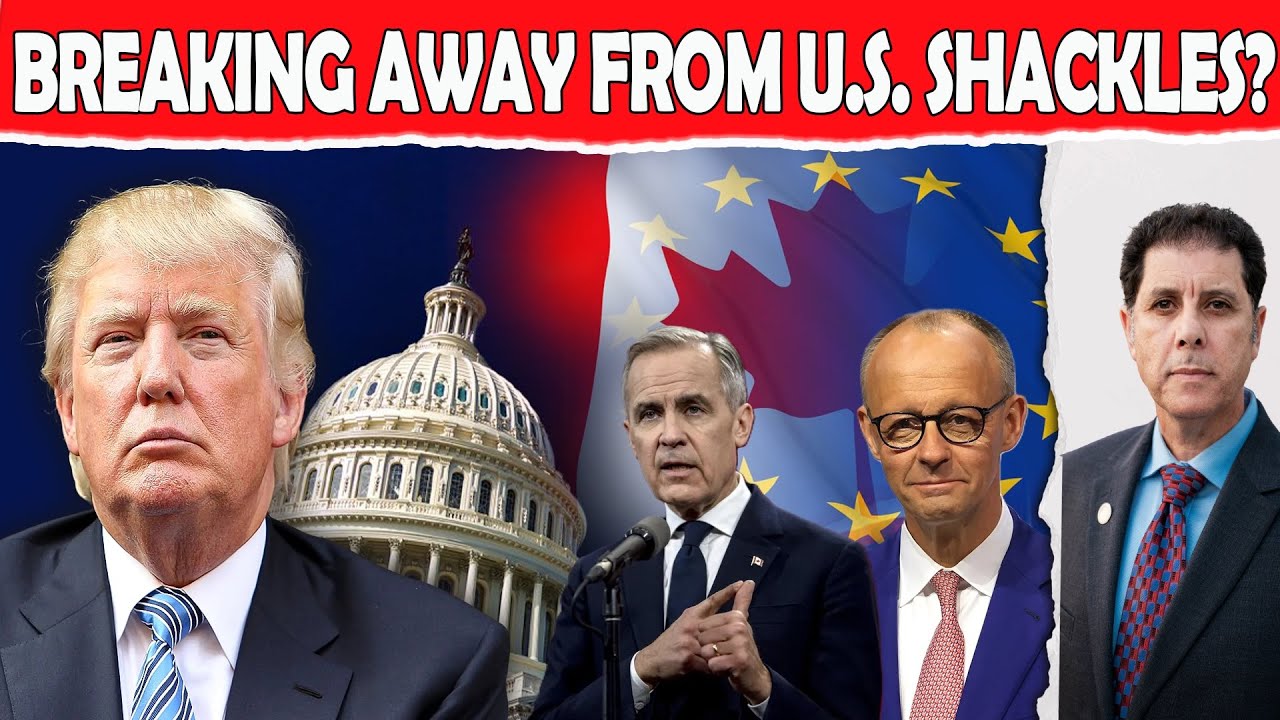
In this livestream, Dr. David Oualaalou examines recent statements by German Chancellor Friedrich Merz and Canadian Prime Minister (Finance Minister) Mark Carney about pursuing strategic autonomy from the United States. He argues that both Germany (representing Europe) and Canada are more rhetorically inclined than substantively prepared to break away from US dominance. Oualaalou critiques Merz’s claims of a new power‑based world order, pointing out Europe’s continued reliance on US troops, NATO, and its inability to act independently on issues such as Nord Stream 2. He details Europe’s deep energy vulnerabilities – 60 % of energy imports, soaring electricity prices, grid fragility, and costly renewable transitions – and questions whether Europe can finance a €5.6 trillion energy overhaul while still funding Ukraine. Turning to Canada, he highlights the country’s strategic advantage in critical minerals (lithium, cobalt, nickel, graphite) and its push for clean‑energy growth, SMR nuclear projects, and a $1 trillion China deal, while also noting structural challenges in its north‑south oriented electricity grid and federal‑provincial coordination. Oualaalou discusses US pressure manifested in Donald Trump’s Greenland remarks, tariff threats, and NATO financing claims, interpreting them as coercive tactics that limit European and Canadian maneuverability. He concludes that true strategic independence would require Europe and Canada to reassess NATO ties, develop robust domestic energy and technology capabilities, and navigate geopolitical realities, but he remains skeptical that either can fully escape the “power system” dominated by the United States. The stream also includes community acknowledgments, promotion of upcoming interviews, and a brief ban of a disruptive participant.
Chapters
Hello everybody and welcome to Geopolitical Trends, where truth matters. I'm your host, Dr. Oualaalou, excited to be with you as always. Today's topic, I will be talking about two countries, uh, one in Europe, one in North America— Germany and Canada. Why am I talking about this? I am talking about the statements coming from both leaders of those countries. Germany, uh, Mersch with the chancellor, and the prime minister of Canada uh, uh, Mark Carney, uh, regarding the really the direction of where the world is headed and what are they signaling to the United States. So this is why I wanted to do this video for you, provide you my own analysis about this one here. But before I'll do this, let me say hi to our wonderful community. Uh, Willie Holman, good to see you as always. American citizen X. Thank you for your, uh, support buying me tea already. I saw the note came up through Buy Me Coffee, so much appreciate you for that. So Truth Seeker, as always, good to see you. Atin Wu, say it like it is, good to see you. Matt Becky, here you are, good to see you, Matt. And Betty Jones, good to see you here. And that's, that's all we have here for now, so people will join in as we move forward. So Some housekeeping items for you. Remember to join me tonight for my conversation with Jayant Bahndari. Yes, we will be talking about Modi's version of democracy. If you only know what's going on with the suppression of the minority Muslims, uh, and the Christians for that matter. But I'll be focusing in this live stream with the Jayant Bahndari about the suppression of the Muslims regarding voting. They're not— Modi's not wanting the Muslim minority to vote. Shame on you, Modi, for claiming to be democracy when in reality you're not even allowing people to vote. So, and next week I will be talking to Anna Tengen and Warwick Powell. That will be on the 27th at 1900 hours. I will post this for you, uh, just to let you know the exact timing. But just make sure to keep an eye open on this one for next week. So, and I am also going to coordinate with Carl Zah for the end of next week. I haven't reached out to him yet. I will do so in a day or two here. So, all right, let's get into our analysis. I don't have headlines for today, so I'm going to get involved directly into the analysis because it's a little bit long and I want to provide you, especially since I have, uh, uh, like Phil and and Truth Seeker. I'm sure you have some viewers from Canada. I want you to also understand the big picture. So, so what I want to do in this analysis, I want to explore, uh, just my own insights whether Europe and Canada, for that matter, can sort of, uh, chart an independent course of action or path or trajectory in a shifting global order that is dominated by the US. And that is the fundamental question I would like— I will, I will try to answer for you in this live stream. I will also examine one of the other aspects both locations are dealing with, and this has to do with the energy, energy system constraint. Yeah, both locations. And I'll detail for you how both regions are facing, given the capacity for their strategic autonomy, if there is anyone. If there is any one of those. So, so I'll be talking, as I said, in parallel way from the German perspective, from the Canadian perspective, and vice versa. So when I shift from Germany to Canada and from Canada to Germany, just for you to know so you can follow the conversation here. So, so the German Chancellor, uh, Friedrich Merz— I think I have it, yes, right here— Friedrich Merz of course, and the Canadian Prime Minister, Carney, both of them, both of those leaders sort of, what they end up doing is that both of them, their statements indicating that they're challenging the American dominance. But is this really just in theory or is it going to translate into action? So I argue, I argue, and again, as one who's looking from outside in, as one who understands the transatlantic relations, as one who've been on the ground in both locations, I argue that neither region so far seeks some sort of a complete breakaway from the United States, but rather some sort of a managed reorientation of the relationship. And that reorientation is towards reducing the vulnerability and to acquire some sort of a greater strategic leverage. Can they? I mean, literally. I mean, for me, so Europe pursues this through technology leadership. What leadership are they talking about? Because you have some analysis coming out of Brussels suggesting that, oh, Europe is technologically innovative and independent. How? How can they compete with the Chinese when they are the one trying to figure out by limiting any transfer of technology from the ASML from Netherlands to Germany, to China rather. So, so when you hear Europeans saying we have this digital sovereignty and this technological leadership, no, They are limited. So similar arguments I can make for Canada, but Canada's concerned from another aspect because Canada focuses on critical minerals. Why? Because of the so-called clean energy. And this is why Canada is diversifying its partnership, especially when it decides to go with China. So my analysis will also highlight here the tensions between ambition and the structural constraint. And I'm finding myself asking the question whether the rhetoric, you know, this statements coming out of Davos or Berlin or Paris or what have you, or Ottawa for that matter, whether this rhetoric translates into substantive policy change. Why? Because there is an integrated, there is a deeply integrated North Atlantic world. So let's start with Germany first, and as I mentioned, I'll be talking simultaneously, uh, uh, between Germany and Canada. So we'll start with Germany first. So the Chancellor, Frederick Merz, in a statement he just released yesterday— actually on Thursday, yesterday was— that he warned now of the impact of the major shifts vis-à-vis US policies. And that not just towards Germany, but towards the global order, arguing that what this system that has sustained for 3 decades, it's coming to an end. So that's what he said in Switzerland when Merz said, and I'm paraphrasing here because I read the article and I remember what he was talking about. The idea that the existing world order, which may not have been perfect, is being shaken. But the new system now, that is, you know what it's based on? Power. It's a power-based system. Funny that I— that Mertz is saying this, because it's the same argument Macron made. So, and this is when Meurs added that Europe— because to me, the way I look at it, Europe is at the mercy of the, the, the, the, the global system, which means what? Headed by the United States. So for him to say this, it reflects to me that he just wanted to put or divert the attention towards something that is not real when he's arguing that Europe is not at the mercy of this New World Order. Well, wait a minute. And has the choice to shape its own future.
Come on, man.
Stop playing with words. If you could have shaped the world in your— if you could have shaped your own future you would have at least take initiative towards when the United States blew up Nord Stream 2, which was bringing gas, cheap gas from Russia to Germany. Why didn't Germany do anything about it? And this is why Merz, what he wants to do, he wants to appear as the leader for the European voices, calling now on countries of the continent to be realistic. Realistic about what? About the new circumstances? But the new circumstances, they contributed to it. Europe could have taken stand back in 2022 before the Ukraine conflict started to begin with, when they knew that it was the US that is fomented that conflict and dragged Europe into it. They could have taken stand and said, You know what, the US, you created this mess, you deal with it. We're not part of it. But they couldn't. And this is why you hear him talk about, oh, we're gonna be injecting investments in defense industries to defend ourselves. Really? How can you do that when you're still allowing over 30,000 US troops on your soil? When he talks about transforming their economy into competitive economies, Who are you going to compete with? China? Do you have the means to do so? And this is again when, when the German chancellor is saying that the world will be very dangerous place if it were based solely on power. Well, it is already because you already letting the US dictate the terms to you. So What I want you to get in this particular, uh, uh, uh, analysis, guys, what I want you to get is to understand the substance of the words from just the rhetoric. So don't fall for the words, don't fall for whatever the, the leaders in Europe are saying, and even to Canada to degree, and we're gonna get into that. So, and this of course was in response to what Mr. Trump claims about Greenland. So, so, and I'm gonna play a clip for you later on explaining a few things to you. So, and this is where Merz is, is arguing that Europe and the United States— here, here is again where I see the playing with words. All of a sudden, Merz, the, the German chancellor, find it convenient, convenience to bring Europe and the US, oh, by saying, oh, they are facing threats from Russia. How can you, how can you now trust what this guy is saying as far as they want an independence, they want a strategic autonomy? So he's adding that, oh, by the way, I'm here to tell you also that Europe and the United States are, as allies of the North Atlantic Treaty Organization, NATO that is, must guarantee the security of the region. Once again, where is this independence that you are, you know, talking vociferously about? So because Germany cannot do nothing without the US. As long as our troops are on German soil, as long as Germany or Europe for that matter cannot take an independent foreign policy away from the transatlantic, they won't be able to do nothing. So, and that's why he's saying, oh, I'm gonna be taking future measures in the future to deal with this. No, no, no, no, no. It's because most of them Europeans couldn't handle the bully, Donald Trump, that is. As a matter of fact, I got a word that Donald Trump made it clear to the organizer in Davos that he wants the full attention, nothing to distract him with anything, dictating the term. So if those leaders were firm, they would have stepped out and said, you know what, we're not sitting here listening to you. But they can't. And this is where that draft about Greenland was on Wednesday, and Merz is saying, oh, this is going to be a long, long-term objective and so forth. So, uh, Merz is always, uh, he also added, the chancellor, that is, that Washington in possession of tariffs will negatively impact relations with Europe. Then what have you done about it? Look what China did when Donald Trump imposed China tariffs on China. What did China do? Retaliated. Same. What did Trump end up doing? Wanted to sit down and negotiate with the Chinese, and the Chinese said, sure, we'll sit down and negotiate, but till you do this XYZ, then we'll, we'll move forward. Did you see the Europeans doing this? But all of them are just talking. And here is what gets to me the most is when he said, and I'm quoting this, I had to put the quote as it is. When he mentioned about or emphasized the need to preserve NATO by stating, and I quote, "The United States has reliable partners and friends," end of quote. Once again, is this a language of someone who wants to be independent? So no. But at the same time, what you look at is that the beginning of 2026, you see in both Canada and Europe, both of them coming to grips with the reality of the shifting global order. This is why they are trying, they, Europe and Canada, trying to strengthen this strategic economic and defense ties, largely in response to the unpredictable United States. But again, the first order of business will have to be, you know what, maybe we're done being in NATO altogether and we'll figure it out as we move forward. But neither Canada nor Germany in this case, or some other Europeans, but we don't talk about the other Europeans, I'm talking about specifically Germany and Canada, If they wanted to do this, that would be the first order of business. Show leadership when it matters, because it matters if you say, "I'm done with NATO, I'm withdrawing." So, and this is why you see now Europe is tapping into Canada as a non-AU member country, which by the way, Europe now is allowing Canada to bid on a contract. They're about, to my knowledge, about €150 billion in the Safe Defence Pact. And this initiative, in my opinion, aimed to secure Europe's access to Canadian steel, Canadian technology and security and so forth. Will it work? I don't know. I don't know. One thing that I know for a fact is that in the case of Canada, it's already realigning itself economically speaking. And this is why you saw last week the deal Canada sort of struck with the Chinese. It's up to some $1 trillion if I recall my memory serves me well. In MOUs regarding economic ventures. So what is Europe doing? And this is where, as of the beginning of this year, you are noticing Canada and European leaders have now expressed some sort of concern over US actions, especially when it comes down to Greenland. But also when it comes down to the threat to Canada, because both Canada and Europe translated or interpreted Donald Trump's statements regarding taking Canada as the 51 states and taking over Greenland, they interpreted that as a threat to both of them. And this is where now you're seeing Donald Trump backing down. Yeah, he's backing down on two things. He's backing down on tariffs for some European nations. And he, of course, he didn't do because he cares. He did this because of the rapid decline in asset prices in the markets. So he's saying this because he will be blamed for it. And he's doing the same thing regarding Greenland because he wants to force the Europeans to give him some alternative. They already did. So, and this is again where you are seeing the Europeans and the Canadians are kind of moving forward. But in my opinion, these actions, what it reflects, reflects this efforts to build some new Western alliance that offered mutual support, but hopefully without the United States. Or just the reduction of the US. You won't be able to succeed to do that as long as you are tied to the US through NATO. You won't be able to break away. So, and this leads me to ask the key question, one of the key questions: are Europe and Canada at the mercy of the power system? Of course, there are those who say, Dr. O, You are sort of giving it a strong word by using the term mercy. You know, I'm using it figuratively speaking here. But on the other hand, I am thinking pragmatically here. I am thinking on both countries, Canada and Germany, or Europe for that matter. So let's start with Europe energy vulnerabilities because those are the key, key key words or key aspects that I wanted to draw your attention to. So Europe, Europe remains heavily dependent on import of energy. We're talking about buying 60% of its energy from abroad. 60%, okay, including 90% of its gas and 97% of oil. Where do you think the gas coming from now? We're selling that to them 5, 6 times the price. There's also some gas pipe that I believe it's in the works between Morocco and Nigeria is gonna go through Southern Europe up and away. They're still in the works. Of course, Western think tanks will have you believe that, oh, there is substantial progress in this front or on this front rather. Europe has substantially, reduced its dependence on Russian oil or Russian energy. Yeah, it did. But at the same time, look how much they're paying for it in comparison to what they were paying prior to 2022. And if I am to say Europe really want to embark on this new strategy, why didn't they say anything in 2022 when they knew that the United States was sort of pushing them over a cliff? By dragging them into this conflict, which by the way, we had no intentions of getting involved. We just triggered the conflict, take a step back and let the European fight it. That's the same I see in Asia with Philippines, Japan, South Korea, Australia. And this is again, where you say, this is where you see the European continent, mainly Germany here, sort of, they are facing— Europe writ large is facing these interconnected challenges. These are not just one or whatever. Remember in 2000, on April, if I recall, was in March or April, if anybody know the exact month, can you please share it on the chat box, uh, with the community? Remember when it was a blackout in Europe, especially in Spain and Portugal in 2025? I, I, if I recall, it was April, if I'm not mistaken. And to me, why, why is this important? Because it exposed the risk from insufficient grid resilience in a network within Europe. Why? Because they were thinking about this renewable energy. So, and usually when you do this, you have to rotate regarding the grid capacity. So, and the blackout took a few hours. So, so that's one of the area you have to think about when it comes down to that. So this is why think tank in Europe will say, oh no, no, no, no, no, no, there is a development, there is a positive development. So because the EU has issued about grid and so forth. What they're saying, which is true, they did mention about, uh, they want to invest by 2040 about €477 billion. And I have the link, I'm going to share it with you in the chat box, uh, if, if you want to read that, uh, on this one here later on. So then we move into Canada. Well, Canada has its own issues with the grid fragmentation. So I'm very familiar with Canada. I lived in Canada, uh, some time in my life, so I'm very familiar with that. So Canada's situation is different than Europe. So, and here is what I found from my own research into the North American Electric Reliability Corporation. Here is what they found. They found that Québec and Nova Scotia to be particularly exposed to electricity shortages in the next 10 years. And you will understand why in a second here. And with energy deficits also identified in other locations like Alberta, like Saskatchewan, and like Ontario and New Brunswick. And this is going to be through 2023. So, so the core problem, in my opinion, is more structural than anything. So when you hear the German chancellor is arguing for this, oh, we want to be independent and so forth, when you hear the argument of Carney also that we need to do A, B, C, and D, well, come on, man. Let's get real here. So because this structural problem in Canada, for example, is the distribution system which are oriented north to south rather than east to west. That's part of the problem because why you have provinces trading more electricity with the United States than with each other. So building an east-west electrical grid through interventional and interconnections is being promoted as we speak as a solution for now to improve the grid reliability and sort of reduce the blackouts risk. But that's just an idea for now. The bottom line to all this is that neither Europe nor Canada will be able to manage this. That's why I'm— I use the term mercy. I know some will disagree with me about this. Oh, they are not at the mercy of the power system. And when you think about Europe, you know, does he have a clear strategic direction to begin with? No, you know. Of course, Europe has always been talking about this energy independence through renewables and so forth. That's not gonna cut it. That's not gonna cut it because most of the money required for this is now being diverted to Ukraine. Even the German Chancellor himself still calling for the support of Ukraine. I mean, give me a break. Give me a break, man. So here is the thing, the reality of it, the transition, the transition that will require for this energy. So, so this energy transition, when you look at it from a monetary aspect, what is going to cost? It's going to cost, based on the research that I conducted, about €5.6 trillion. By 2050. Which means what? This is averaging about €220 billion on an annual basis. That's an increase of 50% on the current level. And all this is because the damn Europe, the dumbest European leaders end up following the US policy. When it comes down to Ukraine. Europe was getting cheap energy from Russia. Germany was— its economy was, was going up, but they decided to do this. That's why I think this is just in theory right now what they're talking about. I mean, are you gonna believe what the Europeans are saying? So, because here is the harsh reality. The harsh reality is this pace to so-called renewable deployment You know, it's, it's gonna take a long time. It's not an easy, even for Canada itself, they're trying now to, to redo a few things that is going to move forward regarding that. So, so the crucial difference that I want you to understand in this is that both regions, Canada and Europe for that matter, Germany since we're talking about Germany, so, you know, are they going to be able to shape the future with different constraints. So it's hard unless they got, they have to overcome two main things. For Europe, they must transform their entire energy system. So, which by the way, it's a technological and industrial challenge that requires a decade of sustained investments across many technologies. How can you gonna do that when you are sending your money to Ukraine month after month? How you gonna do this when your citizens now are starting to really realize that the, uh, electricity is costing 5, 6 times than what it was before 2022? So, and if this is not enough for Europe, then you look at Canada. Canada must solve largely a political and regulatory problem. So because for Canada, building infrastructure, by the way, to share resources, uh, it's, it's even though some of it exists, but it's not up to date. Recent data that I did the research about, and even some reports which I'll share with you, the, the link that I read through the IEA, the International Energy Agency, because the recent data and the report suggests and indicates a significant shift in Canadian public sentiment. In other words, Canadians are pissed. So, and especially when you consider they're not pissed about just the economy, but also they want a massive reduction in immigration, especially from India. This is the harsh reality that's going on. I mean, ask anybody in Ontario and they'll tell you so. And that's again the real question for both, in my opinion. You know, it remains about realistic objectives that can match the capabilities because Europe has demonstrated lack of taking a decisive action when it matters. Like, for example, what I said earlier regarding Nord Stream 2 that was blown up by the Americans. It was the CIA and joined a Navy, uh, naval task force from Norway. And I had the image of, of the, the satellites, uh, not the classified one, just the regular. I was able to obtain a copy of that. So, so of course Canada might, might have the political backing, but Canada has another problem. And the other problem is it has to navigate the federal-provincial coordination, which is not an easy task if you ask me. So that's the why— that's why I use the term, are they at the mercy of the, uh, major powers, especially the US?
Then if this—
we're gonna say, well, maybe that's the case, maybe not. We're gonna ask the next, the next question. And the next question is, what role, if any, can they play in the new global order? So of course there are those who say, oh, they can play a significant role. I am not denying that, only if they are independent. Which they are not. So, and even if we are to think this, both can— both locations, meaning Canada and Germany, or Europe for that matter, will face fundamentally different strategic challenges. They will also have opportunities. Look what Canada just did with China. So, because the harsh truth is this, that the new global order is being remade around what? Two things, energy and technology. You can add supply chain also, which I will be addressing with Dr. Powell, uh, uh, uh, Warwick Powell and Ina Tangen on the 27th, because I, I need to bring up this particular aspect. But how can they do that when they are still bowing to US pressures? So, so even if they say Europe wants to become these industrial competitors, They don't have the means to do it because they have shot themselves in the foot. So Europe's role in a new global order hinges on technology and not just having technology. We're talking about technological leadership, which is wishful thinking, in my opinion, if you ask me. And this is why you have the— she is, you know, you know who she is, right? She's emphasizing that Europe plans to strengthen international cooperation. The one that is, by the way, has been corrupted because of what she did with Pfizer. So it tells you the corruption, it's on both sides of the Atlantic.
That's—
I just don't see how this is going to happen. So when they're saying we're going to rise to this global competition, you know, and this transatlantic cooperation, You know, how you gonna do that when you couldn't take a stand for yourself? And you know what? All this is aimed at challenging China. You know, would it make more sense to cooperate with China so you move forward? And that's again where I see the challenges, what they are stating versus what it is, because it was a public forum. Of course they have to say what sounds right. Not what's true. Because the harsh reality, especially in Germany or Europe writ large, is that electric— electricity prices now are currently 3 to 5 times higher than in the United States. Which, by the way, that was the whole reason for why we got involved to begin with, when we even threatened to impose sanctions on Germany if it went forward if it moved forward with the Nord Stream 2 at that time. This is why I kind of— when Angela Merkel used to be the German chancellor, she was the one to push against the US. She had the gut to say no. I mean, do you see Merz saying that to the Americans or his predecessor Olaf Scholz?
No.
This is again, uh, because if I am to think, why will Europeans be talking about this energy and all this, and, and we're going to invest this and invest that? If I am to think, they're probably thinking in terms of, well, maybe they are considering this energy transition as geopolitical instruments to pressure, whatever. But are they going to be having people worrying about climate change, whatever, which you all know what it is, versus whether they have something to eat for dinner or not. So, so when you hear the Europeans saying we want to place Europe as the EU, uh, or the EU as global leader in energy, that just hypes. No more, no less. So, so the same arguments I would make about Canada. Because Canada is in a different trajectory altogether. What Canada wants to do, it wants to leverage its resources. Because if it doesn't, it will be left behind. This is why Canada now is talking about this clean technology sector is growing, per se. As a matter of fact, one of the research that I did And I did it under Electricity Canada. There's a link there, uh, uh, actually I'm gonna put it for you right here. I read up their stuff and yeah, I'm not buying whatever. Here is what they argue. They argue that they're growing some sort of, uh, need for this because it's going faster for the national average what they need. So Canada Clean Energy GDP, it will be projected at about $107 billion Canadian over the next 5 years. And that in itself will be driven by about $58 billion investments by 2030. Okay, where are you going to get this money from? So, and this is why Canada wants to position itself as the first member of the G7 to have some sort of an operational grid that is connecting small modular reactors through the Darlington new nuclear project. I looked into this and I have a picture for you right here. This is the Darlington, the new nuclear project. This will, would possession Canada. That's what they're saying. And I don't buy it. As a global leader in the deployment of the SMR technology. They forgot about China, what it has developed, especially with using thorium technology. That's what I'm saying. Come on, let's get real here. What politicians says versus what it is. Where Canada has an edge over, uh, over, over Germany and Europe for that matter, is the advantage for critical minerals. Because Canada holds a strategic advantage with abundant reserves of critical minerals. We're talking about lithium. Remember a few months ago, uh, both channels, we used to do advertisement for a company from Canada regarding lithium. That was the reason why. And the reason I accepted to do the, the, the advertisement is because I, I, I fact-checked the companies before I put— it's my credibility in line. When I found out that is exactly— that's their domain, it was about lithium, and I knew what Canada has as far as its reserves. So that's where Canada has the advantage. You're looking at lithium, you're looking at cobalt, you're looking at nickel. And Yulkin graphite. Why is this important? They are essential for the EV battery manufacturer. That is why Canada cut a deal with the Chinese, because the next order of business or investments is going to be investments in EV batteries in conjunction with the Chinese. So, and this is why you are noticing The demand for critical minerals that feed into this clean technology will grow, in my opinion, by about 5 times between now and the next decade or so. Because when I looked at the data, we're looking at about, for Canada, 21% just made up in Canada by itself. And that's the same amount they export in 2023. So, but at the same time, Canada has another problem that needs to deal with. And this problem is much more linked to geopolitics than anything else. The rise in geopolitical instability and its strained and tense relations with the United States are forcing Ottawa now to reconsider its place in the world because they are hoping— they, Ottawa, or Canadian government, is hoping to sort of chart a new path to economic energy and national security. The same argument that Germany is making, but Germany is making it on behalf of Europe. Give me a break. So, and that's again, I believe that's why Canada went ahead, Carney went ahead and did what he did with the Chinese. So, so, because the New Global Order, the way you have to look at it, is a dividing line. This is how you have to look at the New Global Order moving forward. Other than that, it's not going to make any sense whatsoever. And this dividing line, it's because the geopolitical realities and the risks of that, because they are emerging. So because there is a widening divide right now as we speak in how countries pursues now, you know, independent political independence, technological advancements, energy security, you name it, tariffs, economy, and so forth. So the supply chain, because where the leverage is going to be is about the control of the supply and prices. So, so because you're going to be looking at the Europeans and the Chinese competing into the electoral, uh, states moving forward. Because we're talking about the use of electrons, we're talking about the use of technology, we're talking about even the use of leadership in this matter, control over supply chain, critical minerals. You got the idea. So to Canada, the calculation is clear. To the European is more complicated. And why is it clear for Canada is because the future leverage lies in the electrified systems. Canada has natural resources, but Canada needs also to build a reliable electricity to power industry. So, so both, both regions, Europe and Canada, yeah, they can shape the future of the new order. You know, first of all, they have to do it quickly. And second, it's challenging. It's challenging at this point. And this leads me to the next question. The next question is, will they be able to break away from the shackles of the US dominance? Some will say, you know what, Dr. O, This question is more of a geopolitical one. Well, yeah, because geopolitics is at the heart of it. So, and of course I am not denying both of them will come up with similar answer. No, it's because the answer is fundamentally different for Europe or Germany than it is for Canada. I'm under no illusion whatsoever. So, so. Because at least when you look at the answer, partially you can say yes, they can break away if they want to. And the other part you say no, they will have some constraint, like for example being in NATO and some other realities, whatever they might be. So Europe is now talking about with this Greenland issue about incomplete break with the US, because what they're gonna do Now they are struggling to come up with some proposal to the Americans. For what? Heck, why would you even want to answer the Americans? But it tells you who's in charge right there. So, and this is why you are seeing right now in Denmark people wearing this hat. This is a lady from Denmark, she's Danish. That's what they're wearing right now in Denmark. And I confirmed it. That's their subtle way of rejecting what the Americans are saying. Make America go away. So let me play a clip for you, and I'm gonna do the translation because it's in Arabic. I'll do a translation for you, and we go from there. Take a listen, please. Trump, who spoke at length in Davos, and he focused mainly on Greenland and its importance, its importance for the US national security. What are the best key points he talked about? And she's an anchor asking someone else who was on, on What we can say, Mary— her name is Mary, Maryam in Arabic— what we can say is that Donald Trump provided two types of news. One is good, one is bad. The good news is that he said, meaning Trump, he's not gonna use force to take control over Greenland because this issue was creating anxiety and fear in the Europeans.
And then the bad news is that he is insisting on taking over Greenland.
Which he called this, this land as a part of the, uh, uh, Al-Jalid, uh, an ice— I forget the word in English for it— in Arabic, in Arabic. And he illustrated that this enters into the concept of the national security, meaning that is important for the American national security. And this is a word that means his insistence, his firm insistence. More than this, he said, well, The Europeans, either they have to accept, and in this case, we will be very grateful, or they can refuse, and we will never— and we will not forget this. And when he said, we will not forget this, He followed up with— he followed with the talks about what the US have done and continue to do for Europe regarding their security, meaning the security of the Europeans, their economy as well. And this basically has some sort of a threat in it. In other words, this language is, is, is a threatening language. And that was even evident and clear when he talked about the NATO, the alliance. That it was the United States that had financed NATO 100%. By the way, on this point, I disagree with what Donald Trump said. It's a lie.
NATO—
US has never financed NATO 100%. US has financed NATO up to 75%, but not 100% as he claimed. Let's continue here. And now he has imposed that some European countries will have to increase their defense spending. He also talked about the Ukrainian issue and that the Ukrainian matter is a European issue. Then he talked about the economics, especially specifically about the tariffs, which means basically what he did, he threw a fireball in the European court. It's true, he did promise that he's not going to use force.
To take over Greenland, but he insists that he is going to go for it.
Now the European is not that they are less worried about in comparison to what they used to think before. It's true that the foreign minister of Denmark expressed his satisfaction with that no force is going to be used. He's considered Donald Trump's statement as a positive. Now the Europeans are studying What options do they have? And apparently that their options are limited, meaning for the Europeans, in comparison that they are now realizing that this alliance that existed for almost 80 years is now coming to a place where this alliance is not in possession and capable of defending them. And it's not able to stand to these waves of zawabi. I mean, this is like a tornado in a figurative sense.
Because they didn't expect this to happen.
Now they are Europeans. I'm going to end it right here because that's almost the end of it here. So, so basically Europeans are now trying to figure out what can be done, what can we propose. And one of the proposals, which I should have played it, but you know, because I read the article and listened to it, one of the proposals is that we will give the Americans— that's what the European are considering. We will give the Americans the military upper hand on the island. The moment you do this, there is no more sovereignty. Look, Germany is in that position. That's exactly where the problem is. And this is why the way I look at it with what just happened in Switzerland, to me, is the funeral of the international order. That's how I, that's how I categorize it. It's the, like, everybody coming to attend the funeral of the Western system. So that's, that's perfect explanation that I could think of. So, and this is again where you think about where the Europeans are, are moving forward with this. I just don't see, I just really don't see any alternative for them except to take stand, firm stand by saying to the United States, here are our options. First of all, we want you to withdraw your statements about taking over Greenland. It's a sovereign state. Second, we want to reassess our alliance in NATO. And as a matter of fact, we, and again, Each country will have to decide for itself, but the first order of business will have to be to withdraw from this NATO altogether. That's why I am looking at this meeting in, in Switzerland like a funeral. Everybody's coming to attend the last meeting, last funeral of the Western hegemony, because that's exactly where things are. So, so, and that's again to fall back to the idea of why Canada want the direction he went versus the Europeans. It's, it's different. It's very, very, very different. So the one thing I want to conclude here, uh, uh, with you has to do with Canada. Why some in Canada are pissed at Carney while others saying maybe he is approaching it different than the previous government of of Dictator Trudeau and his debbie reform minister or prime minister, what's her name, Freeland, Chrystia Freeland? Well, because what Carney is doing is a different strategy than his predecessor. Remember Carney's background. Carney is a banker, was a banker, is a banker, and a former central bank individual with a really major relationships in the financial world. So his reputation as a technocrat, so that's what's playing more to his favor at this point instead of moving into the ideological confrontation with the Americans. So, and that is why he won the elections by about 86% versus, uh, what's her name, Freeland, who got 8%. Because remember, uh, uh, Freeland, uh, I have a picture of her, by the way. Oh no, I don't. Oh, I do. Hold on, hold on, let me, let me get you a picture here. Uh, Freeland, here you are, Christina. You know, she has a background from Ukraine, grandparents from Ukraine, by the way, just to let you know. In her case, in her case was, some might say, well, she had the political will to challenge the Americans because she resigned on principle. So, and that in itself forced the prime minister to resign as well. So, but of course, dictator Trudeau for the policies he embarked on that defies logic. You all remember the demonstrations in Toronto and how he used the brutal force. So, so, uh, Carney, on the other hand, is moving more towards managing the US relationship, not challenging it. So, so, and this is again where you see that difference. The real question remains for me is that so far, Carney chooses not to challenge the US very directly. But, and that's not even the real question. The real question will be whether the Canadian voters, so, will prefer someone who will some sort of face Donald Trump's tariffs and economic uncertainty or they would prefer someone who will embark on negotiations and so forth with the Americans. And that will be the decision for the Canadian voters to decide. So, so that's where I see the difference here. So anyway, I just wanted to share this with you to provide you my own insights, because to me, the reason I do this kind of topics— again, I don't do random I do the topics that I feel and I see the impact long term, and I wanted to prepare you for all that one. So, so before I sign off here, I want to remind you, remember to join me tonight at, at 1900 hours for my conversation with the only one, Jayant Bhandari, about really what the, uh, the government, Modi's government is really suppressing the minority Muslims, not allowing them to vote, you know, by leashing or launching, rather, the Hindu fanatics and, and doing it in certain ways. So I look forward to this conversation with, with the giant Bahndari. Once again, I take this opportunity to say thank you to American Citizen X for buying me a tea. And as a matter of fact, you mentioned about good Cuba. So maybe I'll do a topic for, for, uh, for the, for you guys, for you about Cuba. But so far, a lot of people think about Trump is going to target Cuba. There are those who say, yeah, it's on, on the list. But again, uh, we saw what happened with the Bay of Pigs, uh, and that was a, a dark chapter in the history of the Special Ops for the US. So I don't see things moving, uh, forward the way it did in Venezuela. Uh, it will be more for Colombia than it will be for Cuba. So, but I'm gonna keep an eye open on this one here for you. So, and also want to thank my dear friend Ray for his generous, generous donation in support of the channel. Uh, should you decide to do so, similar to these individuals, I would greatly appreciate it. Here is the link to the channel. That's if you want to support the channel. I will also be going to Asia in a few months from now, and I already launched the funding campaign for that. If you want to buy me tea in support of my upcoming Asia trip, I will be grateful to you for that. So, uh, I hope you enjoyed listening to my analysis. You know the type of work that I do for you here. It's not something that— it requires a lot of time, a lot of research, and I'm grateful that you are here to learn something and share time with the community and engage in a civil conversation here. So I greatly, greatly appreciate you. Okay, I'm gonna ban this individual here. Because you don't need to be here. I'm gonna expose you here. Let me just show— guys, make sure to, uh, ban this individual here. But I am going to definitely ban this guy here from being in our community. You don't deserve to be here. Yeah, you don't deserve to be here. So anyway, look forward to seeing you, uh, at, uh, 1900 hours. As always, remember, geopolitics impacts your daily life in more ways than one. Till next time, bye-bye.
More from David


Beyond the Single Actor: Why the Gulf Isn't Choosing Between the US and China


Iran, Iraq's Militias, and the Houthis Are Coordinating! This Changes Everything




Who Controls the Next Decade's Resources? Latin America and Africa's Geopolitical Crossroads

The Chokepoint Trap: How Washington's Stupidity Triggered a Cascade That Now Controls the World

Trump Spooked as IRGC Unveiled dual-use SLV, Deployed Ghadir Mini-Subs & Hinted at Tactical Nukes!
