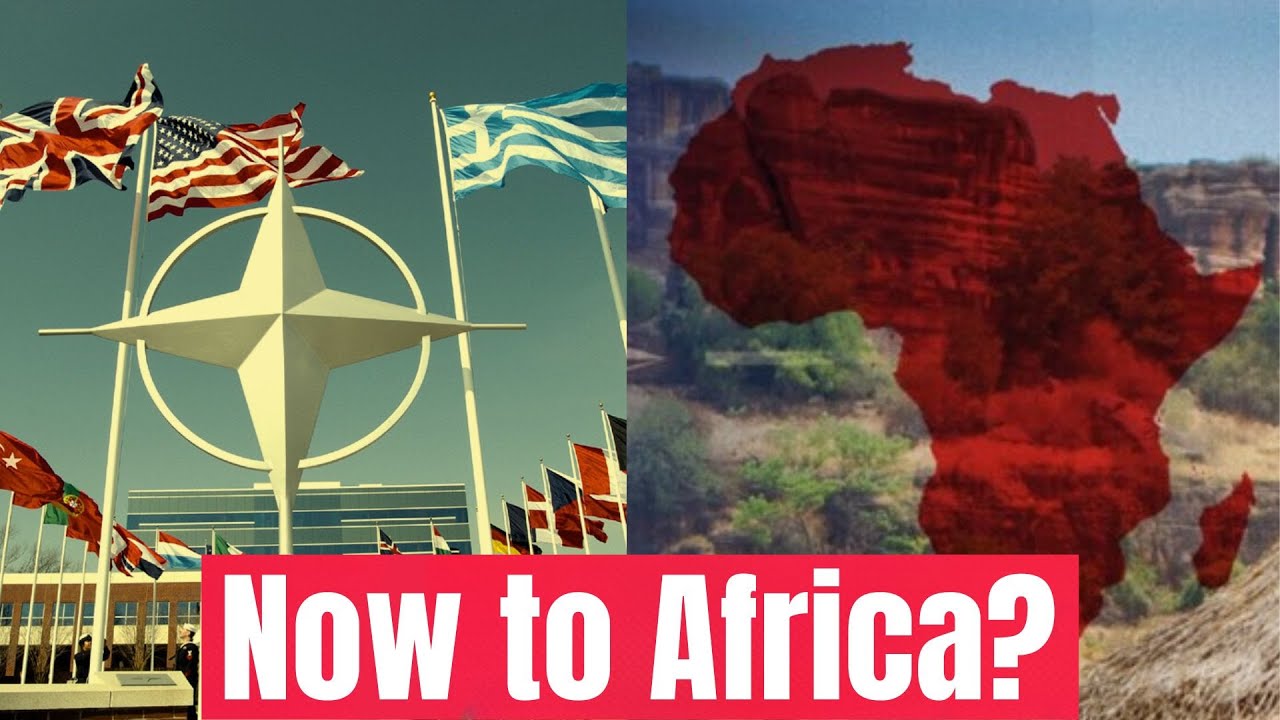
David Oualaalou breaks down NATO's push into Mauritania and the Sahel, tracing it back to the Madrid Summit and fears of Russian and Chinese influence. He's skeptical of the security justifications, reading it instead as a power play over ports, resources, and military positioning.
Chapters
Hello everyone and welcome to Geopolitical Trends. My name is David Oualaalou. So good to be with you as always. After the Russians reached the coast, will Mauritania be NATO's gateway to West and North Africa? In this video, I'm going to provide you a brief analysis as to what NATO's objective is being in this part of the world, in Africa, that is. While placing this within the context of French President's recent statements about Russia destabilizing Africa. But before I'll do all this, I'd like to thank the channel's members and supporters. And for you, if this is your first time landing here on this channel, please make sure to subscribe and smash that notification button so you will be notified every time I upload a new video. And thank you all for your continued support. Let's dive in into this. As I promised you, I will do a video about NATO's expansion in the Sahel area. So here it is. So NATO has finally begun growing interest in Mauritania. And Mauritania, by the way, just a little bit geography here, Mauritania is bordered by the Atlantic Ocean to the west, Western Sahara to the north, to the north and northwest, Algeria to the northeast, Mali to the east and southeast, and Senegal to the southwest. This is where Mauritania is. It's of a strategic location. NATO won't be interested for no reason, so Well, here's the thing. The interest in this was, of course, furthered during the NATO summit, which, by the way, took few months ago. This— I know it's a little bit late for this video, but I promised you I will do a video for you because I want to provide you some analysis about this part of the world that I am familiar with. So the summit that took place in Madrid a few months ago to which only two countries were invited. And guess who those countries are? Mauritania and Jordan in the Middle East. And you can just see, is NATO thinking expansion like they're doing right now in Japan? They're gonna open up an office in Tokyo. So, so here's the thing. Spain, which is a member of NATO Alliance, is leading the rapprochement initiative between Mauritania and NATO. Well, Spain has its own interest for that because the issue of the Western Sahara part, Spain had something to do with it as well. But that's a conversation for another day. For now, suffice it to see, or to say rather, that Spain sees kind of provided an assessment that there is a danger from the south and from the east, which to Spain, it suggests that there is an instability that could explode in the Sahel area. I can see the rationale for their arguments, especially when you know what's included in this Sahel area. Once again, a little bit of geography here. So I'm gonna provide you just a brief description about the Sahel area. Well, the Sahel area or Sahel region, and by the way, is the same word in Arabic, as-Sahel. The Sahel region includes Mauritania, Mali, Burkina Faso, Chad, and Niger. Of course, when you break it down, it extends from Senegal eastward to Sudan. That's how far it goes. And I'm sure, as you see on the map here, you know, it forms a transitional— get this, guys— transitional zone between the arid Sahara Desert to the north and the belt of the humid savannas to the south. You know, the Sahel area, or Sahel region, that is, stretches from the Atlantic Ocean eastward through northern Senegal, southern Mauritania, the great bend of the Niger River in Mali, then Burkina Faso, formerly known as Upper Volta, then southern Niger and northeastern Nigeria, south-central Chad, and into Sudan. That is why it's a very strategic location, and NATO would not express interest for no reason because they care about the safety of the region. No, no, no, no, no, there is a strategic, uh, reason for, for that. So, so during an interview, as a matter of fact, with the Mauritanian press agency, which was published, uh, uh, on a few months ago, Nairo Debiri Assistant Secretary General for Political and Security, his name is Japhir Colomina. Japhir Colomina, he said to the journalist, his name is Ali Amin, in Nouakchott. Nouakchott is the capital of Mauritania. So what Mr. Japhir Colomina said He said that Nouakchott's role in the Sahel is great and necessary for two reasons, and I put this in quote for you. Reason one: it is NATO's only partner in the Sahel, and it is the only one that can access some of our tools in a systematic way because it is a partner. End of quote. And number 2, in quote again, "Mauritania is the only country in the Sahel region that controls its territory and borders, and it is a country that enjoys political and security stability. So cooperation with it, it is better in the eyes of the alliance," end of quote. You all can see now, you see why President Macron of France said what he said about Russia being— and I put this in quotes— destabilizing force. And I released a video for you for that reason, for you to understand. So, so, uh, like I said again, during that summit in Madrid, NATO announced its intention to provide aid package to Mauritania. We all know it's no different than what they're saying right now for Japan. Oh, we're gonna just provide some administrative support and all. No, no, no, no, no, no, no. We all know they're gonna be establishing military presence, that is. So, but here in this case, they're saying we will provide an aid package to Mauritania without providing its size or revealing— without revealing its size or quality. So at the same time, NATO Secretary General, uh, Jens Stoltenberg, said that the aid was intended to support Mauritania's effort to deal with border security and irregular migration and terrorism. Yeah, they're gonna have to say something to justify, you know. But here is the thing, there is a strategic reason for all this. And like I said last time, you know, France didn't— Macron, that is, President Macron didn't say that in a vacuum. Why? Because you're talking about Russia's presence in Mali, because France was kicked out. Remember, there is a reason why all of a sudden you're seeing NATO's move into Africa. So the rapprochement between Mauritania and NATO can only be read within the context of what the alliance called the Madrid Summit, the new— or what's called, I'm sorry, at the Madrid Summit, the new Strategic Concepts and the raging conflict between Russia and the West, of course, in reaction to the Ukraine conflict. And this is again where I find it very, very interesting the journalist, the Spanish journalist, his name is Mohamed Lamine Ould Kattari. So the argument he provided was that NATO— and I agree with him to this, to a degree— he says that NATO sees the presence of Russia in Africa region of great concern to Europeans in light of the global scene formed according, formed according to a new map through which Moscow is trying to play a strategic role in Africa and Asia. There is some logical reasoning into that. Now you see why when I, uh, published my book back then, I put the word, the, the, uh, the dynamics of Russia's geopolitics the making of the glo— or the remaking of the global order. That's part of it. Of course, we know now, now Africa is kicking out France, and Africa doesn't want the presence of the US, and it's welcoming both Russia and China. So basically, NATO's expansion in Africa is nothing but a countermeasure to the presence of China in Africa.— I'm sorry, of China and Russia in Africa. So, so the journalist, uh, uh, Will Qattari said, and I quote, there is also no doubt that the Russian presence in Mali and the announced Russian military aid to Bamako raised NATO's concern and strengthened what the southern wing of the alliance called it at its recent at its recent summit, end of quote. You can just see, so basically the conflict between Russia and NATO is also expanding or extending to Africa beside what's going on in Ukraine. So, and the conflict in itself is a struggle for influence to gain a strategic foothold, especially on seaports. This is why Russia was in talk with Sudan to establish a naval base. This is why France, when it was kicked out of Mali in favor of Russia, they didn't like it. Once again, that's why President Macron said that the, uh, for the, uh, the Russian presence, uh, in Africa is problematic and so forth. Yeah, it wasn't problematic for France, and now it's problematic because Russia is there. So, and as you— as I mentioned to you, geographically, Mauritania has shores extending as far as the European Union territory, uh, European Union, and extends into the overlap of its territorial waters to Spain territorial waters as well. So, because Mauritania is really in a strategic location, that is. And by the way, guys, if you like the content of this video so far, please hit that like button and subscribe in support of this channel. I would really appreciate it. So, so here is the thing: the presence of the Russians in Mali, and of course their proximity to the region, sort of raised fears among European strategists. About Russia's access to transatlantic port. It is to a degree about that, but also it has to do with access to natural resources because Europeans wants to be the one dominating the African nations so they can exploit their resources. This is where you're seeing the pushback by African nations against the United States and Europe in favor of Russia and China. Why? Especially with China. China is bringing more economic ventures. Europe and the US bring in both conflict and exploitation. So the Africans kind of like, it's no-brainer, we want this, not this. So it's common sense. So this development, of course, was taking place with the Russian presence and so forth. Have reinforced the fear of EU countries and made NATO establish a new strategic concept through which Mauritania will play a partner in countering Russian influence in the region, although it has not been yet officially announced. You can just see it's the fearmongering The more you provide fear, the more you convince the masses about, oh my gosh, we need to have military presence so we can secure the resources and so forth. It's all about fear. And by the way, this is a note for you. Mauritania, by virtue of its strategic location, is a key platform in NATO's new vision by virtue of its overlapping borders with the Canary Islands. Yeah, there is a reason for— NATO's not doing it because they care about Mauritania. They care less. They care less for any country. Look at just what's going on with Ukraine. They care less for Ukraine, you know. So there's that argument also about where the extremist groups could take advantage of the instability in the Sahel region, especially in Mali after the withdrawal of French troops. Yeah, but Mali didn't want French because they were exploiting their resources. It's no different than what France was doing in Niger, and still to a degree it's same what they're doing in Burkina Faso. Yeah, that's because those countries are like the, the, the resources for France that has been exploiting for decades. As a matter of fact, the journalist, uh, Ould Katari, said, and I put this in quote, this has established the new strategic perspective of the state of security overlap between Mauritania and the EU countries, and therefore Mauritania is highly likely to become the first active locomotive in the context of this new strategic transformations, end of quote. So we're not talking here about traditional relationships here, you know. Since when NATO was involved or interested in Africa? After all, what is the title of NATO anyway? The North Transatlantic Alliance. NATO. So what the heck NATO is going doing in Africa, or has been doing in Afghanistan, or now dealing with Ukraine, fermenting tensions there. You know, it's common sense. I do believe, however, that they're going to convince Mauritania to sort of, uh, uh, uh, uh, what's the word I'm looking for, give up its sovereignty in support of NATO's vision. So the relationship, and this is my assessment, uh, the relationship between, uh, Mauritania and or in this case, Nouakchott, the capital, and Madrid, in this case, in security context, is traditional and based on accumulations of intelligence, security, and military exchanges by virtue of the overlap between the Canary Islands and Mauritania. Because you're looking at many countries are closer to Mauritania. And when you take into consideration that the interest of Spain, you know, as I said, the Canary Islands and Mauritania as other African neighbors closest to the Spanish borders, including Morocco and Algeria. And you all remember when I did the, the live stream about Algeria and Morocco and the tensions about the Western Sahara and so forth. Spain is playing a fomenting role into this behind the scenes. So here's my conclusion for you, yeah, through this overlap, Spain is trying to play the card by bringing Mauritania closer to NATO countries, not just Spain, but countries, which means other countries in NATO can go over there. And strengthening the possession of the Spanish strategic security, but according to the European or NATO umbrella. This is the keyword, which means Mauritania will have no say. This is exactly what I see it's going to be happening in Japan with NATO opening an office over there. So NATO's relationship with Mauritania is longstanding and includes cooperation and coordination in the fight against extremist groups and irregular migration. That's the justification NATO is providing, which is not true. NATO has worked in recent years— this is nothing new— to support Mauritania in the areas of military training Once again, NATO doesn't care for Mauritania. They want to establish the presence there. This is where I see it going. It behooves now Mauritania to think, should we open the door? Because if Mauritania opens the door, you're looking at the region of the Sahel transforming. And all this has nothing to do with security of the region. It has to do with countering both Russia China. Once again, guys, if you like the content of this video, please hit that like button and subscribe, and I truly appreciate it. I hope you find this very informative, and as always, remember, geopolitics impact your daily life in more ways than one. Till next time, guys, bye-bye.
More from David


Beyond the Single Actor: Why the Gulf Isn't Choosing Between the US and China


Iran, Iraq's Militias, and the Houthis Are Coordinating! This Changes Everything




Who Controls the Next Decade's Resources? Latin America and Africa's Geopolitical Crossroads

The Chokepoint Trap: How Washington's Stupidity Triggered a Cascade That Now Controls the World

Trump Spooked as IRGC Unveiled dual-use SLV, Deployed Ghadir Mini-Subs & Hinted at Tactical Nukes!
