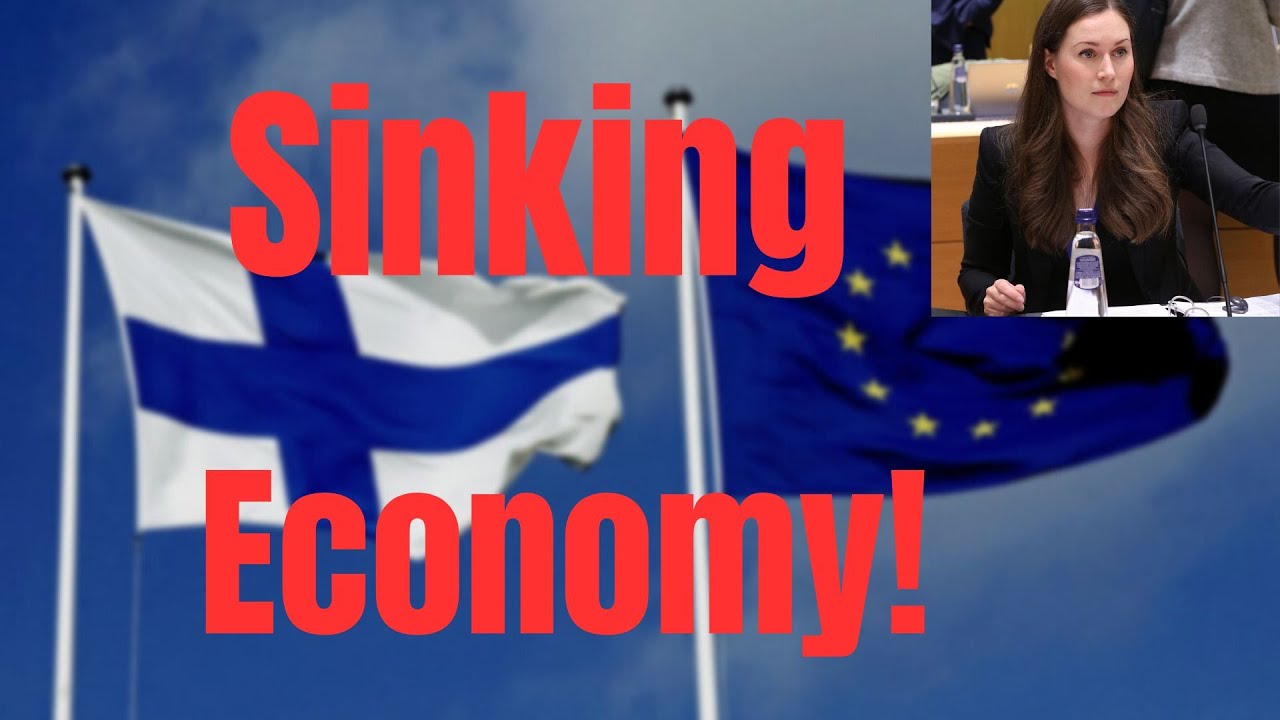
David Oualaalou examines Finland's proposed 30% windfall tax on energy companies, questioning whether the projected €500M to €1.3B in revenue will actually reach citizens or be redirected elsewhere. He argues the tax won't solve Finland's predicted 2023 recession and warns companies will shift profits to avoid it.
Chapters
Hello everyone and welcome to Geopolitical Trends. My name is David Oualaalou. So good to be with you as always. Is Finland following in the footsteps of Britain, Germany, and other European countries as its economy is slowly collapsing? In this video, I'm going to provide you a brief assessment as to what lies ahead for Finland's economy as it imposes now a new tax on oil companies. But before I'll delve deeper into this, make sure to check out our membership. If you like what I provide as far as information and the knowledge that I'm sharing with you and you want to support this channel, check out the join button. You can, you can join as a supporter or as a member whatever you feel comfortable with. And also, if you have not subscribed, please do so at this time and smash the notification button so you will be notified every time I upload a new video. And thank you for your continued support. So let's dive in into this. Finland now, uh, the country of Finland, Nordic state of course, proposed a 30% windfall tax on power companies. So the Finnish government has announced, which just like few days ago, towards the end of the year, last year, that it has proposed now a temporary windfall tax. Yeah, temporary. Would you trust the government for what it says? So it says a temporary windfall tax on profit from the country's electricity companies. And all this, the Finnish government says, as part of the EU response to soaring power costs. And by the way, Finland, Finland, by the way, has been a member of the EU since 1995. But the question we need to ask is, well, what did Europe— how did Europe end up in this mess to begin with? We all know the story, how we went. You know, so now Finland is moving into that direction, which by the way, mainstream media is limited as far as reporting on this topic. That's why I decided to go and research it and share this information with you. But let me take you back a few months ago in last year. Specifically, I'll take you back to October 2022. What happened in October 2022? It was like countries like Greece, Hungary, Italy, Romania, Spain, and UK. UK wasn't— it's not a member of the EU, of course. You know what those countries shared in common back then in October? They all implemented a windfall tax. And I'll tackle the UK later on in, in this episode. Here you got also the Czech Republic. What's interesting about is that the Czech Republic and Poland have published proposals back then to enact the windfall tax. Spain also published a proposal to enact the second windfall tax, and the reason they did the second, because the first one, the first tax, a levy, was diluted by a sort of a series of exclusions that left many energy companies provider out of its scope. So you can just see it was planned in a sense of, uh, what I found interesting because I looked into that information of back in October is that Belgium, Finland, Germany, Ireland, Netherlands, and Slovakia at that time in October of 2022 have either officially announced or shown intentions to implement a windfall tax. Of course, at that time, France was the only country that opposed or voted down on the windfall tax. But what happened with France? Later on, it reversed course and now becoming the latest country in the EU, the European Union, that is, to support the extra— or the extraordinary measure to rein in the effects of the power crisis. Well, again, it leads to the common question: how did Europe end up in this mess to begin with? Because I'm here to tell you that that, that windfall tax, it's not gonna benefit the citizens, it's gonna benefit the companies. And governments is gonna be wasting money by allocating that tax, okay, and turn around and send it to Ukraine. So, so here's the thing about Finland, because that's what the topic is all about here. The proposed 30%, that's how much a windfall tax is, the 30% will apply to any profit that exceeds a 10% return on, on capital in 2023. No. And with the Finnish government, with the government now, uh, because Finnish government estimated that it could bring in between €500 million to €1.3 billion in revenues, the equivalency of $533 million and $1.9 billion in revenues. It's a lie. It is a lie. They just saying that so the people can say, well, well, the government is allocating a sort of collecting taxes that is going to benefit us, the citizens. You all know the truth how governments are operating. But first of all, before I move forward into this, if you like this video so far, please subscribe and hit that like button. And let me first provide you a brief definition of What is a windfall tax? We hear about it a lot. What is a windfall tax? A windfall tax is surcharge or surtax that is imposed by governments on businesses or economic sectors that have benefited from an economic expansion. Makes you just wonder, isn't that the business there to begin with to make profit? So And the purpose is to redistribute excess profits in one area for the greater social good. However, this can be a very, very contentious issue. You know, I'm here to tell you this windfall tax is nonsense. The government is going to just waste money. That's the truth of it. So the Finnish government in Helsinki went ahead with its plan, and, and it joined now the UK and Germany and other EU members, of course, that have introduced the windfall tax to energy power companies. And the reason being because the Finnish government said that starting on December 1st, which is last year, December 1st, in comparison to what Germany did. What Germany introduced, a special tax that will see the country's oil, gas, and coal companies or firms, that is, pay about 33% of windfall profits. We're basically generating a revenue of between €1 and €3 billion. That's what the government, the German government says. And we all know where that money is going to go, right? So Finland is embarking on the same path. Makes you just wonder about these leaders. Are they that dumb? Are they that stupid? Are they lacking pragmatism, common sense? So this tax, which is, by the way, has a name in Europe, and it's called the EU energy crisis contribution. That shows you— I'm not laughing out laughing, I'm laughing out of sadness that the, the average citizen in Europe, he's been— he or she been lost in this jargon of the government language because this tax is not going to benefit the average citizen. Look no further than what's taking place right now in the UK. And yet the UK is now going to increase its military spending by an extra $50 billion. So makes you just wonder about the priorities. Germany, same problem. France, same problem. You know, you got the idea. So, but here is the thing, this tax is unlikely to affect dozens of energy companies. It won't, because now the government is saying they want to tax the companies for 2022 profits and 2023 profits. You know, well, that's what the plan is. So Finland is thinking in the same, same, same line that they're gonna now target, uh, tax companies that made profit— electricity, that is— in 2022, and in— and, and they're gonna be taxing them also in 2023. So the new tax will affect oil, gas, coal companies whose profit for the current year and the upcoming one, which means 2022 and 2023, if their profits or revenues exceed 20% of their profit in comparison to 2020 or 2021. That's how far back they're going. Well, you all know what happened in 2020 and 2021 with the lockdowns. What did it do to the economy as a whole? And now adding the Ukraine crisis, we all know where things are headed. So, however, I do believe that this tax has a major, major drawback. And you know what the drawback is? Is that the plan tax can be circumvented on a larger scale beyond your wild imagination. And you know how? It's by having companies moving their profits abroad, elsewhere. Yeah, what else the governments can do? Nothing. So the profits being earned by energy companies now in many oil-producing countries, it's a currency of high commodity prices that had attracted the attention, of course, and sometimes anger of governments with some imposing windfall taxes, because there are only a few countries that did that. So So I remember, if my memory serves me well, since I hope I'm not getting Alzheimer's or something, I still remember because I remember in May last year at that time, Sonak, Rishi Sonak, the current Prime Minister, the clown Prime Minister of UK, he used to be the Finance Minister at that time. But what did he do? He imposed a windfall tax on oil and gas companies. And he argued that the purpose for this is to alleviate the country's worsening cost of living crisis. You know, you know, at that time, the finance minister, Mr. Sunak, said that the tax will be taxed on energy companies that were making extraordinary profits due to spike in commodity prices. What the heck does he know about— the guy is a millionaire, has no clue about how an average Brit's, in that case, daily life is. So, and this is why when the UK imposed at that time what is called temporary targeted energy profit tax with the so-called investments allowance. And he went ahead with the tax of about 25%, if I am not mistaken. And the whole reason did that, saying that it will incentivize oil and gas firms or companies to reinvest their profits. Yeah, it didn't work. Even here in the United States, President Biden has threatened to introduce a windfall tax for oil and gas companies as they continue to post record profit. As a matter of fact, Exxon posted a 9— if I'm not mistaken, $7 or $9 billion. And President Biden got pushback from the energy companies because they have a strong lobbyist here in the US. American president, FYI, for those who are not Americans, or or even Americans. American president has no power, despite what you hear. So, as a matter of fact, Exxon in this case went ahead and sued the EU, the European Union, in a bid to block the windfall tax against oil companies. Yeah, that's how it is. So, so it is my conclusion for you, you know. Regarding Finland, because that's what we're talking about, the Ministry of Finance in Finland just stated that the Finnish economy, the economy in Finland, will slide into recession in early 2023. You know, that's the forecast that just came out last month, you know, and revealing that it expects the gross domestic product, or GDP, to contract by about 0.2% in 2023 before growing by 1.2% in 2024 and 1.4% in 2025. Yeah, right. That's a lie. That's what they're saying. It's no different than what the IMF, uh, and World Bank said about the economy of China is going to be contracting, only to find out that the Chinese economy grew by about 4.4%. Yeah, it just shows you how, you know, would you trust the government? You know, I leave that up to you to decide. So, so here's my question for you for today: do you believe, in your opinion, will this windfall tax contribute to the collapse of the economy in Finland? Let me repeat this: do you believe, in your opinion, Will this windfall tax contribute to the collapse of the economy in Finland? Make sure to leave me some comments, as I always like to read your feedback. And as always, remember, geopolitics impacts your daily life in more ways than one. Till next time, guys. Bye-bye!
More from David


Beyond the Single Actor: Why the Gulf Isn't Choosing Between the US and China


Iran, Iraq's Militias, and the Houthis Are Coordinating! This Changes Everything




Who Controls the Next Decade's Resources? Latin America and Africa's Geopolitical Crossroads

The Chokepoint Trap: How Washington's Stupidity Triggered a Cascade That Now Controls the World

Trump Spooked as IRGC Unveiled dual-use SLV, Deployed Ghadir Mini-Subs & Hinted at Tactical Nukes!
